ch9 Key
1. An intermediate product is a product that might require further processing before it is salable to the ultimate
consumer, either by the producer or by another processor.
2. A joint process simultaneously converts a common input into several outputs.
3. The net realizable value (NRV) of a product is its sales revenue less all allocated costs.
4. The net realizable value (NRV) us a measure of a product’s contribution to profit before the split-off-point.
5. Joint costs are irrelevant in a sell-or-process-further decision.
6. Costs incurred before the split–off point should be allocated to products according to sales revenue to
determine whether products should be sold at the split–off point or processed further.
7. Joint costs should never be allocated to final products, since they cannot be easily identified as to which
product caused the cost.
8. Allocated joint costs may make some products appear unprofitable even if they have positive sales value after
split off.
9. Only the revenues from selling or processing a product beyond the split-off-point and any expenditures from
additional processing are relevant factors in deciding whether to process a product beyond the split-off point.

10. Manufacturing companies are required to use joint-cost allocation for both financial accounting and tax
purposes.
11. Determining exactly how much of a joint product resource is used by any of the joint products is
impossible.
12. Because joint-cost allocation is always arbitrary, it is excluded from consideration in determining casualty
losses for insurance purposes.
13. By-products are outputs from a joint production process that are minor in quantity and/or net realizable
value when compared to main products.
14. Because they are immaterial in value, by-products should never receive more than 10% of the allocation of
joint product costs.
15. The net realizable value (NRV) method allocates joint costs based on the net realizable value of the
byproducts and main products at split–off.
16. The net realizable value (NRV) of a product is the difference between its joint costs up to the split–off point
and additional processing costs after split-off.
17. The net realizable value method preserves the relative profitability of joint products.
18. The gross margin percentage of joint products using the net realizable value method will not exactly be
equal due to further processing costs.
19. Companies prefer the physical-measures method of allocating joint costs when product prices are stable and
predictable.
20. The physical–measure method of allocating joint costs is based on the relative volumes, weights, energy
contents or another physical-measure of joint products at the split-off point.
21. The final sales total of each product would be an appropriate way to allocate joint costs using the
physical-measure method.
22. A disadvantage of the net realizable value (NRV) method is that it can distort the profitability of a product.
23. The physical-measures method of allocating joint costs can sometimes distort the profitability of products.
24. Regardless of the method of allocation of joint costs, total production costs and cost of goods sold remain
the same.
25. If a company uses the net realizable value method and has further processing costs that are equal in dollars
for all joint products, then the gross margin as a percentage of sales will be equal for all the joint products with
common joint costs.
26. If a company uses the net realizable value method and has further processing costs that are equal
percentages of the final sales value for all the joint products, then the gross margin as a percent of sales will be
equal for all the joint products with common joint costs.
27. The physical-quantities method of assigning costs may provide a reasonable basis for joint cost allocation as
long as the physical measures reflect economic value.
28. If a company uses the physical measures method of allocating joint costs, the gross margin as a percent of
sales will always be equal for all joint products with common joint costs.
29. A product will have a negative net realizable value if costs of further processing exceed sales value.
30. If by-product costs are immaterial, it is acceptable to expense their cost in the period incurred even though
this violates the matching principle.
31. Two standard measures of accounting for by-products that are sold at the split-off point are to consider
by-product net realizable value as other revenue or deduct by-product net realizable value from cost of goods
sold.
32. By-products can occur before the split-off point, at the split-off point or after the split-off point.
33. Accounting for by-products seeks to accurately record transactions at minimum effort and cost.
34. The constant gross margin percentage method is based on the physical measures of joint products.
(Appendix)
35. The constant gross margin percentage method results in the same gross margin in dollars for all joint
products.
(Appendix)
36. The first step in the constant gross margin percentage method is to compute the total gross margin
percentage of all products. (Appendix)
37. The net realizable value method results in gross margin percentages that are equal as a percent of the net
realizable value of each product, while the constant gross margin percentage requires that gross margin
percentages be equal as a percent of the revenues of the joint products. (Appendix)
38. Which of the following is not a step needed to maximize the profits from joint products?
39. A product‘s net realizable value is calculated by:
40. Which of the following statements about maximizing the profit of joint product processes is true?
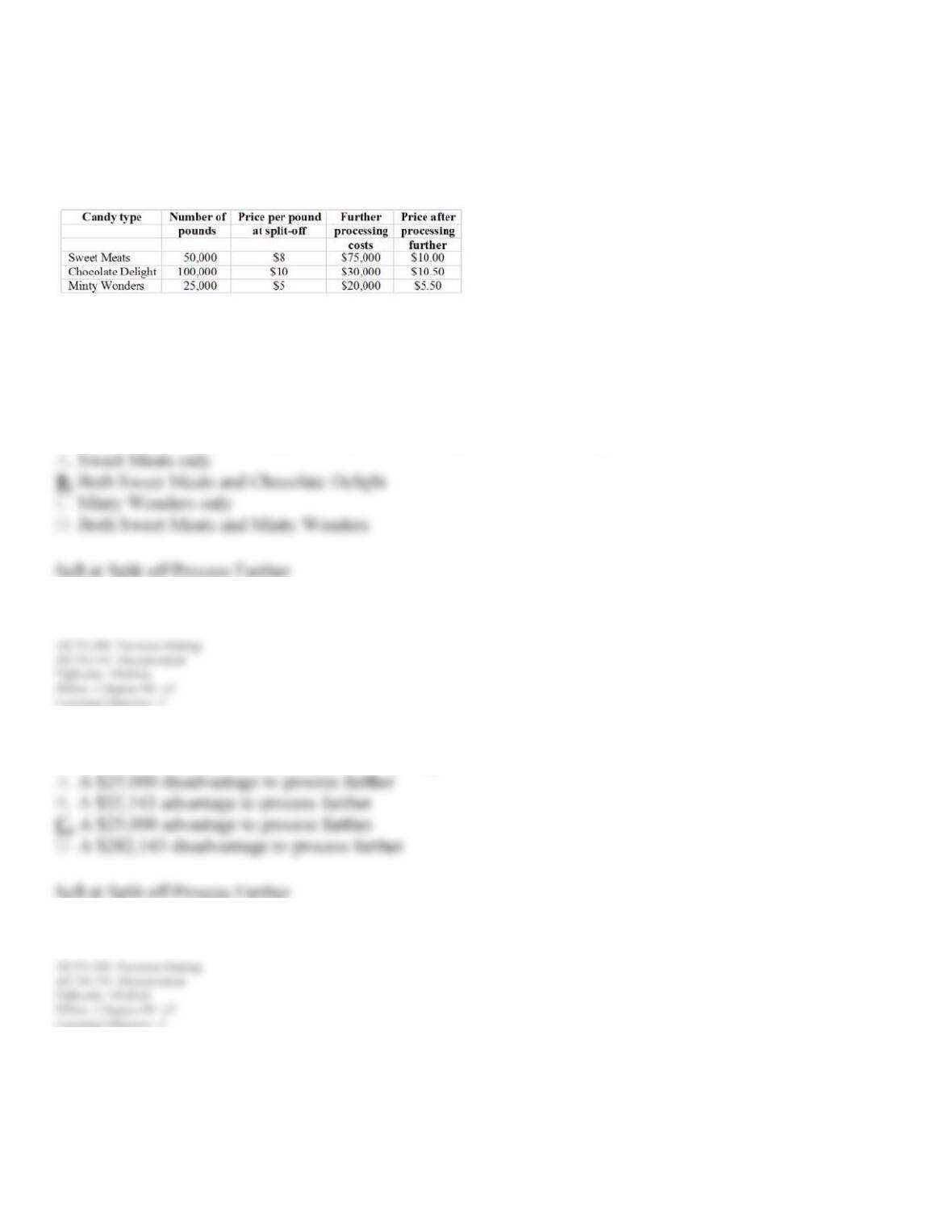
Use the following to answer questions 41-44:
Great Sweets Candy Company produces various types of candies. Several candies could be sold at the split-off
point or processed further and sold in a different form after further processing. The candies are produced in a
joint processing operation with $500,000 of joint processing costs monthly, which are allocated based on
pounds produced. Information concerning this process for a recent month appears below:
Hilton – Chapter 09
41. Based on the information presented, which of the products should be processed further?
42. The net advantage (disadvantage) of processing Sweet Meats further is:
43. The joint processing costs in this operation:
44. If Chocolate Delight is processed further, the gross profit margin that will appear in a product line income
statement for Chocolate Delight would be:
45. Great Sweets Candy Company’s management makes processing decisions that will result in the maximum
possible profits to the company, the company‘s monthly profits will be:
46. Which of the following statements regarding joint cost allocation isFalse?
Use the following to answer questions 47-48:
Gardner Company processes products in a joint processing operation that produces products A and B in a joint
process. The company incurs $1,200,000 of joint processing costs monthly. Currently, 3,600 of A and 2,800 of
B are being produced each month. Management plans to decrease B’s production by 600 units in order to
increase the production of A by 1,000 units. Additionally, this change will require minor modifications which
will add $40,000 to the production costs. This cost is entirely attributable to product B
Hilton – Chapter 09
47. What is the amount of the joint costs allocable to A before the changes are made to the existing production
process, assuming Gardner allocates its joint costs according to the proportion of A and B produced?
48. What is the new unit-cost of Product B if the changes are made, assuming the physical-measures method of
allocating joint costs is used?
49. WhitneySmithCompany makes two products: X and Y. They are initially processed from the same raw
material and than, after split off, further processed separately. Additional information is as follows:
What are the joint costs allocated to products A and B assuming Whitney Smith uses the net-realizable-value
approach?
X Y
50. Which of the following is not a method of allocating joint costs?
51. Which of the following would not be a physical measure used to allocate joint costs?
Use the following to answer questions 52-54:
Glenwilliams Lumber Company manufactures 3 products: Poplar, Birch, and Pine from a joint process.
Joint-process costs in 2007 were $3,000,000. Additional information regarding the three products is as follows:
Hilton – Chapter 09
52. Assuming that joint-product costs are allocated using the physical-measures method, what were the total
costs of Pine?
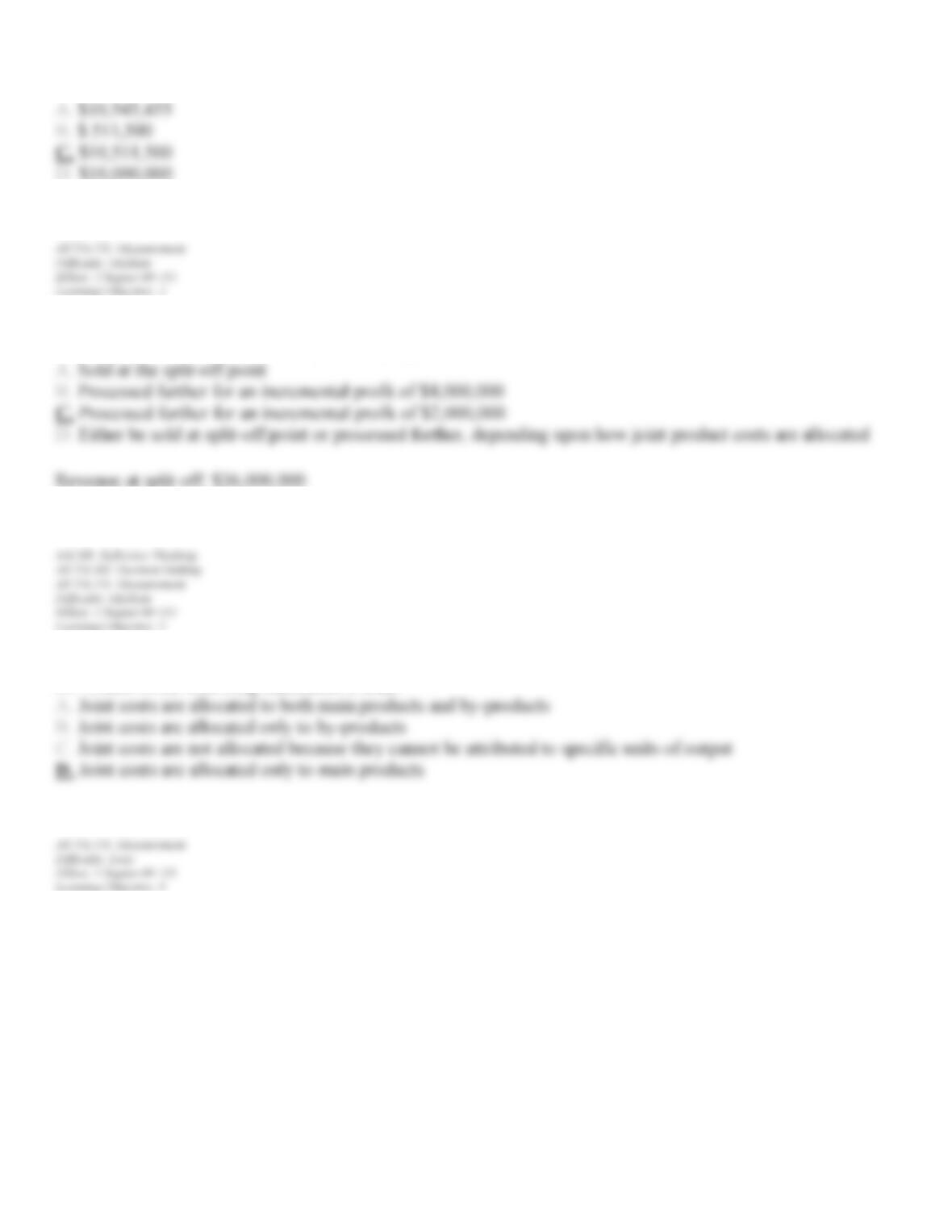
53. Assuming that joint-product costs are allocated using the net–realizable-value method, what were the total
costs of Birch?
54. Based on the cost information provided, Poplar should be:
55. Which of the following statements is true?
56. If by-product revenue is treated as other revenue instead of deducted from the net-realizable-value of the
main products:
57. Companies may prefer the physical-measures method of joint cost allocation when:
58. Which of the following statements regarding the physical-measures method of allocating joint-product costs
is false?
Use the following to answer questions 59-64:
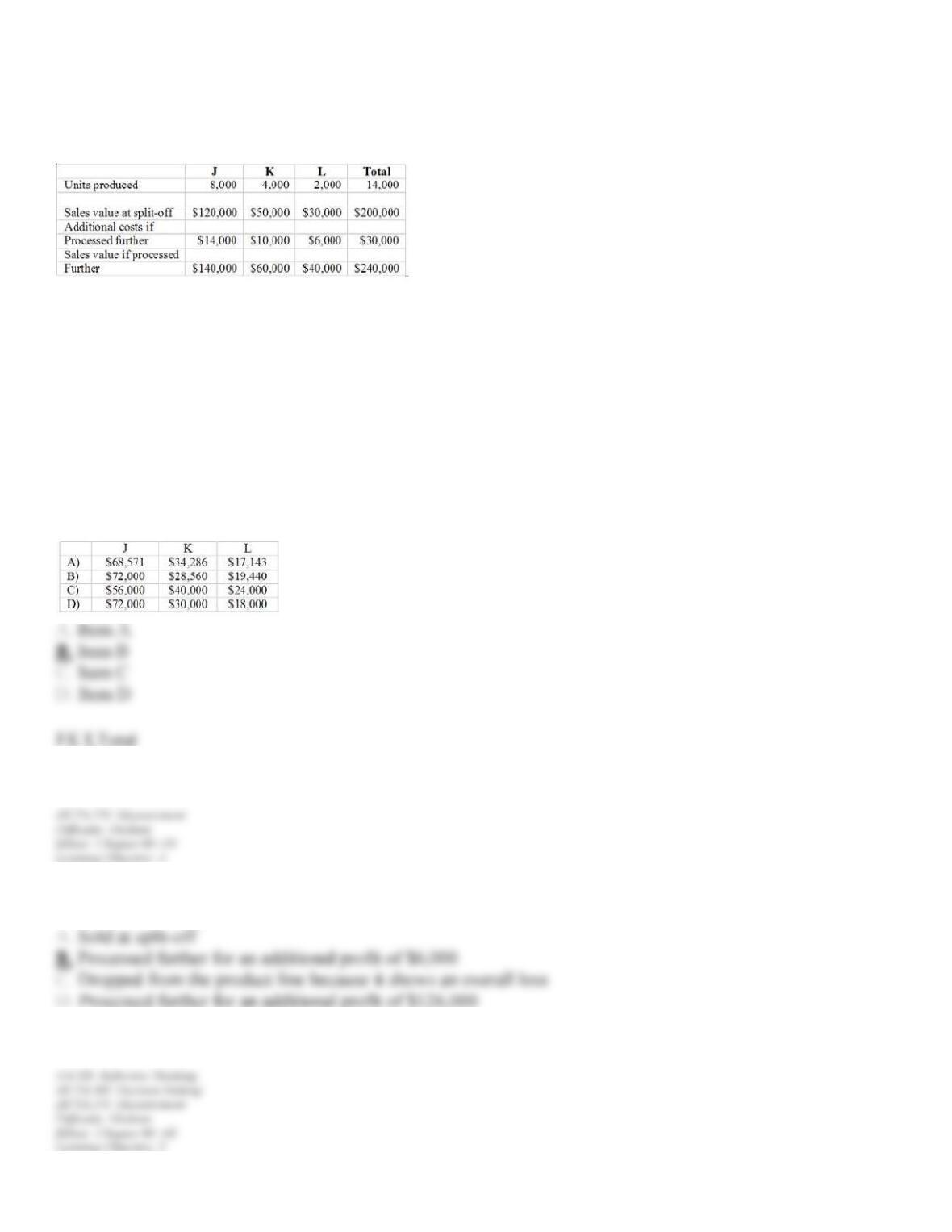
SimpsonSpring Corporation manufactures products J, K and L from a joint process. Additional information is as
follows:
Total joint costs of $120,000 were incurred on the three products
Hilton – Chapter 09
59. Assuming that joint product costs are allocated using the net-realizable-value at split-off, what joint costs
were allocated to the three products?
60. Product J should be:
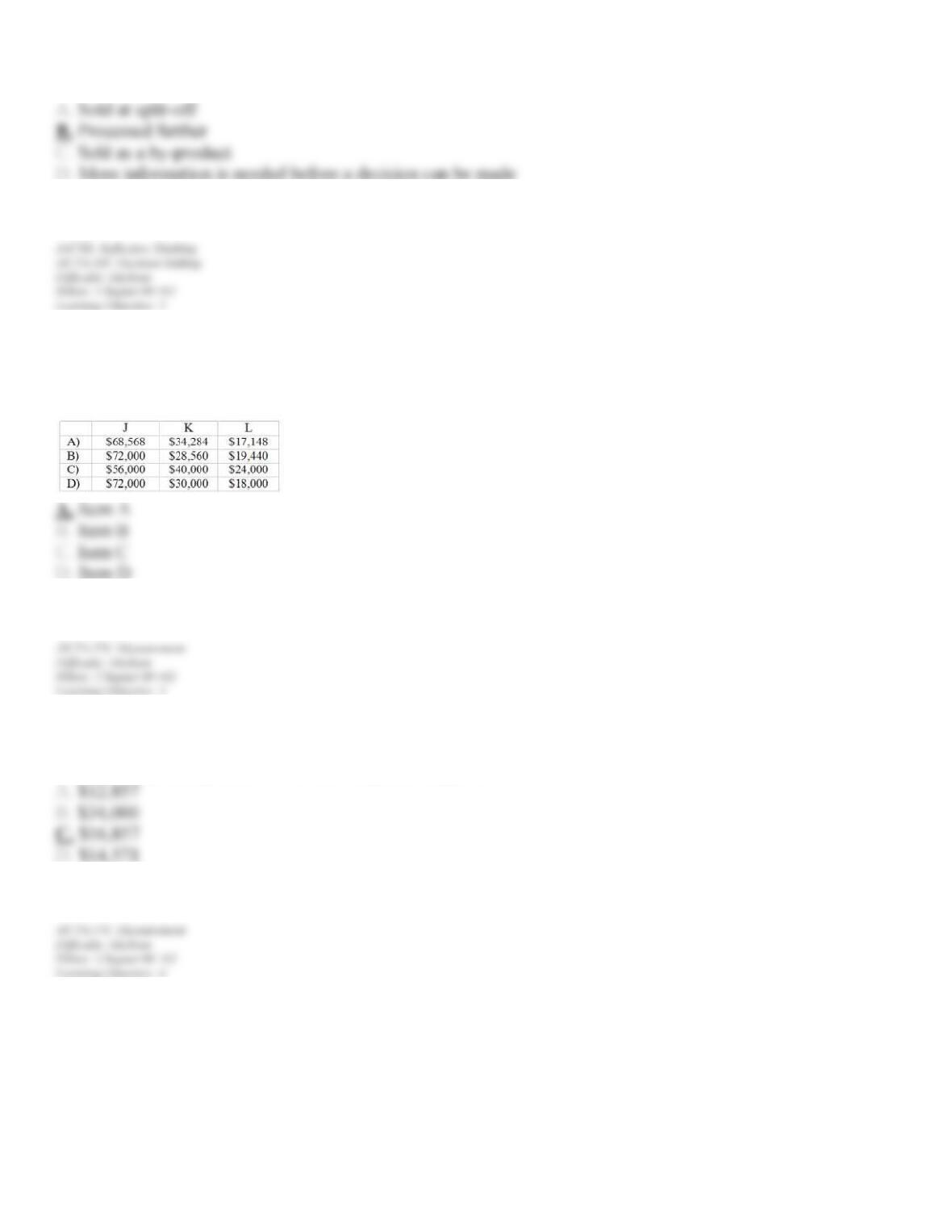
61. Without regard to your previous answers, assume that the joint costs allocated to product L were $20,000.
Product L should be:
62. The joint-costs allocated to each product using the physical-measures method of cost allocation would be:
63. If the decision is made that will maximize company profits and if joint costs are allocated using
physical–measures, product L will show a gross margin of:
64. Regarding a decision to sell products J and L at split-off or process them further, the company should:
65. Which of the following statements regarding accounting for by-products is true?
Use the following to answer questions 66-67:
KeithManufacturing produced three products in a joint operation. Joint costs up to the split off point were
$150,000. Products H and I were processed further. Additional information is as follows:
Hilton – Chapter 09
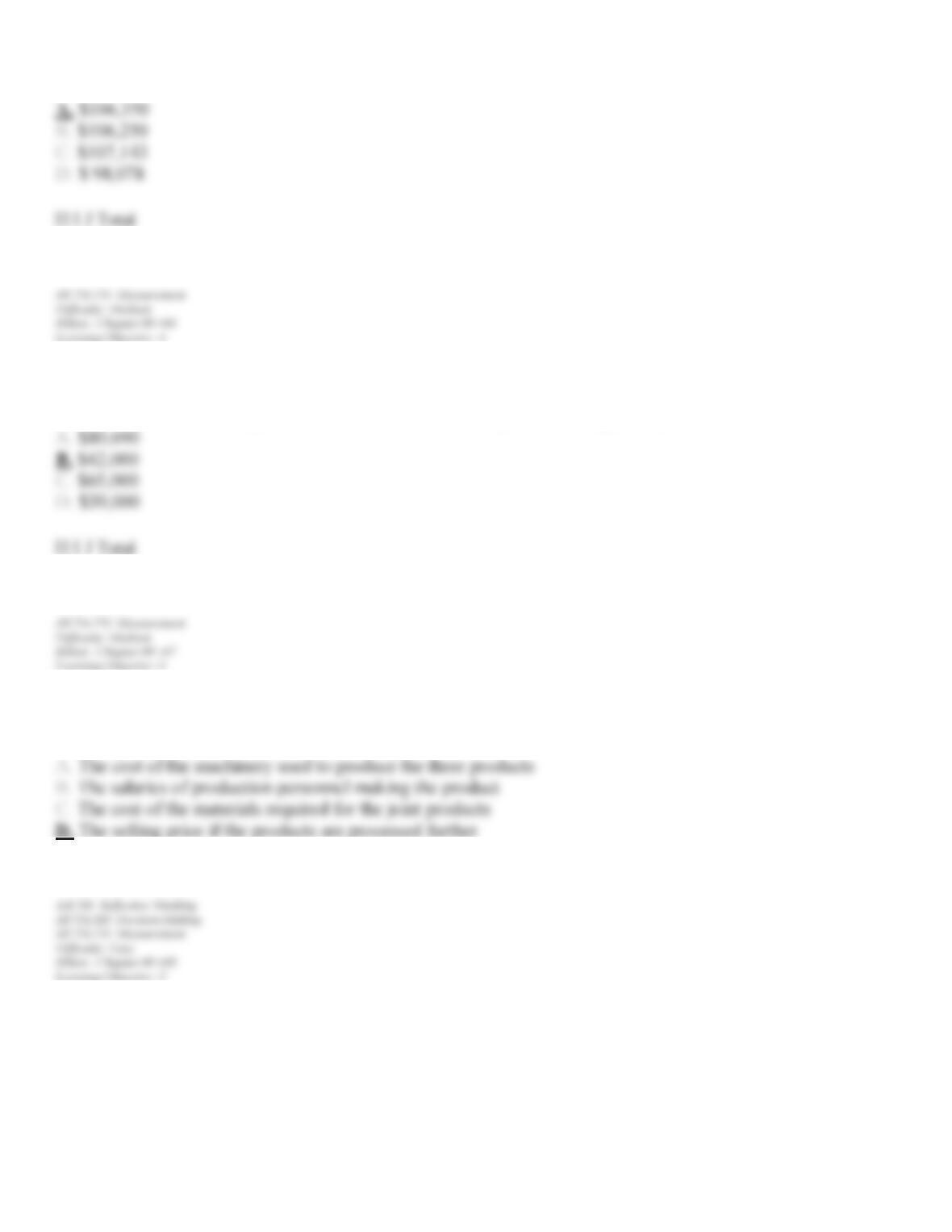
66. If the net-realizable-value method is used and product J is accounted for as a joint product, how much of the
joint-costs would be allocated to Product H?
67. Assume the relative sales value at split-off method is used and that product J is accounted for as a joint
product, how much of the joint-costs would be allocated to product I? (Appendix)
68. In joint-process costing and analysis, which of the following costs is relevant when deciding the point at
which a product should be sold to maximize profits?