Chapter 9
Chapter Focus
This chapter addresses the assessment of behaviors that decrease academic engaged time and
interfere with learning, such as externalizing (acting out) behaviors (including those attributed to
attention deficit disorders), and the assessment of emotional and social difficulties of students.
The 1997 IDEA amendments included new mandates for the assessment of behaviors that may
impede student academic success. These regulations remained in the 2004 IDEA. A discussion
of tier-one behavioral management is presented briefly at the beginning of this chapter. Methods
used for functional behavioral assessment as well as published instruments used to measure
behavioral and emotional difficulties are discussed. Specific requirements for determining
emotional disturbance are presented at the end of the chapter.
Check Your Understanding
Activity 9.1
1. Analyze the observations of Jessica’s behavior for antecedent, behavior, and
consequence.
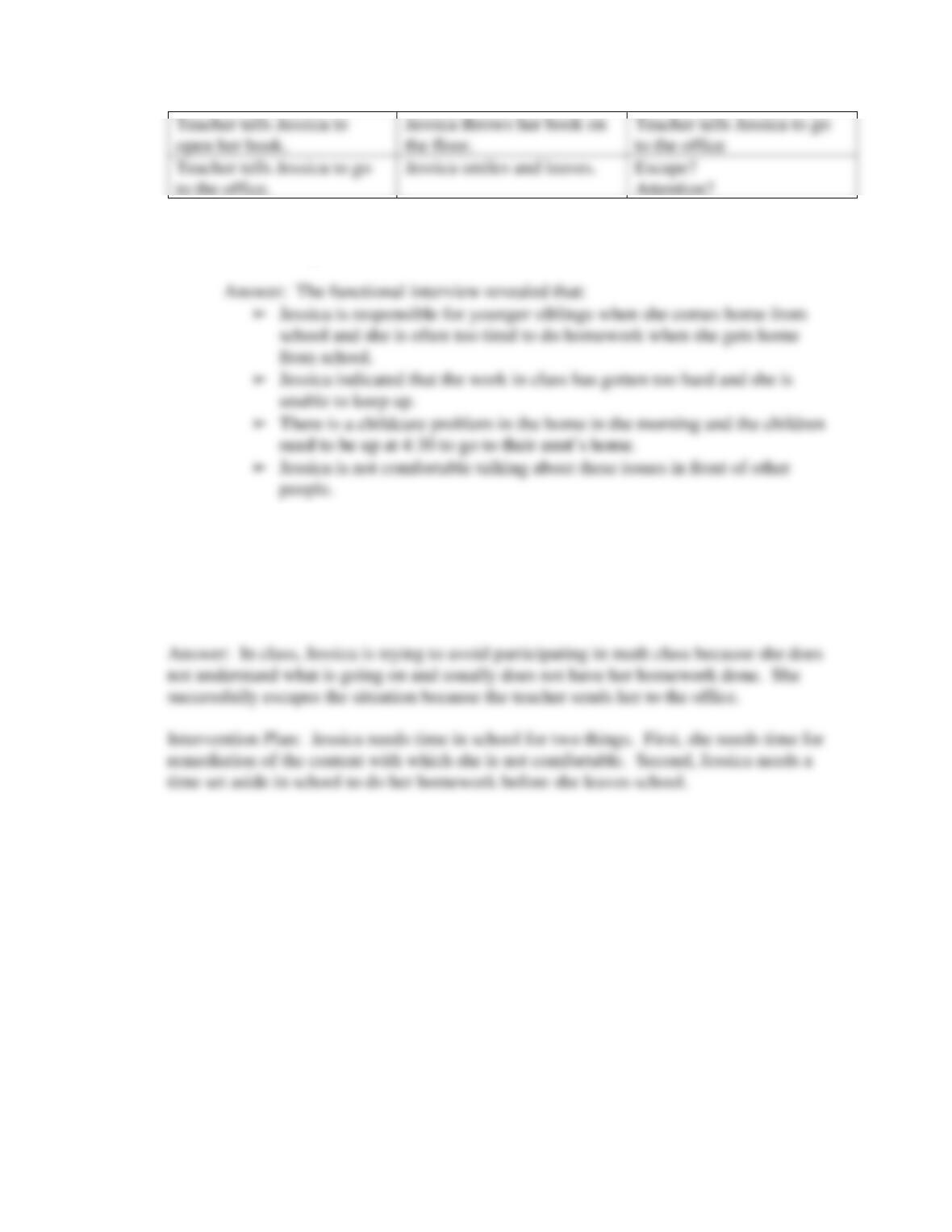
2. What additional important information was obtained in the functional interview?
Apply Your Knowledge
Based on your analysis of the antecedents, behaviors, and consequences displayed in the above
scenario, what purpose is her behavior serving for Jessica? What would you recommend for an
intervention plan?
Activity 9.2
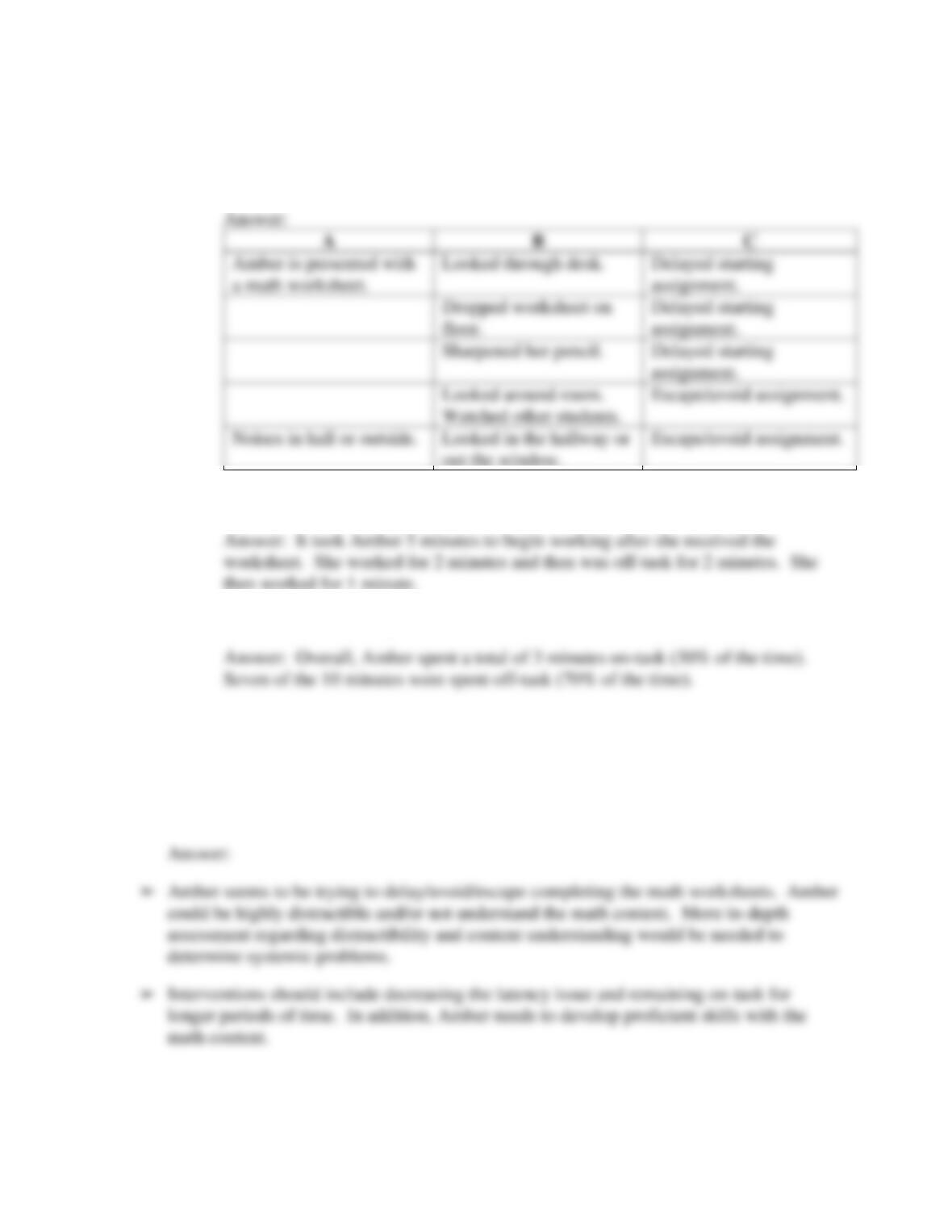
1. Analyze the anecdotal recording. What are the antecedents, behaviors, and
consequences?
2. Analyze the latency recording information.
3. Analyze the interval recording data. How often is the student on task?
Apply Your Knowledge
Based on the information provided, why do you think Amber is having difficulty with this task?
What interventions would you suggest for Amber?
Activity 9.3
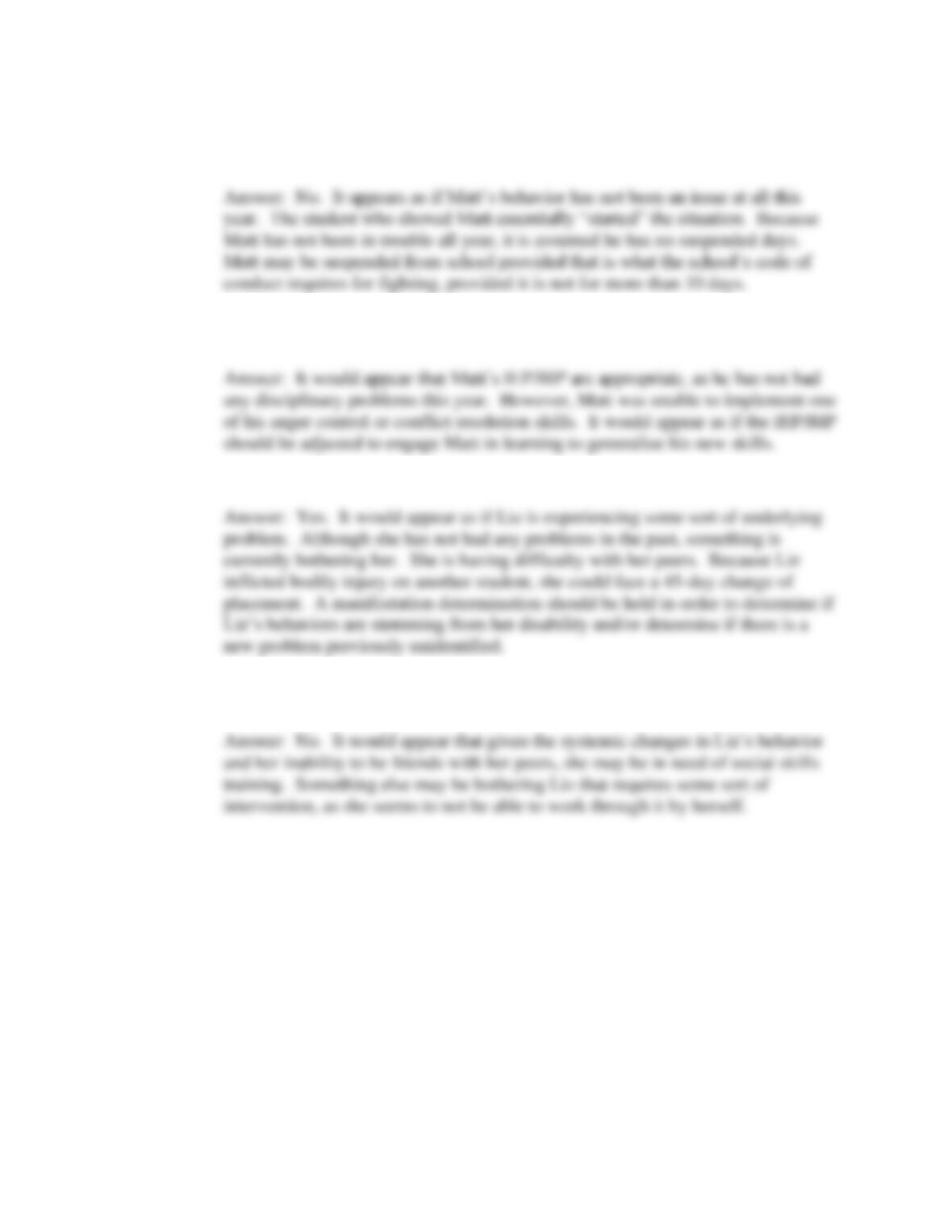
1a. Does Matt’s misbehavior warrant a manifestation determination?
1b. From the information provided, does it seem that his IEP and BIP are appropriate? Why
or why not?
2a. Does Liz’s misbehavior warrant a manifestation determination?
2b. From the information provided, does it seem that her IEP is appropriate? Why or why
not?
Activity 9.4
1. Which students have made mutual choices?
2. Which students seem to be isolated from their peers?
3. Which students appear to be in cliques or groups?
4. Which students seem to be the most socially popular?
5. Who are the academic “stars”?
Apply Your Knowledge
List other questions that you believe are useful in developing a sociogram.
Think Ahead Exercises
Part I
1. Ms. Lancaster wants to determine the exact number of times Lindsay inappropriately
leaves her seat. Ms. Lancaster needs this information before she can begin an
intervention. Her initial data collection is referred to as the ___.
2. Information about a student’s behavior can be obtained by questioning persons who work
with that student. However, in order to determine what behavior occurs in a specific
environment, the method of ___ will need to be used over multiple sessions.
3. Mr. Malapati writes down information about a student’s behavior that he will later
analyze for antecedent, behavior, and consequence. He has used ___ as part of a
functional behavioral assessment.
4. Mrs. Elliott notices that Bryan has not been able to complete class work in the amount of
time allotted. All other students in the class usually finish within the time frame expected.
Bryan also seems to take more time preparing to begin assignments than his classmates.
To establish a baseline about this specific behavior, Mrs. Elliott will need to record the __
time between the time she issues the assignment and the time Bryan begins to work.
5. Mr. Dodd and other school personnel have observed Cal’s off-task behavior in several
settings. In assessing Cal’s overall school performance with a particular focus on
behavior, the school psychologist might administer a(n)___ to measure Cal’s
distractibility and sustained focused attention.
6. A test that requires the psychologist to analyze story responses a student gives when
shown specific picture cards is called a(n) ___.
7. Although much information can be obtained from norm-referenced standardized
assessments, in order to analyze a student’s progress and productivity in a curriculum,
____ should be collected and evaluated.
8. The evaluation of the information collected in question 7 is called ___.
9. Mrs. O’Connor questions Martin, one of her third-grade students, after she breaks up a
playground fight he initiated. Martin is quite upset and tells Mrs. O’Connor that his
parents were fighting that morning before school and he witnessed his father shoving his
mother. This incident may be referred to as the ___ of Martin’s behavior on the
playground.
10. Assessment techniques such as completing sentence stems and drawing pictures of a
house or person are called ___.
11. Assessment reveals that a student’s continued calling out during class time is a strategy
used by the student to gain the teacher’s attention. Assessment that identifies the
reason(s) for a particular behavior is known as ___.
12. Students display many varieties of behaviors during a school day. When a specific
behavior is identified as problematic requires intervention, it is referred to as ___.
Part II
Read the following scenario. Complete an analysis of the scenario and identify the highlighted
phrases or words behaviorally.
A middle-school student has begun arguing and getting into fights during unstructured times
during the school day. You observe that nobody seems to provoke the student, but rather the
student becomes argumentative whenever another student jokingly touches or comes near the
target student. The result of the student’s problematic behaviors is that the student who was
jokingly touching or coming near the target student backs away and leaves the target student
alone. The target student seems to be happier during structured times with adult supervision.
Upon questioning the target student, you learn that his older brother has been hitting the target
student when the parents are not at home.
Present your analysis here:
Chapter 9 Test Bank
True and False
1. Latency recording measures the amount of time elapsed between the specific stimulus
and the actual response.
2. Projective techniques are used to assess the student’s feelings when shown various
stimuli.
3. Roberts-2, like its predecessor Roberts Apperception Test for Children, is an example of
a test that requires students to express their feelings based on a picture card provided.
4. Checklists, questionnaires, and parent interviews are techniques that require assessment
personnel to conduct direct observation of student behavior.
5. When a child has been sent from the classroom for misbehavior and the child feels a
sense of relief, the function of the target behavior is escape.
6. When the total learning environment is analyzed to determine if there are factors that
contribute to a specific behavior, it is called ecological assessment.
7. Drawing tests assess a student’s feelings about what they perceive is happening in a
picture.
8. Academic engaged time is a technical term that simply means how long a student is
required to be in class during the school day.
9. Research has shown that punitive types of disciplinary procedures are effective in long-
term changes in negative behaviors.
10. When the school has not followed either the IEP or the FBA, the student cannot be
suspended.
Multiple Choice
1. Which of the following must be conducted to determine if misbehaviors are related to a
child’s disability?
A. An individualized education program
B. A transition plan
C. A behavior intervention plan
D. A manifestation determination
2. Which of the following is designed to increase positive behaviors and decrease negative
behaviors?
A. A functional behavioral assessment
B. Replacement behaviors
C. A behavioral intervention plan
D. All of the above
3. Which of the following is an assessment that utilizes multiple components to determine
the specific purpose of targeted behaviors?
A. A functional behavioral assessment
B. A replacement behavioral assessment
C. A behavioral intervention assessment
D. A behavior intervention plan
4. Prior to beginning a behavioral observation, which of the following must be determined?
A. Replacement behaviors
B. Positive rewards for appropriate behavior
C. Target behavior
D. Antecedents
5. Direct observation enables the observer to note how often a behavior occurs and to
establish which of the following?
A. Consequences
B. A baseline
C. Target analysis
D. Rapport for follow-up interview
6. An event that occurs prior to the target behavior that increases the likelihood of the target
behavior occurring is known as which of the following?
A. Antecedent
B. Baseline
C. Target behavior
D. Consequence
7. An event that occurs prior to a target behavior but not in the same environment is known
as which of the following?
A. Setting event
B. Consequence event
C. Negative event
D. Related event
8. Every five minutes during math class, the teacher notes when Helen is on or off task.
Helen’s behavior is being observed and recorded using which of the following methods?
A. Anecdotal
B. Latency
C. Interval recording
D. None of the above
9. Linda has difficulty with talking out in class at inappropriate times. In order to determine
if this behavior occurs more during a specific time of day, the teacher decides to note
each occurrence. Linda’s behavior is being observed and recorded using which of the
following methods?
A. Establishing operation
B. Latency recording
C. Duration recording
D. Time sampling
10. Which of the following methods of data collection would be most useful in determining
an antecedent event?
A. Latency recording
B. Anecdotal recording
C. Duration recording
D. Frequency counting
11. Which of the following is a graphic representation of the social dynamics of a classroom?
A. A graphic distribution
B. A sociogram
C. A social distribution graphic
D. An ecological assessment
12. Judy, a young preschooler, has temper tantrums. With interventions, the tantrums
continue but do not seem to be as intense or as long. In order to determine if Judy’s
tantrums are truly decreasing in length, the teacher should use which of the following?
A. Latency recording
B. Duration recording
C. Anecdotal recording
D. Magnitude recording
13. This principle is founded in the theory that behaviors are maintained or increased by the
reinforcing events that follow the event or behavior.
A. FBA theory
B. Academic engagement theory
C. Observational principle
D. Behavioristic principle