Exam
Name___________________________________
MULTIPLE CHOICE. Choose the one alternative that best completes the statement or answers the question.
1)
Which of the following accurately describes integration by parts?
1)
A)
f(x)g'(x) dx = f'(x)g(x) –f'(x)g(x) dx
B)
f(x)g'(x) dx = f(x)g(x) –f'(x)g(x) dx
C)
f(x)g(x) dx = f'(x)g(x) –f(x)g'(x) dx
D)
f(x)g(x) dx = f'(x)g'(x) –f'(x)g'(x) dx
E)
none of these
2)
Consider lim
b
2b – 1
b. Which of the following is true?
2)
A)
The limit exists and is equal to zero.
B)
The limit exists and is equal to two.
C)
The limit diverges.
D)
none of these
E)
The limit exists and is equal to one.
3)
Which of the following is a correct substitution for the integral
e
1
cos(ln x)
xdx ?
3)
A)
u =ln x
x;
e
1
cos u du
B)
u = ln x;
1
0
cos u du
C)
u= ln x;
1
0
cos u
u du
D)
u = ln x;
e
1
cos u du
E)
u = ln x;
1
0
sin u du
Evaluate the integral.
4)
1
0
xex2 dx
4)
A)
e
2
B)
e – 1
C)
1
D)
e
E)
none of these
E
B
5)
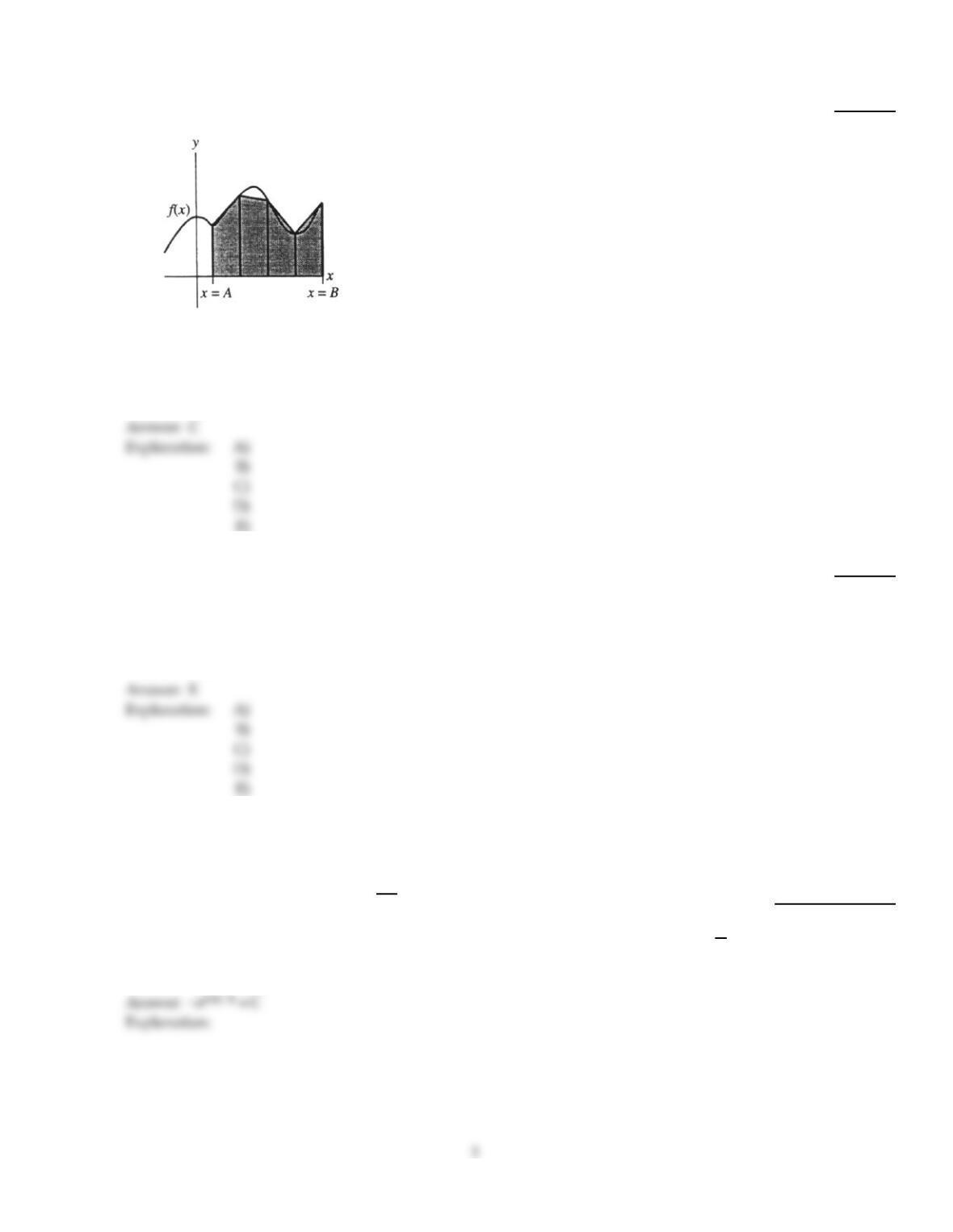
The shaded area in the diagram represents an estimation
b
a
f(x) dx using:
5)
A)
the midpoint rule with n = 4
B)
a Riemann Sum using right endpoints
C)
the trapezoid rule with n = 4
D)
a Riemann Sum using left endpoints
E)
Simpson’s rule with n =4
6)
Which of the following statements are true?
6)
A)
In general, Simpson’s rule is more accurate than the midpoint rule.
B)
In general, the trapezoid rule is more accurate than the midpoint rule.
C)
In general, the error from the midpoint rule is less than the error from the trapezoid rule.
D)
The error in the trapezoid rule decreases as the number of subintervals increases.
E)
All of these statements are true.
SHORT ANSWER. Write the word or phrase that best completes each statement or answers the question.
Determine the integral by making an appropriate substitution.
7)
cot x csc x ecsc x dx [Hint: d
dx csc x = – cot x csc x]
Enter your answer with any coefficients in front as integers or reduced fractions of form a
b.
No parentheses around arguments of functions.
7)
Evaluate the integral.
8)
3
1
1
x dx
Enter just a real number (no approximations and no parentheses around the argument).
8)
Determine the integral by making an appropriate substitution.
9)
5x sin x2 dx
Enter your answer with any coefficients in front as integers or reduced fractions of form a
b.
9)
10)
Find the area under the graph of y =4e–3x for x 1. Enter your answer as aeb with any
fractions reduced of form a
b.
10)
Approximate the integral by the midpoint rule.
11)
Approximate
3
1
1
x dx; n = 4
Enter just a real number rounded to two decimal places.
11)
12)
Does this integral ln(2x)
x2 dx = – 1 + ln 2 + ln x
x+ C?
Enter “yes” or “no”.
12)
13)
Does this integral ln x dx = x ln x + x + C?
Enter “yes” or “no”.
13)
4
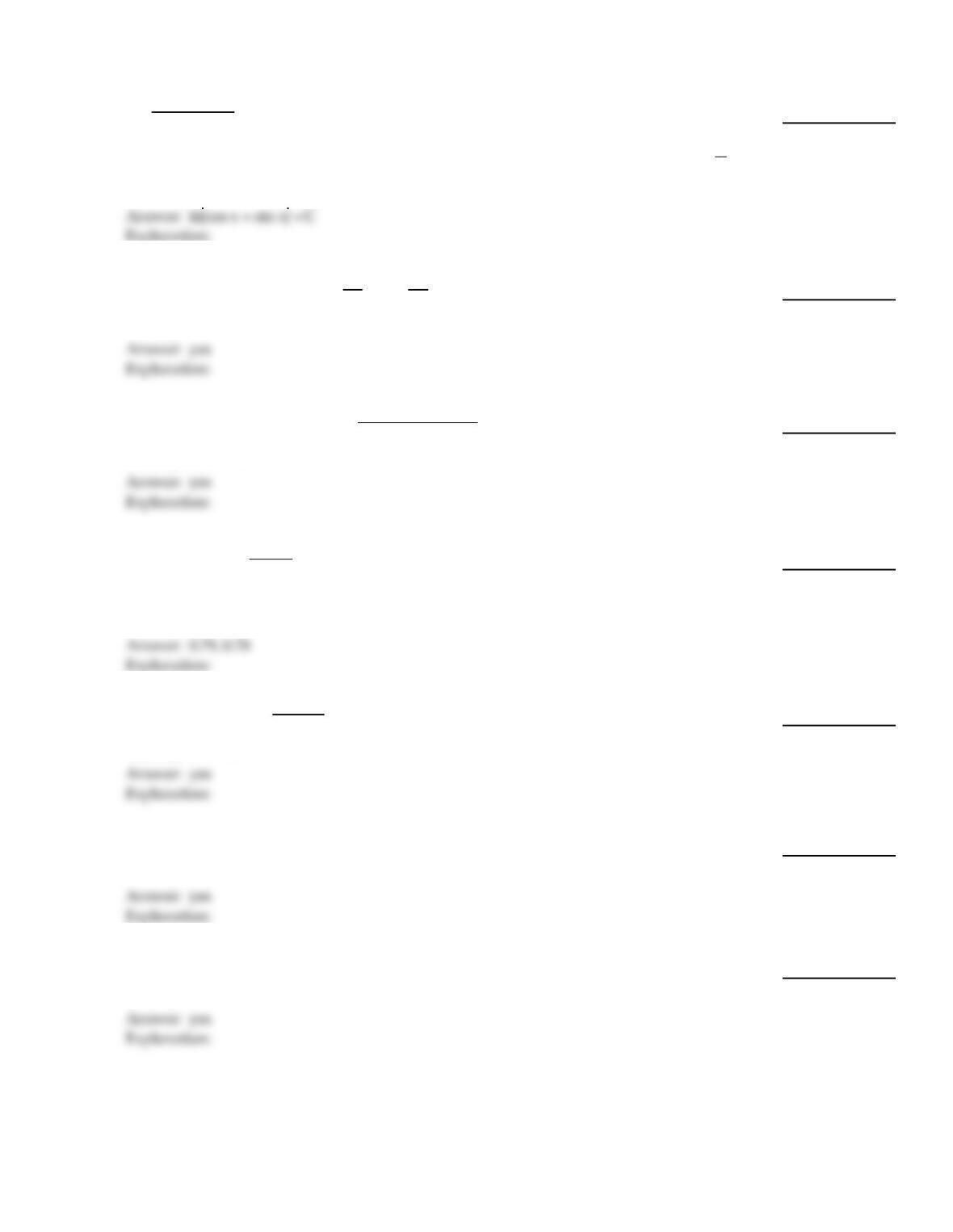
Determine the integral by making an appropriate substitution.
14)
cos x – sin x
cos x + sin x dx
Enter your answer with any coefficients in front as integers or reduced fractions of form a
b.
No parentheses around arguments of functions.
14)
15)
Does this integral x ln x dx =x2
2 ln x –x2
4+ C?
Enter “yes” or “no”.
15)
16)
Does this integral ex cos x dx =ex sin x +ex cos x
2+ C?
Enter “yes” or “no”.
16)
17)
Approximate
1
0
1
1 +x2dx; n = 4, by (a) Simpson’s rule and (b) the trapezoidal rule.
Enter your answers in that order as just unlabeled real numbers rounded to two decimal
places, separated by a comma.
17)
18)
Does this integral ln(ln x)
x dx = ln x(ln(ln x) –1) + C?
Enter “yes” or “no”.
18)
19)
Does this integral t3 cos t dt = (t3– 6t) sin t + 3(t2– 2) cos t + C?
Enter “yes” or “no”.
19)
20)
Does this integral x2ex dx =x2ex– 2(xex–ex) + C?
Enter “yes” or “no”.
20)
5
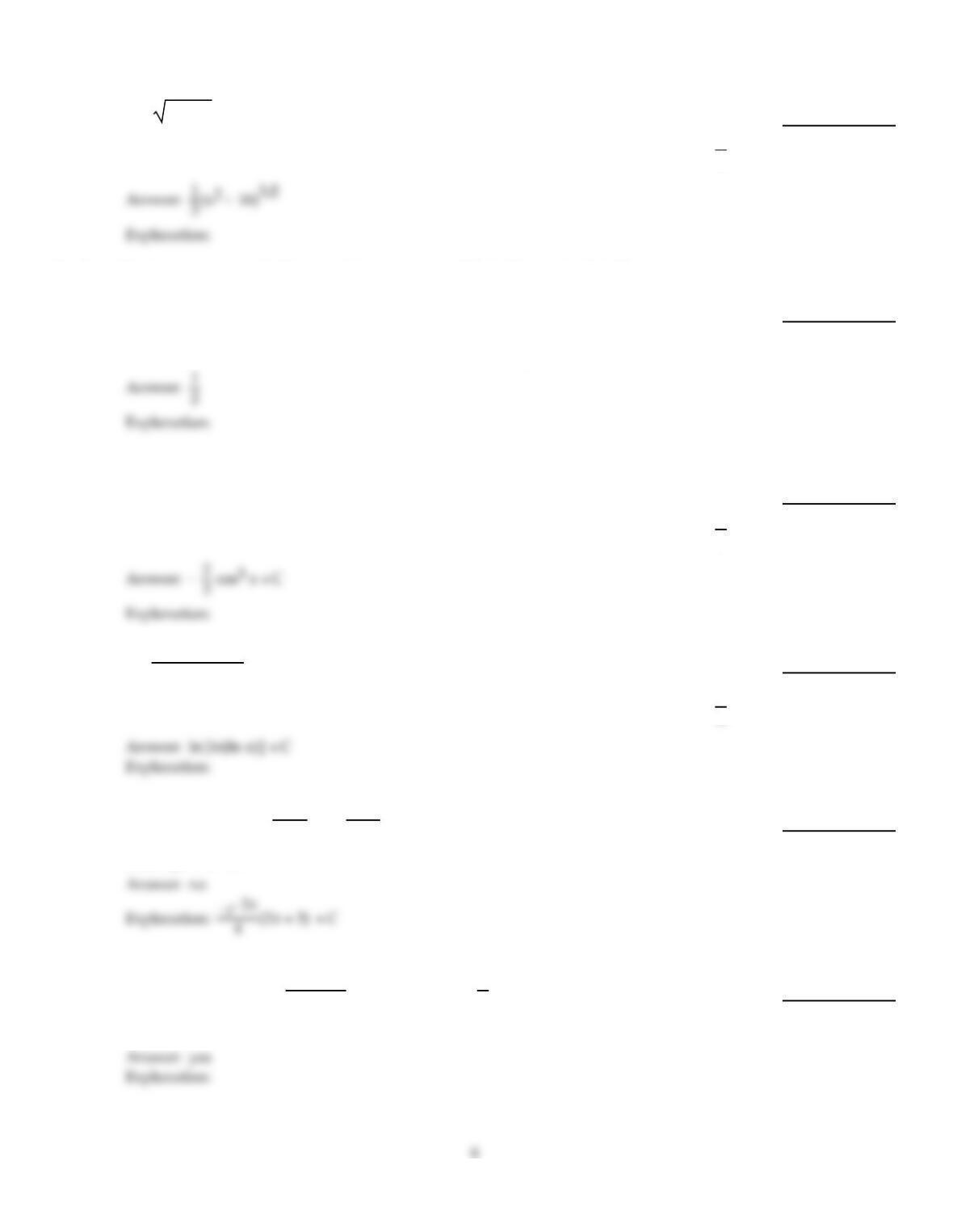
Determine the integral by making an appropriate substitution.
21)
x x2– 16 dx
Enter your answer with any coefficients in front as integers or reduced fractions of form a
b.
21)
Evaluate the improper integral whenever it is convergent. If it is divergent, state this.
22)
0
e–2x dx
Enter your answer as a reduced fraction or the word “divergent”.
22)
Determine the integral by making an appropriate substitution.
23)
2 cos2 x sin x dx
Enter your answer with any coefficients in front as integers or reduced fractions of form a
b.
23)
24)
1
x ln x ln(ln x) dx [Hint: Let u = ln(ln x).]
Enter your answer with any coefficients in front as integers or reduced fractions of form a
b.
24)
25)
Does this integral x + 1
e2x dx =
–e2x
4(2x + 3) + C?
Enter “yes” or “no”.
25)
26)
Does this integral
1
0
2x3
(x2+ 4)2 dx = ln 5 – 2 ln 2 –1
5?
Enter “yes” or “no”.
26)
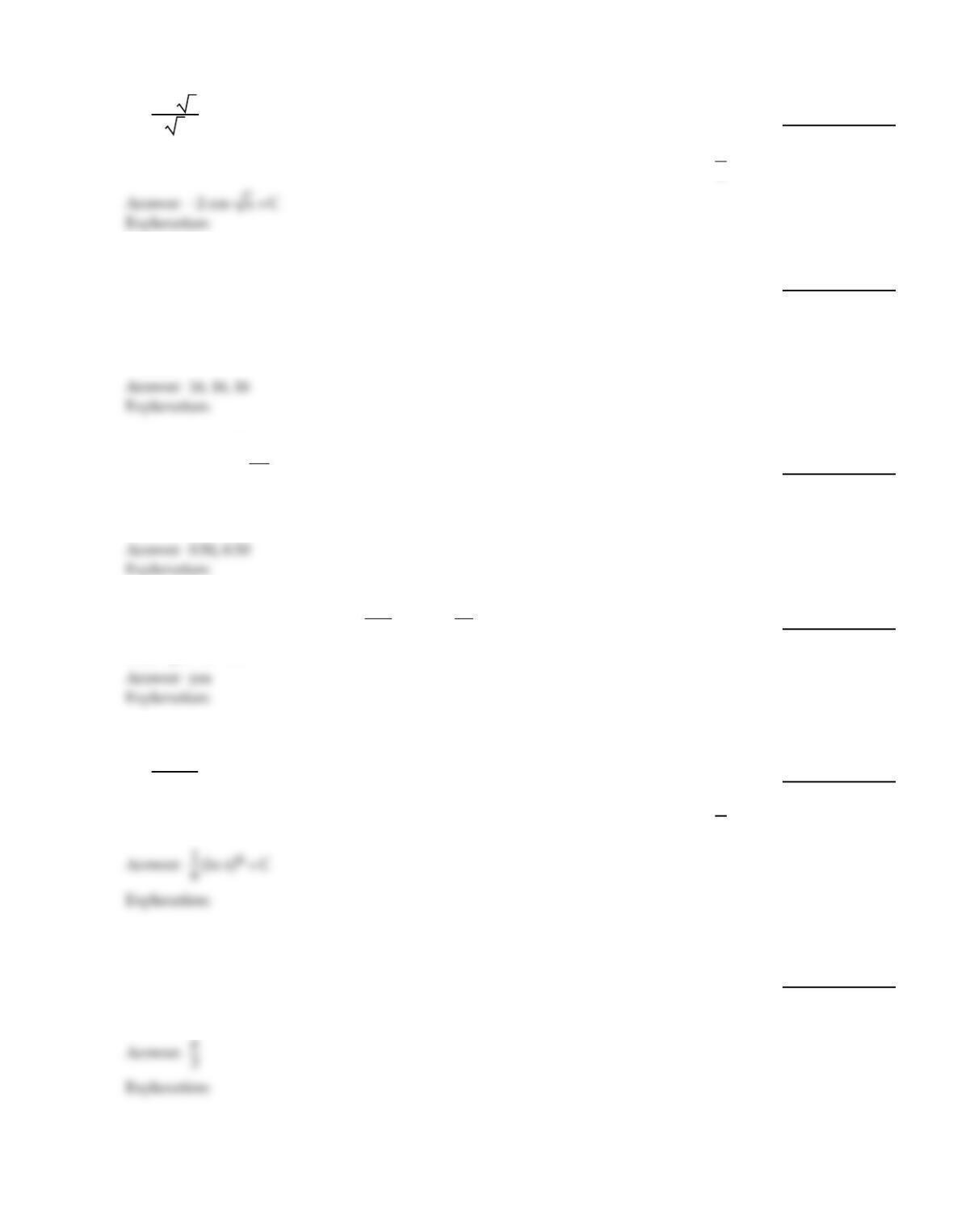
Determine the integral by making an appropriate substitution.
27)
sin x
x dx
Enter your answer with any coefficients in front as integers or reduced fractions of form a
b.
27)
28)
Approximate
4
0
2x dx ; n = 4, by (a) the trapezoidal rule, (b) the midpoint rule, and (c)
then find the exact value of the integral.
Enter just three integers separated by commas answering (a), (b), (c) in that order but
unlabeled.
28)
29)
Approximate
2
1
1
x2dx; n = 6, by (a) Simpson’s rule and (b) the trapezoidal rule.
Enter your answers in that order as just unlabeled real numbers rounded to two decimal
places, separated by a comma.
29)
30)
Does this integral x sin 10x dx =1
100sin 10x –x
10 cos 10x + C?
Enter “yes” or “no”.
30)
Determine the integral by making an appropriate substitution.
31)
(ln x)5
x dx
Enter your answer with any coefficients in front as integers or reduced fractions of form a
b.
31)
Evaluate the improper integral whenever it is convergent. If it is divergent, state this.
32)
0
–
e3x + 1 dx
Enter your answer as a reduced quotient or the word “divergent”.
32)
7
33)
Does this integral sin x sec2 x dx = sin x tan x + cos x + C?
Enter “yes” or “no”.
33)
Determine the integral by making an appropriate substitution.
34)
e2xcos(e2x) dx
Enter your answer with any coefficients in front as integers or reduced fractions of form a
b.
34)
35)
xe(x2– 2x) –e(x2– 2x) dx
Enter your answer with any coefficients in front as integers or reduced fractions of form a
b.
35)
36)
x(x2– 1)3 dx
Enter your answer with any coefficients in front as integers or reduced fractions of form a
b.
36)
37)
exex+ 2 dx
Enter your answer with any coefficients in front as integers or reduced fractions of form a
b.
37)
38)
xex2dx
Enter your answer with any coefficients in front as integers or reduced fractions of form a
b.
38)
Evaluate the improper integral whenever it is convergent. If it is divergent, state this.
39)
8/3
(3x +1)–3/2 dx
Enter your answer as just a reduced fraction or the word “divergent”.
39)
40)
Approximate
5
1
1
2x2 dx ; n = 8, by (a) the trapezoidal rule, (b) the midpoint rule, and (c)
then find the exact value of the integral.
Enter just a, b, c as real numbers all rounded to two decimal places. Do not label, but
answer in the above order using commas to separate.
40)
Determine the integral by making an appropriate substitution.
41)
sin x e(x + cos x)
ex dx
Enter your answer with any coefficients in front as integers or reduced fractions of form a
b.
No parentheses around arguments of functions.
41)
42)
tan4 2x sec2 2x dx
Enter your answer with any coefficients in front as integers or reduced fractions of form a
b.
No parentheses around arguments of functions.
42)
43)
Approximate
1
0
1 +x3dx; n = 4, by (a) Simpson’s rule and (b) the trapezoidal rule.
Enter your answers in that order as just unlabeled real numbers rounded to two decimal
places, separated by a comma.
43)
9
Evaluate the improper integral whenever it is convergent. If it is divergent, state this.
44)
0
(x + 1)
(x + 1)3 dx
Enter your answer as an integer or the word “divergent”.
44)
Determine the integral by making an appropriate substitution.
45)
tan x dx
ln(cos x)
Enter your answer with any coefficients in front as integers or reduced fractions of form a
b.
45)
46)
Does this integral 3x cos x dx = 3x sin x + 3 cos x + C?
Enter “yes” or “no”.
46)
47)
Does this integral x(x + 2)2/3 dx +3
40 (2 + x)5/3 (5x – 6) + C?
Enter “yes” or “no”.
47)
Determine the integral by making an appropriate substitution.
48)
2x(x2+ 1)3 dx
Enter your answer with any coefficients in front as integers or reduced fractions of form a
b.
48)
49)
sin x sin(cos x) dx
Enter your answer with any coefficients in front as integers or reduced fractions of form a
b.
49)
50)
Approximate
1
0
x4dx; n = 6, by (a) Simpson’s rule and (b) the trapezoidal rule.
Enter your answers in that order as just unlabeled real numbers rounded to two decimal
places, separated by a comma.
50)
51)
Determine whether the expressions approach a limit as b . If they do, give the value of
the limit. b(b + 3)–2,2 b – 1
b, e3b + 2
Enter your answer as just a, b, c where these are either limits (integers) or the words “no
limit” in the same order they appear above separated by commas.
51)
52)
Approximate
1
0
x3dx; n = 4, by (a) Simpson’s rule and (b) the trapezoidal rule.
Enter your answers in that order as just unlabeled real numbers rounded to two decimal
places, separated by a comma.
52)
53)
A company estimates that the rate of revenue produced by an investment will be K(t)
thousand dollars per year at time t, where K(t) =9te–0.2t. Find the present value of this
stream of income over the next four years using 10% interest rate.
Enter just an integer (no units) representing the amount to the nearest dollar.
53)
54)
Calculate (a) the trapezoidal approximation and (b) Simpson’s approximation to
b
a
f(x) dx where f is the tabulated function.
x a= 1.0 1.33 1.67 2.0 2.33 2.67 3.0 = b
f(x) 5.2 6.9 1.4 0.06 2.3 0.01 1.5
Enter your answers in that order as just unlabeled real numbers rounded off to two
decimal places, separated by a comma.
54)
Determine the integral by making an appropriate substitution.
55)
x(x2+ 1)17 dx
Enter your answer with any coefficients in front as integers or reduced fractions of form a
b.
55)
56)
Find the area under the graph of y =xe–x2 for x 0. Enter just a reduced fraction.
56)
Determine the integral by making an appropriate substitution.
57)
xe(4 –x2) dx
Enter your answer with any coefficients in front as integers or reduced fractions of form a
b.
57)
Evaluate the integral.
58)
3
2
x
(x2– 2)2 dx
Enter just a reduced fraction of form a
b.
58)
Determine the integral by making an appropriate substitution.
59)
(x3– 3x2)(6x2– 12x) dx
Enter your answer with any coefficients in front as integers or reduced fractions of form a
b.
59)
60)
tan x dx
Enter your answer with any coefficients in front as integers or reduced fractions of form a
b.
No parentheses around arguments of functions.
60)
61)
Does this integral 2xex dx = 2ex(x – 1) + C?
Enter “yes” or “no”.
61)
62)
Does this integral
e
1
cos (ln x2)
xdx =1
2 sin(1)?
Enter “yes” or “no”.
62)
63)
Does this integral x cos 5x dx =1
5x sin 5x –1
25 cos 5x + C?
Enter “yes” or “no”.
63)
Approximate the integral by the midpoint rule.
64)
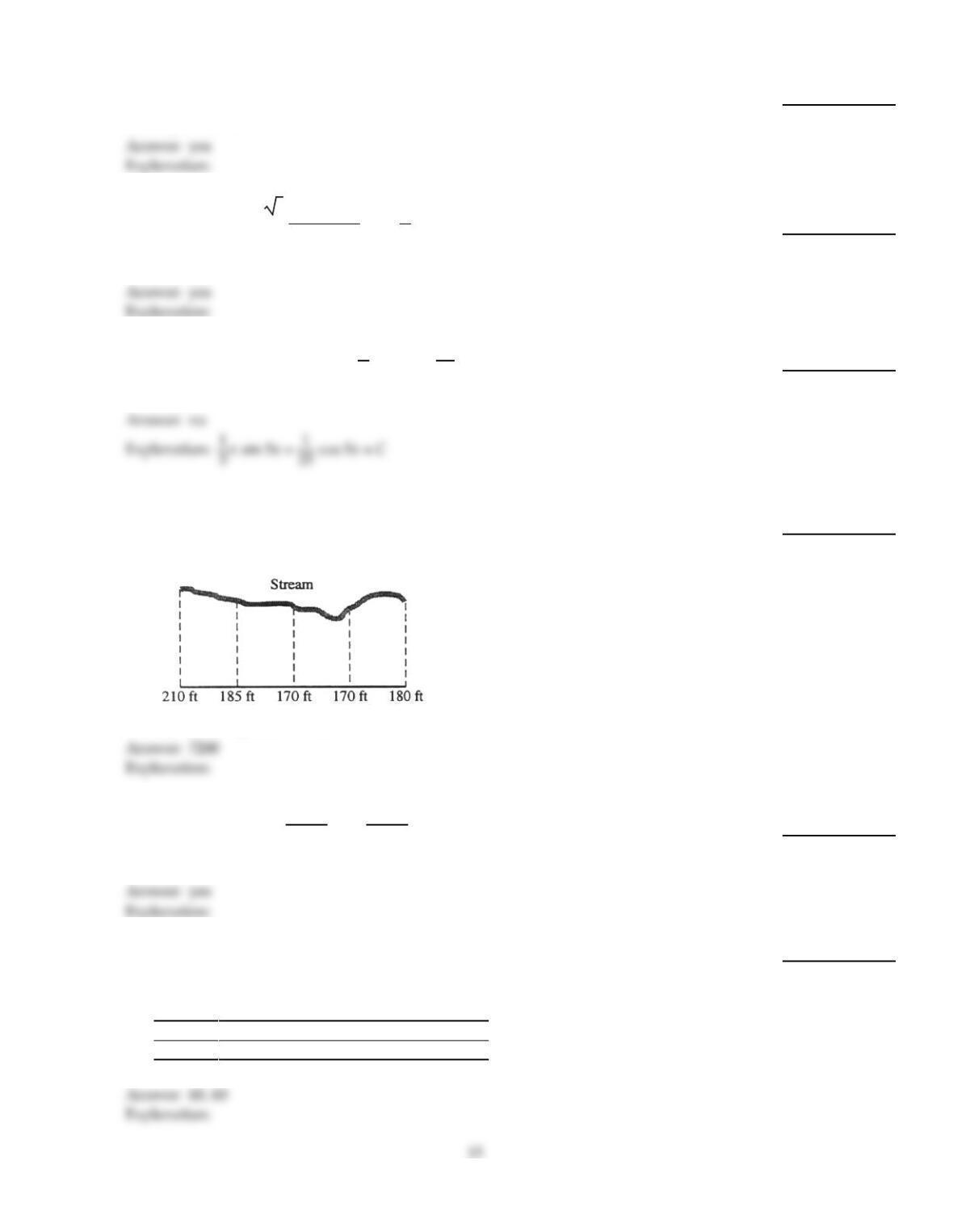
A homeowner has fences on three sides of her property and a stream runs along the fourth
side. She makes measurements of the distance to the stream every 10 feet as illustrated.
What is the approximate area of her property?
Enter just an integer (no units).
64)
65)
Does this integral
1
0
2x + 1
ex dx =3e – 5
e?
Enter “yes” or “no”.
65)
66)
Calculate (a) the trapezoidal approximation and (b) Simpson’s approximation to
b
a
f(x) dx where f is the tabulated function.
xa = 0
f(x) 1
1 2 3 4 5 6 7 8 9 10 = b
2 3 4 5 6 7 8 9 10 11
Enter your answers in that order as just unlabeled integers separated by a comma.
66)
67)
Does this integral cos x
(3 sin x + 1)2 dx =1
3(3 sin x + 1) + C?
Enter “yes” or “no”.
67)
Determine the integral by making an appropriate substitution.
68)
cos x esin x dx
Enter your answer with any coefficients in front as integers or reduced fractions of form a
b.
No parentheses around arguments of functions.
68)
69)
Does this integral xe–x
(x –1)2 dx =e–x
1 – x + C?
Enter “yes” or “no”.
69)
Determine the integral by making an appropriate substitution.
70)
sin4 x cos x dx
Enter your answer with any coefficients in front as integers or reduced fractions of form a
b.
70)
71)
x x2– 4 dx
Enter your answer with any coefficients in front as integers or reduced fractions of form a
b.
71)
72)
Does this integral xx +3 dx =2
3x(x + 3)3/2 –4
15 (x + 3)5/2 + C?
Enter “yes” or “no”.
72)
14

Determine the integral by making an appropriate substitution.
73)
cos x sin2 x dx
Enter your answer with any coefficients in front as integers or reduced fractions of form a
b.
No parentheses around arguments of functions.
73)
74)
Does this integral x cos x dx = x sin x + cos x + C?
Enter “yes” or “no”.
74)
Determine the integral by making an appropriate substitution.
75)
(x – 1)e(3x2– 6x) dx
Enter your answer with any coefficients in front as integers or reduced fractions of form a
b.
75)
Approximate the integral by the trapezoidal rule.
76)
3
1
1
x dx; n = 4
Enter just a real number rounded to two decimal places.
76)
Determine the integral by making an appropriate substitution.
77)
ex+ xex
4 + xex dx
Enter your answer with any coefficients in front as integers or reduced fractions of form a
b.
77)
78)
cos3x dx [Hint: cos2 x = 1 –sin2 x.]
Enter your answer with any coefficients in front as integers or reduced fractions of form a
b.
No parentheses around arguments of functions.
78)
79)
ex–e–x
ex+e–x dx
Enter your answer with any coefficients in front as integers or reduced fractions of form a
b.
79)
80)
Approximate
1
0
x4dx; n = 4, by (a) Simpson’s rule and (b) the trapezoidal rule.
Enter your answers in that order as just unlabeled real numbers rounded to two decimal
places, separated by a comma.
80)
Determine the integral by making an appropriate substitution.
81)
tan x ln(cos x) dx
Enter your answer with any coefficients in front as integers or reduced fractions of form a
b.
81)
82)
cos 2x
sin3 2x dx
Enter your answer with any coefficients in front as integers or reduced fractions of form a
b.
No parentheses around arguments of functions.
82)
83)
4x
x2+ 2
dx
Enter your answer with any coefficients in front as integers or reduced fractions of form a
b.
83)
84)
Does this integral x sec2 x dx = x tan x + ln cos x + C?
Enter “yes” or “no”.
84)
16
Determine the integral by making an appropriate substitution.
85)
4x5(x6+ 100)5 dx
Enter your answer with any coefficients in front as integers or reduced fractions of form a
b.
85)
86)
xe3x2 dx
Enter your answer with any coefficients in front as integers or reduced fractions of form a
b.
86)
MULTIPLE CHOICE. Choose the one alternative that best completes the statement or answers the question.
Evaluate the improper integral whenever it is convergent. If it is divergent, state this.
87)
2
e–3x dx Give your answer in exact form.
87)
A)
0
B)
e–6
3
C)
–e–6
D)
Divergent
Determine the integral by making an appropriate substitution.
88)
sin x cos7 x dx
88)
A)
–7cos7 x + C
B)
–1
8cos8 x + C
C)
1
8sin8 x + C
D)
7sin7 x + C
89)
2x2– 3x 3x–9
4dx
89)
A)
1
2(2x2– 3x)3/2 + C
B)
(2x2– 3x)2+ C
C)
(2x2– 3x)3/2 + C
D)
(2x2– 3x)1/2 + C
E)
none of these
90)
t2
57+t3
dt
90)
A)
1
12(7 +t3)4+ C
B)
5
12 (7 +t3)4/5 + C
C)
5
18 (7 +t3)4/5 + C
D)
5
12 t3(7 +t3)4/5 + C
Evaluate the integral using integration by parts.
91)
xe3x dx
91)
A)
e3x
3+ C
B)
x2e3x
6+ C
C)
3xe3x –e3x
9+ C
D)
xe3x –e3x
3+ C
E)
none of these
Determine the integral by making an appropriate substitution.
92)
x2 sin(7x3– 6) dx
92)
A)
1
21 cos(7x3– 6) + C
B)
–1
21 cos(7x3– 6) + C
C)
–21 cos(7x3– 6) + C
D)
21 cos(7x3– 6) + C
Evaluate the integral.
93)
1
0
3x2x3+4 dx
93)
A)
10 5– 16
3
B)
2 5 –4
C)
10 5+16
3
D)
10 5– 16
9
Evaluate the integral using integration by parts.
94)
x4 ln x dx
94)
A)
x51
5 ln x –1
25 + C
B)
x55 ln x –1
25 + C
C)
x51
5 ln x –1
5+ C
D)
x51
5 ln x – 1 + C
95)
ln 8x dx
95)
A)
x ln 8x – 8x + C
B)
x ln 8x – x + C
C)
x ln 8x + x + C
D)
8x ln x – x + C
Evaluate the integral.
96)
2
1
ln x dx
96)
A)
2 ln 2 – 1
B)
–ln 2
C)
ln 2
D)
ln 2 + 1
Evaluate the integral using integration by parts.
97)
x –5 e4xdx
97)
A)
4(x –5)e4x –16 e4x + C
B)
(x –5)e4x –e4x + C
C)
1
4(x –5)e4x +1
16 e4x + C
D)
1
4(x –5)e4x –1
16 e4x + C
Evaluate the improper integral whenever it is convergent. If it is divergent, state this.
98)
xe–x2dx
98)
A)
–1
B)
1
C)
divergent
D)
0
E)
2