Introduction to Financial Accounting, 10e (Horngren)
Chapter 9 Liabilities and Interest
Learning Objective 9.1 Questions
9.1-1) A liability is created ________.
A) when merchandise is purchased with cash
B) when owners invest in a company
C) when merchandise is sold on account
D) when salary expense is recognized before employees are paid
E) when rent is paid in advance
9.1-2) Liabilities that fall due more than 1 year beyond the balance sheet date are
A) long–term liabilities.
B) delinquent liabilities.
C) current liabilities.
D) risky liabilities.
E) contingent liabilities.
9.1-3) Examples of a current liability include all of the following except:
A) Prepaid rent
B) Accrued income taxes payable
C) Accrued wages payable
D) Current portion of long–term debt
E) Accounts payable
9.1-4) A written promise to repay a loan principal plus interest at a specific future date is
A) a promissory note.
B) a line of credit.
C) commercial paper.
D) a product warranty.
E) a returnable deposit.
Table 9–1
Lexie Company has a monthly payroll with the following information:
A. The monthly gross salary for all its employees is $60,000. Lexie Company withholds 20% of the
employees’ gross salary for federal taxes, 6% for state taxes, and 8% for Social Security (FICA) taxes.
B. Lexie Company also incurs other employee–related costs. Specifically, the company must (1) match the
Social Security taxes withheld from the employees, (2) contribute 4% of the employees’ gross pay to the
employees’ pension fund, and (3) pay 3% of the employees’ gross pay for health insurance premiums on
behalf of the employees.
9.1-5) Referring to Table 9–1, what is the appropriate journal entry to be made by Lexie Company for part
A of their monthly payroll, which is associated with gross pay and withholdings?
A) Compensation Expense 60,000
Salaries and Wages Payable 60,000
B) Compensation Expense 60,000
Federal Income Tax Withholding Payable 12,000
State Income Tax Withholding Payable 3,600
Social Security Withholding Payable 4,800
Salaries and Wages Payable 39,600
C) Compensation Expense 60,000
Tax Expense 20,400
Federal Tax Withholding Payable 12,000
State and FICA Tax Withholding Payable 8,400
Salaries and Wages Payable 60,000
D) Compensation Expense 60,000
Federal Tax Expense 12,000
State Tax Expense 3,600
Social Security Tax Expense 4,800
Salaries and Wages Payable 80,400
E) Compensation Expense 80,400
Federal Tax Withholding Payable 12,000
State Tax Withholding Payable 3,600
Social Security Tax Withholding Payable 4,800
Salaries and Wages Payable 60,000
9.1-6) Referring to Table 9–1, what is the appropriate journal entry to be made by Lexie Company for part
B of their monthly payroll, which is associated with other employee–related costs?
A) Employee Benefit Expense 9,000
Employer Social Security Payable 4,800
Pension Liability Payable 2,400
Health Insurance Payable 1,800
B) Compensation Expense 9,000
Employer Social Security Payable 4,800
Pension Liability Payable 2,400
Health Insurance Payable 1,800
C) Prepaid Employee Benefits 9,000
Employer Social Security Payable 4,800
Pension Liability Payable 2,400
Health Insurance Payable 1,800
D) Unearned Employee Benefits 9,000
Employer Social Security Payable 4,800
Pension Liability Payable 2,400
Health Insurance Payable 1,800
E) Compensation Expense 9,000
Employer Social Security Payable 4,800
Pension Withholding Payable 2,400
Health Insurance Withholding Payable 1,800
9.1-7) A debt contract issued by prominent companies that allow the companies to borrow directly from
investors is
A) a promissory note.
B) a line of credit.
C) commercial paper.
D) product warranties.
E) returnable deposits.
9.1-8) Drew Industries has a temporary shortfall of cash, but needs to pay its employees tomorrow. What
will Drew Industries most likely do to obtain the cash?
A) Go to bank and sign a promissory note for the funds needed
B) Issue commercial paper in hopes that creditors will loan Drew Industries the needed funds
C) Offer a 1–day incentive to salespersons in order to increase cash
D) Ask employees to wait until the company has the funds to pay them
E) Borrow money from their line of credit
Table 9–2
Green Top Industries has the following monthly payroll transactions:
A. The monthly gross salary for all its employees is $120,000. Green Top withholds 21% of the employees’
gross salary for federal taxes, 7% for state taxes, and 9% for Social Security (FICA) taxes.
B. Green Top also incurs other employee–related costs. Specifically, the company must (1) match the
Social Security taxes withheld from the employees, (2) contribute 3% of the employees’ gross pay to the
employees’ pension fund, and (3) pay 4% of the employees’ gross pay for health insurance premiums on
behalf of the employees.
9.1-9) Referring to Table 9–2, what is the appropriate journal entry to be made by Green Top Industries for
transaction A of its monthly payroll, which is associated with gross pay and withholdings?
A) Compensation Expense 120,000
Salaries and Wages Payable 120,000
B) Compensation Expense 120,000
Tax Expense 44,400
Federal Income Tax Withholding Payable 25,200
State and FICA Tax Withholding Payable 19,200
Salaries and Wages Payable 120,000
C) Compensation Expense 120,000
Federal Tax Expense 25,200
State Tax Expense 8,400
Social Security Withholding Expense 10,800
Salaries and Wages Payable 164,400
D) Compensation Expense 120,000
Federal Income Tax Withholding Payable 25,200
State Income Tax Withholding Payable 8,400
Social Security Tax Withholding Payable 10,800
Salaries and Wages Payable 75,600
E) Compensation Expense 164,400
Federal Tax Withholding Payable 25,200
State Tax Withholding Payable 8,400
Social Security Tax Withholding Payable 10,800
Salaries and Wages Payable 20,000
9.1-10) Referring to Table 9–2, what is the appropriate journal entry to be made by Green Top Industries
for transaction B of their monthly payroll, which is associated with other employee–related costs?
A) Compensation Expense 19,200
Employer Social Security Payable 10,800
Pension Liability Payable 3,600
Health Insurance Payable 4,800
B) Employee Benefit Expense 19,200
Employer Social Security Payable 10,800
Pension Liability Payable 3,600
Health Insurance Payable 4,800
C) Prepaid Employee Benefits 19,200
Employer Social Security Payable 10,800
Pension Liability Payable 3,600
Health Insurance Payable 4,800
D) Unearned Employee Benefits 19,200
Employer Social Security Payable 10,800
Pension Liability Payable 3,600
Health Insurance Payable 4,800
E) Compensation Expense 19,200
Employer Social Security Payable 10,800
Pension Withholding Payable 3,600
Health Insurance Withholding Payable 4,800
9.1-11) Schwitzer Company estimated at January 1, 20X9, that its income before taxes for the year ended
December 31, 20X9, would be $7,500,000. Schwitzer Company‘s tax rate for the year is 45%. The company
made quarterly tax payments on April, June, September, and December 15. The actual income before
taxes for the year ended December 31, 20X9, for the Schwitzer Company was $7,700,000. What was the
balance in the income tax payable account at December 31, 20X9?
A) $0
B) $90,000
C) $110,000
D) $150,000
E) $200,000

9.1-12) Slinger Company estimated at January 1, 20X9, that its income before taxes for the year ended
December 31, 20X9, would be $5,500,000. Slinger Company’s tax rate for the year is 42%. The company
made quarterly tax payments on April, June, September, and December 15. The actual income before
taxes for the year ended December 31, 20X9, for the Slinger Company was $5,700,000. What was the
balance in the income tax payable account at December 31, 20X9?
A) $0
B) $84,000
C) $100,000
D) $144,000
E) $200,000
9.1-13) The current portion of long–term debt represents
A) the amount of principal on long–term debt that comes due in the coming year.
B) the amount of long–term debt that appears in the noncurrent liability section of the balance sheet.
C) the amount of interest that comes due in the coming year.
D) a short–term loan from a bank that has also granted a long–term loan.
E) the amount of principal and interest that comes due within a coming year.
9.1-14) On January 1, 20X9, Comps Company issued $200,000 in long–term bonds at par. The bonds pay
interest of 12% on January 1, and the principal will be paid in $25,000 annual increments, beginning on
December 31, 2X13 and continuing every year thereafter for 8 years. What journal entry is necessary on
December 31, 2X12?
A) No journal entry is necessary.
B) Cash 25,000
Long–Term Bond Payable 25,000
C) Long–Term Bond Payable 25,000
Cash 25,000
D) Long–Term Bond Payable 25,000
Current Portion of Long–Term Bond Payable 25,000
E) Prepaid Long–Term Bond Payable 25,000
Cash 25,000
9.1-15) Sales tax
A) is a tax on sales and is an expense to the company who collects it.
B) is collected from the customer and remitted to the state or local government.
C) is paid daily to the state or local government and, thus, never appears as a payable.
D) is represented as a long–term payable on the balance sheet.
E) is not collected on the internet.
9.1-16) Pink Flamingo, Inc., operates in a state where there is a 7% sales tax. If a customer pays cash for
merchandise with a sales price of $300, Pink Flamingo would record the transaction using which of the
following journal entries?
A) Cash 300
Sales 300
B) Cash 300
Sales Tax Payable 21
Sales 279
C) Cash 300
Sales Tax Expense 21
Sales Tax Payable 21
Sales 300
D) Cash 321
Sales Tax Payable 21
Sales 300
E) Cash 321
Sales Tax Expense 21
Sales Tax Payable 21
Sales 321
9.1-17) Smith Lots, Inc., operates in a state where there is a 6% sales tax. If a customer pays cash for
merchandise with a sales price of $500, what effect will this transaction have on Smith Lots’ balance
sheet? (Ignore the effect of cost of goods sold.)
A) Assets increase by $530, current liabilities increase by $30, and stockholders’ equity increases by $500.
B) Assets increase by $500, and stockholders’ equity increases by $500.
C) Assets increase by $500, long–term liabilities increase by $30, and stockholders’ equity increases by
$500.
D) Assets increase by $500, current liabilities increase by $30, and stockholders’ equity increases by $470.
E) Assets increase by $530, long–term liabilities increase by $30, and stockholders’ equity increases by
$500.
Table 9–3
Mulch Barn Company began business on January 1, 20X9. The company manufactures and sells stereo
equipment. The company provides a warranty on its units, whereby the company will replace any
defective part for two and one–half years after the sale, at no additional cost to the customer. During
20X9, Mulch Barn Company had sales of $700,000. The company estimates that the cost of the warranties
will be 3% of sales. No warranty claims were made in 20X9. During 2X10, warranty claims of $14,900
were made. All warranty claims were satisfied and paid for.
9.1-18) Referring to Table 9–3, what journal entry, if any, is necessary for 20X9 by Mulch Barn Company?
A) No journal entry is necessary.
B) Prepaid Warranty 21,000
Liability for Warranties 21,000
C) Warranty Expense 21,000
Liability for Warranties 21,000
D) Warranty Expense 21,000
Warranty Sales 21,000
E) Warranty Expense 21,000
Unearned Warranties 21,000
9.1-19) Referring to Table 9–3, what journal entry, if any, is necessary for 2X10 by Mulch Barn Company?
A) No journal entry is necessary.
B) Liability for Warranties 14,900
Inventory 14,900
C) Prepaid Warranties 14,900
Inventory 14,900
D) Warranty Expense 14,900
Inventory 14,900
E) Unearned Warranties 14,900
Inventory 14,900
9.1-20) Which of the following statements is false?
A) Well–known examples of returnable deposits are those for returnable containers such as soft–drink
bottles and beer kegs.
B) Companies that receive deposits record them as a form of receivable.
C) The account Deposits is a current liability of the company receiving the deposit.
D) Ordinarily, the recipient of the cash deposit may use the cash for investment purposes from the date of
deposit to the date of its return to the depositor.
E) In some states, the law allows interest earned on deposits to be retained by the landlord; in others, the
interest must be paid to the tenant.
9.1-21) Unearned revenues
A) are considered to be a type of revenue.
B) are revenues that are collected before services or goods are delivered.
C) normally have a debit balance.
D) are credited when the sales revenue is finally earned.
E) include cash donations made to universities from wealthy alumni.
9.1-22) James publishes the Marley Gazette. In June, he collected $60 in advance for 1–year subscriptions.
He delivered the first issue in July. Assume one issue is published per month. The journal entry to record
the delivery of the magazines in July would be
A) Cash 5.00
Subscription Revenue 5.00
B) Unearned Subscription Revenue 5.00
Subscription Revenue 5.00
C) Prepaid Subscriptions 5.00
Subscription Revenue 5.00
D) Prepaid Subscriptions 5.00
Cash 5.00
E) Cash 5.00
Prepaid Subscriptions 5.00
9.1-23) Sally publishes the Sunshine News. In March, she collected $600 in advance for 1–year
subscriptions. The journal entry to record the delivery of the newspapers in April would be
A) Cash 50.00
Subscription Revenue 50.00
B) Prepaid Subscriptions 50.00
Subscription Revenue 50.00
C) Prepaid Subscriptions 50.00
Cash 50.00
D) Cash 50.00
Prepaid Subscriptions 50.00
E) Unearned Subscription Revenue 50.00
Subscription Revenue 50.00
9.1-24) The portion of a long–term liability that is due within a year is still included in the long–term
liability section of the balance sheet.
9.1-25) A line of credit is a written promise to repay the loan principal plus interest at a specific future
date.
9.1-26) A promissory note is an agreement with a bank to provide automatically short-term loans up to
some pre-established maximum amount.
9.1-27) Commercial paper is a debt contract issued by prominent companies that borrow directly from
investors.
9.1-28) Expenses that have been incurred and recognized on the income statement but not yet paid are
accrued liabilities.
9.1-29) A company’s portion of long–term debt that includes payments due within a year should be
reclassified as a current liability.
9.1-30) Warranty costs are expensed at the time the item covered by the warranty is sold.
9.1-31) Income tax withholdings and Social Security withholdings are a type of payroll tax that is an
expense to the employer.
9.1-32) Revenue collected in advance is usually a current asset.
9.1-33) If warranty obligations are material, they must be accrued when products are sold because the
obligation arises then, not when the actual repair services are performed.
9.1-34) Revenues that are collected before services or goods are delivered are called unearned revenue
under accrual accounting.
9.1-35) Deposits to a bank are considered to be current liabilities by the bank.
9.1-36) Employee withholdings are an employer’s expense.
9.1-37) Corporations pay taxes in one lump sum at the end of the year.
9.1-38) The journal entry to reclassify a noncurrent liability as a current liability includes a debit to the
current portion of long–term obligations.
9.1-39) A company selling merchandise in a state charging 6% sales tax would debit sales tax expense for
6% of gross revenue each time a sale is recorded.
9.1-40) Unearned sales revenue is debited when a business receives cash in advance of performing
services.
9.1-41) Most disbursement systems require that all disbursements be made by check.
9.1-42) Bay’s Alligator Shop is located in a state where the sales tax is 7 1/2%. Total sales for the month of
June were $81,000, all of which were subject to sales tax.
a. Prepare a journal entry that summarizes sales (all in cash) for the month.
b. Prepare a journal entry regarding the disbursement for the sales tax.
9.1-43) At the beginning of 20X9, Papling Enterprises had a liability for warranties of $17,500 on the
books. During 20X9, Papling Industries had sales of $205,000. The company estimates that the cost of
servicing products under warranty will average 2.5% of sales. Expenditures (all in cash) to satisfy
warranty claims during 20X9 were $4,800, of which $2,500 was for products sold in 20X9.
a. Prepare the journal entries for sales revenue and the related warranty expense for 20X9. Assume all
sales are for cash.
b. Prepare the journal entry for the warranty expenditures.
c. Compute the December 31, 20X9, ending balance in the Liability for Warranties account.
9.1-44) For the week ended May 16, Cheap Printing Company had a total payroll of $183,000. Three items
are withheld from employee’s paychecks: (1) Social Security (FICA) tax of 7.1% of payroll; (2) income
taxes, which average 20% of the payroll; and (3) employees’ savings that are deposited in their credit
union, which are $12,020. In addition, Cheap Printing Company pays (1) Social Security tax equal to the
amount withheld from employees, (2) health insurance premiums of $12,750, and (3) contributions to the
employees’ pension fund of $17,000.
Prepare the journal entries to record the compensation expense and the employee benefit expense.
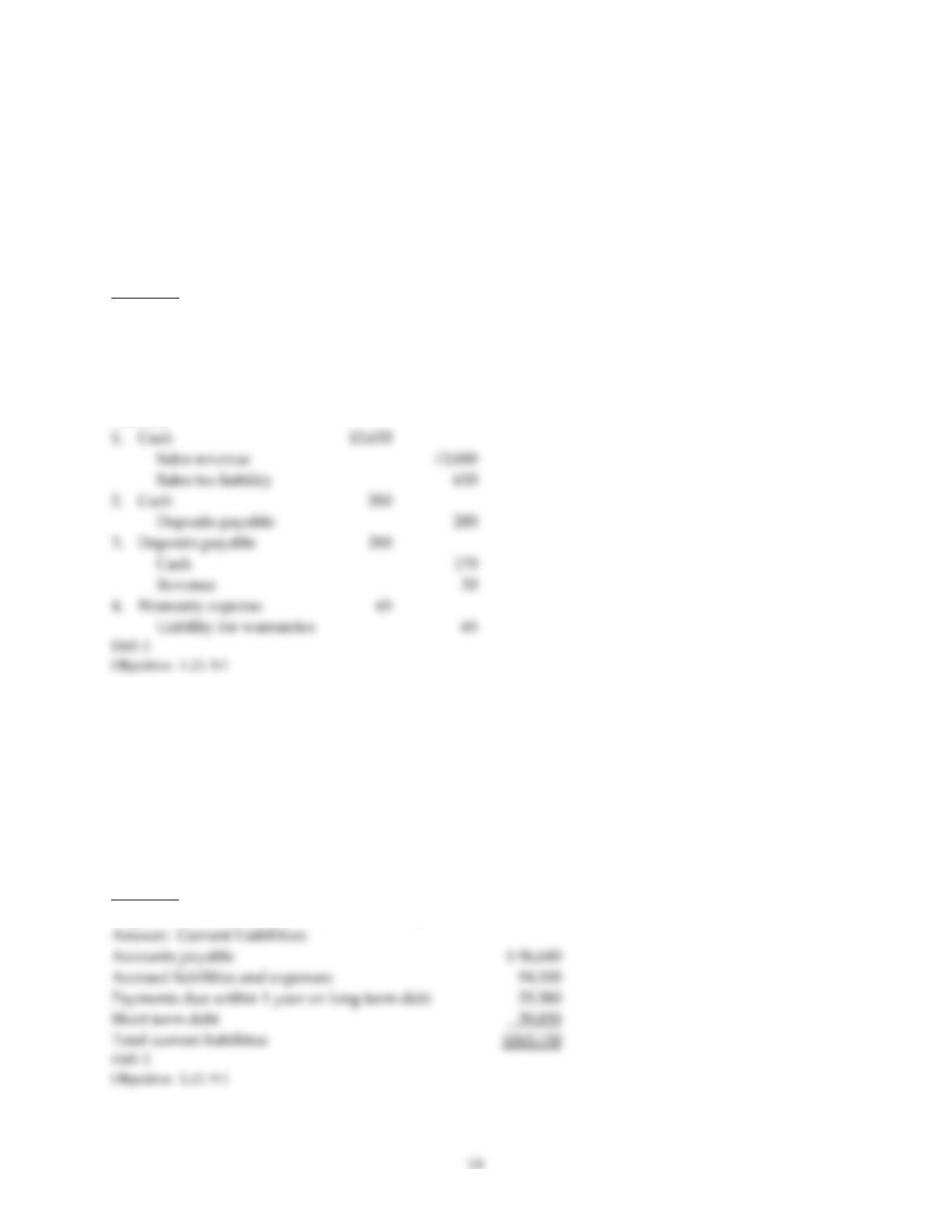
9.1-45) Dot to Dot, Inc., which resides in a 5% sales tax county, sold $13,000 worth of beads to customers
in January, 2X09 for cash. Since beads were difficult to carry home, Dot to Dot, Inc., offered a convenient
carrying case for customers to use with the stipulation that it should be returned by the end of the month
of the original sale. If customers did not return the case by January 31, 2X09, Dot to Dot, Inc.’s agreement
was to keep the deposit money. Customers paid $200 cash in carrying case deposits during January, 2X09
and Dot to Dot, Inc., returned $170 of the money to customers by January 31, 2X09. In addition, although
Dot to Dot, Inc., rarely encounters batches of defective beads, it does occur on occasion. Dot to Dot, Inc.,
estimates .5% of sales to be returned as defective.
Required:
1. Prepare the journal entry to record sales and sales tax for January, 2X09.
2. Prepare the journal entry to record returnable deposit money received in January, 2X09.
3. Prepare the journal entry to record deposit money returned to customers and the portion of the deposit
money kept by Dot to Dot, Inc.
4. Prepare the journal entry to record estimated product warranties.
Answer:
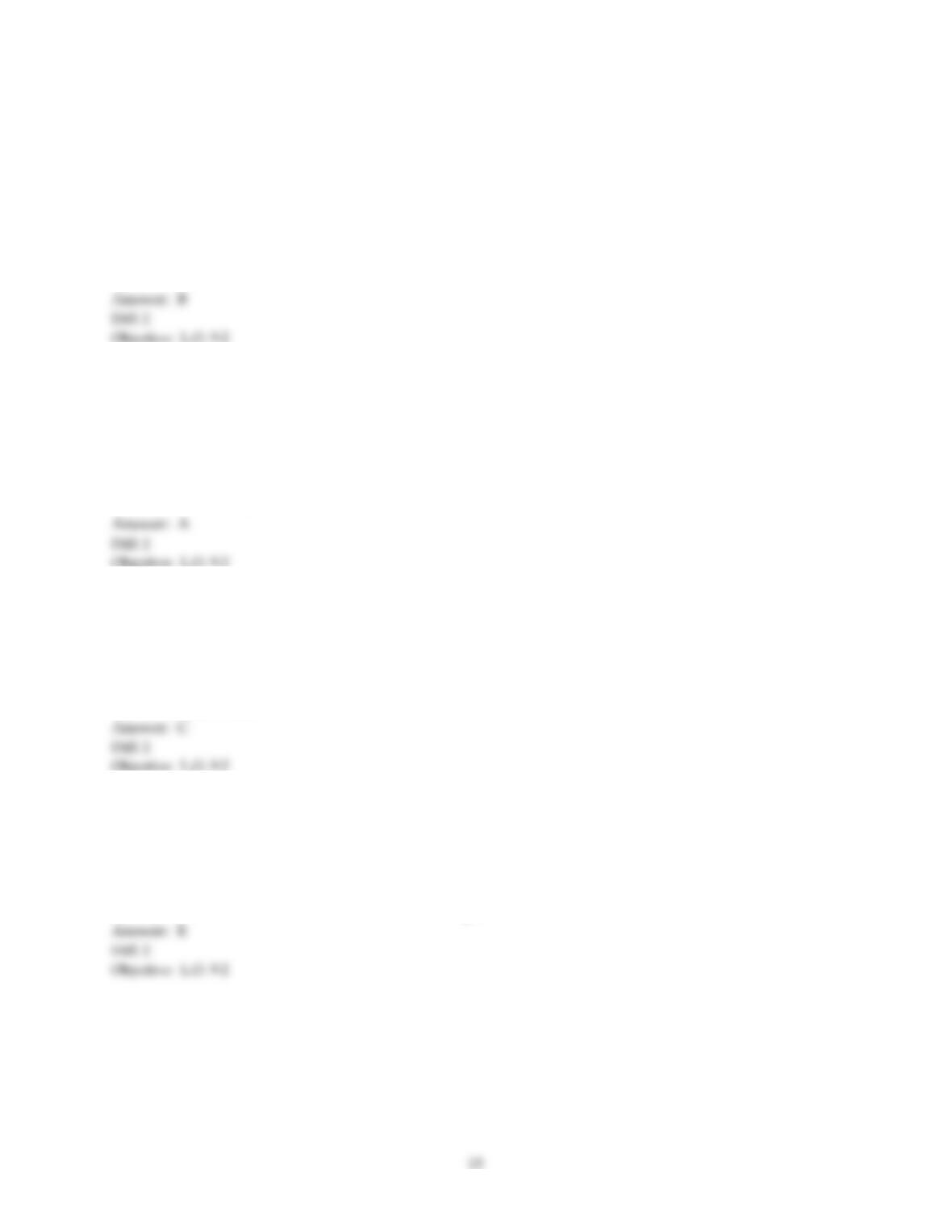
9.1-46) Nincy Industries had the following items on its December 31, 20X9, balance sheet:
Cash and cash equivalents $56,230
Accounts payable 96,640
Inventories 60,790
Additional paid–in capital 51,690
Accrued liabilities and expenses 94,100
Payments due within 1 year on long–term debt 35,380
Short–term debt 39,030
Long–term debt 97,290
Required:
Prepare the current liabilities section of Nincy Industries’ balance sheet.
Learning Objective 9.2 Questions
9.2-1) ________ are a form of long–term debt that is secured by the pledge of specific property.
A) Convertible bonds
B) Mortgage bonds
C) Callable bonds
D) Sinking fund bonds
E) Debentures
9.2-2) ________ are bonds whose holders have claims against only the assets that remain after the claims
of the general creditors are satisfied.
A) Subordinated debentures
B) Mortgage bonds
C) Callable bonds
D) Sinking fund bonds
E) Convertible bonds
9.2-3) ________ are subject to redemption before maturity at the option of the issuer.
A) Debentures
B) Mortgage bonds
C) Callable bonds
D) Sinking fund bonds
E) Convertible bonds
9.2-4) Convertible bonds are attractive to investors because
A) the issuing company cannot retire the bonds before maturity.
B) they can be converted into stock by the issuing company.
C) they usually carry a higher rate of interest than non–convertible bonds.
D) they usually carry a lower rate of interest than non–convertible bonds.
E) they can be converted into stock at the holder’s option.
9.2-5) Notes and bonds are often called ________ financial instruments or securities because they can be
transferred from one lender to another.
A) private placement
B) negotiable
C) current liability
D) long term liability
E) sinking fund
9.2-6) Bonds are typically sold through
A) board of directors.
B) underwriters.
C) corporations.
D) commercial insurance companies.
E) None of the above
9.2-7) The excess of a bond’s issue price over its face value is known as the
A) discount.
B) effective interest amount.
C) coupon interest amount.
D) premium.
E) contingent liability.
9.2-8) The interest rate that determines the amount of cash paid for interest to the bondholder is referred
to as the
A) effective rate.
B) market rate.
C) coupon rate.
D) daily rate.
E) imputed rate.
9.2-9) All of the following are rates used to compare investments in similar bonds at a moment in time,
except:
A) Yield to maturity
B) LIBOR rate
C) Coupon rate
D) Market interest rate
E) Effective interest rate
9.2-10) The cash proceeds received from issuing a bond are less than the face value of the bond. It is
apparent that the bond was issued at
A) face value.
B) a premium.
C) a discount.
D) par value.
E) nominal value.
9.2-11) As the market rate of interest rises above the nominal or stated interest rate for a bond, the market
price of the bond will
A) stay the same.
B) fall.
C) rise.
D) Cannot be determined without more information
E) go in sync with the stock’s price.
9.2-12) When the market interest rate is 13% and the coupon rate is 10%, a bond sells at
A) a discount.
B) a premium.
C) par.
D) liquidation value.
E) Cannot be determined without more information
9.2-13) Bond interest payments are typically made ________.
A) annually
B) semiannually
C) monthly
D) quarterly
E) weekly
9.2-14) When the market interest rate is 7% and the coupon rate is 10%, a bond sells at
A) a discount.
B) a premium.
C) par.
D) liquidation value.
E) Cannot be determined without more information
9.2-15) If a $10,000 bond, with a 12% coupon rate, is trading at 100, what can be said about the current
price and current yield of the bond?
A) Current Price Current Yield
$10,000 Greater than 12%
B) Current Price Current Yield
$10,000 Equal to 12%
C) Current Price Current Yield
$10,000 Less than 12%
D) Current Price Current Yield
$11,200 Equal to 12%
E) Current Price Current Yield
$11,200 Less than 12%
9.2-16) Which statement is false?
A) The periodic interest payment on a bond is based upon the market rate of interest.
B) Typically when a company issues a bond, the company will sell the bonds to an underwriter, who in
turn sells the bonds to the general public.
C) The nominal rate of interest and the market rate of interest are usually different on the date the bond is
issued.
D) If a bond is sold at a price that is greater than face value, it is said to be sold at a premium.
E) If a bond is sold at a price that is less than face value, it is said to be sold at a discount.
9.2-17) A debenture is a debt security with a general claim against the company’s total assets, rather than
against a particular asset.
9.2-18) Protective covenants are provisions within a trust indenture that are intended to protect the
shareholders’ interests.
9.2-19) A callable bond is one in which the bondholder can sell the bond back to the company, even if the
company does not want the bond returned.
9.2-20) Notes and bonds are common financial contracts that businesses use to raise money.
9.2-21) Negotiable instruments are legal financial contracts that can be transferred from one lender to
another.
9.2-22) Debenture bonds may be subordinated, which means that their interest rates may vary depending
on the prime rate.
9.2-23) A protective covenant is a contract whereby the issuing corporation of a bond promises that it will
abide by stated provisions.
9.2-24) Sinking fund bonds require the issuer to make annual payments into a sinking fund.
9.2-25) Convertible bonds are bonds that may be redeemed before maturity date by the issuing
corporation.
9.2-26) A callable bond is one in which the bondholder can sell the bond back to the company, even if the
company does not want the bond returned.
9.2-27) Bond prices can change very much, even though periodic interest payments will occur and the
principal amount of the bond will be paid at maturity.
9.2-28) Interest expense that is not explicitly recognized in a loan agreement is referred to as coupon or
nominal interest.
9.2-29) Companies that have a poor credit rating will always issue a bond at a discount.
9.2-30) Higher bond ratings lead to lower prices and therefore lower yields on a bond.