9-1: Job Order Sheet
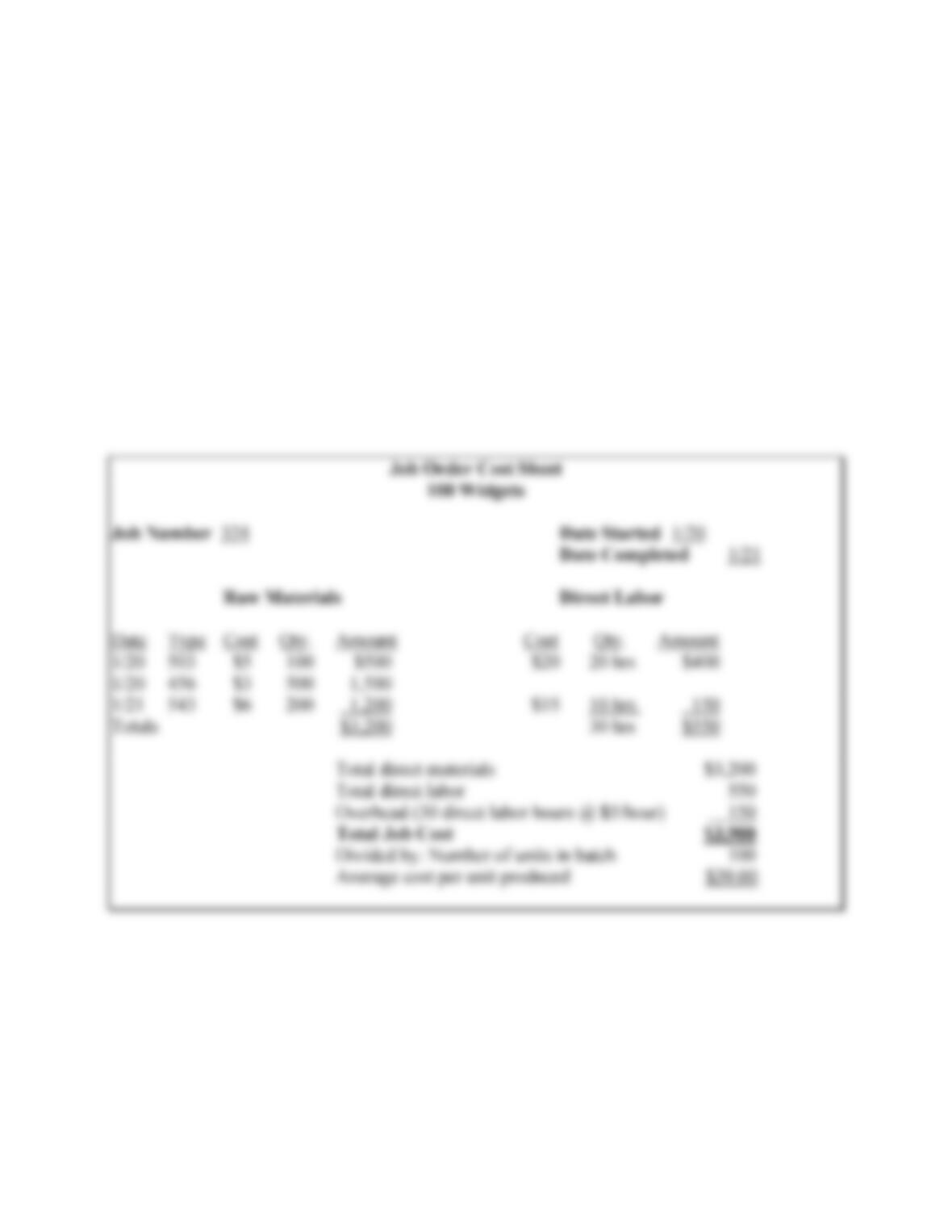
The Talbott Company has received an order (#324) for 100 widgets. On January 20 the
shop supervisor requisitioned 100 units of part 503 at a cost of $5 per unit and 500 units part 456
at a cost of $3 per unit to begin work on the 100 widgets. On the same day 20 hours of direct labor
at $20 per hour are used to work on the widgets. On January 21, 200 units of part 543 at $6 per
unit are requisitioned and 10 hours of direct labor at $15 per hour are performed on the 100 units
of widgets to complete the job. Overhead is allocated to the job based on $5 per direct labor hour.
Required:
Make a job order cost sheet for the 100 widgets.
9-1: Solution to Job Order Sheet (15 minutes)
9-2: Job Cost Flows
The job cost sheet for 1,000 units of toy trucks is:
Job Number 555 Date Started 4/13
Date Completed 6/18
Raw Materials Direct Labor
Date Type Cost Qty. Amount Cost Hours Amount
4/13 565 $ 3 1,000 $3,000 $18 20 $ 360
5/24 889 1 4,000 4,000 12 10 120
6/18 248 2 1,000 2,000 15 100 1,500
$9,000 130 $1,980
Total direct materials $9,000
Total direct labor 1,980
Overhead (130 direct labor hours @ $10/hour) 1,300
Total Job Cost $12,280
All of the materials for the job were purchased on 4/10. The batch of 1,000 toy trucks is
sold on 7/10.
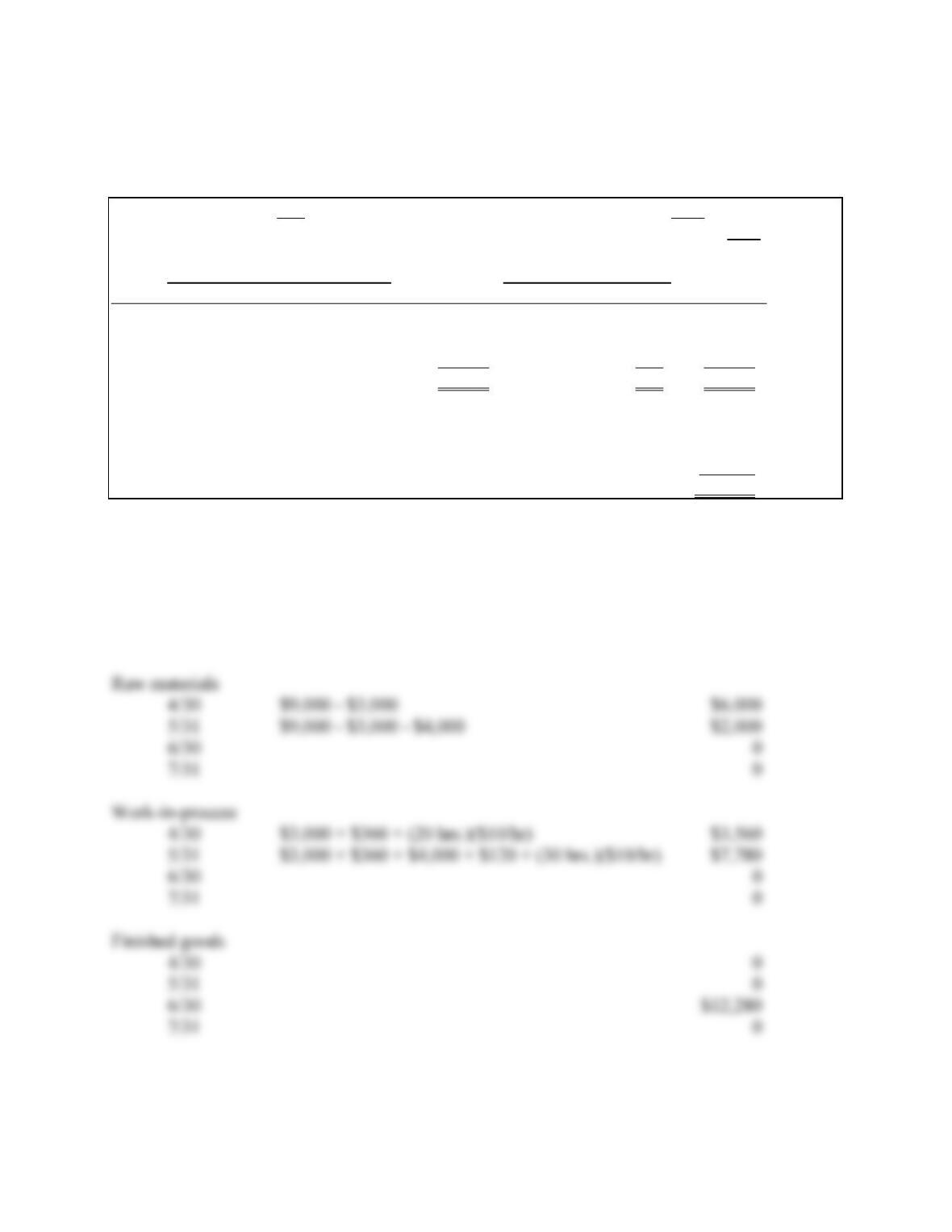
What are the costs of this job order in the raw materials account, the work–in-process
account, the finished goods account, and the cost of goods account on 4/30, 5/31, 6/30 and 7/31?
9-2: Solution to Job Cost Flows (15 minutes)
9-3: Over/Underabsorbed Overhead
The Alphonse Company allocates fixed overhead costs by machine hours and variable
overhead costs by direct labor hours. At the beginning of the year the company expects fixed
overhead costs to be $600,000 and variable costs to be $800,000. The expected machine hours are
6,000 and the expected direct labor hours are 80,000. The actual fixed overhead costs are $700,000
and the actual variable overhead costs are $750,000. The actual machine hours during the year are
5,500 and the actual direct labor hours are 90,000.
Required:
a. How much overhead is allocated?
b. What is the over/underabsorbed overhead?
9-3: Solution to Over/Underabsorbed Overhead (10 minutes)
9-4: Prorating Over/Underabsorbed Overhead
A computer manufacturer has the following account balances at the end of the year.
Work-in-process $ 100,000
Finished goods 800,000
Cost of goods sold 2,000,000
Total $2,900,000
These accounts contain $500,000 of allocated overhead. Actual overhead, however, is $600,000.
What are the account balances after prorating the underabsorbed overhead?
9-4: Solution to Prorating Over/Underabsorbed Overhead (10 minutes)
9-5: Incentives and Depreciation Methods
What conditions are likely to exist when operating managers are compensated based on
accounting earnings and accelerated depreciation methods are used to compute overhead charges
to operating departments?
9-5: Solution to Incentives and Depreciation Methods (10 minutes)
9-6: Plantwide vs. Department Overhead Rates
Rose Bach has recently been hired as controller of Empco Inc., a sheet-metal manufacturer.
Empco has been in the sheet-metal business for many years and is currently investigating ways to
modernize its manufacturing process. At the first staff meeting Bach attended, Bob Kelley, chief
engineer, presented a proposal for automating the drilling department. Kelley recommended that

Empco purchase two robots that could replace the eight direct labor workers in the department.
The cost savings outlined in Kelley’s proposal include two elements. First, direct labor cost in the
drilling department is eliminated. Second, manufacturing overhead cost in the department is
reduced to zero because Empco charges manufacturing overhead on the basis of direct labor dollars
using a plantwide rate.
The president of Empco felt that Kelley’s explanation of the cost savings made no sense.
Bach agreed and explained that as firms become more automated, they should rethink their
manufacturing overhead systems. The president asked Bach to look into the matter and prepare a
report for the next staff meeting.
To refresh her knowledge, Bach reviewed articles on manufacturing overhead allocation
for an automated factory and discussed the matter with some of her peers. She also gathered the
historical data presented below on the manufacturing overhead rates experienced by Empco over
the years. Bach also wanted to have some departmental data to present at the meeting. Using
Empco’s accounting records, she was able to estimate the annual averages presented below for
each manufacturing department in the 1990s.
Historical Data
Date
Average Annual
Direct Labor
Cost
Average Annual
Manufacturing
Overhead Cost
Average
Manufacturing
Overhead
Application
Rate
1950s
$1,000,000
$1,000,000
100%
1960s
1,200,000
3,000,000
250
1970s
2,000,000
7,000,000
350
1980s
3,000,000
12,000,000
400
1990s
4,000,000
20,000,000
500
Annual Averages
Cutting
Department
Grinding
Department
Drilling
Department
Direct labor
$ 2,000,000
$1,750,000
$ 250,000
Manufacturing overhead
11,000,000
7,000,000
2,000,000
Required:
a. Disregarding the proposed use of robots in the drilling department, describe the
shortcomings of Empco’s current system for applying overhead.
b. Do you agree with Bob Kelley’s statement that the manufacturing overhead cost in the
drilling department will be reduced to zero if the automation proposal is implemented?
Explain.
c. Recommend ways to improve Empco’s method for applying overhead by describing how
it should revise its overhead accounting system:
(i) in the cutting and grinding departments.
(ii) to accommodate the automation of the drilling department.
Source: CMA adapted.
9-6: Solution to Plantwide vs. Department Overhead Rates (CMA adapted) (20 minutes)
9-7: Absorption Costing in a Bank
First Eastern Bank is a large, multibranch bank offering a wide variety of commercial and
retail banking services. Eastern uses an absorption costing system to monitor the costs of various
services and provide information for a variety of decisions.
One set of services is a retail loan operation providing residential mortgages, car loans, and
student college loans. All loan applications are filed by the applicant at a branch bank, where the
branch manager fills out the loan application. From there, the loan application is sent to the loan
processing department, where the applicant’s credit history is checked and a recommendation is
made regarding loan approval based on the applicant’s credit history and current financial situation.
This recommendation is forwarded to the loan committee of senior lending officers, who review
the file and make a final decision.
Thus, there are three stages to making a loan: application in a branch, the loan processing
department, and the loan committee. Mr. and Mrs. Jones visit the West Street branch and file an
application for a residential mortgage. The Jones’s loan application is processed through the three
stages.
• West Street Branch Bank. The branch manager spends one hour taking the application.
The branch manager spends 1,000 hours per year of her total time taking loan applications
and the remainder of her time providing other direct services to customers. Total overhead
in the West Street Branch is budgeted to be $259,000, excluding the manager’s salary, and
is allocated to direct customer services using the branch manager’s time spent providing
direct customer services. The branch manager’s annual salary is $42,600.
• Processing department. The processing department budgets its total overhead for the year
to be $800,000, which is allocated to loans processed using direct labor hours. Budgeted
direct labor hours for the year are 40,000 hours. Direct labor hours in the processing
department cost $18 per hour. The Jones’s loan requires five direct labor hours in the loan
processing department.
• Loan committee. Ten senior bank executives are on the loan committee. The loan
committee meets 52 times per year, every Wednesday, all day, to approve all loans. The
average salary and benefits of each member of the loan committee are $104,000. The loan
committee spends 15 minutes reviewing the Jones’s loan application before approving it.
For costing purposes, all employees are assumed to work eight-hour days, five days per
week, 52 weeks per year.
Required:
Calculate the total cost of taking the application, processing, and approving the Joneses’
mortgage.
9-7: Solution to Absorption Costing in a Bank (25 minutes)
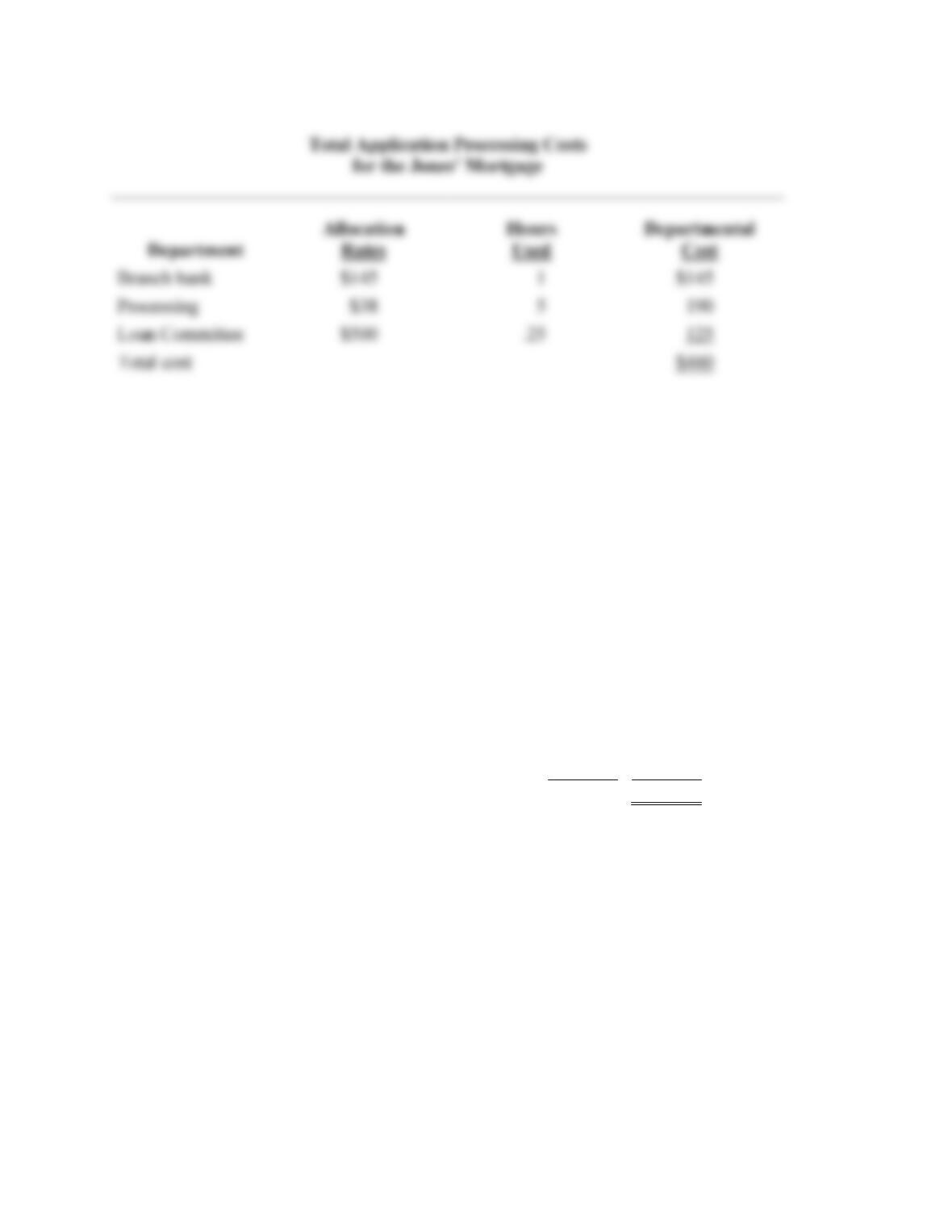
Branch bank
Processing
Loan Committee
Total cost
9-8: Product Profitability and Mix — Calculating Variable Overhead
Sportway Inc. is a wholesale distributor supplying a wide range of moderately priced
sporting equipment to large chain stores. About 60 percent of Sportway’s products are purchased
from other companies and the remainder are manufactured by Sportway. The company has a
plastics department that is currently manufacturing molded fishing tackle boxes. Sportway is able
to manufacture and sell 8,000 tackle boxes annually, making full use of its direct labor capacity at
available workstations. Presented below are the selling price and costs associated with Sportway’s
tackle boxes.
Selling price per box
$86.00
Costs per box
Molded plastic
$ 8.00
Hinges, latches, handle
9.00
Direct labor ($15.00/hr.)
18.75
Manufacturing overhead
12.50
Selling and administrative cost
17.00
65.25
Profit per box
$20.75
Because Sportway believes it could sell 12,000 tackle boxes if it had sufficient
manufacturing capacity, the company has looked into the possibility of purchasing the tackle boxes
for distribution. Maple Products, a steady supplier of quality products, would be able to provide
up to 9,000 tackle boxes per year at a price of $68 per box delivered to Sportway’s facility.
Bart Johnson, Sportway’s product manager, has suggested that the company could make
better use of its plastics department by manufacturing skateboards. To support his position,
Johnson has a market study that indicates an expanding market for skateboards and a need for
additional suppliers. Johnson believes that Sportway could expect to sell 17,500 skateboards
annually at $45 per skateboard. Johnson’s estimate of the costs to manufacture the skateboards
follows.
Selling price per skateboard
$45.00
Costs per skateboard
Molded plastic
5.50
Wheels, hardware
7.00
Direct labor ($15.00/hr.)
7.50
Manufacturing overhead
5.00
Selling and administrative cost
9.00
34.00
Profit per skateboard
$11.00
In the plastics department, Sportway uses direct labor hours as the application base for
manufacturing overhead. Included in manufacturing overhead for the current year is $50,000 of
factorywide, fixed manufacturing overhead that has been allocated to the plastics department. For
each product that Sportway sells, regardless of whether the product has been purchased or is
manufactured by Sportway, a portion of the selling and administrative cost is fixed at $6 per unit.
Total selling and administrative costs for the purchased tackle boxes would be $10 per unit.
Required:
Prepare an analysis based on the data presented that will show which product or products
Sportway Inc. should manufacture and/or purchase to maximize the company’s profitability. Show
the associated financial impact. Support your answer with appropriate calculations.
Source: CMA adapted.
9-8: Solution to Product Profitability and Mix – Calculating Variable Overhead (CMA
adapted) (50 minutes)