CHAPTER 9
Fill-in-the-Blank and True-False Items
ITEMS
1. In classroom assessment, it is acceptable if a few test items are focused on minor points of content.
(a) True
(b) False
2. In classroom assessment, it is of very little importance if students use their knowledge of flaws in
the items to answer them correctly.
(a). True
(b) False
3. If a student has a good command of a learning objective, you should expect that the student would
answer a test item about that objective correctly even if the item were worded rather ambiguously.
(a) True
(b) False
4. Which of the following abilities can be assessed by fill-in-the-blank items?
(a) Knowledge of facts
(b) Comprehension
(c) Manipulation of equations
(d) All of the above
5. What, if anything, is wrong with the following item? “The part of speech that modifies a noun is
called an _______.”
(a) Students who know the content will be confused by the grammatical structure of the item.
(b) Students who do not know the content will be clued by the grammatical structure of the item.
(c) The item probably does not assess an important part of a learning objective.
(d) Nothing, the item is not flawed.
6. In classroom assessment, fill-in–the-blank items are typically scored with the same objectivity as
multiple-choice items.
(a) True
(b) False

7. For which item format do students have the least probability of answering correctly solely by
guessing randomly?
(a) fill-in-the-blank
(b) true-false
(c) matching
(d) multiple-choice
8. It is acceptable if a student can answer a test item correctly by using his or her partial knowledge of
the learning objective.
(a) True
(b) False
9. You will improve the reliability of your students’ fill–in-the-blank test scores if you use an answer
key to score their responses.
(a) True
(b) False
10. When your fill-in–the-blank items fail to follow your assessment plan, the most probable effect is to
lower the
(a) validity of your students’ scores.
(b) reliability of your students’ scores.
(c) objectivity of your scoring.
(d) magnitude of students’ scores on the assessment.
11. You would generally expect to increase the validity of your students’ scores on your completion
items if you changed them into direct questions.
(a) True
(b) False
12. When would a completion variety be preferred over a direct question variety of fill-in-the-blank
items?
(a) Never (i.e., direct questions should always be used.)
(b) Only when students tend to think a long, complex answer is required
(c) Whenever numerical answers are required
(d) Whenever one or two words are required as the answer
13. For which students are “blanks” at the beginning of a completion item most problematic?
(a) Elementary school students
(b) Middle school students
(c) High school students
(d) College and university students
14. When crafting a completion item, it is best to use a statement taken verbatim from the textbook,
delete an important word, and replace the word with a blank.
(a) True
(b) False
15. When crafting completion items for elementary students, it is best to provide clues by making the
length of the blanks proportional to the length of the omitted word.
(a) True
(b) False
16. What is (are) the flaw(s) in the following item? “___________ is an example of a mammal.”
(a) Irrelevant clue to the answer
(b) Misplacement of blank
(c) Use of textbook statement
(d) All of the above
17. The primary value of true-false items is to assess a student’s ability to judge the correctness of
verbal propositions.
(a) True
(b) False
18. True-false items are able to assess the
(a) ability to recognize generalizations in a subject.
(b) ability to compare concepts.
(c) ability to recognize instances or examples of a principle.
(d) All of the above abilities.
(e) Only abilities (a) and (c) above.
19. A student who uses random guessing on a test comprised only of true-false items has a good chance
of getting a good score.
(a) True
(b) False
20. In classroom assessment, true-false items are best used to assess a student’s ability to
(a) recall minor points of content.
(b) memorize important textbook statements.
(c) plan problem solutions logically.
(d) judge the correctness of verbal propositions.

21. A good true-false item is one that is obviously correct
(a) to any person with a large amount of general knowledge.
(b) to any person with good common sense.
(c) only to a person who has a good command of the course material.
(d) only to the few top students in the course.
22. Suppose you wrote a true-false item whose correct answer is “false.” You then attempt to rewrite a
“true” parallel version of the item. You find that the only way this can be done is by writing “not”
into the false item. What does this imply about your false item?
(a) It is not worth using.
(b) It is likely to be a good item.
(c) It probably would work better as part of a multiple-true false item.
(d) It is probably too close to the wording in the textbook.
23. Which of the following is able to best assess students’ breadth of content knowledge?
(a) True-false
(b) Restricted essay
(c) Extended essay
(d) Portfolio
24. A poorly functioning multiple-choice item can often be rewritten into two or more good true-false
items.
(a) True
(b) False
25. What is one clear advantage of using multiple true-false items over traditional multiple-choice
items?
(a) Each multiple true-false alternative does not have to be consistent with the stem as is required
for good multiple-choice items.
(b) Multiple true-false items require more complex thinking than do regular multiple-choice
items.
(c) Multiple true-false items have higher reliability than comparable regular multiple-choice
items.
(d) Students perceive multiple true-false items as easier than comparable multiple-choice items.
26. One ten-point quiz consists only of traditional true-false items. Another ten-point quiz, assessing
the same content, consists only of multiple true-false items. How does the reliability of the scores
on the two quizzes compare?
(a) The traditional true-false quiz will likely be more reliable.
(b) The traditional true-false quiz likely to have the same reliability.
(c) The traditional true-false quiz is likely to be less reliable.
27. Multiple true-false items are least appropriate to assess
(a) elementary students.
(b) high school students.
(c) college/university students.
(d) adults seeking occupational certification.
28. Students think multiple true-false items do a better job of assessing knowledge than do comparable
traditional multiple-choice items.
(a) True
(b) False
29. The most discriminating true-false items tend to be those
(a) whose correct answer is true.
(b) whose correct answer is false.
(c) that have the word NOT in them.
(d) that incorporate two or more ideas in the statement.
30. The appropriate time to use the response categories “Right” and “Wrong” is when a true-false variety
item asks a direct question.
(a) True
(b) False
CHAPTER 9
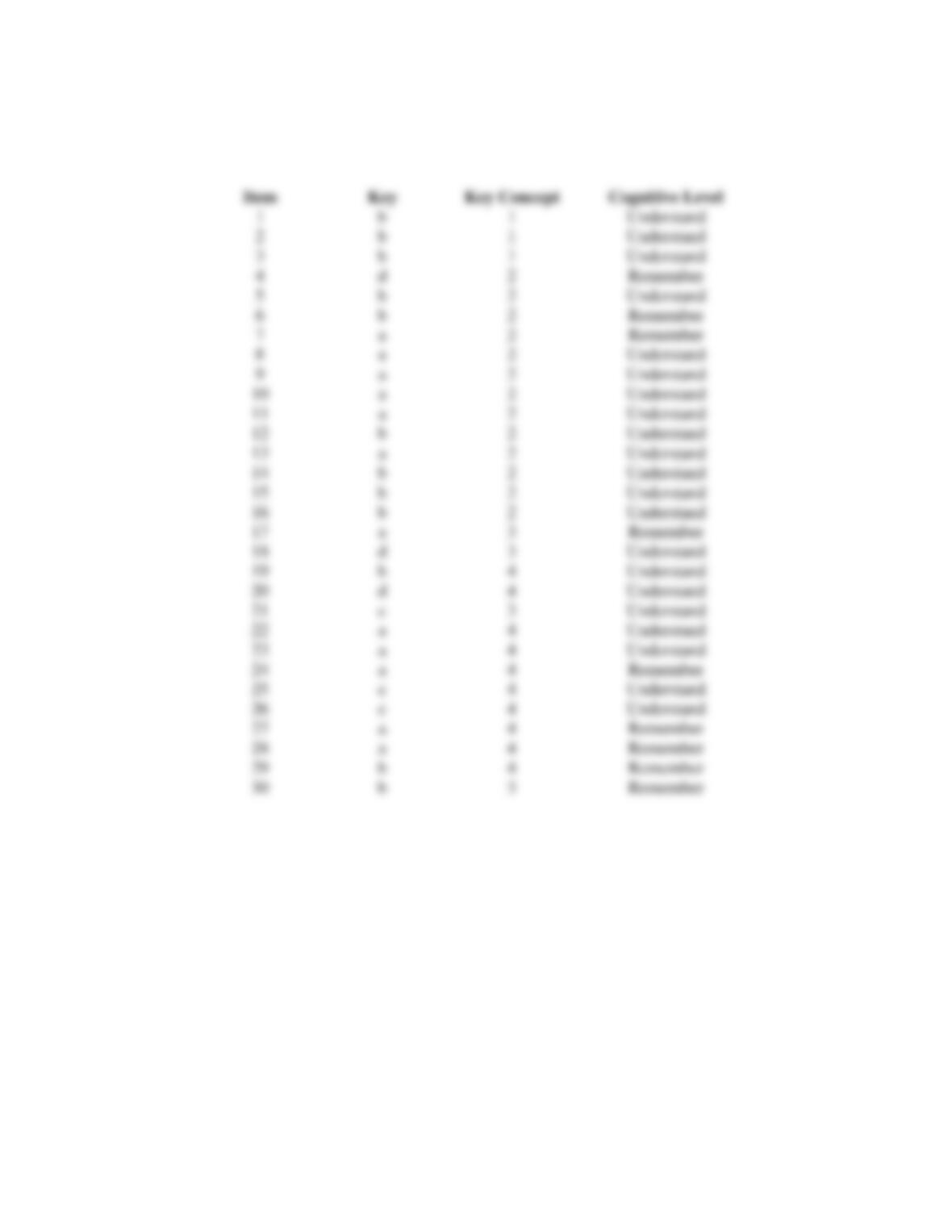
Answers and Classification of Items