College Physics: A Strategic Approach, 3e (Knight)
Chapter 9 Momentum
9.1 Conceptual Questions
1) A rubber ball and a lump of clay have equal mass. They are thrown with equal speed against
a wall. The ball bounces back with nearly the same speed with which it hit. The clay sticks to
the wall. Which one of these objects experiences the greater momentum change?
A) the ball
B) the clay
C) Both of them experience the same non-zero momentum change.
D) Both of them experience zero momentum change.
2) Which of the following quantities are units of momentum? (There could be more than one
correct choice.)
A) N ∙ m
B) kg ∙ s/m
C) kg ∙ m/s
D) N ∙ s
E) kg ∙ m2/s2
3) A tiger is running in a straight line. If we double both the mass and speed of the tiger, the
magnitude of its momentum will increase by what factor?
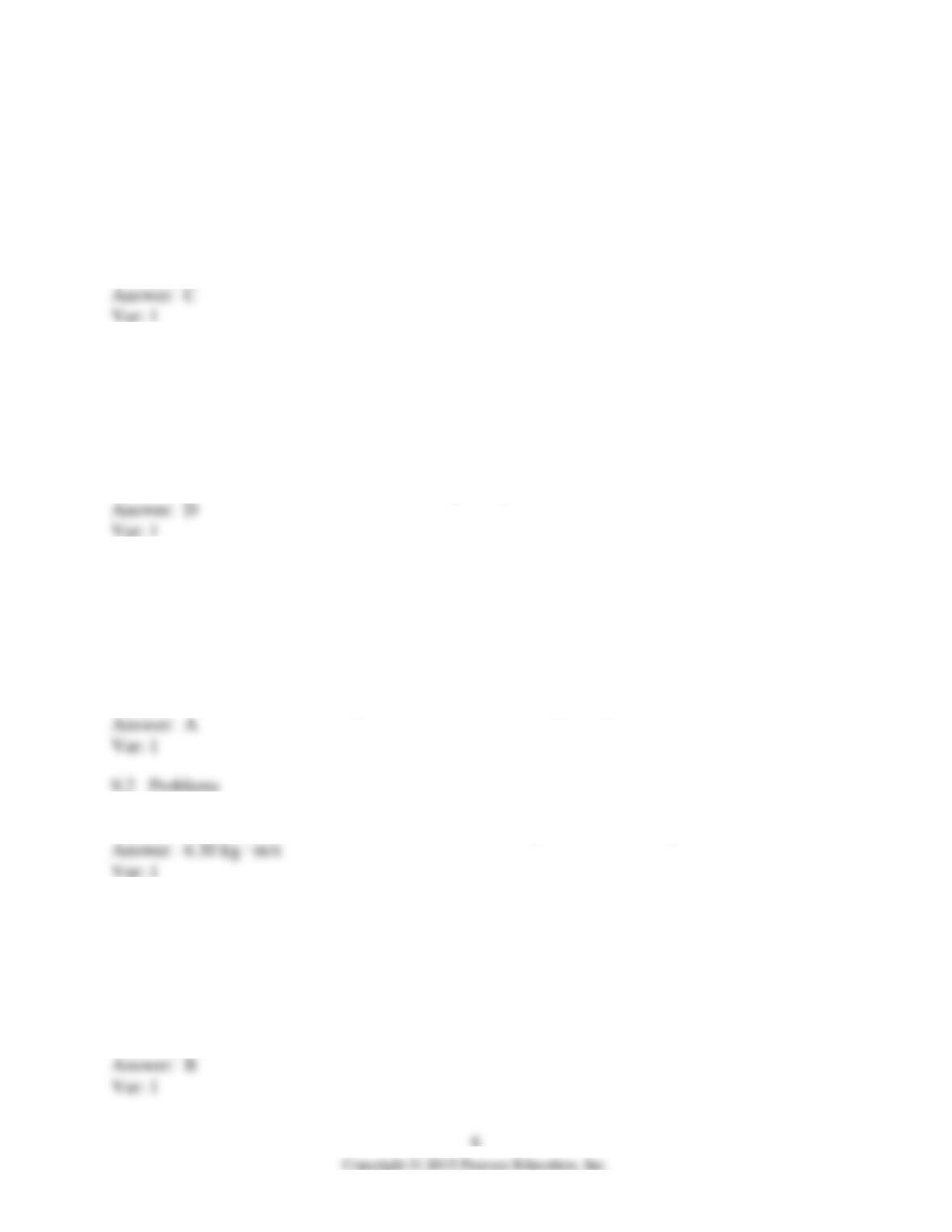
A)
B) 2
C) 4
D) 8
E) 16
4) A very elastic rubber ball is dropped from a certain height and hits the floor with a downward
speed v. Since it is so elastic, the ball bounces back with the same speed v going upward. Which
of the following statements about the bounce are correct? (There could be more than one correct
choice.)
A) The ball had the same momentum just before and just after the bounce.
B) The magnitude of the ball’s momentum was the same just before and just after the bounce.
C) The ball’s momentum was conserved during the bounce.
D) None of the above statements are correct.

5) The momentum of an isolated system is conserved
A) only in inelastic collisions.
B) only in elastic collisions.
C) in both elastic and inelastic collisions.
6) Two friends are standing on opposite ends of a canoe that is initially at rest with respect to a
frictionless lake. The person in the front throws a very massive ball toward the back, and the
person in the back catches it. After the ball is caught, the canoe is
A) moving backward.
B) stationary.
C) moving forward.
7) You are standing on a skateboard, initially at rest. A friend throws a very heavy ball towards
you. You have two choices about what to do with the ball: either catch the ball or deflect it back
toward your friend with the same speed as it was originally thrown. Which choice should you
make in order to maximize your speed on the skateboard?
A) Catch the ball.
B) Deflect the ball back.
C) Your final speed on the skateboard will be the same regardless whether you catch the ball or
deflect the ball.
8) A small car meshes with a large truck in a head-on collision. Which of the following
statements concerning the magnitude of the momentum change during the collision is correct?
(There could be more than one correct choice.)
A) The truck experiences the greater magnitude momentum change.
B) The small car experiences the greater magnitude momentum change.
C) The small car and the truck experience the same magnitude momentum change.
D) The magnitude of the momentum change experienced by each one is inversely proportional to
its mass.
E) The magnitude of the momentum change experienced by each one is directly proportional to
its mass.

9) A small car meshes with a large truck in a head-on collision. Which of the following
statements concerning the momentum during the collision are correct? (There could be more
than one correct choice.)
A) The momentum of the truck is conserved.
B) The momentum of the car is conserved.
C) The car and the truck must undergo the same change in speed.
D) The momentum of the car and the momentum of the truck are each conserved.
E) The momentum of the car-truck system is conserved, but the momentum of each one
separately is not conserved.
10) Consider two less-than-desirable options. In the first you are driving 30 mph and crash head-
on into an identical car also going 30 mph. In the second option you are driving 30 mph and
crash head-on into a stationary brick wall. In neither case does your car bounce back from the
thing it hits, and the collision time is the same in both cases. Which of these two situations would
result in the greater impact force on your car?
A) hitting the other car
B) hitting the brick wall
C) The force would be the same in both cases.
D) None of the above choices are correct.
11) A rocket explodes into two fragments, one 25 times heavier than the other. The magnitude of
the momentum change of the lighter fragment is
A) 25 times as great as the momentum change of the heavier fragment.
B) The same as the momentum change of the heavier fragment.
C) 1/25 as great as the momentum change of the heavier fragment.
D) 5 times as great as the momentum change of the heavier fragment.
E) 1/4 as great as the momentum change of the heavier fragment.
12) Which of the following quantities are units of impulse? (There could be more than one
correct choice.)
A) N ∙ m
B) kg ∙ s/m
C) kg ∙ m/s
D) N ∙ s
E) kg ∙ m2/s2

13) Three cars, car X, car Y, and car Z, begin accelerating from rest at the same time. Car X is
more massive than car Y, which is more massive than car Z. The net accelerating force exerted
on each car is identical. After 10 seconds, which car has the most amount of momentum?
A) They all have the same amount of momentum.
B) Car X
C) Car Y
D) Car Z
14) During World War I, Germany used a “Big Bertha” cannon to hurl shells into Paris 30 miles
away. This gun also had a very long barrel. What was the reason for using a long barrel in these
guns?
A) to exert a larger force on the shells
B) to reduce frictional losses
C) to allow the force of the expanding gases from the gunpowder to act for a longer time
D) to increase the force exerted on the bullet due to the expanding gases from the gunpowder
E) to reduce the force exerted on the bullet due to the expanding gases from the gunpowder
15) In a collision between two unequal masses, which mass receives a greater magnitude
impulse?
A) the larger mass
B) the smaller mass
C) They receive equal impulses.
16) Identical forces act for the same length of time on two different objects. The magnitude of
the change in momentum of the lighter object is
A) smaller than the magnitude of the change in momentum of the larger mass, but not zero.
B) larger than the magnitude of the change in momentum of the larger mass.
C) exactly equal to the magnitude of the change in momentum of the larger mass.
D) zero.
E) There is not enough information to answer the question.

17) A very light ping-pong ball moving east at a speed of 4 m/s collides with a very heavy
stationary bowling ball. The Ping-Pong ball bounces back to the west, and the bowling ball
moves very slowly to the east. Which object experiences the greater magnitude impulse during
the collision?
A) Neither; both experienced the same magnitude impulse.
B) the Ping-Pong ball
C) the bowling ball
D) It is impossible to tell since the actual mass values are not given.
E) It is impossible to tell since the velocities after the collision are unknown.
18) A small car meshes with a large truck in a head-on collision. Which of the following
statements concerning the magnitude of the average force during the collision is correct?
A) The truck experiences the greater average force.
B) The small car experiences the greater average force.
C) The small car and the truck experience the same average force.
D) The force experienced by each one is inversely proportional to its mass.
E) The force experienced by each one is directly proportional to its mass.
19) In an inelastic collision involving an isolated system, the final total momentum is
A) exactly the same as the initial momentum.
B) more than the initial momentum.
C) less than the initial momentum.
20) A 5-kg ball collides inelastically head-on with a 10-kg ball, which is initially stationary.
Which of the following statements is true? (There could be more than one correct choice.)
A) The magnitude of the change of velocity the 5-kg ball experiences is greater than that of the
10-kg ball.
B) The magnitude of the change of velocity the 5-kg ball experiences is less than that of the 10-
kg ball.
C) The magnitude of the change of velocity the 5-kg ball experiences is equal to that of the 10-kg
ball.
D) The magnitude of the change of the momentum of the 5-kg ball is equal to the magnitude of
the change of momentum of the 10-kg ball.
E) Both balls lose all their momentum since the collision is inelastic.
21) A 2.0-kg ball moving eastward at 3.0 m/s suddenly collides with and sticks to a 4.0-kg ball
moving northward at 2.0 m/s. What is the magnitude of the momentum of this system just after
the collision?
A) 14 kg ∙ m/s
B) 2.0 kg ∙ m/s
C) 10 kg ∙ m/s
D) 6.0 kg ∙ m/s
E) 8.0 kg ∙ m/s
22) A person sits on a freely spinning lab stool that has no friction in its axle. When this person
extends her arms,
A) her moment of inertia decreases and her angular speed increases.
B) her moment of inertia decreases and her angular speed decreases.
C) her moment of inertia increases and her angular speed increases.
D) her moment of inertia increases and her angular speed decreases.
E) her moment of inertia increases and her angular speed remains the same.
23) A merry-go-round spins freely when Diego moves quickly to the center along a radius of the
merry-go-round. As he does this, it is true to say that
A) the moment of inertia of the system decreases and the angular speed increases.
B) the moment of inertia of the system decreases and the angular speed decreases.
C) the moment of inertia of the system decreases and the angular speed remains the same.
D) the moment of inertia of the system increases and the angular speed increases.
E) the moment of inertia of the system increases and the angular speed decreases.
1) What is the magnitude of the momentum of a 0.140 kg baseball traveling at 45.0 m/s?
2) A 0.14-kg baseball is dropped from rest from a height of 2.0 m above the ground. What is the
magnitude of its momentum just before it hits the ground if we neglect air resistance?
A) 0.28 kg ∙ m/s
B) 0.88 kg ∙ m/s
C) 0.44 kg ∙ m/s
D) 0.62 kg ∙ m/s
E) 1.4 kg ∙ m/s

3) Three objects are moving along a straight line as shown in the figure. Taking the positive
direction to be to the right, what is the total momentum of this system?
A) +106 kg ∙ m/s
B) –106 kg ∙ m/s
C) +14.0 kg ∙ m/s
D) –14.0 kg ∙ m/s
E) 0.00 kg ∙ m/s
4) A 0.330-kg volleyball is thrown vertically downward with a speed of 0.150 m/s in a place
where g = 9.81 m/s2. It takes it 0.0655 s to reach the ground. What is the magnitude of its
momentum just before it hits the ground?
A) 0.212 kg ∙ m/s
B) 0.262 kg ∙ m/s
C) 0.163 kg ∙ m/s
D) 0.0216 kg ∙ m/s
E) 0.0418 kg ∙ m/s
5) Two air track carts move along an air track towards each other. Cart A has a mass of 450 g
and moves toward the right with a speed of 0.850 m/s. Cart B has a mass of 300 g and moves
toward the left with a speed of 1.12 m/s. What is the total momentum of the two-cart system?
A) 0.047 kg ∙ m/s toward the right
B) 0.719 kg ∙ m/s toward the right
C) 0.719 kg ∙ m/s toward the left
D) 0.750 kg ∙ m/s toward the right
E) 0.750 kg ∙ m/s toward the left
6) A 100-g ball falls from a window that is 12 m above ground level and experiences no
significant air resistance as it falls. What is its momentum when it strikes the ground?
A) 3.3 kg ∙ m/s
B) 4.8 kg ∙ m/s
C) 1.8 kg ∙ m/s
D) 1.5 kg ∙ m/s
E) 2.4 kg ∙ m/s
7) A 0.140-kg baseball is dropped and reaches a speed of 1.20 m/s just before it hits the ground
and bounces. It rebounds with an upward velocity of 1.00 m/s. What is the change of the ball’s
momentum during the bounce?
A) 0.0280 kg ∙ m/s upwards
B) 0.0280 kg ∙ m/s downwards
C) 0.308 kg ∙ m/s upwards
D) 0.308 kg ∙ m/s downwards
E) 0.000 kg ∙ m/s
8) A firecracker breaks up into two pieces, one of which has a mass of 200 g and flies off along
the +x-axis with a speed of 82.0 m/s. The second piece has a mass of 300 g and flies off along
the +y-axis with a speed of 45.0 m/s. What is the total momentum of the two pieces?
A) 361 kg ∙ m/s at 56.3° from the +x-axis
B) 93.5 kg ∙ m/s at 28.8° from the +x-axis
C) 21.2 kg ∙ m/s at 39.5° from the +x-axis
D) 361 kg ∙ m/s at 0.983° from the +x-axis
E) 21.2 kg ∙ m/s at 56.3° from the +x-axis
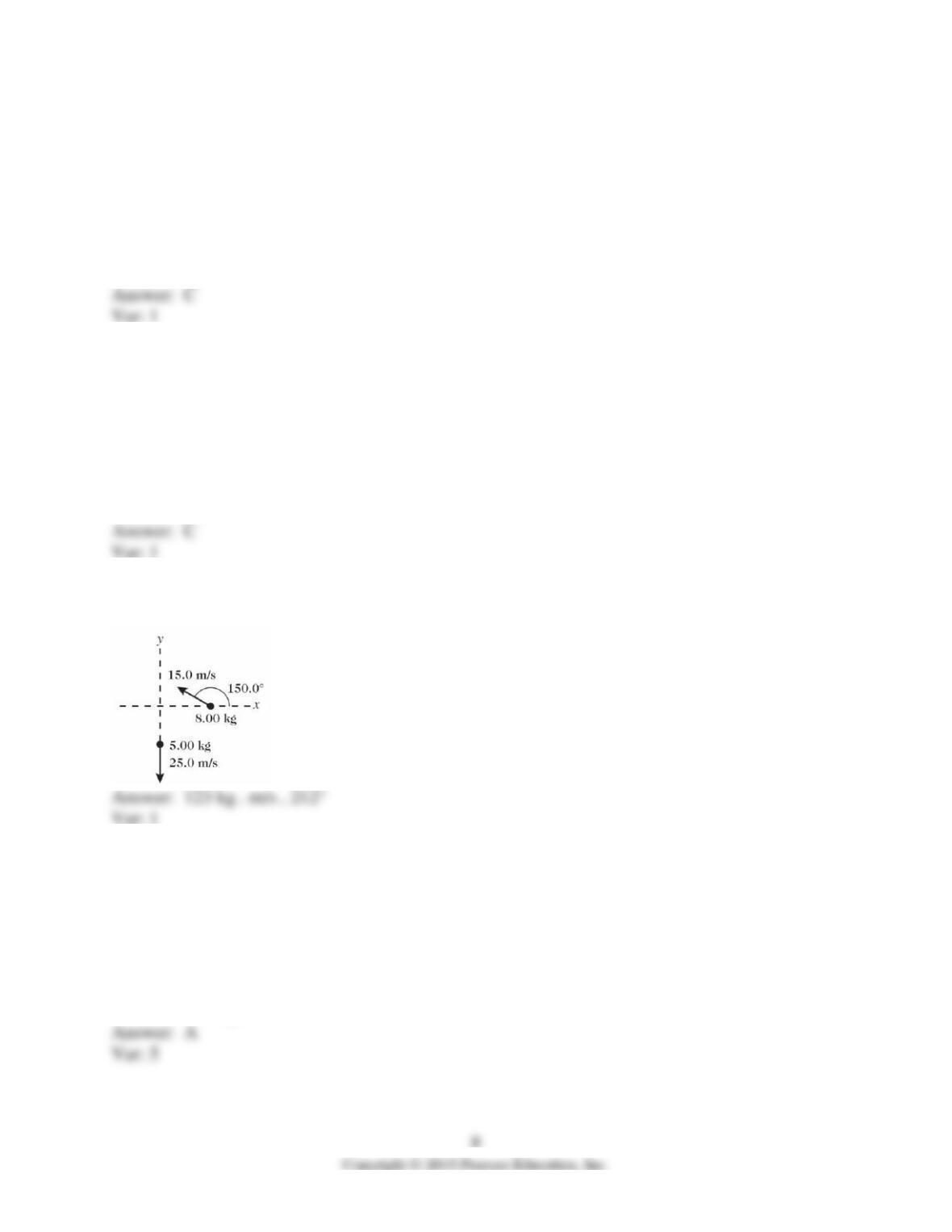
9) Find the magnitude and direction of the net momentum of the system shown in the figure.
Express the direction by giving the angle the net momentum makes with the +x-axis.
10) A 600-kg car makes a 90° turn. Its speed before the turn is 21.0 m/s and after the turn it is
24.0 m/s. What is the magnitude of the change in the car’s momentum during the turn?
A) 19.1 × 10³ kg∙m/s
B) 10.2 × 10³ kg∙m/s
C) 9.55 × 10³ kg∙m/s
D) 12.0 × 10³ kg∙m/s
E) 22.2 × 10³ kg∙m/s
11) A 0.10-kg ball, traveling horizontally at 25 m/s, strikes a wall and rebounds at 19 m/s. What
is the magnitude of the change in the momentum of the ball during the rebound?
A) 1.2 kg ∙ m/s
B) 1.8 kg ∙ m/s
C) 4.4 kg ∙ m/s
D) 5.4 kg ∙ m/s
E) 72 kg ∙ m/s
12) A 60-kg swimmer suddenly dives horizontally from a 150-kg raft with a speed of 1.5 m/s.
The raft is initially at rest. What is the speed of the raft immediately after the diver jumps if the
water has negligible effect on the raft?
13) A 14,000-kg boxcar is coasting at 1.50 m/s along a horizontal track when it suddenly hits and
couples with a stationary 10,000-kg boxcar. What is the speed of the cars just after the collision?
14) In a police ballistics test, 2.00-g bullet traveling at 700 m/s suddenly hits and becomes
embedded in a stationary 5.00-kg wood block. What is the speed of the block immediately after
the bullet has stopped moving relative to the block?
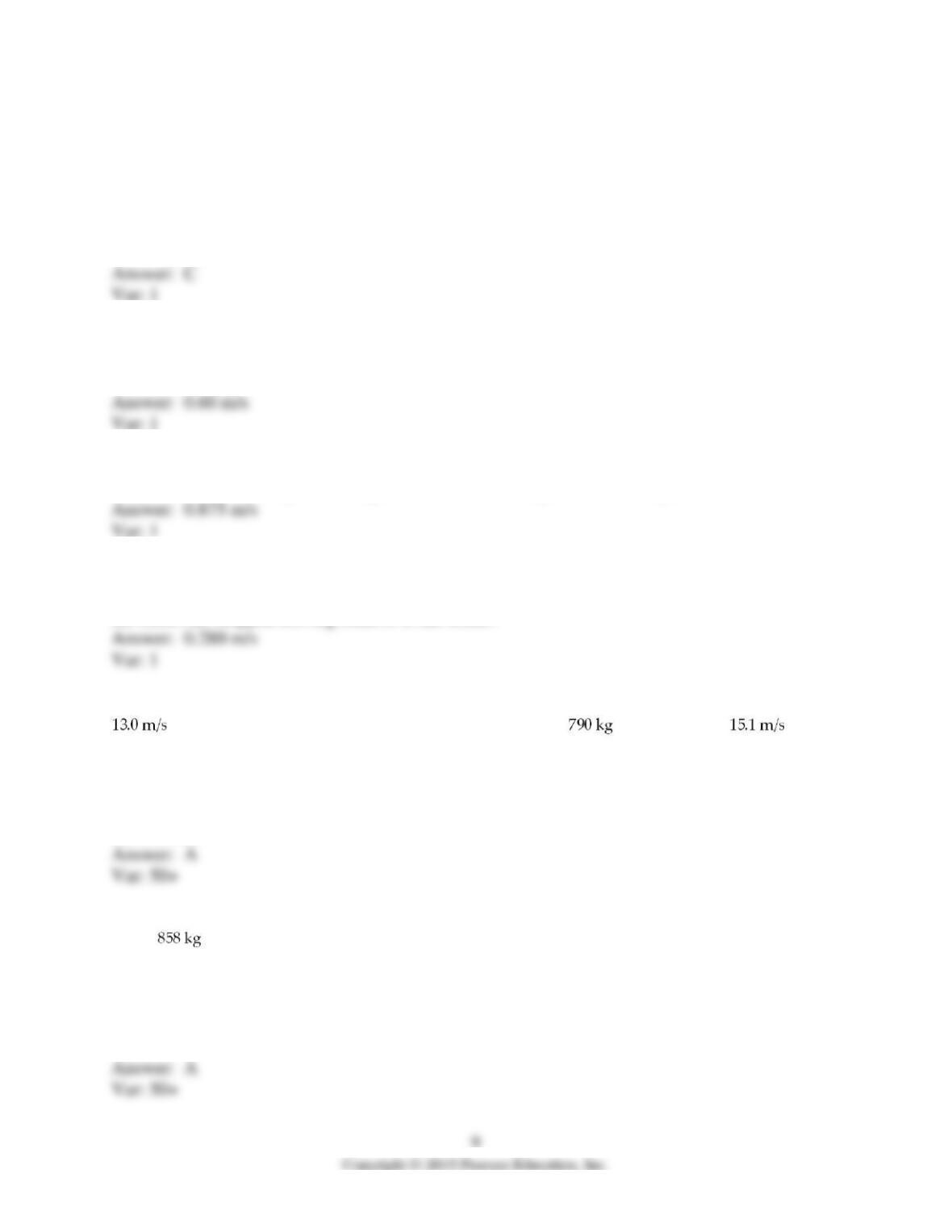
15) A 328-kg car moving at 19.1 m/s in the +x direction hits from behind a second car moving at
in the same direction. If the second car has a mass of and a speed of right
after the collision, what is the velocity of the first car after this sudden collision?
A) 14.0 m/s
B) 18.2 m/s
C) 24.2 m/s
D) -14.0 m/s
16) A 1200-kg ore cart is rolling at 10.8 m/s across a flat friction-free surface. A crane suddenly
drops of ore vertically into the cart. How fast does the cart move just after being loaded
with the ore?
A) 6.30 m/s
B) 3.80 m/s
C) 4.20 m/s
D) 5.70 m/s

17) An empty train car of mass 2.0 x 10⁴ kg coasts along at 10 m/s. A 3000-kg boulder is
suddenly dropped vertically into the car. Find the speed of the car immediately after the boulder
is dropped in.
18) Two ice skaters suddenly push off against one another starting from a stationary position.
The 45-kg skater acquires a speed of 0.375 m/s relative to the ice. What speed does the 60-kg
skater acquire relative to the ice?
A) 0.50 m/s
B) 0.28 m/s
C) 0.38 m/s
D) 0.75 m/s
E) 0.00 m/s
19) A 1200-kg cannon suddenly fires a cannonball at What is the recoil speed of the
cannon? Assume that frictional forces are negligible and the cannon is fired horizontally.
A) 2.9 m/s
B) 35 m/s
C) 3.5 m/s
D) 3.2 m/s
20) A dinner plate falls vertically to the floor and breaks up into three pieces, which slide
horizontally along the floor. Immediately after the impact, a 200-g piece moves along the +x-axis
with a speed of 2.00 m/s, a 235-g piece moves along the +y-axis with a speed of 1.50 m/s. The
third piece has a mass of 100 g. What is the speed of the third piece?
A) 2.51 m/s
B) 2.57 m/s
C) 3.50 m/s
D) 5.33 m/s
E) 6.83 m/s

21) A dinner plate falls vertically to the floor and breaks up into three pieces, which slide
horizontally along the floor. Immediately after the impact, a 320-g piece moves along the +x-axis
with a speed of 2.00 m/s and a 355-g piece moves along the +y-axis with a speed of 1.50 m/s.
The third piece has a mass of 100 g. In what direction relative to the +x-axis does the third piece
move?
A) 216.9° from the +x-axis
B) 219.8° from the +x-axis
C) 36.9° from the +x-axis
D) 39.9° from the +x-axis
E) 39.8° from the +x-axis
22) In a police ballistics test, a 10.0-g bullet moving at 300 m/s is fired into a 1.00-kg block at
rest. The bullet goes through the block almost instantaneously and emerges with 50.0% of its
original speed. What is the speed of the block just after the bullet emerges?
A) 1.50 m/s
B) 2.97 m/s
C) 3.00 m/s
D) 273 m/s
23) Two astronauts, of masses 60 kg and 80 kg, are initially right next to each other and at rest in
outer space. They suddenly push each other apart. What is their separation after the heavier
astronaut has moved 12 m?
A) 9.0 m
B) 16 m
C) 21 m
D) 24 m
E) 28 m
24) Two astronauts, of masses 60 kg and 80 kg, are initially right next to each other and at rest in
outer space. They suddenly push each other apart. How far has the heavier astronaut moved
when the lighter astronaut has moved 12 m?
A) 16 m
B) 9.0 m
C) 21 m
D) 7.0 m
E) 12 m
25) Astronaut Jennifer’s lifeline to her spaceship comes loose and she finds herself stranded,
“floating” 100 m from the mothership. She suddenly throws her 2.00-kg wrench at 20 m/s in a
direction away from the ship. If she and her spacesuit have a combined mass of 200 kg, how long
does it take her to coast back to her spaceship?
A) 1000 s
B) 750 s
C) 500 s
D) 250 s
E) 2.50 min
26) A 14-cm diameter champagne bottle rests on its side on top of a frictionless horizontal table.
Suddenly, the cork pops and the bottle slides backward, covering a distance of in If
the mass of the bottle is 500 times the mass of the cork, find the distance from the original
position that the cork will land on the table. Neglect air resistance and assume that the cork is
very small compared to the bottle.
A) 3000 cm
B) 60 m
C) 85 m
D) 8.5 cm
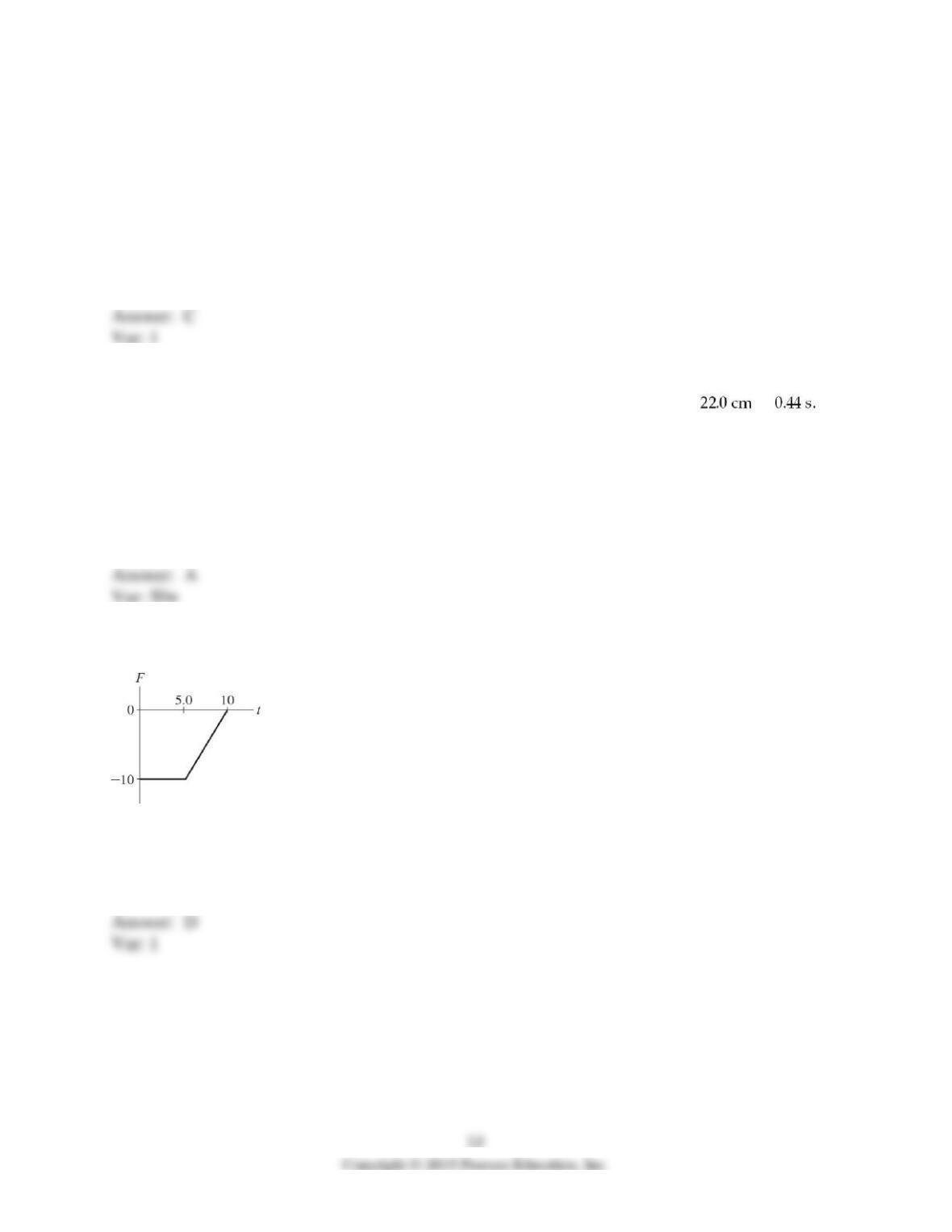
27) The graph in the figure shows the x component F of the net force that acts for 10 s on a 100-
kg crate. What is the change in the momentum of the crate during the 10 s that this force acts?
A) -100 kg ∙ m/s
B) –25 kg ∙ m/s
C) 75 kg ∙ m/s
D) –75 kg ∙ m/s
E) 25 kg ∙ m/s
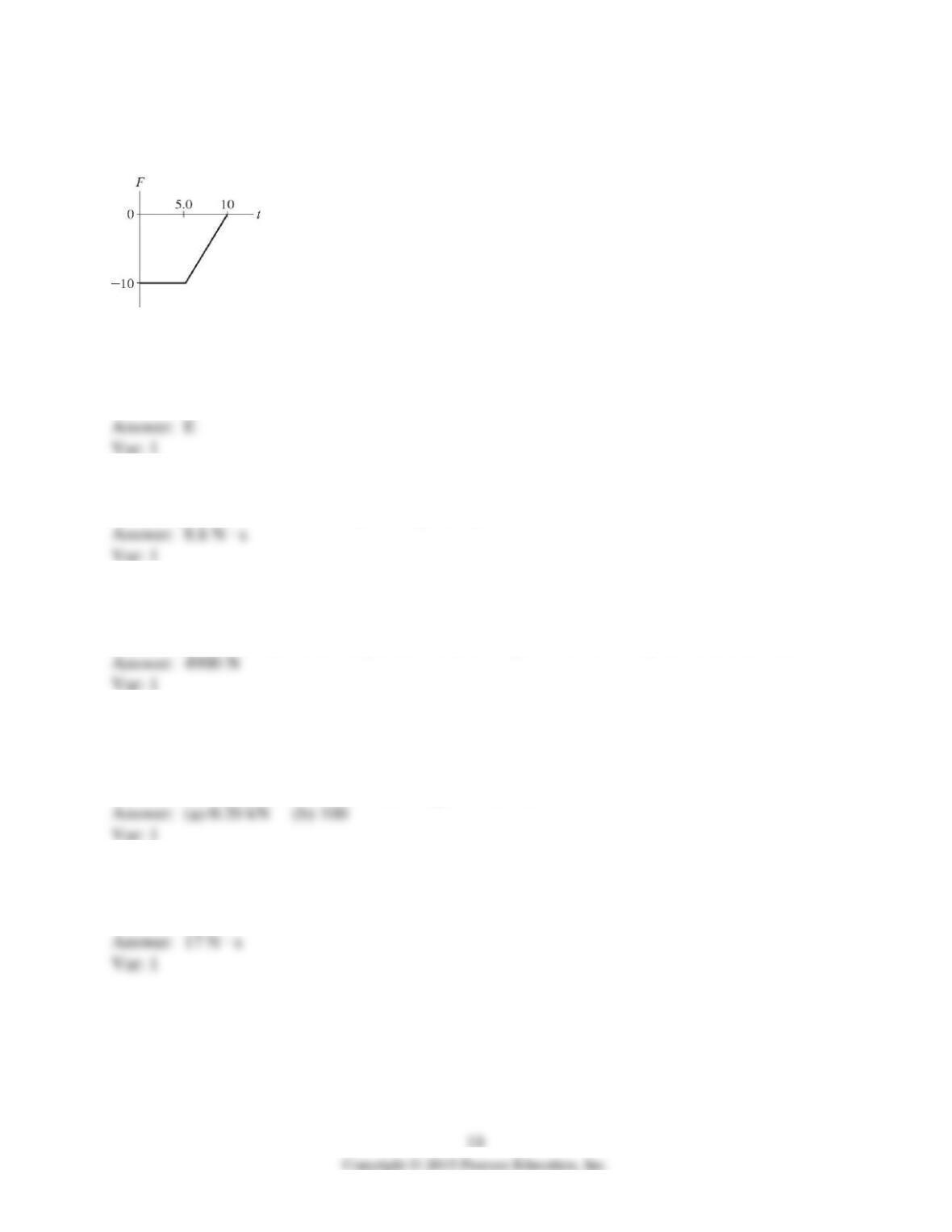
28) A forklift pushes a 100-kg crate, starting from rest, with a horizontal force of magnitude F.
The graph in the figure shows the x component of this force as a function of time. What is the
instantaneous velocity of the crate at time t = 10 s?
A) 25 cm/s
B) 0.00 cm/s
C) 75 cm/s
D) -25 cm/s
E) -75 cm/s
29) A batter applies an average force of 8000 N to a baseball for 1.1 ms. What is the magnitude
of the impulse delivered to the baseball by the bat?
30) A batter hits a 0.140-kg baseball that was approaching him at 30 m/s and, as a result, the ball
leaves the bat at 40 m/s in the reverse of its original direction. The ball remains in contact with
the bat for 2.0 ms. What is the magnitude of the average force exerted by the bat on the ball?
31) Jennifer hits a stationary 0.20-kg ball, and it leaves her racket at 40 m/s. Time-lapse
photography shows that the ball was in contact with the racket for 40 ms.
(a) What average force did the ball exert on the racket?
(b) What is the ratio of this force to the weight of the ball?
32) A 0.17-kg baseball is thrown with a speed of 38 m/s and it is hit straight back toward the
pitcher with a speed of 62 m/s. What is the magnitude of the impulse exerted upon the ball by the
bat?