Chapter 9 Object-Oriented Database Management
Last Update: November 13, 2011 — 1PM
Chapter 10: Object-Oriented Database Management
Multiple Choice
1. Relational database management systems directly support ____.
a. complex relationships among different sub-categories or specialized categories of
particular entities
b. situations in which particular entities are constructed from other component
entities
c. the concept of particular data being updated only by a controlled set of program
segments which are not in application programs
d. complex data types such as graphic images, photo images, video clips, and audio
clips
e. tabular data such as accounting data
2. An object ____.
a. is the same thing as an entity
b. is a method or operation that acts on stored data
c. includes an entity’s attributes plus methods or operations which can operate on
the attribute values
d. is a rectangular box in an entity-relationship diagram
e. is a descriptive characteristic of a person, thing, or event in the business
environment
3. The objects that describe similar entities are known collectively as a(n) ____.
a. file
b. class
c. UML diagram
d. OODBMS
e. operation

4. Unified Modeling Language (UML) is ____.
a. another term for Entity-Relationship diagrams
b. a logical database design technique
c. a programming language used to access data stored in object-oriented databases
d. the standard diagramming notation for object-oriented systems development
e. a query language that is a substitute for SQL in the OODBMS environment
5. The term for the relationship that recognizes that some kinds of entities can really be
subdivided into smaller, more specific groups is ____.
a. generalization/specialization
b. aggregation
c. binary one-to-many
d. binary many-to-many
e. polymorphism
6. The object classes in a generalization/specialization relationship are arranged in a
____.
a. row
b. string
c. hierarchy
d. closed loop
e. linked list
7. Attributes in object classes in a generalization/specialization relationship ____.
a. cannot be inherited from one class to another
b. can be inherited from the general class to the specialized classes
c. can be inherited from the specialized classes to the general class
d. can be inherited from one specialized class to another specialized class
e. can be inherited from one general class to another general class

8. In a generalization/specialization relationship ____.
a. attributes can be inherited but operations cannot be inherited
b. operations can be inherited but attributes cannot be inherited
c. both attributes and operations can be inherited
d. neither attributes nor operations can be inherited
e. attributes can only be inherited if they are aggregated
9. The modification or refinement of operations as they are inherited downwards in a
generalization/specialization relationship is called ____.
a. polygraphism
b. polygenesism
c. polytrophism
d. polychromism
e. polymorphism
10. The term for the relationship in which a class is shown to be composed of other
classes is ____.
a. generalization/specialization
b. aggregation
c. binary one-to-many
d. binary many-to-many
e. polymorphism
11. All of the following are true about encapsulation, except ____.
a. it is designed to improve data integrity
b. it prevents application code outside of the encapsulated object from modifying the
object’s data
c. a message from an application program can trigger an encapsulated object
d. operations are stored in the database together with the data they operate on
e. objects can only be encapsulated if they are in an aggregation relationship

12. In the object-oriented concept, abstract data types ____.
a. can include simple numeric and alphabetic data types
b. cannot exist – they are strictly part of the relational concept
c. can have operations associated with them
d. are a disaster recovery feature
e. can only be implemented if the DBMS is of the object/relational type
13. All of the following kinds of data are candidates for abstract data types, except ____.
a. numeric data
b. video clips
c. audio clips
d. photo images
e. graphic images
14. An object/relational DBMS is essentially ____.
a. an environment in which separate relational and object-oriented DBMSs pass data
to each other
b. a legacy DBMS
c. an advanced research concept that is not as yet commercially viable
d. an object-oriented DBMS with relational features
e. a relational DBMS with object-oriented features
True/False
1. Generalization/specialization relationships are a form of aggregation relationships.
2. Aggregation relationships are handled naturally by relational DBMSs but
generalization/specialization relationships are not.
3. A potential exposure that can introduce errors in relational data is the ability of many
application programs to manipulate shared data.
4. The relational data model does not directly support such data types as photo images,
video clips, and audio clips.
5. An object is an advanced data structure that includes an entity’s attributes plus
methods which can operate on and modify the object’s attribute values.
6. An instance of an object is an object class.
7. The Unified Modeling Language (UML) is the standard diagramming notation for
object-oriented systems development.
8. Generalization/specialization is a relationship that can be handled directly by an
OODBMS.

9-6
9. Generalization/specialization is a relationship in which a class is shown to be
composed of other classes.
10. Generalization/specialization is a relationship that recognizes that some kinds of
entities can really be subdivided into smaller, more specialized groups.
11. Generalization/specialization is denoted in a UML diagram by an arrow pointing
upward towards the “general” object class.
12. In a generalization/specialization hierarchy, attributes are inherited downwards from
the general object class to the specialized object classes.
13. In a generalization/specialization hierarchy, attributes can be inherited downwards
from the general object class to the specialized object classes, but methods or
operations cannot.
14. The modification or refinement of methods or operations as they are inherited
downwards is called polymorphism.
15. Methods or operations cannot be modified when they are inherited downwards.
Chapter 9 Object-Oriented Database Management
16. Aggregation is a special case of the generalization/specialization relationship.
17. Aggregation is denoted by a diamond-shaped symbol in a UML diagram.
18. An object class can only be encapsulated if it is involved in an aggregation
relationship.
19. An OODBMS will only permit the attributes of an encapsulated object to be updated
by its encapsulated methods or operations.
20. When an application program has to update encapsulated data, it sends a message to
one of the object’s encapsulated operations to trigger the operation.
21. A BLOB (binary large object) is an example of generalization/specialization
hierarchy.

9-8
22. An OODBMS allows associated operations to be defined along with abstract data
types.
23. A video clip is an example of an abstract data type.
24. An object/relational DBMS is an OODBMS with relational features added to them.
25. An object/relational database might include a table that has audio clip data in one of
its columns.
Problems
1. Draw an object-oriented class diagram, including traditional unary, binary and ternary
relationships, as well as generalization and aggregation relationships as needed, to
represent the following Central Zoo environment. Include all of the attributes and
operations listed in the description.
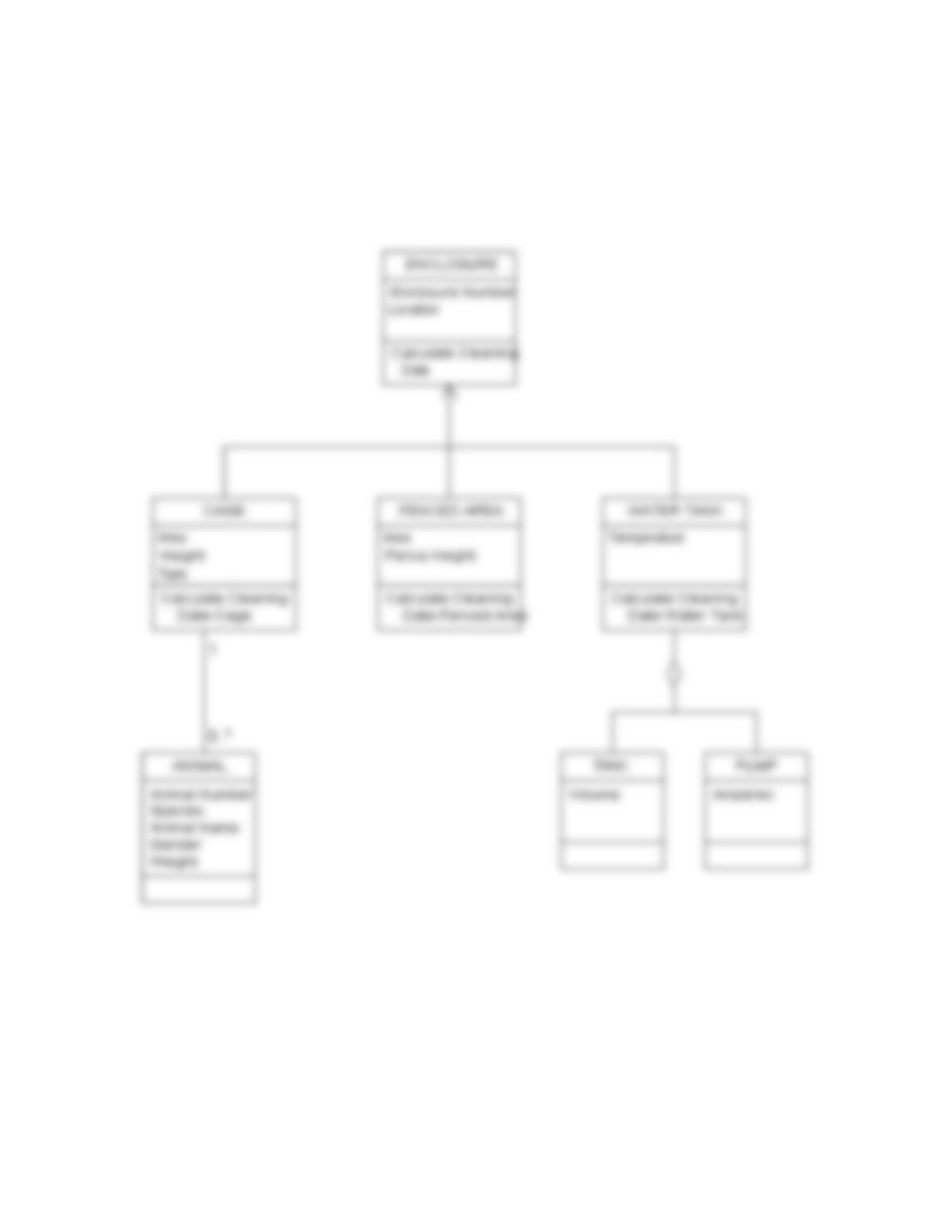
Central Zoo has three kinds of enclosures: cages, fenced areas, and water tanks. Each
enclosure, regardless of which kind it is, has a unique enclosure number and a
location. In addition, each cage has an area (in square feet or square meters), a
height, and a type, each fenced area has an area and a fence height, each water tank
has a temperature. Each water tank is composed of two parts, a tank (the zoo keeps
track of the volume of the tank) and a pump (the zoo keeps track of the number of
amperes of the pump.)
Each animal that lives in a cage in the zoo has a unique animal number, a species,
name, gender, and weight. Each cage can have several animals living in it or it can be
empty. An animal can live in only one cage.
Chapter 9 Object-Oriented Database Management
9-9
There is an operation that calculates the next cleaning date of each enclosure, but this
calculation is different for cages, fenced areas, and water tanks.
Answer
2. Draw an object-oriented class diagram, including traditional unary, binary and ternary
relationships, as well as generalization and aggregation relationships as needed, to
represent the following Grand Travel Airlines environment. Include all of the
attributes and operations listed in the description.
Chapter 9 Object-Oriented Database Management
9-10
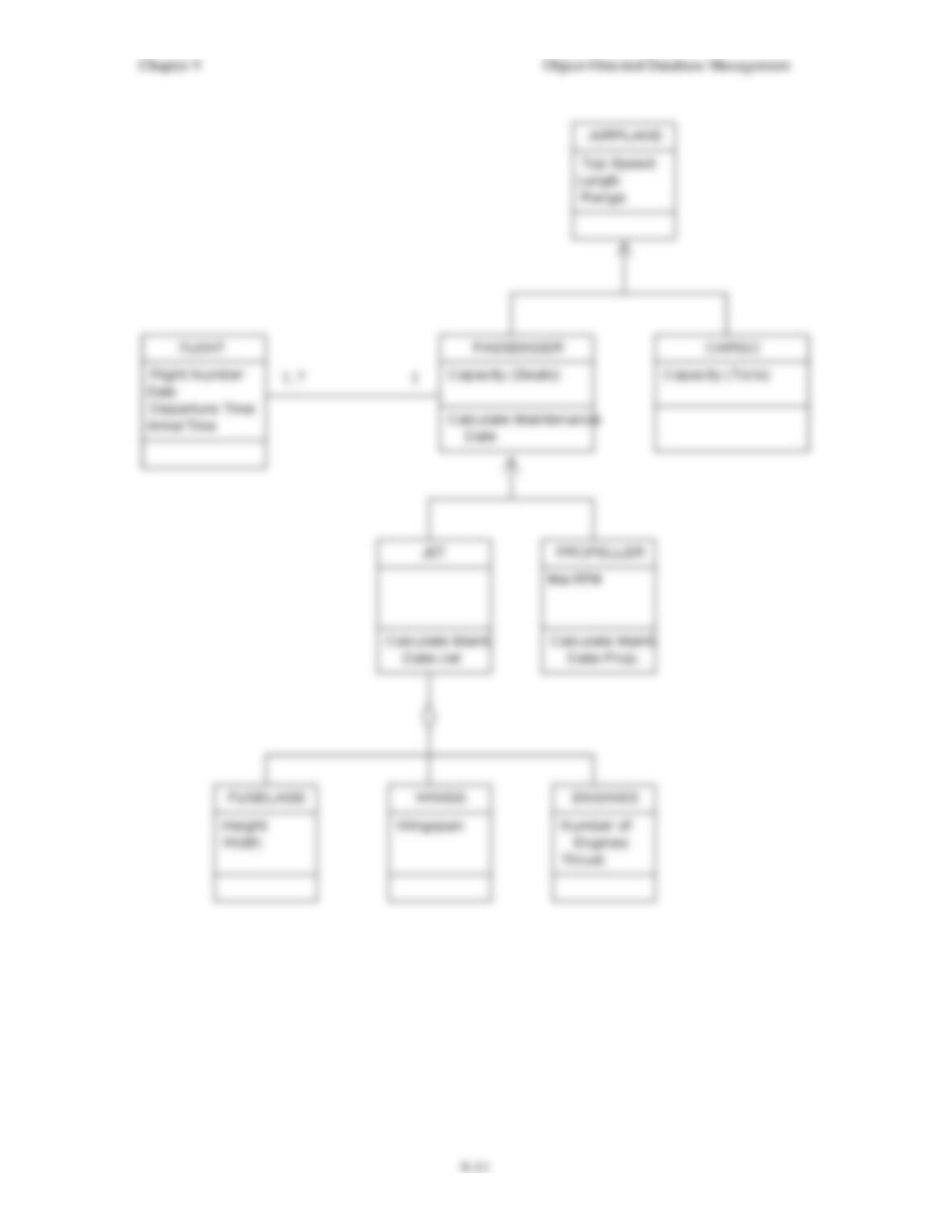
Grand Travel Airlines operates as both a passenger and a cargo airline. It has
different kinds of planes for each of the two functions. For planes of both types it
keeps track of each plane’s top speed, length, and range. In addition, it keeps track of
the capacity (number of seats) of each passenger plane and the capacity (in tons or
metric tons) of each cargo plane.
Each passenger flight has a flight number, a date, departure time, and arrival time. A
flight uses only one airplane while a particular plane is used on many flights.
Grand Travel Airlines has two kinds of passenger planes: jet and propeller driven.
For the propeller driven planes it must keep track of the maximum revolutions per
minute (RPM) of the propellers. Each jet plane is composed of three parts: the
fuselage, the wings, and the engines. Grand Travel records the fuselage height and
width, the wingspan (length) of the wings, and the number of engines and their
maximum thrust.
An operation calculates the next maintenance date of each passenger plane, but the
calculation is different for jet and propeller driven planes.
Answer