Chemistry for Changing Times, 14e (Hill/McCreary)
Chapter 9 Organic Chemistry
9.1 Multiple Choice Questions
1) Organic chemistry is most broadly defined as
A) the chemistry of living systems.
B) the chemistry of substances produced by living systems.
C) the chemistry of the compounds of carbon.
D) the chemistry of the non-metallic compounds.
2) Approximately what percentage of known compounds are classified as organic compounds?
A) ≈ 95%
B) ≈ 70%
C) ≈ 40%
D) ≈ 20%
3) The most unique property of carbon is its ability to
A) form four bonds.
B) bond to oxygen.
C) bond to nitrogen.
D) bond to carbon.
4) The term “organic” refer to foods that
A) are grown using “all-natural” methods and without the use of synthetic pesticides or herbicides.
B) contain no organic compounds.
C) contain only organic compounds.
D) are grown hydroponically.
5) The first organic compound to be synthesized in a chemist‘s laboratory was
A) cholesterol.
B) chlorophyll.
C) urea.
D) benzene.
6) The first recorded synthesis of an organic compound in a scientific laboratory was by
A) Isaac Newton in 1665.
B) Benjamin Franklin in 1788.
C) Friedrich Wöhler in 1828.
D) Thomas Edison in 1888.
7) The element whose atoms have a unique ability to bond to each other and to other kinds of atoms is
A) sodium.
B) carbon.
C) sulfur.
D) nitrogen.
8) Carbon is almost always
A) monovalent.
B) divalent.
C) trivalent.
D) tetravalent.
9) The unique aspect of a saturated hydrocarbon is that it must contain
A) only carbon and hydrogen.
B) only single bonds.
C) single and double bonds.
D) single, double and triple bonds.
10) The simplest alkane is
A) monane.
B) ethane.
C) methane.
D) propane.
11) Petroleum jelly is
A) a mixture of low carbon number hydrocarbons.
B) a mixture of moderate carbon number hydrocarbons.
C) a mixture of higher carbon number hydrocarbons.
D) none of the above
12) What is the name of the compound with a formula CH3CH2CH3?
A) methane
B) ethane
C) propane
D) butane
13) Organic compounds are
A) nonpolar and less dense than water.
B) polar and less dense than water.
C) nonpolar and more dense than water.
D) polar and more dense than water.
14) A compound containing only carbon and hydrogen and which has only single bonds between atoms
is classified as an
A) alkane.
B) alkene.
C) aromatic compound.
D) alkyne.
15) Identify the alkane that contains three carbons.
A) propene
B) propane
C) propyne
D) propanone
16) What is the name of the compound that has the formula CH3CH3?
A) methane
B) ethane
C) propane
D) butane
17) What is the name of the compound with a formula CH3CH2CH2CH3?
A) methane
B) ethane
C) propane
D) butane
18) How many different structural isomers are there for a hydrocarbon with the formula C4H10?
A) 1
B) 2
C) 3
D) 4
19) How many different structural isomers are there for a hydrocarbon with the formula C5H12?
A) 1
B) 2
C) 3
D) 4
20) How many different structural isomers are there for a hydrocarbon with the formula C6H14?
A) 1
B) 2
C) 3
D) > 4
21) Which of the following is NOT a reason for the great variety of organic molecules?
A) The ability of carbon to form chains
B) Carbon atoms can form more than four bonds.
C) Isomerism
D) Carbon forms bonds with a variety of elements, including H, O, N, Cl and Br.
22) Alkanes are often called
A) unsaturated hydrocarbons.
B) saturated hydrocarbons.
C) carbohydrates.
D) saturated fats.
23) Compounds with the same number and kinds of atoms but with different structures are known as
A) homologs.
B) isotopes.
C) isomers.
D) allotropes.
24) The compounds CH3CH3 and CH3CH2CH3 are
A) isomers.
B) allotropes.
C) isotopes.
D) homologs.
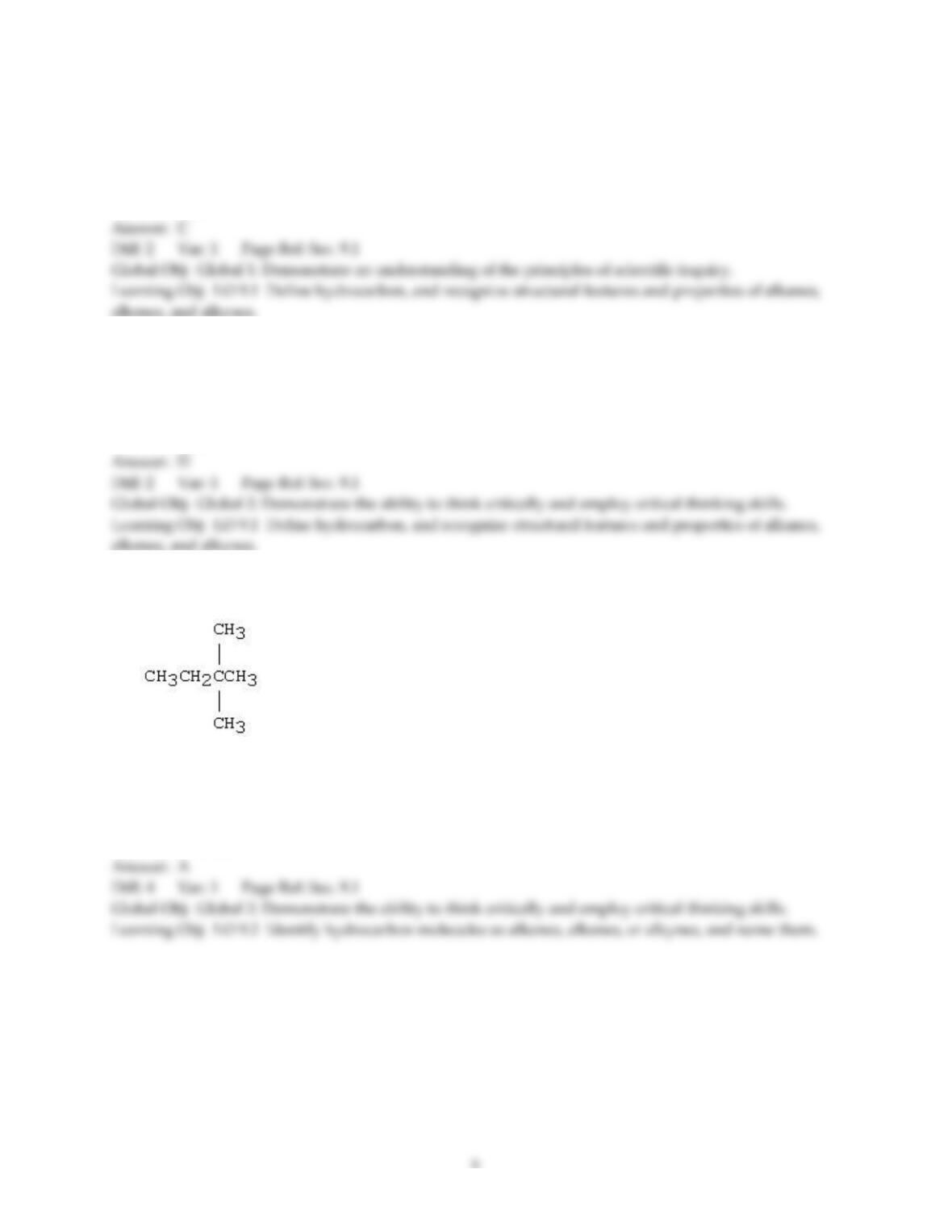
25) The condensed structural formula for the molecule below is
A) CH3CH2C(CH3)3.
B) CH3CH2CH2(CH3)2CH3.
C) CH3CH2CH2CH2CH2CH3.
D) none of the above
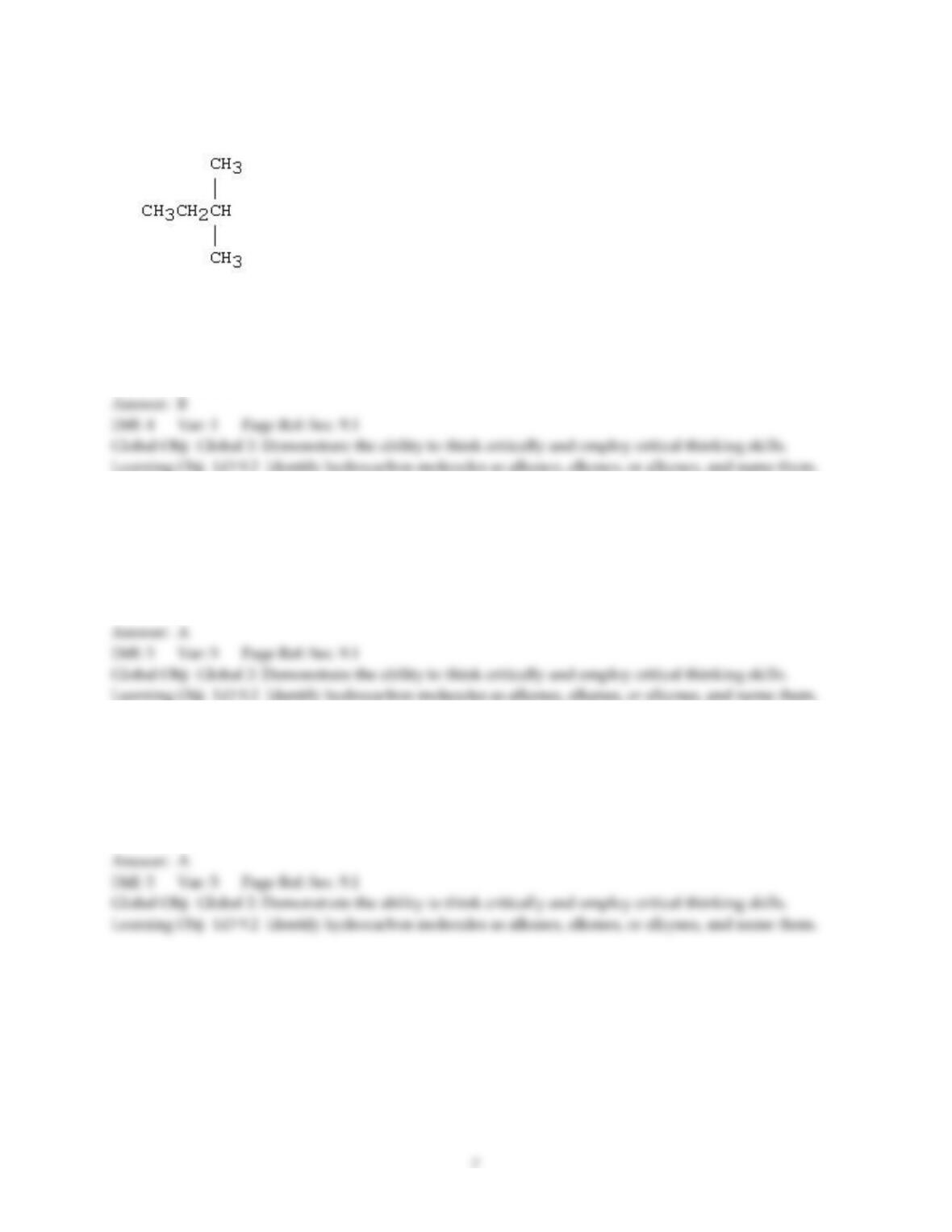
26) The condensed structural formula for the molecule below is
A) CH3CH2C(CH3)2CH3.
B) CH3CH2CH(CH3)2.
C) CH3CH2CH2CH2CH2CH3.
D) none of the above
27) The formula for butane is
A) C4H10.
B) C5H12.
C) C6H14.
D) C4H8.
28) The formula for heptene is
A) C7H14.
B) C3H8.
C) C4H10.
D) C5H12.
29) The formula for cyclopropane is
A) C3H8.
B) C7H16.
C) C3H6.
D) C7H12.
30) An emollient is a
A) skin softener.
B) sun screen.
C) laxative.
D) detergent.
31) Which one of the following statements is NOT true of all alkanes?
A) All alkanes burn to produce carbon dioxide and water.
B) All alkanes consist of carbon and hydrogen.
C) All alkanes exist as two or more isomers.
D) All alkanes fit the general molecular formula CnH2n+2.
32) Which of the following is NOT a property of alkanes?
A) Alkanes are not soluble in water.
B) Alkanes have a lower density than water does.
C) Alkanes will undergo addition reactions.
D) Alkanes will burn easily and can be used as fuels.
33) Which of the following alkanes will have the highest boiling point?
A) CH4
B) C6H14
C) C12H26
D) C19H40
34) Which of the following alkanes will have the lowest boiling point?
A) CH4
B) C3H8
C) C14H30
D) C22H46
35) An example of an alkane is
A) C9H20.
B) C5H10.
C) C7H12.
D) C8H20.
36) A compound that contains only carbon and hydrogen is a(n)
A) alcohol.
B) carbohydrate.
C) homolog.
D) hydrocarbon.
37) All of the following are properties of hydrocarbons EXCEPT
A) they have a higher density than water.
B) their boiling points increase as the number of carbons increases.
C) they burn readily.
D) they are good solvents for nonpolar substances.
38) The chemical formula of cyclopropane is
A) C3H3.
B) C3H6.
C) C3H7.
D) C3H8.
39) The chemical formula of cyclohexane is
A) C6H6.
B) C6H8.
C) C6H10.
D) C6H12.
40) The chemical formula of cyclopentane is
A) C5H6.
B) C5H8.
C) C5H10.
D) C5H12.
41) What is the general formula for a cycloalkane?
A) CnHn
B) CnH2n+2
C) CnH2n-2
D) CnH2n
42) Methane, benzene, 1-butyne, and 2-pentene are all examples of
A) alkenes.
B) alkanes.
C) aromatic compounds.
D) hydrocarbons.
43) Which of the following compounds is a homolog of CH2=CH2?
A) CH3CH3
B) CH3CH2CH3
C) CH3CH=CH2
D) CH3CCH
44) The most important commercial organic compound is
A) methane, CH4.
B) ethane, CH3CH3.
C) ethylene, CH2CH2.
D) propane, CH3CH2CH3.
45) Acetylene is
A) CH4.
B) C2H6.
C) C2H4.
D) C2H2.
46) Acetylene is an
A) alkane.
B) alkene.
C) alkyne.
D) aromatic compound.
47) A cyclic hydrocarbon containing eight carbon atoms and one double bond will have the formula
A) C8H12.
B) C8H18.
C) C8H16.
D) C8H14.
48) A cyclic hydrocarbon containing seven carbon atoms and two double bonds will have the formula
A) C7H16.
B) C7H14.
C) C7H12.
D) C7H10.
49) The formula for propyne is
A) C3H6.
B) C3H4.
C) C3H8.
D) C3H3.
50) The hydrocarbon that is used in torches along with oxygen to produce very hot flames for cutting and
welding is
A) ethylene.
B) methane.
C) propane.
D) acetylene.
51) Which of the following compounds is saturated?
A) pentene
B) ethane
C) butyne
D) pentadiene
52) An example of a molecular formula of an alkene is
A) C7H16.
B) C5H10.
C) C5H8.
D) C6H6.
53) An example of a molecular formula of an alkyne is
A) C6H14.
B) C5H10.
C) C5H8.
D) C6H6.
54) Which of the following is an alkene?
A) ethylene
B) butyne
C) cyclohexane
D) xylene
55) Which of the following is an alkyne?
A) ethylene
B) hexyne
C) heptane
D) benzene
56) Which of the following is an alkane?
A) butene
B) propyne
C) butane
D) toluene
57) Which of the following is an aromatic compound?
A) butene
B) hexyne
C) ethane
D) ethylbenzene
58) The formula of benzene is
A) C7H7.
B) C4H4.
C) C6H6.
D) C6H12.
59) Benzene is an unsaturated hydrocarbon. Which of the following is NOT a property of benzene?
A) Benzene is a liquid at room temperature.
B) Benzene undergoes the same reactions that other unsaturated hydrocarbons do.
C) Benzene contains only carbon and hydrogen.
D) Benzene has a ring of carbon atoms in its structure.
60) The correct structure for benzene was proposed by ________ in 1865.
A) Boyle
B) Kekule
C) Faraday
D) Curie
61) Organic compounds that contain a benzene ring or possess certain properties similar to those of
benzene are called ________ compounds.
A) alkaloid
B) acidic
C) aromatic
D) saturated
62) A molecular formula of an aromatic hydrocarbon is
A) C10H18.
B) C8H16.
C) C7H10.
D) C6H6.
63) Chlorinated hydrocarbons, such as carbon tetrachloride CCl4, make good dry cleaning solvents
because
A) they dissolve in water.
B) they dissolve water insoluble stains, like grease and oil.
C) they are not liquids at room temperature.
D) they cause no significant health problems.
64) The compound with the formula, CHCl3, was used as an anesthetic in earlier times, but has been
found to have some serious side effects. The compound is called
A) methyl chloride.
B) methylene chloride.
C) chloroform.
D) carbon tetrachloride.
65) When carbon tetrachloride reacts with hot water it produces phosgene (COCl2). Phosgene was used
in poison-gas warfare in World War I. Based upon this chemistry, carbon tetrachloride is no longer used
in
A) fire extinguishers.
B) anesthetics.
C) chemical reactions.
D) toilet bowl cleaners.
66) In general, CFCs are
A) solids with high melting points.
B) solids with low melting points.
C) liquids with high boiling points.
D) gases or liquids with low boiling points.
67) With respect to reactivity on the surface of the earth, chlorofluorocarbons are
A) very reactive.
B) very unreactive.
C) moderately reactive.
D) variable depending upon the chlorofluorocarbon.
68) Perfluorocarbons are
A) hydrocarbons in which all hydrogen atoms have been replaced by fluorine.
B) hydrocarbons in which most hydrogen atoms have been replaced by fluorine.
C) hydrocarbons in which there is one fluorine per carbon atom.
D) none of the above
69) Perfluorocarbons have been used in which of the following?
A) temporary blood substitutes
B) nonstick cooking surfaces
C) oxygen solvent for treatment of premature babies
D) all of the above
70) Chlorinated hydrocarbons have been used as
A) fuels.
B) insecticides.
C) propellants.
D) refrigerants.
71) In representing the general formula of various functional groups, the symbol R stands for
A) a halogen atom.
B) a ring.
C) an aromatic group.
D) an alkyl group.
72) In organic chemistry, compounds are generally classified by
A) state.
B) functional group.
C) color.
D) odor.
73) The structures that contains single bonds and an oxygen are
A) alcohols and ethers.
B) aldehydes and ketones.
C) carboxylic acids and esters.
D) alkenes.
74) Alcohols are characterized by which functional group?
A) hydroxyl
B) carboxyl
C) halide
D) ester
75) The formula of methanol is
A) COH.
B) CHOH.
C) CH2OH.
D) CH3OH.
76) When wood is heated in the absence of air, the wood is destructively distilled and condensed to a
liquid mixture. The primary component of this mixture is
A) methanol.
B) ethanol.
C) rubbing alcohol.
D) gasoline.
77) Methanol is an important solvent. It is also an important starting material for the synthesis of other
molecules. Most methanol today is obtained from the
A) destructive distillation of wood.
B) reaction of carbon monoxide and hydrogen at high temperature and pressure.
C) fermentation of corn.
D) decomposition of animal waste.
78) The intoxicating alcohol in “alcoholic” beverages is
A) ethanol.
B) methyl alcohol.
C) 1-propanol.
D) rubbing alcohol.