CHAPTER 9
INVENTORIES: ADDITIONAL VALUATION ISSUES
IFRS questions are available at the end of this chapter.
TRUE-FALSE—Conceptual
Answer No. Description
MULTIPLE CHOICE—Conceptual
Answer No. Description
Test Bank for Intermediate Accounting, Sixteenth Edition
9 – 2
MULTIPLE CHOICE—Conceptual (cont.)
MULTIPLE CHOICE—Computational
Inventories: Additional Valuation Issues
9 – 3
MULTIPLE CHOICE—Computational (cont.)
Answer No. Description
Test Bank for Intermediate Accounting, Sixteenth Edition
9 – 4
MULTIPLE CHOICE—Computational (cont.)
Answer No. Description
P These questions also appear in the Problem-Solving Survival Guide.
S These questions also appear in the Study Guide.
* This topic is dealt with in an Appendix to the chapter.
MULTIPLE CHOICE—CPA Adapted
Answer No. Description
BRIEF EXERCISES
Item Description
BE9–139 Lower-of-cost-or-market.
BE9–140 Lower-of-cost-or-market.
BE9–141 Lower-of-cost-or-market.
EXERCISES
Item Description
E9–142 Lower-of-cost-or-market.
E9–143 Lower-of-cost-or-market.
E9–144 Relative sales value method.
E9–145 Gross profit method.
E9–146 Gross profit method.
E9–147 Gross profit method.

Inventories: Additional Valuation Issues
9 – 5
PROBLEMS
Item Description
P9–148 Gross profit method.
P9–149 Retail inventory method.
*P9-150 Retail inventory method.
*P9-151 LIFO retail inventory method, fluctuating prices.
*P9-152 LIFO retail inventory method, stable prices.
*P9-153 Dollar-value LIFO retail method.
*P9-154 Retail LIFO.
CHAPTER LEARNING OBJECTIVES
1. Understand and apply the lower-of-cost-or-net realizable value rule.
2. Understand and apply the lower-of-cost-or-market rule.
3. Understand other inventory valuation issues.
4. Determine ending inventory by applying the gross profit method.
5. Determine ending inventory by applying the retail inventory method.
6. Explain how to report and analyze inventory.
*7. Determine ending inventory by applying the LIFO retail methods.
8. Compare the accounting procedures related to valuation of inventories under GAAP and
IFRS.

Test Bank for Intermediate Accounting, Sixteenth Edition
9 – 6
SUMMARY OF QUESTIONS BY LEARNING OBJECTIVES AND BLOOM’S TAXONOMY
Item
LO
BT
Item
LO
BT
Item
LO
BT
Item
LO
BT
Item
LO
BT
TRUE-FALSE STATEMENTS
1.
1
K
5.
2
C
9.
3
K
13.
4
K
17.
5
K
2.
3
C
6.
2
C
10.
3
C
14.
4
K
18.
6
K
3.
3
K
7.
3
K
11.
3
C
15.
5
C
19.
6
K
4.
2
K
8.
3
K
12.
4
K
16.
5
C
20.
7
K
MULTIPLE CHOICE QUESTIONS
21.
1
K
45.
3
AP
69.
2
AP
93.
3
AP
117.
7
AP
22.
1
K
46.
4
K
70.
2
AP
94.
4
AP
118.
7
C
23.
1
K
47.
4
K
71.
2
AP
95.
4
AP
119.
5
AP
24.
1
K
48.
4
K
72.
2
AP
96.
4
AP
120.
5
AP
25.
1
K
49.
4
K
73.
2
AP
97.
4
AP
121.
6
AP
26.
1
K
50.
5
K
74.
2
AP
98.
4
AP
122.
6
AP
27.
1
K
51.
5
K
75.
2
AP
99.
4
AP
123.
6
AP
28.
2
K
52.
5
K
76.
2
AP
100.
4
AP
124.
6
AP
29.
2
K
53.
5
K
77.
2
AP
101.
4
AP
125.
5
AP
30.
2
K
54.
5
K
78.
2
AP
102.
4
AP
126.
5
AP
31.
2
K
55.
5
K
79.
2
AP
103.
4
AP
127.
5
AP
32.
2
K
56.
5
K
80.
2
AP
104.
4
AP
128.
7
AP
33.
2
AN
57.
5
K
81.
2
AP
105.
4
AP
129.
7
AP
34.
2
K
58.
5
K
82.
3
AP
106.
4
AP
130.
7
AP
35.
2
C
59.
5
K
83.
3
AP
107.
4
AP
131.
7
AP
36.
2
C
60.
5
K
84.
3
AP
108.
4
AP
132.
2
AP
37.
2
C
61.
5
AN
85.
3
AP
109.
4
AP
133.
2
K
38.
3
C
62.
5
AN
86.
3
AP
110.
5
AP
134.
2
C
39.
3
K
63.
6
K
87.
3
AP
111.
5
AP
135.
4
AP
40.
3
K
64.
6
K
88.
3
AP
112.
5
AP
136.
5
AP
41.
3
K
65.
6
K
89.
3
AP
113.
5
AP
137.
5
AP
42.
3
C
66.
7
K
90.
3
AP
114.
5
AP
138.
7
AN
43.
3
AP
67.
7
K
91.
3
AP
115.
5
AP
44.
3
AP
68.
2
AP
92.
3
AP
116.
5
C
BRIEF EXERCISES
139.
2
AP
140.
2
AP
141.
2
AN
EXERCISES
142.
2
AP
144.
3
AP
146.
4
AP
143.
2
AP
145.
4
AP
147.
4
AP
PROBLEMS
148.
4
AP
150.
7
AP
152.
7
AP
154.
7
AP
149.
5
AP
151.
7
AP
153.
7
AP
Inventories: Additional Valuation Issues
9 – 7
TRUE-FALSE—Conceptual
1. A company should abandon the historical cost principle when the future utility of the
inventory item falls below its original cost.
2. GAAP requires reporting inventory at net realizable value, even if above cost, whenever
there is a controlled market with a quoted price applicable to all quantities.
3. A reason for valuing inventory at net realizable value is that sometimes it is too difficult to
obtain the cost figures.
4. Application of the lower-of-cost-or-market rule results in inconsistency because a
company may value inventory at cost in one year and at market in the next year.
5. The lower-of-cost-or-market method is used for inventory despite being less conservative
than valuing inventory at market value.
6. The purpose of the “floor” in lower–of-cost-or-market considerations is to avoid overstating
inventory.
7. In a basket purchase, the cost of the individual assets acquired is determined on the basis
of their relative sales value.
8. A basket purchase occurs when a company agrees to buy inventory weeks or months in
advance.
9. According to FASB concepts statement No.6, purchase commitments include only the
right to receive assets.
Test Bank for Intermediate Accounting, Sixteenth Edition
9 – 8
10. If the contract price on a noncancelable purchase commitment exceeds the market price,
the buyer should record any expected losses on the commitment in the period in which
the market decline takes place.
11. When a buyer enters into a formal, noncancelable purchase contract, an asset and a
liability are recorded at the inception of the contract.
12. The gross profit method can be used to approximate the dollar amount of inventory on
hand.
13. In most situations, the gross profit percentage is stated as a percentage of cost.
14. A disadvantage of the gross profit method is that it uses past percentages in determining
the markup.
15. When the conventional retail method includes both net markups and net markdowns in the
cost-to-retail ratio, it approximates a lower-of-cost-or-market valuation.
16. A markup cancellation can exceed the original markup but a markdown cancellation
cannot exceed the original markdown.
17. In the retail inventory method, abnormal shortages are deducted from both the cost and
retail amounts and reported as a loss.
18. The inventory turnover is computed by dividing the cost of goods sold by the ending
inventory on hand.
Inventories: Additional Valuation Issues
9 – 9
19. The average days to sell inventory represents the average number of days’ sales for
which a company has inventory on hand.
*20. The LIFO retail method assumes that markups and markdowns apply only to the goods
purchased during the period.
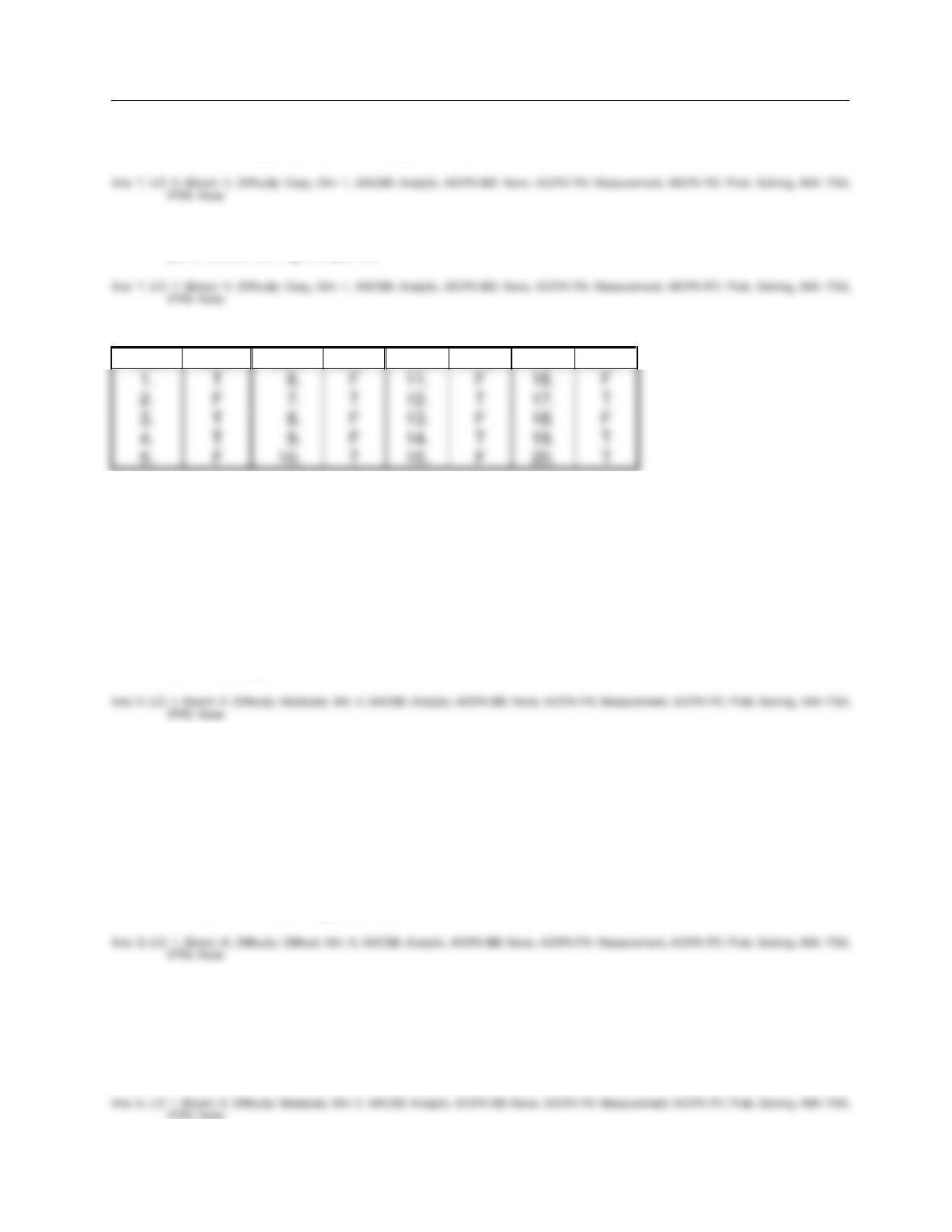
True False Answers—Conceptual
Item
Ans.
Item
Ans.
Item
Ans.
Item
Ans.
MULTIPLE CHOICE—Conceptual
21. Which of the following accounts is credited in the loss method of writing-down of inventory
to its net realizable value?
a. Allowance to Reduce Inventory to NRV
b. Loss Due to Decline of Inventory to NRV
c. Cost of Goods Sold
d. Inventory
S22. When the cost-of–goods-sold method is used to record inventory at net realizable value
a. there is a direct reduction in the selling price of the product that results in a loss being
recorded on the income statement prior to the sale.
b. a loss is recorded directly in the inventory account by crediting Inventory and debiting
Loss on Inventory Decline.
c. only the portion of the loss attributable to inventory sold during the period is recorded
in the financial statements.
d. the market value figure for ending inventory is substituted for cost and the loss is
buried in cost of goods sold.
23. Lower-of-cost or net realizable value as it applies to inventory is best described as the
a. drop of future utility below its original cost.
b. method of determining cost of goods sold.
c. assumption to determine inventory flow.
d. change in inventory value to market value.
Test Bank for Intermediate Accounting, Sixteenth Edition
9 – 10
24. Why are inventories stated at lower-of-cost and net realizable value?
a. To report a loss when there is a decrease in the future utility.
b. To keep track of the market value of the inventory.
c. To report a loss when there is a decrease in the future utility below the original cost.
d. To permit future profits to be recognized.
25. Which of the following is not an acceptable approach in applying the lower-of-cost-and net
realizable value method to inventory?
a. Inventory location.
b. Categories of inventory items.
c. Individual item.
d. Total of the inventory.
26. Which method(s) may be used to record a loss due to a price decline in the value of
inventory?
a. The cost-of–goods-sold method.
b. The sales method.
c. The loss method
d. Both the cost-of–goods-sold method and the loss method.
27. Net realizable value is
a. acquisition cost plus costs to complete and sell.
b. selling price.
c. selling price plus costs to complete and sell.
d. selling price less costs to complete, sell, and transport
28. Which of the following statements is incorrect regarding the lower-of-cost-or-market rule?
a. It is inconsistent because losses are recognized but not gains.
b. It usually understates assets.
c. It can increase future income if the expected reductions do not materialize.
d. It incorporates both gains and losses in value that occur during the course of
business.
29. When valuing raw materials inventory at lower-of-cost-or-market, what is the meaning of
the term “market”?
a. Net realizable value
b. Net realizable value less a normal profit margin
c. Replacement cost, Net realizable value, or Net realizable value less a normal profit
margin.
d. Discounted present value
Inventories: Additional Valuation Issues
9 – 11
30. In no case can “market” in the lower-of-cost-or-market rule be more than
a. estimated selling price in the ordinary course of business.
b. estimated selling price in the ordinary course of business, less reasonably predictable
costs of completion and disposal.
c. estimated selling price in the ordinary course of business, less reasonably predictable
costs of completion and disposal and an allowance for an approximately normal profit
margin.
d. estimated selling price in the ordinary course of business, less reasonably predictable
costs of completion and disposal, an allowance for an approximately normal profit
margin, and an adequate reserve for possible future losses.
31. The designated market value
a. is always the middle value of replacement cost, net realizable value, and net realizable
value less a normal profit margin.
b. should always be equal to net realizable value.
c. may sometimes exceed net realizable value.
d. should always be equal to net realizable value less a normal profit margin.
32. Lower-of-cost-or-market
a. is most conservative if applied to the total inventory.
b. is most conservative if applied to major categories of inventory.
c. is most conservative if applied to individual items of inventory.
d. must be applied to major categories for taxes.
33. An item of inventory purchased this period for $15.00 has been incorrectly written down
to its current replacement cost of $10.00. It sells during the following period for $30.00, its
normal selling price, with disposal costs of $3.00 and normal profit of $12.00. Which of the
following statements is not true?
a. The cost of sales of the following year will be understated.
b. The current year’s income is understated.
c. The closing inventory of the current year is understated.
d. Income of the following year will be understated.
34. The floor to be used in applying the lower-of-cost-or-market method to inventory is
determined as the
a. net realizable value.
b. net realizable value less normal profit margin.
c. replacement cost.
d. selling price less costs of completion and disposal.
Test Bank for Intermediate Accounting, Sixteenth Edition
9 – 12
35. What is the rationale behind the ceiling when applying the lower-of-cost-or-market method
to inventory?
a. Prevents understatement of the inventory value.
b. Allows for a normal profit to be earned.
c. Allows for items to be valued at replacement cost.
d. Prevents overstatement of the value of obsolete or damaged inventories.
36. When inventory declines in value below original (historical) cost, and this decline is
considered other than temporary, what is the maximum amount that the inventory can be
valued at?
a. Sales price
b. Net realizable value
c. Historical cost
d. Net realizable value reduced by a normal profit margin
37. If a unit of inventory has declined in value below original cost, but the market value
exceeds net realizable value, the amount to be used for purposes of inventory valuation is
a. net realizable value.
b. original cost.
c. market value.
d. net realizable value less a normal profit margin.
38. Why might inventory be reported at sales prices (net realizable value or market price)
rather than cost?
a. When there is a controlled market with a quoted price applicable to all quantities and
when there are no significant costs of disposal.
b. When there are no significant costs of disposal.
c. When a non-cancellable contract exists to sell the inventory.
d. When there is a controlled market with a quoted price applicable to all quantities.
S39. Recording inventory at net realizable value is permitted, even if it is above cost, when
there are no significant costs of disposal involved and
a. the ending inventory is determined by a physical inventory count.
b. a normal profit is not anticipated.
c. there is a controlled market with a quoted price applicable to all quantities.
d. the internal revenue service is assured that the practice is not used only to distort
reported net income.
Inventories: Additional Valuation Issues
9 – 13
40. Which of the following statements regarding the recording of inventory at net realizable
value is inaccurate?
a. GAAP permits recording of inventory at net realizable value when there is a controlled
market with a quoted price applicable to all quantities.
b. GAAP permits net realizable value for inventory when there are no significant costs of
disposal involved.
c. GAAP permits net realizable value in cases where the product is available for
immediate delivery.
d. GAAP is not similar to IFRS regarding the use of net realizable values for agricultural
and mineral products.
41. If a material amount of inventory has been ordered through a formal purchase contract at
the balance sheet date for future delivery at firm prices,
a. this fact must be disclosed.
b. disclosure is required only if prices have declined since the date of the order.
c. disclosure is required only if prices have since risen substantially.
d. an appropriation of retained earnings is necessary.
42. In hedging, the purchaser in the purchase commitment simultaneously enters into a
contract in which it agrees to sell in the future:
a. the same quantity of the same goods at a fixed price.
b. a higher quantity of the same goods at a higher price.
c. a lower quantity of the same goods at a fixed price.
d. same quantity of different goods at a lower price.
P43. In 2017, Orear Manufacturing signed a contract with a supplier to purchase raw materials
in 2018 for $700,000. Before the December 31, 2017 balance sheet date, the market price
for these materials dropped to $510,000. The journal entry to record this situation at
December 31, 2017 will result in a credit that should be reported
a. as a valuation account to Inventory on the balance sheet.
b. as a current liability.
c. as an appropriation of retained earnings.
d. on the income statement.
Test Bank for Intermediate Accounting, Sixteenth Edition
9 – 14
44. At the end of the fiscal year, Apha Airlines has an outstanding non-cancellable purchase
commitment for the purchase of 1 million gallons of jet fuel at a price of $4.10 per gallon
for delivery during the coming summer. The company prices its inventory at the lower of
cost or market. If the market price for jet fuel at the end of the year is $4.50, how would
this situation be reflected in the annual financial statements?
a. Record unrealized gains of $400,000 and disclose the existence of the purchase
commitment.
b. No impact.
c. Record unrealized losses of $400,000 and disclose the existence of the purchase
commitment.
d. Only disclose the existence of the purchase commitment.
45. At the end of the fiscal year, Apha Airlines has an outstanding purchase commitment for
the purchase of 1 million gallons of jet fuel at a price of $4.60 per gallon for delivery during
the coming summer. The company prices its inventory at the lower of cost or market. If the
market price for jet fuel at the end of the year is $4.25, how would this situation be
reflected in the annual financial statements?
a. Record unrealized gains of $350,000 and disclose the existence of the purchase
commitment.
b. No impact.
c. Record unrealized losses of $350,000 and disclose the existence of the purchase
commitment.
d. Only disclose the existence of the purchase commitment.
46. How is the gross profit method used as it relates to inventory valuation?
a. Verify the accuracy of the perpetual inventory records.
b. Verify the accuracy of the physical inventory.
c. To estimate cost of goods sold.
d. To provide an inventory value of LIFO inventories.
S47. Which of the following is not a basic assumption of the gross profit method?
a. The beginning inventory plus the purchases equal total goods to be accounted for.
b. Goods not sold must be on hand.
c. If the sales, reduced to the cost basis, are deducted from the sum of the opening
inventory plus purchases, the result is the amount of inventory on hand.
d. The total amount of purchases and the total amount of sales remain relatively
unchanged from the comparable previous period.

Inventories: Additional Valuation Issues
9 – 15
48. The gross profit method of inventory valuation is invalid when
a. a portion of the inventory is destroyed.
b. there is a substantial increase in inventory during the year.
c. there is no beginning inventory because it is the first year of operation.
d. applying a blanket gross profit rate to merchandise that have widely varying rates of
gross profit.
49. Which statement is true about the gross profit method of inventory valuation?
a. It may be used to estimate inventories for annual statements.
b. It may be used to estimate inventories for interim statements.
c. It eliminates the need for physical inventories.
d. When calculated on selling price, it will always be more than the related percentage
based on cost.
50. A major advantage of the retail inventory method is that it
a. provides reliable results in cases where the distribution of items in the inventory is
different from that of items sold during the period.
b. hides costs from competitors and customers.
c. gives a more accurate statement of inventory costs than other methods.
d. provides a method for inventory control and facilitates determination of the periodic
inventory for certain types of companies.
51. An inventory method which is designed to approximate inventory valuation at the lower of
cost or market is
a. last-in, first-out.
b. first-in, first-out.
c. conventional retail method.
d. specific identification.
52. The retail inventory method is based on the assumption that the
a. final inventory and the total of goods available for sale contain the same proportion of
high-cost and low-cost ratio goods.
b. ratio of gross margin to sales is approximately the same each period.
c. ratio of cost to retail changes at a constant rate.
d. proportions of markups and markdowns to selling price are the same.
Test Bank for Intermediate Accounting, Sixteenth Edition
9 – 16
53. Which statement is true about the retail inventory method?
a. It may not be used to estimate inventories for interim statements.
b. It may not be used to expedite physical inventory counts.
c. It may not be used by auditors.
d. There are different versions of the retail inventory method.
54. When the conventional retail inventory method is used, markdowns are commonly ignored
in the computation of the cost to retail ratio because
a. there may be no markdowns in a given year.
b. this tends to give a better approximation of the lower of cost or market.
c. markups are also ignored.
d. this tends to result in the showing of a normal profit margin in a period when no
markdown goods have been sold.
55. To produce an inventory valuation which approximates the lower of cost or market using
the conventional retail inventory method, the computation of the ratio of cost to retail
should
a. include markups but not markdowns.
b. include markups and markdowns.
c. ignore both markups and markdowns.
d. include markdowns but not markups.
*56. When calculating the cost ratio for the retail inventory method,
a. if it is the conventional method, the beginning inventory is included and markdowns
are deducted.
b. if it is the LIFO method, the beginning inventory is excluded and markdowns are
deducted.
c. if it is the LIFO method, the beginning inventory is included and markdowns are not
deducted.
d. if it is the conventional method, the beginning inventory is excluded and markdowns
are not deducted.
S57. Which of the following is not required when using the retail inventory method?
a. All inventory items must be categorized according to the retail markup percentage
which reflects the item’s selling price.
b. A record of the total cost and retail value of the goods purchased.
c. A record of the total cost and retail value of the goods available for sale.
d. Total sales amount for the period.
Inventories: Additional Valuation Issues
9 – 17
S58. Which of the following is not a reason the retail inventory method is used widely?
a. As a control measure in determining inventory shortages
b. For insurance information
c. To permit the computation of net income without a physical count of inventory
d. To defer income tax liability
59. What condition is not necessary in order to use the retail method to provide inventory
results?
a. Retailer keeps a record of the total costs of products sold for the period.
b. Retailer keeps a record of the total costs and retail value of goods purchased.
c. Retailer keeps a record of the total costs and retail value of goods available for sale.
d. Retailer keeps a record of sales for the period.
60. Which of the following is true of normal shortages?
a. They do not include theft and shrinkage.
b. They are deducted from both the cost and retail columns.
c. These goods are no longer available for sale.
d. This loss is considered in calculating cost-to-retail ratio.
61. What is the effect of net markups on the cost-retail ratio when using the conventional retail
method?
a. Increases the cost-to-retail ratio.
b. No effect on the cost-to-retail ratio.
c. Depends on the amount of the net markdowns.
d. Decreases the cost-to–retail ratio.
62. What is the effect of freight-in on the cost–to-retail ratio when using the conventional retail
method?
a. Increases the cost-to-retail ratio.
b. No effect on the cost-to-retail ratio.
c. Depends on the amount of the net markups.
d. Decreases the cost-to–retail ratio.
63. Which of the following is not a common disclosure for inventories?
a. Inventory composition.
b. Inventory location.
c. Inventory financing arrangements.
d. Inventory costing methods employed.
Test Bank for Intermediate Accounting, Sixteenth Edition
9 – 18
P64. Which of the following statements is false regarding an assumption of inventory cost flow?
a. The cost flow assumption need not correspond to the actual physical flow of goods.
b. The assumption selected may be changed each accounting period.
c. The FIFO assumption uses the earliest acquired prices to cost the items sold during a
period.
d. The LIFO assumption uses the earliest acquired prices to cost the items on hand at
the end of an accounting period.
P65. The average days to sell inventory is computed by dividing
a. 365 days by the inventory turnover.
b. the inventory turnover by 365 days.
c. net sales by the inventory turnover.
d. 365 days by cost of goods sold.
*66. The reason for eliminating the price change in inventory is:
a. to measure the dollar increase in inventory.
b. to inflate profits of a company.
c. to increase the cost of inventory.
d. to measure the real increase in inventory.
*67. When using dollar-value LIFO, if the incremental layer was added last year, it should be
multiplied by
a. last year’s cost ratio and this year’s index.
b. this year’s cost ratio and this year’s index.
c. last year’s cost ratio and last year’s index.
d. this year’s cost ratio and last year’s index.
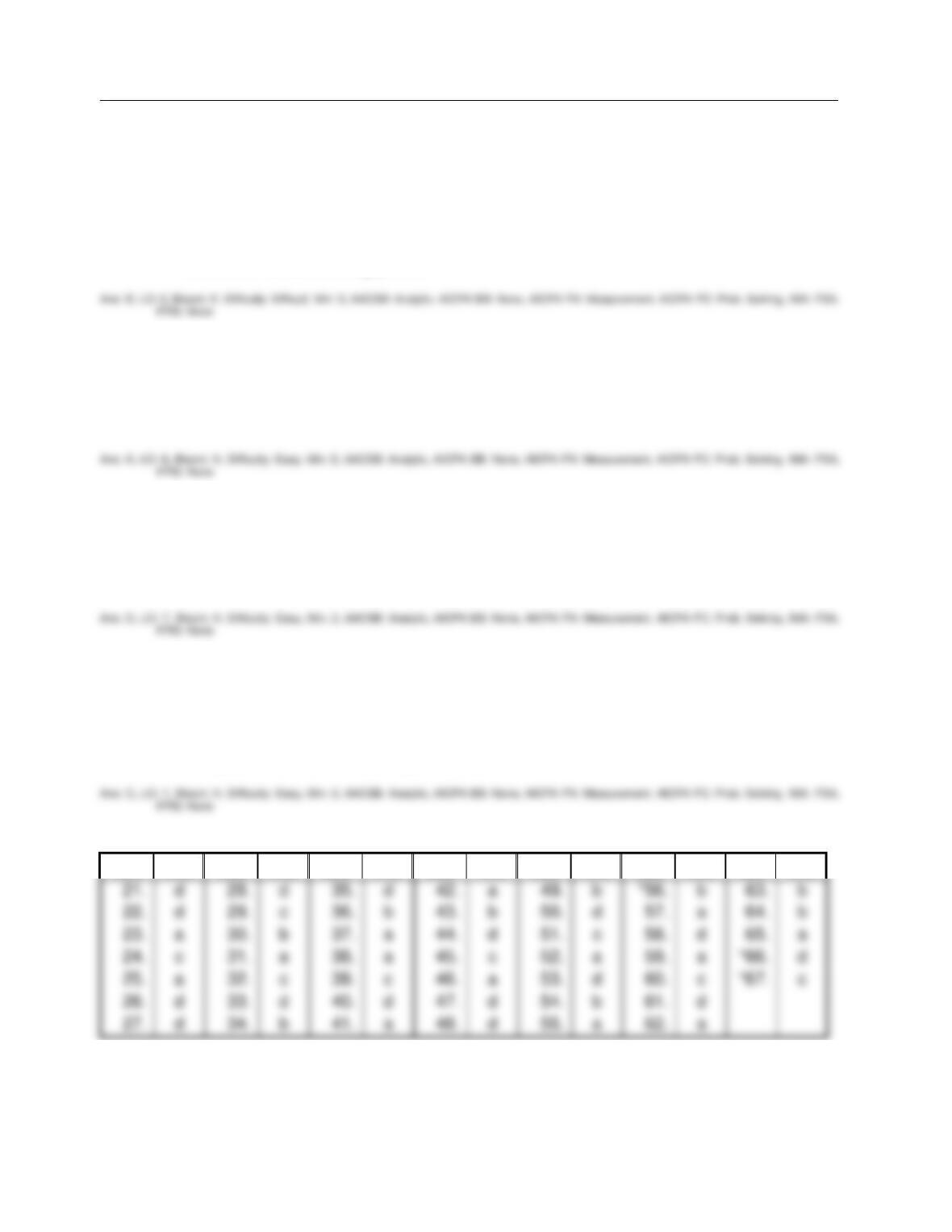
Multiple Choice Answers—Conceptual
Item
Ans.
Item
Ans.
Item
Ans.
Item
Ans.
Item
Ans.
Item
Ans.
Item
Ans.

Inventories: Additional Valuation Issues
9 – 19
MULTIPLE CHOICE—Computational
68. Oslo Corporation has two products in its ending inventory, each accounted for at the lower
of cost or market. A profit margin of 30% on selling price is considered normal for each
product. Specific data with respect to each product follows:
Product #1 Product #2
Historical cost $10 $ 18
Replacement cost 11 14
Estimated cost to dispose 3 7
Estimated selling price 20 33
In pricing its ending inventory using the lower-of-cost-or-market, what unit values, rounded
to the nearest dollar, should Oslo use for products #1 and #2, respectively?
a. $10 and $16.
b. $13 and $16.
c. $13 and $15.
d. $11 and $14.
69. Muckenthaler Company sells product 2005WSC for $30 per unit. The cost of one unit of
2005WSC is $27, and the replacement cost is $26. The estimated cost to dispose of a unit
is $6, and the normal profit is 40%. At what amount per unit should product 2005WSC be
reported, applying lower-of-cost-or-market?
a. $12.
b. $24.
c. $26.
d. $27.
70. Lexington Company sells product 1976NLC for $20 per unit. The cost of one unit of
1976NLC is $18, and the replacement cost is $17. The estimated cost to dispose of a unit
is $4, and the normal profit is 40%. At what amount per unit should product 1976NLC be
reported, applying lower-of-cost-or-market?
a. $8.
b. $16.
c. $17.
d. $18.
71. Given the acquisition cost of product Z is $27, the net realizable value for product Z is
$24, the normal profit for product Z is $2, and the market value (replacement cost) for
product Z is $25, what is the proper per unit inventory value for product Z applying LCM?
a. $27.
b. $25.
c. $22.
d. $24.
Test Bank for Intermediate Accounting, Sixteenth Edition
9 – 20
72. Given the acquisition cost of product ALPHA is $21, the net realizable value for product
ALPHA is $20, the normal profit for product ALPHA is $1.50, and the market value
(replacement cost) for product ALPHA is $18, what is the proper per unit inventory value
for product ALPHA applying LCM?
a. $21.00.
b. $18.50
c. $18.00.
d. $20.00.
73. Given the acquisition cost of product Dominoe is $20, the net realizable value for product
Dominoe is $17, the normal profit for product Dominoe is $2, and the market value
(replacement cost) for product Dominoe is $18, what is the proper per unit inventory price
for product Dominoe applying LCM?
a. $18.
b. $15.
c. $17.
d. $20
74. Given the historical cost of product Z is $20, the selling price of product Z is $25, costs to
sell product Z are $3, the replacement cost for product Z is $21, and the normal profit
margin is 40% of sales price, what is the market value that should be used in the lower–of–
cost-or-market comparison?
a. $18.
b. $20.
c. $21.
d. $22.
75. Given the historical cost of product Z is $20, the selling price of product Z is $25, costs to
sell product Z are $3, the replacement cost for product Z is $21, and the normal profit
margin is 40% of sales price, what is the amount that should be used to value the
inventory under the lower-of-cost-or-market method?
a. $18.
b. $20.
c. $21.
d. $22.
76. Given the historical cost of product Dominoe is $12, the selling price of product Dominoe
is $15, costs to sell product Dominoe are $2, the replacement cost for product Dominoe is
$11, and the normal profit margin is 20% of sales price, what is the cost amount that
should be used in the lower–of-cost-or-market comparison?
a. $13.
b. $10.
c. $11.
d. $12.