Exam
Name___________________________________
MULTIPLE CHOICE. Choose the one alternative that best completes the statement or answers the question.
Provide an appropriate response.
1)
Among patients who were improving on a certain day (in the critical care unit of a certain hospital),
the following was determined to be true on the next day: 58% were still improving; 10% were
stable; 7% were deteriorating; and 25% had been discharged. Among the patients who were stable
on a certain day, the following was determined to be true on the next day: 34% were improving;
44% were still stable; 18% were deteriorating; 3% had been discharged; and 1% had died. Among
the patients who were deteriorating on a certain day, the following was determined to be true on
the next day: 13% were improving; 42% were stable; 41% were still deteriorating; none had been
discharged; and 4% had died. What is the expected number of additional days that a patient, who is
improving on that certain day, will spend in the critical care unit? Round your answer to the
nearest hundredth.
1)
A)
7.53 days
B)
5.76 days
C)
3.22 days
D)
4.65 days
2)
A B C D
Identify the absorbing state(s) in the transition matrix P =
A
B
C
D
0 0 1 0
0 1 0 0
0 1 0 0
0 0 0 1
2)
A)
B and D
B)
A and B
C)
A and D
D)
C and D
3)
Suppose that for a certain absorbing Markov chain the fundamental matrix is found to be
$1 $2 $3
$1
$2
$3
1.5 1.0 0.5
1.0 2.0 1.0
0.5 1.0 1.5
What is the expected number of times a person will have $3, given that she started with $1?
3)
A)
0.5
B)
2.0
C)
1.0
D)
1.5
1
4)
Find the stationary matrix for the transition matrix P =
0.1 0.9 0
0.3 0.4 0.3
0.2 0.2 0.6
.
4)
A)
9
2
9
4
9
3
B)
1 0 0
0 1 0
0 0 1
C)
[0.25 0.45 0.35]
D)
2
9
4
9
1
3
5)
Find a standard form for the absorbing Markov chain with the transition matrix
A B C
A
B
C
0 0 1
0 1 0
0.2 0.6 0.2
5)
A)
A B C
B
A
C
1 0 0
0 0 1
0.6 0.2 0.2
B)
A B C
A
B
C
0 0 1
0 1 0
0.2 0.6 0.2
C)
B A C
A
B
C
1 0 0
0 0 1
0.6 0.2 0.2
D)
B A C
B
A
C
1 0 0
0 0 1
0.6 0.2 0.2
6)
Find the limiting matrix P corresponding to the transition matrix P =0.8 0.2
0.1 0.9 .
Round to the nearest hundredths.
6)
A)
[0.875 0.125]
B)
0.45 0.55
0.28 0.72
C)
0.66 0.34
0.17 0.83
D)
0.33 0.67
0.33 0.67
7)
Decide whether or not the transition matrix is regular. Answer Yes or No.
0.3 0.7
0.9 0.1
7)
A)
Yes
B)
No

8)
Decide whether or not the transition matrix is regular. Answer Yes or No.
1 0
0.5 0.5
8)
A)
Yes
B)
No
9)
According to data collected during one year in a large metropolitan community, 30% of commuters
used public transportation to get to work, and this rose by 4% the following year. This is modeled
by the transition matrix
P P
M =P
P
0.9 0.1
0.1 0.9
where P represents the percentage of people that use public transportation and P the percentage of
people that do not.
Let S0= [0.3 0.7]. Find S2.
Round your answer to the nearest thousandths.
9)
A)
[0.628 0.372]
B)
[0.372 0.628]
C)
[0.34 0.66]
D)
[0.66 0.34]
Solve the problem.
10)
The probability that an assembly line works correctly depends on whether the line worked
correctly the last time. Find the probability that the line will work in the long run. Round your
answer as appropriate.
Works Does not
works
doesn’t
0.9 0.1
0.2 0.8
10)
A)
0.667
B)
0.900
C)
0.855
D)
0.333

Provide an appropriate response.
11)
Find the stationary matrix for the transition matrix P =0.1 0.9
0.6 0.4 .
11)
A)
[0.6 0.4]
B)
0.1 0.9
0.6 0.4
C)
[0.16 0.36]
D)
[0.4 0.6]
12)
Find the fundamental matrix F for the absorbing Markov chain with the given matrix. Express your
answer in fraction form.
1 0 0
0 1 0
0.12 0.72 0.16
12)
A)
F =
21
25
B)
F =
4
25
C)
F =
25
21
D)
F =
11
9
13)
Find the limiting matrix P corresponding to the transition matrix P =
2
3
1
3
1
4
3
4
.
Round to the nearest thousandths.
13)
A)
0.429 0.571
0.429 0.571
B)
0.528 0.472
0.354 0.646
C)
[0.429 0.571]
D)
1 0
0 1
14)
A B C
Using a graphing utility to compute powers of P =
A
B
C
0.2 0.3 0.5
0.1 0.8 0.1
0.4 0.3 0.3
, find the smallest n such that
the corresponding entries in Pn and Pn+1 are, when rounded to 3 decimal places, equal.
14)
A)
3
B)
11
C)
6
D)
2
15)
Fayetteville is experiencing a population movement out of the city to the suburbs. Currently 85% of
the total population live in the city with the remaining 15% living in the suburbs. It has been shown
that each year 7% of the city residents move to the suburbs, while only 1% of the suburb population
move back to the city. Assuming population remains constant for both, what percent of the total
will remain in the suburbs after 5 years. Express your answer rounded to hundredths of a percent.
15)
A)
39.72%
B)
64.44
C)
60.28%
D)
35.56%
16)
According to data collected during one year in a large metropolitan community, 30% of commuters
used public transportation to get to work, and this rose by 4% the following year. This is modeled
by the transition matrix
P P
M =P
P
0.9 0.1
0.1 0.9 S0= [0.3 0.7]
where P represents the percentage of people that use public transportation and P the percentage of
people that do not.
What percentage of commuters in this community will use public transportation in the long run?
16)
A)
34%
B)
37.2%
C)
50%
D)
30%
17)
Suppose that for a certain absorbing Markov chain the fundamental matrix is found to be
$1 $2 $3
$1
$2
$3
1.5 1.0 0.5
1.0 2.0 1.0
0.5 1.0 1.5
What is the expected number of times a person will have $3, given that he started with $2?
17)
A)
0.5
B)
1.0
C)
1.5
D)
2.0
5
18)
The transition matrix for a Markov process is:
State
A B
State A
B
0.1 0.9
0.3 0.7
= P
Find P2.
18)
A)
0.28 0.72
0.24 0.76
B)
0.72 0.28
0.36 0.64
C)
0.1 0.9
0.3 0.7
D)
0.244 0.756
0.252 0.748
19)
The probability that an assembly line operation works correctly depends on whether it worked
correctly the last time it was used. There is a 0.91 chance that the line will work correctly if it
worked correctly the time before and a 0.68 chance that it will work correctly if it did not work
correctly the time before. After setting up a transition matrix with this information, find the
long–run probability that the line will work correctly.
19)
A)
[0.883 0.883]
B)
[0.802 0.198]
C)
[0.883 0.117]
D)
[0.117 0.883]
20)
The transition matrix for a Markov process is:
State
A B
State A
B
0.3 0.7
0.9 0.1
= P
Find P2.
20)
A)
0.72 0.28
0.36 0.64
B)
0.64 0.28
0.36 0.72
C)
0.72 0.36
0.28 0.64
D)
0.468 0.532
0.684 0.316
21)
Find the stationary matrix for the transition matrix P =
0.1 0.1 0.8
0.3 0.3 0.4
0.4 0.4 0.2
Round the numbers in your answer to the nearest hundredth.
21)
A)
[0.17 0.29 0.54]
B)
[0.29 0.29 0.42]
C)
[0.23 0.17 0.60]
D)
[0.26 0.44 0.30]

22)
A red urn contains 4 red marbles, 2 blue marbles, and 4 green marbles. A blue urn contains 2 red
marbles, 2 blue marbles, and 1 green marble. A green urn contains 3 green marbles. A marble is
selected from an urn, the color is noted, and the marble is returned to the urn from which it was
drawn. The next marble is drawn from the urn whose color is the same as the marble just drawn.
Thus, this is a Markov process with three states: draw from the red urn, draw from the blue urn, or
draw from the green urn.
Find the limiting matrix P, if it exists, and describe the long–run behavior of this process.
22)
A)
G B R
P=
G
B
R
1 0 0
0 0.1 0.4
1 0 0
B)
G B R
P=
G
B
R
1 0 0
0.2 0.4 0.4
0.4 0.2 0.4
C)
G B R
P=
G
B
R
1 0 0
1 0 0
1 0 0
D)
G B R
P=
G
B
R
1 0 0
0.2 0.4 0.4
1 0 0
23)
Given the transition matrix:
A B C D
P =
A
B
C
D
0.4 0.3 0.2 0.1
0 1 0 0
0 0 1 0
0.2 0.5 0.1 0.2
Find P4.
23)
A)
A B C D
P =
A
B
C
D
0.084 0.554 0.332 0.03
0 1 0 0
0 0 1 0
0.06 0.726 0.19 0.024
B)
A B C D
P =
A
B
C
D
0.18 0.47 0.29 0.06
0 1 0 0
0 0 1 0
0.12 0.66 0.16 0.06
C)
A B C D
P =
A
B
C
D
0.0396 0.5942 0.3518 0.0144
0 1 0 0
0 0 1 0
0.0288 0.756 0.2044 0.0108
D)
A B C D
P =
A
B
C
D
0.4 0.3 0.2 0.1
0 1 0 0
0 0 1 0
0.2 0.5 0.1 0.2

Construct the transition matrix that represents the data.
24)
70 percent of the people in one generation who have a certain physical characteristic will pass that
characteristic on to the next generation. 40 percent of the people in one generation who do not have
this characteristic will pass it on to the next generation.
24)
A)
0.3 0.7
0.6 0.4
B)
0.7 0.3
0.4 0.6
C)
0.6 0.4
0.3 0.7
D)
0.4 0.6
0.7 0.3
Provide an appropriate response.
25)
Find a standard form for the absorbing Markov chain with the following transition matrix :
A B C D
A
B
C
D
0.4 0.2 0.1 0.3
0 1 0 0
00.2 0.1 0.7
0 0 0 1
25)
A)
B D C A
A
B
C
D
1 0 0 0
0 1 0 0
0.2 0.7 0.1 0
0.2 0.3 0.1 0.4
B)
B D C A
B
D
C
A
1 0 0 0
0 1 0 0
0.2 0.7 0.1 0
0.3 0.2 0.4 0.1
C)
A B C D
B
D
C
A
1 0 0 0
0 1 0 0
0.2 0.7 0.1 0
0.2 0.3 0.1 0.4
D)
B D C A
B
D
C
A
1 0 0 0
0 1 0 0
0.2 0.7 0.1 0
0.2 0.3 0.1 0.4
26)
Find the stationary matrix for the transition matrix P =
0.2 0.6 0.2
0.1 0.1 0.8
0.3 0.3 0.4
.
26)
A)
1 0 0
0 1 0
0 0 1
B)
23
5
23
7
23
11
C)
[5 7 11]
D)
5
23
7
23
11
23
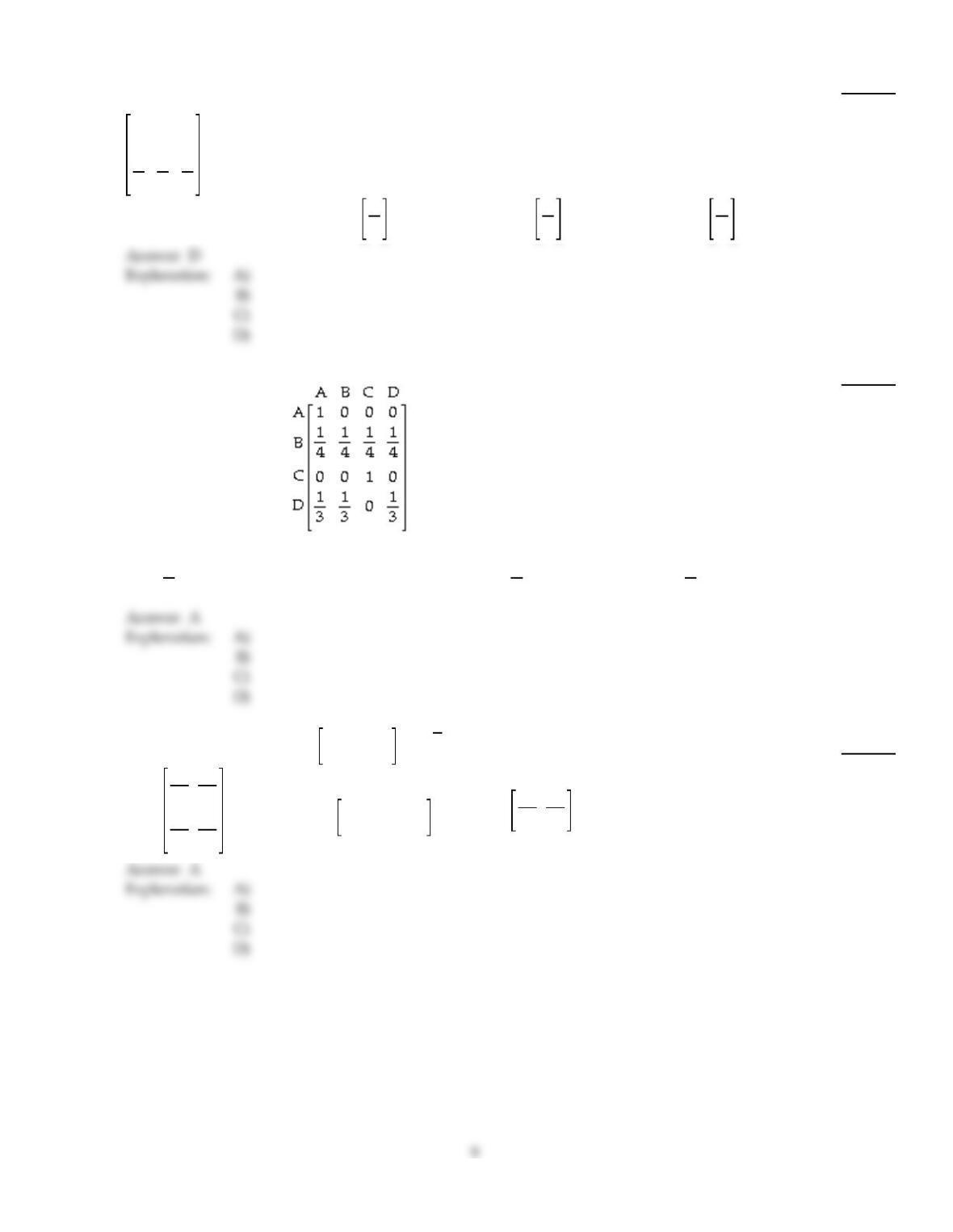
27)
Find the fundamental matrix F for the absorbing Markov chain with the given matrix. Express your
answer in fraction form.
1 0 0
0 1 0
3
7
4
7
1
7
27)
A)
F = [3]
B)
F =
7
3
C)
F =
7
4
D)
F =
7
6
28)
For the transition matrix , find the probability that if one starts in state B, one
will end up in state A over the long run.
28)
A)
3
5
B)
1
C)
4
5
D)
9
5
29)
For the transition matrix P =0.36 0.64
0.20 0.80 find P exactly by converting P16 to fraction form.
29)
A)
5
21
16
21
5
21
16
21
B)
0.213 0.698
0.218 0.715
C)
5
21
16
21
D)
[0.213 0.698]

Construct the transition matrix that represents the data.
30)
If it snows today, there is a 40 percent chance of snow tomorrow; however if it does not snow
today, there is a 30 percent chance that it will not snow tomorrow.
30)
A)
0.7 0.3
0.40.6
B)
0.4 0.6
0.70.3
C)
0.4 0.6
0.3 0.7
D)
0.3 0.7
0.4 0.6
Provide an appropriate response.
31)
Given the transition matrix:
A B C D A B C D
P =
A
B
C
D
0.4 0.3 0.2 0.1
0 1 0 0
0 0 1 0
0.2 0.5 0.1 0.2
P4=
A
B
C
D
0.0396 0.5942 0.3518 0.0144
0 1 0 0
0 0 1 0
0.0288 0.756 0.2044 0.0108
Find the probability of going from state C to state B in four trials.
31)
A)
0
B)
0.756
C)
0.0396
D)
0.0144
32)
Decide whether or not the transition matrix is regular. Answer Yes or No.
0.61 0 0.39
0.47 0.53 0
0 0.24 0.76
32)
A)
Yes
B)
No

33)
A B C D
For the transition matrix
A
B
C
D
0.4 0.1 0.4 0.1
0 1 0 0
0.3 0.1 0.2 0.4
0 0 0 1
, find the limiting matrix. Use fractional entries.
33)
A)
A B C D
A
B
C
D
1 0 0 2
3
0 1 0 0
01
403
4
0 0 0 1
B)
B A C D
B
A
C
D
01
3 0 2
3
0 1 0 0
01
403
4
0 0 0 1
C)
A B C D
A
B
C
D
01
3 0 2
3
0 1 0 0
01
40 1
3
40 0 1
D)
A B C D
A
B
C
D
01
3 0 2
3
0 1 0 0
01
403
4
0 0 0 1
34)
According to data collected during one year in a large metropolitan community, 30% of commuters
used public transportation to get to work, and this rose by 4% the following year. This is modeled
by the transition matrix
P P
M =P
P
0.9 0.1
0.1 0.9
where P represents the percentage of people that use public transportation and P the percentage of
people that do not.
Let S0= [0.3 0.7]. Find S1.
34)
A)
[0.66 0.34]
B)
[0.34 0.66]
C)
[0.3 0.7]
D)
[0.9 0.1]