Chapter 8—Lipids
MULTIPLE CHOICE
1. A fatty acid with eighteen carbons and one double bond could be designated all EXCEPT:
a.
linoleic acid.
b.
18:1.
c.
cis-9-octadecenoic acid.
d.
oleic acid.
e.
elaidic acid
2. Fatty acids are all EXCEPT:
a.
either saturated or unsaturated.
b.
found seldom in free form.
c.
mostly found with an even number of carbons.
d.
found in linear, branched and cyclic forms.
e.
all are true.
3. Dietary essential fatty acids for humans include
a.
-linolenic and oleic acids.
b.
oleic and linoleic acids.
c.
palmitic and oleic acids.
d.
linoleic and -linolenic acids.
e.
all are true.
4. Alkali hydrolysis of triacylglycerols is called ____ and yields ____ and ____.
a.
triacylation; fatty acids; glycerol
b.
saponification; fatty alcohols; fatty acids
c.
triesteration; salts of fatty acids, fatty alcohols
d.
saponification; salts of fatty acids; glycerol
e.
none are true
5. Lipids are the biomolecules of choice for storage of metabolic energy because they:
a.
are soluble in water.
b.
yield a large amount of energy upon oxidation.
c.
are highly oxidized.
d.
are easily hydrolyzed.
e.
are amphipathic.
6. Diets aimed at reducing coronary heart disease should be:
a.
low in trans-fatty acids and high in saturated fatty acids.
b.
high in trans-fatty acids and high in saturated fatty acids.
c.
high in trans-fatty acids and low in saturated fatty acids.
d.
low in trans-fatty acids and low in saturated fatty acids.
e.
low in trans-fatty acids and low in unsaturated fatty acids.
7. Of the following, which would contain the largest amount of fatty acids with trans double bonds?
a.
the fatty acid on carbon #1 of the glycerol of phosphatidylcholine
b.
butter
c.
canola oil
d.
the 2 lb, 99 cent package of cookies containing partially hydrogenated cottonseed and/or
soybean oil that you consumed with 3 (or more) cups of coffee while studying last night
(or early this morning)
e.
none of the above would have very much trans-double bond containing fatty acids
8. Body fat is a major storage form of energy because it:
a.
aggregates in a highly anhydrous form (without additional water weight).
b.
yields about 17 kJ/g (4 cal/g) of energy.
c.
has low insulation properties.
d.
is highly hydrated and easy to metabolize.
e.
yields about 25 kJ/g (6 cal/g) of energy.
9. Membranes with unsaturated fatty acids in their components are more flexible and fluid because:
a.
Unsaturated fatty acids pack closely together to form ordered arrays.
b.
Unsaturated fatty acids bend at the double bond preventing close packing.
c.
Saturated fatty acids have a “kink” that produces more fluid aggregates.
d.
Unsaturated fatty acids have cis double bonds that prevent formation of the “kink.”
e.
All of the above are correct.
10. Glycerolphospholipids are all EXCEPT:
a.
also called sphingolipids.
b.
essential components of cell membranes.
c.
made up of 1,2-diacylglycerol and a phosphate group.
d.
members of the phospholipids.
e.
all are true.
11. In most cases, glycerol phosphatides have ____ fatty acid at position 1 and ____ fatty acid at position
2 of the glycerol.
a.
a saturated; a saturated
b.
a saturated; an unsaturated
c.
an unsaturated; a saturated
d.
an unsaturated; an unsaturated
e.
none are true.
12. Certain phospholipids, including ____ and ____, participate in complex cellular signaling events.
a.
phosphatidylcholine; phosphatidylserine
b.
phosphatidylserine; phosphatidylalanine
c.
phosphatidylcholine; phosphatidylglycerol
d.
phosphatidylinositol; phosphatidylcholine
e.
phosphatidylethanolamine; phosphatidylserine
13. Platelet activating factor (PAF) has all of the characteristics EXCEPT:
a.
PAF is a potential mediator in inflammation, allergic responses and shock.
b.
PAF is a sphingolipid.
c.
PAF has a beneficial effect on toxic-shock syndrome.
d.
PAF is involved in implantation of the egg in the uterine wall.
e.
PAF stimulates production of fetal lung surfactant.
14. Which of the following alcohols is correctly paired with the functional group that it contains?
a.
ethanolamine: secondary amine group
b.
choline: quaternary ammonium group
c.
inositol: aldehyde and alcohol groups
d.
glycerol: ether
e.
none of the above are correct
15. Glycosphingolipids consist of a ____ with one or more ____ residues in a(n) ____ linkage at the 1-
hydroxyl moiety.
a.
sugar; fatty acids; ester
b.
ceramide; sugar; -glycosidic
c.
ceramide; fatty acid; amide
d.
glycerol; fatty acids; ester
e.
none are true
16. Although present in small amounts in most membranes, glycosphingolipids have a number of cellular
functions EXCEPT:
a.
involvement in nerve impulse transmission.
b.
water-repellant properties of animal skin.
c.
tissue and organ specificity.
d.
cell-cell recognition.
e.
tissue immunity.
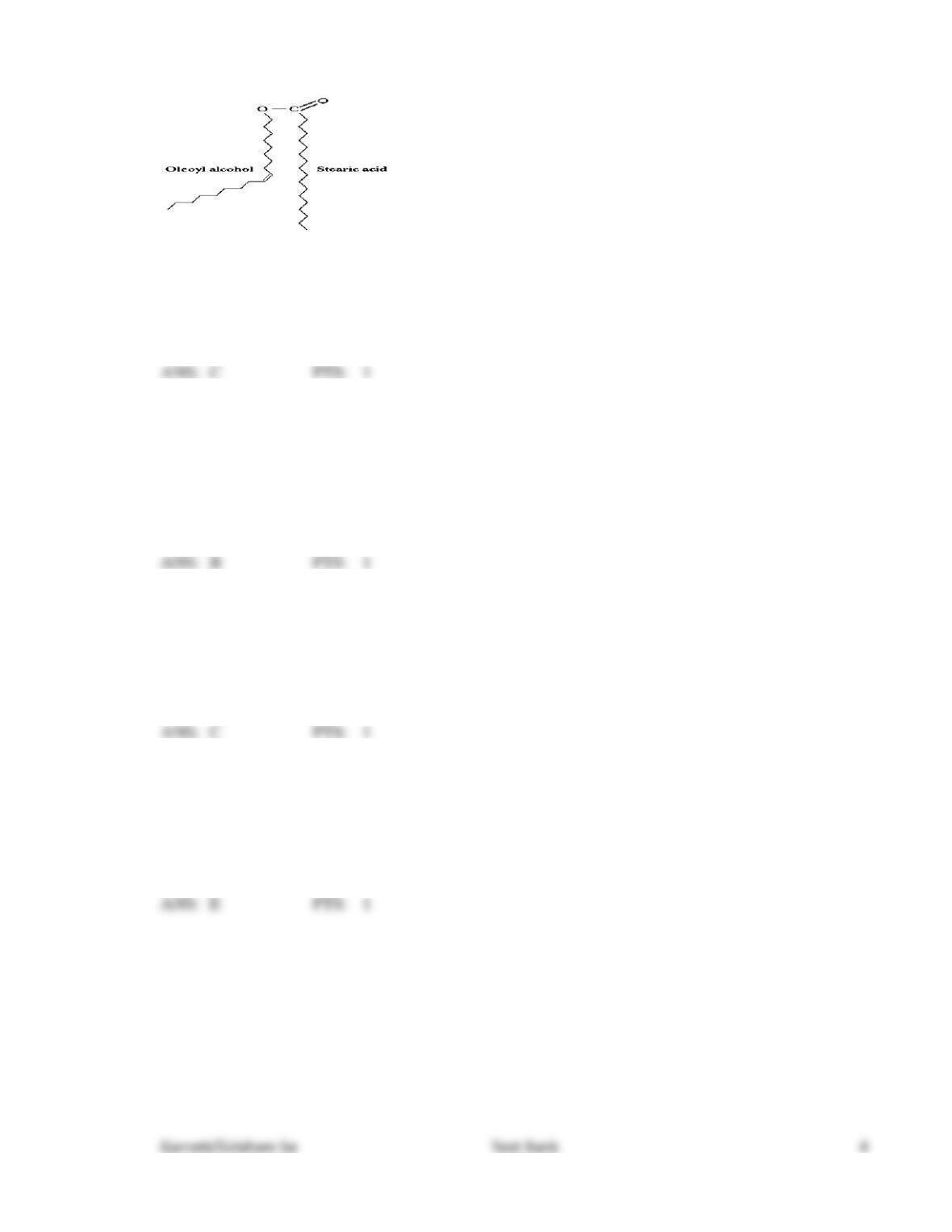
17. The structure is an example of a(n):
a.
diacylglycerol.
b.
triacylglycerol.
c.
wax ester.
d.
eicosanoid.
e.
monoacylglycerol.
18. Which of the following lipids is correctly defined?
a.
triacylglycerol: formed from glycerol and 3 fatty acids, primary lipid of membranes
b.
phospholipid: contains glycerol with 2 fatty acids and a phosphate, very often forms
bilayers
c.
wax: contains a fatty acid and alcohol, used primarily for energy storage
d.
cholesterol: the primary component of “saturated” fats
e.
palmitic acid: the most commonly produced unsaturated fatty acid in animals
19. The terpenes are all EXCEPT:
a.
made up of isoprene monomers.
b.
formed from two or more 2-methyl-1,3-butadiene molecules.
c.
components of wool wax.
d.
monomers units linked head to tail.
e.
all are true.
20. All of the following are terpenes EXCEPT:
a.
squalene.
b.
-tocopherol (vitamin E).
c.
coenzyme Q (UQ).
d.
limonene.
e.
cetyl palmitate (spermaceti).
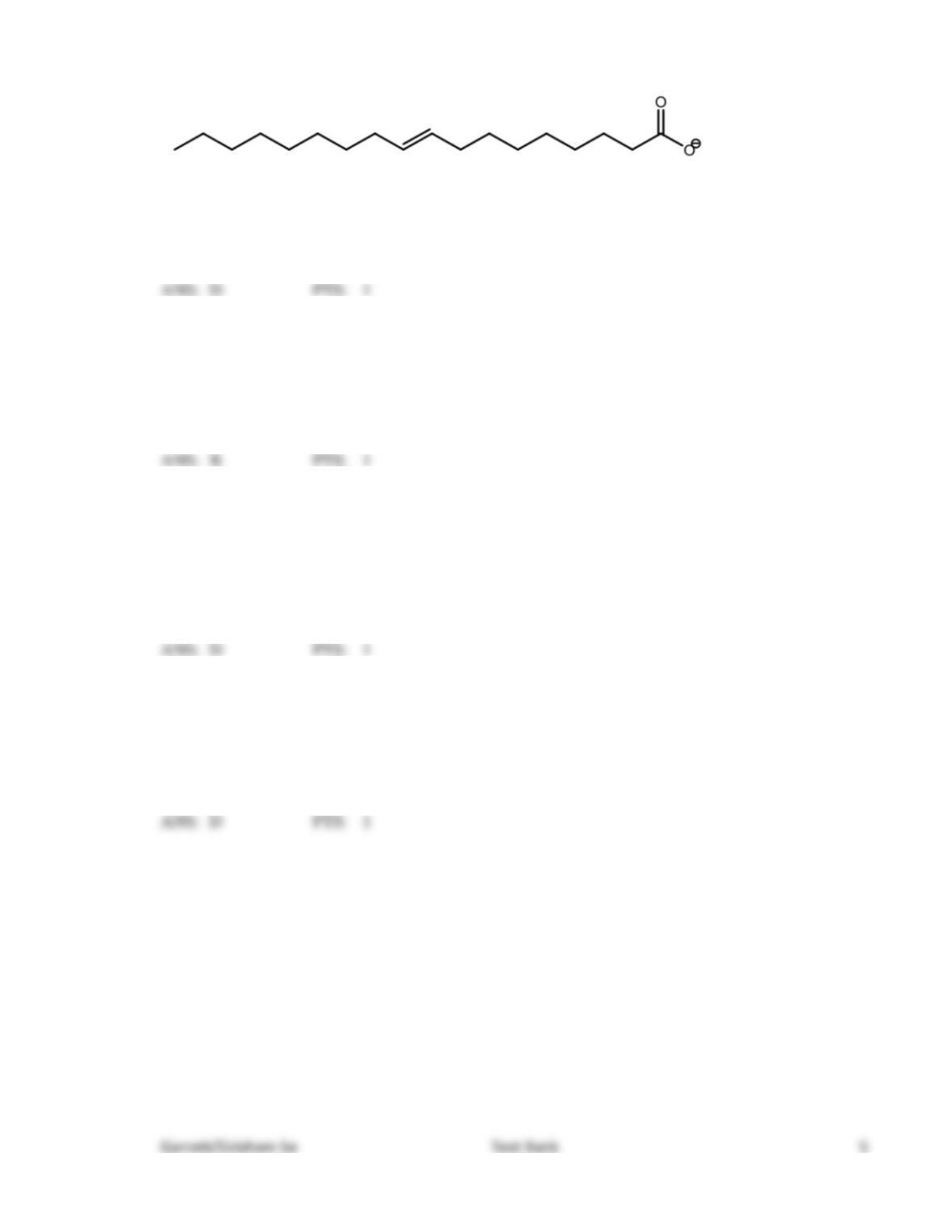
21. Of the following fatty acids, which would have physical and physiological properties most similar to
elaidic acid, pictured below?
a.
oleic acid (18:19)
b.
lauric acid (12:0)
c.
linoleic acid (18:29,12)
d.
stearic acid (18:0)
e.
arachidonic acid (20:45,8,11,14)
22. Cholesterol is a component of all EXCEPT:
a.
lipoproteins.
b.
plant cell plasma membranes.
c.
membranes of intracellular organelles.
d.
animal cell membranes.
e.
all are true.
23. The steroid hormones that participate in the control of carbohydrate, protein and lipid metabolism are
the:
a.
progestins.
b.
mineralocorticoids.
c.
estrogens.
d.
glucocorticoids.
e.
androgens.
24. All are plant steroids EXCEPT:
a.
campesterol.
b.
stigmasterol.
c.
-sitosterol.
d.
cortisol.
e.
all are true.
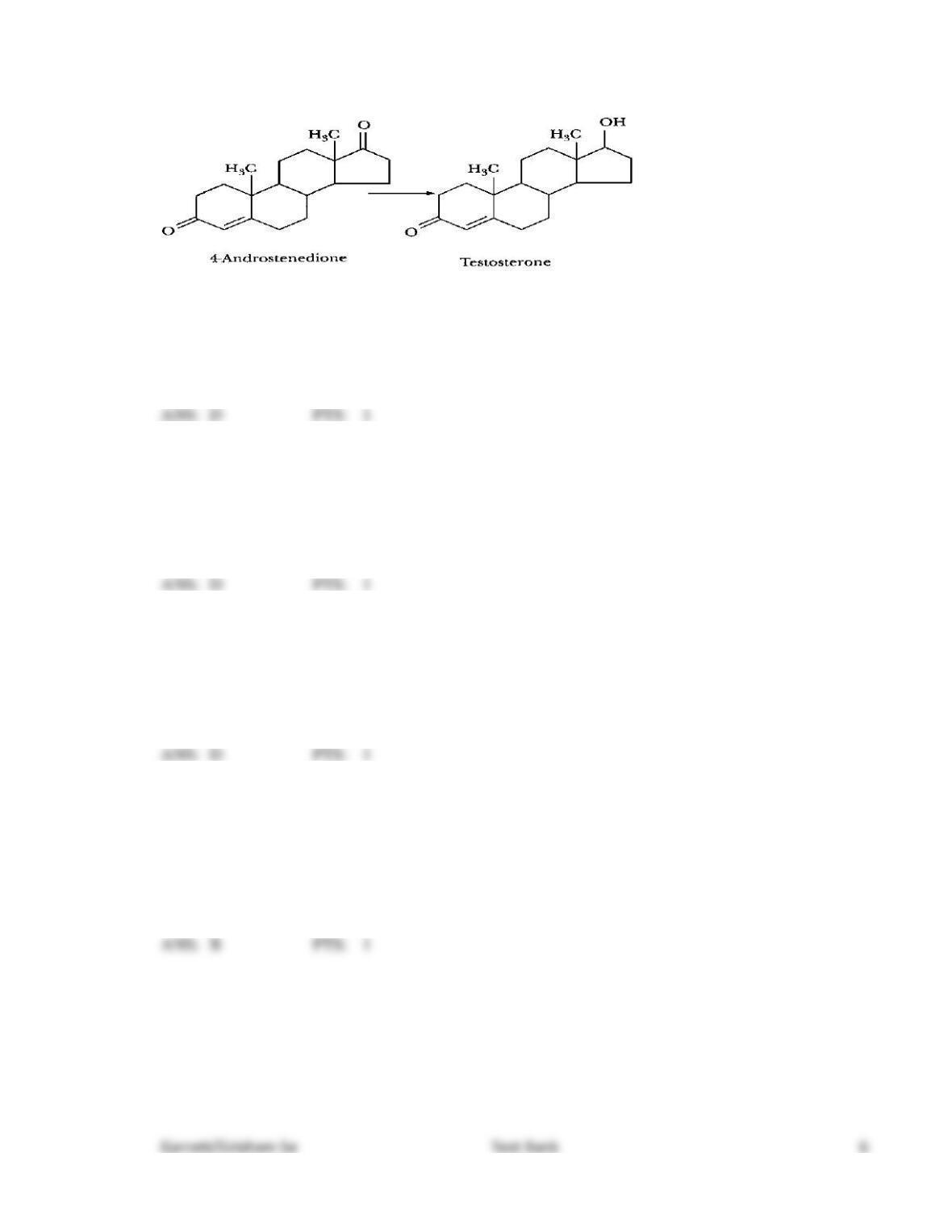
25. The reaction below is catalyzed by:
a.
desmolase.
b.
17-hydroxylase.
c.
17,20-lyase.
d.
17-hydroxysteroid dehydrogenase.
e.
none of the above are true.
26. Plant sterols are:
a.
so similar to cholesterol that they undergo the same physiology and metabolism.
b.
different isomers of cholesterol at the double bond location only.
c.
to be avoided in your diet because they elevate blood cholesterol levels.
d.
highly effective in blocking the absorption of cholesterol by intestinal cells.
e.
none are true.
27. Which of the following steroid hormones is NOT correctly defined?
a.
testosterone: an androgen involved in male sexual development
b.
progesterone: a progestin that controls the menstrual cycle.
c.
cortisol: a glucocorticoid that controls nutrient metabolism
d.
estradiol: a progestin involved in female sexual development
e.
all are correctly defined
28. Which of the following enzymes is responsible for the release of arachidonic acid from membrane
phospholipids?
a.
phospholipase A1
b.
phospholipase A2
c.
phospholipase B
d.
phospholipase C
e.
phospholipase D
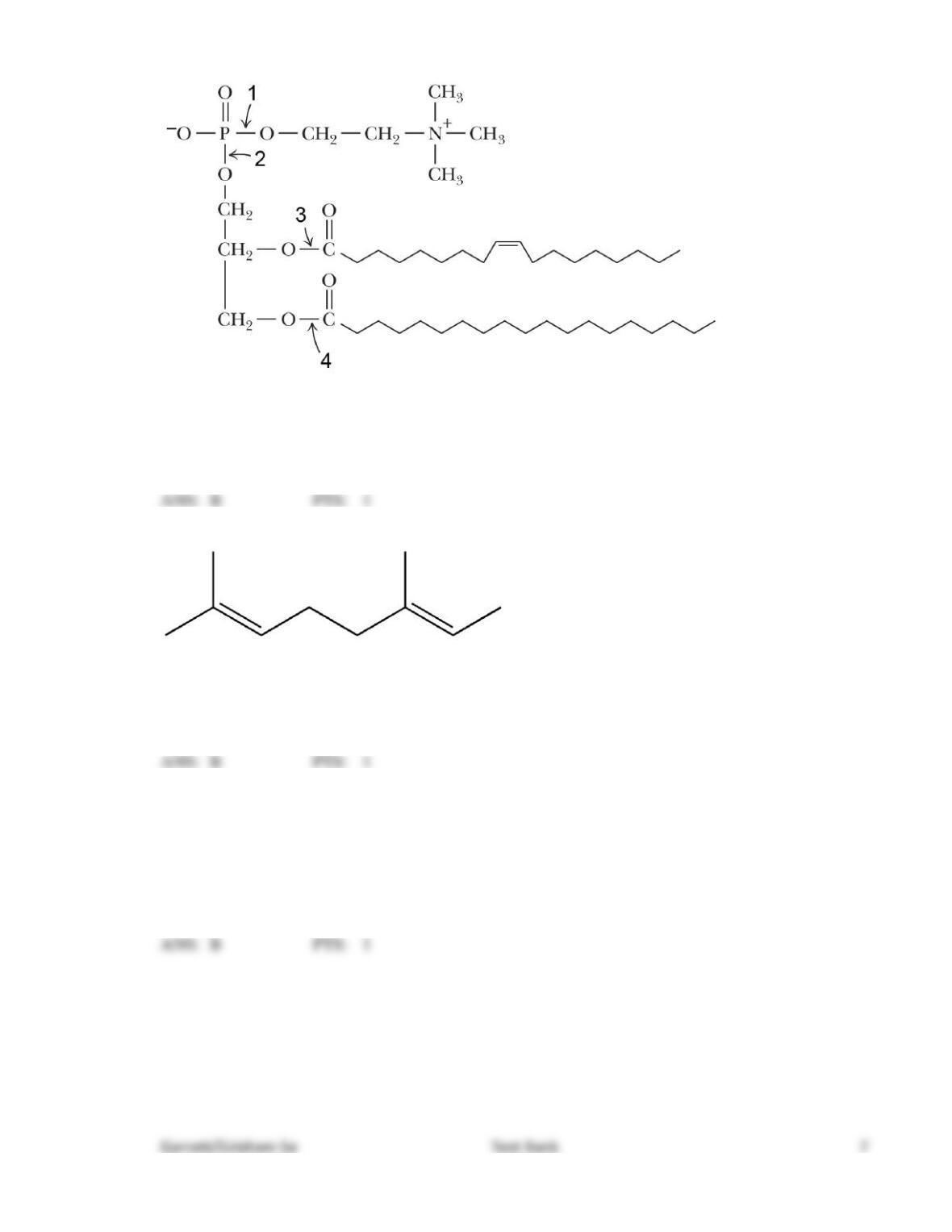
29. Which of the following bonds would be cleaved by phospholipase C?
a.
1
b.
2
c.
3
d.
4
e.
none of the above
30. Which of the following best describes the following molecule?
a.
a monoterpene with a tail-to-tail linkage
b.
a monoterpene with a head-to–tail linkage
c.
a diterpene with a tail-to-tail linkage
d.
a diterpene with a head-to-tail linkage
e.
none of the above
31. Which of the following would be considered an -3 fatty acid?
a.
linoleic acid: 9,12-octadecadieneoic acid (18:29,12)
b.
eicosapentaenoic acid: 5,8,11,14,17-eicosapentaenoic acid (20:55,8,11,14,17)
c.
-linolenic acid: 6,9,12-octadecatrieneoic acid (18:36,9,12)
d.
arachidonic acid: 5,8,11,14-eicosatetraenoic acid (20:45,8,11,14)
e.
none of the above