111. General Lighting
During the first quarter of 2012, the company sold 4,000 batteries on credit for $150 each plus state sales tax of
6%.
Refer to General Lighting. Sales taxes are required to be paid to the state taxing authority at the end of the
quarter. Which of the following records the sale of the batteries?
112. General Lighting
During the first quarter of 2012, the company sold 4,000 batteries on credit for $150 each plus state sales tax of
6%.
Refer to General Lighting. Sales taxes are required to be paid to the state taxing authority at the end of the
quarter. What is the amount of the current liability related to this transaction?
113. General Lighting
During the first quarter of 2012, the company sold 4,000 batteries on credit for $150 each plus state sales tax of
6%.
Refer to General Lighting. What is the amount of the accounts receivable as a result of this transaction?
114. General Lighting
During the first quarter of 2012, the company sold 4,000 batteries on credit for $150 each plus state sales tax of
6%.
Refer to General Lighting. The $150 price of each battery includes a $3 federal excise tax. Which of the
following statements is true regarding the proper accounting treatment for the taxes related to this transaction?
115. General Lighting
During the first quarter of 2012, the company sold 4,000 batteries on credit for $150 each plus state sales tax of
6%.
Refer to General Lighting. When the company records this transaction, what is the impact on the accounting
equation?
116. General Lighting
During the first quarter of 2012, the company sold 4,000 batteries on credit for $150 each plus state sales tax of
6%.
Refer to General Lighting. The price of each battery includes a $1.95 federal excise tax. Any taxes collected
must be paid to the appropriate governmental units at the end of the quarter. Which of the following is the
proper journal entry to record for the sale of the batteries?
117. On April 1, 2012, Guyton Sails accepted a $12,000 advance payment for maintaining a customer’s fleet of
sail boats. The contract is for a twelve month period. In May 2012, the company performed $1,200 worth of
repairs. What is the remaining liability that would appear on the company’s balance sheet at the end of May?
118. Georgia’s Salon
The salon sells $50,000 of gift cards in May 2012. These gift cards may be used anytime before their expiration
on May 31, 2013.
Refer to Georgia’s Salon. Which of the following is the correct journal entry to record the sale of the gift
cards?
119. Georgia’s Salon
The salon sells $50,000 of gift cards in May 2012. These gift cards may be used anytime before their expiration
on May 31, 2013.
Refer to Georgia’s Salon. During May 2013, $10,000 of the gift cards were redeemed for salon services. Which
of the following is the correct journal entry to record the redemption of the gift cards?
120. Georgia’s Salon
The salon sells $50,000 of gift cards in May 2012. These gift cards may be used anytime before their expiration
on May 31, 2013.
Refer to Georgia’s Salon. On May 31, 2013, all but $1,500 of the gift cards had been redeemed for salon
services. Which of the following is the correct journal entry to record for the expired gift cards?
121. Georgia’s Salon
The salon sells $50,000 of gift cards in May 2012. These gift cards may be used anytime before their expiration
on May 31, 2013.
Refer to Georgia’s Salon. On May 31, 2013, all but $1,500 of the gift cards had been redeemed for salon
services. What is the impact on the accounting equation of recording the expired gift cards?
122. Which of the following would appear only in the footnotes accompanying the financial statements?
123. German Auto Parts is a defendant in a multi-million dollar lawsuit that was filed in a prior year. The
lawsuit was not previously disclosed in the financial statements or accompanying footnotes, as the company has
vigorously defended its position and its attorneys initially indicated that the claim was not valid. During the
current year, however, the facts and circumstances have changed such that the likelihood of a loss
approximating $5 million is now considered reasonably possible. How should the company recognize this
lawsuit in its current year financial statements?
124. During January, Gaston Wholesalers experienced some difficulties with cash flow so it approached one of
its vendors about a payment extension. The vendor agreed to the extension on the condition that the company
sign a 30-day note that includes 9% interest. What journal entry is needed to record the retirement of the note on
the maturity date?
125. On August 1, 2012, Genuine Services accepted a $6,000 advance payment from a customer for services to
be provided in the future. The contract requires the company to review operations at each of the customer’s six
locations over the next six months. What is the impact on the accounting equation of recording this transaction
on August 1st?
126. Gibraltar, Inc.
A partial balance sheet for the company is provided below. Assume that all of the account balances on the
balance sheet are normal balances.
Gibraltar, Inc.
Partial Balance Sheet (in millions)
Assets (in order of liquidity):
Dec. 31, 2013
Dec. 31, 2012
Cash
$1,780
$1,649
Marketable securities
1,000
750
Accounts receivable
2,644
2,700
Inventories
3,010
2,950
Prepaid rent
500
500
Supplies
494
76
Total Current Assets
9,428
8,625
Liabilities (in order of magnitude):
Long-term debt
14,465
15,001
Other non-current liabilities
4,421
3,148
Long-term income taxes payable
3,504
3,543
Accounts payable
2,556
2,468
Other current liabilities
2,066
1,738
Accrued compensation and benefits
1,538
1,082
Short-term borrowing
1,200
1,126
Estimated warranty liability
793
928
Income taxes payable
658
1,142
Refer to the partial balance sheet presented above for Gibraltar, Inc. Compute the total current liabilities for December 31, 2013, and December 31,
2012.
Current liabilities include the following accounts and amounts (in order of magnitude):
Dec. 31, 2013
Dec. 31, 2012
Accounts payable
$2,556
$2,468
Other current liabilities
2,066
1,738
Accrued compensation and benefits
1,538
1,082
Short-term borrowing
1,200
1,126
127. Gibraltar, Inc.
A partial balance sheet for the company is provided below. Assume that all of the account balances on the
balance sheet are normal balances.
Gibraltar, Inc.
Partial Balance Sheet (in millions)
Assets (in order of liquidity):
Dec. 31, 2013
Dec. 31, 2012
Cash
$1,780
$1,649
Marketable securities
1,000
750
Accounts receivable
2,644
2,700
Inventories
3,010
2,950
Prepaid rent
500
500
Supplies
494
76
Total Current Assets
9,428
8,625
Liabilities (in order of magnitude):
Long-term debt
14,465
15,001
Other non-current liabilities
4,421
3,148
Long-term income taxes payable
3,504
3,543
Accounts payable
2,556
2,468
Other current liabilities
2,066
1,738
Accrued compensation and benefits
1,538
1,082
Short-term borrowing
1,200
1,126
Estimated warranty liability
793
928
Income taxes payable
658
1,142
Refer to the partial balance sheet presented above for Gibraltar, Inc. Compute the following liquidity ratios for 2013 and 2012:
Current Ratio
Quick Ratio
Cash Ratio
Comment on the direction and significance of the change in the ratios from 2012 to 2013.
The current ratio is computed by dividing current assets by current liabilities:
2013:
$9,428 / 8,811 = 1.07
2012:
$8,625 / 8,484 = 1.02
2013:
($1,780 + 1,000 + 2,644) / 8,811 = 0.6156
2012:
($1,649 + 750 + 2,700) / 8,484 = 0.6010
2013:
($1,780 + 1,000) / 8,811 = 0.3155
128. Glass Doctor
Selected information from the firm’s consolidated balance sheet is provided below. Assume that all of the
account balances on the balance sheet are normal balances.
Glass Doctor
Selected Information from the Consolidated Balance Sheet (in millions)
Assets (in alphabetical order):
Dec. 31, 2014
Dec. 31, 2013
Accounts receivable
$214.2
$124.9
Cash and cash equivalents
100.0
99.5
Inventories
72.1
75.6
Marketable securities
44.7
40.3
Other current assets
10.8
12.0
Property, plant and equipment
5,006.6
5,001.2
Liabilities (in alphabetical order):
Accounts payable and accrued expenses
14.4
15.4
Current portion of long-term debt
44.6
31.5
Income taxes payable
30.8
35.3
Long-term debt
350.0
246.8
Long-term income taxes payable
29.9
31.7
Notes payable due in 8 months
101.0
105.4
Other long-term liabilities
12.5
16.9
Refer to the partial balance sheet presented above for Glass Doctor. Compute the total current liabilities for December 31, 2014, and December 31,
2013.
Current liabilities include the following accounts and amounts:
Dec. 31, 2014
Dec. 31, 2013
Accounts payable and accrued expenses
$14.4
$15.4
Current portion of long-term debt
44.6
31.5
Income taxes payable
30.8
35.3
Notes payable due in 8 months
101.0
105.4
$190.8
$187.6
129. Glass Doctor
Selected information from the firm’s consolidated balance sheet is provided below. Assume that all of the
account balances on the balance sheet are normal balances.
Glass Doctor
Selected Information from the Consolidated Balance Sheet (in millions)
Assets (in alphabetical order):
Dec. 31, 2014
Dec. 31, 2013
Accounts receivable
$214.2
$124.9
Cash and cash equivalents
100.0
99.5
Inventories
72.1
75.6
Marketable securities
44.7
40.3
Other current assets
10.8
12.0
Property, plant and equipment
5,006.6
5,001.2
Liabilities (in alphabetical order):
Accounts payable and accrued expenses
14.4
15.4
Current portion of long-term debt
44.6
31.5
Income taxes payable
30.8
35.3
Long-term debt
350.0
246.8
Long-term income taxes payable
29.9
31.7
Notes payable due in 8 months
101.0
105.4
Other long-term liabilities
12.5
16.9
Refer to the partial balance sheet presented above for Glass Doctor. Compute the following liquidity ratios for 2014 and 2013:
Current Ratio
Quick Ratio
Cash Ratio
Operating Cash Flow Ratio
Assume that Glass Doctor’s statement of cash flows presented cash flows from operating activities of $204.6 million and $201.1 million for the years
ended December 31, 2014 and 2015, respectively. Comment on the direction and significance of the change in the ratios from 2013 to 2014.
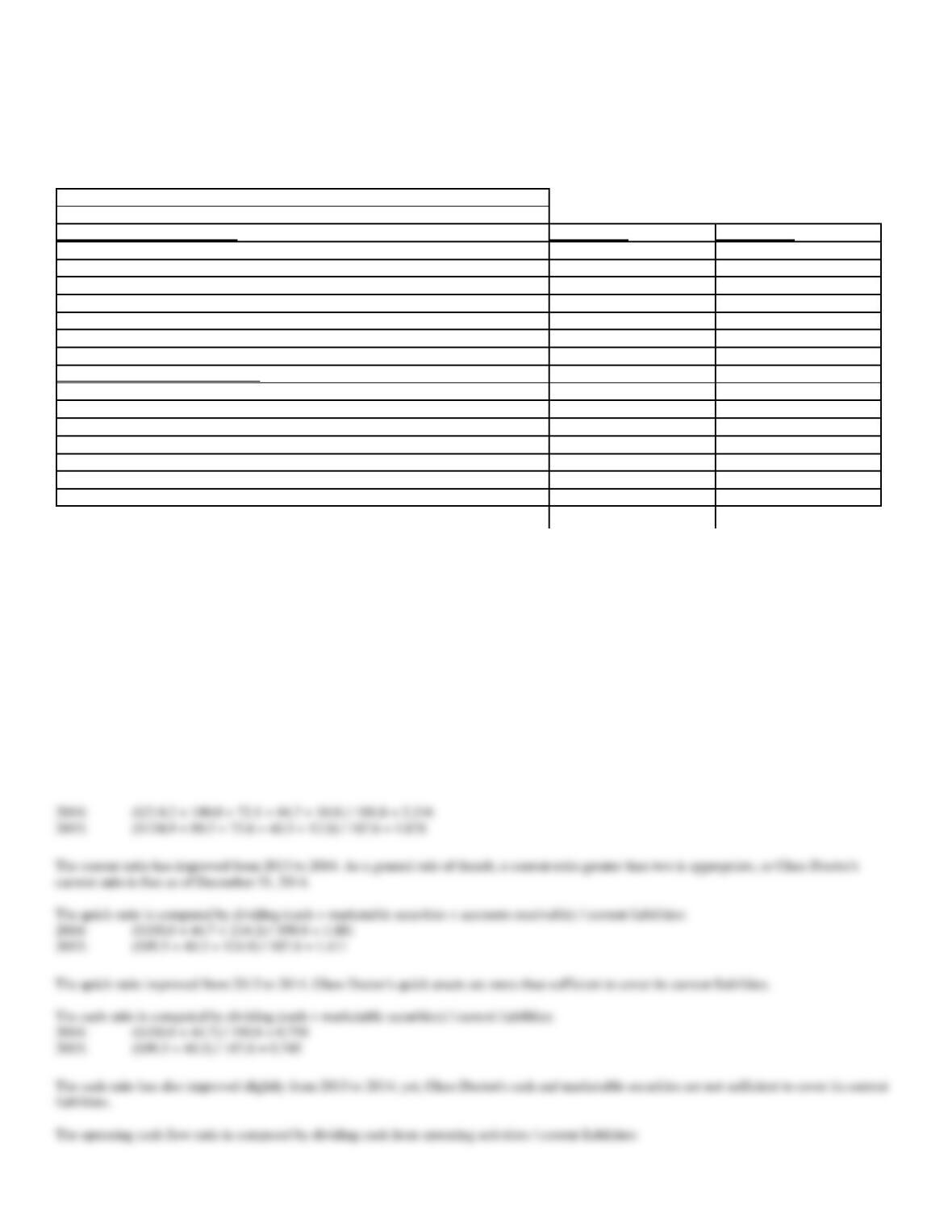
The current ratio is computed by dividing current assets by current liabilities:
2014:
($214.2 + 100.0 + 72.1 + 44.7 + 10.8) / 190.8 = 2.316
2013:
($124.9 + 99.5 + 75.6 + 40.3 + 12.0) / 187.6 = 1.878
2014:
($100.0 + 44.7 + 214.2) / 190.8 = 1.881
2013:
($99.5 + 40.3 + 124.9) / 187.6 = 1.411
2014:
($100.0 + 44.7) / 190.8 = 0.758
2013:
($99.5 + 40.3) / 187.6 = 0.745
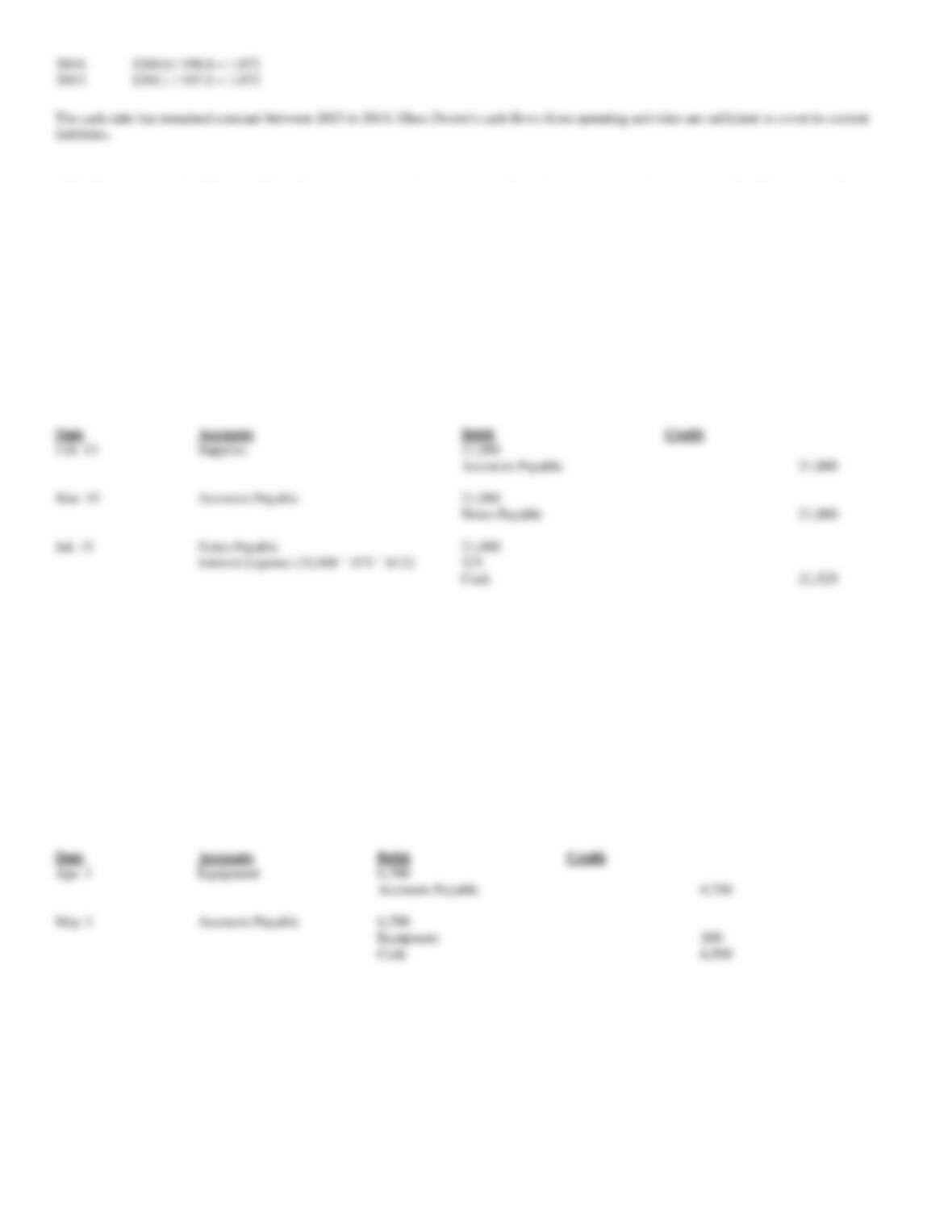
130. Every month, Glacier Distributors orders shipping supplies from a particular vendor. On February 13,
2013, the company orders supplies amounting to $21,000 on account, payable on March 15, 2013. Due to an
unexpected decline in business, the company is unable to pay its vendor on March 15th, and so asked for a
payment extension. The vendor granted the extension but requires the company to sign a note that specifies
7.5% interest beginning March 15, 2013, with a due date of July 15, 2013. The company pays the amount in full
on July 15, 2013.
Prepare the necessary journal entries for Glacier Distributors on February 13th, March 15th, and July 15th.
131. Gospel Ministries purchased on account two pianos on April 3, 2012 for $6,600. The company agreed to
pay an extra $100 to have the seller deliver the pianos. Unfortunately, one of the pianos was damaged during
transit. The seller agreed to deduct $200 from the amount owed. Gospel Ministries paid for the pianos in full
on May 3, 2012.
Prepare the journal entries that Gospel Ministries should make on April 3 and May 3.
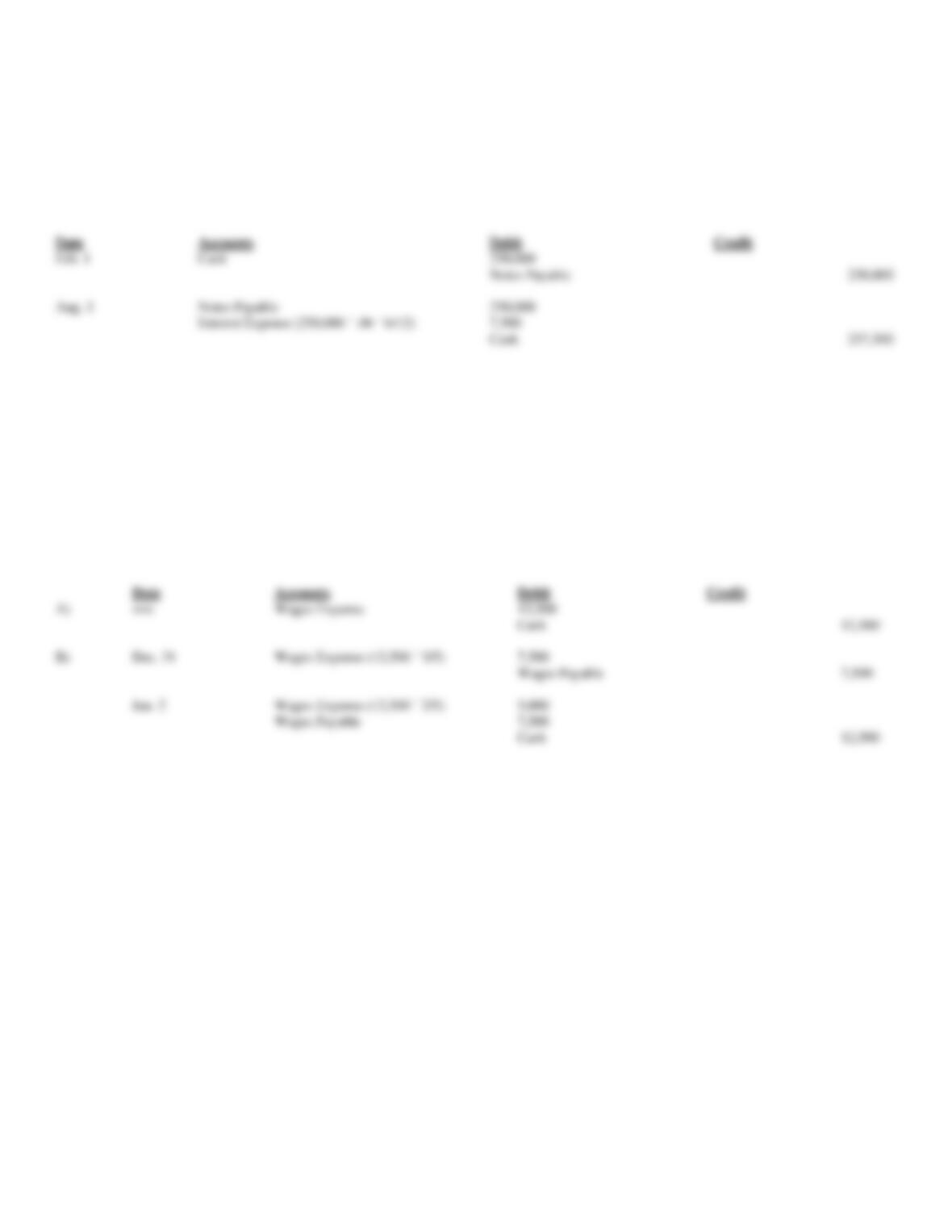
132. Groovy Swing is a retail store specializing in golf equipment and apparel. On February 1, 2014, the
company borrows $250,000 cash from the bank with a six-month, 6% note payable. The note is used to finance
the acquisition of inventory for the spring selling season.
Prepare the company’s necessary journal entries on February 1st and the note’s maturity date.
133. A company pays wages of $12,500 at the end of each five-day work week.
A)
What is the standard entry for wages paid on each pay date?
B)
Assuming the company’s year-end falls on a Wednesday, prepare the necessary journal entries on December 31st and on the January
2nd pay date.
A)
Wages Expense
12,500
Cash
Wages Payable
Jan. 2
Wages Expense (12,500 ´ 2/5)
5,000
Cash
Feb. 1
Cash
250,000
Aug. 1
Notes Payable
250,000
Interest Expense (250,000 ´ .06 ´ 6/12)
7,500
Cash
257,500