
Chapter 8—Current and Contingent Liabilities Key
1. An example of a current liability is a note payable that is due in two years.
2. An example of a current liability is the current maturity of a long-term debt.
3. An example of a current liability is a note payable that is due in eight months.
4. A liability must be recognized when a business is required to transfer assets or provide services to another
entity at some point in the future for activities that have already occurred.
5. When accrual basis accounting matches an expense to a period before it is actually paid, an adjusting entry is
necessary to record the accrued expense and corresponding liability.
6. Sales taxes collected from customers should be recorded in a liability account until the cash is passed along to
the taxing authority.
7. Employers withhold taxes from their employees’ gross pay and later pay these amounts withheld to the taxing
authority.
8. When a company sells goods or provides services for a customer but the customer intends to pay later, the
company must record a current liability.

9. Federal excise taxes payable is not a current liability.
10. Federal income taxes payable is not a current liability.
11. Current liabilities should include any amounts that have been accrued as expenses but not yet paid.
12. The proceeds from advance ticket sales for a concert to be held next month should be recorded as a current
liability.
13. When a company uses past experience to estimate the amount of likely warranty claims in the future, a
current liability account must be created.
14. A company’s management expects to incur future expenses related to the repair or replacement of defective
products sold. Those expenses must be matched to revenues in the period of the repair or replacement.
15. Warranty expenses result when a company sells products then estimates the units and cost per unit for
repairs and replacements that may occur during the warranty period.
16. A company provides a one-year warranty for its products. The estimated cost of parts and labor required to
satisfy warranty claims should be recorded as a current liability in the period the products are sold.
17. A probable loss from a lawsuit that can be reasonably estimated should not be reported on the balance sheet
as a current liability.

18. A company expects to receive a substantial cash settlement from a lawsuit. Therefore, the company must
record this on its accounting records if a reasonable estimate can be made of the amount to be received.
19. A contingent liability must be recorded if it is reasonably possible and the amount can be reasonably
estimated.
20. For any given contingent liability, a company must choose between recording it on the accounting records
or disclosing it in the footnotes to the financial statements
21. Contingent liabilities must be recorded in the accounting records if they are probable and the amount can be
reasonably estimated.
22. Interest on a note payable can be calculated by multiplying the amount owed by the interest rate by the
fraction of year that represents the time elapsed since borrowing.
23. The current ratio is calculated as follows: Current Assets / Current Liabilities.
24. The cash ratio is calculated by dividing current liabilities by the total of cash and marketable securities.
25. The cash ratio is calculated as follows: (Cash + Marketable Securities) / Current Liabilities.
26. The cash ratio is calculated by dividing cash flows from operating activities by current liabilities.

27. The operating cash flow ratio is calculated by dividing the cash flows from operating activities by current
liabilities.
28. The operating cash flow ratio is calculated by dividing current assets by cash flows from operating
activities.
29. The quick ratio is calculated as follows: (Cash + Marketable Securities + Accounts Receivable) / Current
Liabilities.
30. Liquidity relates to a company’s ability to sell its assets for amounts that exceed the assets’ book values.
31. Acceptable current ratios vary from industry to industry, but a general rule of thumb is that a current ratio
greater than ____________________ is appropriate.
32. The current ratio is computed by dividing current assets by ____________________.
33. The operating cash flow ratio is computed by dividing cash flows from operating activities by
____________.
34. A company has a note payable that is due on December 31, 2013. In its December 31, 2012, balance sheet,
this note payable should be classified as a(n) ____________________.
35. Accounts payable represent amounts owed to outside suppliers of goods and services; whereas
____________________ reflect amounts owed in which a formal agreement or contract has been signed.
36. An obligation that involves an existing condition for which the outcome is not known with certainty and
depends upon some event that will occur in the future is called a(n) ____________________.
37. A contingent liability must be recognized in the accounting records if it ____________________ and a
reasonable estimate of the loss can be made.
38. If no reasonable estimate of the loss can be made, then a contingent liability should be recognized in the
____________________.
39. ____________________ is the liability created when customers pay for goods or services in advance.
40. ____________________ are commitments that represent probable future sacrifices of economic benefits.
41. A(n) ____________________ usually guarantees the repair or replacement of defective goods during a
period ranging from a few days to several years following the sale.
42. When a company estimates the amount of expected warranty expenses to be incurred in the future pertaining
to past product sales, the account to be credited is called the ____________________.
43. ____________________ refers to the ability of a company to meet its short-term obligations.
44. Current liabilities require a transfer of assets or performance of services within the longer of
____________________ or one operating cycle.
45. A(n) ____________________ arises when a business purchases goods or services on credit.
46. A fast food restaurant sells gift cards which may be redeemed at any time; however, they expire in one year.
At the time these gift cards are sold, the account to be credited is called ____________________.
47. When a company records the gross wages paid to its employees, the accounts to be credited include various
taxes payable and ____________________.
48. When a retail company sells products to customers on credit for the amount of the sales price plus the
applicable sales tax, the related journal entry includes a debit to accounts receivable, a credit to sales revenue,
and a credit to ____________________.
49. An adjusting entry to record accrued interest on a note payable includes a debit to Interest Expense and a
credit to ____________________.
50. A flour mill orders grain sacks from a local farmer. When the company places an order for grain on account,
the corresponding journal entry includes a debit to Supplies and a credit to ____________________.
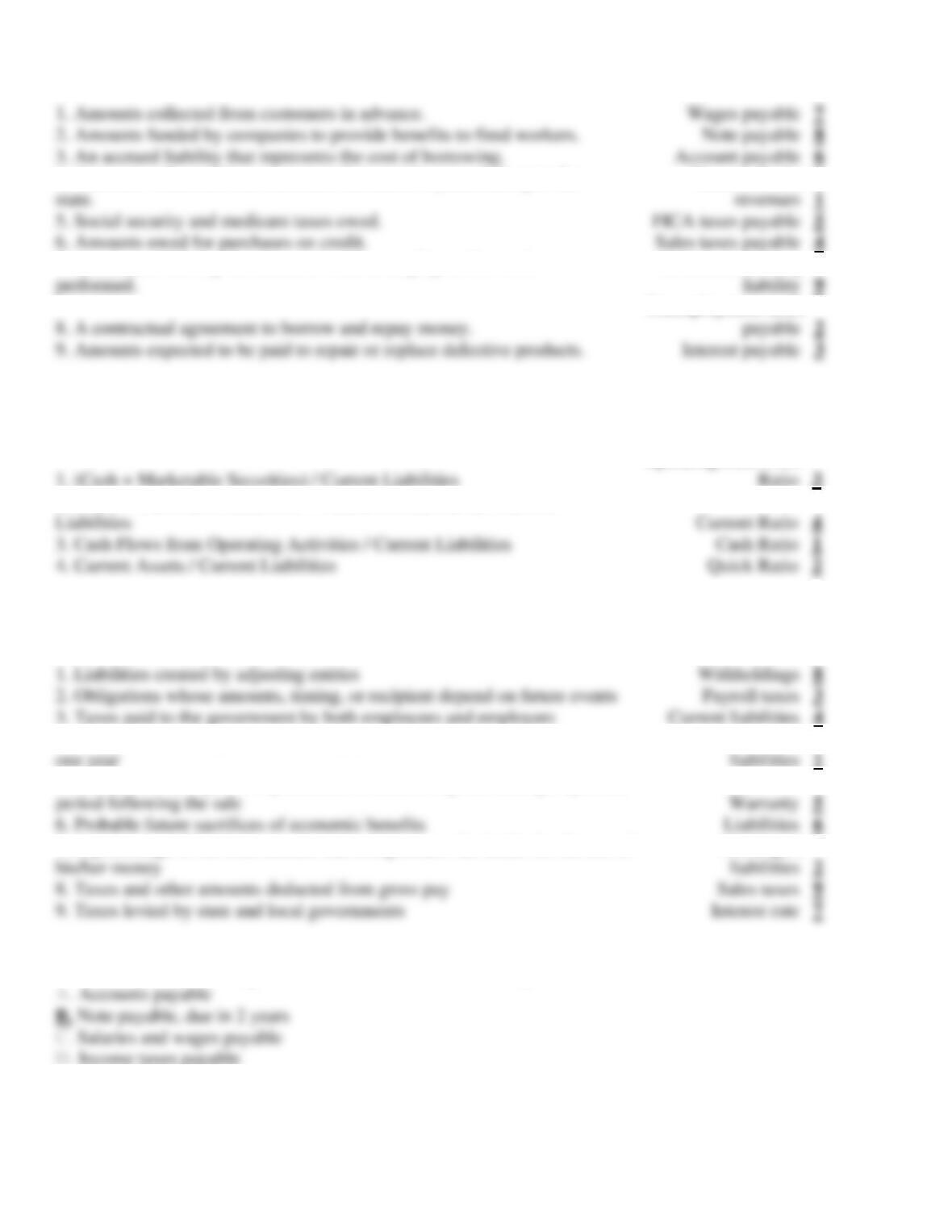
51. Match each of the following current liabilities with its meaning.
4. Amounts collected from customers that must be passed along to the
Unearned sales
7. An accrued liability for amounts owed to employees for work
Estimated warranty
Unemployment taxes
52. Match each of the ratios named with the proper formula for computation.
Operating Cash Flow
2. (Cash + Marketable Securities + Accounts Receivable) / Current
53. Match the following terms with the appropriate definition.
4. Obligations that require the firm to pay cash or another current asset within
Accrued
5. Guarantees the repair or replacement of defective goods during a specified
7. A percentage of the loan amount that compensates the lender for the use of
Contingent
54. Which of the following is not classified as a current liability account?
55. A current liability is defined as a commitment or obligation which requires a company to transfer assets,
create a new current liability, or provide services to another entity at some point in the future that must occur
56. A current liability includes obligations which must be repaid
57. The amount of a current liability reported on the balance sheet for interest payable includes
58. Which of the following statements regarding liabilities is true?
59. Which of the following statements regarding accounts payable is false?
60. What is the impact on the accounting equation of recording a payment to a supplier on account?
61. What is the impact on the accounting equation of recording the accrual of wages expense?
62. What is the impact on the accounting equation of recording the accrual of interest expense?
63. What is the impact on the accounting equation of recording the issuance of a short-term note payable?
64. Giff Services Company experienced some difficulties with cash flow so it approached one of its vendors
about a payment extension. The vendor agreed to the extension on the condition that the company sign a note
that includes 9% interest. What is the impact on the accounting equation of recording a note payable in
exchange for the account payable?
65. Which of the following statements about current liabilities is true?

66. GTO Division has $14,000 in current assets, $2,000 in accounts payable, and $2,000 in unearned sales
revenue. What is the division’s current ratio?
67. GTX Corp. has $100,000 in cash, $40,000 in inventory, $25,000 in accounts payable and $15,000 in
accrued liabilities (salaries, interest, taxes, etc.). If the company has $280,000 in cash flows from operating
activities, what is its operating cash flow ratio?
68. GT Company has $200 in cash, $500 in accounts receivable, and $700 in inventory. The company also has
$200 in accounts payable and $200 in unearned sales revenue. What is the company’s quick ratio?
69. Go Cars has $200 in cash, $500 in accounts receivable, $400 in marketable securities, and $700 in
inventory. Assuming the company also has $200 in accounts payable and $200 in unearned sales revenue, what
is its cash ratio?
70. A company has total assets of $350,000 consisting of current assets of $115,000, property, plant, and
equipment of $200,000, and other assets of $35,000. The company has total liabilities of $100,000 consisting
of current liabilities of $65,000 and other liabilities of $35,000. What is the current ratio?
71. A company has long-term assets of $2,000, current liabilities of $1,250, and long-term liabilities of $1,500.
If the current ratio is 2.5, then current assets must be
72. A company has cash of $800, current liabilities of $500, and long-term liabilities of $600. If the cash ratio is
2.5, then marketable securities must be
73. A company has current assets of $4,400, current liabilities of $2,750, and long-term liabilities of $5,500. If
the operating cash flow ratio is 1.5, then cash flows from operating activities must be
74. The payment of Accounts Payable results in a(n)
75. Assume a company has a current ratio of 2. Payment of accrued wages payable would cause the current
ratio to
76. Assume that a company has an operating cash flow ratio of 0.75. Payment of accrued wages payable would
cause the operating cash flow ratio to
77. Assume a company has a current ratio of .75. The purchase of inventory on account would cause the current
ratio to
78. Assume that a company has a current ratio of 3. Failure to record estimated warranty costs will cause the
current ratio to be
79. Assume that a company has a cash ratio of .45. Recording the estimated warranties expense on the period’s
sales would cause the cash ratio to
80. A landlord records the collection of a tenant’s security deposit as a(n)
81. A company has $8,000 in cash, $9,250 in accounts receivable, and $19,500 in inventory. If current liabilities
are $14,350, then the quick ratio will be
82. If a business has current assets of $62,000, total assets of $350,000, current liabilities of $31,000, and total
liabilities of $125,000, then its current ratio will be
83. A company has property, plant, and equipment of $500,000, current liabilities of $70,000, and long-term
liabilities are $300,000. If the company’s current ratio is 3.0, what are current assets?
84. Long-term assets are $5,000, current liabilities are $700, and long-term liabilities are $3,000 and the
operating cash flow ratio is 1.1, then the company’s cash flows from operating activities will be
85. There are some liabilities, such as income taxes payable and the estimated warranty liability, for which the
amounts must be estimated so they can be recorded in the same period as the related revenues. Failure to record
these amounts in the same period as the related revenues is a violation of the
86. A manufacturing company’s weekly payroll is $80,000 for a 5-day work week beginning each Monday and
ending each Friday. The last time salaries and wages were recorded was Friday, December 26. What adjustment
is needed on December 31, the last day of the company’s fiscal period?
87. An example of a current liability that must be accrued is
88. On October 1st, a company borrowed $60,000 from Eighth National Bank on a 1-year, 7% note. If the
company’s fiscal year ends on December 31st, a year-end adjusting entry is required to increase
89. A company’s employees earn $5,000 per day, work 5 days per week (Monday through Friday), and get paid
each Friday. If the previous payday was January 26 and the accounting period ends on January 31, what is the
ending balance in the wages payable account?
90. Gainesville Truck Center
This company has a weekly payroll of $10,000 for its employees who work Monday through Friday. Federal
and state income taxes are withheld in the amounts of $1,700 and $400, respectively, and FICA taxes are
withheld at a mandatory rate of 7.65% (6.2% for Social Security and 1.45% for Medicare). In addition, the
federal and state unemployment taxes are applied at rates of 2% and 5%, respectively. The company’s year-end
is December 31.
Refer to Gainesville Truck Center. Assuming December 31st falls on a Thursday, the year-end adjusting entry
would
91. Gainesville Truck Center
This company has a weekly payroll of $10,000 for its employees who work Monday through Friday. Federal
and state income taxes are withheld in the amounts of $1,700 and $400, respectively, and FICA taxes are
withheld at a mandatory rate of 7.65% (6.2% for Social Security and 1.45% for Medicare). In addition, the
federal and state unemployment taxes are applied at rates of 2% and 5%, respectively. The company’s year-end
is December 31.
Refer to Gainesville Truck Center. Which of the following statements is true regarding the entry to record
wages and the related liabilities?
92. Gainesville Truck Center
This company has a weekly payroll of $10,000 for its employees who work Monday through Friday. Federal
and state income taxes are withheld in the amounts of $1,700 and $400, respectively, and FICA taxes are
withheld at a mandatory rate of 7.65% (6.2% for Social Security and 1.45% for Medicare). In addition, the
federal and state unemployment taxes are applied at rates of 2% and 5%, respectively. The company’s year-end
is December 31.
Refer to the information for Gainesville Truck Center. Which of the following statements is true regarding the
entry to record wages and the related liabilities?
93. Gainesville Truck Center
This company has a weekly payroll of $10,000 for its employees who work Monday through Friday. Federal
and state income taxes are withheld in the amounts of $1,700 and $400, respectively, and FICA taxes are
withheld at a mandatory rate of 7.65% (6.2% for Social Security and 1.45% for Medicare). In addition, the
federal and state unemployment taxes are applied at rates of 2% and 5%, respectively. The company’s year-end
is December 31.
Refer to Gainesville Truck Center. When the company journal entry is recorded for the payment of these
wages and related liabilities, which of the following statements is true regarding the impact on the accounting
equation?
94. Gainesville Truck Center
This company has a weekly payroll of $10,000 for its employees who work Monday through Friday. Federal
and state income taxes are withheld in the amounts of $1,700 and $400, respectively, and FICA taxes are
withheld at a mandatory rate of 7.65% (6.2% for Social Security and 1.45% for Medicare). In addition, the
federal and state unemployment taxes are applied at rates of 2% and 5%, respectively. The company’s year-end
is December 31.
Refer to Gainesville Truck Center. Which of the following expense accounts will be recorded as a result of this
payroll transaction?
1
Wages Expense
2
Federal Unemployment Tax Expense
3
State Unemployment Tax Expense
4
Social Security Tax Expense
5
Medicare Tax Expense
95. Gainesville Truck Center
This company has a weekly payroll of $10,000 for its employees who work Monday through Friday. Federal
and state income taxes are withheld in the amounts of $1,700 and $400, respectively, and FICA taxes are
withheld at a mandatory rate of 7.65% (6.2% for Social Security and 1.45% for Medicare). In addition, the
federal and state unemployment taxes are applied at rates of 2% and 5%, respectively. The company’s year-end
is December 31.
Refer to Gainesville Truck Center. Which of the following statements is true regarding the FICA taxes that
must be recorded?
96. Gainesville Truck Center
This company has a weekly payroll of $10,000 for its employees who work Monday through Friday. Federal
and state income taxes are withheld in the amounts of $1,700 and $400, respectively, and FICA taxes are
withheld at a mandatory rate of 7.65% (6.2% for Social Security and 1.45% for Medicare). In addition, the
federal and state unemployment taxes are applied at rates of 2% and 5%, respectively. The company’s year-end
is December 31.
Refer to Gainesville Truck Center. Which of the following statements is true regarding the unemployment
taxes to be recorded?
97. Gainesville Truck Center
This company has a weekly payroll of $10,000 for its employees who work Monday through Friday. Federal
and state income taxes are withheld in the amounts of $1,700 and $400, respectively, and FICA taxes are
withheld at a mandatory rate of 7.65% (6.2% for Social Security and 1.45% for Medicare). In addition, the
federal and state unemployment taxes are applied at rates of 2% and 5%, respectively. The company’s year-end
is December 31.
Refer to Gainesville Truck Center. What is the impact on the accounting equation of the journal entry for the
employer’s tax expenses and related liabilities for this payroll transaction?
98. A company whose fiscal year ends December 31, has a weekly payroll of $100,000. Employees work 5
days per week, Monday through Friday and payday is every Friday. How much wages expense will be recorded
on the Friday, January 3 payday?
99. On May 1, a company borrowed $30,000 from the First National Bank on a 1-year, 6% note. Assuming the
company keeps its records on a calendar year basis, an entry is needed on December 31st to increase
100. Which of the following would appear on the balance sheet as a current liability?
101. Which of the following would appear on the balance sheet as a current liability?
102. During 2012, Gardner Home Center sold 800 power washers for $350 each. The power washers carry a 2-
year warranty for repairs. Estimates indicate that repair costs will average 2% of sales. How much warranty
expense should be accrued as a result of the 2012 sales of this product?
103. During 2012, Going, Going, Gone sold 100 hot air balloons for $4,000 each. The balloons carry a 5-year
warranty for defects. Estimates indicate that repair costs will average 4% of the total selling price. The
estimated warranty liability at the beginning of the year was $42,000. $11,000 in claims was actually incurred
during the year to honor their warranty. What was the balance in the estimated warranty liability at the end of
the year?
104. During 2012, Great Adventures sold 150 dune buggies for $4,000 each. The dune buggies carry a 5-year
warranty for defects. Estimates suggest that repair costs will average 4% of the total selling price. The estimated
warranty liability at the beginning of the year was $14,000, and $20,000 in claims was actually incurred during
2012 to honor the warranty. What was the warranty expense for 2012?
105. Which of the following statements regarding contingent liabilities is true?
106. A cookie company includes one premium coupon in every cookie package. Upon returning 10 such
coupons to the company, the customer will be sent a free cookie jar. In a recent year, the company sold 200,000
packages of cookies for $1 per package. It is estimated that 20% of the coupons will be redeemed. If the cookie
jars cost the company $3 each, what amount of liability should be recorded?
107. A company is required to estimate a liability for repairs for products sold with a warranty. In the year
following the sale, the firm’s accountants find that the estimated amount for repairs has been overstated. The
correct accounting procedure in the year following the sale is to
108. A retail company issues numerous discount coupons throughout the year. A balance in the estimated
liability account indicates
109. Geiss Motorsports sold 50 motorbikes for $1,000 each. The bikes carry a 2-year warranty for repairs.
Estimates indicate that repair costs will average 2% of the total selling price. What is the amount that would be
recorded in the estimated warranty liability account as a result of selling the bikes?
110. The total amount of interest that will be paid on a 5-year, $90,000 note payable at 11% simple annual
interest is?