168 Chapter 8 Risk and Rates of Return
33. Which of the following statements is most correct?
a.
According to CAPM theory, the required rate of return on a given stock can be found by
use of the SML equation:
ki = kRF + (kM – kRF)I
Expectations for inflation are not reflected anywhere in this equation, even indirectly, and
because of that the text notes that the CAPM may not be strictly correct.
b.
If the required rate of return is given by the SML equation as set forth in Answer a, there
is nothing a financial manager can do to changer his or her company’s cost of capital,
because each of the elements in the equation is determined exclusively by the market, not
by the type of actions a company’s management can take, even in the long run.
c.
Assume that the required rate of return on the market is currently kM = 15%, and that kM
remains fixed at that level. If the yield curve has a steep upward slope, the calculated
market risk premium would be larger if the 30-day T-bill rate were used as the risk-free
rate than if the 30-year T-bond rate were used as kRF.
d.
Statements a and b are both true.
e.
Statements a and c are both true.
34. Which of the following statements is most correct?
a.
If investors become more risk averse, but kRF remains constant, the required rate of return
on high beta stocks will rise, the required return on low beta stocks will decline, but the
required return on an average risk stock will not change.
b.
If Mutual Fund A held equal amounts of 100 stocks, each of which had a beta of 1.0, and
Mutual Fund B held equal amounts of 10 stocks with betas of 1.0, then the two mutual
funds would have betas of 1.0 and thus would be equally risky from an investor’s
standpoint.
c.
An investor who holds just one stock will be exposed to more risk than an investor who
holds a portfolio of stocks, assuming the stocks are all equally risky. Since the holder of
the 1-stock portfolio is exposed to more risk, he or she can expect to earn a higher rate of
return to compensate for the greater risk.
d.
Assume that the required rate of return on the market , kM, is given and fixed. If the yield
curve were upward-sloping, then the Security Market Line (SML) would have a steeper
slope if 1-year Treasury securities were used as the risk-free rate than if 30-year Treasury
bonds were used for kRF.
e.
Statements a, b, c, and d are all false.
35. Based on the information given below, which of the following statements is incorrect?
Investment
D
E
F
Expected return,
15.0%
18.0%
18.0%
Standard deviation,
10.0%
12.0%
20.0%
a.
Based on both risk and return, Investment D and Investment E should be considered
equally risky.
b.
If Investment F is negatively related to both Investment D and Investment E, then
combining Investment F with both Investment D and Investment E would always produce
a portfolio with lower risk than a portfolio of Investment F and either one of the other
investments combined.
Chapter 8 Risk and Rates of Return 169
c.
Investment F is the most desirable security for investors who are risk averse and who want
to hold a one-security portfolio.
d.
An investor can purchase positive amounts of Investment D and Investment F and form a
two-security portfolio with a return greater than 18 percent and a standard deviation less
than 10 percent.
e.
None of the above statements is correct.
36. Given the following probability distributions, what are the expected returns for the Market and
for Security J?
1
0.3
-10%
40%
2
0.4
10
-20
3
0.3
30
30
a.
10.0%; 11.3%
b.
9.5%; 13.0%
c.
10.0%; 9.5%
d.
10.0%; 13.0%
e.
13.0%; 10.0%
37. If the risk-free rate is 7 percent, the expected return on the market is 10 percent, and the expected
return on Security J is 13 percent, what is the beta of Security J?
a.
1.0
b.
1.5
c.
2.0
d.
2.5
e.
3.0
38. HR Corporation has a beta of 2.0, while LR Corporation’s beta is 0.5. The risk-free rate is 10%,
and the required rate of return on an average stock is 15%. Now the expected rate of inflation
built into kRF falls by 3 percentage points, the real risk-free rate remains constant, the required
return on the market falls to 11%, and the betas remain constant. When all of these changes are
made, what will be the difference in required returns on HR’s and LR’s stocks?
a.
1.0%
b.
2.5%
c.
4.5%
d.
5.4%
e.
6.0%
170 Chapter 8 Risk and Rates of Return
39. Stock X and the “market” had the following returns during the last three years, and the same
relative volatility is expected to exist in the future:
Year
Stock X
Market
1
15.0
10.0
2
5.0
5.0
3
-15.0
-5.0
The riskless rate is kRF = 8%, and the expected return on the market is 12 percent. If equilibrium
exists, what is the expected return on Stock X?
a.
-4%
b.
8%
c.
12%
d.
14%
e.
16%
Chapter 8 Risk and Rates of Return 171
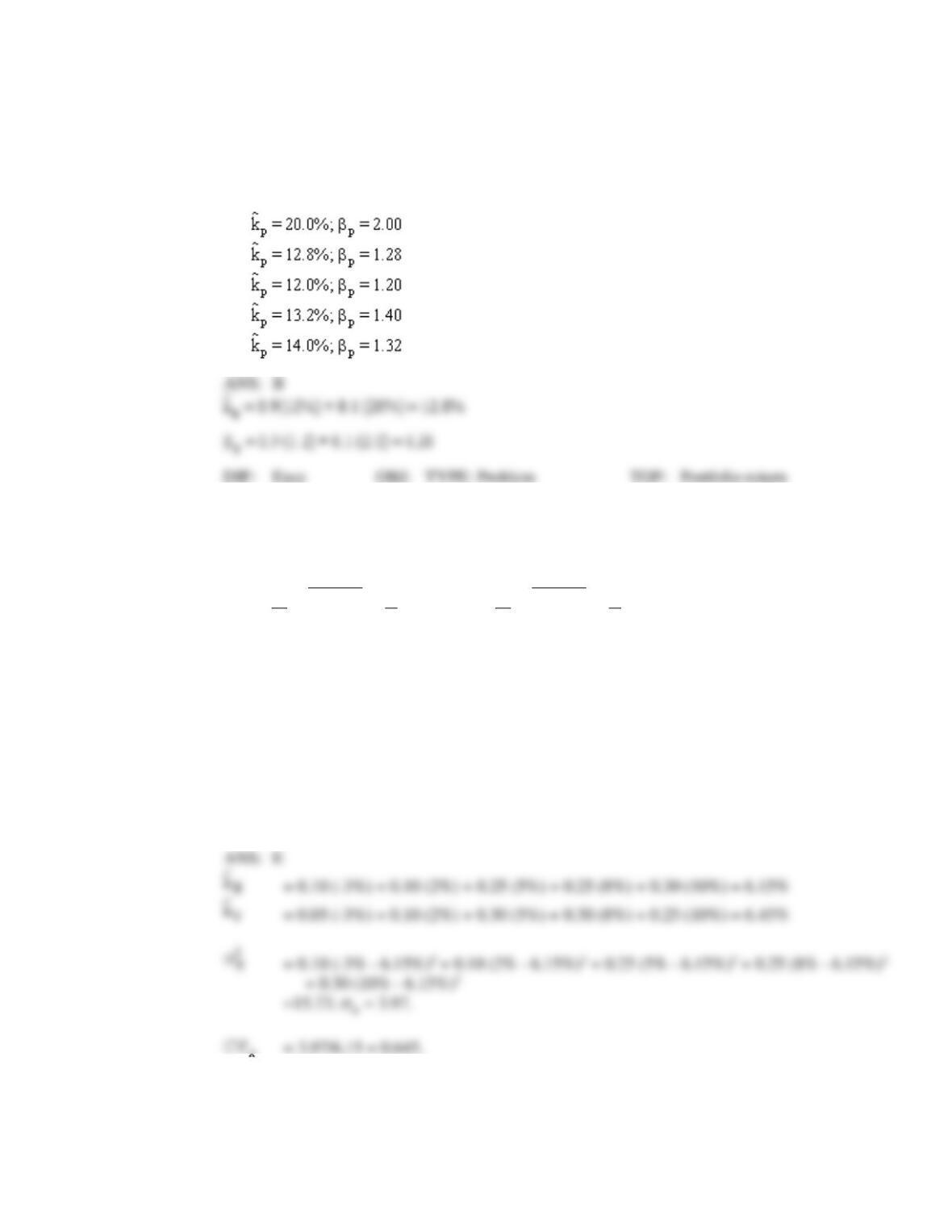
40. You are an investor in common stock, and you currently hold a well-diversified portfolio which
has an expected return of 12 percent, a beta of 1.2, and a total value of $9,000. You plan to
increase your portfolio by buying 100 shares of AT&E at $10 a share. AT&E has an expected
return of 20 percent with a beta of 2.0. What will be the expected return and the beta of your
portfolio after you purchase the new stock?
a.
b.
c.
d.
e.
41. Assume that a new law is passed which restricts investors to holding only one asset. A risk-averse
investor is considering two possible assets as the asset to be held in isolation. The assets’ possible
returns and related probabilities (i.e., the probability distributions) are as follows:
Asset X
Asset Y
Pr
K
Pr
K
0.10
-3%
0.05
-3%
0.10
2
0.10
2
0.25
5
0.30
5
0.25
8
0.30
8
0.30
10
0.25
10
Which asset should be preferred?
a.
Asset X, since its expected return is higher.
b.
Asset Y, since its beta is probably lower.
c.
Either one, since the expected returns are the same.
d.
Asset X, since its standard deviation is lower.
e.
Asset Y, since its coefficient of variation is lower and its expected return is higher.
= 0.05 (-3%) + 0.10 (2%) + 0.30 (5%) + 0.30 (8%) + 0.25 (10%) = 6.45%
172 Chapter 8 Risk and Rates of Return
42. Calculate the standard deviation of the expected dollar returns for Ditto Copier Center, given the
following distribution of returns:
Probability
Return
0.2
$50
0.5
$20
0.3
-$15
a.
$36.0
b.
$23.0
c.
$18.0
d.
$13.0
e.
$30.0
43. Consider the following information, and then calculate the required rate of return for the
Scientific Investment Fund. The total investment in the fund is $2 million. The market required
rate of return is 15 percent, and the risk-free rate is 7 percent.
Stock
Investment
Beta
A
$ 200,000
1.50
B
300,000
-0.50
C
500,000
1.25
D
1,000,000
0.75
a.
14.3%
b.
15.0%
c.
13.1%
d.
12.7%
e.
10.3%
A
0.10
1.50
0.150
B
0.15
D
0.50
0.75
0.375
Chapter 8 Risk and Rates of Return 173
44. Oakdale Furniture Inc. has a beta coefficient of 0.7 and a required rate of return of 15 percent.
The market risk premium is currently 5 percent. If the inflation premium increases by 2
percentage points, and Oakdale acquires new assets which increase its beta by 50 percent, what
will be Oakdale’s new required rate of return?
a.
13.5%
b.
22.8%
c.
18.75%
d.
15.25%
e.
17.00%
45. Company X has beta = 1.6, while Company Y’s beta = 0.7. The risk-free rate is 7%, and the
required rate of return on an average stock is 12%. Now the expected rate of inflation built into
kRF rises by 1 percentage point, the real risk-free rate remains constant, the required return on the
market rises to 14%, and betas remain constant. After all of these changes have been reflected in
the data, by how much will the required return on Stock X exceed that on Stock Y?
a.
3.75%
b.
4.20%
c.
4.82%
d.
5.40%
e.
5.75%
174 Chapter 8 Risk and Rates of Return
46. You hold a diversified portfolio consisting of a $5,000 investment in each of 20 different
common stocks. The portfolio beta is equal to 1.15. You have decided to sell one of your stocks, a
lead mining stock whose = 1.0, for $5,000 net and to use the proceeds to buy $5,000 of stock in
a steel company whose = 2.0. What will be the new beta of the portfolio?
a.
1.12
b.
1.20
c.
1.22
d.
1.10
e.
1.15
47. You are managing a portfolio of 10 stocks which are held in equal amounts. The current beta of
the portfolio is 1.64, and the beta of Stock A is 2.0. If Stock A is sold, what would the beta of the
replacement stock have to be to produce a new portfolio beta of 1.55?
a.
1.10
b.
1.00
c.
0.90
d.
0.75
e.
0.50
CAPM Analysis
You have been asked to use a CAPM analysis to choose between stocks R and s, with your choice
being the one whose expected rate of return exceeds its required rate of by the widest margin. The
risk-free rate is 6%, and the required return on an average stock (or “the market”) is 10%. Your
security analyst tells you that Stock S’s expected rate of return is , while Stock R’s
expected rate of return in . The CAPM is assumed to be a valid method for selecting
stocks, but the expected return for any given investor (such as you) can differ from the required
rate of return for a given stock. The following past rates of return are to be used to calculate the
Chapter 8 Risk and Rates of Return 175
two stocks’ beta coefficients, which are then to be used to determine the stocks’ required rates of
return.
Year
Stock R
Stock S
Market
1
-15%
0%
-5%
2
5
5
5
3
25
10
15
Note: The averages of the historical returns are not needed, and they are generally not equal to the
expected future returns.
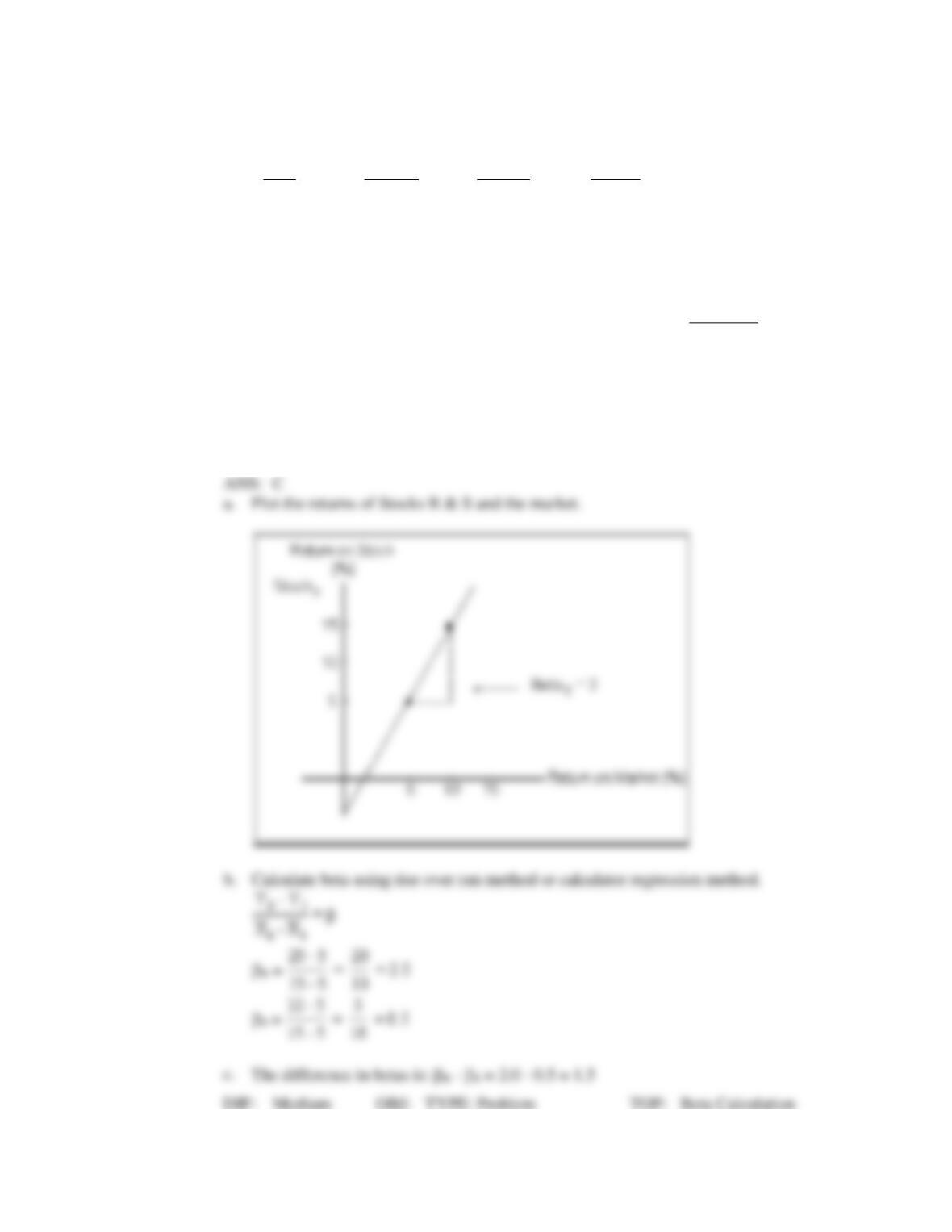
48. Refer to CAPM Analysis. Calculate both stocks’ betas. What is the difference between the betas,
i.e., what is the value of betaR – betaS? (Hint: The graphical method of calculating the rise over
run, or (Y2 – Y1) divided by (X2 – X1) may aid you.)
a.
0.0
b.
1.0
c.
1.5
d.
2.0
e.
2.5
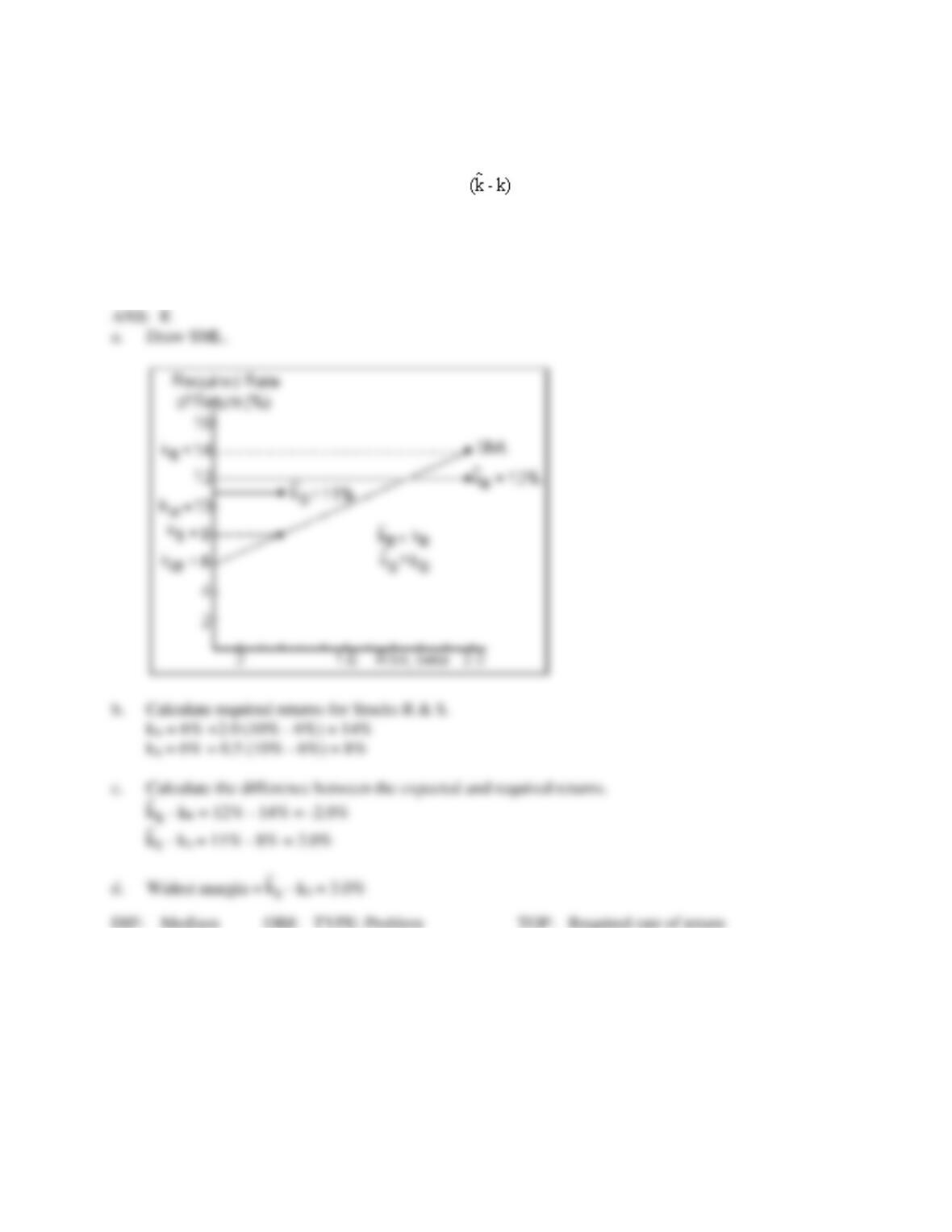
176 Chapter 8 Risk and Rates of Return
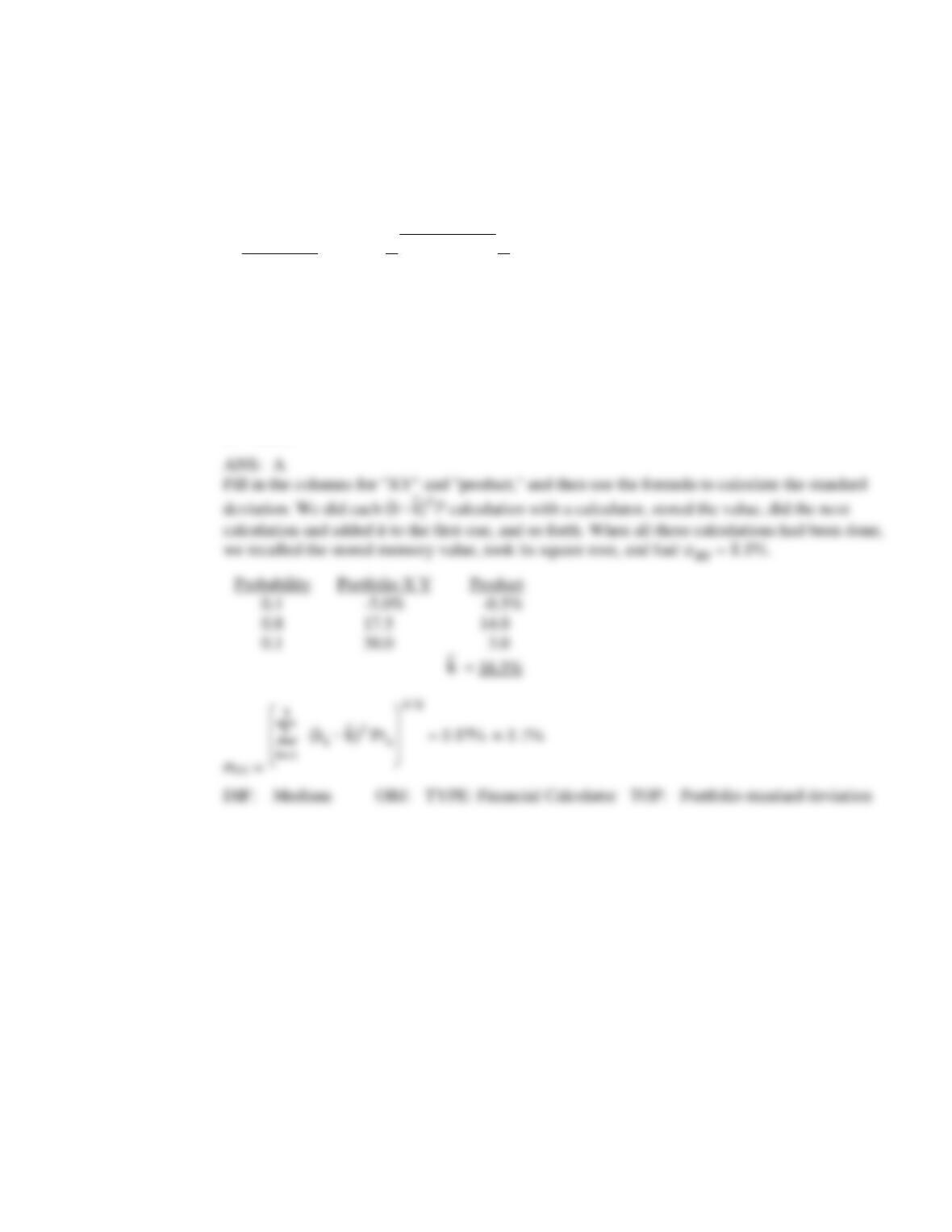
49. Refer to CAPM Analysis. Set up the SML equation and use it to calculate both stocks’ required
rates of return, and compare those required returns with the expected returns given above. You
should invest in the stock whose expected return exceeds its required return by the widest margin.
What is the widest margin, or greatest excess return ?
a.
0.0%
b.
0.5%
c.
1.0%
d.
2.0%
e.
3.0%
Chapter 8 Risk and Rates of Return 177
Financial Calculator Section
The following question(s) may require the use of a financial calculator.
50. Here are the expected returns on two stocks:
Returns
Probability
X
Y
0.1
-20%
10%
0.8
20
15
0.1
40
20
If you form a 50-50 portfolio of the two stocks, what is the portfolio’s standard deviation?
a.
8.1%
b.
10.5%
c.
13.4%
d.
16.5%
e.
20.0%
0.1
0.8