Exam
Name___________________________________
MULTIPLE CHOICE. Choose the one alternative that best completes the statement or answers the question.
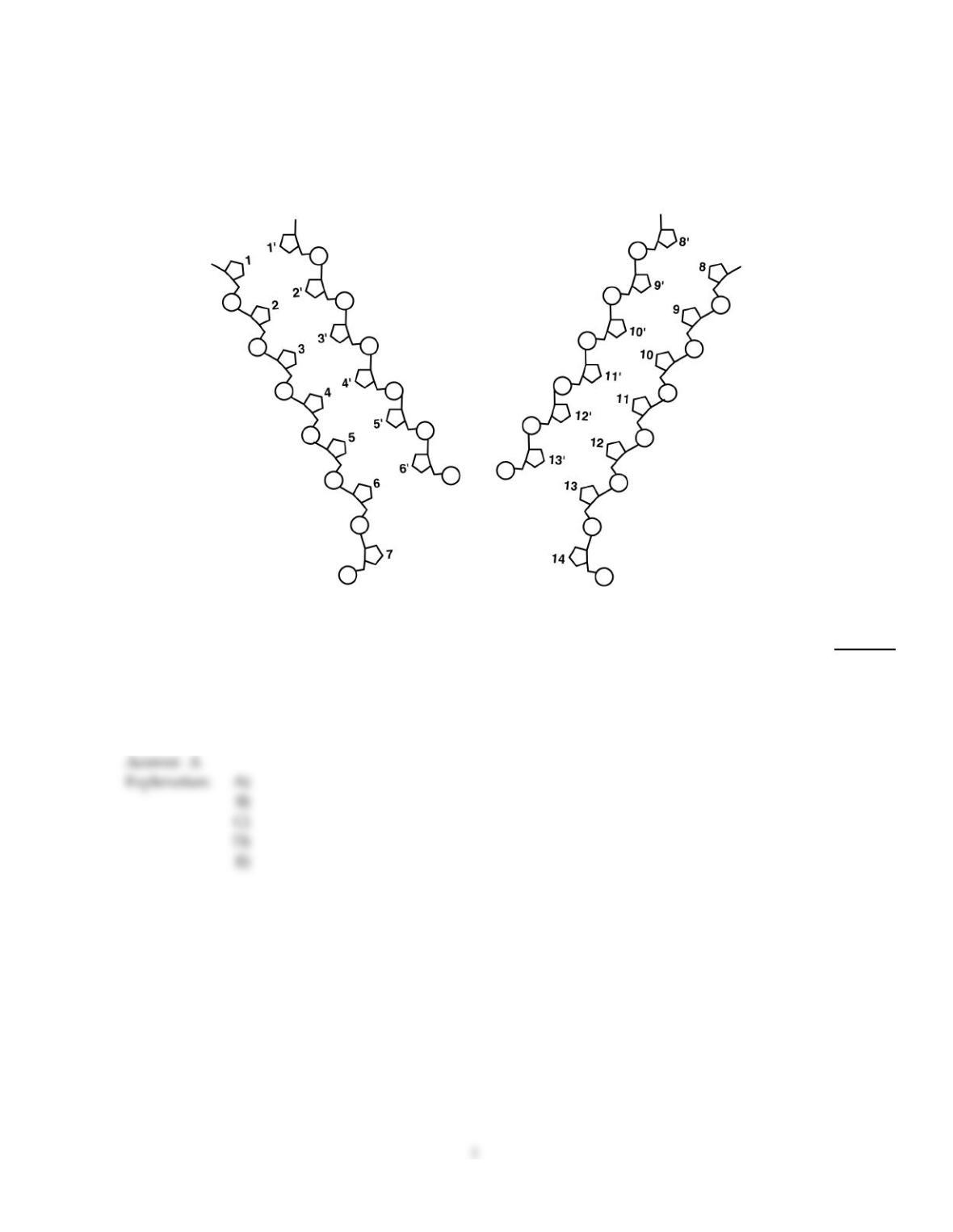
Figure 8.2
REPLICATION FORK
1)
In Figure 8.2, base 2 is attached to
1)
A)
deoxyribose.
B)
thymine.
C)
phosphate.
D)
ribose.
E)
The answer cannot be determined based on the information provided.
A
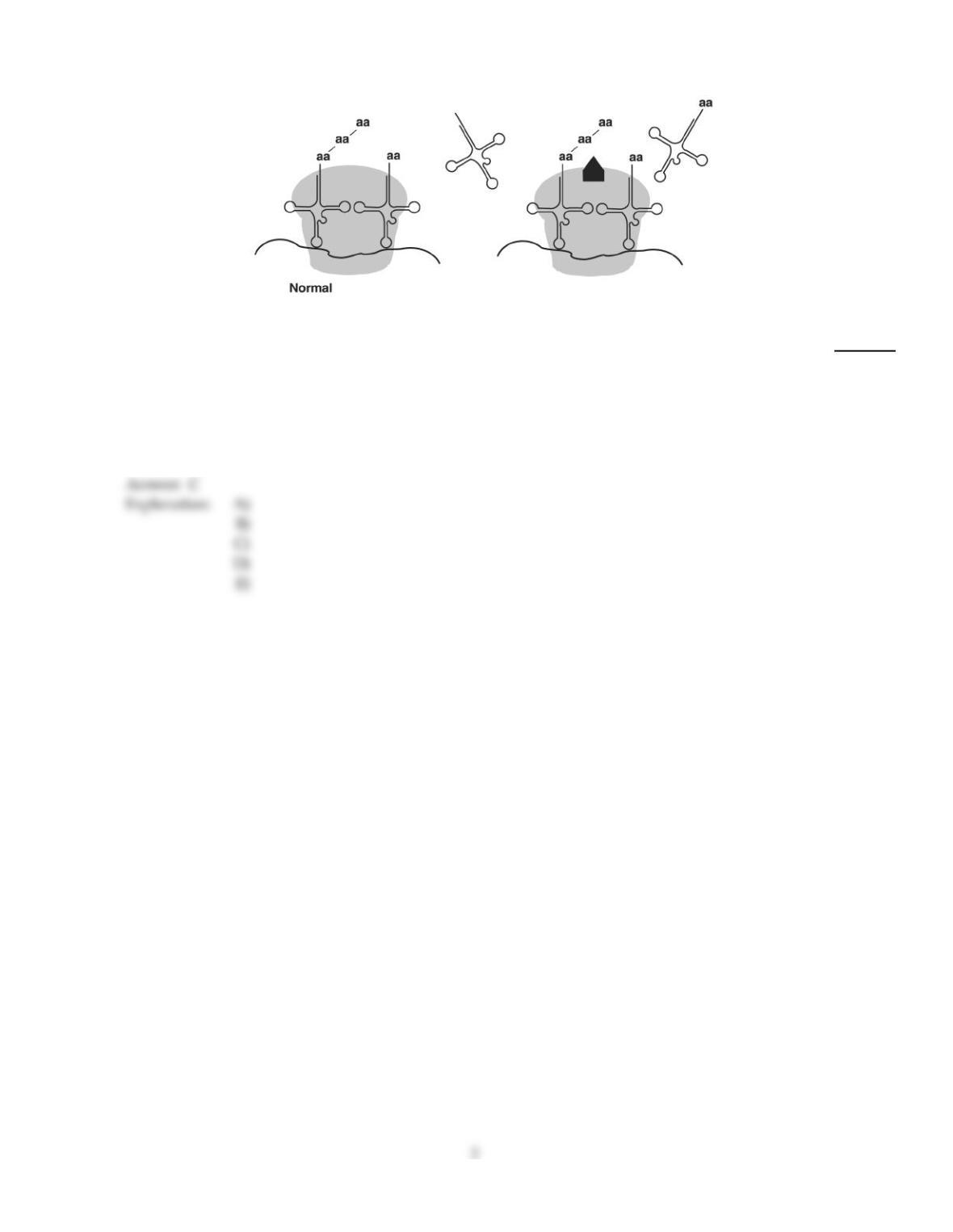
Figure 8.4
2)
In Figure 8.4, the antibiotic chloramphenicol binds the 50S ribosome as shown. From this
information you can conclude that chloramphenicol
2)
A)
prevents translation in eukaryotes.
B)
prevents mRNA–ribosome binding.
C)
prevents translation in prokaryotes.
D)
prevents transcription in prokaryotes.
E)
prevents transcription in eukaryotes.
3)
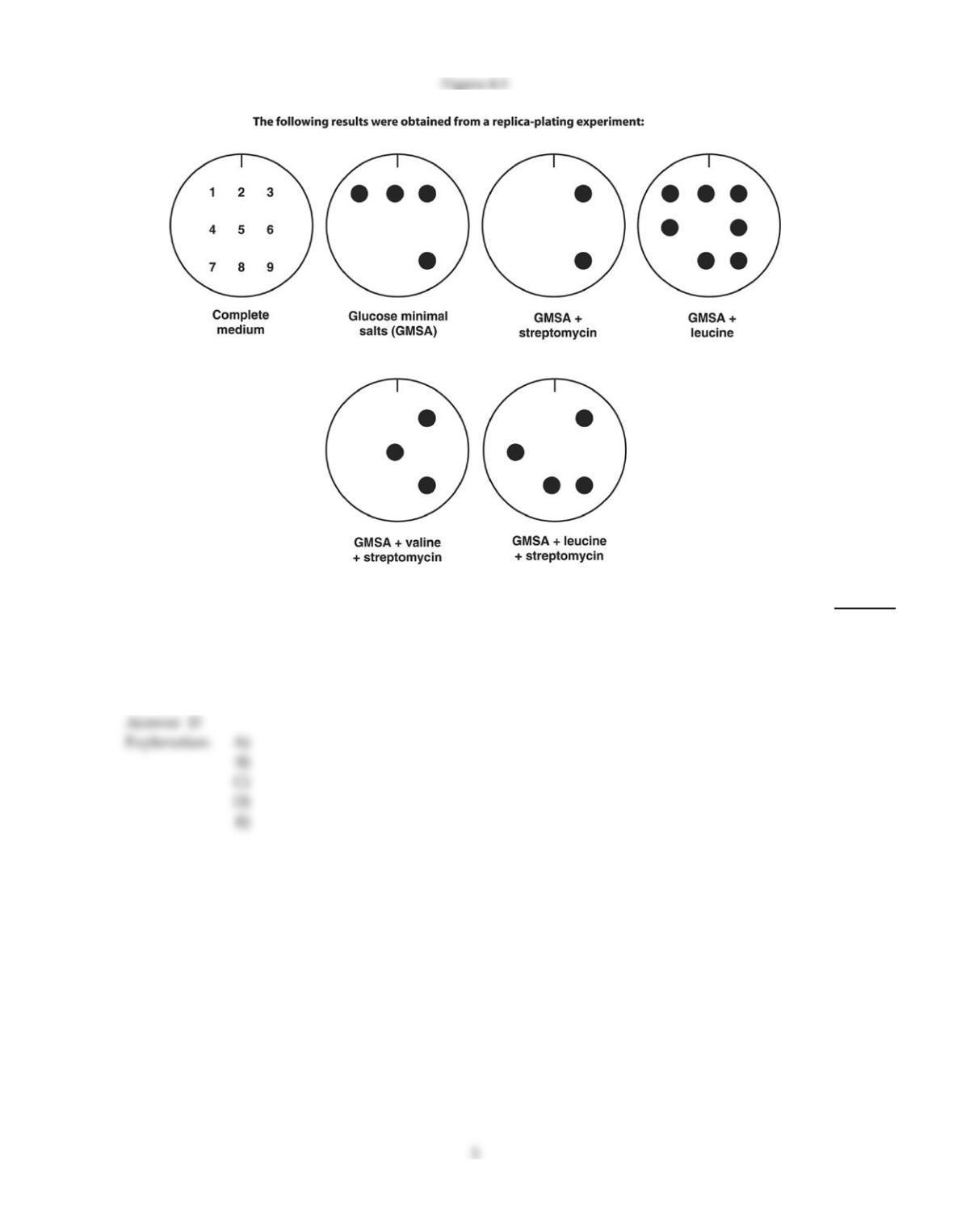
In Figure 8.1, which colonies are streptomycin–resistant and leucine–requiring?
3)
A)
5 and 6
B)
4, 6, and 8
C)
1, 2, 3, and 9
D)
4 and 8
E)
3 and 9
4)
In Figure 8.3, if enzyme A is an inducible enzyme,
4)
A)
compound C would bind to the repressor.
B)
compound B would bind to enzyme A.
C)
compound A would bind to the repressor.
D)
compound C would react with gene a.
E)
compound A would react with enzyme B.
5)
A gene is best defined as
5)
A)
three nucleotides that code for an amino acid.
B)
a transcribed unit of DNA.
C)
a sequence of nucleotides in DNA that codes for a functional product.
D)
a sequence of nucleotides in RNA that codes for a functional product.
E)
a segment of DNA.
6)
Which of the following pairs is mismatched?
6)
A)
DNA ligase — joins segments of DNA
B)
RNA polymerase — makes a molecule of RNA from an RNA template
C)
DNA polymerase — makes a molecule of DNA from a DNA template
D)
DNA gyrase — coils and twists DNA
E)
transposase — insertion of DNA segments into DNA
7)
Which of the following statements regarding a bacterium that is R+is FALSE?
7)
A)
It possesses a plasmid.
B)
R+ can be transferred to a cell of the same species.
C)
R+ can be transferred to a different species.
D)
It is F+.
E)
It is resistant to certain drugs and heavy metals.
8)
Conjugation differs from reproduction because conjugation
8)
A)
transfers DNA vertically, to new cells.
B)
replicates DNA.
C)
copies RNA to make DNA.
D)
transfers DNA horizontally, to cells in the same generation.
E)
transcribes DNA to RNA.
9)
Assume the two E.coli strains shown below are allowed to conjugate.
Hfr: pro+, arg+, his+, lys+, met+, ampicillin–sensitive
F: pro–, arg–, his–, lys–, met–, ampicillin–resistant
What supplements would you add to glucose minimal salts agar to select for a recombinant cell
that is lys+, arg+, amp–resistant?
9)
A)
ampicillin, proline, histidine, methionine
B)
ampicillin, prolein, histidine, lysine
C)
ampicillin, lysine, arginine
D)
proline, histidine, methionine
E)
lysine, arginine
10)
According to the operon model, for the synthesis of an inducible enzyme to occur, the
10)
A)
substrate must bind to the enzyme.
B)
substrate must bind to the repressor.
C)
repressor must bind to the operator.
D)
end–product must not be in excess.
E)
repressor must not be synthesized.
11)
The mechanism by which the presence of arabinose controls the arabinose operon is
11)
A)
repression.
B)
catabolite repression.
C)
DNA polymerase.
D)
translation.
E)
induction.
E
12)
An enzyme that copies DNA to make a molecule of RNA is
12)
A)
DNA polymerase.
B)
transposase.
C)
RNA polymerase.
D)
DNA ligase.
E)
DNA helicase.
C
B
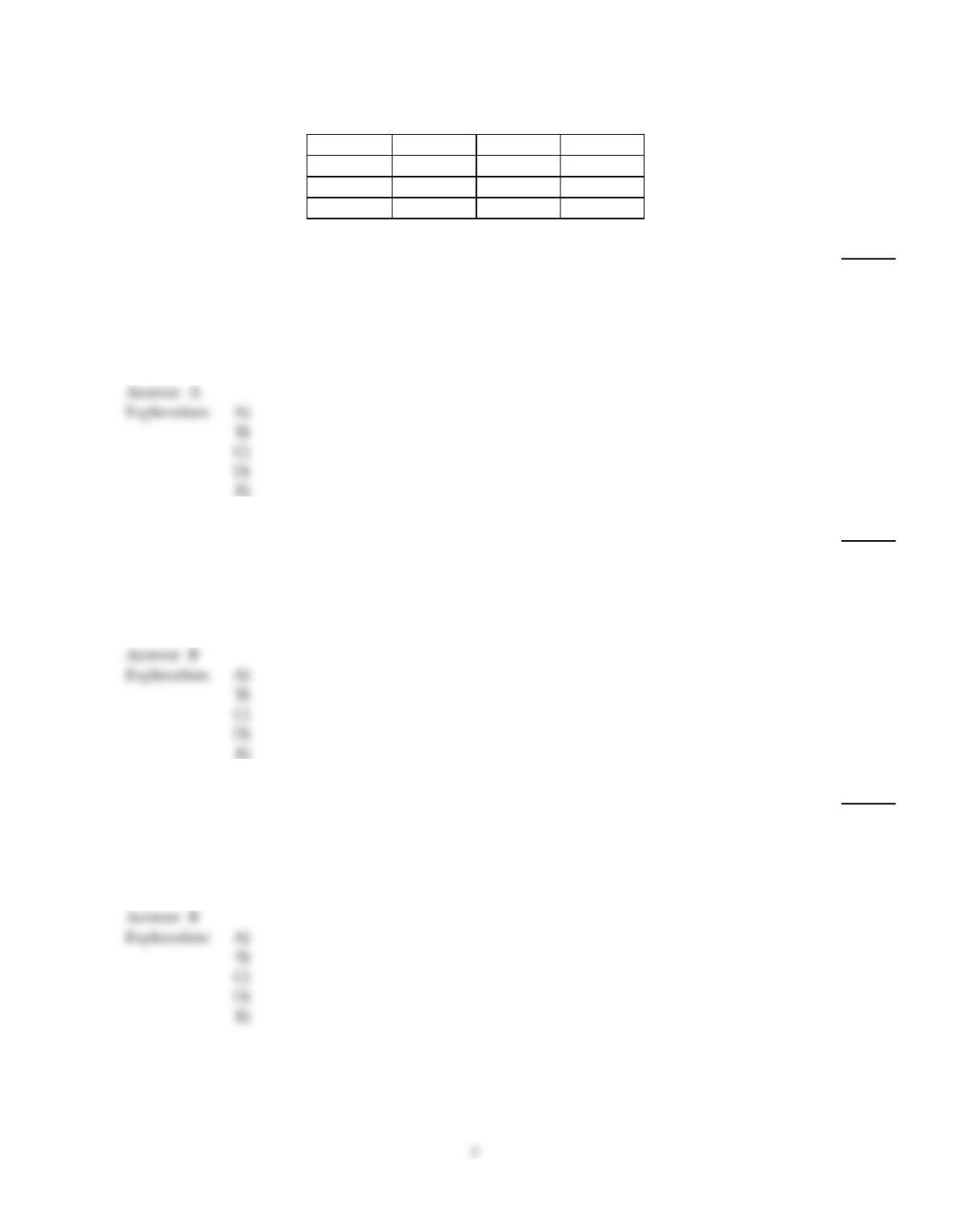
Table 8.2
Codon on mRNA and corresponding amino acid
UUA leucine UAA nonsense
GCA alanine AAU sparagine
AAG lysine UGC cysteine
GUU valine UCG, UCU serine
13)
Refer to Table 8.2. If the sequence of amino acids encoded by a strand of DNA is
serine–alanine–lysine–leucine, what is the order of bases in the sense strand of DNA?
13)
A)
3’ AGACGTTTCAAT
B)
3’ UGUGCAAAGUUA
C)
3’ TCTCGTTTGTTA
D)
5’ TGTGCTTTCTTA
E)
5’ AGAGCTTTGAAT
14)
Which of the following statements is FALSE?
14)
A)
The lagging strand of DNA is started by an RNA primer.
B)
DNA replication proceeds in one direction around the bacterial chromosome.
C)
Multiple replication forks are possible on a bacterial chromosome.
D)
The leading strand of DNA is made continuously.
E)
DNA polymerase joins nucleotides in one direction only.
15)
Which of the following statements about bacteriocins is FALSE?
15)
A)
The genes coding for them are on plasmids.
B)
They cause food–poisoning symptoms.
C)
Bacteriocins kill bacteria.
D)
Nisin is a bacteriocin used as a food preservative.
E)
They can be used to identify certain bacteria.
Table 8.1
Culture 1: F+, leucine+, histidine+
Culture 2: F–, leucine–, histidine–
16)
In Table 8.1, if culture 1 mutates to Hfr, what will be the result of conjugation between the two
cultures?
16)
A)
They will both remain the same.
B)
1 will remain the same;
recombination will occur in 2
C)
1 will become F–, leu+, his+;
2 will become Hfr, leu+, his+
D)
1 will become F+, leu+, his+;
2 will become F+, leu+, his+
E)
The answer cannot be determined based on the information provided.
B
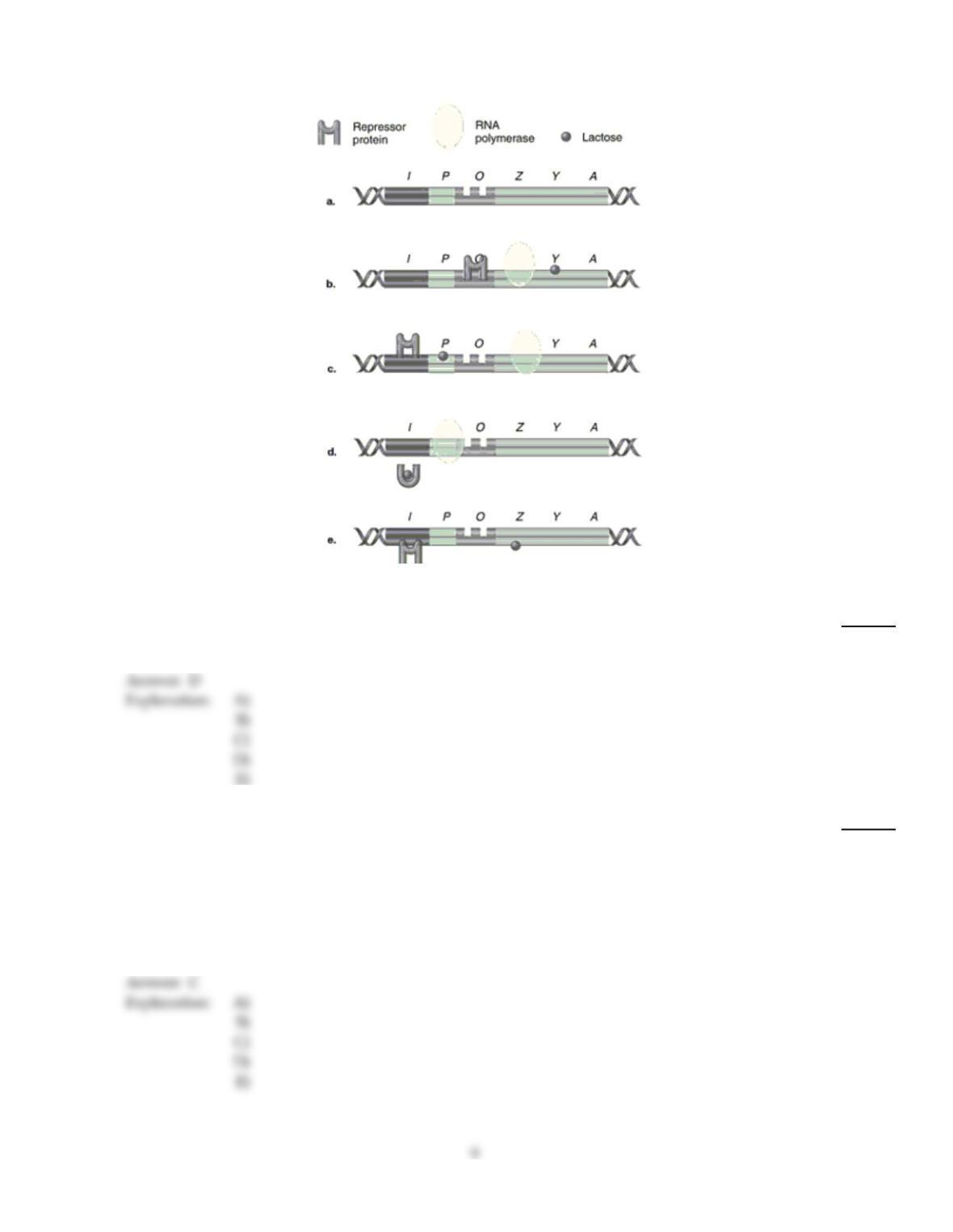
Figure 8.5
17)
In Figure 8.5, which model of the lac operon correctly shows RNA polymerase, lactose, and
repressor protein when the structural genes are being transcribed?
17)
A)
a
B)
b
C)
c
D)
d
E)
e
18)
The cancer gene ras produces mRNA containing an extra exon that includes a number of UAA
codons. Cancer cells produce ras mRNA missing this exon. This mistake most likely is due to a
mistake by
18)
A)
UV radiation.
B)
DNA polymerase.
C)
snRNPs.
D)
photolyases.
E)
a chemical mutagen.
19)
The damage caused by ultraviolet radiation is
19)
A)
repaired during transcription.
B)
repaired during translation.
C)
cut out and replaced.
D)
never repaired.
E)
repaired by DNA replication.
20)
Repair of damaged DNA might be viewed as a race between an endonuclease and
20)
A)
DNA ligase.
B)
DNA polymerase.
C)
helicase.
D)
primase.
E)
methylase.
21)
In Figure 8.3, if compound C reacts with the allosteric site of enzyme A, this would exemplify
21)
A)
transcription.
B)
feedback inhibition.
C)
a mutation.
D)
repression.
E)
competitive inhibition.
22)
Genetic change in bacteria can be brought about by
22)
A)
transduction.
B)
conjugation.
C)
transformation.
D)
mutation.
E)
All of the answers are correct.
23)
Synthesis of a repressible enzyme is stopped by the
23)
A)
substrate binding to the repressor.
B)
end product binding to the promoter.
C)
corepressor binding to the operator.
D)
corepressor–repressor complex binding to the operator.
E)
allosteric transition.
D
24)
In Table 8.1, what will be the result of conjugation between cultures 1 and 2?
24)
A)
1 will remain the same;
2 will become F+, leucine–, histidine–
B)
1 will become F–, leu–, his–;
2 will remain the same
C)
1 will become F–, leu+, his+;
2 will become F+, leu–, his–
D)
1 will remain the same;
2 will become F+ and recombination may occur
E)
1 will remain the same;
2 will become F+, leu+, his+
A
E
25)
The mechanism by which the presence of glucose inhibits the arabinose operon is
25)
A)
catabolite repression.
B)
repression.
C)
DNA polymerase.
D)
translation.
E)
induction.
Table 8.2
Codon on mRNA and corresponding amino acid
UUA leucine UAA nonsense
GCA alanine AAU sparagine
AAG lysine UGC cysteine
GUU valine UCG, UCU serine
26)
Refer to Table 8.2. If the sequence of amino acids encoded by a strand of DNA is
serine–alanine–lysine–leucine, the coding for the antisense strand of DNA is
26)
A)
5’ ACAGTTTCAAT.
B)
5’ TCTGCAAAGTTA.
C)
3’ TCACGUUUCAAU.
D)
3’ UGUGCAAAGUUA.
E)
3’ UCUCGAAAGUUA.
27)
An enzyme that catalyzes the cutting and resealing of DNA, and is translated from insertion
sequences, is
27)
A)
RNA polymerase.
B)
DNA polymerase.
C)
transposase.
D)
DNA ligase.
E)
DNA helicase.