Exam
Name___________________________________
MULTIPLE CHOICE. Choose the one alternative that best completes the statement or answers the question.
1)
Which of the following is not necessary for the formation of metamorphic rock?
1)
A)
chemically active liquids
B)
calcium–rich or liquids
C)
heat
D)
pressure
2)
What foliated, metamorphic rock is texturally intermediate between slate and schist?
2)
A)
quartzite
B)
phyllite
C)
gneiss
D)
fault breccia
3)
What major change occurs during metamorphism of limestone to marble?
3)
A)
Limestone grains react to form quartz and feldspars.
B)
Calcite grains grow larger and increase in size.
C)
Clays crystallize to micas, forming a highly foliated, mica–rich rock.
D)
Calcite grains are dissolved away leaving only marble crystals.
4)
What term describes the zone of contact metamorphism surrounding an intrusive magma body?
4)
A)
oracle
B)
aura
C)
auricle
D)
aureole
5)
________ is a strong, parallel alignment of coarse mica flakes and/or of different mineral bands in a
metamorphic rock.
5)
A)
Rock cleavage
B)
Foliation
C)
Marbleizing
D)
Stress streaking
6)
Which low–grade metamorphic rock, composed of extremely fine–sized mica and other mineral
grains, typically exhibits well–developed rock cleavage?
6)
A)
hornfels
B)
schist
C)
quartzite
D)
slate
7)
________ is a nonfoliated rock formed by contact metamorphism of a shale or mudstone.
7)
A)
Marble
B)
Hornfels
C)
Schist
D)
Gneiss
8)
What platy, parallel, mineral grains are the most visual aspect of foliated metamorphic rocks?
8)
A)
quartz
B)
micas
C)
carbonates
D)
feldspars
9)
In which setting would regional metamorphism be most likely?
9)
A)
at great depths in the crust where two continents are colliding
B)
at shallow depths along major transform faults in the continental crust
C)
at shallow depths beneath the seafloor where water pressures are immense
D)
at shallow depths below an oceanic ridge or rift zone
10)
________ is thought to form by partial melting and in situ crystallization of the melted portion.
10)
A)
Magmatite
B)
Megatite
C)
Migmatite
D)
Magnetite
11)
________ is characterized by the segregation of light– and dark–colored minerals into thin layers or
bands.
11)
A)
Slate
B)
Quartzite
C)
Garnet hornfels
D)
Granitic gneiss
12)
Which of the following is not connected or involved with shock metamorphism?
12)
A)
impactiles
B)
mylonites
C)
asteroids
D)
coesite
13)
Which of the following environments would exhibit sheared and mechanically fragmented rocks?
13)
A)
regional metamorphism of pyroclastic volcanic rocks
B)
intense compression in a deep–seated, regional metamorphic zone
C)
heating of shales and mudstones near a pluton
D)
fault movements at shallow depths
14)
Amphibolite is a foliated metamorphic rock composed principally of hornblende and plagioclase. It
forms ________.
14)
A)
by the impact of an asteroid on interbedded sandstone and shale
B)
by regional metamorphism of volcanic rocks such as basalt
C)
by contact metamorphism of sandstone along the contact with a granitic batholith
D)
by gouging and crushing of limestone along a fault
15)
Which of the following lists the rocks in the order of increasing grain size and increasing grade of
metamorphism?
15)
A)
slate, schist, phyllite
B)
phyllite, slate, schist
C)
schist, slate, phyllite
D)
slate, phyllite, schist
16)
Which rock has the finest grain size?
16)
A)
gneiss
B)
marble
C)
phyllite
D)
slate
17)
What is the major source of heat for contact metamorphism?
17)
A)
heat from the spontaneous decomposition of micas and feldspars
B)
deep burial and heat from the Earth’s interior
C)
heat from grinding and shearing on faults
D)
heat from a nearby magma body
18)
Which of the following forms at the highest grade of regional metamorphism?
18)
A)
schist
B)
phyllite
C)
hornfels
D)
slate
19)
During metamorphism, what is the major effect of chemically active fluids?
19)
A)
They facilitate the formation of schistosity and gneissic banding in hornfels and slates.
B)
They prevent partial melting so solid rocks can undergo very high temperature regional
metamorphism.
C)
They aid in the movement of dissolved silicate constituents and facilitate growth of the
mineral grains.
D)
They increase the pressures in deeply buried, regional–metamorphic zones.
20)
________ is typically formed by metamorphism of a sandstone.
20)
A)
Amphibolite
B)
Quartzite
C)
Marble
D)
Slate

21)
________ forms from the metamorphism of limestone or dolostone.
21)
A)
Amphibolite
B)
Marble
C)
Quartzite
D)
Migmatite
22)
Which of the following best describes the conditions of contact metamorphism?
22)
A)
Depths are fairly shallow, but temperatures and pressures are so high that the rocks begin to
partially melt.
B)
Pressures are fairly low, the rock is in the upper part of the crust, and heat is supplied from a
nearby magma body.
C)
Heat is generated by shearing and mechanical movements along faults.
D)
Pressures are very high, the rock is deeply buried, and temperatures are raised by the Earth’s
internal heat.
23)
Which of the following statements concerning slate is NOT true?
23)
A)
Rock cleavage is common.
B)
It has abundant, coarse–grained mica.
C)
Sedimentary features may be visible.
D)
It forms from shales and mudstones.
24)
Graphite is identified in a particular schist. Which one of the following conclusions is justified?
24)
A)
The schist formed from a quartz–rich, sedimentary limestone.
B)
The graphite lubricated shearing movements along a fault, causing a schist to form.
C)
The pre–metamorphic rock was a shale or mudstone containing organic matter.
D)
The rock also contains diamonds; both are crystalline forms of the element carbon.
SHORT ANSWER. Write the word or phrase that best completes each statement or answers the question.
25)
What strongly banded, metamorphic rocks show good evidence for having formed by
partial melting?
25)
26)
List the three most important agents of metamorphism.
26)
27)
Give the name of a rock formed by regional metamorphism of a conglomerate.
27)
28)
Which metamorphic rock or rocks exhibit alternating layers or bands of different light–
and dark–colored minerals?
28)
29)
Which type of metamorphism occurs specifically in the heated zone around a pluton or
other body of magma?
29)
30)
What metamorphic rock forms by intense ductile deformation along fault zones at depth in
the Earth?
30)
Word Analysis. Examine the words and/or phrases for each question below and determine the relationship among the
majority of words/phrases. Choose the option that does not fit the pattern.
31)
a. porphyroblastic b. slaty cleavage c. schistosity d. gneissic
texture
31)
32)
a. aureole b. hornfels c. skarn d. schist
32)
33)
Which metamorphic rock, widely used for monuments and buildings, would deteriorate
significantly in contact with acid rain?
33)
34)
Foliation in metamorphic rocks is mainly evident in the parallel alignment of certain
mineral grains. What are they?
34)
35)
What type of sedimentary rock is typically metamorphosed to form slates or phyllites?
35)
Word Analysis. Examine the words and/or phrases for each question below and determine the relationship among the
majority of words/phrases. Choose the option that does not fit the pattern.
36)
a. pressure b. recrystallization c. melting d. chemical
fluids
36)
37)
a. phyllite b. marble c. slate d. schist
37)
TRUE/FALSE. Write ‘T’ if the statement is true and ‘F’ if the statement is false.
38)
Calcite is the main mineral constituent of the sedimentary rock limestone and of the metamorphic
rock marble.
38)
39)
Hornfels are metamorphic rocks produced at great depths and high temperatures associated with
regional metamorphism.
39)
40)
Muscovite, biotite, and chlorite are common minerals found in phyllites and schists.
40)
41)
Metamorphic rocks formed during episodes of mountain building typically show textural
characteristics indicative of shearing stress and deformation.
41)
42)
Partial melting is an important process in the formation of migmatites.
42)
43)
Rock cleavage or slaty cleavage in slates is largely a consequence of abundant, parallel–aligned,
very fine–grained mica flakes in the rock.
43)
44)
Foliated metamorphic rocks are composed largely of equidimensional grains of minerals such as
quartz and calcite.
44)
45)
Slate and schist are both derived by metamorphism of shales and mudstones.
45)
46)
High–grade, regional metamorphism produces significant and recognizable changes in the textures
and mineral compositions of rocks.
46)
47)
At high pressures and elevated temperatures of regional metamorphism, silicate rocks are more
resistant to flowage and deformation than at low temperatures and pressures.
47)
48)
The distinctive layers or bands of different minerals in gneisses may indicate complex folding.
48)
MATCHING. Choose the item in column 2 that best matches each item in column 1.
Match the rock with the appropriate description.
49)
nonfoliated metamorphic rock
consisting mostly of calcite
50)
coarse–grained, metamorphic rock
with alternating bands or stringers of
light and dark minerals
51)
foliated, fine–grained metamorphic
rock formed from mudstone and shale
52)
forms by contact metamorphism of
mudstones and shales
A)
marble
C)
gneiss
D)
phyllite
49)
50)
51)
52)
ESSAY. Write your answer in the space provided or on a separate sheet of paper.
53)
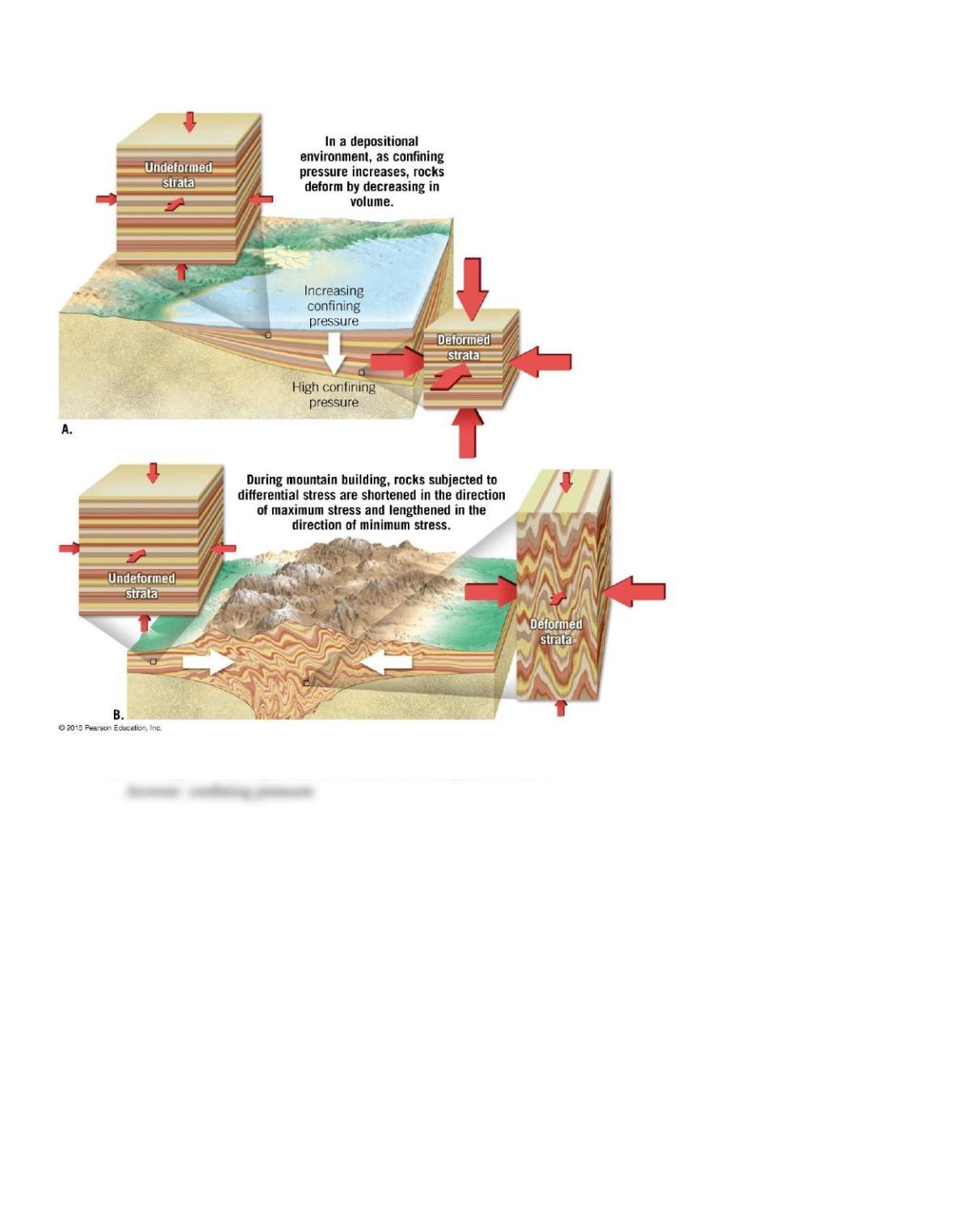
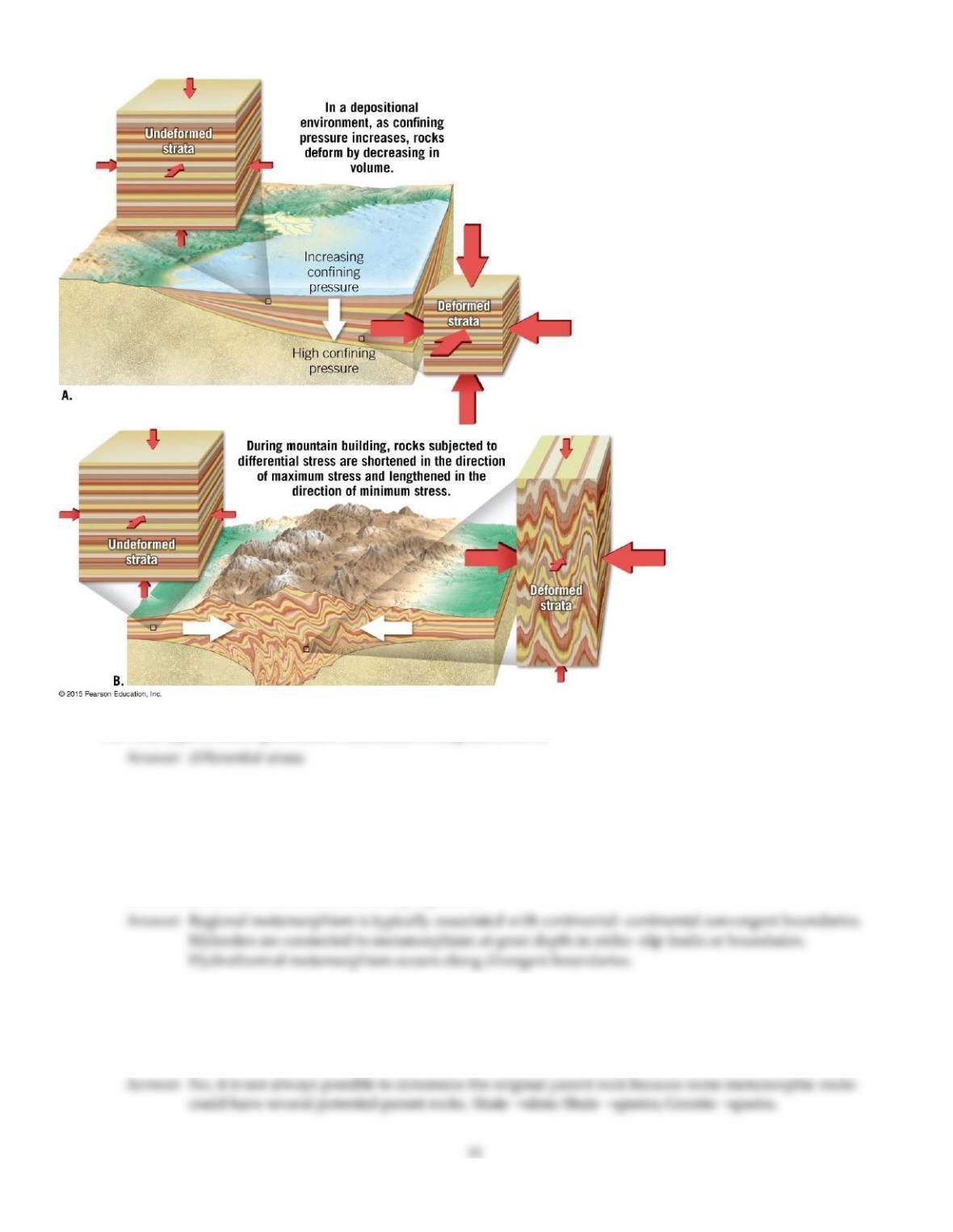
What type of stress (pressure) is illustrated in diagram A above?
9
Critical thinking and discussion questions. Use complete sentences, correct spelling, and the information presented in
chapter 8 to answer the questions below.
54)
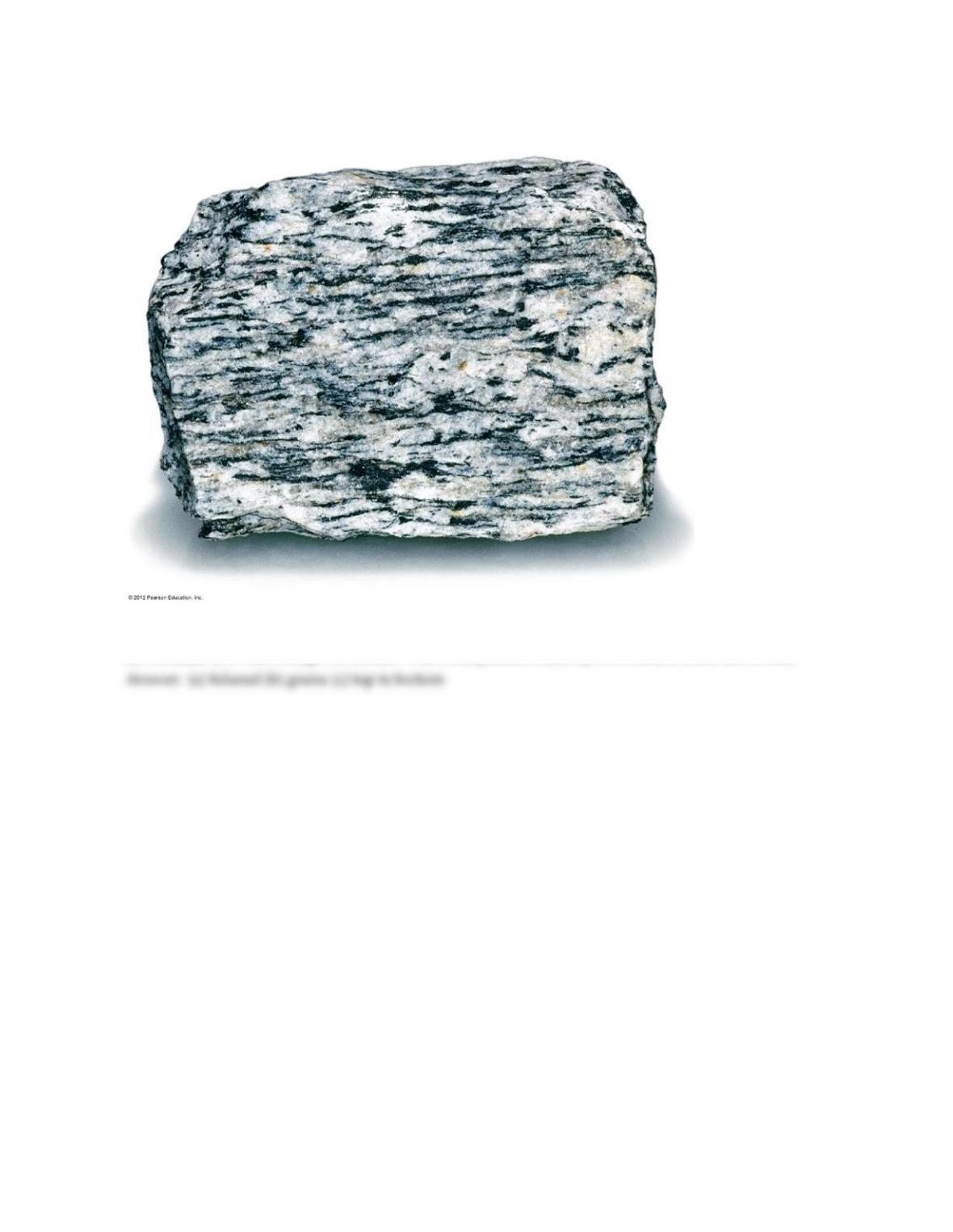
Carefully examine the photograph below of a metamorphic rock sample. The sample is shown as its actual size.
(a) Is this rock foliated or nonfoliated?
(b) What is the name of this metamorphic rock?
(c) Consider how this rock got its texture. Was it compressed from top to bottom or from side to side?
10
55)
What type of stress (pressure) is illustrated in diagram B above?
Critical thinking and discussion questions. Use complete sentences, correct spelling, and the information presented in
chapter 8 to answer the questions below.
56)
Briefly outline how regional metamorphism is related to plate boundaries. Are certain types of metamorphic
rocks indicative of particular plate boundaries or tectonic settings? Give two or three examples of such rocks
and indicate the tectonic environment they represent.
Critical thinking and discussion questions. Use complete sentences, correct spelling, and the information presented in
chapter 8 to answer the question below.
57)
Is it always possible to determine the original parent rock (called a protolith) prior to metamorphism? Why or
why not? List three protoliths and give a possible metamorphic equivalent for each one.

Critical thinking and discussion questions. Use complete sentences, correct spelling, and the information presented in
chapter 8 to answer the questions below.
58)
Is the texture of a metamorphic rock always indicative of the conditions (degree of metamorphism) under
which it formed? (Hint: Think about the protolith and how it may influence the resulting metamorphic rock.)
Answer Key
Testname: C8
13
Answer Key
Testname: C8
14