Chapter 8: Budgeting for Planning and Control
91. The following forecasted sales pertain to Rapid City:
Month
Sales
June
$160,000
July
200,000
August
120,000
September
80,000
Finished goods inventory as of May 31 6,000 units
Rapid City has a selling price of $5 per unit and expects to maintain ending inventories equal to 25 percent of next
month’s sales.
What is the budgeted beginning balance in units for finished goods inventory on August 1?
a. 8,000 units
b. 6,000 units
c. 10,000 units
d. 6,400 units
92. Dali, Inc. is constructing its marketing budget.
1st quarter
2nd quarter
3rd quarter
4th quarter
Sales
30,000
40,000
50,000
60,000
Production
35,000
45,000
55,000
65,000
Commissions are $3 per unit sold. Salesperson salaries are $100,000 per quarter. Depreciation is $25,000 per
quarter. Travel is $10,000 per quarter. Advertising is $50,000 in the first quarter; $40,000 in the second quarter;
$60,000 in the third quarter; and $55,000 in the fourth quarter. What is the budgeted marketing expense for the
third quarter?
a. $795,000
b. $735,000
c. $360,000
d. $345,000

Chapter 8: Budgeting for Planning and Control
93. In a merchandising organization, the merchandise purchases budget replaces what budget from a manufacturing
firm?
a. the administrative expense budget
b. the pro-forma income statement
c. the production budget
d. the cost of goods sold budget
94. What is the formula used to compute the units to be produced?
a. Units produced = Units sold
b. Units produced = Units sold + Units in beginning inventory + Units in ending inventory
c. Units produced = Units sold + Units in beginning inventory – Units in ending inventory
d. Units Produced = Units sold – Units in beginning inventory + Units in ending inventory
95. Which of the following is a financial budget?
a. capital expenditures budget
b. sales budget
c. budgeted income statement
d. overhead budget
96. Which of the following is NOT a component of the Cash Budget?
a. Sales forecast
b. Cash Disbursements
c. Financing
d. Cash excess or deficiency
97. Which of the following is a financial budget?
a. cost of goods sold budget
b. budgeted balance sheet
c. marketing expense budget
d. production budget
Chapter 8: Budgeting for Planning and Control
98. Mikhail Corporation has the following sales forecasts for the first three months of 2016:
Month
Sales
January
$36,000
February
24,000
March
40,000
Sixty-five percent of sales are collected in the month of the sale and the remainder are collected in the following
month. Mikhail will borrow from its bank to maintain its minimum cash balance.
Accounts receivable balance (January 1, 2016) $16,000
Cash balance (January 1, 2016) 12,000
Minimum cash balance needed 20,000
What is the cash balance at the end of January, assuming that cash is received only from customers and that
$48,000 is paid out during January?
a. $19,400
b. $23,400
c. $20,000
d. $21,000
99. Mikhail Corporation has the following sales forecasts for the first three months of 2016:
Month
Sales
January
$36,000
February
24,000
March
40,000
Sixty-five percent of sales are collected in the month of the sale and the remainder are collected in the following
month.
Accounts receivable balance (January 1, 2016) $16,000
Cash balance (January 1, 2016) 12,000
Minimum cash balance is $20,000. Cash can be borrowed in $1,000 increments from the local bank (assume no
interest charges).
How much cash would be collected in March from sales?
a. $32,000
b. $58,400
c. $48,000
d. $34,400
Chapter 8: Budgeting for Planning and Control
Figure 8-4
Discus Productions needs to know its anticipated cash inflows for the next quarter by month. Cash sales are 10
percent of total sales each month. Historically, sales on account have been collected as follows: 60 percent in the
month of sale, 30 percent in the month after the sale, and the remaining 10 percent two months after the sale. Sales
for the quarter are projected as follows: April, $120,000; May, $100,000; and June, $80,000. Accounts receivable on
March 31 were $60,000.
100. Refer to Figure 8-4. The expected cash collections of Discus Productions for June are
a. $48,000.
b. $98,000.
c. $68,000.
d. $89,000.
101. Refer to Figure 8-4. Discus Productions would expect to have an accounts receivable balance on June 30 of
a. $37,800.
b. $42,000.
c. $32,000.
d. $28,800.
102. Shiller Corporation has the following sales forecasts for the selected three-month period in 2016:
Month
Sales
July
$24,000
August
14,000
September
16,000
All sales are on account. Seventy percent of sales are collected in the month of the sale, and the remainder are
collected in the following month.
Accounts receivable balance (July 1, 2016) $20,000
Cash balance (July 1, 2016) 10,000
Minimum cash balance is $10,000. Cash can be borrowed in $1,000 increments from the local bank (assume no
interest charges).
How much cash would be collected in September from sales?
a. $15,400
b. $17,000
c. $16,000
d. $20,000
Chapter 8: Budgeting for Planning and Control
103. Shiller Corporation has the following sales forecasts for the selected three-month period in 2016:
Month
Sales
July
$24,000
August
14,000
September
16,000
All sales are on account. Seventy percent of sales are collected in the month of the sale, and the remainder are
collected in the following month.
Accounts receivable balance (July 1, 2016) $20,000
Cash balance (July 1, 2016) 10,000
Minimum cash balance is $10,000. Cash can be borrowed in $1,000 increments from the local bank (assume no
interest charges).
What is the cash balance at the end of July, assuming that cash is received only from customers and that $40,000 is
paid out during July?
a. $20,000
b. $16,800
c. $6,800
d. $10,800
104. Natasha Company has a sales budget for next month of $150,000. Cost of goods sold is expected to be 40 percent
of sales. All goods are purchased in the month used and paid for in the month following purchase. The beginning
inventory of merchandise is $5,000, and an ending inventory of $6,000 is desired. Beginning accounts payable is
$38,000.
For Natasha Company, the ending accounts payable should be
a. $39,000.
b. $61,000.
c. $89,000.
d. $91,000.
Chapter 8: Budgeting for Planning and Control
105. Quicksand Corporation has a sales budget for next month of $50,000. Cost of goods sold is expected to be 60
percent of sales. All goods are purchased in the month used and paid for in the month following their purchase. The
beginning inventory of merchandise is $1,500 and an ending inventory of $2,000 is desired. Beginning accounts
payable is $13,000.
The ending accounts payable for Quicksand Corporation should be
a. $30,500.
b. $30,000.
c. $13,000.
d. $29,500.
Figure 8-5
The following forecasted sales pertain to Spyware Corporation:
Month
Sales
September
$40,000
October
50,000
November
30,000
December
20,000
Collection pattern:
65 percent in month of sale
35 percent in month following sale
Accounts receivable as of August 31 $7,000
Finished goods inventory as of August 31 1,500 units
Spyware Corporation has a selling price of $2.50 per unit and expects to maintain ending inventories equal to 25
percent of the next month’s sales.
106. Refer to Figure 8-5. How many dollars are expected to be collected in September?
a. $7,000
b. $40,000
c. $33,000
d. $21,000
107. Refer to Figure 8-5. How many dollars are expected to be collected in December?
a. $30,500
b. $37,000
c. $26,500
d. $23,500
Chapter 8: Budgeting for Planning and Control
Figure 8-6
The records of Morgantown, Inc. show the following forecasted sales:
Month
Sales
September
$400,000
October
500,000
November
300,000
December
200,000
Collection pattern:
60 percent in month of sale
40 percent in month following the sale
Accounts receivable as of August 31 $70,000
Finished goods inventory as of August 31 8,000 units
The company has a selling price of $10 per unit and expects to maintain ending inventories equal to 20 percent of
next month’s sales.
108. Refer to Figure 8-6. How many dollars are expected to be collected in October?
a. $420,000
b. $460,000
c. $240,000
d. $510,000
109. Refer to Figure 8-6. How much is Accounts Receivable as of October 31?
a. $420,000
b. $460,000
c. $240,000
d. none of the above
110. Firefly Manufacturing Company needs to know its anticipated cash inflows for the next quarter by month. Cash
sales are 20 percent of total sales each month. Historically, sales on account have been collected as follows: 50
percent in the month of the sale, 35 percent in the month after the sale, and the remaining 15 percent two months
after the sale. Sales for the quarter are projected as follows: January, $60,000; February, $30,000; and March,
$90,000.
Accounts receivable on December 31 were $45,000.
Chapter 8: Budgeting for Planning and Control
The expected cash collections of Firefly Manufacturing Company for March are
a. $90,000.
b. $69,600.
c. $64,500.
d. $114,600.
111. Firefly Manufacturing Company needs to know its anticipated cash inflows for the next quarter by month. Cash
sales are 20 percent of total sales each month. Historically, sales on account have been collected as follows: 50
percent in the month of the sale, 35 percent in the month after the sale, and the remaining 15 percent two months
after the sale. Sales for the quarter are projected as follows: January, $60,000; February, $30,000; and March,
$90,000.
Accounts receivable on December 31 were $45,000.
Firefly Manufacturing Company would expect to have an accounts receivable balance on March 31 of
a. $45,000.
b. $55,500.
c. $39,600.
d. $90,000.
Figure 8-7
Macheski Company, an importer and retailer of Polish pottery and kitchenware, prepares a monthly master budget.
Data for the July master budget are given below:
The June 30th balance sheet follows:
Cash
$ 25,000
Accounts
$ 45,000
Accounts receivable
110,000
Capital stock
300,000
Inventory
54,000
Retained
94,000
Building and equipment (net)
250,000
Actual sales for June and budgeted sales for July, August, and September are given below:
June
$137,500
July
360,000
August
400,000
September
320,000
Sales are 20 percent for cash and 80 percent on credit. All credit sales are collected in the month following the
sale. There are no bad debts.
Chapter 8: Budgeting for Planning and Control
The gross margin percentage is 40 percent of sales. The desired ending inventory is equal to 25 percent of the
following month‘s sales. One fourth of the purchases are paid for in the month of purchase and the others are
purchased on account and paid in full the following month.
The monthly cash operating expenses are $43,000, and the monthly depreciation expenses are $7,000.
112. Refer to Figure 8–7. What is the balance of the accounts receivable at the end of July?
a. $110,000
b. $288,000
c. $360,000
d. $398,000
113. Refer to Figure 8-7. What is the balance of the accounts payable at the end of July?
a. $55,500
b. $93,000
c. $120,000
d. $166,500
114. Refer to Figure 8-7. What is the balance of the inventory account at the end of July?
a. $54,000
b. $60,000
c. $124,000
d. $216,000
115. Refer to Figure 8-7. What is the balance of the building and equipment (net) account at the end of July?
a. $243,000
b. $250,000
c. $257,000
d. $300,000
116. Refer to Figure 8–7. What is the balance of the retained earnings account at the end of July?
a. $94,000
b. $188,000
c. $360,000
d. $398,000
Chapter 8: Budgeting for Planning and Control
117. Refer to Figure 8-7. What is the balance of the cash account at the end of July?
a. $8,500
b. $15,500
c. $62,500
d. $114,000
118. Refer to Figure 8-7. What are the total assets at the end of July?
a. $439,000
b. $446,500
c. $515,500
d. $653,500
119. A budget that is developed around one particular level of activity is
a. a static budget.
b. a continuous budget.
c. an incremental budget.
d. none of these.
120. When budgets are used for control,
a. budgeted amounts from different years are compared.
b. actual amounts from different years are compared.
c. budgeted amounts are compared to actual amounts.
d. none of these.
Figure 8-8
Rammazzotti, Inc., is looking for feedback on company performance. The company compares the budget for the year
with the actual costs. Data have been collected below:
Rammazzotti Inc., had the following budgeted data:
Unit sales for 2016 26,000
Unit production for 2016 26,000
Budgeted fixed overhead for 2016:
Supervision $ 800
Depreciation 2,000
Rent 100
Chapter 8: Budgeting for Planning and Control
Budgeted variable costs per unit:
Direct materials $0.15
Direct labor 0.20
Supplies 0.02
Indirect labor 0.05
Power 0.02
The following actually occurred:
Actual unit sales for 2016 24,000
Actual unit production for 2016 28,000
Actual fixed overhead for 2016:
Supervision $ 850
Depreciation 2,000
Rent 100
Actual variable costs:
Direct materials $3,500
Direct labor 4,900
Supplies 530
Indirect labor 1,250
Power 470
121. Refer to Figure 8-8. The total budgeted costs for 2016 were
a. $11,440.
b. $13,510.
c. $14,340.
d. $13,460.
122. Refer to Figure 8-8. The budgeted cost for direct labor for 2016 was
a. $1,200.
b. $1,300.
c. $4,800.
d. $5,200.
Chapter 8: Budgeting for Planning and Control
123. Refer to Figure 8-8. The static budget variance for rent is
a. $100 F.
b. $100 U.
c. $-0-.
d. $50 U.
124. Refer to Figure 8-8. The actual cost for direct materials for 2016 was
a. $3,600.
b. $3,900.
c. $4,500.
d. $3,500.
125. Refer to Figure 8-8. The static budget variance for total fixed overhead is
a. $50 U.
b. $50 F.
c. $-0-.
d. $100 U.
126. Refer to Figure 8-8. The static budget variance for direct materials is
a. $100 F.
b. $100 U.
c. $400 F.
d. $400 U.
Chapter 8: Budgeting for Planning and Control
127. Refer to Figure 8–8. The static budget variance for total variable costs is
a. $90 U.
b. $180 U.
c. $790 F.
d. $880 F.
128. Refer to Figure 8-8. The total flexible budgeted costs for 2016 are
a. $10,560.
b. $13,460.
c. $13,510.
d. $15,220.
129. Refer to Figure 8-8. The flexible budget for direct materials cost in 2016 is
a. $3,500.
b. $3,600.
c. $3,900.
d. $4,200.
130. Refer to Figure 8-8. The flexible budget variance for indirect labor for 2016 is
a. $1,250 F.
b. $50 F.
c. $150 F.
d. $1,200 U.
131. Refer to Figure 8-8. The flexible budget for rent in 2016 is
a. $100.
b. $200.
c. $2,900.
d. $2,950.
Chapter 8: Budgeting for Planning and Control
132. Refer to Figure 8-8. The flexible budget variance for supervision for 2016 is
a. $67 F.
b. $67 U.
c. $50 F.
d. none of these.
133. Refer to Figure 8-8. The flexible budget variance for total cost for 2016 is
a. $90 F.
b. $140 F.
c. $1,620 F.
d. $50 F.
134. Refer to Figure 8-8. The total actual costs for 2016 were
a. $13,550.
b. $10,650.
c. $13,600.
d. $13,510.
135. Refer to Figure 8-8. The static budget variance for supervision is
a. $50 U.
b. $50 F.
c. 100 U.
d. 100 F.
Chapter 8: Budgeting for Planning and Control
136. Refer to Figure 8–8. The static budget variance for supplies is
a. $10 U.
b. $10 F.
c. $50 U.
d. $50 F.
137. The budget most appropriate for control purposes is the
a. static budget.
b. flexible budget.
c. continuous budget.
d. incremental budget.
138. Laramie, Inc., has an operating environment with considerable uncertainty. The company prepares the budget for
several different volume levels.
Laramie had the following budgeted data: Budgeted variable costs per unit:
Direct materials
$ 7.00
Direct labor
10.00
Supplies
1.00
Indirect labor
0.50
Power
0.05
Budgeted fixed overhead for 2016:
Supervision
$4,000
Depreciation
3,000
Rent
2,000
What are the budgeted costs for materials if 5,000 units were produced?
a. $9,000
b. $4,000
c. $50,000
d. $35,000
Chapter 8: Budgeting for Planning and Control
139. Laramie, Inc., has an operating environment with considerable uncertainty. The company prepares the budget for
several different volume levels.
Laramie had the following budgeted data: Budgeted variable costs per unit:
Direct materials
$ 7.00
Direct labor
10.00
Supplies
1.00
Indirect labor
0.50
Power
0.05
Budgeted fixed overhead for 2016:
Supervision
$4,000
Depreciation
3,000
Rent
2,000
What are the budgeted costs for rent if 5,000 units were produced?
a. $2,000
b. $100,000
c. $9,000
d. $45,000
140. Laramie, Inc., has an operating environment with considerable uncertainty. The company prepares the budget for
several different volume levels.
Laramie had the following budgeted data: Budgeted variable costs per unit:
Direct materials
$ 7.00
Direct labor
10.00
Supplies
1.00
Indirect labor
0.50
Power
0.05
Budgeted fixed overhead for 2016:
Supervision
$4,000
Depreciation
3,000
Rent
2,000
What are the total budgeted costs for 5,000 units?
a. $9,000
b. $92,750
c. $101,750
d. $110,000
Chapter 8: Budgeting for Planning and Control
141. Laramie, Inc., has an operating environment with considerable uncertainty. The company prepares the budget for
several different volume levels.
Laramie had the following budgeted data: Budgeted variable costs per unit:
Direct materials
$ 7.00
Direct labor
10.00
Supplies
1.00
Indirect labor
0.50
Power
0.05
Budgeted fixed overhead for 2016:
Supervision
$4,000
Depreciation
3,000
Rent
2,000
What is the difference in total budgeted costs between the volume range of 4,000 and 5,000 units?
a. $-0-
b. $18,550
c. $1,000
d. $9,000
142. Laramie, Inc., has an operating environment with considerable uncertainty. The company prepares the budget for
several different volume levels.
Laramie had the following budgeted data: Budgeted variable costs per unit:
Direct materials
$ 7.00
Direct labor
10.00
Supplies
1.00
Indirect labor
0.50
Power
0.05
Budgeted fixed overhead for 2016:
Supervision
$4,000
Depreciation
3,000
Rent
2,000
What are the total budgeted costs for 3,000 units?
a. $3,000
b. $55,650
c. $64,650
d. $27,000
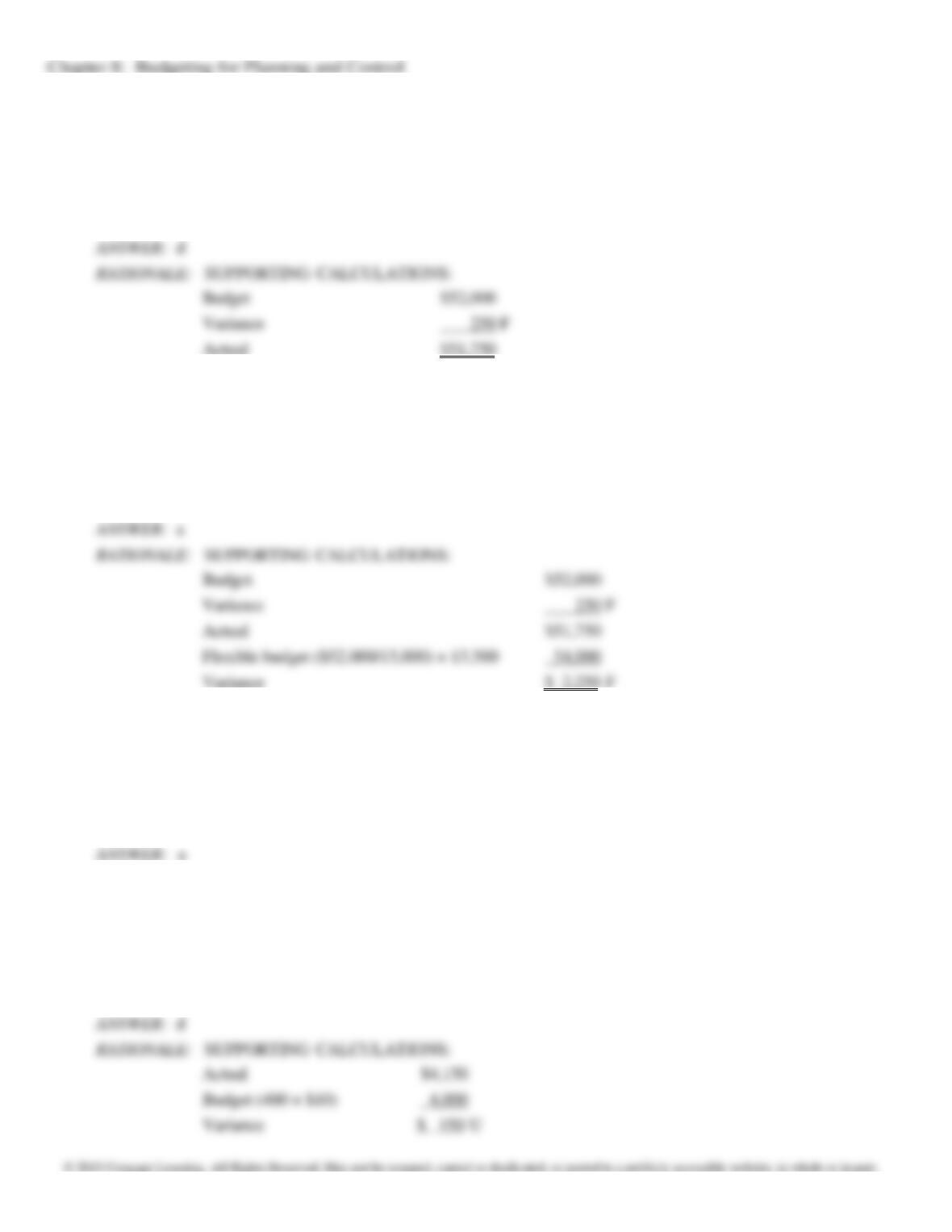
143. If the static budget variance for materials is $250 F and the budgeted cost for materials is $52,000, then the actual
cost of materials is
a. $51,950
b. $52,150.
c. $51,150.
d. $51,750.
144. The static budget variance for materials is $250 F and the budgeted cost for materials is $52,000. If the budgeted
volume is 13,000 and the actual volume is 13,500, then the flexible budget variance is
a. $2,250 F.
b. $3,050 F.
c. $2,050 F.
d. $1,850 F.
145. A budget that is developed around one particular level of activity is
a. a static budget.
b. a continuous budget.
c. an incremental budget.
d. none of these.
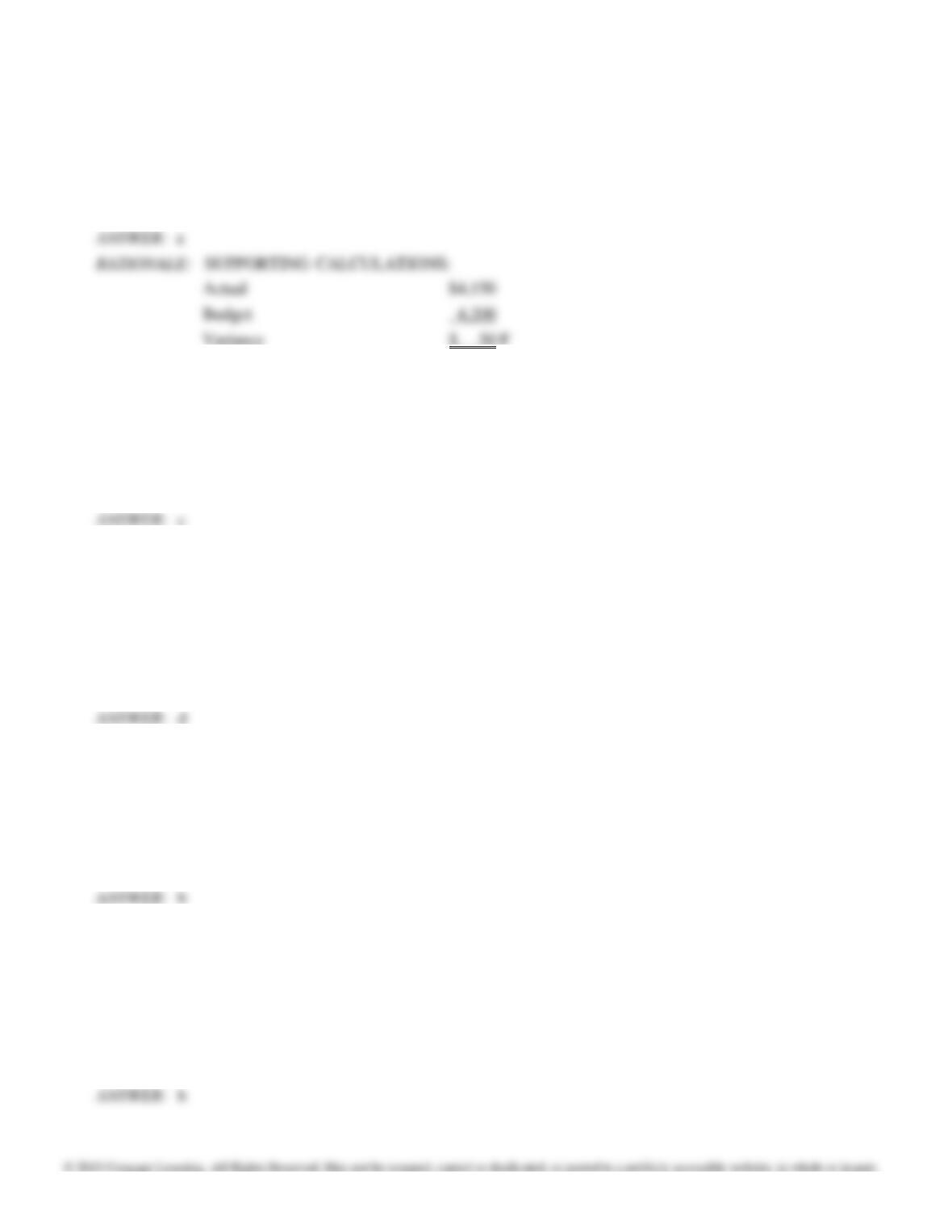
146. If production was budgeted at 400 units and the actual production was 420 units, what would be the static budget
variance for materials if the actual cost of materials was $4,150 and the budgeted cost per unit is $10?
a. $50 F
b. $200 U
c. $100 F
d. $150 U
Chapter 8: Budgeting for Planning and Control
147. If production was budgeted at 400 units and the actual production was 420 units, what would be the flexible budget
variance for materials if the actual cost of materials was $4,150 and the budgeted cost per unit is $10?
a. $50 F
b. $200 U
c. $100 F
d. $150 U
148. Flexible budgets do NOT provide
a. expected costs for a range of activity.
b. budgeted costs for the actual level of activity.
c. budgeted costs for a predetermined level of activity.
d. expected costs for the actual performance level.
149. If a static budget forecasted 100,000 units to be sold in the fiscal year and actual units sold amounted to 120,000,
what assumption could be made under a flexible budget process?
a. Since the actual volume exceeds the budgeted volume, there is an unfavorable volume variance for output.
b. Fixed costs would increase in the flexible budget due to the volume change.
c. The effectiveness of the manager is in question.
d. Variable costs will be higher than projected in the static budget due to the volume variance.
150. Volume variances examine differences between
a. the static budget and actual costs.
b. the flexible budget and static budget.
c. the static budget and the rolling budget.
d. none of these.
151. Activity-based budgets
a. use the knowledge of cost behavior to split the functional-based line items into fixed and variable
components.
b. start with output and then determine the resources necessary to create that output.
c. rely on the use of functional-based line items.
d. work in environments where the products are homogenous and the production process is simple.

Chapter 8: Budgeting for Planning and Control
152. Activity-based budgeting is most useful when
a. output is homogeneous.
b. production processes are simple.
c. diverse products are produced.
d. volume levels are stable.
153. With an activity flexible budget, a budget variance is calculated
a. based on a flexible budget based on cost for actual units produced.
b. based on a flexible budget based on various activity drivers for actual units produced.
c. based on a flexible budget based on flexible manufacturing.
d. based on a flexible budget based on committed resources for actual units produced.
154. Which is NOT one of the four steps needed to build an activity-based budget?
a. Determine output level.
b. Determine the activities and their drivers needed to produce output.
c. Estimate the demand for each activity to produce the output.
d. Estimate the committed capacity.
155. Activity-based budgets compare costs for items based on activities such as
a. direct material.
b. direct labor.
c. setups.
d. power.
156. A flexible-based budgeting system
a. uses functional-based line items.
b. splits costs into variable and fixed components.
c. prepares budgets for a range of activity levels.
d. all of these.
157. A functional-based approach to budgeting compares costs for functional line items such as
a. setups.
b. direct materials.
c. ordering.
d. inspections.