195
CHAPTER 8: PRINCIPLES OF PRICING FORWARDS, FUTURES AND OPTIONS ON FUTURES
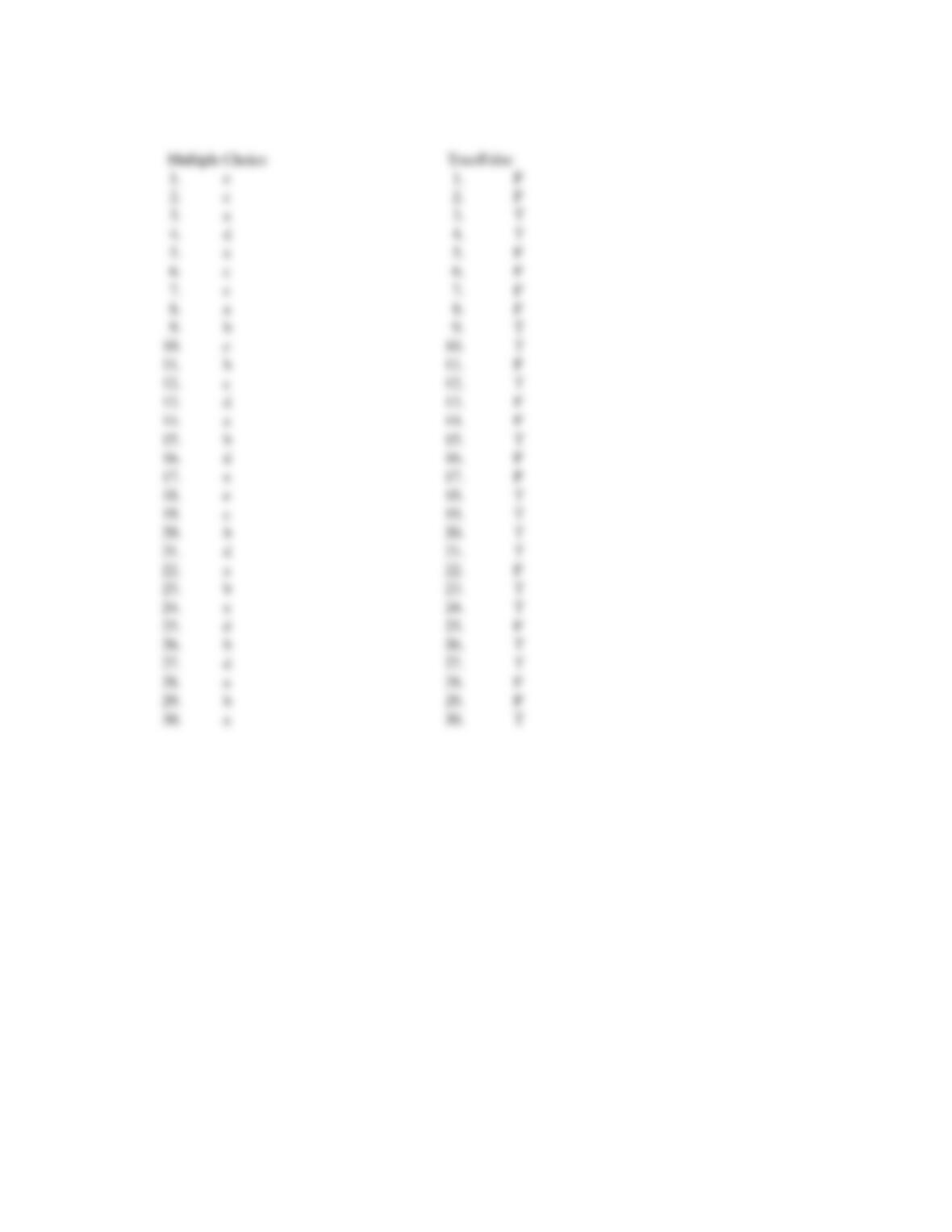
MULTIPLE CHOICE TEST QUESTIONS
1. What is the lower bound of a European call option on a futures contract where f0 is the futures price and X is
the exercise price? Assume f0 is greater than X.
a. the difference between f0 and X
b. zero
c. the present value of the difference between f0 and X
d. the ratio of f0 to X
e. none of the above
2. Which of the following best describes normal contango?
a. the spot price is less than the futures price
b. the futures price is less than the spot price
c. the expected spot price is less than the futures price
d. the cost of carry is negative
e. none of the above
3. Which of the following can explain a contango?
a. the interest rate exceeds the dividend yield
b. the cost of carry is negative
c. futures prices exceed forward prices
d. the market is at less than full carry
e. none of the above
4. Determine the appropriate price of a European put on a futures if the call is worth $6.55, the continuously
compounded risk-free rate is 5.6 percent, the futures price is $80, the exercise price is $75, and the expiration
is in three months.
a. $12.56
b. $0.54
c. $11.48
d. $1.62
e. none of the above
5. Suppose you buy a one-year forward contract at $65. At expiration, the spot price is $73. The risk-free rate is
10 percent. What is the value of the contract at expiration?
a. $8.00
b. –$8.00
c. $0.00
d. $7.27
e. none of the above
6. Suppose you sell a three-month forward contract at $35. One month later, new forward contracts with similar
terms are trading for $30. The continuously compounded risk-free rate is 10 percent. What is the value of your
forward contract?
a. $4.96
b. $5.00
c. $4.92
d. $4.55
e. none of the above
7. Suppose you buy a futures contract at $150. If the futures price changes to $147, what is its value an instant
196
before it is marked-to-market?
a. 0
b. $3
c. –$3
d. it is impossible to tell
e. none of the above
8. Find the price of a European call on a futures contract if the futures price is $106, the exercise price is $100,
the continuously compounded risk-free rate is 7.2 percent, the volatility is 0.41 and the call expires in six
months.
a. $14.57
b. $17.04
c. $6.00
d. $19.78
e. none of the above
9. A deep in-the-money call option on futures is exercised early because
a. the intrinsic value is maximized
b. it behaves like a futures but ties up funds
c. the futures price is not likely to rise any further
d. all of the above
e. none of the above
10. Find the value of a European put option on futures if the futures price is 72, the exercise price is 70, the
continuously compounded risk-free rate is 8.5 percent, the volatility is 0.38 and the time to expiration is three
months.
a. 6.30
b. 12.90
c. 4.34
d. 2.00
e. none of the above
11. Futures prices differ from spot prices by which one of the following factors?
a. the systematic risk
b. the cost of carry
c. the spread
d. the risk premium
e. none of the above
12. Find the forward rate of foreign currency Y if the spot rate is $4.50, the domestic interest rate is 6 percent, the
foreign interest rate is 7 percent, and the forward contract is for nine months. (The interest rates are
continuously compounded.)
a. $4.458
b. $5.104
c. $4.468
d. $4.532
e. none of the above
13. A contango market is consistent with
a. a negative basis
b. futures prices exceeding spot prices
c. a positive cost of carry
d. all of the above
197
e. none of the above
14. What is the lower bound of a European foreign currency call if the spot rate is $2.25, the domestic interest rate
is 5.5 percent, the foreign interest rate is 6.2 percent, the option expires in three months, and the exercise price
is $2.20? (The interest rates are continuously compounded.)
a. $0.0457
b. $0.05
c. $0.0793
d. $0.0529
e. none of the above
15. Suppose there is a risk premium of $0.50. The spot price is $20 and the futures price is $22. What is the
expected spot price at expiration?
a. $21.50
b. $22.50
c. $20.50
d. $24.50
e. none of the above
16. Find the value of a European foreign currency call if the spot rate is $5.25, the exercise price is $5.40, the
domestic interest rate is 6.1 percent, the foreign interest rate is 5.5 percent, the call expires in one month, and
the volatility is 0.32. (The interest rates are continuously compounded.)
a. $0.167
b. $0.15
c. $0.140
d. $0.131
e. none of the above
17. What would be the spot price if a stock index futures price were $75, the risk-free rate were 10 percent, the
continuously compounded dividend yield is 3 percent, and the futures contract expires in three months?
a. $73.70
b. $77.48
c. $72.60
d. $76.32
e. none of the above
18. Find the lower bound of a European foreign currency put if the spot rate is $3.50, the domestic interest rate is
8 percent, the foreign interest rate is 7 percent, the option expires in six months, and the exercise price is
$3.75. (The interest rates are continuously compounded.)
a. zero
b. $0.250
c. $0.366
d. $0.108
e. none of the above
19. Suppose it is currently July. The September futures price is $60 and the December futures price is $68. What
does the spread of $8 represent?
a. the cost of carry from July to September
b. the expected risk premium from July to September
c. the cost of carry from September to December
d. the expected risk premium from September to December
e. none of the above
198
20. Why is the initial value of a futures contract zero?
a. the futures is immediately marked-to-market
b. you do not pay anything for it
c. the basis will converge to zero
d. the expected profit is zero
e. none of the above
21. The spot price plus the cost of carry equals
a. the convenience yield
b. the expected future spot price
c. the risk premium
d. the futures price
e. none of the above
22. Determine the value of a European foreign currency put if the call is at $0.05, the spot rate is $0.5702, the
exercise price is $0.59, the domestic interest rate is 5.75 percent, the foreign interest rate is 4.95 percent and
the options expire in 45 days. (The interest rates are continuously compounded.)
a. $0.069
b. $0.031
c. $0.050
d. $0.517
e. none of the above
23. Interest rate parity is essentially the same as
a. the cross-rate relationship
b. the cost of carry relationship
c. the Garman-Kohlhagen model
d. all of the above
e. none of the above
24. A transaction that exploits differences in the theoretical and actual values of a foreign currency forward or
futures contract is called
a. covered interest arbitrage
b. triangular arbitrage
c. a conversion
d. interest-rate parity
e. none of the above
25. The cost of carry consists of all the following except
a. the risk–free rate
b. the cost of storage
c. insurance on the asset
d. the risk premium
e. none of the above
26. The value of a long position in a forward contract at expiration is
a. the spot price plus the original forward price
b. the spot price minus the original forward price
c. the original forward price discounted to expiration
d. the spot price minus the original forward price discounted to expiration
e. none of the above
27. The value of a futures contract immediately after being marked to market is
199
a. numerically equal to the daily settlement amount
b. the spot price plus the original forward price
c. equal to the amount by which the price changed since the contract was opened
d. simply zero
e. none of the above
28. Under uncertainty and risk aversion, today’s spot price equals
a. the expected future spot price, minus the storage costs, minus the interest forgone, minus the risk
premium
b. the expected future spot price, minus the storage costs, minus the interest forgone, plus the risk
premium
c. the expected future spot price, minus the storage costs, minus the risk premium
d. the future spot price minus the cost of storage
e. none of the above
29. The additional return earned by holding a commodity that is in short supply or a nonpecuniary gain from an
asset is referred to as
a. the negative cost of carry
b. the convenience yield
c. cash-flow free gains
d. gains on the underlying
e. none of the above
30. Put-call-futures parity is the relationship between the prices of puts, calls, and futures on an asset. Assuming a
constant risk-free rate and European options, which of the following correctly expresses the relationship of
put-call-futures parity?
a. Pe(S0,T) = Ce(S0,T) + (X – f0(T))(1 + r)–T
b. Pe(S0,T,X) = Ce(S0,T) – (X – f0(T))(1 + r)–T
c. Pe(S0,T,X) = Ce(S0,T,X) + (X – f0(T))(1 + r)-T
d. Pe(S0,T,X) = Ce(S0,T,X)(X – f0(T))(1 + r)-T
e. none of the above
200
CHAPTER 8: PRINCIPLES OF PRICING FORWARDS, FUTURES AND OPTIONS ON FUTURES
TRUE/FALSE TEST QUESTIONS
T F 1. The futures price of a non-storable asset is determined by the cost of carry.
T F 2. The risk-free rate is missing from d1 in the Black model because it is effectively zero.
T F 3. A synthetic put option on futures could be constructed by buying a call option on futures
and selling the futures.
T F 4. The daily settlement brings the value of a futures contract back to zero.
T F 5. Value is created in a futures contract with the passage of time.
T F 6. The Black formula prices an option on an instrument with a positive cost of carry.
T F 7. The dividends that are subtracted from the cost of storage to determine the cost of carry are
actually the present value of future dividends.
T F 8. The cost of carry futures pricing model requires that investors be able to sell short the
commodity.
T F 9. A normal market in which the futures price exceeds the spot price is described as a
contango.
T F 10. A convenience yield is an explanation for a negative cost of carry.
T F 11. Normal backwardation and contango are mutually exclusive conditions for a market.
T F 12. In financial futures markets, contango means that long-term interest rates are less than
short-term interest rates.
T F 13. A market in which the futures price is said to be unbiased is also a market in which there is
a risk premium.
T F 14. The Black-Scholes-Merton formula can be used in place of the Black formula if you use the
futures price for the stock price and a risk-free rate of zero.
T F 15. If the exercise price equals the futures price, a put on the futures will have the same price as
a call on the futures.
T F 16. Holding everything else constant, dividends or interest on the underlying commodity would
make a futures price be higher.
T F 17. The price of a futures spread reflects the cost of carry until the time the spread is closed.
T F 18. If one buys an asset, sells a futures, and holds the position until expiration, it is equivalent
to selling the asset at the original futures price.
T F 19. A futures contract can have negative value.
T F 20. Interest-rate parity is a cost-of-carry model.
201
T F 21. The dividend yield on a stock option is similar to the foreign interest rate on a foreign
currency option.
T F 22. American foreign currency calls will never be exercised early.
T F 23. If the U.S. government announced that it would allow the dollar to drop in foreign currency
markets, the price of a euro put would probably fall.
T F 24. The cost of carry includes the interest lost on the funds tied up in the asset stored.
T F 25. If the U.S. risk-free rate is 4 percent and the Swiss risk-free rate is 5 percent, a U.S. investor
can earn the Swiss rate by buying Swiss francs, selling a forward or futures contract and
converting back to dollars at the contract’s expiration.
T F 26. The price of a futures contract that expires immediately is the spot price.
T F 27. As soon as a futures contract is marked to market, its value is zero.
T F 28. Forward and futures prices will be equal prior to expiration if interest rates are certain or if
futures prices and interest rates are correlated.
T F 29. A stock index futures price is the stock price compounded to expiration at the risk-free rate
plus the future value of the dividends.
T F 30. Under uncertainty and risk neutrality, today’s spot price equals the expected future spot
price minus the cost of storage and interest forgone.
202
CHAPTER 8