CHAPTER 8 – WIRELESS SECURITY
TRUE/FALSE
1. WLANA is a consortium of universities researching wireless networking, located at Rutgers
University.
2. Network signals are transmitted over radio waves in a fashion similar to the way your local radio
station broadcasts.
3. Most wireless radio wave network equipment employs closed spectrum technology for packet
transmissions.
4. The IEEE 802.11 standard is also called the IEEE Standard for Wireless LAN Medium Access and
Physical Layer Specifications.
5. Wireless communications only involve two main components: a card that functions as a
transmitter/receiver (transceiver), and an access point.
6. In wireless networking, a directional antenna is often used on an indoor network, in which users are
mobile and need to broadcast and receive in all directions.
7. Priority-based access is intended for communications that are time-sensitive.
8. With ARQ, if the station sending a packet does not receive an acknowledgment from the destination
station, the sending station automatically retransmits the packet.
9. All devices that conform to the 802.11a standard must be able to transmit at 6, 12, 24 and 48 Mbps.
10. The communication method used by 802.11g is OFDM.
MODIFIED TRUE/FALSE

1. An alternative to using radio wave communications is the 802.11R standard for microwave
transmissions. _________________________
2. The IBSS topology consists of ad hoc peer-to-peer communications between WNICs on individual
computers. _________________________
3. ESS enables existing access points to be notified when a new access point is attached to a network, and
it enables adjacent access points to share configuration information with one another.
_________________________
4. Up to seven Bluetooth devices can be connected at the same time. _________________________
5. In 802.11 communications, the shared secret is the SSID key used for encryption and decryption, and
the key itself is encrypted. _________________________
6. The PEAP, developed as an alternative to reduce the complexity of authentication, is identical to EAP-
TTLS, but does not require the use of certificates. _________________________
7. Electronic radiation is propagated through the Earth’s atmosphere and through space, with properties
that resemble waves and properties that resemble particles. _________________________
8. The purpose of a(n) terminal node controller is to convert the computer’s digital signal to an analog
signal that can be amplified by the transmitter/receiver and broadcast out through an antenna.
_________________________

9. Many wireless network users are deploying Bluetooth devices because these devices do not rely on
proprietary communications, particularly in the lower (and slower) 902-928 MHz range common to
older wireless devices. _________________________
10. In asynchronous communication, communications occur in discrete units, with the start of a unit
signaled by a start bit at the front and a stop bit at the back end. _________________________
MULTIPLE CHOICE
1. By 2006, how many wireless devices are expected to be installed?
a.
Over 50 million
c.
Over 90 million
b.
Over 75 million
d.
Over 100 million
2. Which organization recognizes amateur radio as a significant avenue for advancing communications
through experimentation and invention?
a.
FDA
c.
EIA/TIA
b.
OSI
d.
FCC
3. What are the lowest frequencies on which amateur radio operators can transmit?
a.
20.1 to 24.0 MHz
c.
40.1 to 44.0 MHz
b.
30.1 to 34.0 MHz
d.
50.1 to 54.0 MHz
4. What is the mail unit of measurement for radio frequencies?
a.
Rads
c.
Ohms
b.
Hertz
d.
Watts
5. Radio frequencies are the range of frequencies above _____ kilohertz through which an
electromagnetic signal can be radiated into space.
a.
2
c.
10
b.
5
d.
20
6. When was the first 802.11 standard created?
a.
1985
c.
1995
b.
1987
d.
1997
7. Which organization is supported by wireless network device manufacturers and promoters, including
Alvarion, Cisco Systems, ELAN, Intermec, Intersil, Raylink, and Wireless Central?

a.
WINLAB
c.
IEEE
b.
WLANA
d.
WNDMO
8. Which radio frequency band is primarily used in older, nonstandardized wireless devices?
a.
902 MHz
c.
5 GHz
b.
2.4 GHz
d.
11 GHz
9. What is the typical data rate of spread spectrum packet transmission?
a.
1-11 Mbps
c.
1-100 Mbps
b.
1-22 Mbps
d.
1-54 Mbps
10. On which layers of the OSI model does 802.11 focus?
a.
Physical and data-link
c.
Physical only
b.
Data-link and network
d.
Data-link only
11. Which specification enables multiple protocols to be carried over a network, and allows the computer
and the computer’s operating system to interface with the WNIC?
a.
NDIS
d.
Both a and b
b.
ODI
e.
Both b and c
c.
RPC
12. What is the name of the device that attaches to a cabled network and services wireless communications
between WNICs and the cabled network?
a.
Access hub
c.
Access point
b.
Access switch
d.
Wireless router
13. The _____ certification means the device meets the standard for Wi-Fi.
a.
WICA
c.
WECA
b.
WLANA
d.
ISO
14. Which access method is incorporated into the 802.11 standard?
a.
Priority-based
d.
Both a and b
b.
CSMA/CA
e.
Both a and c
c.
CSMA/CD
15. Which of the following can interfere with wireless network communications?
a.
Solar flares
c.
Weather
b.
Physical obstacles
d.
All of the above

16. At what speed must all devices that conform to the 802.11a standard be able to transmit?
a.
6 Mbps
c.
24Mbps
b.
12Mbps
d.
All of the above
17. Which wireless standard uses OFDM?
a.
802.11a
d.
Both a and b
b.
802.11g
e.
Both b and c
c.
802.11b
18. Which wireless standard uses DSSS?
a.
802.11a
c.
802.11c
b.
802.11b
d.
802.11g
19. How many channels does the 802.11b standard use in the United States and Canada?
a.
4
c.
13
b.
11
d.
15
20. How many channels does the 802.11b standard use in France?
a.
4
c.
11
b.
6
d.
13
21. What is the width of each channel in the 802.11b standard?
a.
2.4 Ghz
c.
22 Mhz
b.
5 Ghz
d.
11 Mhz
22. What is the maximum distance that 802.11a devices can transmit?
a.
60 feet
c.
300 feet
b.
100 feet
d.
300 meters
23. Which wireless standard should be used when there are many individual users in a small area, such as
in a computer lab?
a.
802.11a
d.
Both a and c
b.
802.11g
e.
Both a and b
c.
802.11b
24. What is the maximum operating speed of the 802.11b standard?
a.
11 Mbps
c.
56 Mbps
b.
22 Mbps
d.
54 Mbps

25. Which is the most expensive wireless standard to implement?
a.
802.11b
c.
802.11a
b.
802.11g
d.
They are all about the same
26. In which frequency range does 802.11R operate?
a.
1 Ghz to 2 Ghz
c.
100 Ghz to 1000 Ghz
b.
2 Ghz to 5 Ghz
d.
100 Ghz to 1000 Thz
27. What is the maximum speed of transmission for directional 802.11R?
a.
1 Mbps
c.
22 Mbps
b.
16 Mbps
d.
56 Mbps
28. Which wireless network topology uses access points to provide a more extensive area of service?
a.
BSS
c.
IBSS
b.
ESS
d.
SES
29. What is the name of a wireless topology that uses two or more access points?
a.
Multiple-cell wireless LAN
c.
Multiple-cell wireless WAN
b.
Multi access point LAN
d.
Multi access point WAN
30. Which wireless roaming protocol generally conforms to the 802.11 standard?
a.
ESS
c.
IBSS
b.
IAPP
d.
IWAP
31. What is the distance that most Bluetooth devices can transmit?
a.
30 feet
c.
100 feet
b.
60 feet
d.
300 feet
32. What type of device does an attacker use to determine the location of a target wireless network?
a.
Antenna
c.
WNIC
b.
GPS
d.
War-driving software
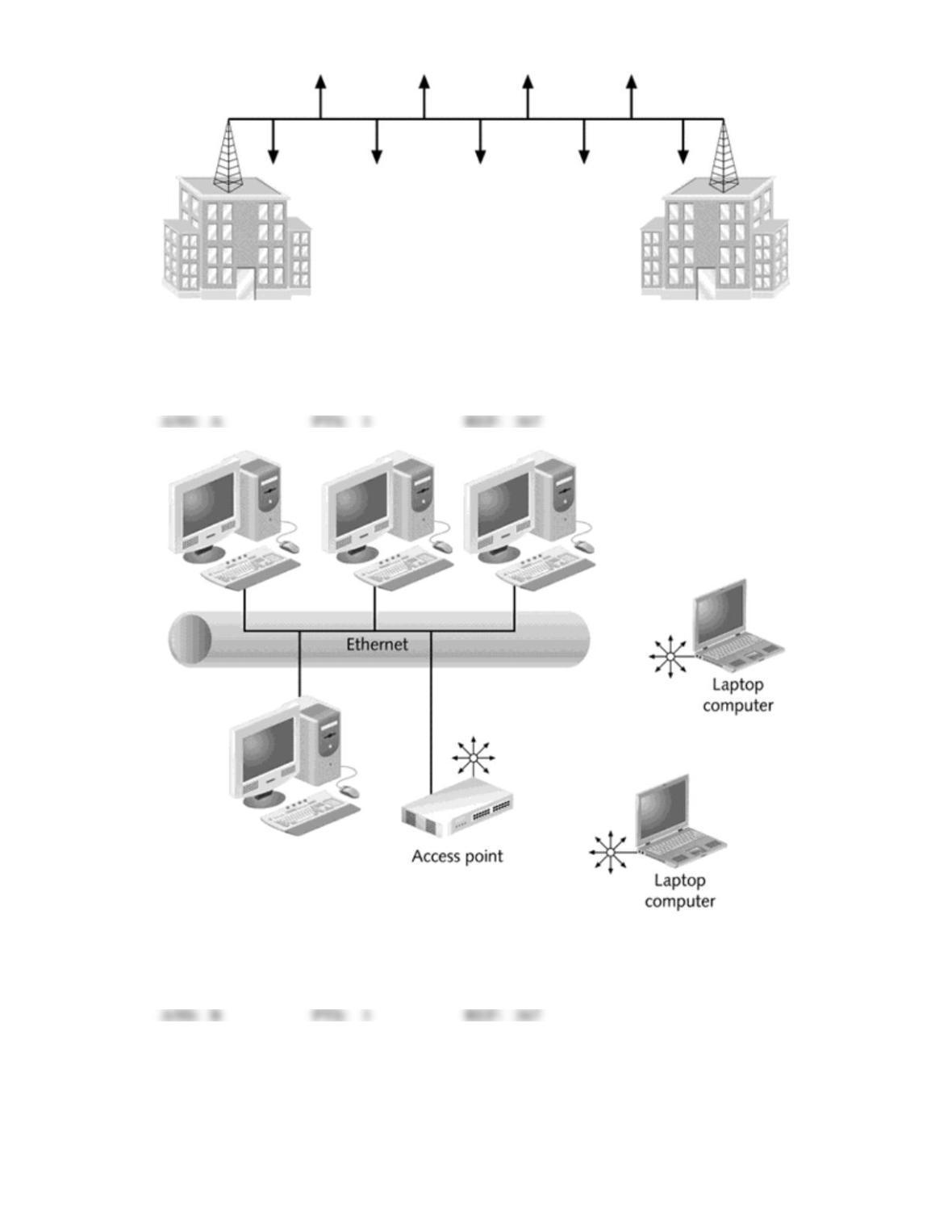
33. What type of antenna is being used in the figure above?
a.
Directional
c.
Unidirectional
b.
Omnidirectional
d.
Bidirectional
34. What type of antenna is being used in the figure above?
a.
Directional
c.
Unidirectional
b.
Omnidirectional
d.
Bidirectional
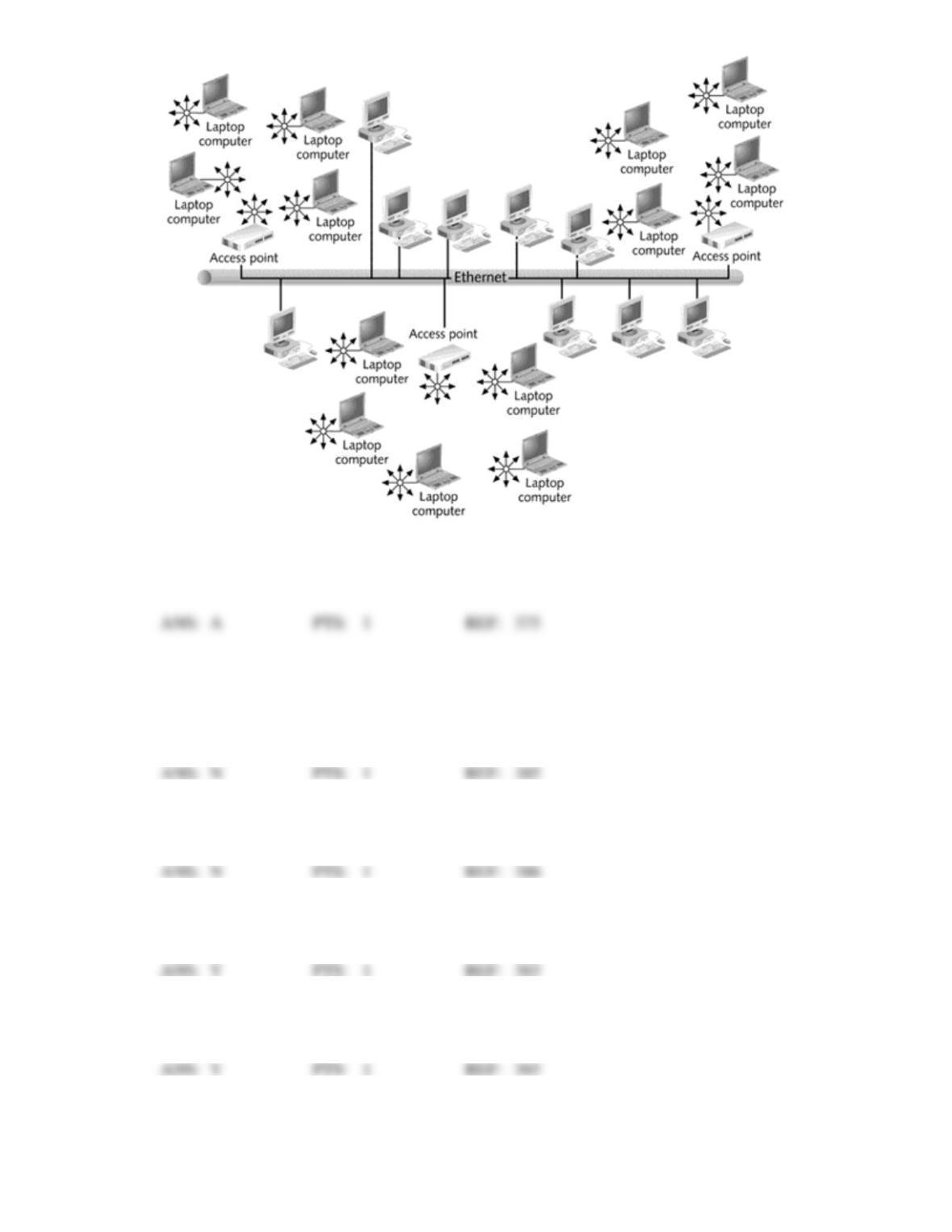
35. What type of wireless network topology is being displayed in the figure above?
a.
ESS
c.
802.11R
b.
IBSS
d.
SOS
YES/NO
1. Does Mac OS X and Apples iMac, iBook, Powerbook G4, and Power Mac G4 computers come with
built-in compatibility for 3COM WNICs and base stations (access points)?
2. Does Red Hat Linux 9.x support Bluetooth and offer the Bluetooth Setup Assistant, the Bluetooth
Serial Utility, and the Bluetooth File Exchange tools?
3. Are network signals transmitted over radio waves in a fashion similar to the way your local radio
station broadcasts?
4. Does the 802.11 standard focus on use of the physical and data-link layers (layers 1 and 2) of the OSI
model?
5. Is an access point usually a router or switch?
6. Does a directional antenna send radio waves in one main direction and generally amplify the radiated
signal to a greater degree than an omnidirectional antenna?
7. Does the signal gain in an indoor network generally need to be as high as for an outdoor network?
8. Is priority-based access also called the distributed coordination function?
9. In CSMA/CA, is the backoff time determined by multiplying a predetermined slot-time by a random
number?
10. Does the 802.11a wireless transmission standard operate in the 5-GHz range?
COMPLETION
1. ____________________ are licensed by the FCC to transmit voice, Morse code, data, satellite, and
video signals over radio waves and microwaves.
2. A limitation of ____________________ transmissions is that they are interrupted by tall land masses,
such as hills and mountains.
3. A(n) ____________________ is a device that sends out (radiates or transmits) and picks up (receives)
radio waves.
4. Because a(n) ____________________ antenna radiates primarily in one direction, the signal goes
farther from the source.
5. In ____________________ access, the access point also functions as a point coordinator.
6. In CSMA/CA, a station waiting to transmit determines if the frequency is idle by checking the
___________________________________ level.
7. 802.11a uses _____________________________________________ which functions by dividing the
5-GHz frequency range into a series of 52 subcarriers or subchannels.
8. The 802.11b standard uses _____________________________________________, which is a method
for radiating a data-carrying signal over radio waves.
9. ____________________ transmissions can be broadcast in a single direction or in all directions, using
a LED to transmit and a photodiode to receive.
10. ____________________ software determines the location of a network, but it can also determine
whether the network is an IBBS or ESS topology.
MATCHING
Match the following terms to the appropriate definition.
a.
802.1i
f.
ESS topology
b.
802.1x
g.
IAPP
c.
ARQ
h.
SSID
d.
Cell
i.
TDD
e.
DSSS
j.
WEP
1. A port-based form of authentication
2. Uses the same encryption key at both stations that are communicating
3. Uses access points to provide a larger service area than an IBSS topology
4. A communications method used by Bluetooth
5. 802.11b technique that spreads data across any of up to 14 channels
6. Used to define a logical network for member devices
7. An 802.11 error-handling technique
8. A roaming protocol for wireless networks
9. Implements the TKIP
10. The broadcast area around an access point
SHORT ANSWER
1. List five needs are wireless networks are designed and installed to accommodate? (List five.)
2. List the four transmission speeds available when using the 802.11b standard?
3. What four main elements can an attacker use to locate a wireless network?
4. What two things can an attacker do after successfully launching a man-in-the-middle attack?
5. What two approaches should be considered when planning for wireless communications?
6. List five of the common wireless security measures that can be taken to protect a wireless network.
7. What four general steps are used in the wireless communication authentication process?
8. What two key lengths are used in WEP encryption?
9. What seven security techniques does Windows 2000 Professional use to support WNICs?
10. What five security techniques does Red Hat Linux 9.x use to support WNICs?