134. A company borrowed $50,000 on November 1, 2012, at 9% interest. The interest and principal are due on
October 31, 2013.
Prepare the company’s journal entries on November 1, 2012, December 31, 2012, and October 31, 2013.
135. Grayson Flowers borrowed $400,000 from the bank on a six-month, 7% interest-bearing note on October
1, 2013. The company’s year-end is December 31st. The note and all related interest was repaid to the bank on
April 1, 2014.
A)
Prepare the company’s entry for this note on October 1, 2013.
B)
Record the adjusting entry for this note on December 31, 2013.
C)
Indicate how the note and the accrued interest would be reported on the balance sheet on December 31, 2013.
D)
Prepare the entry to record the repayment of the note on April 1, 2014.
A)
Oct. 1
Cash
400,000
Notes Payable
B)
Dec. 31
Interest Expense (400,000 ´ .07 ´ 3/12)
7,000
Interest Payable
D)
Apr. 1
Interest Expense (400,000 ´ .07 ´ 3/12)
7,000
Interest Payable
7,000
Notes Payable
400,000
Cash
Nov. 1
Cash
50,000
Notes Payable
Dec. 31
Interest Expense (50,000 ´ .09 ´ 2/12)
Interest Payable
Oct. 31
Interest Expense (50,000 ´ .09 ´ 10/12)
3,750
Interest Payable
Notes Payable
50,000
Cash
54,500
136. Graphic Designs, Inc. engaged in the following transactions during 2013:
Date
Transaction
Feb. 10
Purchased $10,000 of merchandise on credit.
Feb. 27
Paid for the merchandise purchased on Feb. 10th.
May 1
Borrowed $100,000 on a 9-month, 9% interest-bearing note.
May 15
Received a $5,000 deposit from a customer for custom-made products to be manufactured and delivered next month.
June 30
Remitted quarterly installments of FICA and income tax withholdings of $106,000 and $417,000, respectively. The
payroll entries, including the employer’s payroll taxes, have already been recorded.
Dec. 31
Recorded accrued interest on the note payable.
Prepare journal entries for each of these transactions.
Date
Accounts
Debit
Credit
Feb. 10
Merchandise Inventory
10,000
Accounts Payable
Feb. 27
Accounts Payable
10,000
Cash
May 1
Cash
100,000
Notes Payable
May 15
Cash
5,000
June 30
FICA Tax Payable (employee)
106,000
FICA Tax Payable (employer)
106,000
Federal Income Tax Payable
417,000
Cash
Dec. 31
Interest Expense
6,000
Interest Payable
($100,000 ´ 9% ´ 9/12) = $6,750 x 8/9
137. During May 2013, Grant Park Refinery sold, on credit, 1,200,000 gallons of motor fuel at $1.89 each plus
Georgia sales tax of 6%. Included in the price per gallon was a $.42 federal excise tax. All taxes collected are
paid to the appropriate taxing authority at the end of the quarter.
Prepare the appropriate journal entries on May 31, 2013, and June 30, 2013.
138. Grand Strand Power & Light provides utilities to a gulf coast community. On November 30, 2012, the
utility billed 1,500 residential customers a total of $118,500 for electricity. In addition, the company is required
to collect state taxes of 1.5% and Federal excise taxes of 0.95%. Both of these taxes are used to fund the energy
commission.
A)
What total amount should be billed to customers for November 2012?
B)
Provide the journal entry to record the November billings.
C)
Record the remittance of the taxes to the appropriate governmental units on December 31, 2012.
B)
Nov. 30, 2012
Accounts Receivable
121,404
Sales Revenue
State Taxes Payable (118,500 ´ .015)
1,778
Federal Excise Taxes Payable (118,500 ´ .0095)
1,126
C)
Dec. 31, 2012
State Tax Payable
1,778
Federal Excise Tax Payable
1,126
Cash
May 31
Accounts Receivable
2,404,080
Sales Revenue*
Georgia Sales Tax Payable**
Federal Excise Tax Payable***
June 30
Georgia Sales Tax Payable
136,080
Federal Excise Tax Payable
504,000
Cash
*
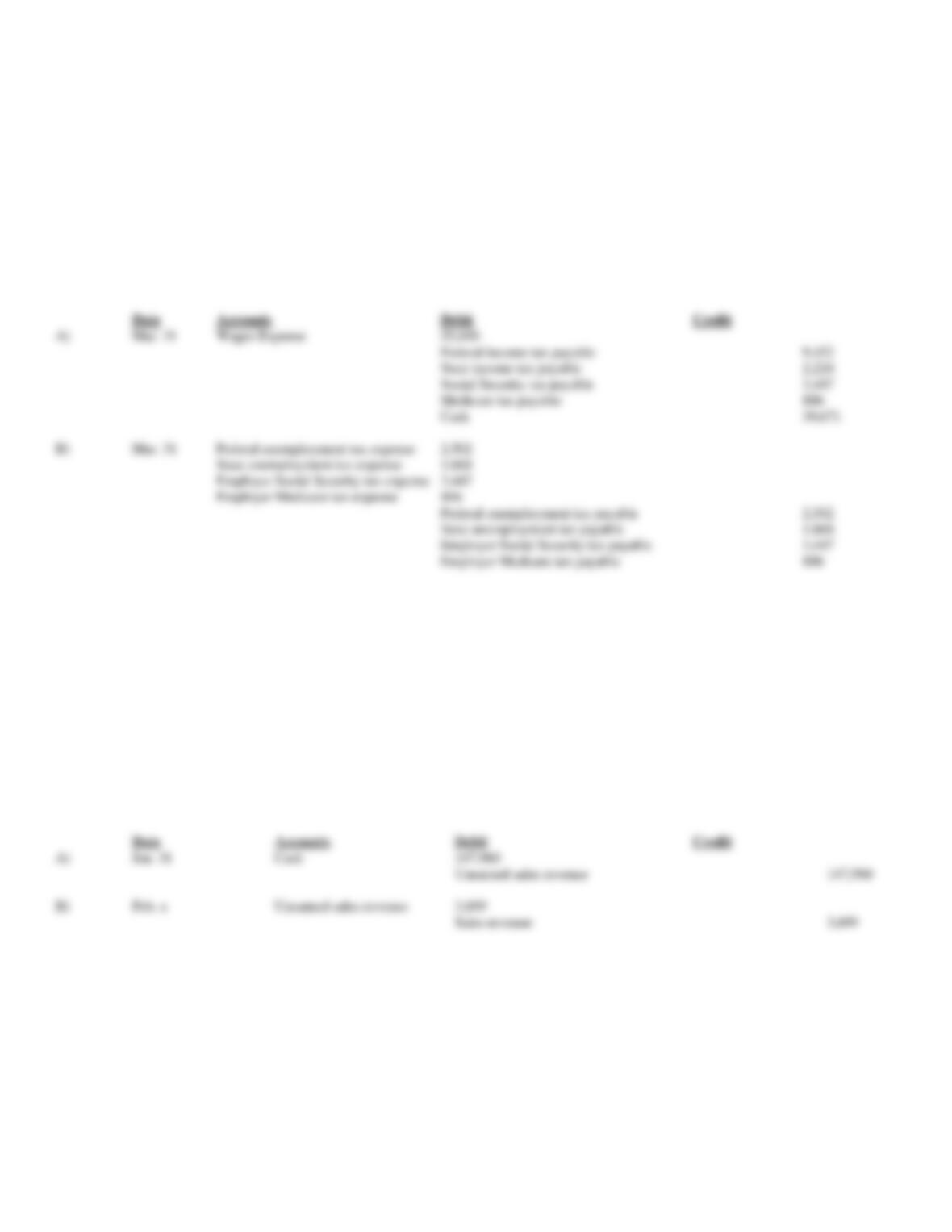
1,200,000 ´ ($1.89 – .42)
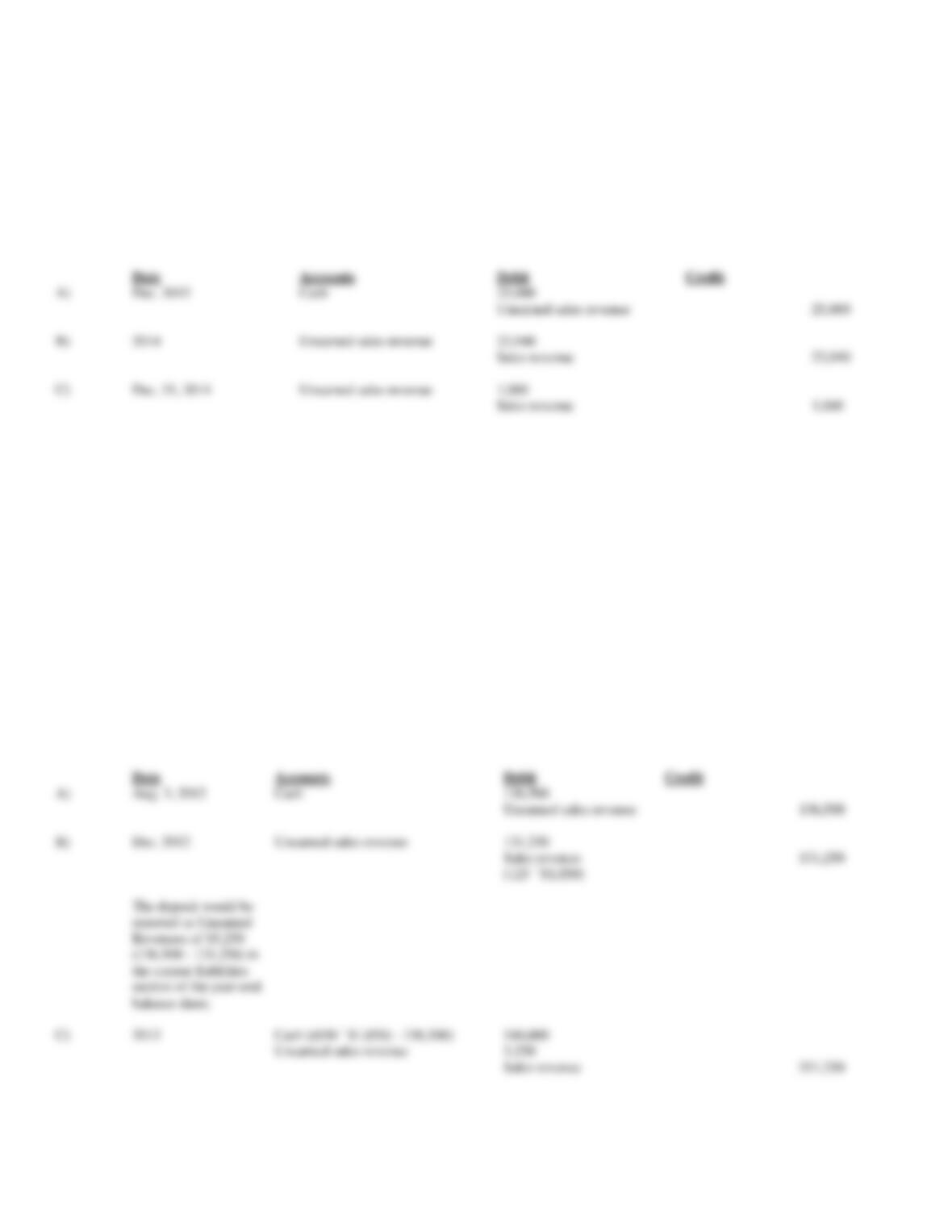
1,200,000 ´ $1.89 ´ 6%
***
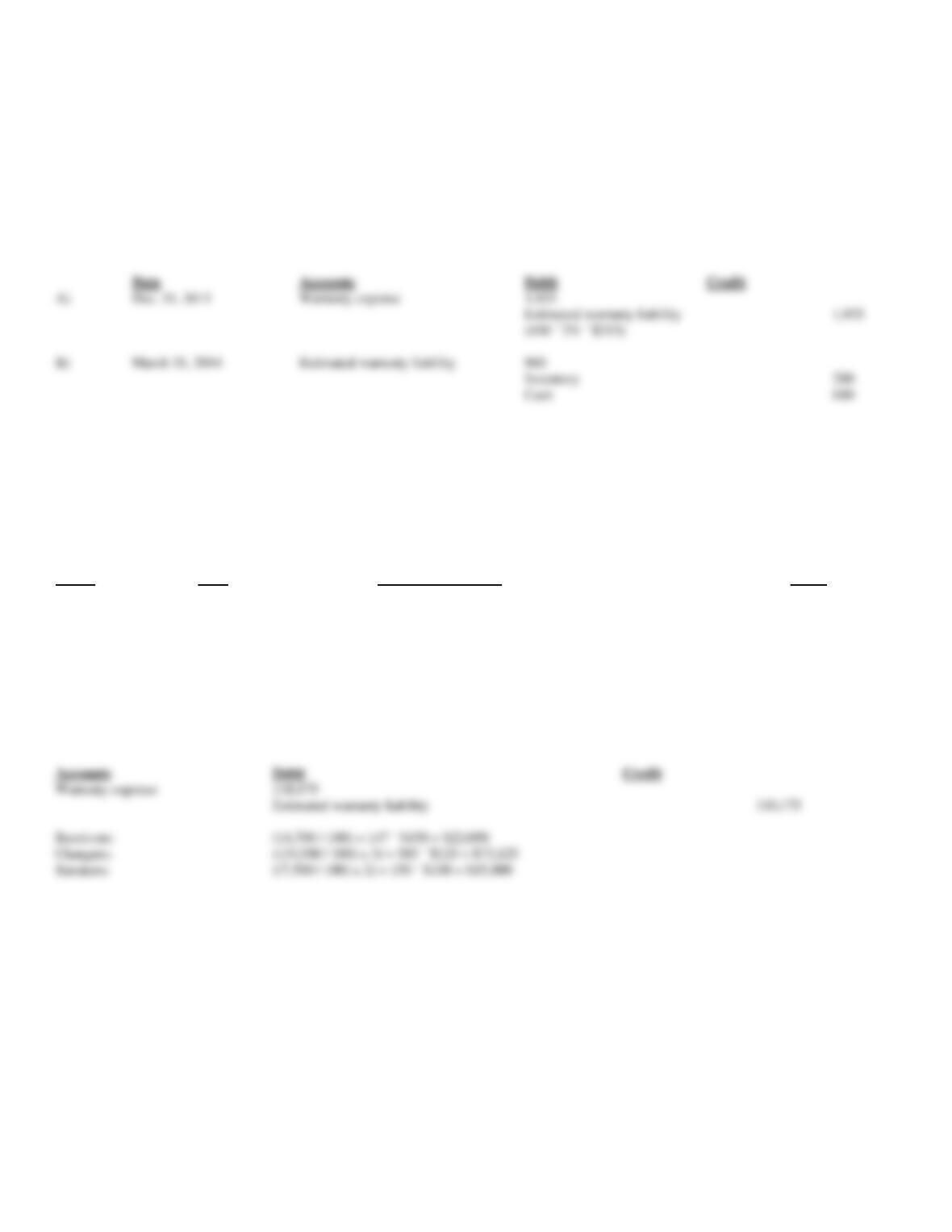
1,200,000 ´ $.42
139. Great Dane Trailers has the following data available for its March 31, 2013, payroll:
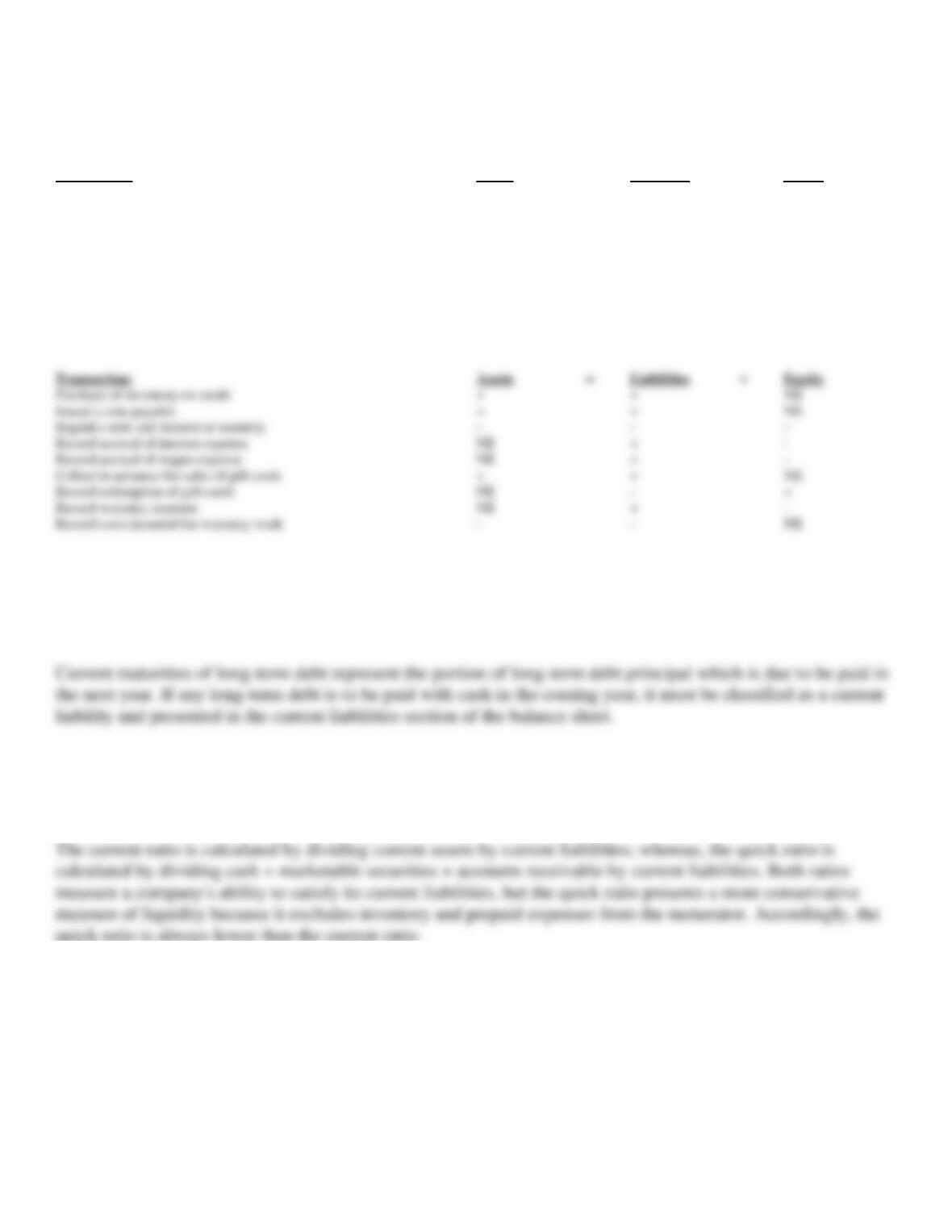
Gross pay*
$180,000
Federal income taxes withheld
43,200
State income taxes withheld
7,200
*All subject to FICA matching and withholding at 7.65%
Federal unemployment tax and state unemployment tax are also applicable at rates of 0.8% and 3.5%, respectively. All wages are subject to these
taxes.
Prepare the journal entries to record the wages earned and payroll taxes.
Mar. 31
Wages Expense
180,000
Federal income taxes payable
State income taxes payable
FICA taxes payable
Cash
Mar. 31
Federal unemployment tax expense
1,440
State unemployment tax expense
6,300
Employer FICA expense
13,770
Federal unemployment tax payable
State unemployment tax payable
FICA taxes payable
140. Grady Company’s hourly employees earned $55,600 in the pay period ending March 31. Assume further
that federal and state income taxes withheld are $9,452 and $2,224, respectively. In addition, social security and
medicare taxes are applicable at rates of 6.2% and 1.45%, respectively, and federal and state unemployment
taxes are applicable at rates of 4.5% and 3%, respectively. All wages are subject to these taxes.
A)
Prepare the journal entry related to the $55,600 gross pay earned by the company’s employees. Round all amounts to the nearest
dollar, if necessary.
B)
Prepare the journal entry for the company’s payroll taxes over and above gross pay. Round all amounts to the nearest dollar, if
necessary.
141. During January, a travel company sold forty cruise vacation packages for $147,960. Customers are
required to pay in advance, but the package price is refundable until the date the cruise departs. The cruises
begin in February.
A)
Record the entry on January 31 to book the amounts collected from customers.
B)
What entry is needed to record each time one of its customers departs on the cruise vacation?
A)
Jan. 31
Cash
147,960
Unearned sales revenue
Feb. x
Unearned sales revenue
3,699
Sales revenue
Mar. 31
Wages Expense
55,600
Federal income tax payable
9,452
State income tax payable
2,224
Social Security tax payable
3,447
Medicare tax payable
Cash
39,671
Mar. 31
Federal unemployment tax expense
2,502
State unemployment tax expense
1,668
Employer Social Security tax expense
3,447
Employer Medicare tax expense
Federal unemployment tax payable
2,502
State unemployment tax payable
1,668
Employer Social Security tax payable
3,447
Employer Medicare tax payable
142. Gottlieb Pool n’ Pub, Inc. sold $25,000 in gift cards during December 2013. The expiration date on these
gift cards is December 31, 2014. During 2014, $23,940 of the gift cards were redeemed by customers.
A)
Record the sale of the gift cards.
B)
Record the redemption of the gift cards.
C)
Record the expiration of the remaining gift cards.
143. On August 3, 2012, Grace Electric Supply agreed to manufacture and supply 650 electrical control units
for a particular customer who deposited $136,500 toward the purchase price upon signing the one-year purchase
agreement, which set the selling price of each control unit at $1,050. In December 2012, 125 units were
delivered to the customer and the remaining units were delivered in January 2013. The customer pays in cash
upon delivery for any units not covered by the deposit.
A)
Record the journal entry to record the receipt of the customer deposit during 2012.
B)
Record the journal entry for the delivery of 125 units to the customer in 2012. How would the customer’s deposit be reported in the
financial statements at the end of 2012?
C)
Record the entry for the delivery of the remaining units to the customer in 2013.
A)
Aug. 3, 2012
Cash
136,500
Unearned sales revenue
136,500
B)
Dec. 2012
Unearned sales revenue
131,250
Sales revenue
131,250
(125 ´ $1,050)
C)
2013
Cash ((650 ´ $1,050) – 136,500)
546,000
Unearned sales revenue
5,250
Sales revenue
551,250
A)
Dec. 2013
Cash
25,000
Unearned sales revenue
25,000
B)
2014
Unearned sales revenue
23,940
Sales revenue
23,940
C)
Dec. 31, 2014
Unearned sales revenue
1,060
Sales revenue
1,060
144. Good Time Carts offers a one-year warranty on all its golf carts. Estimates suggest that two percent of
carts sold will require warranty service and that the average warranty claim will cost $215. During 2013, the
company sold 450 golf carts.
A)
Record the entry at the end of 2013 to record the warranty expenses.
B)
Assume the company incurred costs of $280 in inventory and $680 in cash paid for wages in connection with warranty work
performed during the first quarter of 2014. Record the proper entry to recognize these costs.
145. Golden Sound sells premium car stereo systems and various equipment for home sound systems as well.
Sales and expected warranty claims for 2012 are as follows:
Product
Unit
Expected Warranty Claims
Cost per
Group
Sales
for Warranty Period
Claim
Receivers
14,700
1 claim per 100 sold
$150
CD Changers
19,500
3 claims per 100 sold
125
Speakers
7,500
2 claims per 100 sold
100
Prepare the journal entry to record warranty expense for 2012.
Accounts
Debit
Credit
Warranty expense
110,175
Estimated warranty liability
110,175
Receivers:
(14,700 / 100) = 147 ´ $150 = $22,050
Changers:
((19,500 / 100) x 3) = 585 ´ $125 = $73,125
Speakers:
((7,500 / 100) x 2) = 150 ´ $100 = $15,000
Date
Accounts
Debit
Credit
A)
Dec. 31, 2013
Warranty expense
1,935
Estimated warranty liability
(450 ´ 2% ´ $215)
March 31, 2014
Estimated warranty liability
Inventory
Cash
146. For each of the following transactions, indicate the impact on the accounting equation as a result of
recording the related journal entry. Include an entry in each column for each transactions, whether an increase
(+), decrease (-), or no effect (NE). The first transaction is shown as an example.
Transaction:
Assets
=
Liabilities
+
Equity
Purchase of inventory on credit
+
+
NE
Issued a note payable
Repaid a note and interest at maturity
Record accrual of interest expense
Record accrual of wages expense
Collect in advance for sales of gift cards
Record redemption of gift cards
Record warranty expense
Record costs incurred for warranty work
147. What is meant by the term “current maturities of long-term debt” in the current liabilities section of a
balance sheet?
148. What is the purpose of the current ratio? How does it differ from the quick ratio?
Purchase of inventory on credit
+
+
NE
Issued a note payable
+
+
NE
Repaid a note and interest at maturity
–
–
–
Record accrual of interest expense
NE
+
–
Record accrual of wages expense
+
–
Collect in advance for sales of gift cards
+
+
NE
Record redemption of gift cards
NE
–
+
Record warranty expense
NE
+
–
Record costs incurred for warranty work
–
–
149. What are accrued liabilities, and what are some examples of accounts that would be classified as accrued
liabilities in the current liabilities section of a balance sheet?
150. What type of entry is made to create a credit balance in the Estimated Warranty Liability account on the
balance sheet? What account would be debited in this entry?
151. Why is the liability for warranties recognized during the period when products are sold rather than the
period when warranty claims are satisfied?
152. List several employee withholdings that impact an employee’s net pay. Describe the types of payroll taxes
that an employer might be required to pay.
153. Why are unearned revenues considered current liabilities?
154. Goldberg Financials
The following footnote accompanied this company’s financial statements:
Note 7 – Litigation
On December 2, 2012, the Company was served with a class action complaint filed in federal court filed in
Covington, Kentucky. The complaint, captioned Bradford Haynes vs. The Company, was filed by a shareholder
of the Company on behalf of himself and other shareholders who purchased the Company’s common stock
during the period of March 31, 2011, through December 31, 2011. The plaintiff alleges that the Company
violated federal securities laws by making untrue statements of material facts and omitting material facts
concerning the Company’s construction and start-up of its new manufacturing facility in Plano, Texas. Also
named as defendants in the complaint are certain officers and directors of the Company. The Plaintiff is seeking
an unspecified amount of monetary damages. While this action is in its preliminary stages, management
believes that the allegations are without merit and the Company intends to defend the lawsuit vigorously.
Refer to Goldberg Financials. What type of liability is presented in this disclosure?
155. Goldberg Financials
The following footnote accompanied this company’s financial statements:
Note 7 – Litigation
On December 2, 2012, the Company was served with a class action complaint filed in federal court filed in
Covington, Kentucky. The complaint, captioned Bradford Haynes vs. The Company, was filed by a shareholder
of the Company on behalf of himself and other shareholders who purchased the Company’s common stock
during the period of March 31, 2011, through December 31, 2011. The plaintiff alleges that the Company
violated federal securities laws by making untrue statements of material facts and omitting material facts
concerning the Company’s construction and start-up of its new manufacturing facility in Plano, Texas. Also
named as defendants in the complaint are certain officers and directors of the Company. The Plaintiff is seeking
an unspecified amount of monetary damages. While this action is in its preliminary stages, management
believes that the allegations are without merit and the Company intends to defend the lawsuit vigorously.
Refer to Goldberg Financials. Should the company record a liability in 2012 for this litigation? Why or why
not?
156. “You Decide” Essay
You are the owner of small chain of sporting goods. Currently, you pay a media company to maintain the
company’s website and Internet sales processing software system. You are considering bringing that operation
in-house by hiring an Information Technology (IT) employee.
What factors should you consider in making this decision?
157. “You Decide” Essay
You are the owner and operator of a growing small business. You would like to expand your product offerings
but need $25,000 in short-term financing in order to do so. You have an appointment to see your banker
tomorrow. The banker has asked you to bring certain financial information with you to the meeting. That
information is provided below:
at December 31,
2013
2012
Balance Sheet Information
Total current assets
$66,000
$75,000
Accounts payable
2,610
1,500
Short-term notes payable
12,010
8,885
Income taxes payable
380
560
Income Statement Information
Sales
$842,000
$765,000
Net income
10,275
4,670
Use your financial information to make a case for the loan.