Chapter 8: Budgeting for Planning and Control
192. Realistic budgets reflect
a. actual levels of activity, full capacity usage, efficiencies, and general economic trends.
b. actual levels of activity, seasonal variations, efficiencies, and general economic trends.
c. ideal levels of activity, full capacity usage, efficiencies, and general economic trends.
d. ideal levels of activity, full capacity usage, and efficiencies.
193. Controllable costs are those that a manager
a. has no authority over.
b. cannot avoid.
c. does not participate in authorizing.
d. can influence through decision making.
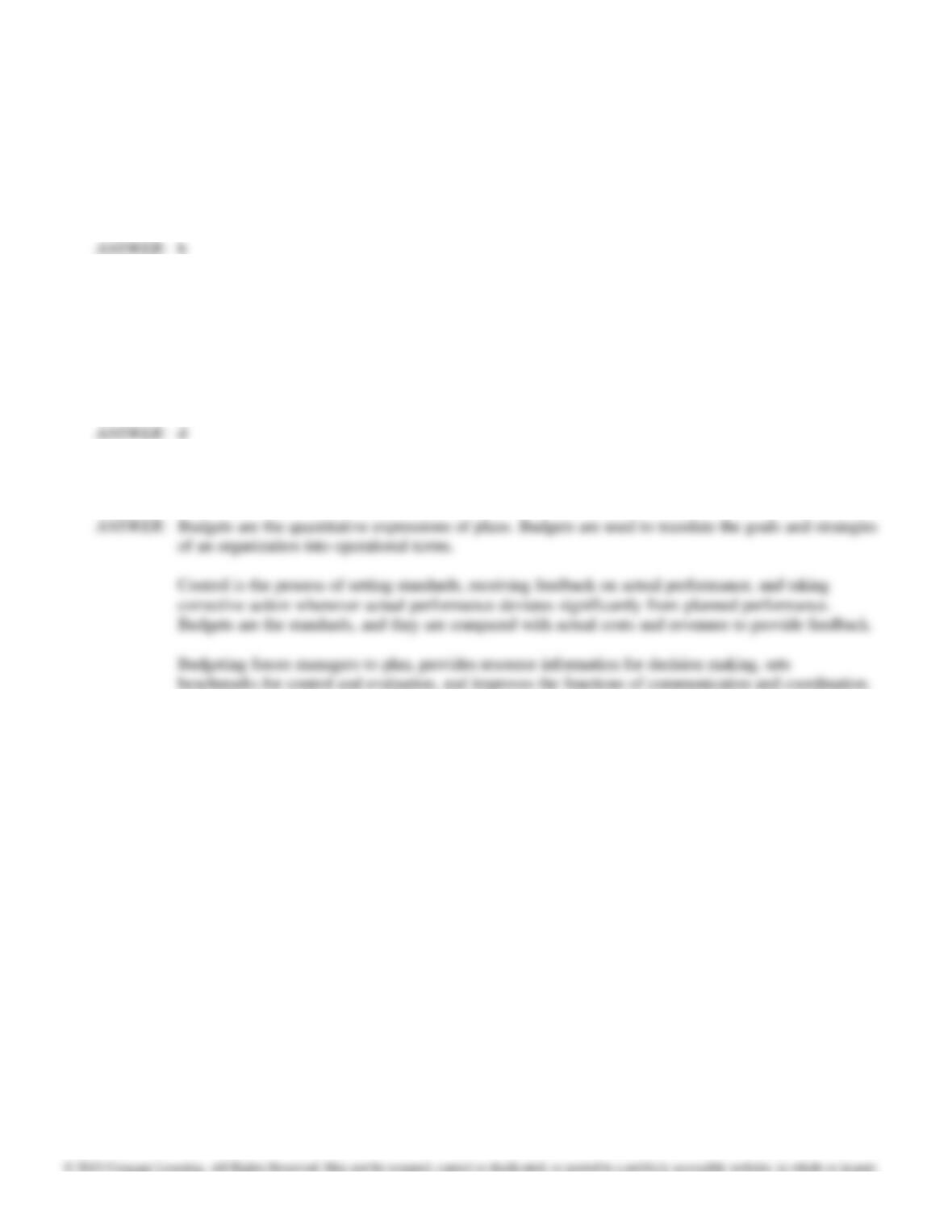
194. Define budgeting and control. How are budgets used in planning? How are budgets used to control? What are
some of the reasons for budgeting?
195. This problem can be broken into components…
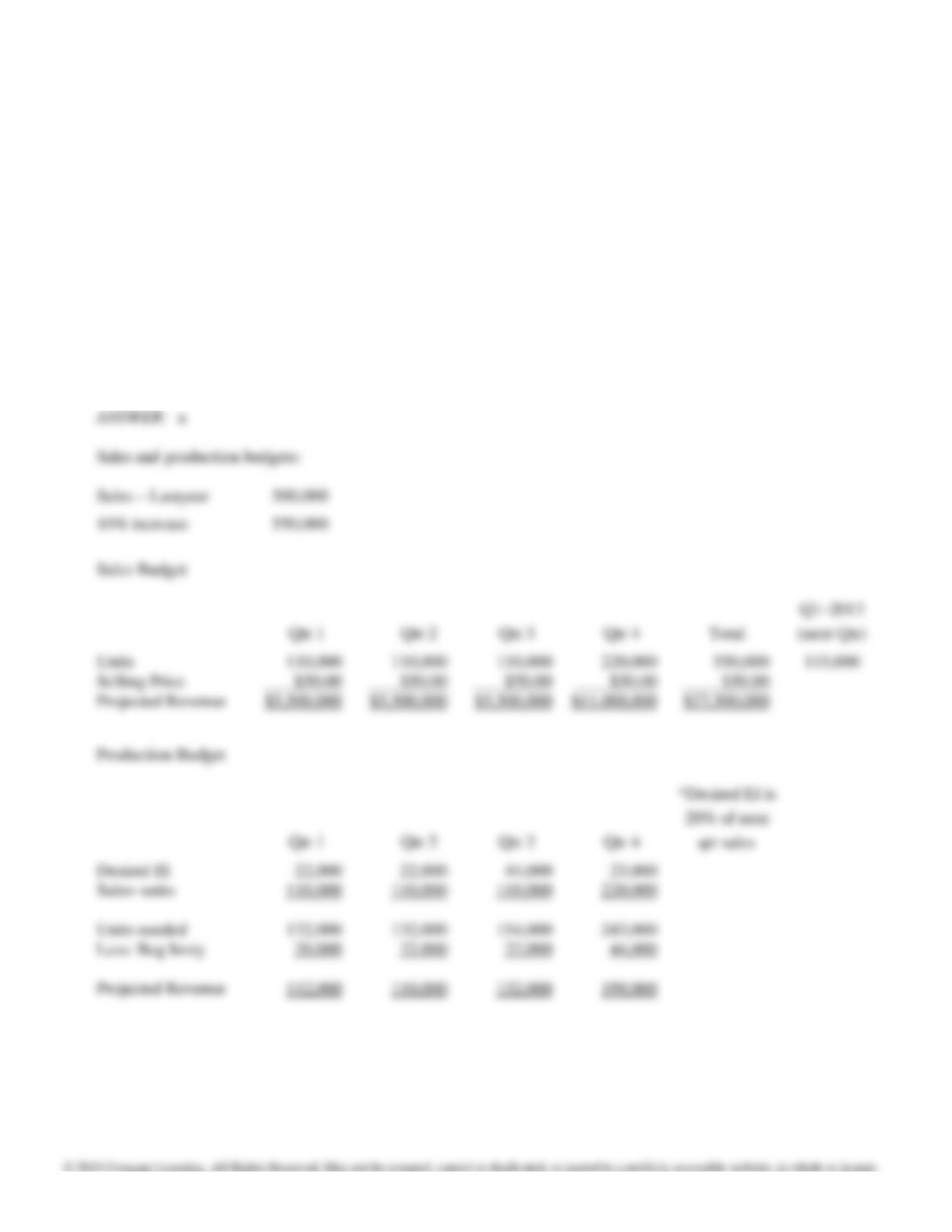
a. Given the following information, prepare a quarterly sales budget and production budget, in units:
Last year sales = 500,000 units. The organization is planning a 10 percent increase in sales for the year 2012. The
company is a retail organization that sees higher sales due to the holidays in the 4th quarter. 40 percent of the
sales occur in the 4th quarter and the remaining units are sold equally over the other three quarters.
The beginning inventory for the year amounts to 20,000 units. The estimated sales for the first quarter of 2013
amount to 115,000 units. The company requires an ending inventory of 20 percent of the next quarters’ sales.
Chapter 8: Budgeting for Planning and Control
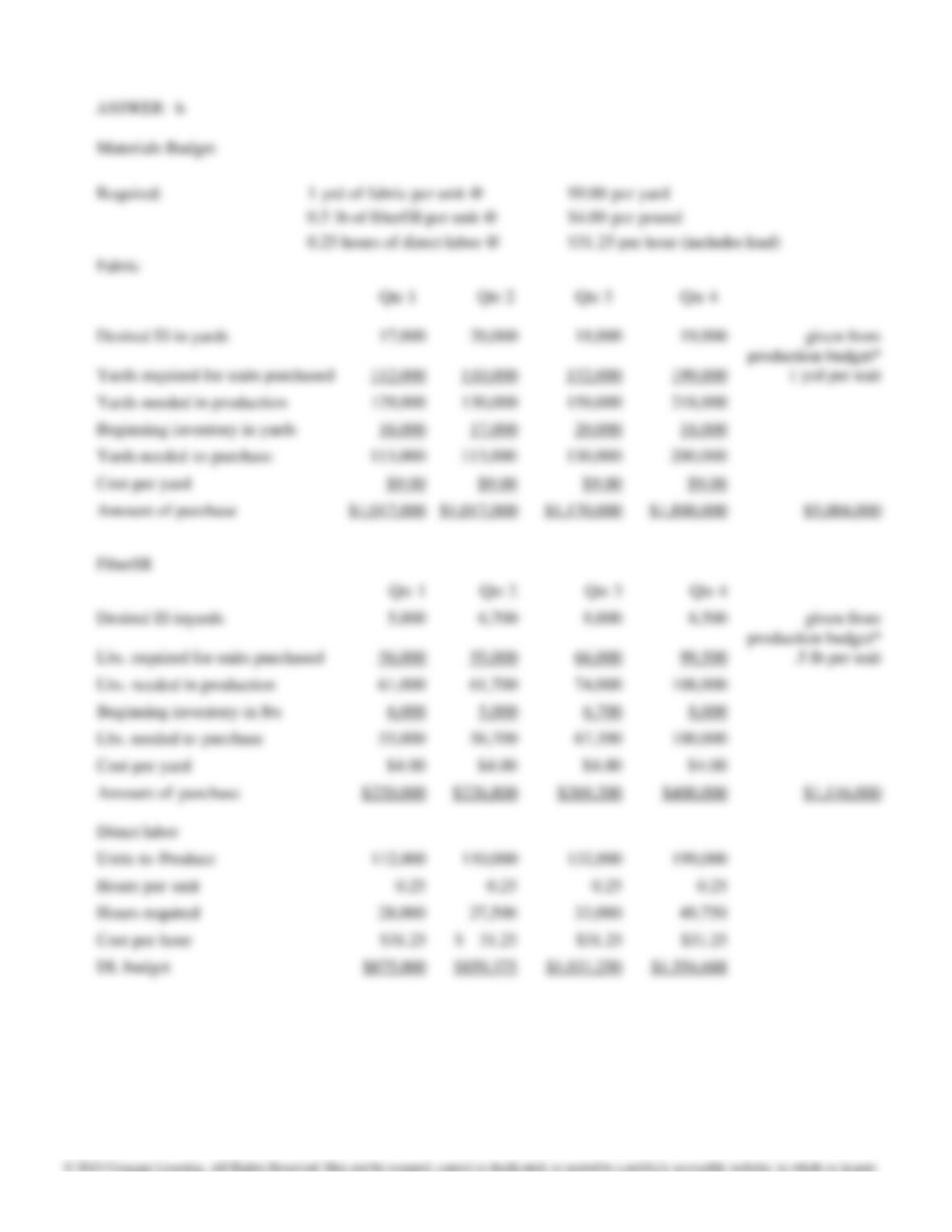
b. Given the schedules above, if the projected sales price is $50 per unit, what is the expected revenue per quarter?
Also, given the following information, what is the estimated costs of production?
Materials: Each unit requires 1 yard of fabric and 1/2 pound of fiberfill stuffing. Fabric can be purchased at $9.00
per yard and fiberfill sells for $4.00 per pound. Inventories of materials are listed as follows:
Qtr1
Qtr2
Qtr3
Qtr4
Fabric/yds
17,000
20,000
18,000
19,000
Fiberfill/lbs
5,000
6,700
8,000
8,500
Beginning inventory of fabric is 16,000 yards and 6,000 lbs of fiberfill.
It takes an estimated time of .25 hours to produce one unit of output. The labor cost per hour is $25 per hour and
the taxes and benefit load is 25 percent.
Chapter 8: Budgeting for Planning and Control
Chapter 8: Budgeting for Planning and Control
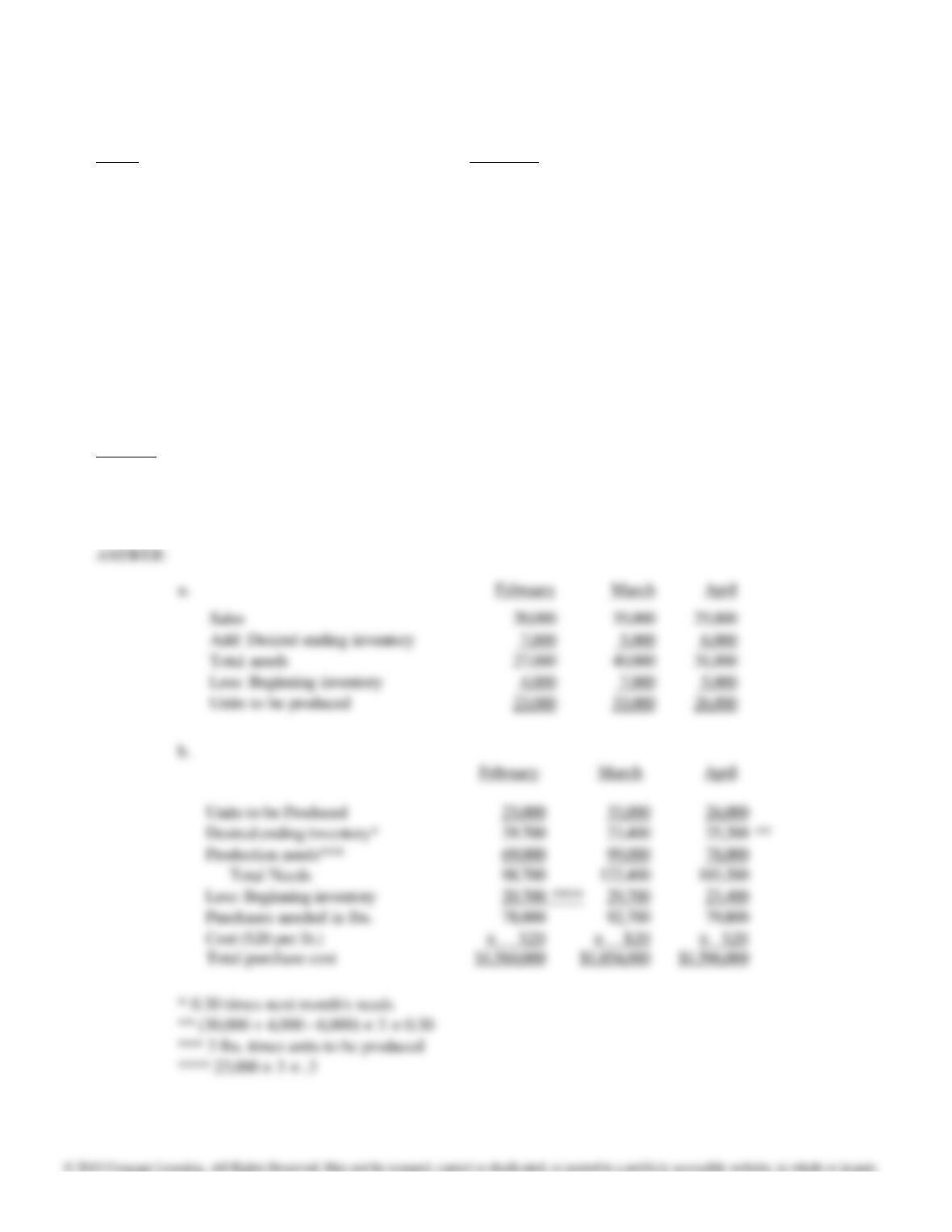
196. Modern Goods Corporation has the following budgeted sales for the selected six-month period:
Month
Unit Sales
January
15,000
February
20,000
March
35,000
April
25,000
May
30,000
June
20,000
There were 7,500 units of finished goods in inventory at the beginning of January. Plans are to have an inventory of
finished product equal to 20 percent of the unit sales for the next month.
Three pounds of materials are required for each unit produced. Each pound of material costs $20. Inventory levels
for materials equal 30 percent of the needs for the next month. Materials inventory on January 1 was 5,000 pounds.
Required:
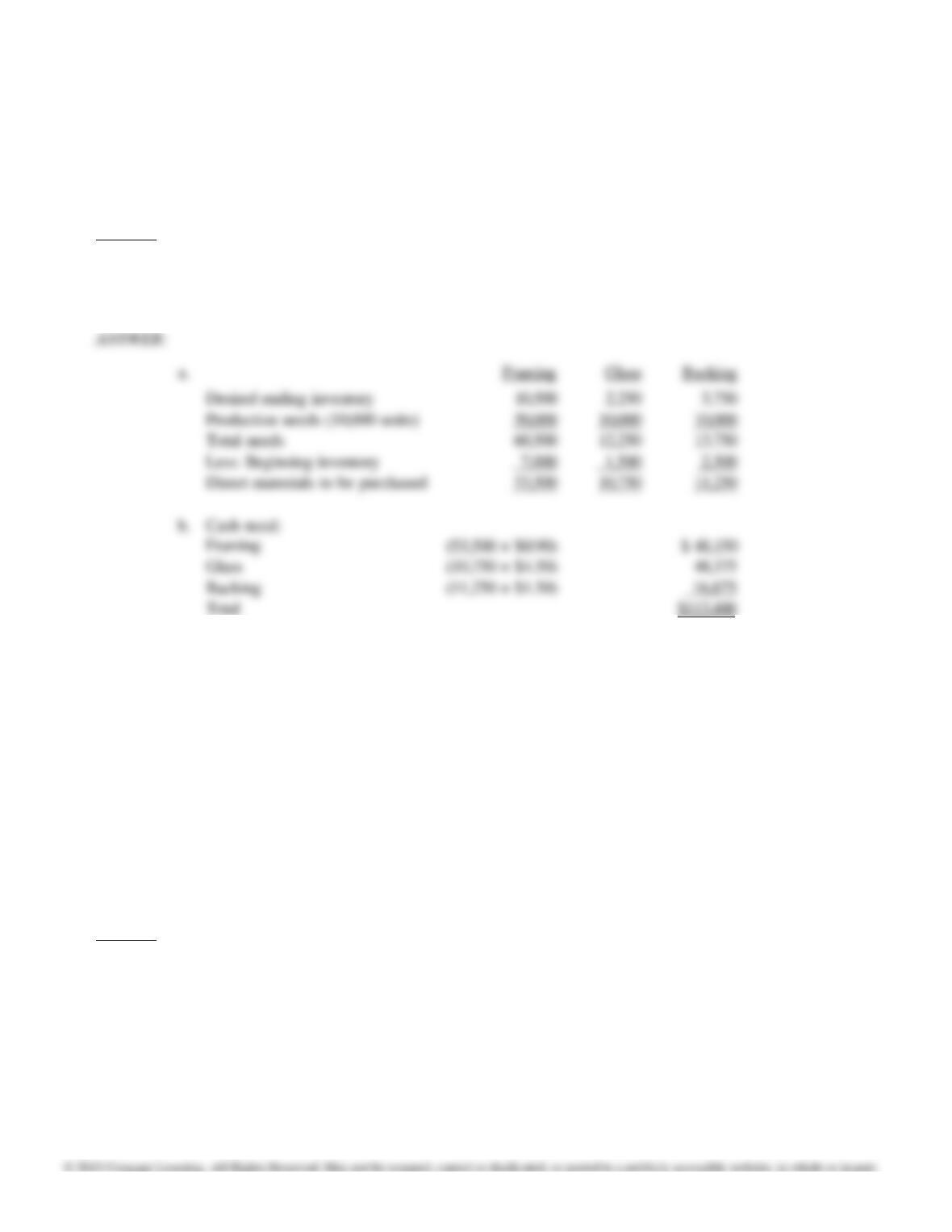
a. Prepare production budgets in units for February, March, and April.
b. Prepare a purchases budget in pounds and dollars for February, March, and April.
35,000
40,000
33,000
Chapter 8: Budgeting for Planning and Control
197. Harlan manufactures picture frames. Sales for July are expected to be 10,000 units of various sizes. Historically, the
average frame requires five foot of framing, one square foot of glass, and one square foot of backing. Beginning
inventory includes 7,000 feet of framing, 1,500 square feet of glass, and 2,500 square feet of backing. Current prices
are $0.90 per foot of framing, $4.50 per square foot of glass, and $1.50 per square foot of backing. Ending
inventory should be 150 percent of beginning inventory. Purchases are paid for in the month acquired.
Required:
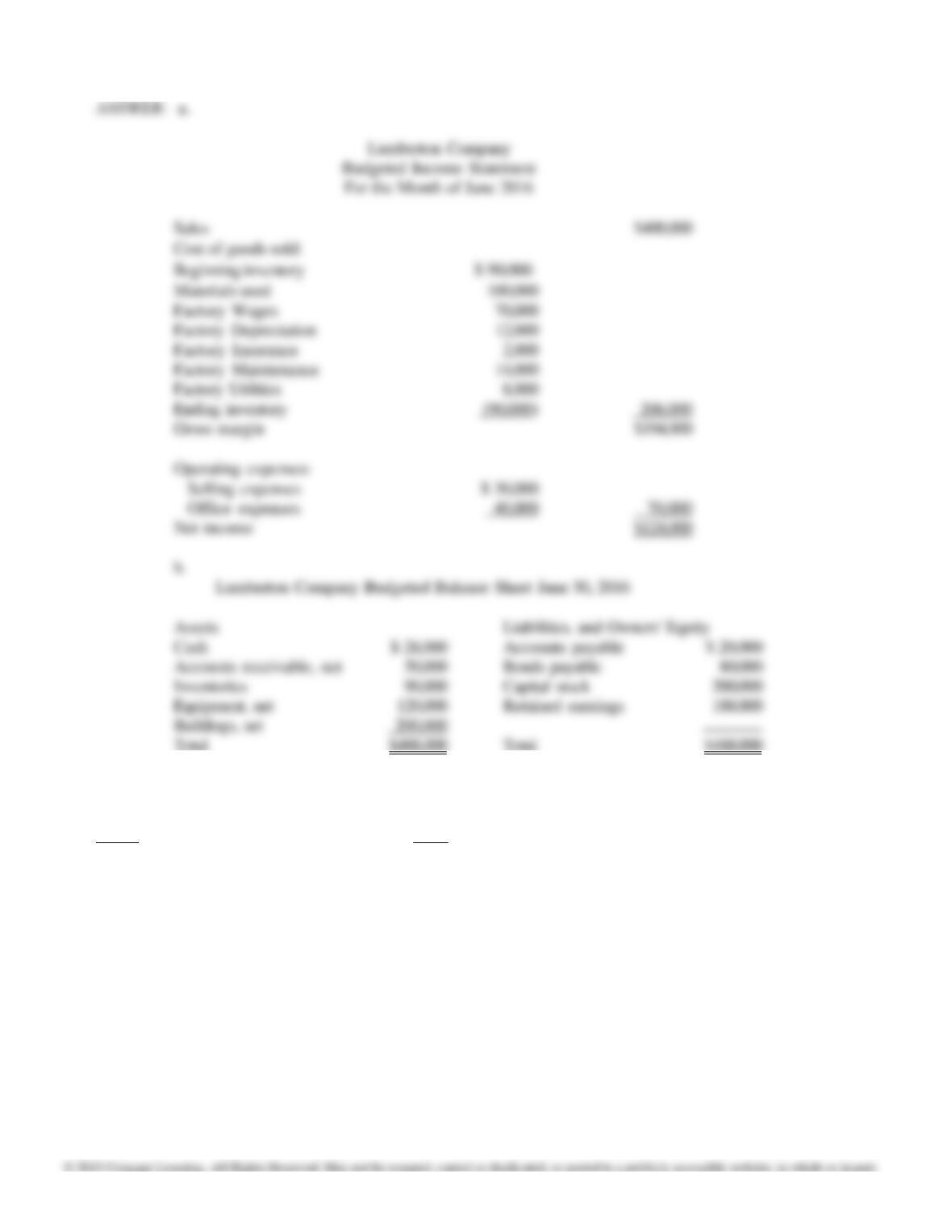
a. Determine the quantity of framing, glass, and backing that is to be purchased during July.
b. Determine the total amount of cash needed for July purchases.
10,000
12,250
198. Lumberton Company has the following projected account balances for June 30, 2016:
Accounts payable
$20,000
Sales
$400,000
Accounts receivable
50,000
Capital stock
200,000
Depreciation, factory
12,000
Retained earnings
????
Inventories (5/31)
90,000
Maintenance, factory
14,000
Inventories (6/30)
90,000
Cash
28,000
Materials used
100,000
Equipment, net
120,000
Office expenses
40,000
Buildings, net
200,000
Insurance, factory
2,000
Utilities, factory
8,000
Factory wages
70,000
Selling expenses
30,000
Bonds payable
80,000
Required:
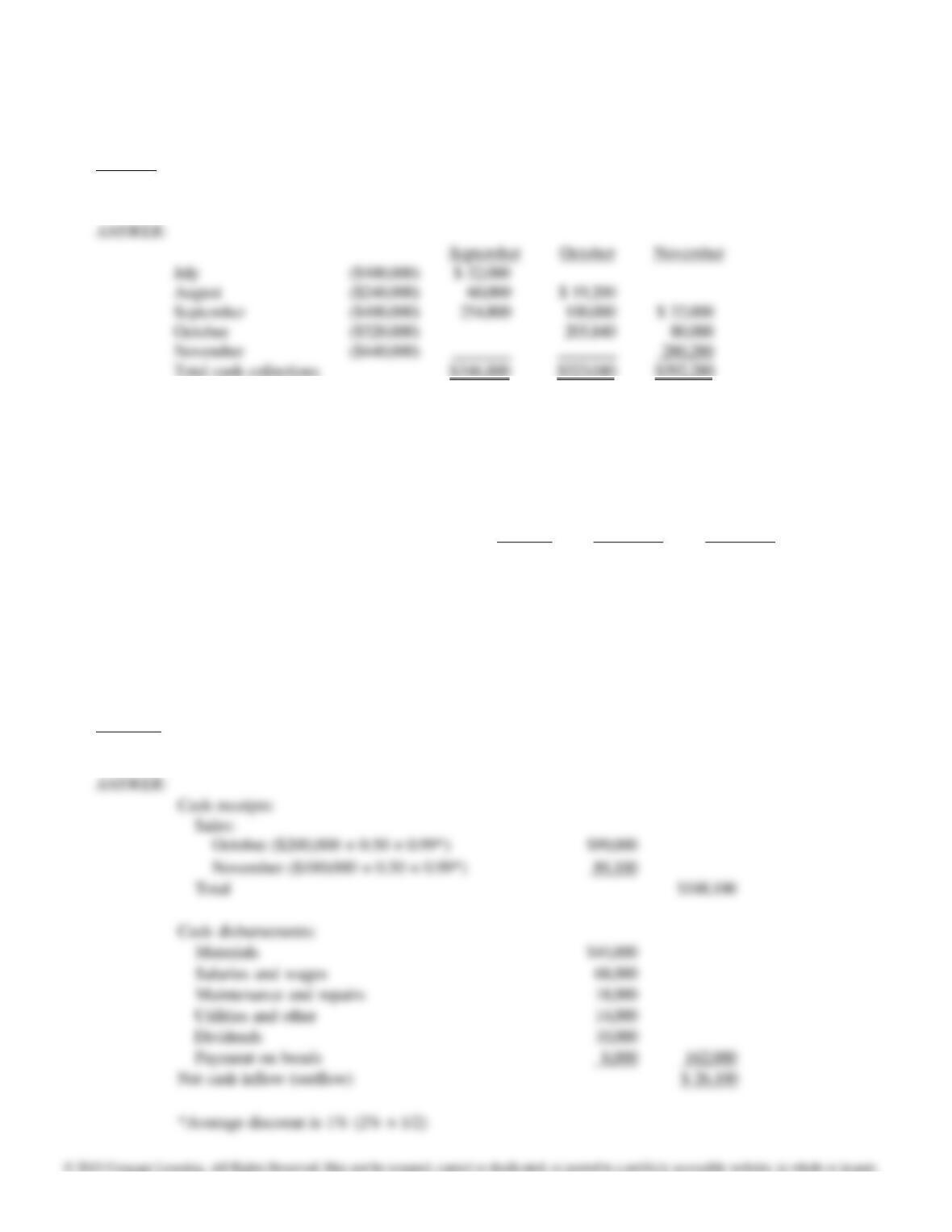
a. Prepare a budgeted income statement for June 2016.
b. Prepare a budgeted balance sheet as of June 30, 2016.
Chapter 8: Budgeting for Planning and Control
199. High Life Corporation has the following sales budget for the last four months of 2016:
Month
Sales
September
$400,000
October
320,000
November
440,000
December
360,000
Historically, the following trend has been established regarding cash collection of sales:
65 percent in month of sale
25 percent in month following sale
8 percent in second month following sale
2 percent uncollectible
Chapter 8: Budgeting for Planning and Control
The company allows a 2 percent cash discount for payments made by customers during the month of the sale. July
and August sales were $400,000 and $240,000, respectively.
Required:
Prepare a schedule of budgeted cash collections from sales for September, October, and November.
200. Sales for October, November, and December are expected to be $200,000, $180,000, and $220,000, respectively,
for the Gurumai Company. All sales are on account (terms 2/15, net 30 days) and are collected 50 percent in the
month of sale and 50 percent in the following month. One-half of all sales discounts are taken on the average.
Materials are purchased one month before being needed, and all purchases and expenses are paid for as incurred.
Activities for the quarter are expected to be:
October
November
December
Materials used
$40,000
$36,000
$44,000
Salaries
70,000
68,000
72,000
Maintenance and repairs
18,000
18,000
18,000
Depreciation
36,000
36,000
36,000
Utilities and other
14,000
14,000
14,000
Dividends paid
–0-
10,000
–0-
Payment on bonds
8,000
8,000
8,000
Required:
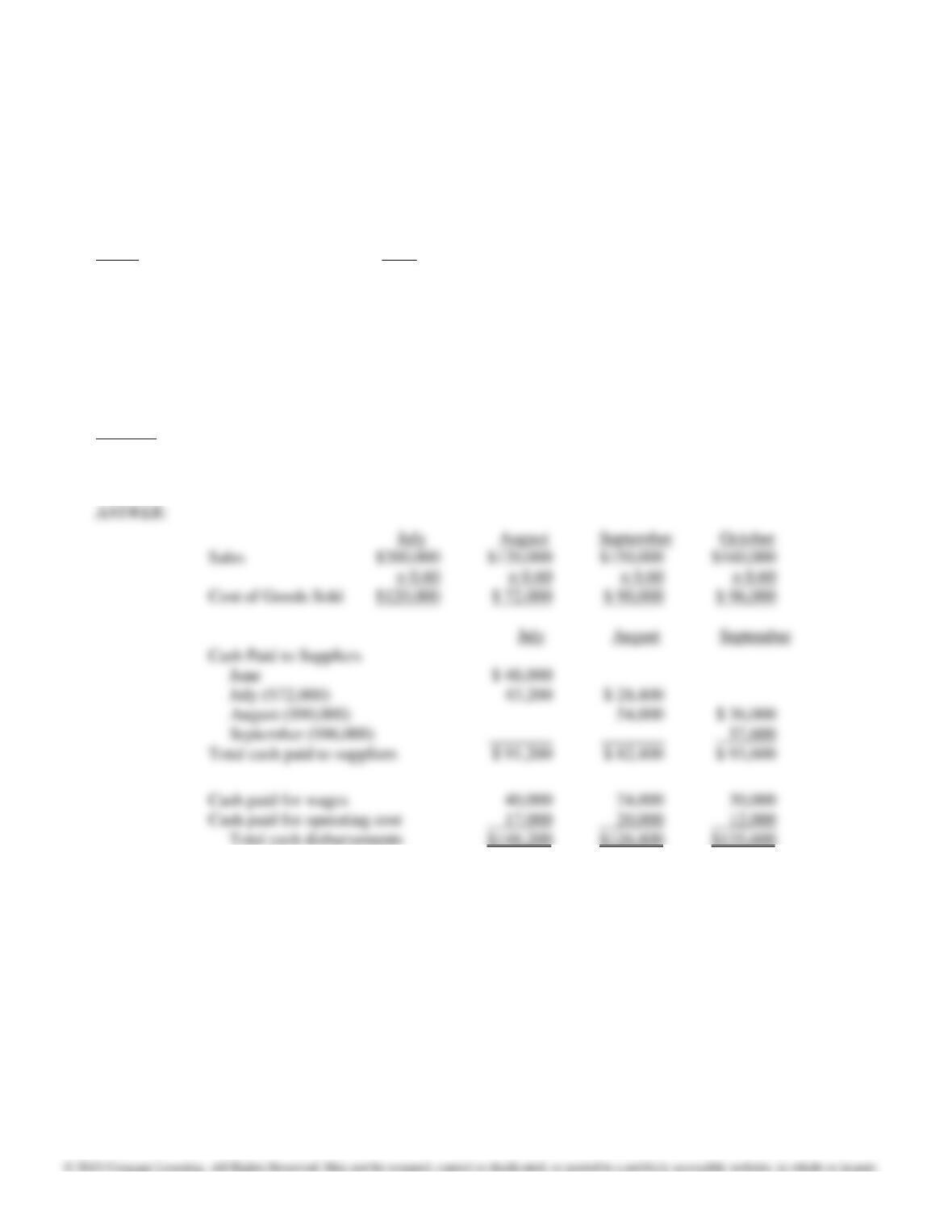
Using the given information, prepare a cash budget for November.
Chapter 8: Budgeting for Planning and Control
201. Thunderbolt Corporation is in the process of preparing its budget for next year. Cost of goods sold has been
estimated at 60 percent of sales. Merchandise purchases are to be made during the month preceding the month of
the sales. Thunderbolt pays 60 percent in the month of purchase, and 40 percent in the month following. Wages are
estimated at 20 percent of sales and are paid during the month of sale. Other operating costs amounting to 10
percent of sales are to be paid in the month following the sale. The accounts payable balance on June 30 was
$48,000.
Month
Sales
June
$170,000
July
200,000
August
120,000
September
150,000
October
160,000
November
100,000
Required:
Prepare a schedule of cash disbursements for July, August, and September.
202. Edison, Inc., a retailer of specialty art supplies, prepares a monthly master budget. Data for the September master
budget are given below:
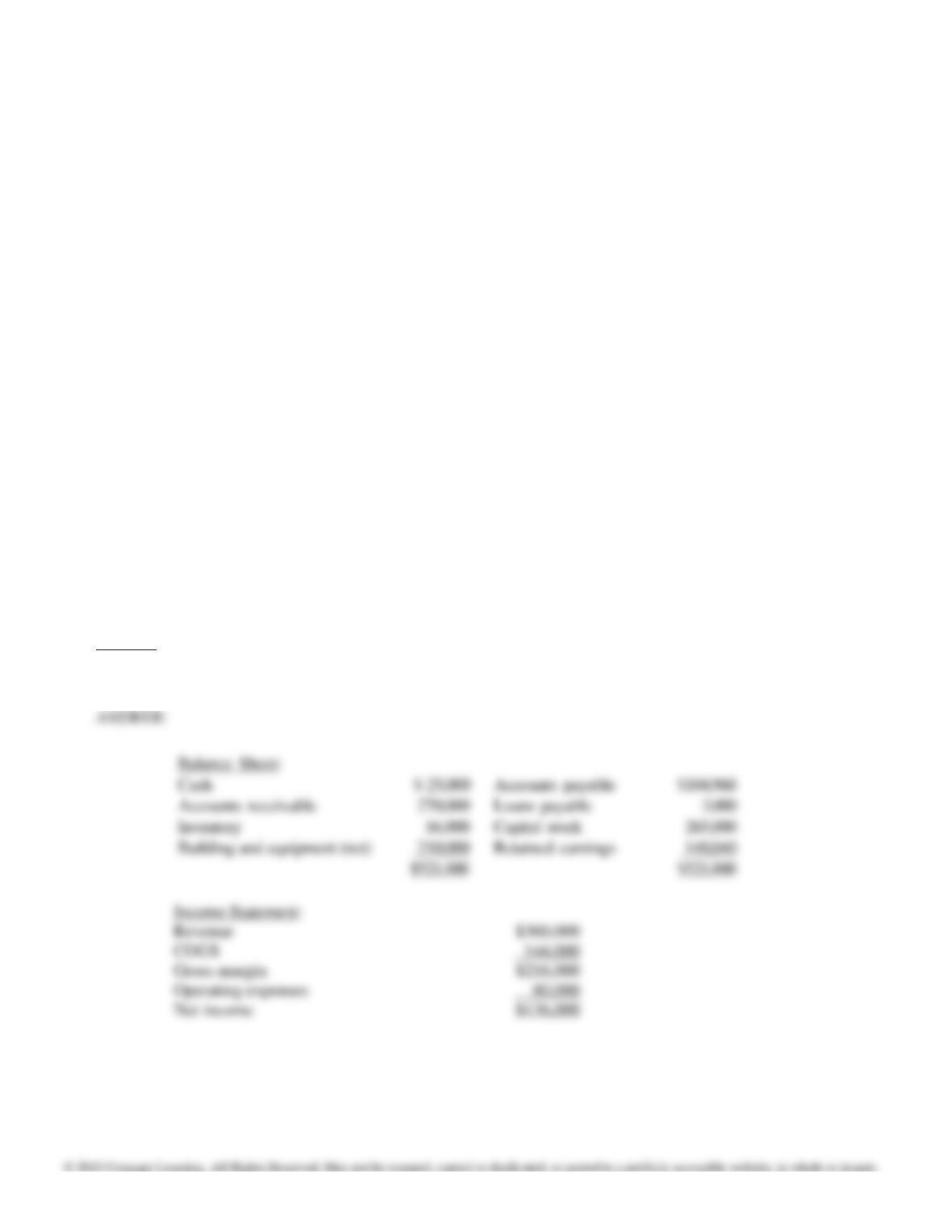
a. The August 31st balance sheet:
Cash $ 25,500 Accounts payable $ 53,760
Accounts receivable 90,000 Capital stock 265,000
Inventory 28,800 Retained earnings 25,540
Building and equipment (net) 200,000
Chapter 8: Budgeting for Planning and Control
b. Actual sales for August and budgeted sales for September, October,
and November are given below:
August
$120,000
September
360,000
October
200,000
November
180,000
c. Sales are 25 percent for cash and 75 percent on credit. All credit sales are collected in the month
following the sale. There are no bad debts.
d. The gross margin percentage is 60 percent of sales. The desired ending inventory is equal to 20 percent of
the following month’s cost of goods sold. One fifth of the purchases are paid for in the month of purchase
and the others are purchased on account and paid in full the following month.
e. The monthly cash operating expenses are $80,000, including the monthly depreciation expense of $7,000.
f. During September, Edison, Inc., will purchase new office equipment for $17,000 cash.
g. Dividends of $13,500 were declared and paid in September.
h. The company must maintain a minimum cash balance of $25,000. A line of credit is used to maintain this
balance. Borrowing will be made in increments of $1,000. All borrowing is done at the beginning of the
month and repayments are made at the end of the month. The annual interest rate is 12 percent, paid when
the loan is repaid (ignore accrual of interest).
Required:
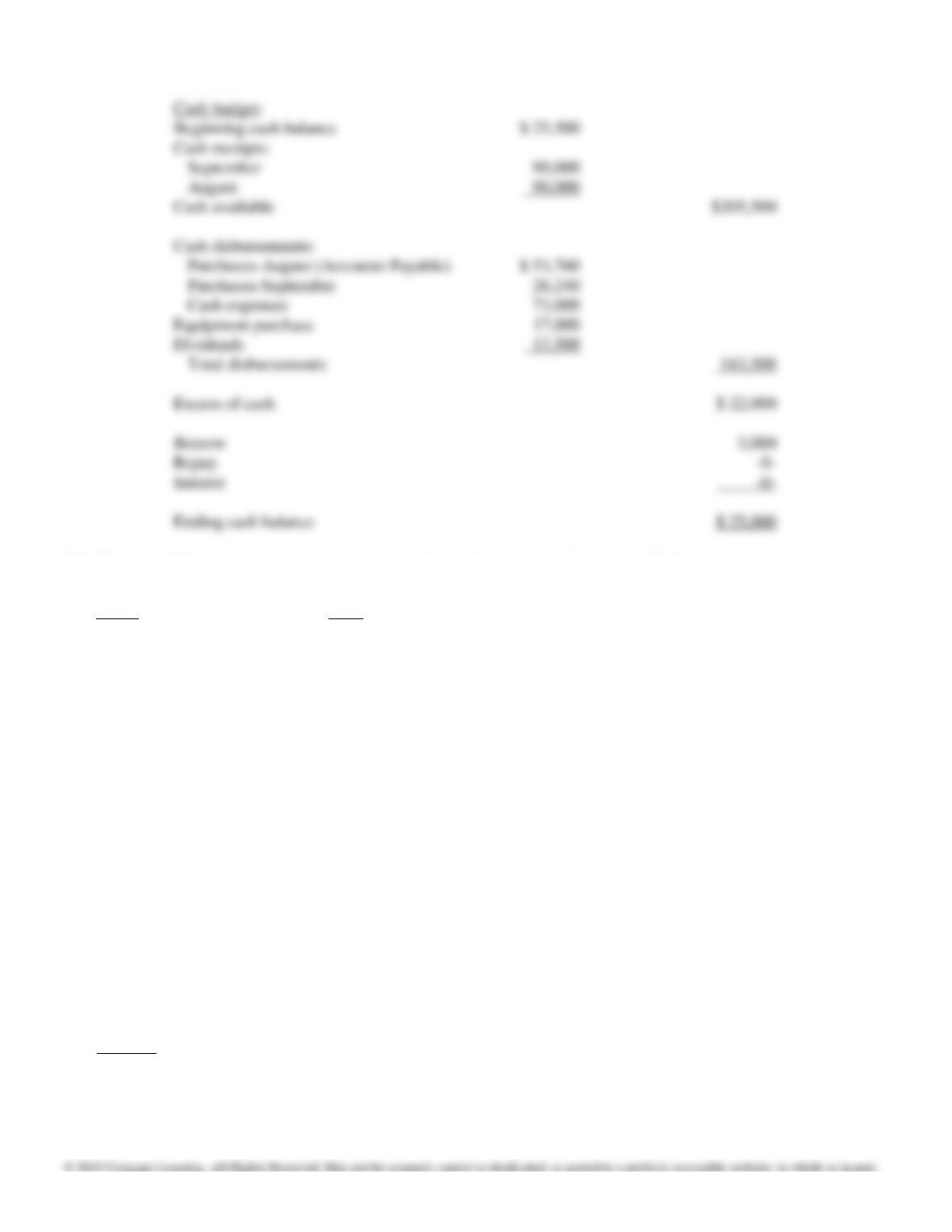
Prepare a balance sheet, income statement, and cash budget for the month of September.
Balance Sheet:
Cash
Accounts receivable
Inventory
Building and equipment (net)
Chapter 8: Budgeting for Planning and Control
203. The city of Charleston had the following sales of water for the selected months of 2016:
Month
Sales
February
$50,000
March
45,000
April
60,000
May
42,500
June
70,000
July
120,000
All sales are on credit. Historically, 50 percent is collected in the month of sale, 35 percent during the first month
following the sale, and 15 percent in the second month following the sale.
Cost of water averages 75 percent of sales. Water is purchased in the month of sale. All purchases are paid during
the month following the purchase.
Operating costs of $10,000 are paid each month.
The April 1 cash balance is expected to be the minimum balance of $5,000.
Money can be borrowed from a local bank in increments of $1,000. (Do not include interest charges in your
budget.)
Required:
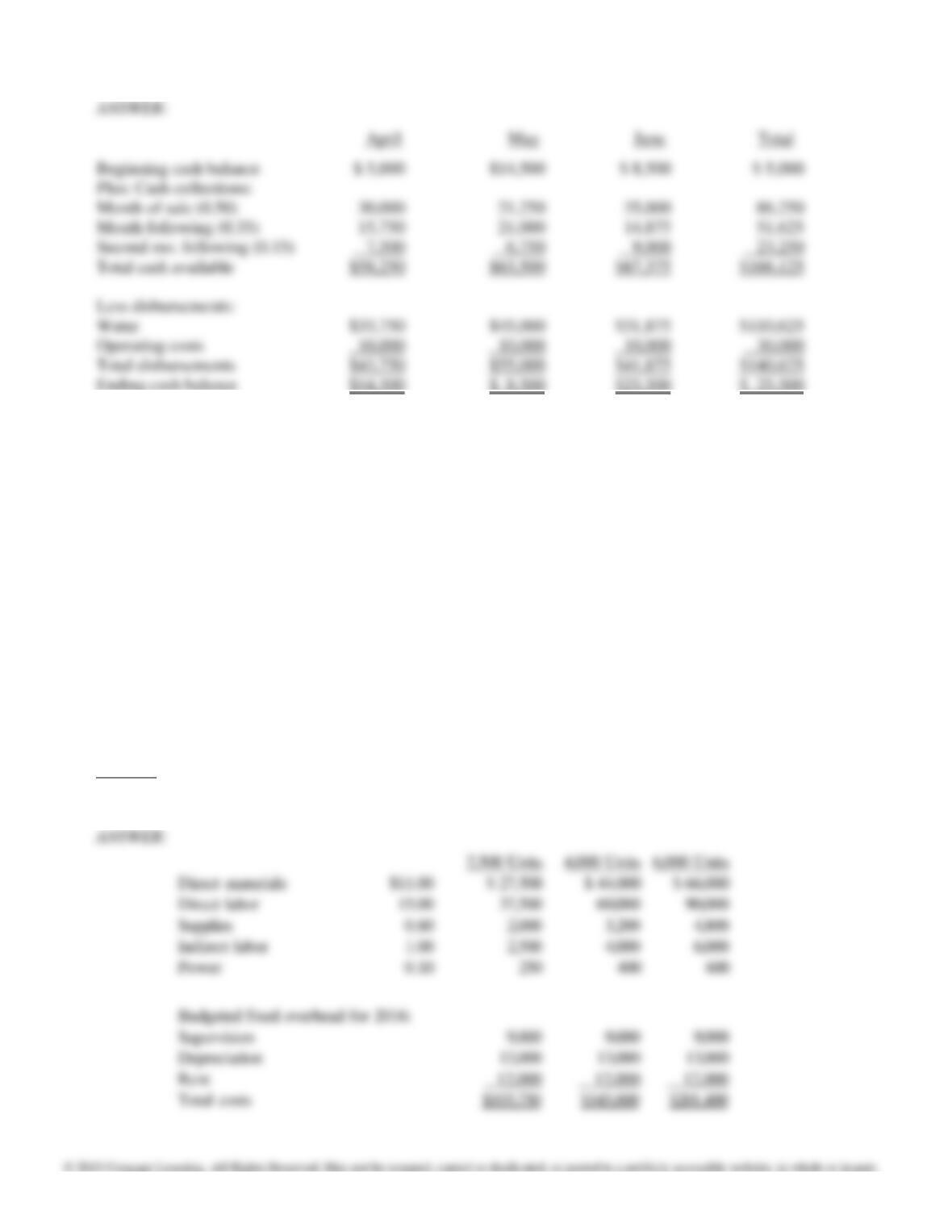
Prepare a cash budget for April, May, and June
Chapter 8: Budgeting for Planning and Control
204. Ruger, Inc., is looking for feedback on performance. The company compares the budget for the year with the
actual costs.
Ruger had the following budgeted data:
Budgeted variable costs per unit:
Direct materials
$11.00
Direct labor
15.00
Supplies
0.80
Indirect labor
1.00
Power
0.10
Budgeted fixed overhead for 2016:
Supervision
$ 9,000
Depreciation
13,000
Rent
12,000
Required:
Prepare a flexible budget for production costs for the following range of activity: 2,500 units; 4,000 units; 6,000 units.
Direct materials
Supplies
Indirect labor
Power
Supervision
Depreciation

Chapter 8: Budgeting for Planning and Control
205. Missoula, Inc., is looking for feedback on performance. The company compares the budget for the year with the
actual costs.
Missoula, Inc., had the following budgeted data:
Unit sales for 2016 10,000
Unit production for 2016 10,000
Budgeted fixed overhead for 2016:
Supervision $18,000
Depreciation 20,000
Rent 10,000
Budgeted variable costs per unit:
Direct materials $18.00
Direct labor 25.00
Supplies 0.20
Indirect labor 1.00
Power 0.10
The following actually occurred:
Actual unit sales for 2016 11,000
Actual unit production for 2016 12,000
Actual fixed overhead for 2016:
Supervision $17,850
Depreciation 20,000
Rent 10,000
Actual variable costs for 2016:
Direct materials $214,000
Direct labor 320,000
Supplies 2,500
Indirect labor 10,000
Power 1,500
Required:
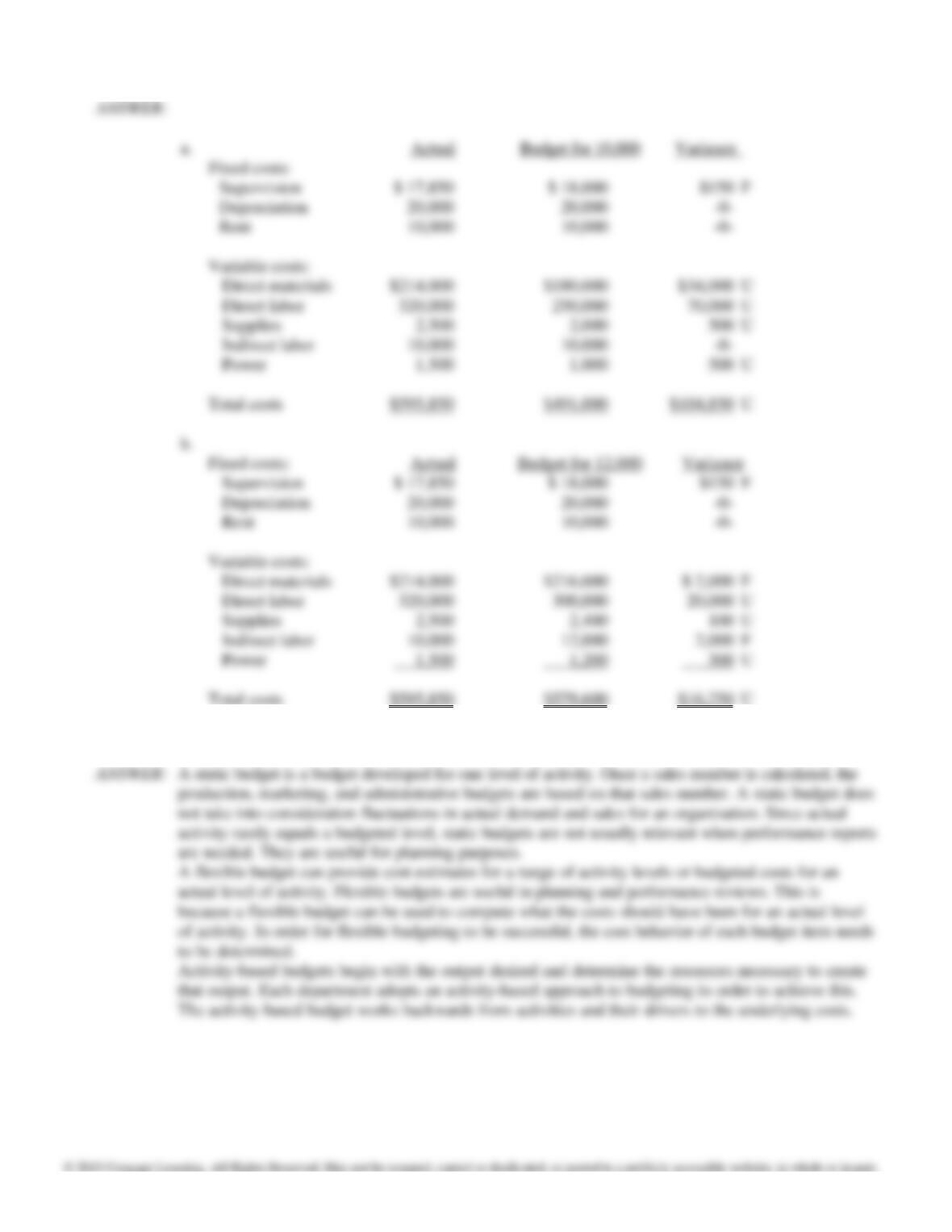
a. Prepare a performance report for all costs showing static budget variances.
b. Prepare a performance report for all costs showing flexible budget variances.
Chapter 8: Budgeting for Planning and Control
206. Compare and contrast static budgets, flexible budgets, and activity-based budgets.
Chapter 8: Budgeting for Planning and Control
207. Collibri, Inc., has done a cost analysis for its production of banners. The following activities and cost drivers have
been developed:
Activity Cost Formula
Maintenance $13,000 + $2 per machine hour
Machining $45,000 + $6 per machine hour
Inspection $70,000 + $500 per batch
Setups $2,000 per batch
Purchasing $80,000 + $150 per purchase order
Following are the actual costs of producing 75,000 banners:
1,000 machine hours; 15 batches; 10 purchase orders
Maintenance
$14,000
Machining
50,000
Inspection
70,000
Setups
32,000
Purchasing
Required:
82,000
Prepare an activity-based performance report.
208. Ringwold, Inc., has done a cost analysis for its production of baseball cards. The following activities and cost
drivers have been developed:
Activity Cost Formula
Photography $50 + $35 per labor hour
Printing $25,000 + $0.01 per machine hour
Setups $25 per batch
Purchasing $25 + $25 per purchase order
Following are the actual costs of producing 35,000 cards:
60 labor hours; 500 machine hours; 5 batches; 30 purchase orders
Photography ?
Printing $25,000
Setups ?
Purchasing $770
Chapter 8: Budgeting for Planning and Control
The following variances were given in the activity performance report:
Photography
Printing
Setups
Purchasing
Required:
$10 F
?
$20 U
?
Find the missing values.
Prepare an activity-based performance report in good form.
209. Splendor, Inc., has done a cost analysis for its production of motorcycle lights.
The following activities and cost drivers have been developed:
Activity Cost Formula
Maintenance $5,000 + $8 per machine hour
Machining $25,000 + $4 per machine hour
Inspection $90,000 + $1,000 per batch
Setups $5,000 per batch
Purchasing $100,000 + $100 per purchase order
Required:
Prepare an activity-based budget for the following:
• 60,000 units: 10,000 machine hours; 30 batches; 20,000 purchase orders
• 100,000 units: 18,000 machine hours; 40 batches; 30,000 purchase orders
Chapter 8: Budgeting for Planning and Control
210. Discuss the features of an ideal budgetary process.