Chapter 8
89.
The function
22
( ) ( )
( , ) x a y b
f x y e− − − −
=
where a and b are constants is sometimes referred
to as a “bump function” and is used to construct functions which take on maximum
values at certain points. Show that f(x, y) has a maximum at (a, b).
90.
Find a and b so that
22
( , )f x y ax bxy y= + +
has a critical point at (1, 6).
91.
The Perfect House company produces two types of bathtub, the Hydro Deluxe model
and the Singing Bird model. The company noticed that demand and prices are related. In
particular,
for Hydro Deluxe: demand = 1300 – price of Hydro Deluxe + price of Singing Bird
for Singing Bird: demand = 1450 + price of Hydro Deluxe –2(price of Singing Bird).
The costs of manufacturing the Hydro Deluxe and Singing Bird are $500 and $300 per
unit respectively. Determine the price of each model that gives the maximum profit.
92.
A company has two manufacturing plants which manufacture the same item. Suppose
the cost function is given by
22
1 2 1 1 2 2
( , ) 4 ,C q q q q q q= + +
where q1 and q2 are the
quantities (measured in thousands) produced in each plant. The total demand q1 + q2 is
related to the price, p, by
12
110 0.5( ).p q q= − +
How much should each plant produce in order to maximize the company’s profit?
Chapter 8
Page 36
93.
Suppose that
22
( , ) 5 3.0000 .f x y x y x= + −
Find and classify (as local maxima, minima, or neither) all critical points of f.
94.
Use Lagrange multipliers to find the maximum or minimum values of
( , ) 3f x y xy=
,
subject to the constraint
4 50xy+=
.
= _____ and the maximum/minimum value of
( , )f x y
is _____.
Part A:
18.75
Part B:
468.75
Lagrange multipliers. difficulty: easy section: 8.6
95.
Use Lagrange multipliers to find the maximum or minimum values of
22
( , )f x y x y=+
, subject to the constraint
2 20xy−=
.
= _____ and the maximum/minimum value
of
( , )f x y
is _____.
Part A:
8
Part B:
80
96.
Use Lagrange multipliers to find the maximum and minimum values of
( , ) 2 2f x y x y=+
, subject to the constraint
22
8xy+=
. For the minimum value,
=
_____ (use the decimal form), and the minimum value of
( , )f x y
is _____.
Part A:
Part B:
Lagrange multipliers. difficulty: easy section: 8.6
values, or neither. difficulty: medium section: 8.5
Chapter 8
97.
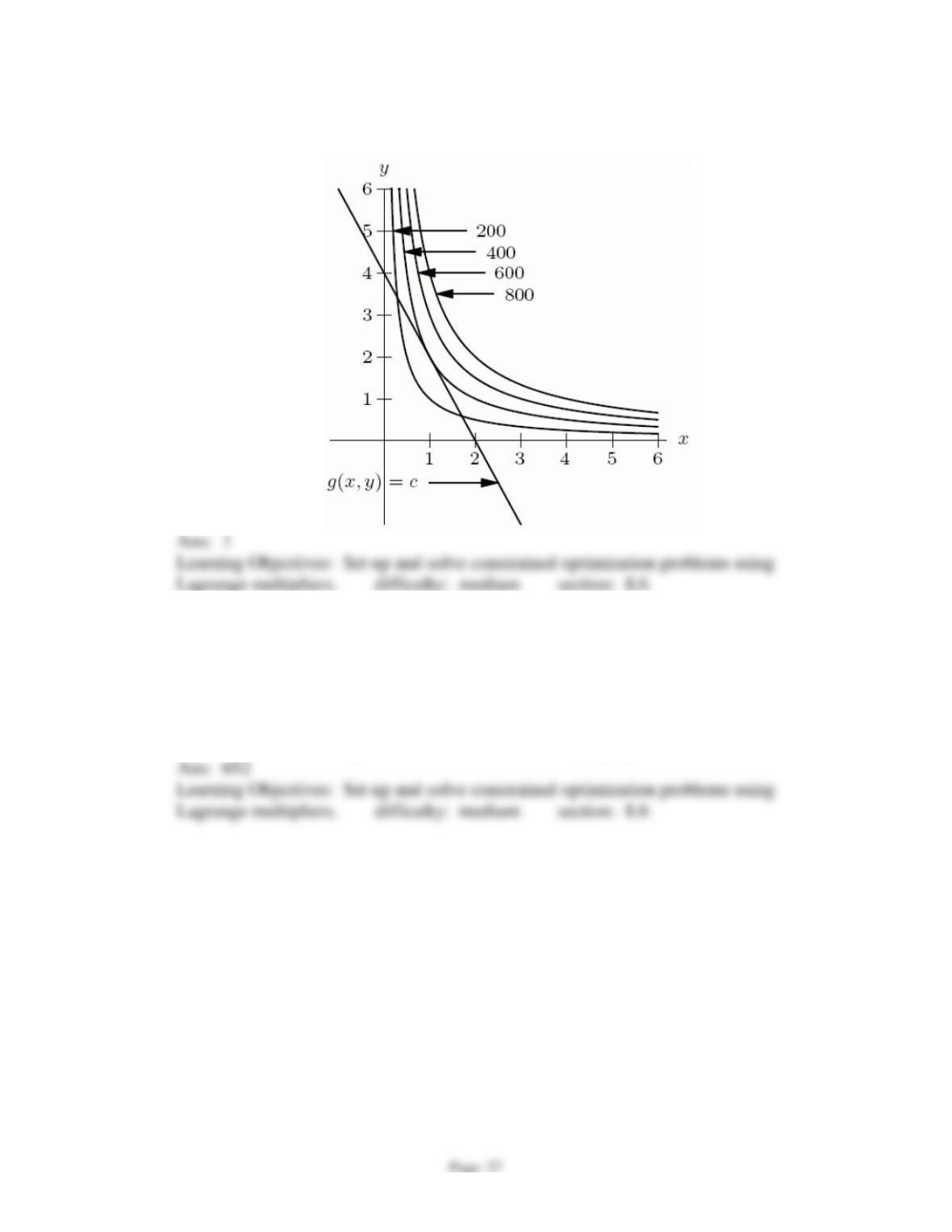
The following figure shows contours of
( , )f x y
and the constraint
( , )g x y c=
. What
is the value of x that maximizes f subject to this constraint?
Ans:
1
98.
A company operates two plants that make the same product. If Plant 1 produces
quantity x of the product and Plant 2 produces quantity y of the product, the cost
functions are
2
18.2 0.03Cx=+
and
2
25.1 0.04Cy=+
. The total market demand
q x y=+
for the product is related to the selling price p by
60 0.4pq=−
. What
quantity should Plant 1 produce to maximize the company’s profit?
Ans:
652
Lagrange multipliers. difficulty: medium section: 8.6
Chapter 8
Page 38
99.
The quantity, Q, of a good produced depends on the quantities
1
x
and
2
x
of the two
main materials used:
0.5 0.5
12
Q x x=
.
Material
1
x
costs $100 per unit, and material
2
x
costs $25 per unit. We want to
minimize the cost of producing 100 units of the good. What is the objective function?
A)
12
100 25C x x=+
B)
0.5 0.5
12 100xx =
C)
12
100 25 100xx+=
D)
0.5 0.5
12
100 25C x x=
100.
The quantity, Q, of a good produced depends on the quantities
1
x
and
2
x
of the two
main materials used:
0.5 0.5
12
Q x x
=
.
Material
1
x
costs $75 per unit, and material
2
x
costs $25 per unit. We want to
minimize the cost of producing 100 units of the good. What is the constraint function?
A)
12
75 25C x x
=+
B)
0.5 0.5
12 100xx =
C)
12
75 25 100xx+=
D)
0.5 0.5
12
75 25C x x=
101.
The quantity, Q, of a good produced depends on the quantities
1
x
and
2
x
of the two
main materials used:
0.5 0.5
12
Q x x
=
.
Material
1
x
costs $55 per unit, and material
2
x
costs $70 per unit. We want to
minimize the cost of producing 100 units of the good. Using Lagrange multipliers, we
see that the minimum cost of ________ occurs when
1
x
= _____ and
2
x
= _____.
Chapter 8
102.
The production function for a company is
0.75 0.25
300P x y=
, where P is the amount
produced given x units of labor and y units of equipment. Each unit of labor costs $1200
and each unit of equipment costs $350. Assuming the goal of the company is to
maximize production given a fixed budget of $45,000, what are the objective and
constraint functions?
A)
objective:
( , )f x y x y=+
; constraint:
0.75 0.25
300(1200 350 ) 45,000xy=
B)
objective:
0.75 0.25
( , ) 1200 350f x y x y=
; constraint:
45,000xy+=
C)
objective:
0.75 0.25
( , ) 300f x y x y=
; constraint:
1200 350 45,000xy+=
D)
objective:
( , ) 1200 350f x y x y=+
; constraint:
0.75 0.25
300 45, 000xy =
Ans: C Learning Objectives: Set up and solve constrained optimization problems
using Lagrange multipliers. difficulty: medium section: 8.6
103.
The production function for a company is
0.75 0.25
300P x y=
, where P is the amount
produced given x units of labor and y units of equipment. Each unit of labor costs $900
and each unit of equipment costs $400. Assuming the goal of the company is to
maximize production given a fixed budget of $40,000, what is the meaning of the
Lagrange multiplier
?
A)
The additional units that can be produced if the budget is increased by $1
B)
The amount it would cost the company to produce one more unit
C)
The additional units of labor allowed if the budget is increased by $1
D)
The amount it would cost the company to obtain one additional unit of equipment
104.
The production function for a company is
0.75 0.25
300P x y=
, where P is the amount
produced given x units of labor and y units of equipment. Each unit of labor costs $900
and each unit of equipment costs $350. Assuming the goal of the company is to
minimize cost given a fixed production goal of 6000 units produced, what are the
objective and constraint functions?
A)
objective:
( , )f x y x y=+
; constraint:
0.75 0.25
300(900 350 ) 6000xy=
B)
objective:
0.75 0.25
( , ) 900 350f x y x y=
; constraint:
6000xy+=
C)
objective:
0.75 0.25
( , ) 300f x y x y=
; constraint:
900 350 6000xy+=
D)
objective:
( , ) 900 350f x y x y=+
; constraint:
0.75 0.25
300 6000xy =
Ans: D Learning Objectives: Set up and solve constrained optimization problems
using Lagrange multipliers. difficulty: medium section: 8.6
Chapter 8
105.
The production function for a company is
0.75 0.25
300P x y=
, where P is the amount
produced given x units of labor and y units of equipment. Each unit of labor costs $800
and each unit of equipment costs $400. Assuming the goal of the company is to
minimize cost given a fixed production goal of 9000 units produced, what is the
meaning of the Lagrange multiplier
?
A)
The additional units that can be produced if the budget is increased by $1
B)
The amount it would cost the company to produce one more unit
C)
The additional units of labor allowed if the budget is increased by $1
D)
The amount it would cost the company to obtain one additional unit of equipment
difficulty: medium section: 8.6
106.
Find the maximum value of
( , ) 8f x y xy=
subject to the constraint equation
2 12xy+=
using Lagrange multipliers.
Ans:
144
Lagrange multipliers. difficulty: easy section: 8.6
107.
For a production function
( , )f x y
, the maximum production cost of $400 is given by
(15,32) 90f=
units, with
0.3
=
. Estimate the production if the budget cost is raised
to $410.
Ans:
93
Lagrange multipliers. difficulty: medium section: 8.6
108.
A mop company can produce
( , )P x y
mops using x units of capital and y units of labor,
with production costs
( , )C x y
dollars. With a budget of $550,000, the maximum
production is 65,000 mops, using $400,000 in capital and $150,000 in labor. The
Lagrange multiplier is
0.3
=
. Which of the following is true?
A)
The objective function is
( , )P x y
and the constraint is
( , ) 550,000C x y =
.
B)
The objective function is
( , )P x y
and the constraint is
( , ) 65,000C x y =
.
C)
The objective function is
( , )C x y
and the constraint is
( , ) 550,000P x y =
.
D)
The objective function is
( , )C x y
and the constraint is
( , ) 65,000P x y =
.
using Lagrange multipliers. difficulty: hard section: 8.6
Chapter 8
Page 41
109.
A mop company can produce
( , )P x y
mops using x units of capital and y units of labor,
with production costs
( , )C x y
dollars. With a budget of $400,000, the maximum
production is 65,000, using $300,000 in capital and $100,000 in labor. The Lagrange
multiplier is
0.4
=
. What are the units for
?
A)
Number of budget dollars per mop
B)
Number of mops per budget dollar
C)
Number of units of capital per mop
D)
Number of units of labor per budget dollar
110.
A mop company can produce
( , )P x y
mops using x units of capital and y units of labor,
with production costs
( , )C x y
dollars. With a budget of $500,000, the maximum
production is 65,000, using $350,000 in capital and $150,000 in labor. The Lagrange
multiplier is
0.3
=
. What is the practical meaning of the statement
0.3
=
?
A)
If the number of units of labor is increased by 1, we expect the number of mops to
increase by about 0.3.
B)
If the number of units of capital is increased by 1, we expect the budget to
increase by about $0.3.
C)
If the budget is increased by $1, we expect the number of mops to increase by
about 0.3.
D)
If the number of mops is increased by 1, we expect the budget to increase by
about $0.3.
Ans: C Learning Objectives: Interpret lambda, the Lagrange multiplier value.
difficulty: hard section: 8.6
111.
The quantity, Q, of a good produced depends on the number of workers, W, and the
amount of capital invested, K, according to the Cobb-Douglas function
2 / 3 1/ 3
9Q W K=
.
In addition, we know that labor costs are $19 per employee, capital costs are $8 per unit,
and the budget is $2500. The maximum production level is about _____ units, where
W = _____ and K = _____. Round to the nearest whole number.
Part A:
836 units of the good
Part B:
88 workers
Part C:
104 units of capital
Learning Objectives: Set up and solve constrained optimization problems using
Lagrange multipliers. difficulty: medium section: 8.6
Ans: B Learning Objectives: Interpret lambda, the Lagrange multiplier value.
difficulty: medium section: 8.6
Chapter 8
112.
The quantity, Q, of a good produced depends on the number of workers, W, and the
amount of capital invested, K, according to the Cobb-Douglas function
2 / 3 1/ 3
9Q W K=
.
If the maximum production level at a budget of $2500 is 973 and
0.37
=
, estimate the
production if the budget is increased by $100.
113.
Suppose that you want to find the maximum and minimum values of
22
( , )f x y x y=+
subject to the constraint x + 6y = 4.
Use the method of Lagrange multipliers to find the exact location(s) of any extrema.
114.
Suppose the quantity, q, of a good produced depends on the number of workers, w, and
the amount of capital, k, invested and is represented by the Cobb-Douglas function
31
44
6q w k=
. In addition, labor costs are $20 per worker and capital costs are $20 per
unit, and the budget is $2720. Using Lagrange multipliers, find the optimum number of
workers.
115.
The owner of a jewelry store has to decide how to allocate a budget of $420,000. He
notices that the earnings of the company depend on investment in inventory x1 (in
thousands of dollars) and expenditure x2 on advertising (in thousands of dollars)
according to the function
21
33
12
( , ) 6 .f x y x x=
How should the owner allocate the $420,000 between inventory and advertising to
maximize his earnings?
Chapter 8
116.
The Green Leaf Bakery makes two types of chocolate cakes, Delicious and Extra
Delicious. Each Delicious requires 0.1 lb of European chocolate, while each Extra
Delicious requires 0.2 lb. Currently there are only 230 lb of chocolate available each
month. Suppose the profit function is given by:
22
( , ) 151 0.2 200 0.1 ,p x y x x y y= − + −
where x is the number of Delicious cakes and y is the number of Extra Delicious cakes
that the bakery produces each month.
(a) How many of each cake should the bakery produce each month to maximize profit?
(b) What is the value of ? What does it mean?
(c) It will cost $36.00 to get an extra pound of European chocolate. Should the bakery
buy it?
section: 8.6
117.
Let
32
( , ) 48 ,f x y kx kx y= − +
where k 0. Find the critical points of f.
values, or neither. difficulty: easy section: 8 review
118.
A person’s weight, w, is a function of the number of calories consumed, c, and the
number of calories burned, b. Thus,
( , )w f c b=
. Would you expect fc (c,b) to be
positive or negative?
Ans:
positive
derivatives. difficulty: easy section: 8 review
119.
A television salesman earns a fixed salary of $9.00 per hour plus a $25 commission for
each television he sells. If h is the number of hours worked and s is the number of
televisions sold, find a formula for
( , )E h s
, the salesman’s total earnings, and use it to
calculate
(40,27)E
.
Ans:
$1035.00
difficulty: medium section: 8 review
Chapter 8
120.
A television salesman earns a fixed salary of $9.00 per hour plus a $25 commission for
each television he sells. If h is the number of hours worked and s is the number of
televisions sold, find a formula for
( , )E h s
, the salesman’s total earnings. Is E an
increasing or decreasing function of s?
Ans:
increasing
section: 8 review
121.
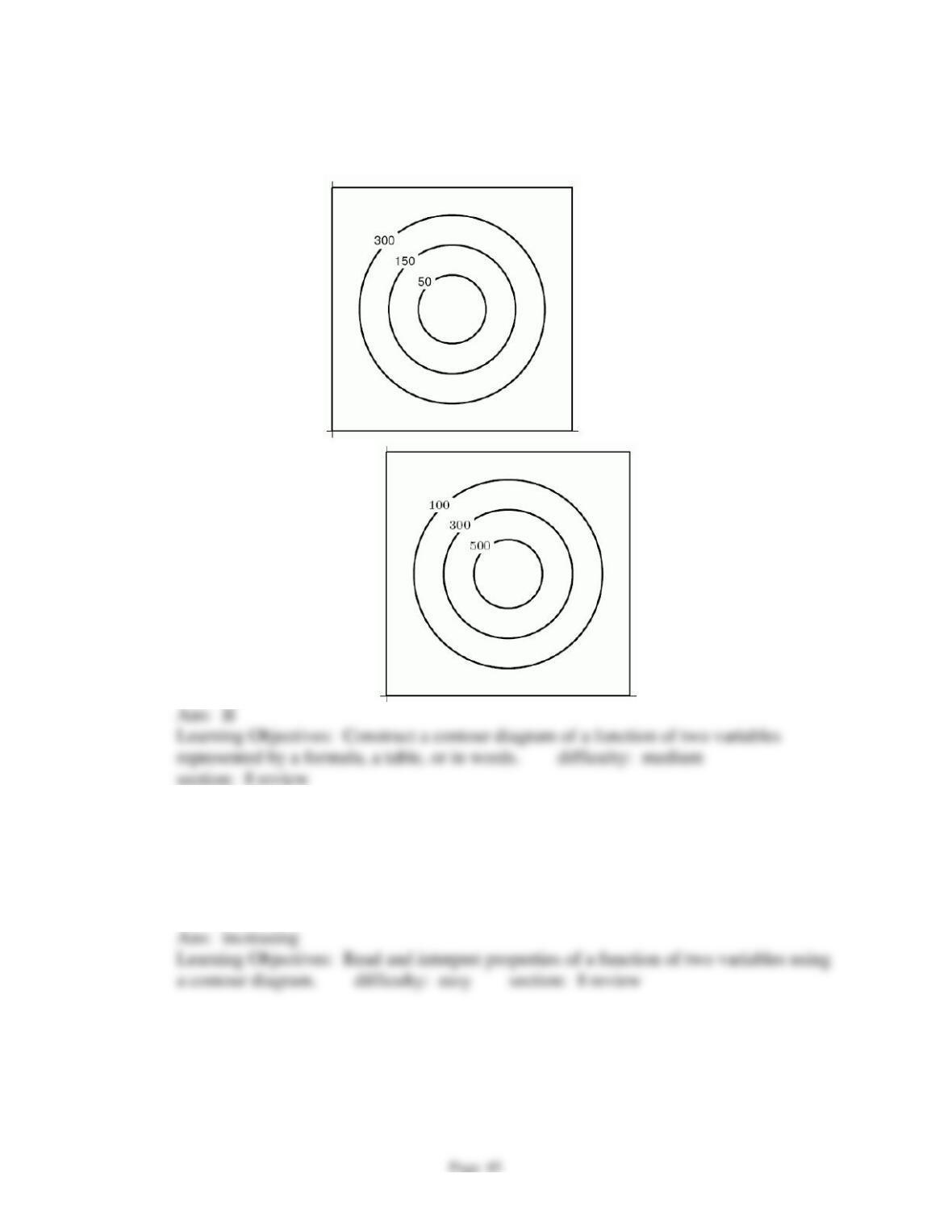
Given the following table of values for
( , )f x y
, estimate fy (10,0.2). Use the next
higher point to make your estimate.
Ans:
90
Chapter 8
122.
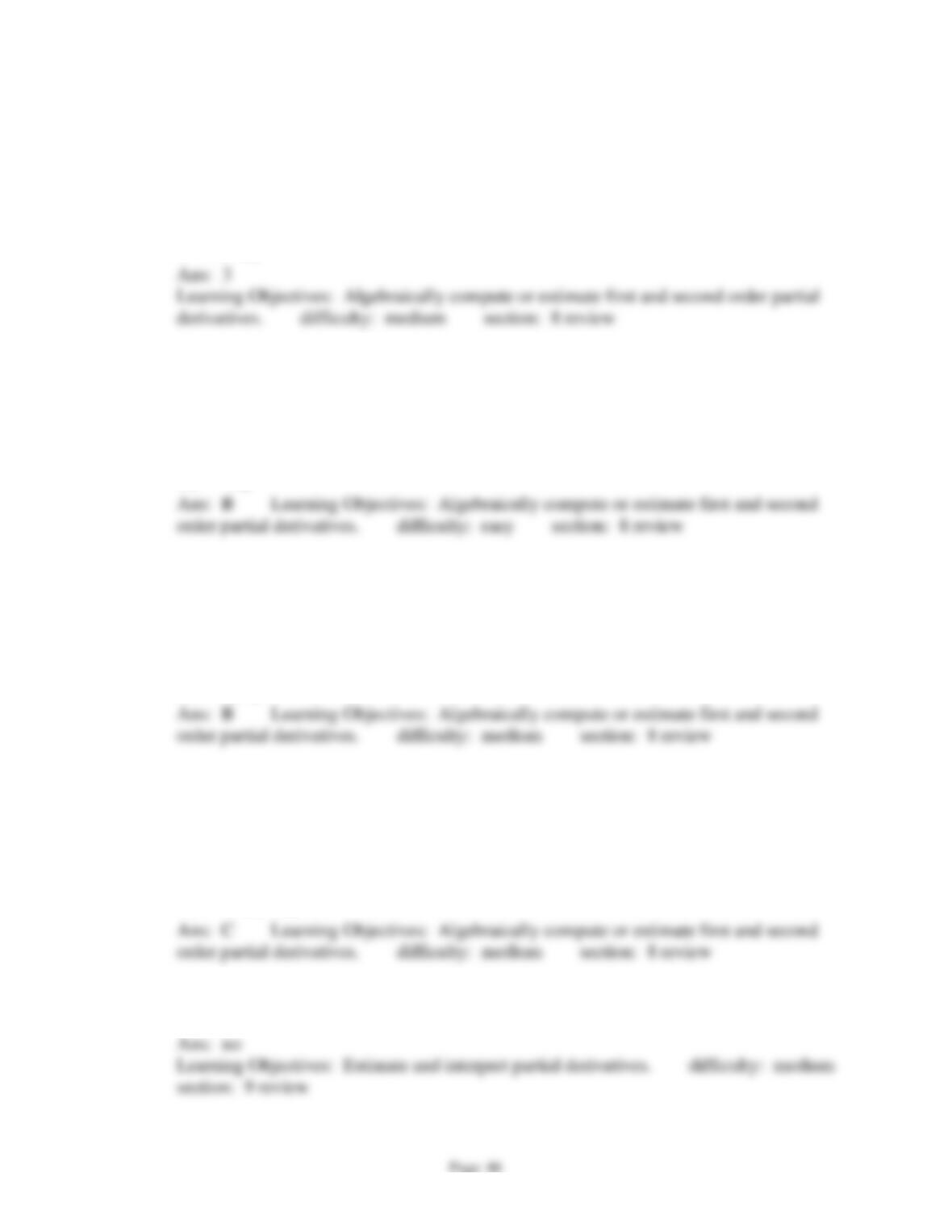
Which of the following contour diagrams is more likely to show the population density
of a region of a small town where the center of the diagram is the town center?
I. II.
123.
The monthly car payment for a new car is a function of three variables,
( , , )P f r A t=
,
where r is the annual interest rate, A is the amount borrowed in dollars, and t is time in
months before the car is paid off. Would you expect fA
( , , )r A t
to be increasing or
decreasing?
Chapter 8
124.
A manufacturer sells two products. The first sells for $7 and the second sells for $5.
The manufacturer’s costs are given by the equation
1 2 1 2
( , ) 3 2 90C q q q q= + +
,
where
1
q
and
2
q
are the respective quantities produced of each product. Let
12
( , )qq
represent the profit at a production level of
1
q
and
2
q
units. Find the value
of
2
/q
.
125.
If
22
( , ) 3f x y x y y x x= + +
, find fx
( , )xy
.
A)
2xy + x2
B)
2xy + y2 + 3
C)
43xy +
D)
4xy
126.
If
5rt
Pe
−
=
, find
2/P
r2.
A)
5r2
rt
e−
B)
5t2
rt
e−
C)
-5r2
rt
e−
D)
-5t2
rt
e−
127.
If
4rt
Pe
−
=
, find
2/P
r
t.
A)
4rt
rte−
B)
4rt
rte−
−
C)
4( 1) rt
rt e−
−
D)
4( 1) rt
rt e−
−−
128.
If
2
( , ) cosf x y x y=
, does fyy
( , )xy
=
2 sinxy−
?
Chapter 8
129.
The critical point of
22
( , ) 8 7f x y x xy y= + + +
occurs at x = _____, y = _____, and is a
local ________ (maximum / minimum / neither).
Part A:
0
Part B:
0
Part C:
neither
values, or neither. difficulty: medium section: 8 review
130.
A company’s cost function to produce x units of one product and y units of a second
product is given by
22
( , ) 1000 4 4 3 24C x y x xy y y= + − + −
.
The minimum cost occurs when x = _____ and y = _____.
Part A:
3
Part B:
6
values, or neither. difficulty: easy section: 8 review
131.
A company manufactures x units of one item and y units of another. The total cost, C,
in dollars of producing these two items is given by the function
22
6 4 2500C x xy y= + + +
.
Use Lagrange multipliers to find the minimum cost subject to the constraint that 100
items (total) must be produced. The minimum cost occurs when x = _____ and y =
_____. Round your answers to the nearest whole number.
Part A:
39
Part B:
61
values, or neither. difficulty: medium section: 8 review
132.
A company manufactures x units of one item and y units of another. The total cost, C,
in dollars of producing these two items is given by the function
22
3 4 1000C x xy y= + + +
.
Use Lagrange multipliers to find the minimum cost subject to the constraint that 100
items (total) must be produced. What is the value of
to one decimal place?
Ans:
391.7
Lagrange multipliers. difficulty: easy section: 8 review
Chapter 8
Page 48
133.
The number, N, of children that can be enrolled in a private school is a function of the
number of certified teachers, T, and the number of aides, A, available, according to the
formula
0.7 0.3
( , ) 35N T A T A=
.
Teachers average an annual salary of $38,000 and aides average an annual salary of
$20,000. The annual budget for salaries is B = $800,000. If we want to maximize
enrollment, which of the following is true?
A)
The objective function is
0.7 0.3
( , ) 35N T A T A=
, and the constraint is
38,000 20,000 800,000TA+=
.
B)
The objective function is
0.7 0.3
( , ) 35N T A T A=
, and the constraint is
38,000 20,000 58,000TA+=
.
C)
The objective function is
( , ) 38,000 20,000B T A T A=+
, and the constraint is
0.7 0.3
35 800,000TA=
.
D)
The objective function is
( , ) 38,000 20,000B T A T A=+
, and the constraint is
0.7 0.3
35 58,000TA=
.
134.
The number, N, of children that can be enrolled in a private school is a function of the
number of certified teachers, T, and the number of aides, A, available, according to the
formula
0.7 0.3
( , ) 35N T A T A=
.
Teachers average an annual salary of $34,000 and aides average an annual salary of
$24,000. The annual budget for salaries is B = $760,000. Using Lagrange multipliers
to maximize enrollment, we find that T = _____, A = _____, and
= _____. Round T
and A to the nearest whole number; round
to 5 decimal places.
Part A:
16
Part B:
10
Part C:
0.00062
Learning Objectives: Set up and solve constrained optimization problems using
Lagrange multipliers. difficulty: medium section: 8 review
Ans: A Learning Objectives: Set up and solve constrained optimization problems
using Lagrange multipliers. difficulty: medium section: 8 review