136. Think of a past or present job. Based on your knowledge of the distinction between a group and a team, would you
say you were part of a team or a group? Explain.
137. Identify a team you were or are a part of and describe the advantages that you derived from being a member of the
team.
138. Based on Self-Assessment 8-1, list some things that a team could do to improve its level of teamwork. Use
experiences associated with a present or past job.
139. Recall a team you have worked with that you would characterize as effective. Which of the characteristics discussed
and listed in Exhibit 8.1 did you team possess?
140. Interview someone you have worked with or know who is a team leader. Ask him or her to provide specific
examples for some of the roles discussed in the text.
141. Think of a work situation in which you were required to do a lot of creative thinking, or in which your job required
doing a lot of very creative things. In what ways did the organization and your immediate supervisor or leader facilitate or
hinder your effectiveness? Use the discussion of top management and the team leader’s roles in facilitating creativity as
your guide.
142. Recall any experience you have had or currently have, working with individuals from different disciplines or
technical specialties outside of yours. How did you get along with these individuals? Describe the positives and negatives
of your experience.
143. Recall a present or past job. Describe what type of team you are in or have been in⎯functional, cross-functional, or
self-managed.
144. Recall a team decision that you were a part of, and describe the team leader’s role during the process leading up to the
final decision. Would you characterize the leader’s role as belonging to the leader-centered or team-centered approach to
decision making?
145. Recall a meeting you attended. Did you receive an agenda prior to the meeting? How well did the leader conduct the
meeting? Give ideas on how the meeting could have been improved. Did the group have any problem members? How
well did the leader handle them?
146. Using your own experience, or asking someone who has been part of an SMT, describe some of the self-managing
activities of the team that made it a truly self-managing team as opposed to a traditional team.
147. If you have been part of an SMT, describe the benefits that you derived from being part of the team. Be specific,
matching your description to the list in Exhibit 8.4.
148. Describe which of the SMT Facilitator’s team-building activities (see Exhibit 8.5) have been employed in a team that
you are or had been a member.
149. Have you worked in a team in which former managers have been reassigned to function simply as members of the
team? What was your experience with the behavior and attitude of these former managers in their new role as team
members?
150. Teams are often credited with making better decisions than individuals, yet they are also criticized for groupthink.
What are some strategies for creating effective teams that are not victims of the groupthink phenomenon?
151. Identify and describe any team you have been a member of, or know about otherwise, that has a strong norm of
teamwork that all members buy into. What role did the team leader play in making this possible?
152. What are some of the key indicators of team dysfunction?
153. What is the key to creating cross-functional teams in which team members put the good of the team ahead of
functional self-interest?
154. How can virtual teams work well together from far apart?
155. What would you describe as some as the do’s and don’ts of team leadership?
Students’ answers will vary.
entire chapter
MGMT.LUSS.16.CT.8.6 – Critical-Thinking Question 8-6
United States – BUSPROG: Reflective Thinking
and abilities
BLOOMS: Synthesis
156. Describe an organization whose culture, structure, and leadership philosophy clearly supports creativity and
innovation.
Students’ answers will vary.
entire chapter
MGMT.LUSS.16.CT.8.7 – Critical-Thinking Question 8-7
United States – BUSPROG: Reflective Thinking
and abilities
BLOOMS: Synthesis
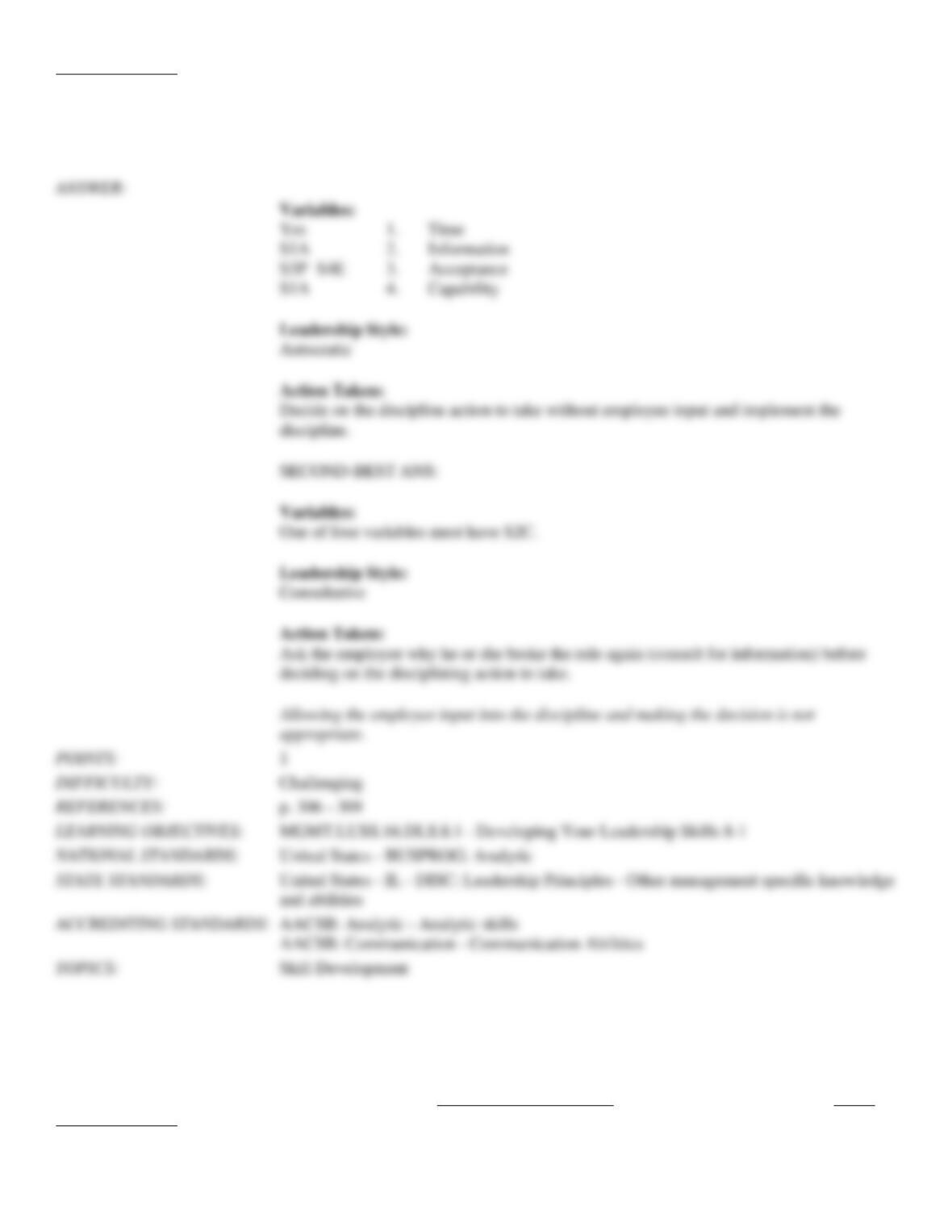
157. Leadership: Decision Making. As the supervisor, you have to make a decision on disciplinary action. An employee
has broken a rule again, after being told not to do so. The employee did not have a good reason for breaking the rule the
first time, but you took no action then.
For the Variables line, write the numbers 1 to 4. To the right of the four numbers, write the four variables. To the left of
MGMT.LUSS.16.CT.8.5 – Critical-Thinking 8-5
United States – BUSPROG: Analytic
United States – IL – DISC: Group Dynamics – Group dynamics in organizations
BLOOMS: Comprehension
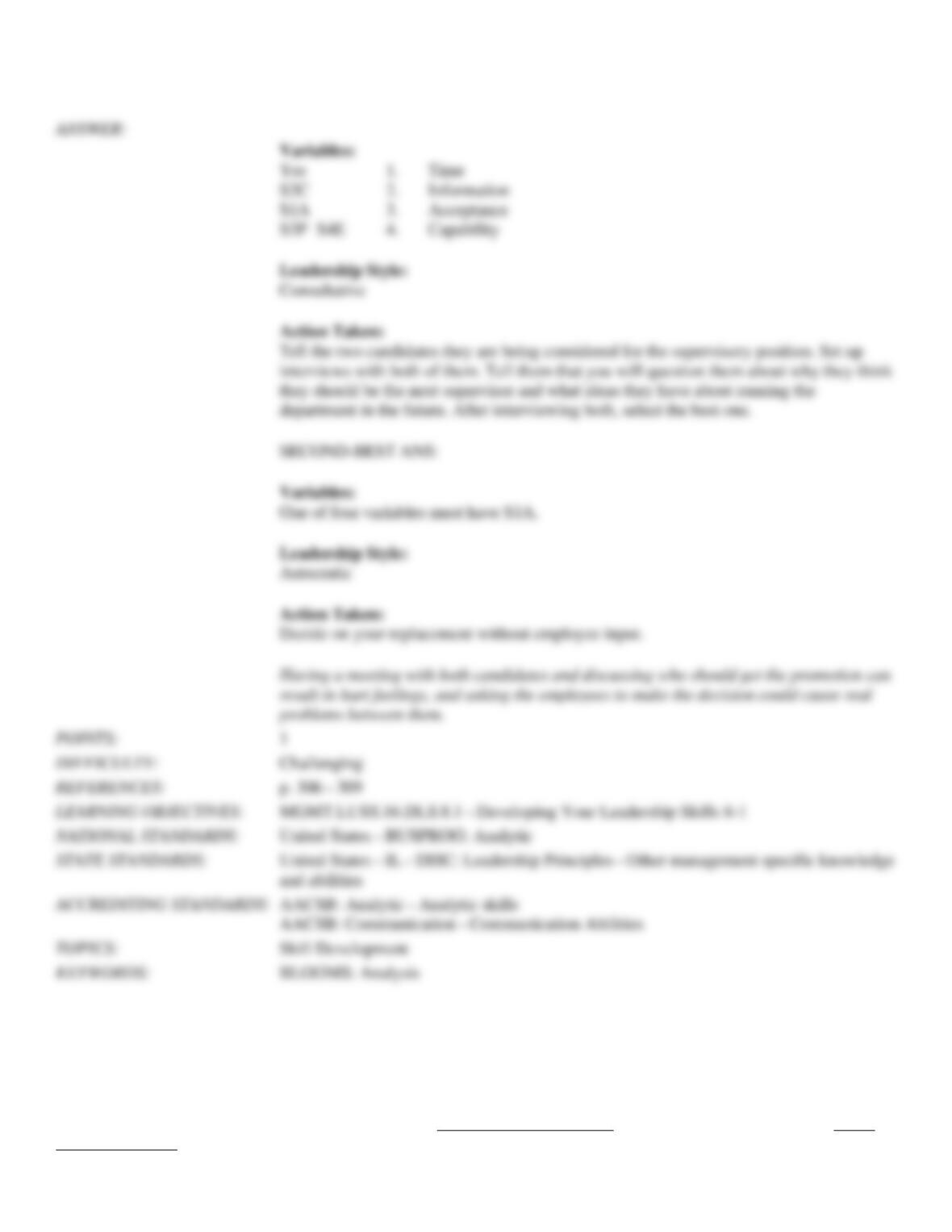
158. Leadership: Decision Making. You are being promoted from a supervisory job to a middle-management position in
two weeks. You have been given the authority to hire your replacement from your department before moving on. You
have two fairly equal candidates who want to be promoted to management.
For the Variables line, write the numbers 1 to 4. To the right of the four numbers, write the four variables. To the left of
the four numbers, write the answers to each variable from the Leadership Decision Making model that represents the style
to use based on the variable. Fill in the Leadership Style and Action Taken lines with the appropriate answers.
Variables:
Time
S1A
Information
S3P−S4E
Acceptance
S1A
Capability
Challenging
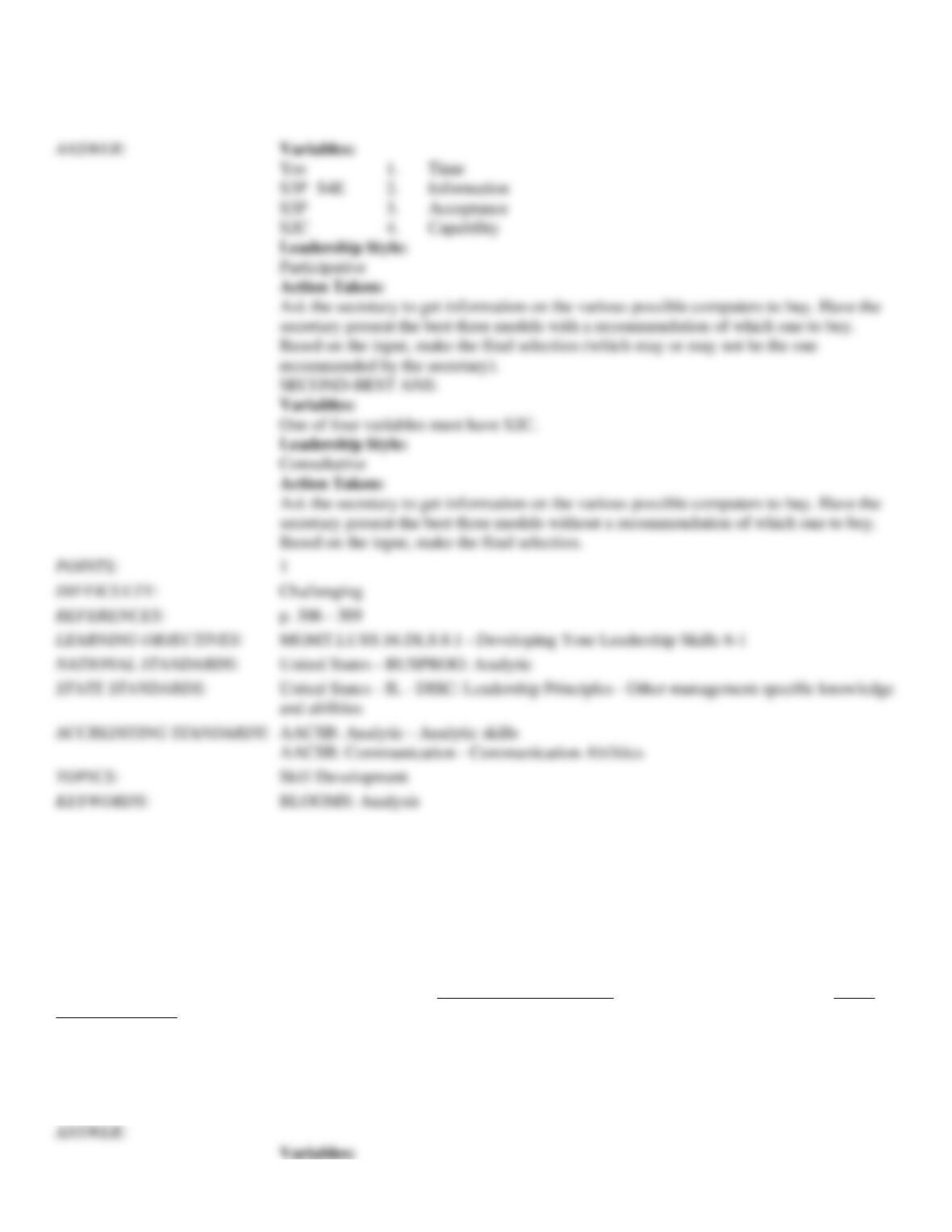
159. Leadership: Decision Making. Your secretary’s computer works OK but is getting old, and you have money in the
budget to replace it. You selected the last computer before the secretary started the job. The secretary has never purchased
a computer before. You haven’t been keeping up with the latest innovations and are not sure of what make, model, or
features to get. The secretary has been doing an excellent job.
For the Variables line, write the numbers 1 to 4. To the right of the four numbers, write the four variables. To the left of
the four numbers, write the answers to each variable from the Leadership Decision Making model that represents the style
to use based on the variable. Fill in the Leadership Style and Action Taken lines with the appropriate answers.
160. Leadership: Decision Making. You are the chairperson of a committee that is charged with recommending ways to
improve interdepartmental communications. There are members – all managers – from the seven departments in the
organization. You are basically providing no leadership. The group works well together, as it makes decisions by
consensus. You have accepted a promotion, which requires you to transfer to a new location in one week; therefore, you
can no longer be on the committee. You have been asked to select your replacement as chair of the committee. You really
don’t know who would want the position, and you believe that any one of the members would do a good job.
For the Variables line, write the numbers 1 to 4. To the right of the four numbers, write the four variables. To the left of
the four numbers, write the answers to each variable from the Leadership Decision Making model that represents the style
to use based on the variable. Fill in the Leadership Style and Action Taken lines with the appropriate answers.
Variables:
Leadership Style:
Action Taken: