
Exam
Name___________________________________
TRUE/FALSE. Write ‘T’ if the statement is true and ‘F’ if the statement is false.
1)
The time value of money is the loss of purchasing power that occurs over time as a result of
inflation.
1)
2)
The time value of money is the gain of purchasing power that occurs over time as a result of
inflation.
2)
3)
The time value of money is the gain of purchasing power that occurs over time as a result of
deflation.
3)
4)
In inflation, a dollar received now can purchase more than a dollar received five years from now.
4)
5)
In inflation, a dollar received now can purchase less than a dollar received five years from now.
5)
6)
Simple interest is added on to the principal to determine the total amount owed or due.
6)
7)
Fixed Principal Commercial Loans can only use a fixed amount of interest.
7)
8)
Fixed Principal Commercial Loans can use either a fixed amount of interest or a variable amount.
8)
9)
Fixed Principal Commercial Loans use a fixed interest rate but vary the principal payment.
9)
10)
Fixed Principal Commercial Loans use the same principal payment for the duration of the loan.
10)
11)
A Bridge Loan is a simple interest loan that provides funds to homeowners and business owners,
bridging the time gap between the sale of one piece of property and the purchase of another piece
of property.
11)
12)
In a Bridge Loan, the new owner can only own one property at a time.
12)
13)
In a Bridge Loan, the borrower actually owns two pieces of property at the same time.
13)

14)
Compound interest is the interest that is earned or charged on both the principal amount and on
the interest already accrued.
14)
15)
The effective rate does not take compounding into effect.
15)
16)
The effective rate takes compounding into effect.
16)
17)
Another name for the effective rate is the stated, or quoted, rate.
17)
18)
The present value of a future lump sum factor is 1+in.
18)
19)
The present value of a future lump sum factor is 1
1+in.
19)
20)
The actual rate of return on an investment is the internal rate of return.
20)
MULTIPLE CHOICE. Choose the one alternative that best completes the statement or answers the question.
21)
If you paid $5.00 to go to a movie in 2001 and you paid $7.00 to go to a movie in 2007, the increase
is price is probably due to
21)
A)
greed on the part of moviemakers.
B)
inflation.
C)
compound interest.
D)
deflation.
22)
If you paid $7.00 to go to a movie in 2006, what will the price of this movie be in the year 2011 if
inflation averages 6 percent?
22)
A)
$5.12
B)
$5.23
C)
$9.37
D)
$9.73
23)
If you deposit $1,000 in an account that compounds quarterly at 8 percent interest, the amount of
your account at the end of 5 years will be
23)
A)
$1,104.10.
B)
$1,485.90.
C)
$1,469.30.
D)
$4,661.00.
24)
If you deposit $1,000 in an account that compounds quarterly at 8 percent interest, the interest
earned on your account at the end of 5 years will be
24)
A)
$104.10.
B)
$485.90.
C)
$469.30.
D)
$661.00.
25)
The interest that is earned or charged on both the principal amount and on the accrued interest that
has been previously earned or charged is
25)
A)
stated interest.
B)
simple interest.
C)
compound interest.
D)
accrued interest.
26)
The interest that is earned or charged on the principal amount and added to the principal to get the
maturity value is
26)
A)
stated interest.
B)
accrued interest.
C)
simple interest.
D)
compound interest.
27)
Which of the following is true for Fixed Principal Commercial Loans?
27)
A)
The bank calculates the total interest due even on variable interest loans.
B)
The bank provides an amortization schedule with a variable interest loan.
C)
The borrower will probably be required to make a 20 percent down payment.
D)
The borrower does not have to make a down payment.
28)
Which of the following is true for Fixed Principal Commercial Loans?
I. The interest rate may be fixed or variable.
II. The principal payment remains the same for the duration of the loan.
III. The bank calculates the payment due each month with a variable interest loan.
IV. The bank calculates an amortization schedule with a variable interest loan.
V. The bank provides the borrower with an amortization schedule with a fixed interest fixed
principal loan.
28)
A)
I, II, III & IV
B)
I, II, IV & V
C)
I, II, III & V
D)
I, III, IV & V
E)
All of the above are true.
29)
With a Fixed Principal Commercial Loan where the amount borrowed is $120,000 for 5 years at 8
percent, the first monthly payment will be
29)
A)
$2,000
B)
$2,800
C)
$9,600
D)
$11,600
30)
With a Fixed Principal Commercial Loan where the amount borrowed is $120,000 for 5 years at 8
percent, the second monthly payment will be
30)
A)
$2,000
B)
$2,800
C)
$2,786.67
D)
none of the above.
31)
In a Bridge Loan, the lender
31)
A)
calculates loans the entire value of the property to the borrower.
B)
requires a 20 percent down payment on the value of the property.
C)
calculates interest on a daily basis.
D)
knows the exact payment prior to making the loan.

32)
When seeking a Bridge Loan, the borrower
32)
A)
owns one piece of property and wishes to purchase another.
B)
borrows only the down payment on a second piece of property.
C)
borrows the down payment and closing costs on a second piece of property.
D)
A and B above.
E)
A and C above.
33)
The amount of interest that is deducted from the amount you wish to borrow in order to get
proceeds is
33)
A)
stated interest.
B)
accrued interest.
C)
bank discount.
D)
simple interest.
34)
The approximate time that it takes a deposit to double at a certain interest rate is calculated by
dividing the annual interest rate into the number
34)
A)
36.
B)
48.
C)
72.
D)
100.
35)
If you purchase an automobile for $20,000 in 2006 and inflation is 4 percent, how much would a
similar automobile sell for four years from then?
35)
A)
$16,438
B)
$16,454
C)
$24,310
D)
$24,334
36)
If you purchase an automobile for $20,000 in 2004 and inflation is 4 percent, how much would a
similar automobile sell for four years from then? To solve this problem you would use the formula
for the
36)
A)
bank discount.
B)
future value of a lump sum.
C)
internal rate of return.
D)
present value of a lump sum.
37)
How long will it take for $500 to amount to $850 at 10% simple interest?
37)
A)
10 years
B)
5 years
C)
3.5 years
D)
7 years
E)
none of the above
38)
Using the rule of 72, how long will it take $1,000 to double if you earn 6% interest per year?
38)
A)
6 years
B)
10 years
C)
7.2 years
D)
12 years
E)
Cannot calculate with information provided.
39)
How much will you pay for a $10,000 Treasury bill at 5.45% discount for 13 weeks?
39)
A)
$135.88
B)
$9,863.75
C)
$9,865.12
D)
$10,135.88

40)
What proceeds would you receive if you borrow $5,000 for 270 days discounted at 12%?
40)
A)
$433.84
B)
$4,550
C)
$4,556.16
D)
$5,455
41)
You have to make a balloon payment on your house five years from now of $15,000. If money can
earn an average of 6 percent a year for the five–year period, how much will you have to place in
the account today to have the $15,000 in five years?
41)
A)
$11,193.00
B)
$11,208.87
C)
$20,073.00
D)
$20,101.50
42)
You have to make a balloon payment on your house five years from now of $15,000. If money can
earn an average of 6 percent a year for the five–year period, what factor will you use to determine
what to deposit now?
42)
A)
0.7462
B)
0.7473
C)
1.3382
D)
1.3401
43)
You have to make a balloon payment on your house five years from now of $15,000. If money can
earn an average of 6 percent a year for the five–year period, how much will you have to place in
the account today to have the $15,000 in five years? To solve this problem you would use the
formula for the
43)
A)
future value of an ordinary annuity.
B)
present value of a lump sum.
C)
future value of a lump sum.
D)
present value of an ordinary annuity.
44)
You have to make a balloon payment on your house five years from now of $15,000. If money can
earn an average of 6 percent a year for the five–year period, how much interest will you earn on
your deposit in five years?
44)
A)
$3,791.13
B)
$3,807.00
C)
$5,073.00
D)
$5,101.50
45)
When you go to a financial institution to obtain a loan, the rate of interest normally quoted will be
the
45)
A)
effective rate.
B)
quoted rate.
C)
stated rate.
D)
both A and C above.
E)
both B and C above.
46)
The rate that the bank is offering is 2 percent compounded monthly. This is an actual rate of interest
of ________ percent.
46)
A)
2.00
B)
2.02
C)
2.04
D)
2.50
47)
If you want an effective rate of 6 percent, what is an acceptable quoted rate if interest is
compounded quarterly?
47)
A)
5.50
B)
5.65
C)
5.87
D)
6.12

48)
If inflation averages 6 percent per year, what is the value of a dollar ten years from now?
48)
A)
53 cents
B)
56 cents
C)
79 cents
D)
$1.79
49)
If inflation averages 6 percent per year, what is the loss of purchasing power for a dollar ten years
from now?
49)
A)
74 cents
B)
47 cents
C)
44 cents
D)
31 cents
50)
You have an absolutely brilliant child who is six years old and will be attending a private college in
twelve years. You know that a four–year college now costs at least $30,000 per year, including
tuition, books, and room and board. The cost of sending a child to college has increased by 7
percent per year, and you believe this will be true for the next twelve years. How much will the
annual tuition be when your child is eighteen?
50)
A)
$67,565.75
B)
$66,320.44
C)
$60,365.89
D)
$45,000.00
51)
You have an absolutely brilliant child who is six years old and will be attending a private college in
twelve years. You know that a four–year college now costs at least $30,000 per year, including
tuition, books, and room and board. The cost of sending a child to college has increased by 7
percent per year, and you believe this will be true for the next twelve years. How much will the
annual tuition be when your child is eighteen?
51)
A)
2.2522
B)
2.2107
C)
2.0122
D)
1.5007
52)
You have an absolutely brilliant child who is six years old and will be attending a private college in
twelve years. You know that a four–year college now costs at least $30,000 per year, including
tuition, books, and room and board. The cost of sending a child to college has increased by 7
percent per year, and you believe this will be true for the next twelve years. How much more
tuition will you have to pay per year when your child is eighteen?
52)
A)
$15,000.00
B)
$30,365.89
C)
$36,320.44
D)
$37,565.75
53)
You have an absolutely brilliant child who is six years old and will be attending a private college in
twelve years. You know that a four–year college now costs at least $30,000 per year, including
tuition, books, and room and board. The cost of sending a child to college has increased by 7
percent per year, and you believe this will be true for the next twelve years. What will a four year
college education cost when your child is eighteen?
53)
A)
$180,087.64
B)
$241,463.56
C)
$265,281.76
D)
$270,263.00
54)
You have an absolutely brilliant child who is six years old and will be attending a private college in
twelve years. You know that a four–year college now costs at least $30,000 per year, including
tuition, books, and room and board. The cost of sending a child to college has increased by 8
percent per year, and you believe this will be true for the next twelve years. How much will the
annual tuition be when your child is eighteen?
54)
A)
$119,881
B)
$75,545
C)
$74,279
D)
$67,566

55)
You purchase 100 shares of stock in ABC for $50 per share in January 2003 and sell the stock at the
end of 2006 for $90. What is your Internal Rate of Return on this investment?
55)
A)
15.83%
B)
21.64%
C)
82.22%
D)
86%
56)
How long in years will it take for a mutual fund investment of $25,000 to reach $250,000 if the fund
pays 12% per year?
56)
A)
20.3178 years
B)
10.65 years
C)
2.03178 years
D)
The time cannot be determined with information provided.
57)
Using the rule of 72, how long will it take $100,000 to equal $200,000 if you can earn 14% annually?
57)
A)
5.1429 years
B)
2.78 years
C)
4.1529 years
D)
1.38 years
58)
If your money doubled in 8 years, then your annual rate of interest is approximately
58)
A)
7.2%.
B)
8%.
C)
9%.
D)
10%.
59)
You buy 1,000 shares of stock at $5.00 per share in January of 2004. You sell the stock at $7.50 per
share in January of 2007. What is your internal rate of return (IRR)?
59)
A)
1.1447%
B)
14.47%
C)
18.00%
D)
87.36%
60)
Joe M. purchases a house for $365,000. He sells the home 5 years later for $440,000. What is his
internal rate of return (IRR)?
60)
A)
8.31%
B)
3.81%
C)
3.18%
D)
1.31%
61)
Joe M. purchases a house for $370,000. He sells the home 7 years later for $600,000. What is his
internal rate of return (IRR)?
61)
A)
15.7%
B)
7.15%
C)
7.50%
D)
5.70%
62)
Joe M. purchases a house for $410,000. He sells the home 8 years later for $629,000. What is his
internal rate of return (IRR)?
62)
A)
5.15%
B)
1.50%
C)
15%
D)
5.50%
63)
Juanita purchases a house for $410,000. She sells the home 8 years later for $1,200,000. What is her
internal rate of return (IRR)?
63)
A)
14.37%
B)
37.40%
C)
3.74%
D)
34%
64)
JT purchases 1,000 shares of stock at $2.48 per share in January 2006. He sells the 1,000 shares in
January 2010 for $5.50 per share. What is his internal rate of return?
64)
A)
22.03%
B)
2.03%
C)
3.22%
D)
2.33%

65)
JT purchases 1,000 shares of stock at $23.50 per share in January 2006. He sells the 1,000 shares in
January 2110 for $35.50 per share. What is his internal rate of return?
65)
A)
10.86%
B)
16.08%
C)
8.06%
D)
6.08%
66)
JT purchases 1,000 shares of stock at $29 per share in January 2006. He sells the 1,000 shares in
January 2012 for $32 per share. What is his internal rate of return?
66)
A)
6.15%
B)
5.61%
C)
5.19%
D)
1.65%
67)
JT purchases 1,000 shares of stock at $14.78 per share in January 2006. He sells the 1,000 shares in
January 2010 for $15.50 per share. What is his internal rate of return?
67)
A)
11.2%
B)
2.11%
C)
1.2%
D)
1.12%
68)
N. Trest bought a $10,000 Treasury bill at a 2.38% discount for 13 weeks (91 days). How much does
N pay for the bond?
68)
A)
$10,000
B)
$9,940.66
C)
$6,640.66
D)
$9,770.08
69)
N. Trest bought a $10,000 Treasury bill at a 1.32% discount for 13 weeks (91 days). How much does
N pay for the bond?
69)
A)
$10,000
B)
$9,967.09
C)
$9,870.54
D)
$9,685.90
70)
N. Trest bought a $10,000 Treasury bill at a 18% discount for 13 weeks (91 days). How much does N
pay for the bond?
70)
A)
$10,000
B)
$9551.23
C)
$8,732.73
D)
$8,548.95
71)
A noted free agent running back just signed a four–year, 30–million dollar contract with a new
team. He will get a 7–million dollar signing bonus and a 4.5–million dollar roster bonus.
Additionally, he will get 3.25 million for year one, 5.25 million for year two, 5 million for year three,
and 5 million for year four. Salary is paid at the end of the first year. Find the present value of his
contract if money can earn 6%.
71)
A)
$15,897,083.78
B)
$27,397,083.78
C)
$23,911,000.35
D)
$30,000,000
72)
A college education costs approximately $75,000 at an Ivy League school. If inflation averages 5%
per year, what will be the cost of the college education in 15 years?
72)
A)
$1,745,697.74
B)
$155,919.61
C)
$125,754.75
D)
$36,076.28
73)
A college education costs approximately $75,000 at an Ivy League school, inflation averages 5%,
what factor will you use to determine the cost of an education in 15 years?
73)
A)
2.0789
B)
2.7890
C)
2.9500
D)
0.4810
74)
A college education costs approximately $75,000 at an Ivy League school. If inflation averages 8%
per year, how much more would the education cost in 15 years?
74)
A)
$162,912.68
B)
$237,912.68
C)
$312,912.68
D)
$2,036,408
75)
A college education costs approximately $75,000 at an Ivy League school. If inflation averages 8%
per year, how much will the education cost in 15 years?
75)
A)
$162,912.68
B)
$237,912.68
C)
$312,912.68
D)
$2,036,408
ESSAY. Write your answer in the space provided or on a separate sheet of paper.
76)
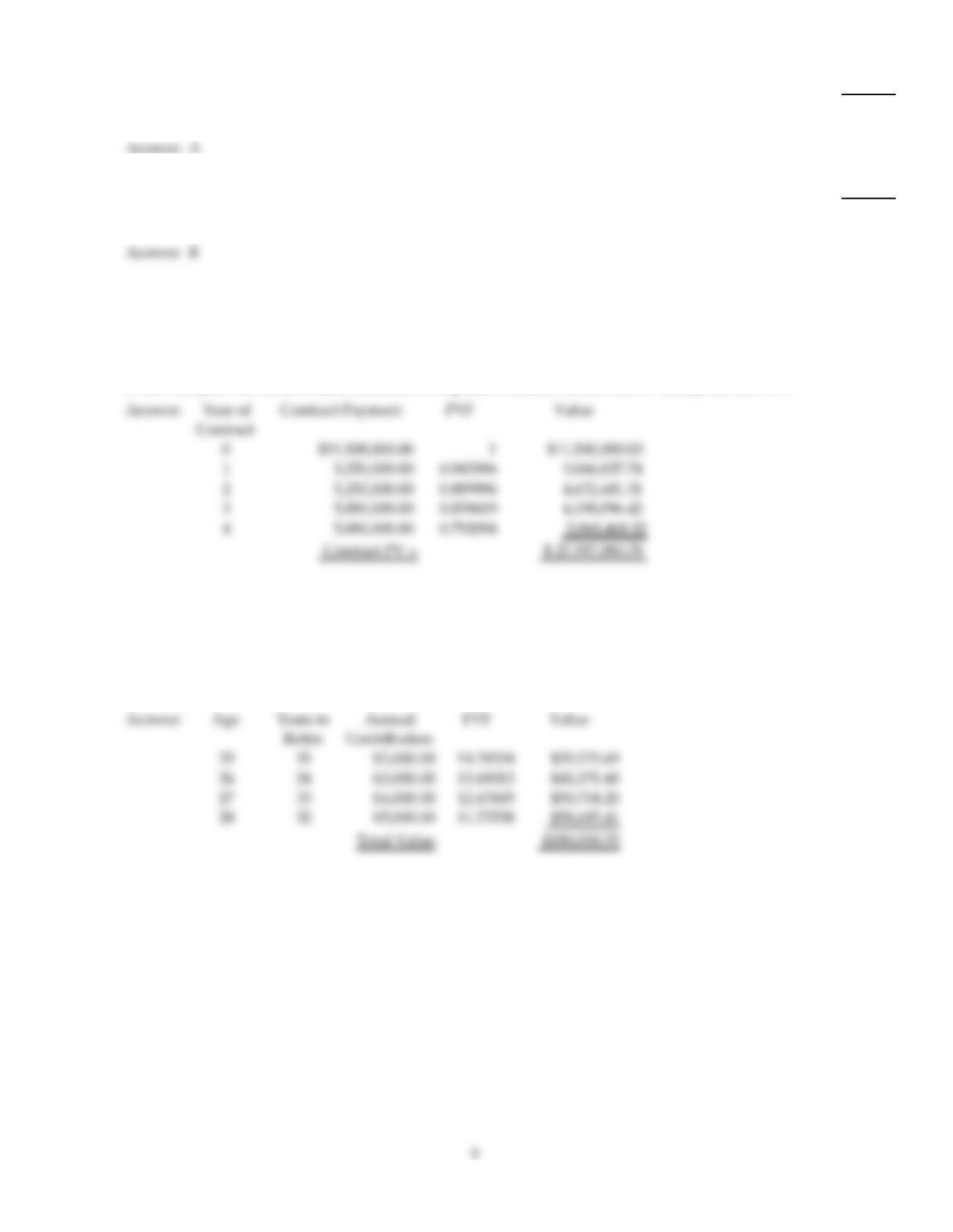
A noted free agent running back just signed a four–year 30–million dollar contract with a new team. He will get
a 7–million dollar signing bonus and a 4.5–million dollar roster bonus. Additionally, he will get 3.25 million for
year one, 5.25 million for year two, 5 million for year three, and 5 million for year four. Salary is paid at the end
of the first year. Construct a table that shows the present value of his contract if money can earn 6%.
77)
You graduate from college and get your first job. You open a Roth IRA with $2,000 at the age of 25. You invest
$3,000 at age 26, $4,000 at age 27, and $5,000 at age 28. You then receive a promotion that brings your income to
a level that disqualified you from making further contributions to the Roth IRA. Construct a table that shows
how much will you have in your IRA at the age of 60 if you had invested in an account that paid an average
yield of 8 percent.