Test Bank Chapter 8
Chapter 8—Cost Analysis
MULTIPLE CHOICE
1. Economies of Scope refers to situations where per unit costs are:
a. Unaffected when two or more products are produced
b. Reduced when two or more products are produced
c. Increased when two or more products are produced
d. Demonstrating constant returns to scale
e. Demonstrating decreasing returns to scale
2. Economies of scale exist whenever long-run average costs:
a. Increase as output is increased
b. Remain constant as output is increased
c. Decrease as output is increased
d. Decline and then rise as output is increased
e. None of the above
3. Which of the following is true with regards to a long-run cost function?
a. The shape of the firm’s long-run cost function is important in decisions to expand the scale of
operations
b. The long-run average cost curve is U-shaped
c. The long-run average cost curve is flatter than the short-run average cost curve.
d. The curve consists of the lower boundary of all the short-run cost curves
e. All of the above
4. If TC = 321 + 55Q – 5Q2, then average total cost at Q = 10 is:
a. 10.2
b. 102
c. 37.1
d. 371
e. 321
5. Suppose that total cost is given by TC = 200 + 5Q – 0.4Q2 + 0.001Q3
a. Fixed cost (FC) is $200
b. Variable cost (VC) is 5Q – 0.4Q2 + 0.001Q3
c. Average variable cost (AVC) is 5 – 0.4Q + 0.001Q2
d. Marginal cost (MC) is 5 – 0.8Q +.003Q2
e. All of the above are correct
6. What method of inventory valuation should be used for economic decision-making problems?
a.
book value
b.
original cost
c.
current replacement cost
d.
cost or market, whichever is lower
e.
historical cost
7. According to the theory of cost, specialization in the use of variable resources in the short-run results
initially in:
a.
decreasing returns and declining average and marginal costs
b.
increasing returns and declining average and marginal costs
c.
increasing returns and increasing average and marginal costs
d.
decreasing returns and increasing average and marginal costs
e.
none of the above
8. For a short-run cost function which of the following statements is (are) not true?
a.
The average fixed cost function is monotonically decreasing.
b.
The marginal cost function intersects the average fixed cost function where the average
variable cost function is a minimum.
c.
The marginal cost function intersects the average variable cost function where the average
variable cost function is a minimum.
d.
The marginal cost function intersects the average total cost function where the average
total cost function is a minimum.
e.
b and c
9. The cost function is:
a.
a means for expressing output as a function of cost
b.
a schedule or mathematical relationship showing the total cost of producing various
quantities of output
c.
similar to a profit and loss statement
d.
incapable in being developed from statistical regression analysis
e.
none of the above
10. Which of the following statements about cost functions is true?
a.
Variable costs will always increase in direct proportion to the quantity of output produced.
b.
The less capital equipment employed in the production process relative to labor and other
inputs, the longer will be the period of time required to increase significantly the scale of
operation.
c.
The shape of the firm’s long-run cost function is important in decisions to expand the scale
of operations.
d.
none of the above
11. Which of the following statements concerning the short-run average cost curve of economic theory is
true?
a.
It is L-shaped
b.
It is -shaped
c.
It is -shaped
d.
It is -shaped
e.
It is M-shaped
12. Possible sources of economies of scale (size) within a production plant include:
a.
specialization in the use of capital and labor
b.
imperfections in the labor market
c.
transportation costs
d.
a and b
e.
a and c
13. The existence of diseconomies of scale (size) for the firm is hypothesized to result from:
a.
transportation costs
b.
imperfections in the labor market
c.
imperfections in the capital markets
d.
problems of coordination and control encountered by management
e.
All of the above
14. The relevant cost in economic decision-making is the opportunity cost of the resources rather than the
outlay of funds required to obtain the resources.
a.
true
b.
false
15. ____ are defined as costs which are incurred regardless of the alternative action chosen in a decision–
making problem.
a.
Opportunity costs
b.
Marginal costs
c.
Relevant costs
d.
Sunk costs
e.
None of the above
16. A cottage industry exists in the home-manufacture of ‘country crafts’. Especially treasured are
handmade quilts. If the fourth completed quilt took 30 hours to make, and the eighth quilt took 28
hours. What is the percentage learning? Hint: Percentage learning = 100% – (c2/c1)•100%.
a. 5%
b. 6.7%
c. 10%
d. 100%
Test Bank Chapter 8
e. 122%
PROBLEMS
1. During the last few days the Superior Company has been running into problems with its computer
system. The last run of the production cost schedule resulted in the incomplete listing shown below.
From your knowledge of cost theory, fill in the blanks.
Q
TC
TFC
TVC
ATC
AFC
AVC
MC
0
40
_____
_____
x
x
x
x
1
_____
_____
_____
52
_____
_____
_____
2
_____
_____
20
_____
_____
_____
_____
3
_____
_____
_____
21.33
_____
_____
_____
4
_____
_____
_____
_____
_____
_____
4
5
_____
_____
40
_____
_____
_____
_____
6
_____
_____
_____
15.67
_____
_____
_____
7
_____
_____
_____
_____
_____
10
_____
8
_____
_____
96
_____
_____
_____
_____
9
_____
_____
_____
_____
_____
15
_____
10
_____
_____
_____
_____
_____
_____
45
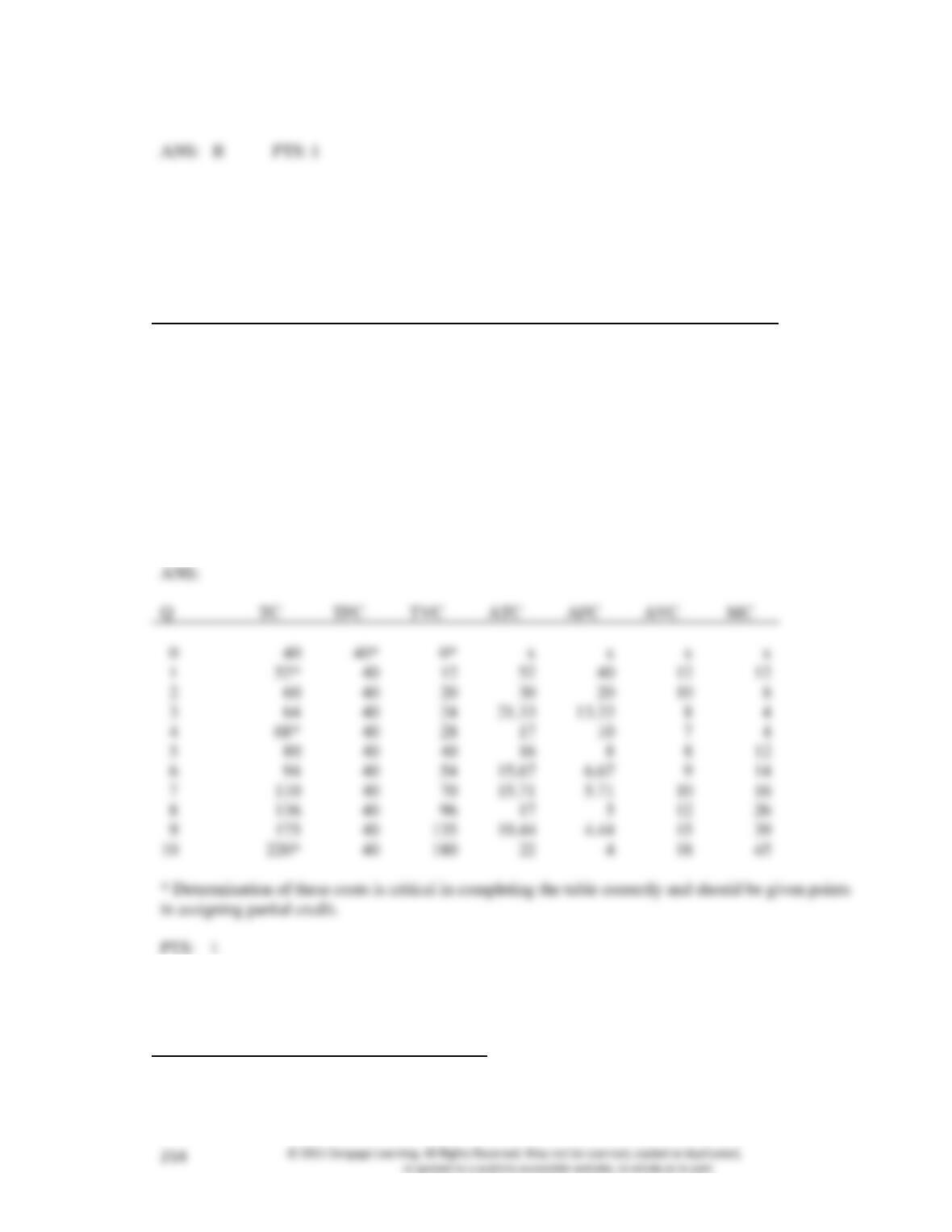
Q
0
40
0*
x
x
x
x
1
40
12
52
40
12
12
2
60
40
20
30
20
10
8
3
64
40
24
8
4
4
40
28
17
10
5
80
40
40
16
8
8
12
6
94
40
54
15.67
14
7
40
70
10
16
8
40
96
17
5
12
26
9
40
19.44
15
39
10
40
22
4
18
45
2. The Jones Company has the following cost schedule:
Output
Total Cost
(Units)
($)
0
3000
50
3750
100
4275
Test Bank Chapter 8
150
4675
200
5000
250
5300
300
5700
350
6250
400
7050
450
8225
50
100
150
200
250
300
350
400
450
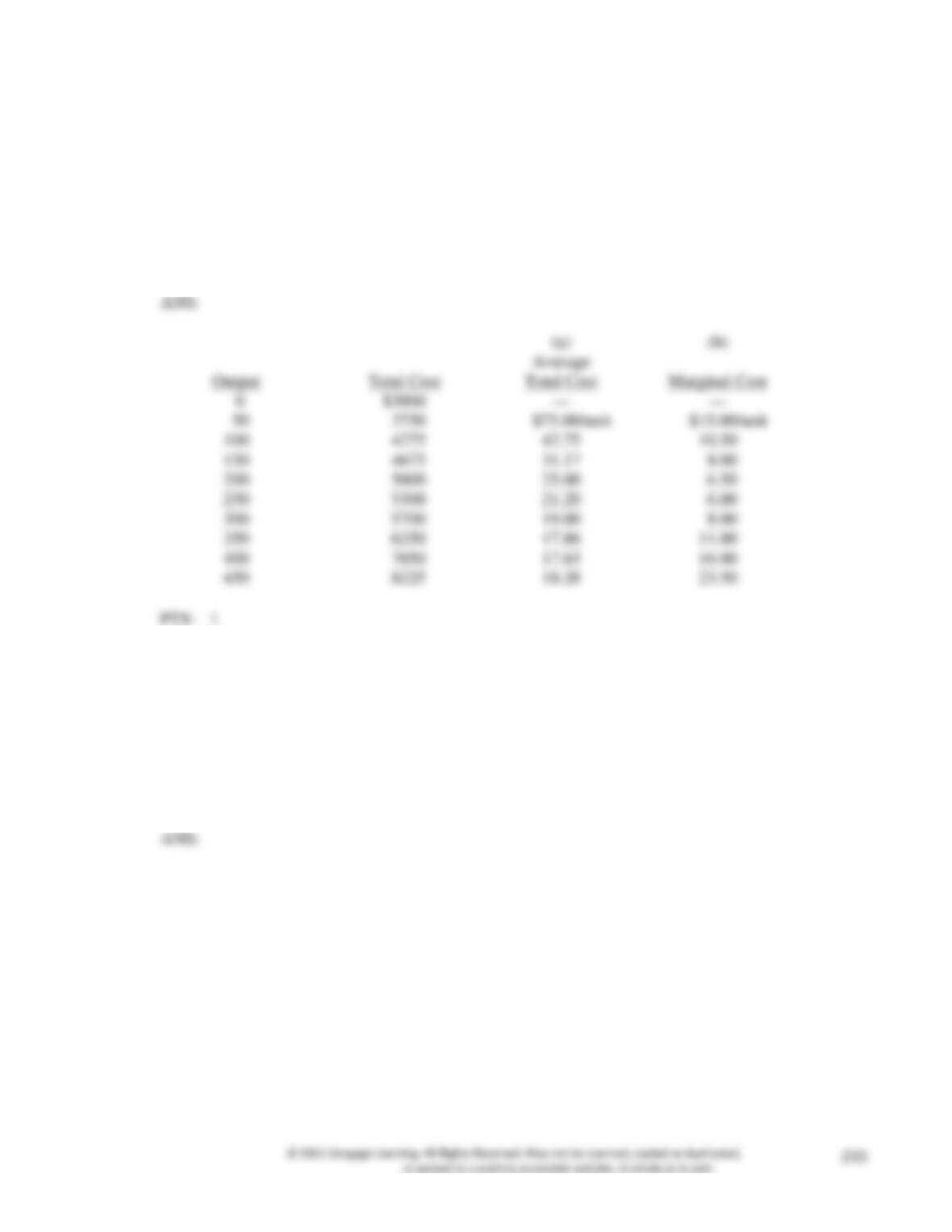
Prepare (a) average total cost and (b) marginal cost schedules for the firm.
3. A firm has determined that its variable costs are given by the following relationship:
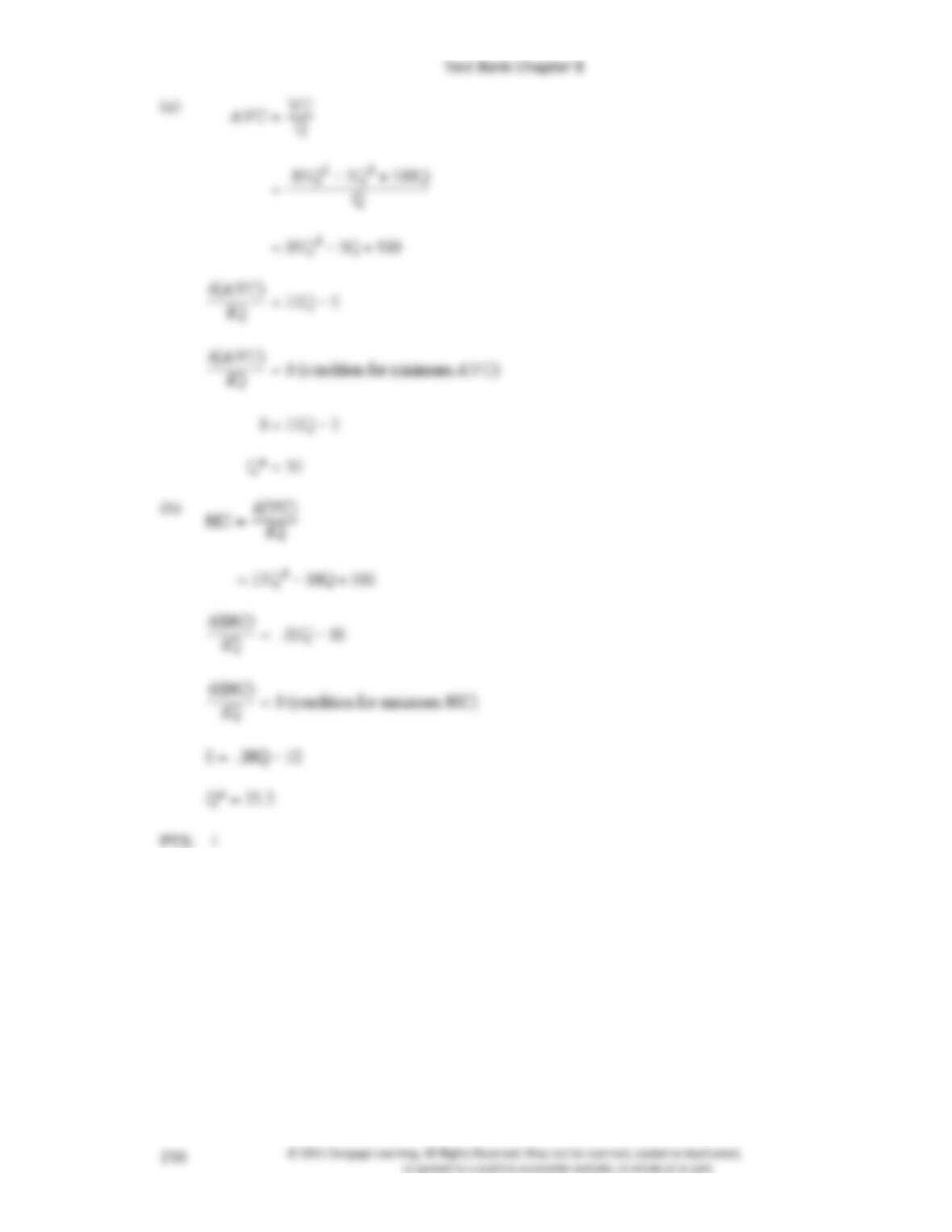
VC = .05Q3 − 5Q2 + 500Q
where Q is the quantity of output produced.
(a)
Determine the output level where average variable costs are minimized.
(b)
Determine the output level where marginal costs are minimized.