
8.2 True or False
1) EPZ, GDP, GNP, OPEC and MVA are all measures of economic development.
2) The beneficial feature of economic development is that it is even across space.
3) Regional inequalities in economic development occur not only in peripheral and
semiperipheral countries, but in core countries as well.
4) As the demonstrated by Japan, the resource base of a country determines how well it can do in
the world economy.
5) A country’s ecological footprint refers to the types of shoes it wears — a symbolic reference to
how it balances environmental concerns with economic development.

6) “Fracking” is helping people and environments in the world’s periphery by reducing reliance
on wood for fuel.
7) Innovations and new technology systems create new opportunities for initial advantage and
cumulative causation in peripheral regions.
8) Once old core regions deindustrialize and suffer the effects of creative destruction, they move
to the periphery.
9) Currently, almost all foreign direct investment goes to the world’s core countries.
10) According to your text, the gap in per capita gross national income between the world’s 10
most and least prosperous countries is closing, from 70 times to only 20 times as great.

11) Like Fordism, neo-Fordism relies on mass production and consumption.
12) In the global office, ancillary services such as banking and customer services are no longer
locally oriented but have been decentralized.
13) In contrast to economies built around natural resources, those based on experiences are not
vulnerable to economic or political uncertainties.
14) Generally, countries with high GNIs per capita have high PPP scores.
15) The elasticity of demand is low for products which have saturated their markets.

16) Generally, peripheral countries produce goods and services with high elasticity of demand.
17) Core-periphery inequalities are commonly found within core countries.
18) From a geographic perspective, economic development is uneven.
19) The economic gap between rich and poor countries has narrowed over the last two decades.
20) Changes in technology change the economic geography of a region.

21) In peripheral countries, a greater percentage of the labor force is engaged in primary and
secondary activities than in tertiary and quaternary activities.
22) Postindustrial societies have the majority of their work force engaged in tertiary and
quaternary activities.
23) Localization economies occur when many firms in one industry are located in the same area.
24) External economies are typically found in rural areas.
25) During the formation of a regional economic core, ancillary industries must be in place
before forward linkages are created.

26) Creative destruction explains the deindustrialization Detroit, Milwaukee, Cleveland and
Buffalo.
27) Conglomerate corporations focus on providing one service or product to every potential
market in the world.
28) Greatly increased transnational corporate activity over recent history is one of the driving
forces behind the globalization of the world economy.
29) Commodity chains link raw materials and natural resources to finished products and end
users.
30) The good thing about conventional oil and gas energy production and distribution is that they
are protected against global climate change.

31) The most important banking, finance, and business services are concentrated in a few
geographic areas; they are not spread uniformly across core countries.
32) Offshore financial centers are strictly regulated by international agencies.
33) China’s Guangdong province suffered backwash effects from Hong Kong’s rise in the 1990s
and 2000s.
34) A cabinet maker is primarily involved in tertiary activities.
35) Creative destruction is motivated by a desire for higher profits.

36) Over the last several decades, foreign direct investment to the world’s periphery has steadily
declined.
37) Over time, knowledge and information have become an important factor in determining
levels of economic development.
38) Level of education and availability of educational opportunities have a strong impact on a
country’s ability to have a strong economy.
39) As a sign of the reaction to conglomerate control of large chains, the number of independent
community pubs in England and local bistros in France are on the rise.
40) The technology systems that launched the Industrial Revolution were based on water power
and steam engines.

41) Despite tensions between Taiwan and China, Taiwan is one of the world’s biggest investors
in China.
42) Leading the way in China’s economic growth are its state-owned enterprises.
43) With deindustrialization of the 1960s and 1970s, the U.S. Manufacturing Belt became the
Rustbelt.
44) Over 50% of the world’s toys are produced in China alone.
45) McDonald’s is the world’s largest purchaser of beef, pork and potatoes.
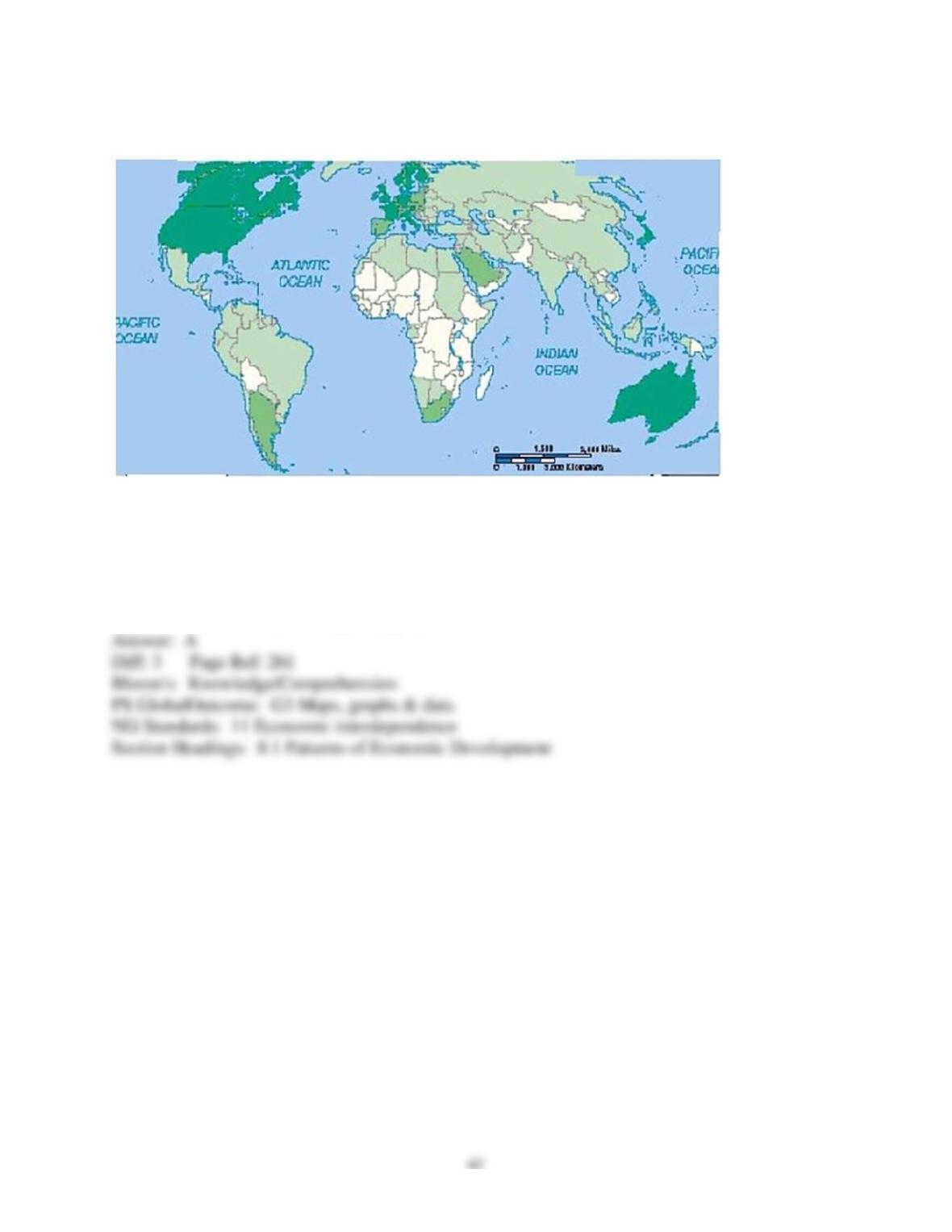
8.3 Questions with Images
1) The above map of ________ exemplifies the core-periphery nature of today’s world system.
A) gross national income per capita
B) gross domestic product
C) total national debt
D) agricultural cover
E) percent of workforce in the primary sector
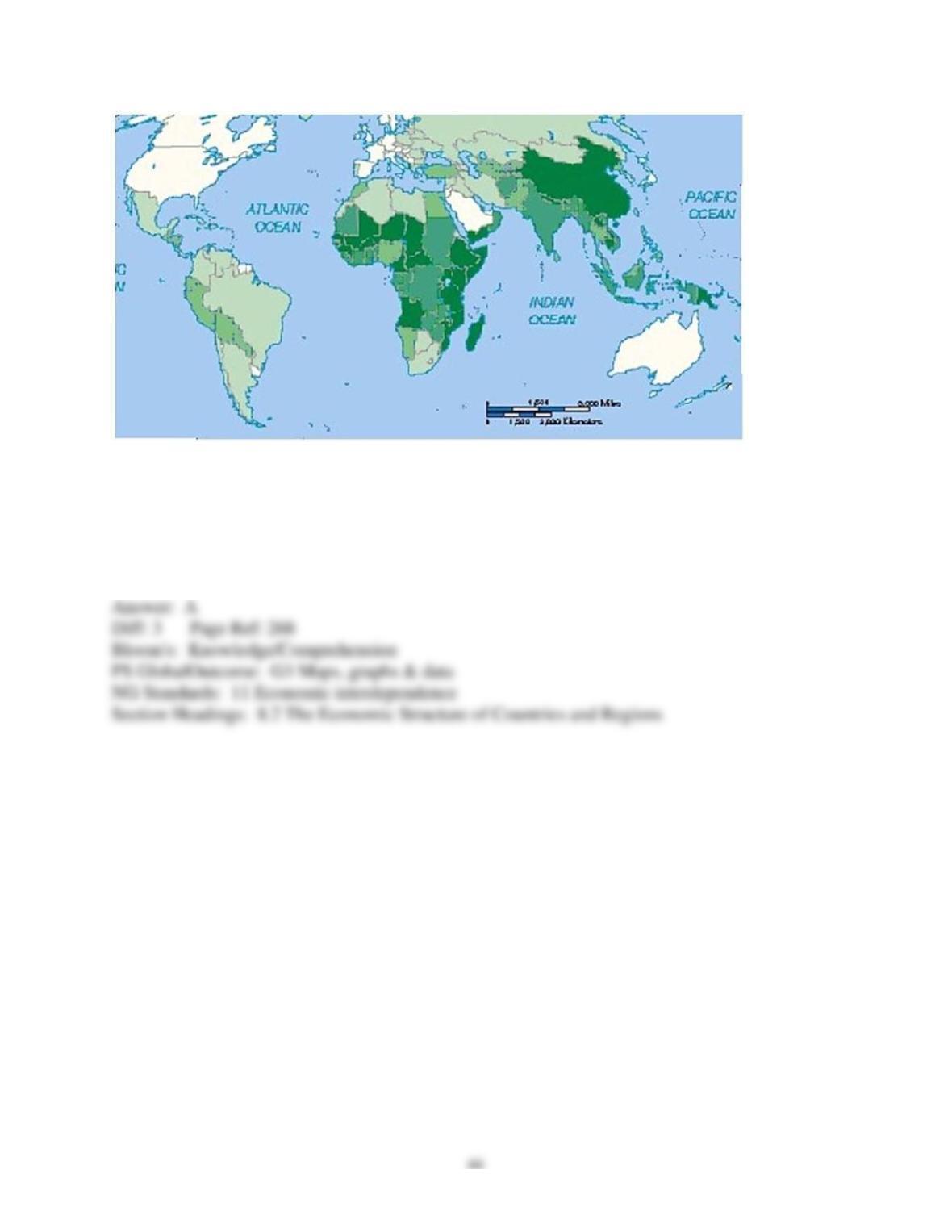
2) The dark shadings in the above map show the distribution of ________ across the world.
A) primary economic activities
B) secondary economic activities
C) tertiary economic activities
D) localization economies
E) backwash effects
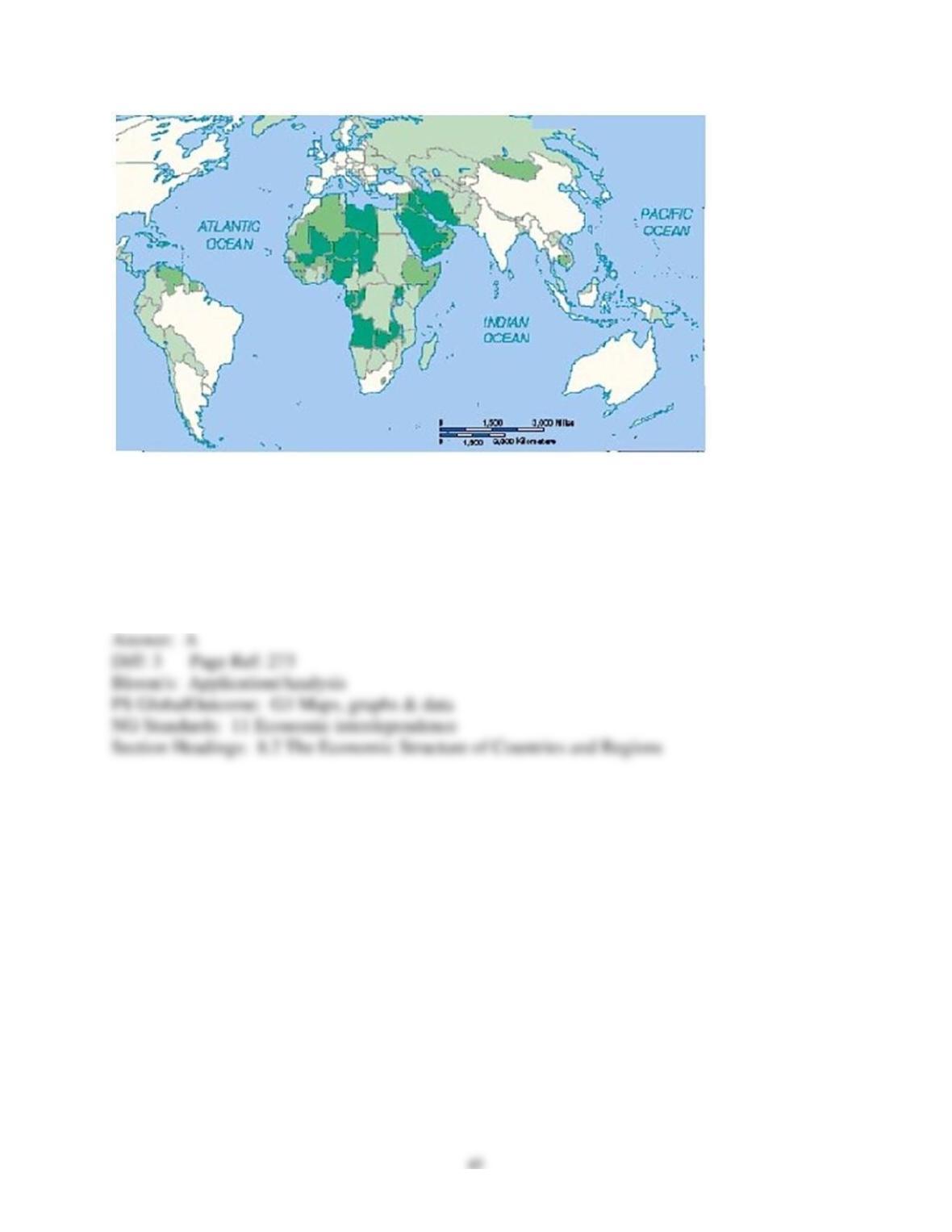
3) The lightly shaded countries have diversified export bases. The darkly shaded countries
depend on ________ for foreign exchange (export earnings).
A) one or two commodities
B) the service sector
C) energy resources
D) tourism
E) both a and b
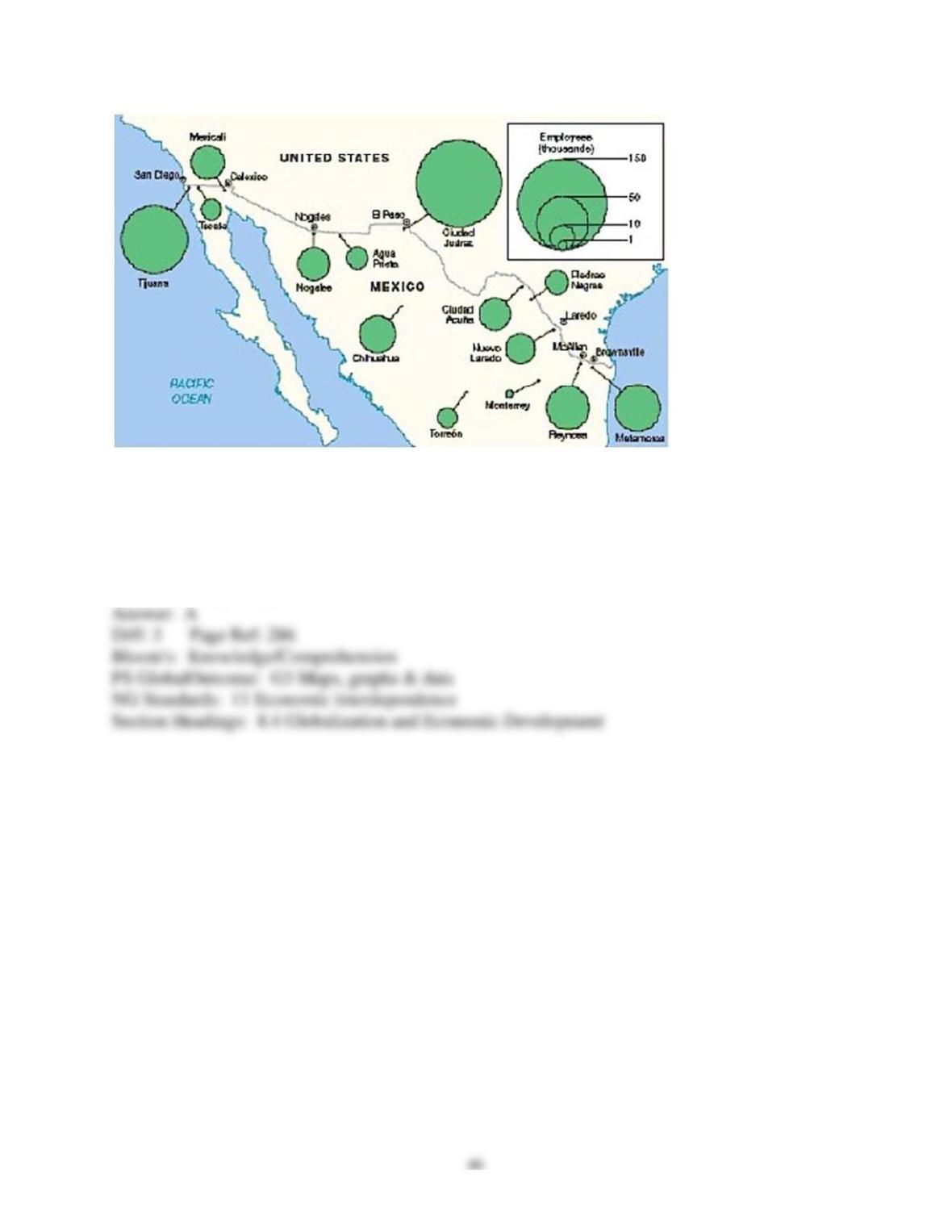
4) The above map shows
A) principal maquiladora centers.
B) the world’s principal EPZs.
C) offshore financial centers.
D) headquarters of principal TNCs.
E) the world’s principal NICs.