Chapter 08 – The Structure – Replication – and Chromosomal Organization of DNA
True / False
1. Adenine and guanine are nitrogen-containing bases found in nucleic acids.
a.
True
b.
False
True
2. The H5N1 influenza killed more than 50% of those infected.
a.
True
b.
False
True
3. In the early twentieth century, most scientists believed that only nucleic acids were complex enough to carry genetic
information.
a.
True
b.
False
4. Rosalind Franklin did not share a part of the 1962 Nobel Prize for Medicine or Physiology because she had died four
years earlier.
a.
True
b.
False
True
HUHE.CUMM.16.8-4-3: – Debate for and against the patentability of genes.
5. Because RNA is single-stranded, it does not participate in the regulation of gene expression.
a.
True
b.
False
False
6. DNA contains two identical polynucleotide chains.
a.
True
b.
False
False
7. A replicated DNA molecule contains one new strand and one old strand.
a.
True
b.
False
True
8. In June 2013, the U.S. Supreme Court ruled that if a gene is removed from the human body and purified it can be
patented.
a.
True
b.
False
False
HUHE.CUMM.16.8-4-3: – Debate for and against the patentability of genes.
9. The interphase nucleus has an internal structure in which each chromosome occupies a distinct region called a
chromosome territory.
a.
True
b.
False
True
10. The process of transferring genetic information between bacterial cells is accomplished with a transformation factor
called DNA.
a.
True
b.
False
True
Chapter 08 – The Structure – Replication – and Chromosomal Organization of DNA
Multiple Choice
11. The basic building block of DNA and RNA is a(n) ____.
a.
nitrogenous base
b.
sugar-phosphate backbone
c.
amino acid
d.
nucleotide
e.
ribose sugar
d
Bloom’s: Understand
8-3 The Chemistry of DNA
label the nucleotides and polynucleotides in DNA and RNA structures.
12. In the Watson–Crick model of DNA structure, the polynucleotide chains ____.
a.
are of unequal length
b.
are arranged with the bases forming the backbone of the helix
c.
form covalent bonds between uracil and adenine
d.
are oriented in the same direction
e.
are oriented in opposite directions
e
Bloom’s: Understand
8-4 The Watson–Crick Model of DNA Structure
how it accounts for several properties of genes.
13. DNA vaccines ____.
a.
use RNA to assist in the transformation process
b.
have been created but are ineffective
c.
show promise in animal studies and are now in clinical trials
d.
have been approved by the government to fight several diseases
e.
sometimes infect the subject with the disease it’s attempting to fight
c
Bloom’s: Understand
8-1 Are DNA Vaccines the Answer?
some of the questions still remaining regarding DNA vaccine use.
14. After contracting SARS, about ____ percent of the infected died.
a.
10
b.
25
c.
50
conclusions about DNA that resulted from this research.
Chapter 08 – The Structure – Replication – and Chromosomal Organization of DNA
d.
75
e.
100
a
Bloom’s: Remember
8-1 Are DNA Vaccines the Answer?
key issues surrounding DNA vaccine use against SARS and other viruses.
15. The search for a(n) ____ treatment led to the discovery that DNA carries genetic information.
a.
pneumonia
b.
AIDS
c.
tuberculosis
d.
influenza
e.
SARS
a
Bloom’s: Remember
8-2 DNA Is the Carrier of Genetic Information
conclusions about DNA that resulted from this research.
16. The sugar in RNA nucleotides is ____.
a.
dextrose
b.
sucrose
c.
glucose
d.
ribose
e.
deoxyribose
d
Bloom’s: Understand
8-5 RNA Is a Single-Stranded Nucleic Acid
HUHE.CUMM.16.8-5-1 – Compare the structures and functions of RNA and DNA.
17. DNA polymerase catalyzes the synthesis of ____.
a.
DNA
b.
histones
c.
proteins
d.
ribose
e.
nucleosomes
a
Bloom’s: Understand
8-6 DNA Replication Depends on Complementary Base Pairing
HUHE.CUMM.16.8-6-1 – Explain the mechanism of semi-conservative DNA replication.
18. Telomeres are short DNA sequences ____.
a.
that code for genetic traits
Chapter 08 – The Structure – Replication – and Chromosomal Organization of DNA
b.
that signal transcription to begin
c.
located in the middle of a chromosome
d.
located at each end of a chromosome
e.
repeated along the backbone of a DNA molecule
d
Bloom’s: Understand
8-7 The Organization of DNA in Chromosomes
illustrate chromosomal organization within the cell nucleus.
19. Histones are the ____.
a.
major class of proteins in chromatin
b.
initiators of DNA replication
c.
cause of SARS
d.
genes that encode for deoxyribose
e.
molecules that prevent strong hydrogen bonding
Bloom’s: Understand
8-7 The Organization of DNA in Chromosomes
process of DNA compaction into the cell nucleus.
20. Bacteriophages are viruses that ____.
a.
catalyze bacterial reproduction
b.
attach to bacterial cells and extract bacterial DNA
c.
interfere with DNA replication in the cytoplasm of cells
d.
produce histones
e.
infect and copy themselves inside bacterial cells
Bloom’s: Understand
8-2 DNA Is the Carrier of Genetic Information
21. In the early 1950s, James Watson and Francis Crick ____.
a.
were awarded the Nobel Prize for Medicine or Physiology
b.
combined all of their previous research in order to explain the structure of DNA
c.
began to work out the structure of DNA by organizing the information about DNA that was already available
d.
produced X-ray diffraction photographs from highly purified DNA samples
e.
isolated two strains of S. pneumoniae and used them to further research the structure of DNA
Bloom’s: Understand
8-4 The Watson–Crick Model of DNA Structure
how it accounts for several properties of genes.
22. Once the strands of DNA are separated, the enzyme DNA polymerase ____ and links nucleotides together.
a.
reads the nucleotide sequence of the template strand
b.
transforms the template strand to either 3’ or 5’
c.
transforms adenine to thymine and guanine to cytosine
d.
folds the bases back on themselves
e.
unwraps the DNA from the nucleosomes
a
Bloom’s: Understand
8-6 DNA Replication Depends on Complementary Base Pairing
HUHE.CUMM.16.8-6-1 – Explain the mechanism of semi-conservative DNA replication.
23. Friedrich Miescher, after he began to study the chemical composition of the nucleus, was one of the first to ____.
a.
propose the nuclear structure of the H5N1 virus
b.
discover that the nucleus contained DNA but no proteins
c.
discover that human and mice chromosome chemistry differs greatly
d.
isolate DNA and propose its structure
e.
isolate and purify a cellular organelle
e
Bloom’s: Understand
8-2 DNA Is the Carrier of Genetic Information
significance of his discoveries.
24. The chemical formula for glucose, C6H12O6, represents ____ atom(s) and ____ molecule(s).
a.
3; 3
b.
3; 6
c.
12; 12
d.
24; 1
e.
1; 24
d
Bloom’s: Analyze
8-3 The Chemistry of DNA
element and illustrate their relationship to DNA structure.
25. Purines and pyrimidines are two classes of organic bases found in ____.
a.
sugars
b.
phosphates
c.
fats
d.
carbohydrates
e.
nucleic acids
e
Bloom’s: Understand
8-3 The Chemistry of DNA
26. In RNA, the base ____ takes the place of the base thymine.
a.
deoxyribose
b.
ribose
c.
pentose
d.
guanine
e.
uracil
e
Bloom’s: Understand
8-5 RNA Is a Single-Stranded Nucleic Acid
HUHE.CUMM.16.8-5-1 – Compare the structures and functions of RNA and DNA.
27. Nucleosomes are bead-like structures ____.
a.
that form during interphase to assist with DNA uncoiling
b.
that are a major class of proteins in chromatin
c.
composed of histone wrapped with DNA
d.
composed of linked homologous chromosomes
e.
composed of pyrimidines and purines
c
Bloom’s: Understand
8-7 The Organization of DNA in Chromosomes
process of DNA compaction into the cell nucleus.
28. Proteins contain twenty different subunits ____.
a.
that are the carriers of genetic information
b.
arranged in a double helix attached to DNA
c.
including thymine, cytosine, guanine, and adenine
d.
in the form of nucleotides
e.
in the form of amino acids
e
Bloom’s: Understand
8-2 DNA Is the Carrier of Genetic Information
significance of his discoveries.
29. A phosphate group is a compound containing phosphorus ____.
a.
and calcium attached to a base
b.
and sodium attached to a sugar
c.
chemically bonded to thymine
d.
chemically bonded to four oxygen molecules
e.
chemically bonded to three nitrogen molecules
d
label the nucleotides and polynucleotides in DNA and RNA structures.
30. SARS symptoms include ____.
a.
high fever, headaches, and respiratory problems
b.
brittle bones and rash
c.
heart arrhythmia, kidney failure, and calcium depletion
d.
liver cirrhosis and difficulty swallowing
e.
eye pain, loss of vision, and headaches
Bloom’s: Remember
8-1 Are DNA Vaccines the Answer?
key issues surrounding DNA vaccine use against SARS and other viruses.
Completion
31. ____________________ is spread by droplets produced when an infected person sneezes or coughs.
Bloom’s: Remember
8-1 Are DNA Vaccines the Answer?
key issues surrounding DNA vaccine use against SARS and other viruses.
32. The sugar found in DNA is a(n) ____________________.
Bloom’s: Understand
8-3 The Chemistry of DNA
label the nucleotides and polynucleotides in DNA and RNA structures.
33. In many organisms, ____________________ functions to transfer genetic information from the nucleus to the
cytoplasm.
Bloom’s: Understand
8-5 RNA Is a Single-Stranded Nucleic Acid
HUHE.CUMM.16.8-5-1 – Compare the structures and functions of RNA and DNA.
34. A(n) ____________________ is made up of a sugar, a phosphate, and a nitrogenous base.
Bloom’s: Understand
8-3 The Chemistry of DNA
Bloom’s: Understand
8-3 The Chemistry of DNA
label the nucleotides and polynucleotides in DNA and RNA structures.
35. Cytosine, uracil, and thymine are single-ringed nitrogen-containing organic bases called ____________________.
36. The name of the enzyme that replicates DNA is ____________________.
37. Sugars and phosphates are held together in a DNA molecule by a(n) ____________________ bond.
38. The type of chemical bond that holds together adenine and thymine in the middle of a DNA molecule is a(n)
________________ bond.
39. The woman scientist who made a major contribution to the discovery of the structure of DNA was
_____________________.
40. Molecules are composed of two or more ____________________ chemically ____________________ together.
41. Despite evidence to the contrary, many scientists during the mid-twentieth century remained convinced that
____________________ were the carrier of genetic information.
42. One of the two strains of Streptococcus pneumoniae isolated in the 1920s was surrounded by a
____________________, giving it the ability to evade the immune system and cause pneumonia.
43. One double-stranded DNA molecule combined with proteins form ____________________, which is visible as
clumps or threads in the cell nucleus.
44. Each chromosome contains a constricted region called a(n) ____________________ where sister chromatids attach.
45. Telomerase is an enzyme that adds telomere repeats to the ends of ____________________.
46. DNA’s two major functions are to ____________________ and to carry the ____________________ information for
proteins and RNA molecules.
47. Maurice Wilkins and Rosalind Franklin obtained X-ray diffraction photographs that indicted that DNA has a
Chapter 08 – The Structure – Replication – and Chromosomal Organization of DNA
____________________ shape with a constant diameter.
48. If one strand of DNA has the sequence 5’-CCGTAGCA-3’, the complementary strand would be written as
____________________.
49. A lawsuit, filed in 2009, challenged the idea that genes can be ____________________.
50. Because genetic information is stored as a linear sequence of bases in DNA, any change in the order or number of
bases in a gene can result in a(n) ____________________ that produces an altered ____________________.
51. Describe one experimental process used to manufacture a DNA vaccine for the SARS virus.
52. Summarize Fredrick Griffith’s, Oswald Avery’s, and others’ experimental search for a treatment for pneumonia.
53. Describe the organization of a human chromosome.
54. Describe the chemical composition of DNA.
55. Outline three properties of genes for which the Watson–Crick model offers an explanation.
56. Explain why X-ray diffraction was important in the study of DNA structure and describe the procedure used in X-ray
diffraction.
57. Explain how a telomerase inhibitor might be an effective cancer treatment.
58. Outline the major arguments for and against the idea of patenting genes.
Chapter 08 – The Structure – Replication – and Chromosomal Organization of DNA
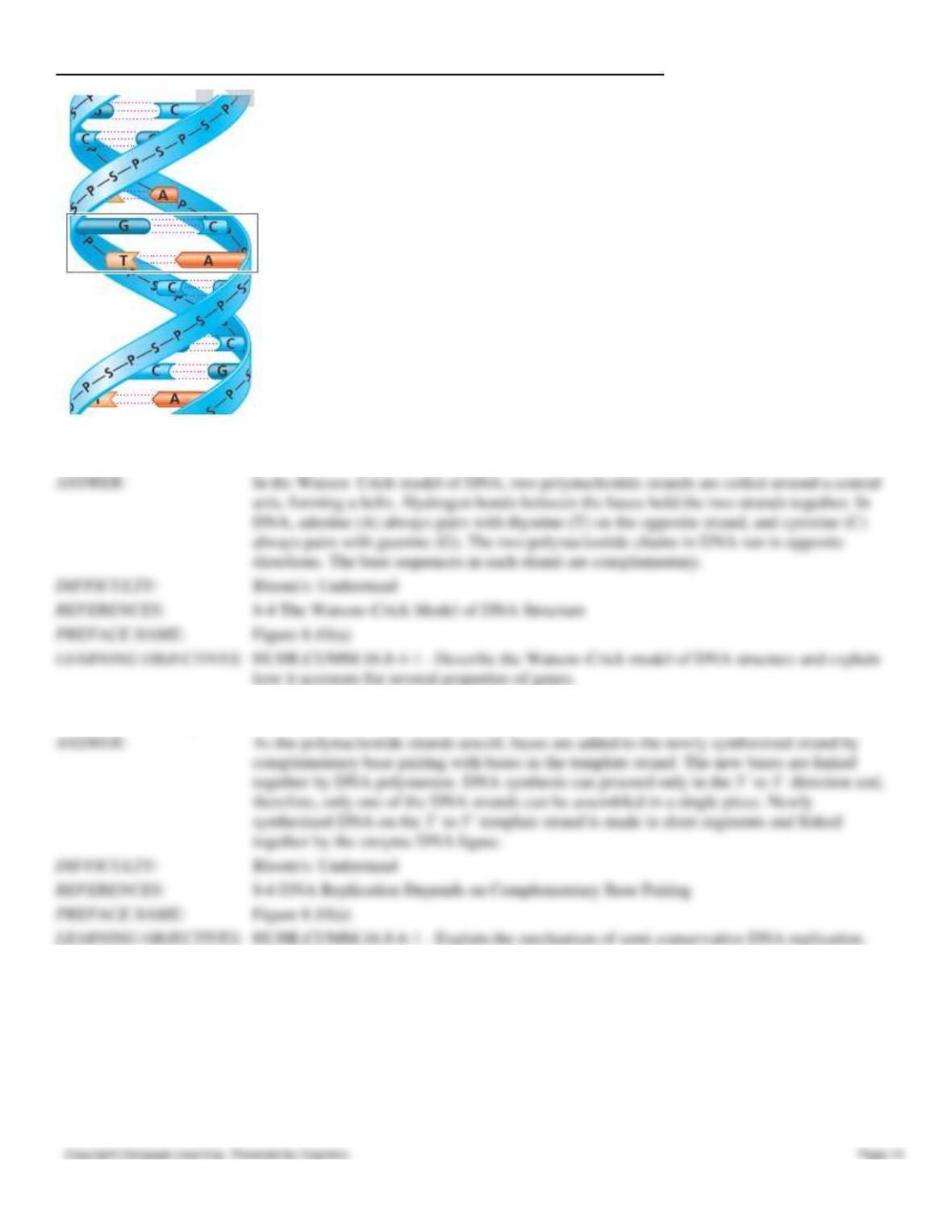
Figure 8.10(a)
59. Describe the structure of DNA using the accompanying figure as a reference.
60. Summarize the process of DNA replication and outline the difference between how each strand replicates.