CHAPTER 8—FINANCIAL OPTIONS AND APPLICATIONS IN CORPORATE
FINANCE
TRUE/FALSE
1. An option is a contract that gives its holder the right to buy or sell an asset at a predetermined price
within a specified period of time.
2. The strike price is the price that must be paid for a share of common stock when it is bought by
exercising a warrant.
3. The exercise value is the positive difference between the current price of the stock and the strike price.
The exercise value is zero if the stock’s price is below the strike price.
4. The exercise value is also called the strike price, but this term is generally used when discussing
convertibles rather than financial options.
5. As the price of a stock rises above the strike price, the value investors are willing to pay for a call
option increases because both (1) the immediate capital gain that can be realized by exercising the
option and (2) the likely exercise value of the option when it expires have both increased.
6. If the current price of a stock is below the strike price, then an option to buy the stock is worthless and
will have a zero value.
7. If the market is in equilibrium, then an option must sell at a price that is exactly equal to the difference
between the stock’s current price and the option’s strike price.
8. Since investors tend to dislike risk and like certainty, the more volatile a stock, the less valuable will
be an option to purchase the stock, other things held constant.
9. Because of the time value of money, the longer before an option expires, the less valuable the option
will be, other things held constant.
10. If we define the “premium” on an option to be the difference between the price at which an option sells
and the exercise value (or the difference between the stock’s current market price and the strike price),
then we would expect the premium to increase as the stock price increases, other things held constant.
11. Because of the put-call parity relationship, under equilibrium conditions a put option on a stock must
sell at exactly the same price as a call option on the stock, provided the strike prices for the put and
call are the same.
12. If a company announces a change in its dividend policy from a zero target payout ratio to a 100%
payout policy, this action could be expected to increase the value of long-term options (say 5-year
options) on the firm’s stock.
MULTIPLE CHOICE
13. An option that gives the holder the right to sell a stock at a specified price at some future time is
a.
a put option.
b.
an out-of-the-money option.
c.
a naked option.
d.
a covered option.
e.
a call option.
14. Other things held constant, the value of an option depends on the stock’s price, the risk-free rate, and
the
a.
Variability of the stock price.
b.
Option’s time to maturity.
c.
Strike price.
d.
All of the above.
e.
None of the above.
15. Which of the following statements is most correct, holding other things constant, for XYZ
Corporation’s traded call options?
a.
The higher the strike price on XYZ’s options, the higher the option’s price will be.
b.
Assuming the same strike price, an XYZ call option that expires in one month will sell at a
higher price than one that expires in three months.
c.
If XYZ’s stock price stabilizes (becomes less volatile), then the price of its options will
increase.
d.
If XYZ pays a dividend, then its option holders will not receive a cash payment, but the
strike price of the option will be reduced by the amount of the dividend.
e.
The price of these call options is likely to rise if XYZ’s stock price rises.
16. BLW Corporation is considering the terms to be set on the options it plans to issue to its executives.
Which of the following actions would decrease the value of the options, other things held constant?
a.
The exercise price of the option is increased.
b.
The life of the option is increased, i.e., the time until it expires is lengthened.
c.
The Federal Reserve takes actions that increase the risk-free rate.
d.
BLW’s stock price becomes more risky (higher variance).
e.
BLW’s stock price suddenly increases.
17. Which of the following statements is CORRECT?
a.
Call options give investors the right to sell a stock at a certain strike price before a
specified date.
b.
Options typically sell for less than their exercise value.
c.
LEAPS are very short-term options that were created relatively recently and now trade in
the market.
d.
An option holder is not entitled to receive dividends unless he or she exercises their option
before the stock goes ex dividend.
e.
Put options give investors the right to buy a stock at a certain strike price before a
specified date.
18. An investor who writes standard call options against stock held in his or her portfolio is said to be
selling what type of options?
a.
Put
b.
Naked
c.
Covered
d.
Out-of-the-money
e.
In-the-money
19. Cazden Motors’ stock is trading at $30 a share. Call options on the company’s stock are also available,
some with a strike price of $25 and some with a strike price of $35. Both options expire in three
months. Which of the following best describes the value of these options?
a.
The options with the $25 strike price will sell for less than the options with the $35 strike
price.
b.
The options with the $25 strike price have an exercise value greater than $5.
c.
The options with the $35 strike price have an exercise value greater than $0.
d.
If Cazden’s stock price rose by $5, the exercise value of the options with the $25 strike
price would also increase by $5.
e.
The options with the $25 strike price will sell for $5.
20. Braddock Construction Co.’s stock is trading at $20 a share. Call options that expire in three months
with a strike price of $20 sell for $1.50. Which of the following will occur if the stock price increases
10%, to $22 a share?
a.
The price of the call option will increase by more than $2.
b.
The price of the call option will increase by less than $2, and the percentage increase in
price will be less than 10%.
c.
The price of the call option will increase by less than $2, but the percentage increase in
price will be more than 10%.
d.
The price of the call option will increase by more than $2, but the percentage increase in
price will be less than 10%.
e.
The price of the call option will increase by $2.
21. Which of the following statements is CORRECT?
a.
Call options generally sell at a price greater than their exercise value, and the greater the
exercise value, the higher the premium on the option is likely to be.
b.
Call options generally sell at a price below their exercise value, and the greater the
exercise value, the lower the premium on the option is likely to be.
c.
Call options generally sell at a price below their exercise value, and the lower the exercise
value, the lower the premium on the option is likely to be.
d.
Because of the put-call parity relationship, under equilibrium conditions a put option on a
stock must sell at exactly the same price as a call option on the stock.
e.
If the underlying stock does not pay a dividend, it does not make good economic sense to
exercise a call option prior to its expiration date, even if this would yield an immediate
profit.
22. Which of the following statements is CORRECT?
a.
Call options generally sell at a price less than their exercise value.
b.
If a stock becomes riskier (more volatile), call options on the stock are likely to decline in
value.
c.
Call options generally sell at prices above their exercise value, but for an in-the-money
option, the greater the exercise value in relation to the strike price, the lower the premium
on the option is likely to be.
d.
Because of the put-call parity relationship, under equilibrium conditions a put option on a
stock must sell at exactly the same price as a call option on the stock.
e.
If the underlying stock does not pay a dividend, it makes good economic sense to exercise
a call option as soon as the stock’s price exceeds the strike price by about 10%, because
this permits the option holder to lock in an immediate profit.
23. Which of the following statements is CORRECT?
a.
As the stock’s price rises, the time value portion of an option on a stock increases because
the difference between the price of the stock and the fixed strike price increases.
b.
Issuing options provides companies with a low cost method of raising capital.
c.
The market value of an option depends in part on the option’s time to maturity and also on
the variability of the underlying stock’s price.
d.
The potential loss on an option decreases as the option sells at higher and higher prices
because the profit margin gets bigger.
e.
An option’s value is determined by its exercise value, which is the market price of the
stock less its striking price. Thus, an option can’t sell for more than its exercise value.
24. Suppose you believe that Basso Inc.’s stock price is going to increase from its current level of $22.50
sometime during the next 5 months. For $3.10 you can buy a 5-month call option giving you the right
to buy 1 share at a price of $25 per share. If you buy this option for $3.10 and Basso’s stock price
actually rises to $45, what would your pre-tax net profit be?
a.
−$3.10
b.
$16.90
c.
$17.75
d.
$22.50
e.
$25.60
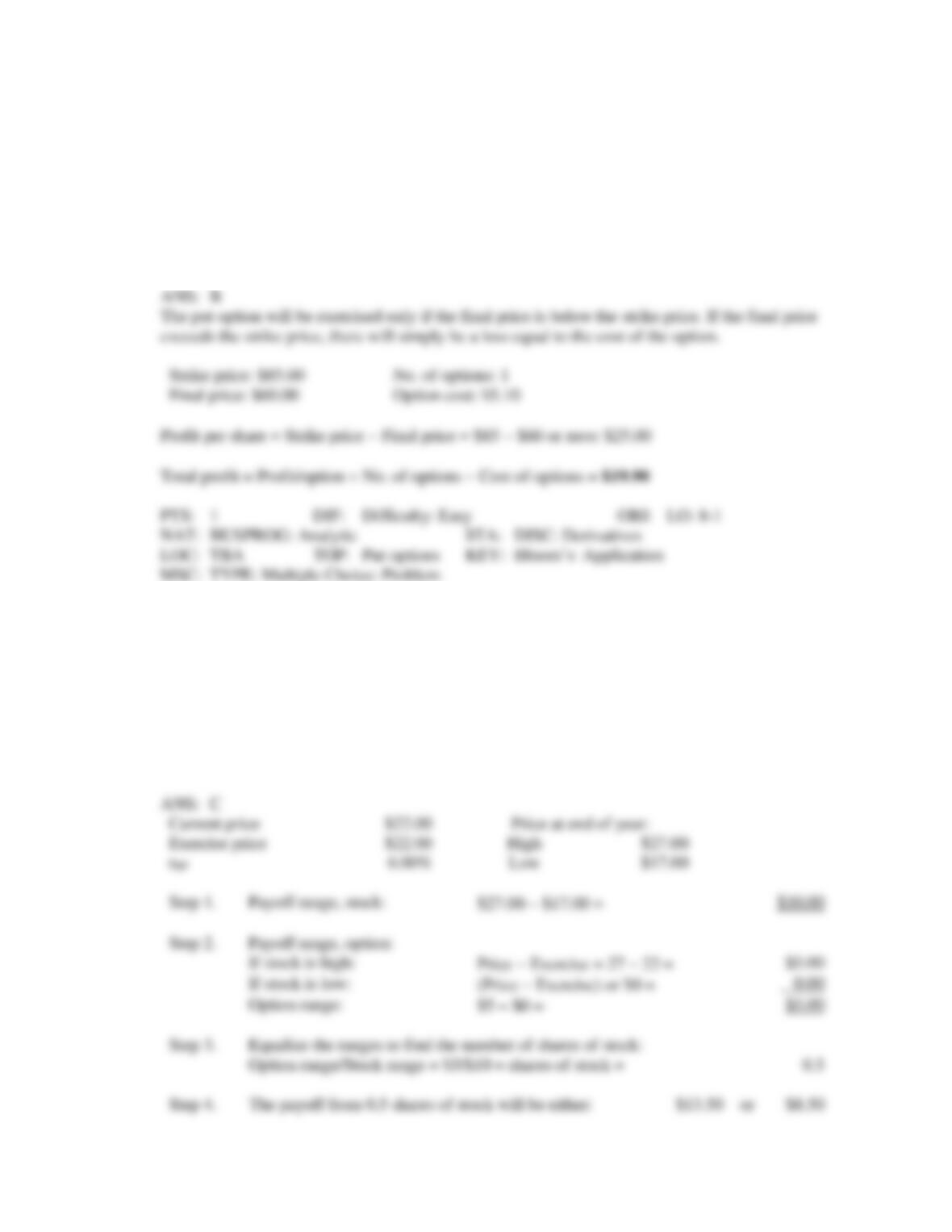
25. Suppose you believe that Florio Company’s stock price is going to decline from its current level of
$82.50 sometime during the next 5 months. For $5.10 you could buy a 5-month put option giving you
the right to sell 1 share at a price of $85 per share. If you bought this option for $5.10 and Florio’s
stock price actually dropped to $60, what would your pre-tax net profit be?
a.
−$5.10
b.
$19.90
c.
$20.90
d.
$22.50
e.
$27.60
26. The current price of a stock is $22, and at the end of one year its price will be either $27 or $17. The
annual risk-free rate is 6.0%, based on daily compounding. A 1-year call option on the stock, with an
exercise price of $22, is available. Based on the binomial model, what is the option‘s value? (Hint: Use
daily compounding.)
a.
$2.43
b.
$2.70
c.
$2.99
d.
$3.29
e.
$3.62
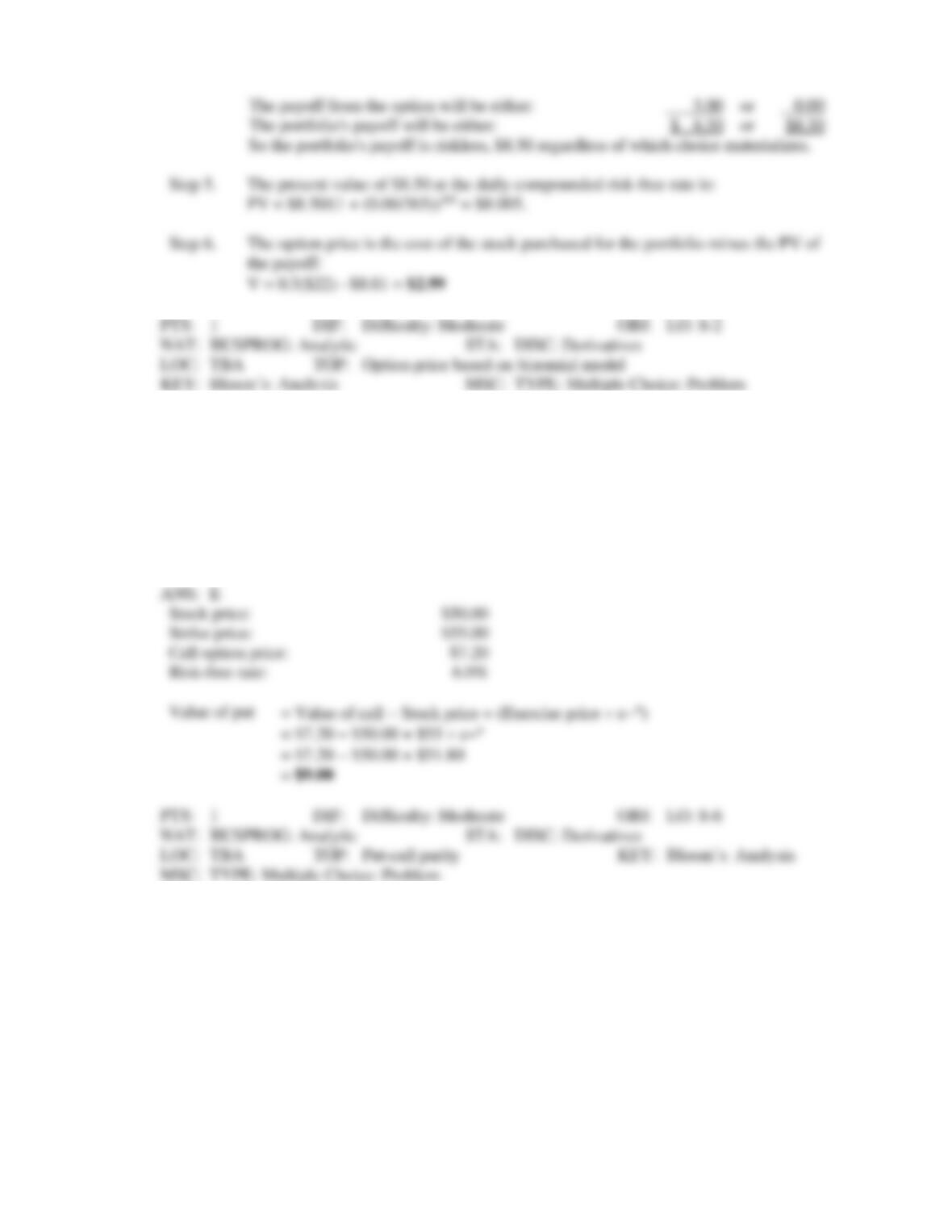
27. The current price of a stock is $50, the annual risk-free rate is 6%, and a 1-year call option with a
strike price of $55 sells for $7.20. What is the value of a put option, assuming the same strike price and
expiration date as for the call option?
a.
$7.33
b.
$7.71
c.
$8.12
d.
$8.55
e.
$9.00
Value of put
28. An analyst wants to use the Black-Scholes model to value call options on the stock of Heath
Corporation based on the following data:
•
The price of the stock is $40.
•
The strike price of the option is $40.
•
The option matures in 3 months (t = 0.25).
•
The standard deviation of the stock’s returns is 0.40, and the variance is 0.16.
•
The risk-free rate is 6%.
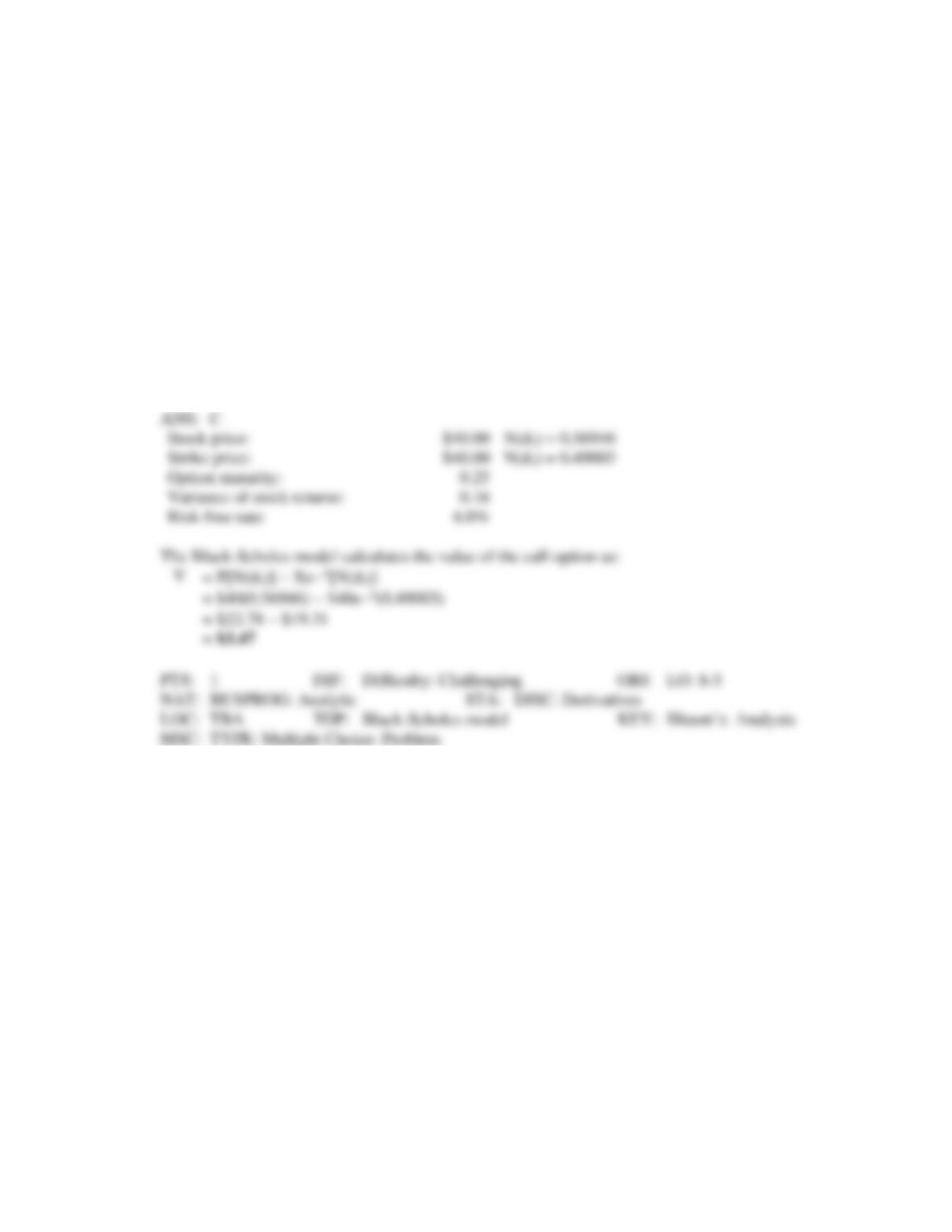
Given this information, the analyst then calculated the following necessary components of the Black-
Scholes model:
•
d1 = 0.175
•
d2 = −0.025
•
N(d1) = 0.56946
•
N(d2) = 0.49003
N(d1) and N(d2) represent areas under a standard normal distribution function. Using the Black-
Scholes model, what is the value of the call option?
a.
$2.81
b.
$3.12
c.
$3.47
d.
$3.82
e.
$4.20