
Exam
Name___________________________________
MULTIPLE CHOICE. Choose the one alternative that best completes the statement or answers the question.
1)
Why do astronomers believe that Triton is a captured moon?
1)
A)
Triton orbits Neptune in a direction opposite that of Neptune’s rotation.
B)
Triton is very small and potato–shaped, which is common of captured moons.
C)
Triton appears to be made mostly of ice.
D)
Triton is too large to have been formed in the “miniature solar nebula” thought to have
surrounded Neptune in its very early history.
2)
According to current understanding, which of the following is required in order for a planet to
have rings?
2)
A)
The planet must be at least as massive as Saturn.
B)
The planet must have many small moons that orbit relatively close to the planet in its
equatorial plane.
C)
The planet must orbit its star at a distance greater than Mars orbits the Sun.
D)
The planet must once have had a large moon that came too close to it, shattering the moon
and creating the ring particles.
3)
How does the strength of Jupiter’s magnetic field compare to that of Earth’s magnetic field?
3)
A)
Jupiter’s magnetic field strength is about the same as Earth’s.
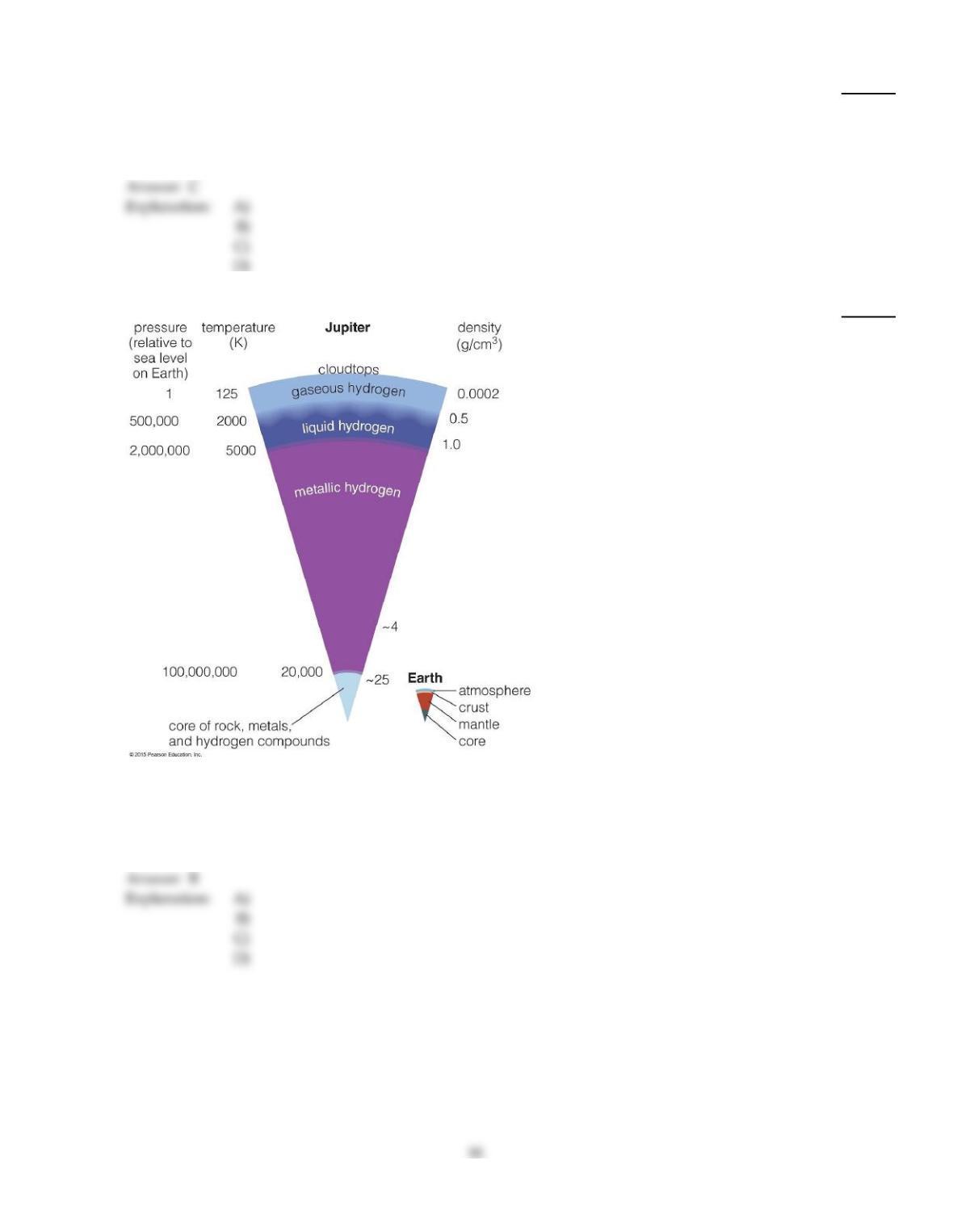
B)
Jupiter’s magnetic field is about twice as strong as Earth’s.
C)
Jupiter’s magnetic field is much weaker than Earth’s.
D)
Jupiter‘s magnetic field is about 20,000 times as strong as Earth’s.
4)
Which of the following gases is not a significant ingredient of the jovian planet atmospheres?
4)
A)
carbon dioxide
B)
helium
C)
hydrogen
D)
water

5)
How do the jovian planet interiors differ?
5)
A)
The core mass decreases with the mass of the planet.
B)
The composition changes from mostly hydrogen in Jupiter and Saturn to mostly helium in
Uranus and Neptune.
C)
The composition changes from mostly ammonia in Jupiter and Saturn to mostly methane in
Uranus and Neptune.
D)
All have cores of about the same mass, but differ in the amount of surrounding hydrogen and
helium.
E)
All have about the same amount of hydrogen and helium but the proportion of rocks is
greater in those planets closer to the Sun.
6)
Which of the jovian planets has/have rings?
6)
A)
Saturn
B)
Neptune
C)
Jupiter
D)
Uranus
E)
all of the above
7)
Which of the following best explains why many jovian moons have been more geologically active
than the Moon or Mercury?
7)
A)
Because of their greater distances from the Sun, the jovian moons receive much less heat from
the Sun.
B)
The jovian moons probably have far more internal heat generated by radioactive decay than
do the Moon or Mercury.
C)
Jovian moons are made mostly of ice that can melt or deform at lower temperatures than can
the rock and metal that make up the Moon and Mercury.
D)
The jovian moons are considerably larger than the Moon and Mercury and therefore have
retained much more internal heat.

8)
Which of the following is not due to tidal forces?
8)
A)
the volcanos on Io (a moon of Jupiter)
B)
the grooved terrain of Enceladus (a moon of Saturn)
C)
the rings of Saturn
D)
the retrograde orbit of Triton (a moon of Neptune)
E)
the synchronous rotation of the Moon around Earth
9)
Which moon has a thick atmosphere made mostly of nitrogen?
9)
A)
Titan
B)
Europa
C)
Triton
D)
Ganymede
10)
Which statement about planetary rings is not true?
10)
A)
Individual ring particles orbit their planet in accord with Kepler’s laws, so that particles closer
in orbit faster than particles farther out.
B)
All four jovian planets have rings.
C)
Rings are always located closer to a planet’s surface than any large moons.
D)
Saturn’s rings formed along with its moons 4.6 billion years ago.
11)
Uranus and Neptune have methane clouds but Jupiter and Saturn do not. Which factor explains
why?
11)
A)
Temperatures on Jupiter and Saturn are too high for methane to condense.
B)
The rapid rotation of Jupiter and Saturn prevents methane clouds from forming.
C)
The stronger gravity on Jupiter and Saturn pulls methane downward so that it can‘t form
clouds.
D)
Jupiter and Saturn do not contain any methane gas.
12)
Why does Jupiter have three distinct layers of clouds?
12)
A)
Jupiter has three different types of wind, each of which makes a different type of cloud.
B)
Clouds form randomly, so on average there are always three layers.
C)
The three layers represent clouds made of gases that condense at different temperatures.
D)
The three layers reflect regions of Jupiter’s atmosphere with different overall chemical
compositions.
13)
Why are Saturn’s rings so thin?
13)
A)
Solar radiation pressure keeps particles pressed into the rings.
B)
Any particle in the ring with an orbital tilt would collide with other ring particles, flattening
its orbit.
C)
Saturn’s gravity prevents particles from migrating upwards out of the rings.
D)
The current thinness is a short–lived phenomenon that is special to this time.
E)
The “gap” moons shepherd the particles and maintain its thin profile.
B
14)
According to our theory of solar system formation, why did Uranus and Neptune end up to be
much less massive than Jupiter and Saturn?
14)
A)
Ices were able to condense at the distance of Jupiter and Saturn, but only rock and metal
could condense at the distances of Uranus and Neptune.
B)
Particles in the solar nebula were more spread out at greater distances, so that accretion took
longer and there was less time to pull in gas before the solar wind cleared the nebula.
C)
The colder gas in the outer regions of the solar nebula had less gravity and therefore could not
gather up into such large balls as it could closer in.
D)
The size differences are thought to be a random coincidence.
B
C
15)
Which of the following best describes the composition of the particles forming Saturn’s rings?
15)
A)
water ice
B)
methane ice
C)
volcanic rock
D)
metallic grains
E)
hydrogen and helium
16)
What is the most abundant gas in Titan’s atmosphere?
16)
A)
oxygen
B)
hydrogen compounds
C)
argon
D)
methane
E)
nitrogen
E
17)
Which of the following is most unlikely to be found on Titan?
17)
A)
volcanic outgassing of methane and other gases
B)
rain or snow consisting of methane or ethane droplets or ice crystals
C)
lakes of liquid methane ethane
D)
lakes of liquid water in the warmer equatorial regions
D
18)
Which of the following statements about the moons of the jovian planets is not true?
18)
A)
Many of the moons are made largely of ices.
B)
Most of the moons are large enough to be spherical in shape, but a few have the more
potato–like shapes of asteroids.
C)
One of the moons has a thick atmosphere.
D)
Some of the moons are big enough that we’d call them planets (or dwarf planets) if they
orbited the Sun.
B
A

19)
The large Jovian satellites have sizes comparable to Mercury. Why do they have an icy composition
compared to Mercury’s rocky composition?
19)
A)
They are captured comets.
B)
They formed beyond the frost line, where ices were three to four times more abundant than
metals and rock.
C)
They formed from hydrogen compounds expelled by the Jovian planets.
D)
They experienced many more cometary impacts during the Late Heavy Bombardment.
20)
Why are there no impact craters on the surface of Io?
20)
A)
Io did have impact craters, but they have all been buried in lava flows.
B)
Any craters that existed have been eroded through the strong winds on Io’s surface.
C)
It is too small to have been bombarded by planetesimals in the early solar system.
D)
Jupiter’s strong gravity attracted the planetesimals more strongly than Io, and thus none
landed on its surface.
E)
Io’s thick atmosphere obscures the view of the craters.
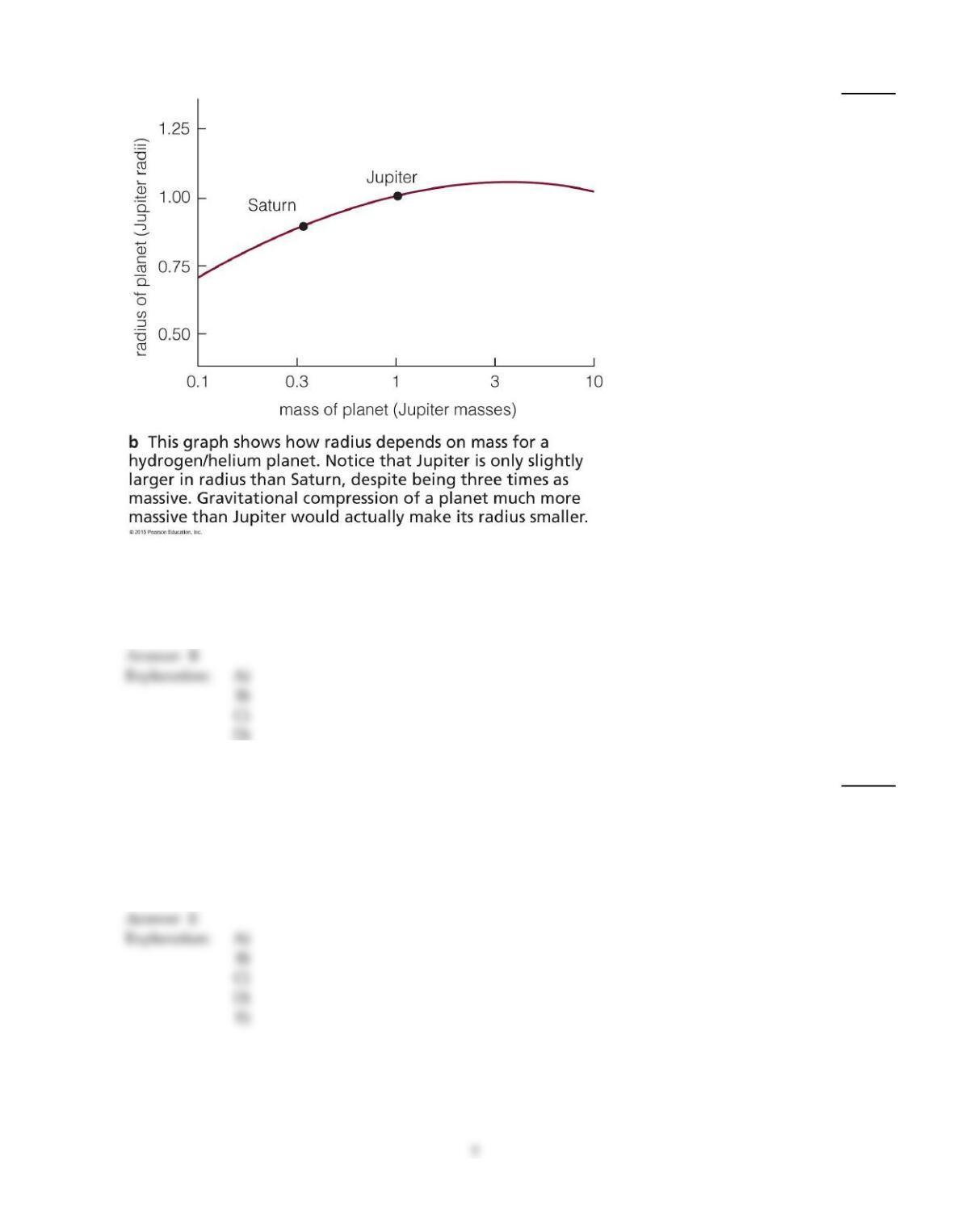
21)
What would be the approximate radius of a hydrogen/helium planet with a mass one–tenth that of
Jupiter?
21)
A)
about 1 time the radius of Jupiter
B)
about 0.7 times the radius of Jupiter
C)
about 0.5 times the radius of Jupiter
D)
about 0.9 times the radius of Jupiter
22)
What is the most important reason why an icy moon is more likely to be geologically active than a
rocky moon of the same size?
22)
A)
Ice contains more radioactive elements than rock.
B)
Ice is less dense than rock.
C)
Ice is less rigid than rock.
D)
Ice is affected by tidal forces to a greater extent than rock.
E)
Ice has a lower melting point than rock.

23)
Jupiter and the other jovian planets are sometimes called “gas giants.” In what sense is this term
misleading?
23)
A)
They are not in any sense “giants.”
B)
They actually contain relatively little material in a gaseous state.
C)
Actually, it’s a great description, because these worlds are big and gaseous throughout.
D)
The materials they are made of are not the kinds of thing we usually think of as gases.
24)
Overall, Jupiter’s composition is most like that of ________.
24)
A)
Earth
B)
an asteroid
C)
a comet
D)
the Sun
25)
What is the Cassini division of Saturn‘s rings?
25)
A)
the imaginary circle marking the halfway point of Saturn’s rings
B)
a large gap, visible from Earth, produced by an orbital resonance with the moon Mimas
C)
the widest ring of Saturn, located between two large ring gaps
D)
a dark ring, visible from Earth, composed of dark, dusty particles
E)
the most opaque ring of Saturn, made of highly reflective ice particles
26)
Which of the following best explains why we see horizontal “stripes” in photographs of Jupiter and
Saturn?
26)
A)
There are three different color stripes corresponding to the three different types of clouds
found on these planets.
B)
Dark stripes are those in which there is a stratosphere and light stripes are those with no
stratosphere.
C)
The dark and light stripes correspond to alternating bands of different chemical composition.
D)
The light stripes are regions of high clouds, and the dark stripes are regions where we can see
down to deeper, darker clouds.

27)
Jupiter’s colors come in part from its three layers of clouds. Which of the following is not the
primary constituent of one of Jupiter’s cloud layers?
27)
A)
clouds of ammonia
B)
clouds of water
C)
clouds of sulfuric acid
D)
clouds of ammonium hydrosulfide
28)
How do typical wind speeds in Jupiter’s atmosphere compare to typical wind speeds on Earth?
28)
A)
They are slightly slower than average winds on Earth.
B)
They are about the same as average winds on Earth.
C)
They are slightly faster than average winds on Earth.
D)
They are much faster than hurricane winds on Earth.
29)
Which moon did the Huygens spacecraft land on?
29)
A)
Europa
B)
Titan
C)
Ganymede
D)
Callisto
E)
Triton
30)
What atmospheric constituent is responsible for the blue color of Uranus and Neptune?
30)
A)
water
B)
methane
C)
ammonia
D)
hydrogen
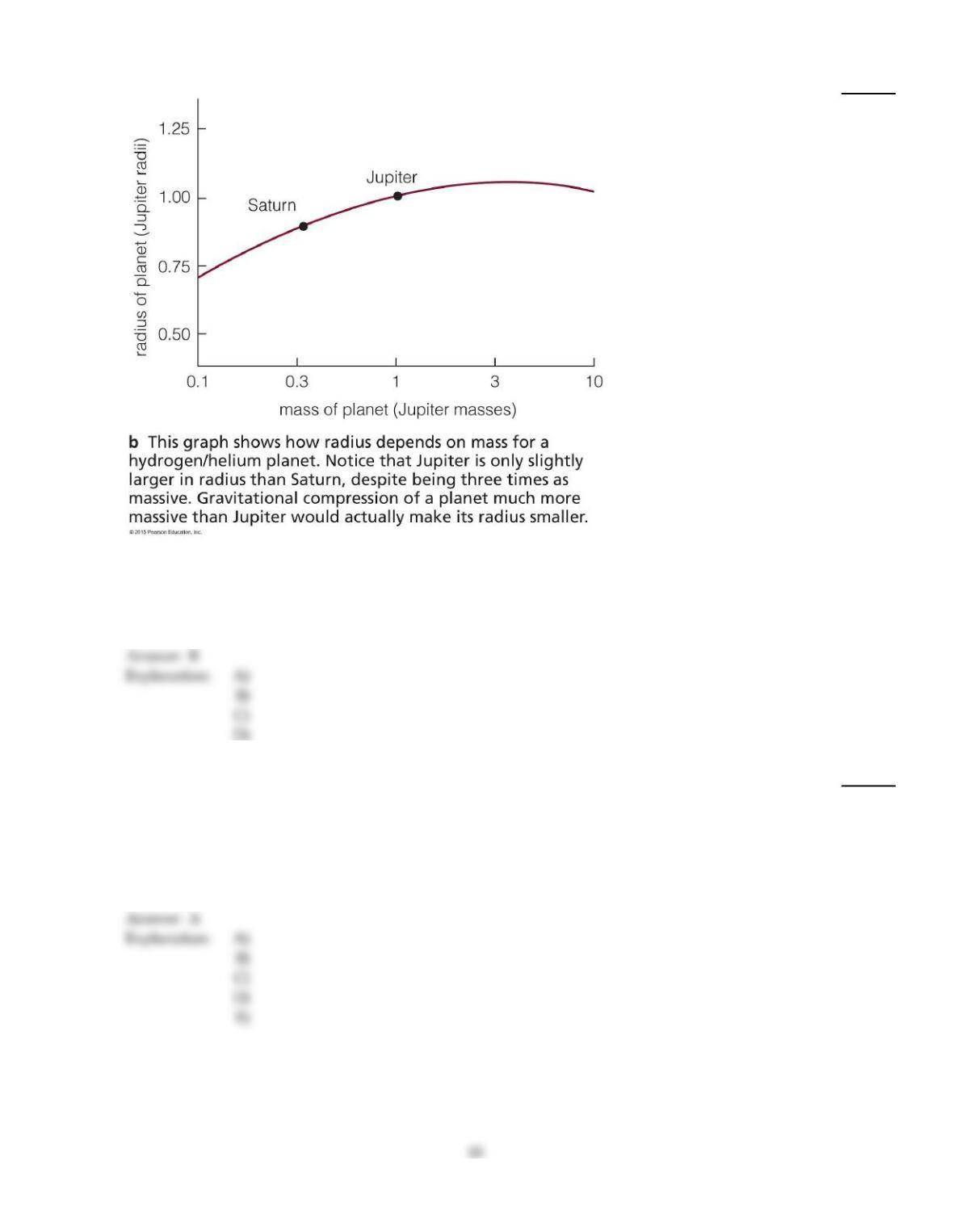
31)
If a planet is found with a radius 5% greater than Jupiter, which is the best first estimate of that
planet’s mass?
31)
A)
about 10 times Jupiter’s mass
B)
about 3 times Jupiter’s mass
C)
about 0.3 times Jupiter’s mass
D)
about 1 times Jupiter’s mass
32)
Why is Saturn almost as big as Jupiter, despite its smaller mass?
32)
A)
Jupiter’s greater mass compresses it more and increases its density.
B)
Saturn has a larger proportion of hydrogen and helium than Jupiter, and is therefore less
dense.
C)
Jupiter‘s strong magnetic field constrains its size.
D)
Saturn’s rings make the planet look bigger.
E)
Saturn is further from the Sun, thus cooler, and therefore less compact.
A
B

33)
Why is Neptune denser than Saturn?
33)
A)
Its hydrogen is molecular, whereas Saturn’s hydrogen is atomic.
B)
The extra mass of Neptune compresses its interior to a greater extent than that of Saturn.
C)
It has a different composition than Saturn, including a higher proportion of hydrogen
compounds and rocks.
D)
It has a greater proportion of hydrogen than Saturn.
E)
It is not denser than Saturn.
34)
How many more times is the atmospheric pressure in Jupiter’s core greater than the atmospheric
pressure at Earth’s surface?
34)
A)
100 million
B)
10 million
C)
10 thousand
D)
100 thousand
E)
1 million
35)
The Huygens probe took numerous pictures as it descended to Titan’s surface in 2005. What did the
pictures show?
35)
A)
primitive life forms
B)
lava flows of molten basalt
C)
features of erosion, including what appeared to be dry river valleys and lakebeds
D)
a densely cratered surface
36)
Planetary rings are
36)
A)
composed of a large number of individual particles that orbit their planet in accord with
Kepler’s third law.
B)
known to exist for all of the jovian planets.
C)
orbiting in the equatorial plane of their planet.
D)
all of the above

37)
Where is Jupiter’s strong magnetic field generated?
37)
A)
gaseous hydrogen layer
B)
metallic hydrogen layer
C)
liquid hydrogen layer
D)
cloud tops
E)
rocky core
38)
If Jupiter were scaled to the size of a basketball, Earth would be the closest to the size of
38)
A)
a grapefruit.
B)
a baseball.
C)
a basketball.
D)
a pinhead.
E)
a marble.
39)
Which of the following is not a general characteristic of the four jovian planets in our solar system?
39)
A)
They are much more massive than any of the terrestrial planets.
B)
They lack solid surfaces.
C)
They are composed mainly of hydrogen, helium, and hydrogen compounds.
D)
They are higher in average density than are the terrestrial planets.
40)
Which of the following statements about Titan is not true?
40)
A)
Its surface is hidden from view by its thick atmosphere.
B)
It may have an ocean of liquid ethane.
C)
It is the coldest moon in the solar system.
D)
Its temperature is too cold for liquid water to exist.
E)
Its atmosphere is mostly nitrogen.

41)
Why is Jupiter denser than Saturn?
41)
A)
The extra mass of Jupiter compresses its interior to a greater extent than that of Saturn.
B)
It is made of a different composition than Saturn, including a higher proportion of hydrogen
compounds and rocks.
C)
It has a greater proportion of helium to hydrogen compared to Saturn.
D)
Its core is much larger than Saturn’s.
E)
Scientists do not know why this is so.
42)
Which large jovian moon is thought to have been captured into its present orbit?
42)
A)
Io
B)
Callisto
C)
Titan
D)
Triton
43)
Why do the jovian planet interiors differ?
43)
A)
The more distant planets had longer to form than the closer planets, since the solar nebula
lasted longer at greater distances from the Sun.
B)
The more distant planets formed in a cooler region of the solar nebula and therefore contain a
greater proportion of ices than the closer jovian planets.
C)
They differ due to giant impacts at the late stages of planet formation.
D)
Accretion took longer further from the Sun, so the more distant planets formed their cores
later and captured less gas from the solar nebula than the closer jovian planets.
44)
What kind of observations can astronomers use to study Io’s volcanoes?
44)
A)
spectroscopy to determine the composition of the plumes
B)
visible–light images to study plumes using reflected sunlight
C)
infrared images to study warm plumes on Io’s night–side
D)
visible–light images to study the distribution of sulfur compounds on its surface
E)
all of the above

45)
How do astronomers think Jupiter generates its internal heat?
45)
A)
internal friction due to its high rotation rate
B)
by contracting, changing gravitational potential energy into thermal energy
C)
nuclear fusion in the core
D)
radioactive decay
E)
chemical processes
46)
Why is the radiation so intense in the region that traces Io‘s orbit around Jupiter (the Io torus)?
46)
A)
The region is full of gases that become ionized after they are released from volcanoes on Io.
B)
Jupiter’s strong magnetic field makes the radiation intense everywhere, and the region
around Io is no different than any other region.
C)
Io’s gravity allows this region to capture huge numbers of charged particles from the solar
wind.
D)
An orbital resonance between Io, Europa, and Ganymede makes the radiation intense.
47)
Which of the following is not a piece of evidence supporting the idea that Europa may have a
subsurface ocean?
47)
A)
Europa’s surface shows very few impact craters.
B)
Photos of Europa’s surface show regions that appear to consist of jumbled icebergs frozen in
place.
C)
Astronomers have detected small lakes of liquid water on Europa’s surface.
D)
Europa has a magnetic field that appears to respond to Jupiter’s magnetic field.
48)
How do the size and mass of Jupiter’s core compare to the size and mass of Earth?
48)
A)
It is about the same size but is 10 times more massive.
B)
It is about 10 times larger in size and the same mass.
C)
It is the same size and mass.
D)
It is about 10 times larger both in size and mass.
E)
Jupiter doesn’t have a coreit is made entirely from hydrogen and helium.

49)
Which statement about Io is true?
49)
A)
It is the largest moon in the solar system.
B)
It is the only moon in the solar system with a thick atmosphere.
C)
It is the most volcanically active body in our solar system.
D)
It is thought to have a deep, subsurface ocean of liquid water.
50)
What would happen to Jupiter if we could somehow double its mass?
50)
A)
It would become a star, with nuclear fusion in its core.
B)
Its density would increase, but its diameter would barely change.
C)
Its density would decrease, and its diameter would double.
D)
Its density would stay about the same, and its volume would double.
B
51)
Which jovian planet should have the most extreme seasonal changes?
51)
A)
Neptune
B)
Jupiter
C)
Uranus
D)
Saturn
C
52)
All the following statements are true. Which one is most important in explaining the tremendous
tidal heating that occurs on Io?
52)
A)
Io orbits Jupiter on an elliptical orbit, due to orbital resonances with other satellites.
B)
Io exhibits synchronous rotation, meaning that its rotation period and orbital period are the
same.
C)
Io orbits Jupiter in the Io torus, and therefore has a surface that is bombarded by many
charged particles.
D)
Io is the closest to Jupiter of Jupiter’s large moons.
A
C
53)
What is the Great Red Spot?
53)
A)
a region on Jupiter where the temperature is so high that the gas glows with red visible light
B)
a place where reddish particles from Io impact Jupiter’s surface
C)
a long–lived, high–pressure storm on Jupiter
D)
a hurricane that comes and goes on Jupiter
54)
The Galileo spacecraft dropped a probe into Jupiter’s atmosphere that survived 200 km, or 0.3% of
Jupiter’s radius. Which is the deepest layer that this probe was able to directly sample?
54)
A)
liquid hydrogen layer
B)
gaseous hydrogen layer
C)
metallic hydrogen layer
D)
rocky core
B
C

55)
Which moon is considered likely to have a deep, subsurface ocean of liquid water?
55)
A)
Io
B)
Europa
C)
Miranda
D)
Triton
56)
Why does Jupiter have several distinct cloud layers?
56)
A)
Different gases are present at different altitudes in Jupiter‘s atmosphere.
B)
Different layers represent clouds made of gases that condense at different temperatures.
C)
Different layers represent the various regions where the temperature is cool enough for liquid
water to condense.
D)
Winds prevent clouds from forming at some altitudes, so we see clouds only at the other
altitudes.
E)
Clouds form randomly, so on average there are always several layers.
57)
Which of the following statements comparing the jovian interiors is not thought to be true?
57)
A)
They all have the same exact set of internal layers, though these layers differ in size.
B)
Deep inside them, they all have pressures far higher than that found on the bottom of the
ocean on Earth.
C)
They all have cores of roughly the same mass.
D)
They all have cores that contain at least some rock and metal.
58)
How thick are Saturn’s rings from top to bottom?
58)
A)
a few tens of thousands of kilometers
B)
a few hundred kilometers
C)
a few kilometers
D)
a few tens of meters
E)
a few million kilometers

59)
Why do Uranus and Neptune appear blue?
59)
A)
Small dust grains preferentially scatter blue light.
B)
Gas molecules in their atmosphere preferentially scatter blue light.
C)
Methane gas absorbs all colors except blue.
D)
Methane snowflakes absorb all colors except blue, which they reflect.
60)
Which statement about Saturn’s rings is not true?
60)
A)
The large gap known as the Cassini Division is shaped by an orbital resonance with the moon
Mimas, which orbits well outside the rings.
B)
The rings are so thin that they essentially disappear from view when seen edge–on.
C)
The rings must look much the same today as they did shortly after Saturn formed.
D)
Some features of the rings are shaped by small moons that actually orbit within the ring
system.
61)
Suppose you could float in space just a few meters above Saturn’s rings. What would you see as
you looked down on the rings?
61)
A)
dozens of large “moonlets” made of metal and rock, each a few kilometers across
B)
countless icy particles, ranging in size from dust grains to large boulders
C)
a solid, shiny surface, looking much like a piece of a DVD but a lot bigger
D)
Nothing–up close; the rings would be so completely invisible that you’d have no way to know
they are there. They can be seen only from a distance.
62)
Which of the following best describes the internal layering of Jupiter, from the center outward?
62)
A)
solid rock core; layer of solid metallic hydrogen; layer of pure liquid hydrogen; cloud layer
B)
core of rock and metal; mantle of lower density rock; upper layer of gaseous hydrogen; cloud
layer
C)
core of rock, metal, and hydrogen compounds; thick layer of metallic hydrogen; layer of
liquid hydrogen; layer of gaseous hydrogen; cloud layer
D)
liquid core of hydrogen compounds; liquid hydrogen layer; metallic hydrogen layer; gaseous
hydrogen layer; cloud layer
63)
What did the Huygens probe photograph as it landed on Titan?
63)
A)
dry, featureless plains
B)
a water world of frozen ice sheets
C)
nothing; there was zero visibility due to the methane smog
D)
hills, valleys and rivers
E)
a pockmarked surface covered with volcanos
64)
What mechanism is most responsible for generating the internal heat of Io that drives its volcanic
activity?
64)
A)
tidal heating
B)
accretion
C)
differentiation
D)
bombardment
E)
radioactive decay
SHORT ANSWER. Write the word or phrase that best completes each statement or answers the question.
65)
Explain how the resonance among Io, Europa, and Ganymede makes their orbits slightly
elliptical.
65)
66)
Describe the possible origins of Jupiter’s vibrant colors. Contrast these with the origins of
the colors of the other jovian planets.
66)
Use these choices for the following questions.
A. the most volcanically active body in the solar system
B. thought to have a deep, subsurface ocean of liquid water
C. probably a captured Kuiper Belt object
D. the target of the Huygens probe, which landed on its surface.
E. the largest moon in the solar system
67)
Which of the above applies to Triton?
67)
68)
Contrast Jupiter’s magnetosphere with that of Earth and of the other jovian planets.
68)
69)
Explain why Titan is of great interest to astronomers.
69)
Use these choices for the following questions.
A. the most volcanically active body in the solar system
B. thought to have a deep, subsurface ocean of liquid water
C. probably a captured Kuiper Belt object
D. the target of the Huygens probe, which landed on its surface.
E. the largest moon in the solar system
70)
Which of the above applies to Io?
70)
71)
How would Jupiter be different if it rotated slowly?
71)
Use these choices for the following questions.
A. the most volcanically active body in the solar system
B. thought to have a deep, subsurface ocean of liquid water
C. probably a captured Kuiper Belt object
D. the target of the Huygens probe, which landed on its surface.
E. the largest moon in the solar system
72)
Which of the above applies to Europa?
72)
73)
Why does it make sense that the jovian planets farther from the Sun have less mass?
73)
74)
The satellite Amalthea orbits Jupiter at just about the same distance in kilometers at which
Mimas orbits Saturn. Yet Mimas takes almost twice as long to orbit. What can you deduce
from this difference qualitatively? Since Jupiter and Saturn are not very different in radius,
what else can you conclude?
74)
75)
Describe some of the results from the Cassini/Huygens mission to Saturn and its moons.
75)
76)
Suppose the jovian planet atmospheres were composed 100 percent of hydrogen and
helium rather than 98 percent of hydrogen and helium. How would the atmospheres be
different in terms of color and weather?
76)
77)
What is “ice geology”? Give an example illustrating why it is important in the outer solar
system.
77)
78)
Which of the above applies to Ganymede?
78)
79)
Describe two leading scenarios for the origin of the planetary rings. What makes us think
that ring systems must be continually replenished?
79)
Use these choices for the following questions.
A. the most volcanically active body in the solar system
B. thought to have a deep, subsurface ocean of liquid water
C. probably a captured Kuiper Belt object
D. the target of the Huygens probe, which landed on its surface.
E. the largest moon in the solar system
80)
Which of the above applies to Titan?
80)
Use these choices for the following questions.
A. the most volcanically active body in the solar system
B. thought to have a deep, subsurface ocean of liquid water
C. probably a captured Kuiper Belt object
D. the target of the Huygens probe, which landed on its surface.
E. the largest moon in the solar system
81)
Why is Triton such an unusual satellite?
81)
TRUE/FALSE. Write ‘T’ if the statement is true and ‘F’ if the statement is false.
82)
Ganymede is larger than Mercury, but it is not classified as a planet because it orbits Jupiter as
opposed to the sun.
82)
83)
Hydrogen exists as a gas, liquid, and solid within Jupiter.
83)
84)
If the Jovian planets had solid surfaces, their large storms would likely dissipate faster.
84)
85)
Titan’s surface may contain lakes of liquid methane.
85)
86)
Jupiter is the only Jovian planet with large storms.
86)
87)
The water–ice particles forming Saturn’s rings are frozen together into a thin sheet that rotates
around Saturn like a solid body.
87)
88)
The mass of Saturn can be determined by applying Kepler’s 3rd Law to the motion of a single ice
particle in its rings.
88)
89)
If Jupiter were 10 times more massive, it would actually have a smaller radius.
89)
90)
Some of the moons of the jovian planets have significant atmospheres.
90)
91)
If Jupiter were 10 times more massive, it would generate nuclear fusion in its core and be a star
instead of a planet.
91)
92)
Jupiter’s Great Red Spot is a low–pressure storm, like a hurricane on Earth.
92)
93)
No spacecraft has landed on a Jovian planet moon.
93)
94)
The Huygens landing showed that the surface of Titan is as hard as a rock.
94)
ESSAY. Write your answer in the space provided or on a separate sheet of paper.
95)
Observing Galilean moons: The Galileo spacecraft launched towards Jupiter carried a small telescope (about 25 cm
diameter) for collecting visible light images. Explain why these collect images with much better spatial
resolution than even the largest Earth–bound telescopes (for example, the 10 meter Keck telescopes).
96)
Probing the Interior of Jupiter: Astronomers claim to have a reasonable model for interior structure of Jupiter.
What is the observational basis for this model? Does it make any predictions that have been put to observational
tests? How is the interior structure of the Earth known (review Chapter 7 if necessary)? Do you think the
interior structure of Jupiter is more or less well–tested than that of the interior structure of the Earth? Explain.
97)
Unification in Science: One of the true pleasures of science is to discover that two rather different phenomena are
really manifestations of the same set of physical principles. To this end, explain how the volcanoes on Io, the
subsurface ocean on Europa, and the gaps in Saturn’s rings reflect the operation of the same physical principle.
98)
Io’s Volcanoes Predicted? The intense volcanic activity on Io came as somewhat of a surprise to many when it was
discovered by the Voyager mission in 1979. Nevertheless, argue that all of the elements where in place to make
a prediction of intense volcanic activity on Io before the Voyager mission. Search on the web for the history of Io’s
volcanism to see if such a prediction was actually made.

Answer Key
Testname: C8
Answer Key
Testname: C8
26
Answer Key
Testname: C8