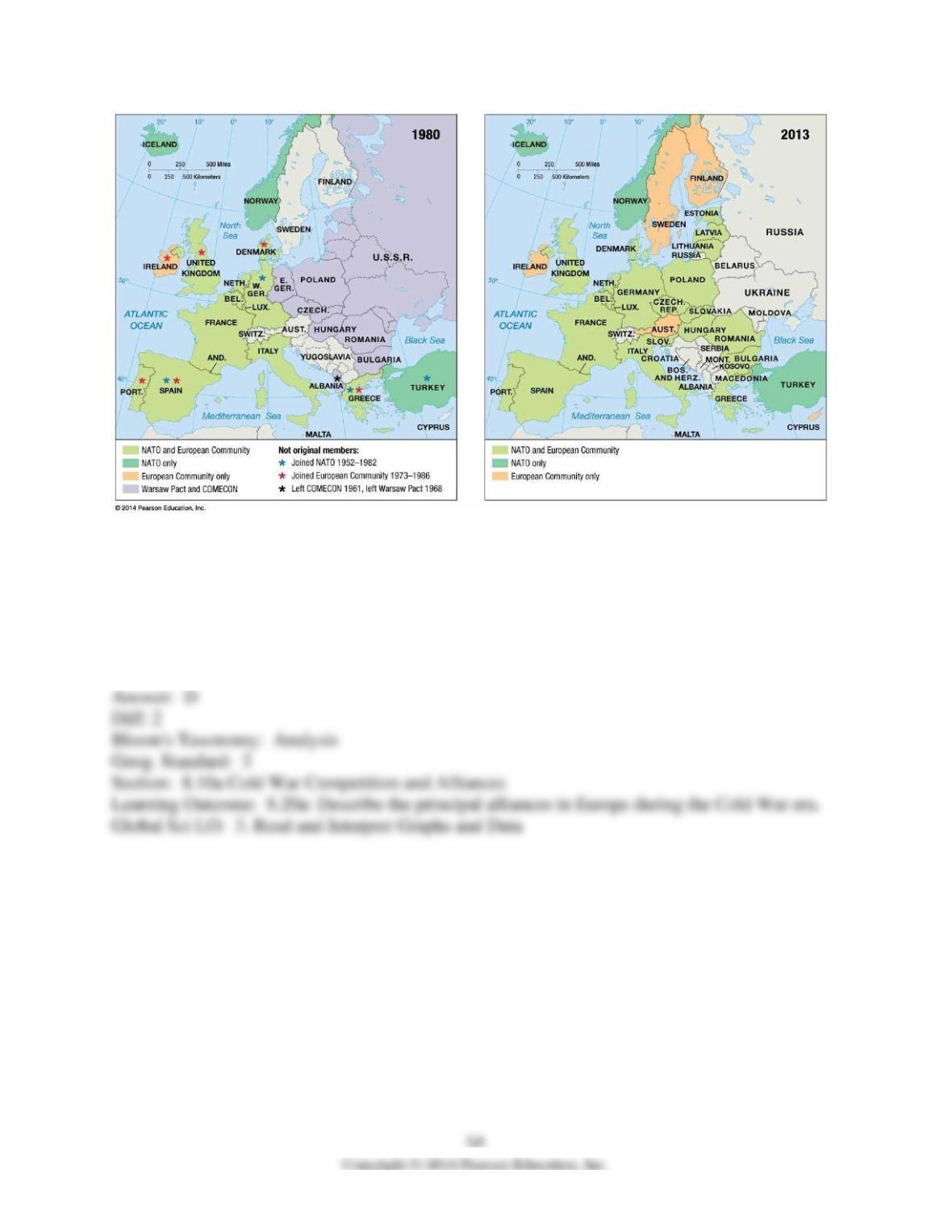
90) As shown on the map of European economic and military alliances in 1980, which NATO
member was directly south of the USSR and bordered on the Black Sea?
A) West Germany
B) Greece
C) Norway
D) Turkey
E) Yugoslavia
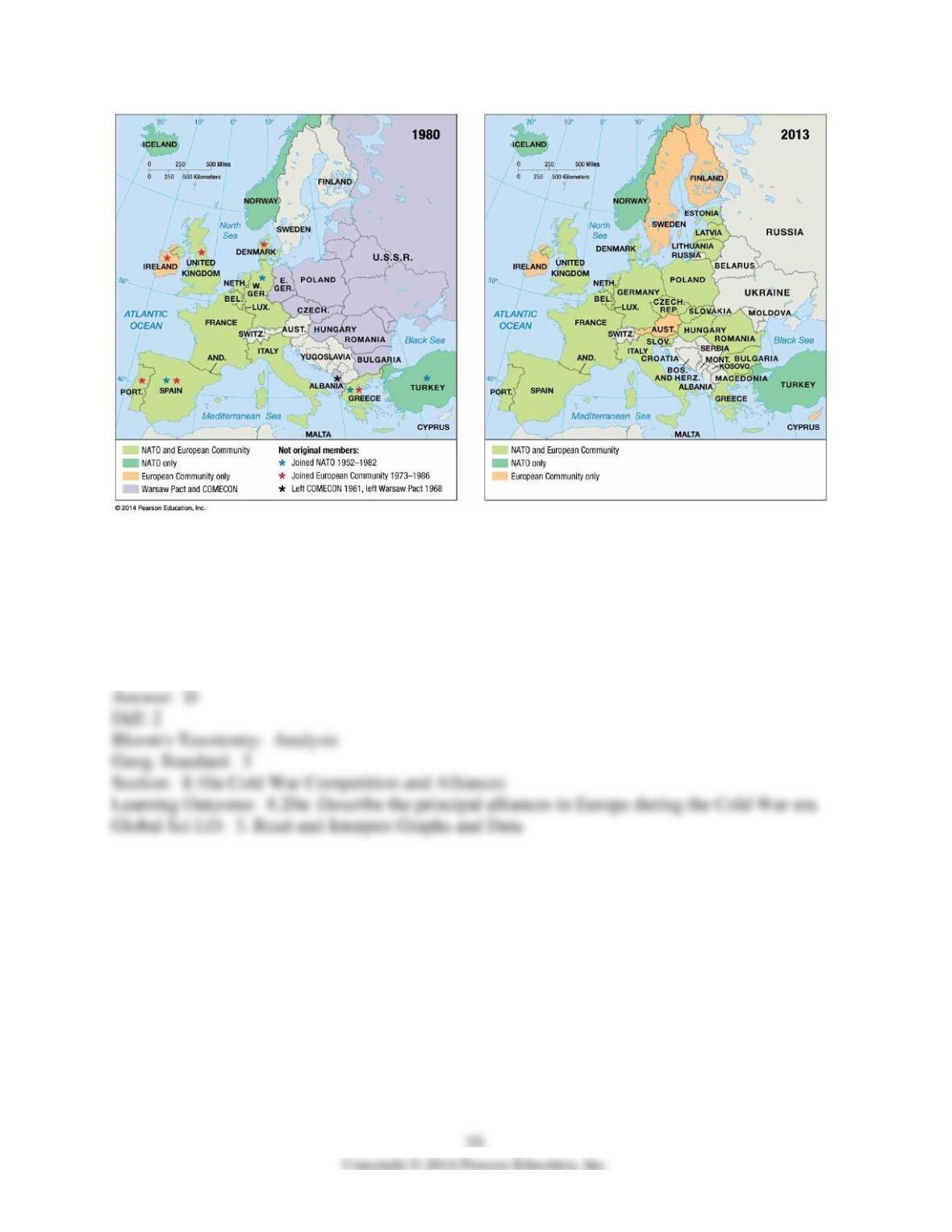
91) As shown on the map of European economic and military alliances, among the members of
the Warsaw Pact, the country bordering Hungary on the east was
A) Austria.
B) Poland.
C) Yugoslavia.
D) Romania.
E) Czechoslovakia.
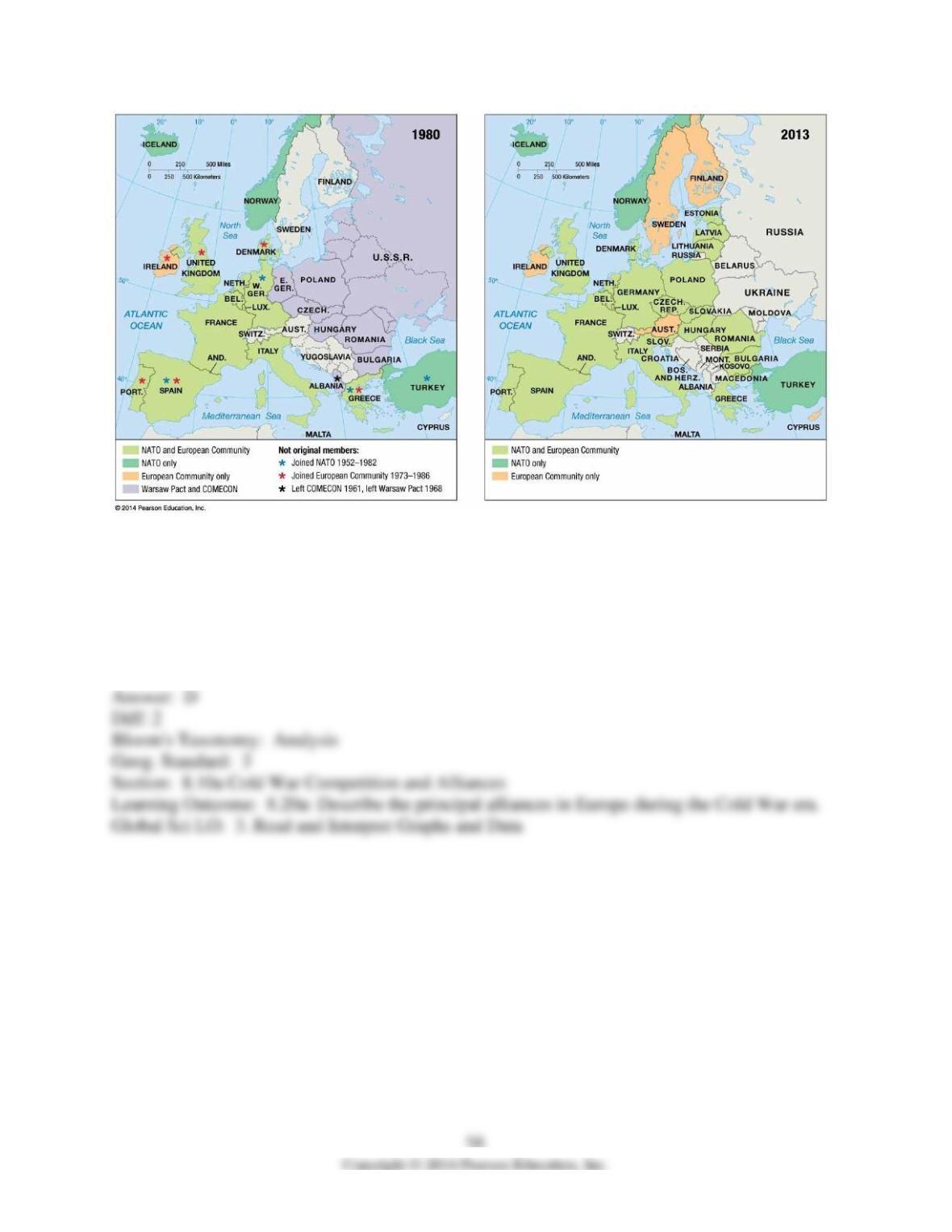
92) As shown on the map of European economic and military alliances in 1980, among the
members of the Warsaw Pact, the country bordering Poland on the east was
A) Austria.
B) East Germany.
C) Yugoslavia.
D) the Soviet Union (USSR)
E) Czechoslovakia.
93) Which of the following is true about both China and Taiwan?
A) Neither one is a member of the United Nations.
B) Both consider Taiwan to be the sovereign property of the communist government in Beijing.
C) Both now hold seats in the United Nations.
D) Neither was once ruled by the Nationalists, although both have official relationships with the
United States.
E) Both were once ruled by the Nationalists, and both have official relationships with the United
States.
94) Since the end of the Cold War,
A) Russia has become a nation-state, with the expulsion of minorities from regions such as the
Caucasus.
B) military alliances have become more important in Europe.
C) nationalities have been discouraged from expressing their cultural identities, particularly in
the Caucasus region and Siberia.
D) Russia has undergone political and economic turmoil, including rebellion in the Caucasus
region.
E) COMECON has reemerged as a major economic entity in Eastern Europe, and has cooperated
with the European Union and NATO on environmental issues and regional trade.
95) Terrorism differs from assassinations and other acts of political violence because
A) attacks are never well coordinated.
B) attacks are aimed at military targets or political leaders.
C) attacks are aimed at ordinary people.
D) attacks use only personal and improvised weapons.
E) attacks are typically made without regard for political goals.
96) In the 1980s, the United States sent bombers to attack ________ in a failed attempt to kill
Colonel Muammar el-Qaddafi, in retribution for his country’s support of terrorism.
A) Libya
B) Iraq
C) Iran
D) Egypt
E) Israel
97) Which of the following is not true of al-Qaeda?
A) Al-Qaeda has been implicated in several bombings since the attack on the United States in
2001.
B) Al-Qaeda is a single unified organization.
C) Most al-Qaeda cell members have lived in ordinary society, supporting themselves with jobs
or crime.
D) Finance, media, legal-religious policy and military committees report to a council called
Majiis al shura.
E) Al-Qaeda grew out of the war against the Soviet Union in Afghanistan.
98) Key challenges to establishing a representative government in Iraq after Saddam Hussein are
A) geometric boundaries established by British and French treaties.
B) tribal and ethnic differences between provinces.
C) sectarian conflict between the Shiite and Sunni Muslims.
D) Al-Qaeda insurgents opposed to a secular state with U.S. ties.
E) All of these answers are correct.
99) UN experts concluded that Iraq had ________ in 1991 after its Desert Storm defeat, but
officials in U.S. president George W. Bush’s administration attempted to argue that the UN
experts were wrong.
A) destroyed its weapons of mass destruction
B) hidden its weapons of mass destruction
C) illegally invaded and occupied a neighboring country
D) supported terrorist attacks
E) falsified data concerning the presence of weapons of mass destruction
100) Taiwan is a member of the United Nations.
101) The nation-state concept originated and has been used most extensively in modern Europe.
102) Language and religion are two significant characteristics which can distinguish among
nationalities.
103) In the 1980s, Yugoslavia was a good example of a federal state.
104) Physical boundaries are more important than cultural boundaries.
105) Argentina and Chile are separated by one type of physical boundary, a desert.
106) The boundary between the Republic of Ireland and Northern Ireland is a good example of a
physical boundary.
107) South Africa is a good example of a landlocked state.
108) Most Iraqis have stronger loyalty to a tribe or clan than to a national government.
109) The most important elements of state power are increasingly military rather than economic.
110) Russia is a member of the European Union.
111) Chechen rebels attempted to separate Chechnya from Russia after the collapse of the Soviet
Union.
112) Russian leaders fought to prevent Chechnya from gaining independence partly because the
Caucasus region contained deposits of petroleum.
113) Osama bin Laden declared war on the United States in 1996 because of U.S. involvement
with Saudi Arabia and Israel.
114) Al Qaeda terrorists consider all U.S. citizens to be potential targets.
115) What are the two main nationalities on the island of Cyprus? Imagine that you are chosen to
lead a UN effort to bring lasting peace to the island. What would your first priorities be? How
would you begin to implement changes?
116) How might landlocked states attempt to overcome transportation problems if they wish to
export their raw materials overseas?
117) Describe how the alliances in Europe after the Cold War related to changing global
economic interests.
118) Scientists are observing a rapid decrease in polar ice owing to global warming. How might
a warming climate affect national claims to land and resources in Antarctic and Arctic areas?
How might the states of the world best address those changing claims?
119) Since the end of the Cold War, what elements of cultural geography have been weaknesses
for Russia, limiting it from maintaining its old superpower status?
120) Since the end of the Cold War, what elements of cultural geography have been weaknesses
for the United States, potentially threatening its superpower status? Use evidence from this
chapter to reinforce your assertions.
121) What are the major types of physical boundaries, and how can these either reduce or
increase the likelihood of potential conflicts between states?
122) What are the major types of cultural boundaries, and what conflicts could you hypothesize
occurring between states because of the manner in which boundaries are drawn?
123) Why are many countries moving from unitary to federal forms of government?
124) Using the maps of regime types and alliances in this chapter, discuss the similarities
between the types of regimes that formed alliances during the 20th century.
125) What elements of physical geography contributed to the development of the United States
and Soviet Union as superpowers?
126) Describe how the alliances in Europe during the Cold War related to global and local
economic interests.
127) Imagine that you lead a country that shares borders with three other countries which may be
lending support to terrorist attacks within your country. Given that your country does not have
unlimited resources, but it does have standing with the United Nations, what actions and
strategies might you advocate to reduce the threat of state-supported terrorism?
128) Most U.S. textbooks discuss terrorism as acts committed against U.S. and European
interests; however, many people in the world accuse the United States of engaging in state-
sponsored terrorism. Although we do not like to hear these kinds of accusations, it is important to
consider why other people might have this point of view. Considering U.S. military and political
actions in recent decades, discuss the kinds of evidence that would tend to support such anti-U.S.
claims. Finally, would you agree or disagree with those claims? Why or why not?