
Fundamentals of Corporate Finance 3e Test Bank
Chapter 8: Bond Valuation and the Structure of Interest Rates
1.
The largest investors in corporate bonds are state government agencies.
A)
True
B)
False
Ans:
B
2.
The largest investors in corporate bonds are big institutional investors such as life insurance
companies and pension funds.
A)
True
B)
False
Ans:
A
AICPA: Industry/Sector Perspective
3.
Most secondary market transactions for corporate bonds take place on the New York Stock
Exchange.
A)
True
B)
False
Ans:
B

Fundamentals of Corporate Finance 3e Test Bank
4.
Most secondary market transactions for corporate bonds take place through dealers in the over-
the-counter (OTC) market.
A)
True
B)
False
Ans:
A
AICPA: Industry/Sector Perspective
5.
A thin market for a security implies a high frequency of trades for that type of security in the
markets.
A)
True
B)
False
Ans:
B
AICPA: Industry/Sector Perspective
6.
Corporate bonds have a thin market relative to market for corporate stocks.
A)
True
B)
False
Ans:
A

Fundamentals of Corporate Finance 3e Test Bank
7.
Prices in the corporate bond market tend to be more volatile than securities sold in markets with
greater trading volumes.
A)
True
B)
False
Ans:
A
AICPA: Industry/Sector Perspective
8.
Vanilla bonds have coupon payments that are fixed for the life of the bond, with the principal
being repaid at maturity.
A)
True
B)
False
Ans:
A
AICPA: Measurement
9.
The face or par value for most corporate bonds is equal to $1,000, and it is the principal amount
owed to bondholders at maturity.
A)
True
B)
False
Ans:
A

Fundamentals of Corporate Finance 3e Test Bank
10.
Zero coupon bonds sell well above their par value because they offer no coupons.
A)
True
B)
False
Ans:
B
AICPA: Measurement
11.
Convertible bonds can be converted into shares of common stock at some predetermined ratio
at the discretion of the bondholder.
A)
True
B)
False
Ans:
A
12.
The value, or price, of any asset is the present value of its future cash flows.
A)
True
B)
False
Ans:
A

Fundamentals of Corporate Finance 3e Test Bank
13.
The yield to maturity of a bond is the discount rate that makes the present value of the coupon
and principal payments equal to the price of the bond.
A)
True
B)
False
Ans:
A
AICPA: Risk Analysis
14.
Interest rate risk is the risk that bond prices will fluctuate as interest rate changes.
A)
True
B)
False
Ans:
A
15.
As interest rates fall, the prices of bonds decline.
A)
True
B)
False
Ans:
B

Fundamentals of Corporate Finance 3e Test Bank
16.
Higher coupon bonds have greater interest rate risk.
A)
True
B)
False
Ans:
B
AICPA: Measurement
17.
All other things being equal, a given change in the interest rates will have a greater impact on
the price of a low-coupon bond than a higher-coupon bond with the same maturity.
A)
True
B)
False
Ans:
A
18.
Bonds with a call provision pay lower yields than comparable noncallable bonds.
A)
True
B)
False
Ans:
B

Fundamentals of Corporate Finance 3e Test Bank
19.
The risk that the lender may not receive payments as promised is called default risk.
A)
True
B)
False
Ans:
A
AICPA: Measurement
20.
U.S. Treasury securities are the best proxy measure for the risk-free rate.
A)
True
B)
False
Ans:
A
21.
Upward-sloping yield curves often occur before the beginning of recession.
A)
True
B)
False
Ans:
B

Fundamentals of Corporate Finance 3e Test Bank
22.
If investors believe inflation will be increasing in the future, the prevailing yield will be
downward sloping.
A)
True
B)
False
Ans:
B
AICPA: Measurement
23.
The real rate of interest varies with the business cycle, with the highest rates seen at the end of a
period of business expansion and the lowest at the bottom of a recession.
A)
True
B)
False
Ans:
A
AICPA: Measurement
24.
Which of the following statements is true?
A)
The largest investors in corporate bonds are institutional investors such as life insurance
companies and pension funds.
B)
The market for corporate bonds is thin compared to the market for corporate stocks.
C)
Prices in the corporate bond market tend to be more volatile than prices of securities sold
in markets with greater trading volumes.
D)
All of the above are true.
Ans:
D

Fundamentals of Corporate Finance 3e Test Bank
AICPA: Measurement
25.
Which one of the following statements is NOT true?
A)
Prices in the corporate bond market tend to be more volatile than the markets for stocks
or money market securities.
B)
Corporate bonds are more marketable than the securities that have higher daily trading
volumes.
C)
The market for corporate bonds is thin compared to the market for corporate stocks.
D)
The largest investors in corporate bonds are life insurance companies and pension funds.
Ans:
B
AICPA: Measurement
26.
It is easy for individuals to trade in the corporate bond market because:
A)
the corporate bond market is considered to be very transparent.
B)
prices in the corporate bond market tend to be more stable.
C)
centralized reporting of deals between buyers and sellers take place.
D)
None of the above statements is true.
Ans:
D
AICPA: Measurement
27.
Which one of the following statements about vanilla bonds is NOT true?
A)
They have fixed coupon payments.
B)
The face value, or par value, for most corporate bonds is $1,000.
C)
Coupon payments are usually made quarterly.
D)
The bond’s coupon rate is calculated as the annual coupon payment divided by the bond’s
face value.
Ans:
C

Fundamentals of Corporate Finance 3e Test Bank
28.
Which of the following statements is true of zero coupon bonds?
A)
Zero coupon bonds have no coupon payments over its life and only offer a single
payment at maturity.
B)
Zero coupon bonds sell well below their face value (at a deep discount) because they
offer no coupons.
C)
The most frequent and regular issuer of zero coupon securities is the U.S. Treasury
Department.
D)
All of the above are true.
Ans:
D
AICPA: Measurement
29.
Which of the following statements is true?
A)
To secure the conversion option on a bond, bondholders would be willing to pay a
premium.
B)
Typically, the conversion ratio is set so that the firm’s stock price must appreciate at least
15 to 20 percent before it is profitable to convert bonds into stock.
C)
Convertible bonds can be converted into shares of common stock at some predetermined
ratio at the discretion of the bondholder.
D)
All of the above are true.
Ans:
D

Fundamentals of Corporate Finance 3e Test Bank
30.
Which of the following statements is true of convertible bonds?
A)
The most significant disadvantage to a corporation of issuing convertible bonds is that
they increase the cash that the firm must use to make interest payments.
B)
The typical conversion ratio is set so that the firm’s stock price must appreciate 5% or
less before it is profitable for the holder to convert the bond to stock.
C)
Firms that issue convertible bonds can do so at a lower interest rate.
D)
The typical issue of convertible bonds allows the holder of the bond to convert it to
preferred stock.
Ans:
C
AICPA: Measurement
31.
Which of the following statements is most true about zero coupon bonds?
A)
They typically sell at a premium over par when they are first issued.
B)
They typically sell for a higher price than similar coupon bonds.
C)
They are always convertible to common stock.
D)
They typically sell at a deep discount below par when they are first issued.
Ans:
D

Fundamentals of Corporate Finance 3e Test Bank
32.
Which one of the following statements about bonds is NOT true?
A)
To compute a bond’s price, one needs to calculate the present value of the bond’s
expected cash flows.
B)
The value, or price, of any asset is the future value of its cash flows.
C)
The required rate of return, or discount rate, for a bond is the market interest rate called
the bond’s yield to maturity
D)
The expected future cash flows are estimated using the coupons that the bond will pay
and the maturity value to be received.
Ans:
B
AICPA: Measurement
33.
If a bond’s coupon rate is equal to the market rate of interest, then the bond will sell:
A)
at a price equal to its face value.
B)
at a price greater than its face value.
C)
at a price less than its face value.
D)
None of the above is true.
Ans:
A
34.
Bonds sell at a discount when the market rate of interest is:
A)
less than the bond’s coupon rate.
B)
greater than the bond’s coupon rate.
C)
equal to the bond’s coupon rate.
D)
None of the above is true.
Ans:
B

Fundamentals of Corporate Finance 3e Test Bank
35.
Bonds sell at a premium when the market rate of interest is:
A)
less than the bond’s coupon rate.
B)
greater than the bond’s coupon rate.
C)
equal to the bond’s coupon rate.
D)
None of the above is true.
Ans:
A
36.
In calculating the current price of a bond paying semiannual coupons, one needs to
A)
use double the number of years for the number of payments made.
B)
use the semiannual coupon.
C)
use the semiannual rate as the discount rate.
D)
All of the above need to be done.
Ans:
D
37.
Which one of the following statements about zero coupon bonds is NOT true?
A)
Zero coupon bonds have no coupon payments but promise a single payment at maturity.
B)
Zero coupon bonds must sell for less than similar bonds that make periodic coupon
payments.
C)
Zero coupon bonds make coupon payments but no principal payment at maturity.
D)
All of the above statements are true.
Ans:
C
Fundamentals of Corporate Finance 3e Test Bank
38.
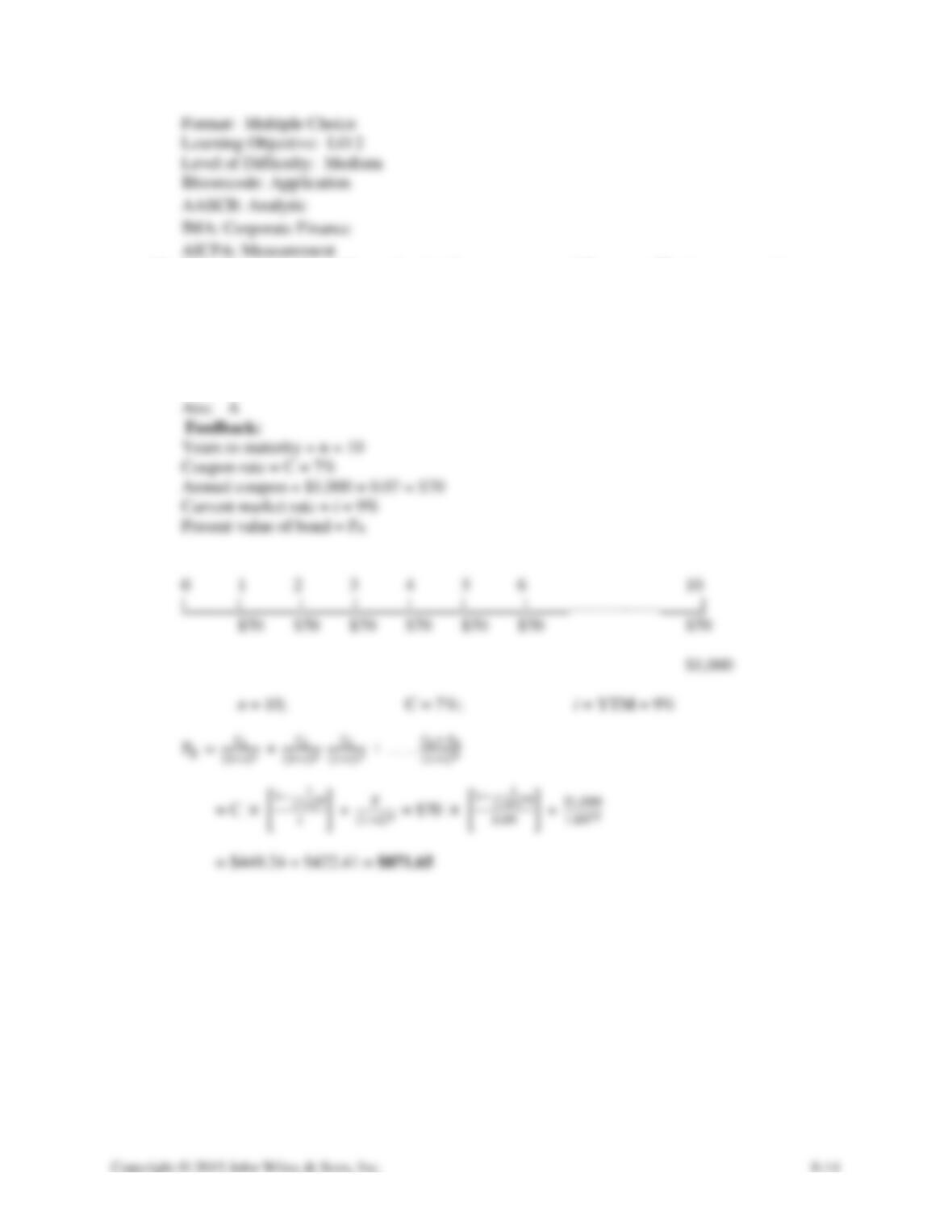
Briar Corp is issuing a 10-year bond with a coupon rate of 7 percent. The interest rate for
similar bonds is currently 9 percent. Assuming annual payments, what is the present value of the
bond? (Do not round intermediate computations. Round your final answer to the nearest dollar.)
A)
$872
B)
$1,066
C)
$990
D)
$945
Ans:
A
Fundamentals of Corporate Finance 3e Test Bank
39.
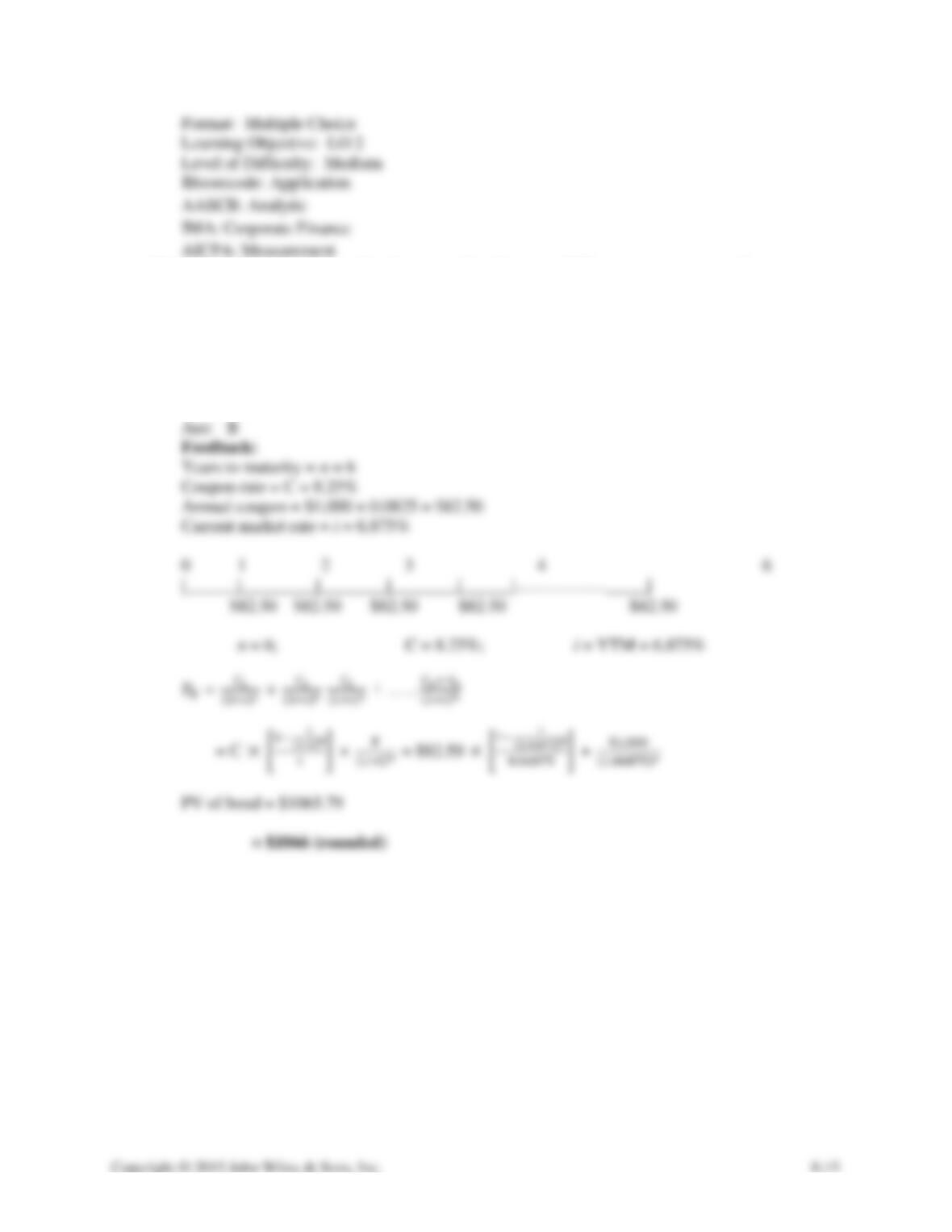
Regatta, Inc., has six-year bonds outstanding that pay a 8.25 percent coupon rate. Investors
buying the bond today can expect to earn a yield to maturity of 6.875 percent. What should the
company’s bonds be priced at today? Assume annual coupon payments. (Do not round
intermediate computations. Round your final answer to the nearest dollar.)
A)
$972
B)
$1,066
C)
$1,014
D)
$923
Ans:
B
Fundamentals of Corporate Finance 3e Test Bank
40.
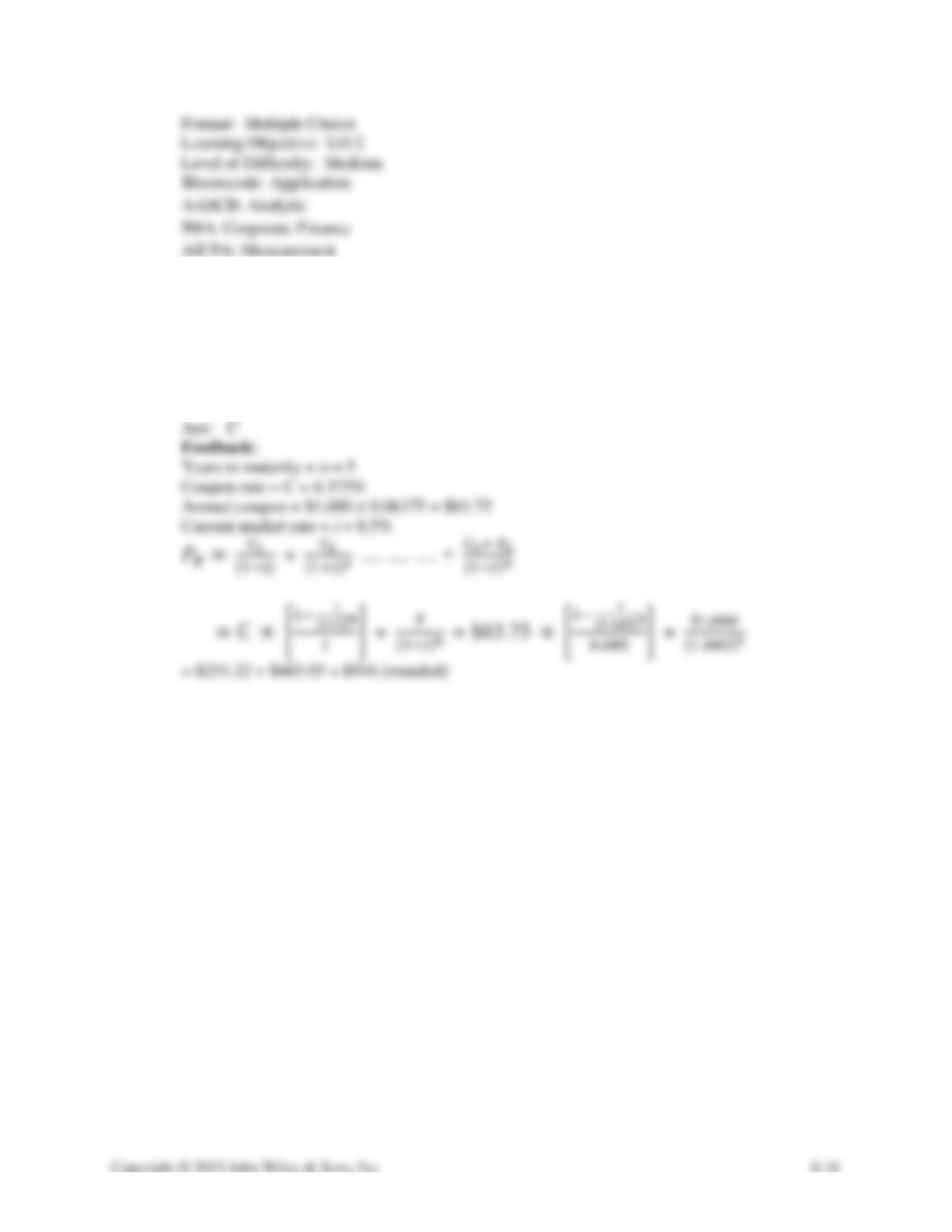
Triumph Corp. issued five-year bonds that pay a coupon of 6.375 percent annually. The current
market rate for similar bonds is 8.5 percent. How much will you be willing to pay for Triumph’s
bond today? (Do not round intermediate computations. Round your final answer to the nearest
dollar.)
A)
$1,023
B)
$1,137
C)
$916
D)
$897
Ans:
C
= $251.22 + $665.05 = $916 (rounded)
Fundamentals of Corporate Finance 3e Test Bank
41.
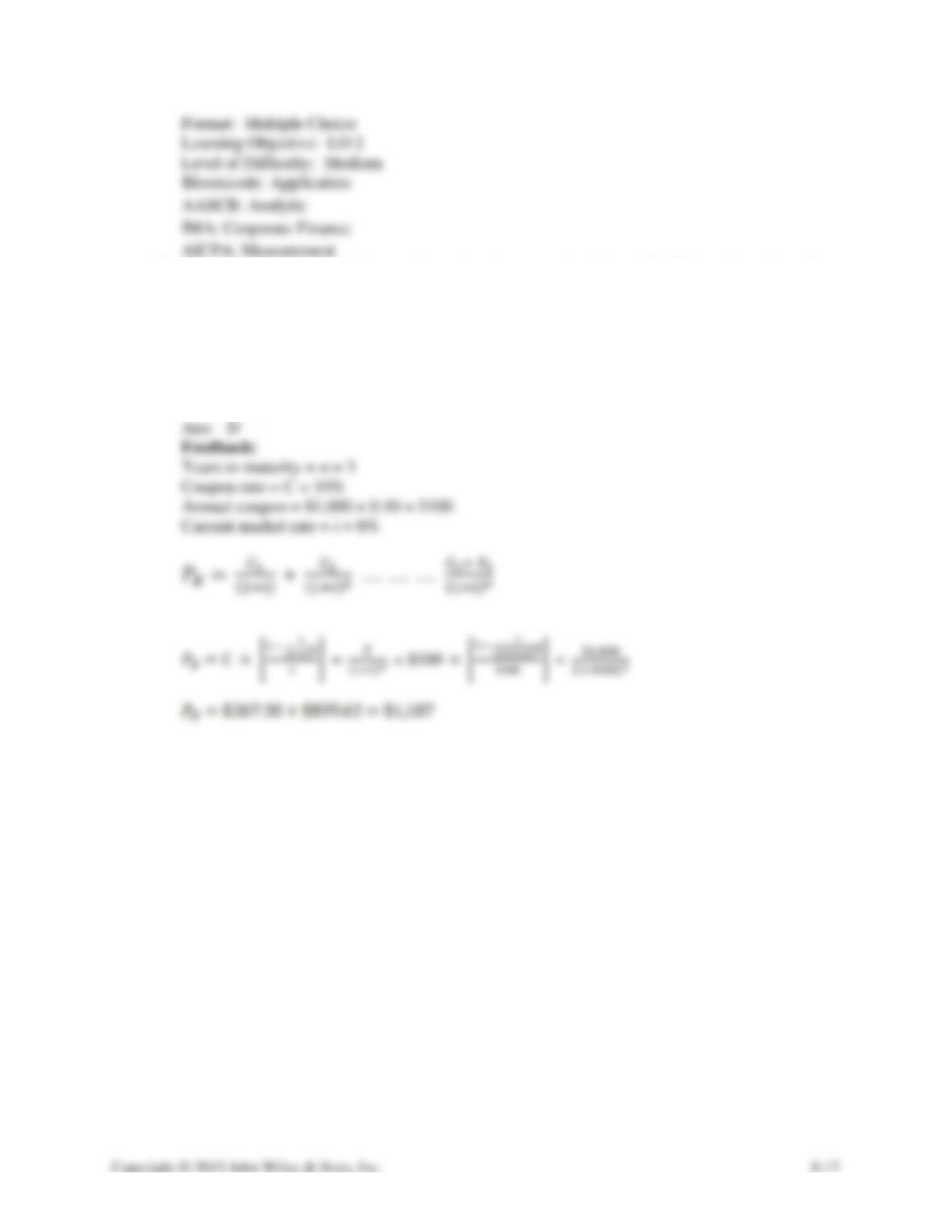
Your friend recommends that you invest in a three-year bond issued by Trimer, Inc., that will
pay annual coupons of 10 percent. Similar investments today will yield 6 percent. How much
should you pay for the bond? (Do not round intermediate computations. Round your final
answer to the nearest dollar.)
A)
$1,024
B)
$979
C)
$886
D)
$1,107
Ans:
D
Fundamentals of Corporate Finance 3e Test Bank
42.
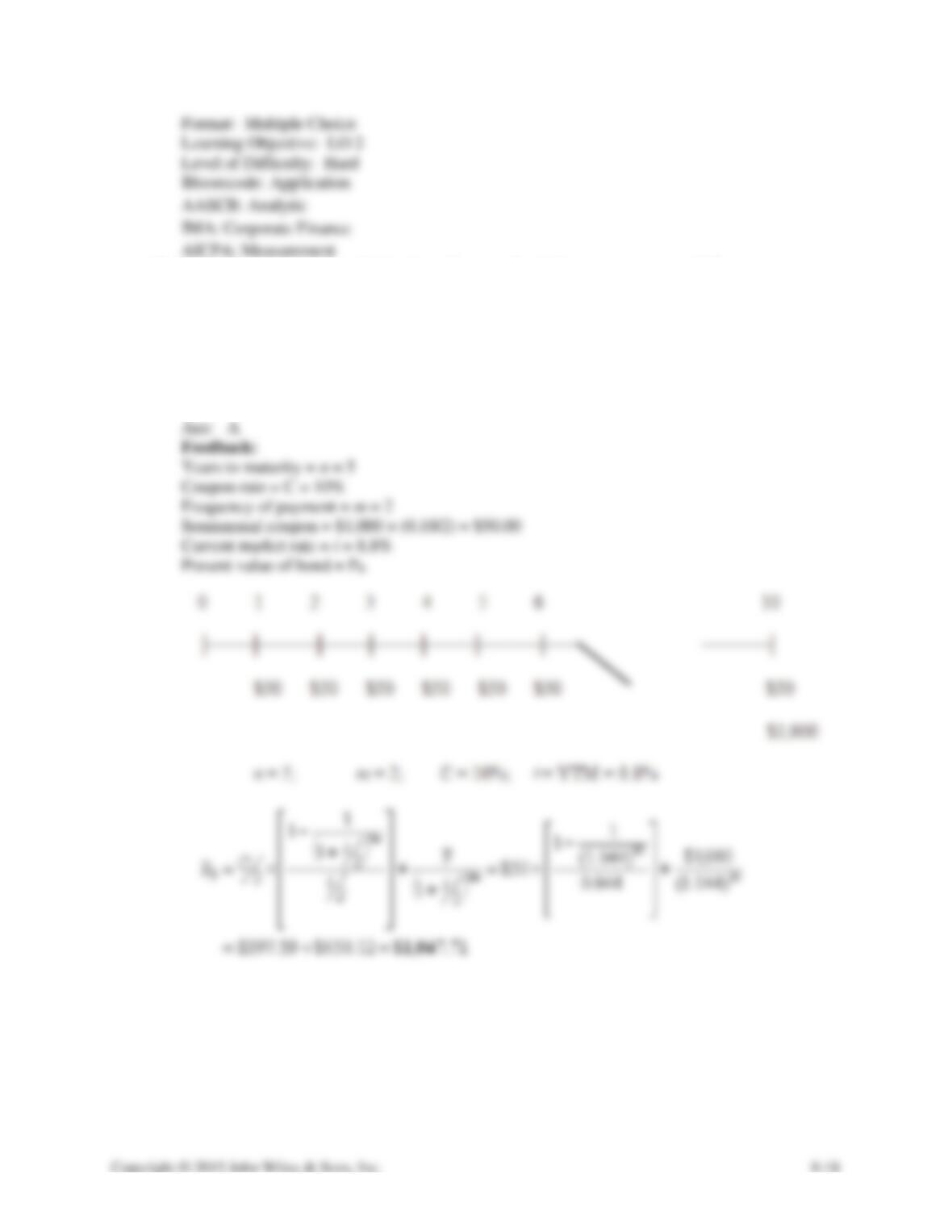
Kevin Rogers is interested in buying a five-year bond that pays a coupon of 10 percent on a
semiannual basis. The current market rate for similar bonds is 8.8 percent. What should be the
current price of this bond? (Do not round intermediate computations. Round your final answer
to the nearest dollar.)
A)
$1,048
B)
$965
C)
$1,099
D)
$982
Ans:
A
Fundamentals of Corporate Finance 3e Test Bank
43.
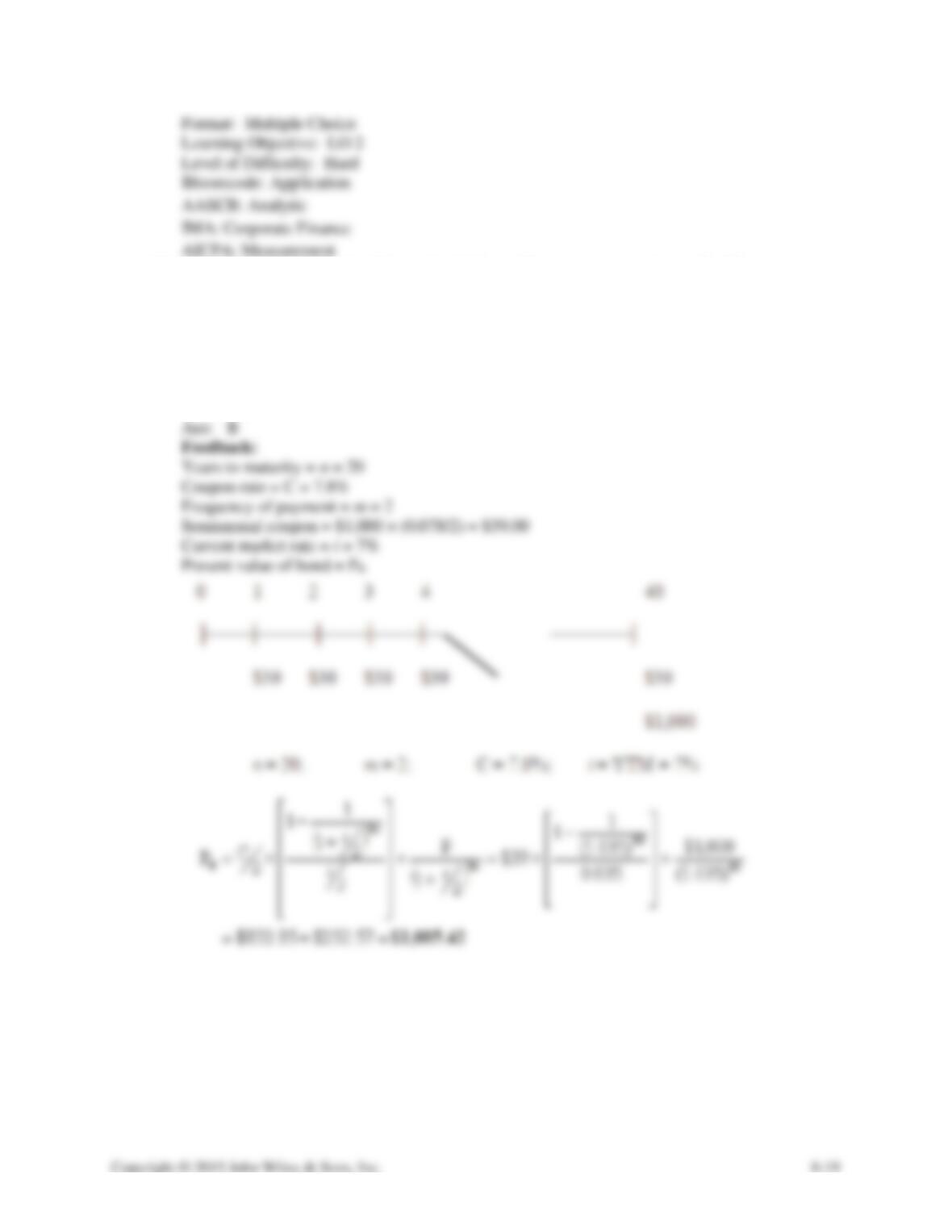
Giant Electronics is issuing 20-year bonds that will pay coupons semiannually. The coupon rate
on this bond is 7.8 percent. If the market rate for such bonds is 7 percent, what will the bonds
sell for today? (Do not round intermediate computations. Round your final answer to the
nearest dollar.)
A)
$1,037
B)
$1,085
C)
$861
D)
$923
Ans:
B
Fundamentals of Corporate Finance 3e Test Bank
44.
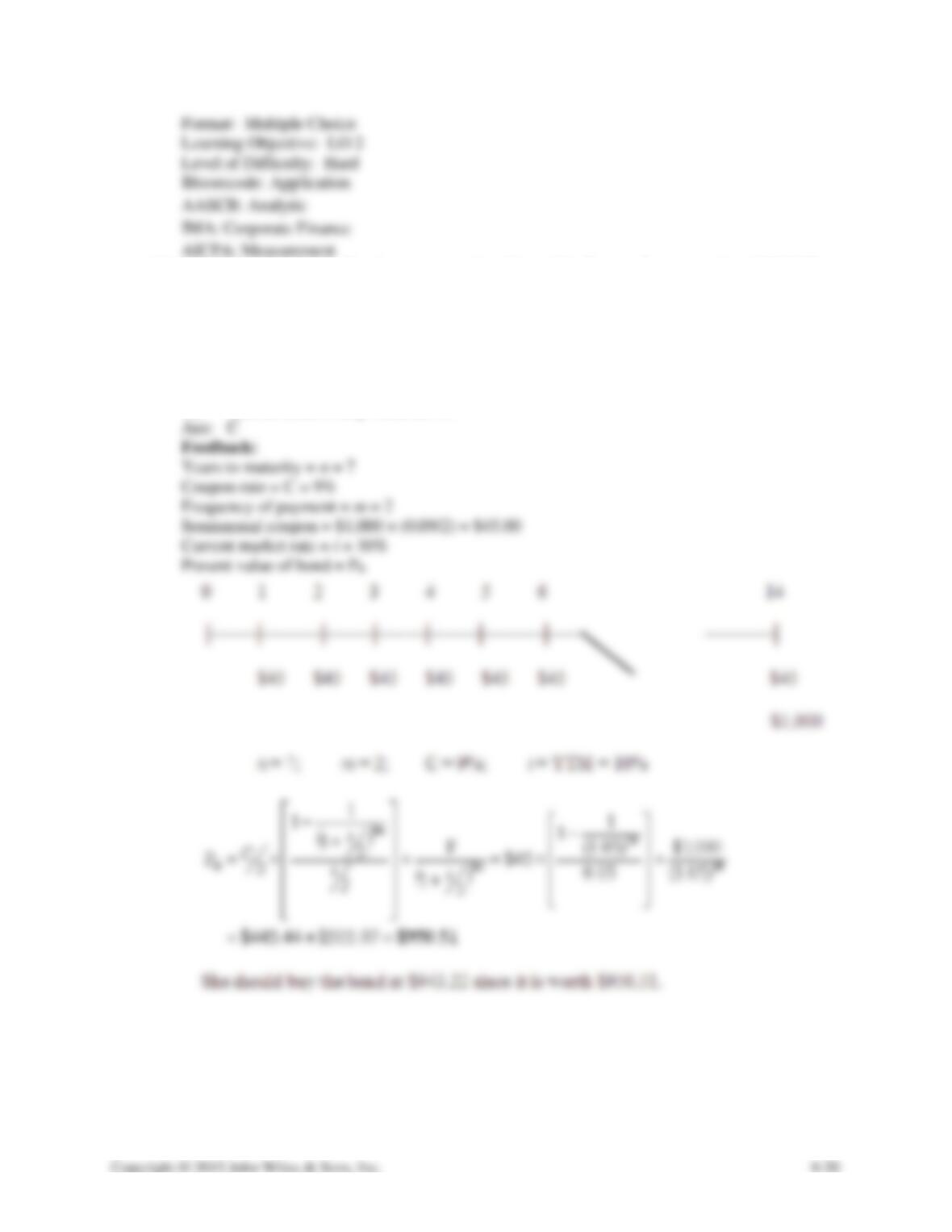
Jane Thorpe has been offered a seven-year bond issued by Barone, Inc., at a price of $943.22.
The bond has a coupon rate of 9 percent and pays the coupon semiannually. Similar bonds in
the market will yield 10 percent today. Should she buy the bonds at the offered price? (Do not
round intermediate computations. Round your final answer to the nearest dollar.)
A)
Yes, the bond is worth more at $1,015.
B)
No, the bond is only worth $921.
C)
Yes, the bond is worth more at $951.
D)
No, the bond is only worth $912.
Ans:
C