Cost Accounting: A Managerial Emphasis, 6e
Chapter 8 – Flexible Budgets, Variances, and Management Control: II
22) A company had the following information pertaining to two different cases:
Case X
Case Y
Budgeted fixed overhead
$130,000
$230,000
Variable factory overhead
per direct-labour hour
$24
$14
Standard direct-labour hours
1,000
6,000
Flexible-budget variance
$10,000 F
$20,000 U
Production-volume variance
$6,000 U
$8,000 F
The total overhead variance in Case Y was
A) $4,000 unfavourable.
B) $4,000 favourable.
C) $10,000 unfavourable.
D) $12,000 favourable.
E) $12,000 unfavourable.
23) A leased factory building has a fixed monthly rental payment, and a variable overhead cost of energy
and indirect labour. Which of the following is TRUE, assuming that all activity levels are within the
relevant range?
A) Variable OVH costs will increase as production increases, but Fixed OVH costs will decrease.
B) Variable OVH costs will decrease as production increases, but Fixed OVH costs will increase.
C) Variable OVH costs will increase as production increases, and Fixed OVH costs will increase.
D) Variable OVH costs will increase as production increases, but Fixed OVH costs will remain constant.
E) Both will increase with production, but at different rates.
Cost Accounting: A Managerial Emphasis, 6e
Chapter 8 – Flexible Budgets, Variances, and Management Control: II
24) During October 2012 Foxmore Inc. used $250,000 in manufacturing overhead costs, of which $66,500
was variable. Budgeted manufacturing overhead was $229,500, of which $75,000 was variable. Which of
the following entries for manufacturing overhead could have been recorded?
A)
Accounts Receivable
75,000
Work in Process Control
75,000
B)
Variable Manufacturing Overhead Allocated
75,000
Accounts Payable and other accounts
75,000
C)
Work in Process Control
66,500
Accounts Payable and other accounts
66,500
D)
Variable Manufacturing Overhead Control
66,500
Accounts Payable and other accounts
66,500
E)
Work in Process Control
66,500
Variable Manufacturing Overhead Control
66,500
25) If Pope Inc. uses standard costing, the overhead allocated to work in process is recorded as a
A) debit to Manufacturing Overhead Allocated and a credit to Work–in-Process.
B) debit to Work-in-Process and credit to Manufacturing Overhead Control.
C) debit to Manufacturing Overhead Allocated and a credit to Manufacturing Overhead Control.
D) debit to Manufacturing Overhead Control and a credit to Manufacturing Overhead Allocated.
E) debit to Work-in-Process and a credits to Manufacturing Overhead Allocated.
Cost Accounting: A Managerial Emphasis, 6e
Chapter 8 – Flexible Budgets, Variances, and Management Control: II
26) If Miller Company makes the following journal entry:
Variable Overhead Allocated
50,000
Variable Overhead Efficiency Variance
15,000
Variable Overhead Control
62,500
Variable Overhead Rate Variance
2,500
It may be inferred that
A) Miller over-allocated variable manufacturing overhead.
B) the net variance is a $12,500 favourable rate variance.
C) actual variable manufacturing overhead costs were $62,500.
D) the journal entry accounts are incorrect.
E) the net variance is $12,500 unfavourable.
27) Which option(s) would be consistent with the proration approach for end–of-period adjustments
when the underallocated or overallocated variable overhead costs are significant?
A) prorate based on the allocated overhead amount in the ending balance of work–in-process inventory
and cost of goods sold
B) immediate write-off to cost of goods sold
C) prorate based on the total ending balance of variable overhead allocated and variable overhead control
D) prorate based on the allocated overhead amount in the ending balance of work–in-process inventory,
finished goods inventory, and cost of goods sold
E) prorate based on the total ending balance of cost of goods sold and variable overhead control
28) Which of the following would possibly be adjusted as an end–of-period adjustment, using the
adjusted allocation rate approach?
A) individual job records
B) ending work-in-process and finished goods inventories
C) cost of goods sold
D) only individual job records and ending finished goods inventory
E) ending work-in-process and finished goods inventories, individual job records, and cost of goods sold
Cost Accounting: A Managerial Emphasis, 6e
Chapter 8 – Flexible Budgets, Variances, and Management Control: II
29) The variable overhead flexible-budget variance can be further subdivided into the
A) price variance and the efficiency variance.
B) static-budget variance and sales-volume variance.
C) rate variance and production-volume variance.
D) sales-volume variance and the rate variance.
E) rate variance and the efficiency variance.
30) An unfavourable variable overhead rate variance indicates that
A) variable overhead items were used efficiently.
B) the price of variable overhead items was more than budgeted.
C) the variable overhead cost-allocation base was not used efficiently.
D) the denominator level was not accurately determined.
E) the denominator level was used more than planned.
31) When machine-hours are used as an overhead cost-allocation base, the LEAST likely cause of a
unfavourable variable overhead rate variance is
A) excessive machine breakdowns.
B) the production scheduler inefficiently scheduled jobs.
C) poor coordination between sales and production resulting in displacement of normal batches by. rush
orders and excessive setup times.
D) strengthened demand for the product.
E) a decrease in the cost of energy.
Cost Accounting: A Managerial Emphasis, 6e
Chapter 8 – Flexible Budgets, Variances, and Management Control: II
Answer the following question(s) using the information below.
Kellar Corporation manufactured 1,500 chairs during June. The following variable overhead data pertain
to June:
Budgeted variable overhead cost per unit
$12.00
Actual variable manufacturing overhead cost
$16,800
Flexible-budget amount for variable manufacturing
overhead
$18,000
Variable manufacturing overhead efficiency variance
$360 unfavourable
32) What is the variable overhead flexible-budget variance?
A) $1,200 favourable
B) $360 unfavourable
C) $840 favourable
D) $1,200 unfavourable
E) $1,560 unfavourable
33) What is the variable overhead rate variance?
A) $840 unfavourable
B) $1,200 favourable
C) $1,200 unfavourable
D) $1,560 favourable
E) $1,560 unfavourable
Cost Accounting: A Managerial Emphasis, 6e
Chapter 8 – Flexible Budgets, Variances, and Management Control: II
34) Cirilla’s Weathervane Company manufactures weathervanes. The 2012 operating budget is based on
the production of 10,000 weathervanes with 1.25 machine-hour allowed per weathervane. Variable
manufacturing overhead is anticipated to be $300,000.
Actual production for 2012 was 11,000 weathervanes using 12,100 machine-hours. Actual variable costs
were $23.75 per machine-hour.
Required:
Calculate the variable overhead rate and the efficiency variances.
35) Can the variable overhead efficiency variance
a. be computed the same way as the efficiency variance for direct-cost items?
b. be interpreted the same way as the efficiency variance for direct-cost items? Explain.
36) Trilite Windows manufactures windows. The 2012 operating budget is based on production of 56,000
windows with 1.0 machine hours allowed per window. Variable manufacturing overhead is anticipated
to be $896,000.
Actual production for 2012 was 58,000 windows using 60,000 machine hours. Actual variable costs were
$15 per machine hour.
Required:
Determine the variable overhead rate and efficiency variances.
Cost Accounting: A Managerial Emphasis, 6e
Chapter 8 – Flexible Budgets, Variances, and Management Control: II
37) Heather’s Pillow Company manufactures pillows. The 2012 operating budget is based on production
of 20,000 pillows with 0.5 machine-hour allowed per pillow. Variable manufacturing overhead is
anticipated to be $220,000.
Actual production for 2012 was 18,000 pillows using 9,500 machine-hours.
Actual variable costs were $20 per machine-hour.
Required:
Calculate the variable overhead rate and efficiency variances.
Cost Accounting: A Managerial Emphasis, 6e
Chapter 8 – Flexible Budgets, Variances, and Management Control: II
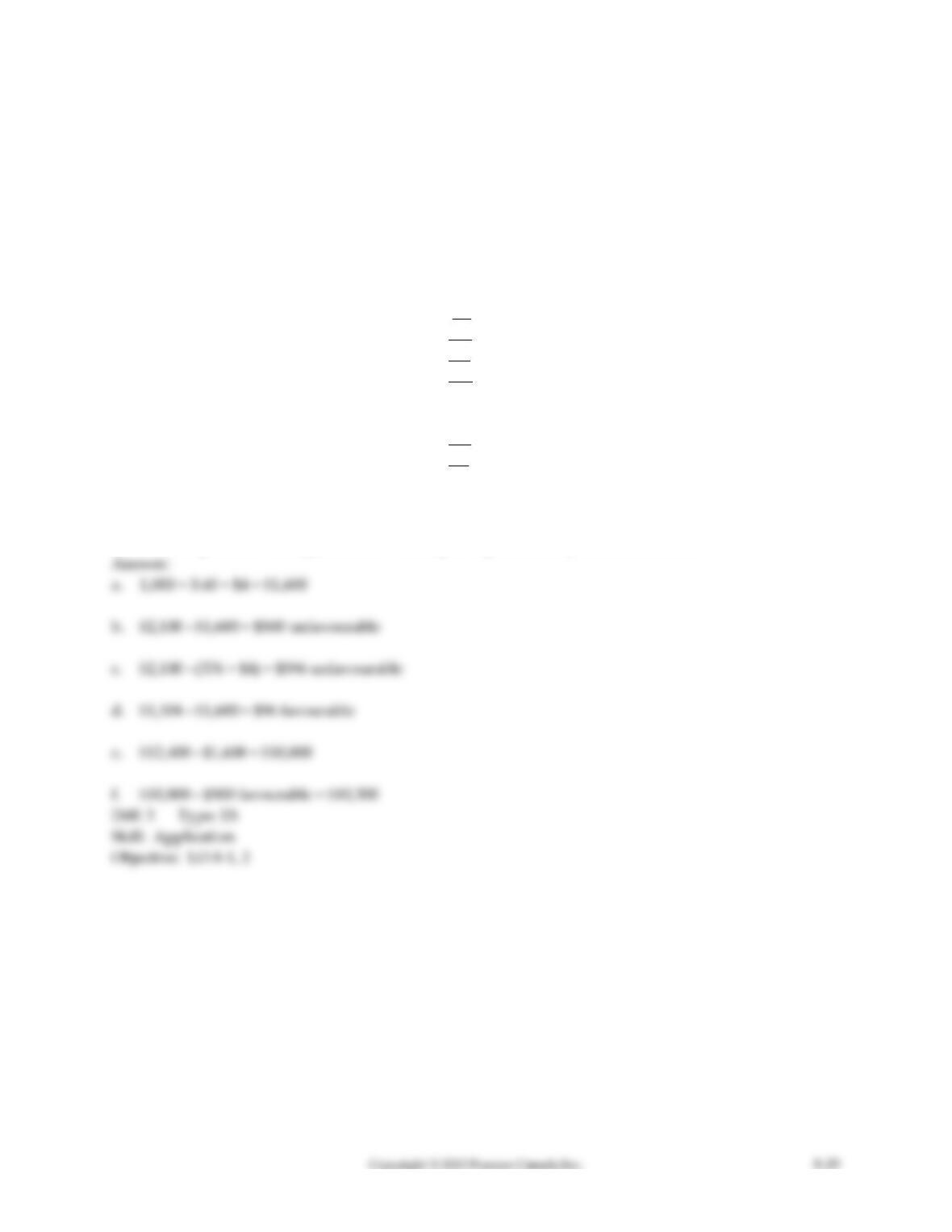
38) Zebra Jewellers manufactured 2,000 necklaces during March with a total overhead budget of $49,600.
However, while manufacturing the 2,000th necklace the microcomputer that contained the month’s cost
information broke down. With the computer out of commission, the accountant has been unable to
complete the variance analysis report. The missing information of the report is lettered in the following
set of data:
Variable overhead:
Standard cost per necklace: 0.4 labour hour at $8 per hour
Actual costs: $8,400 for 752 hours
Flexible budget: a
Total flexible-budget variance: b
Variable overhead rate variance: c
Variable overhead efficiency variance: d
Fixed overhead:
Budgeted costs: e
Actual costs: f
Flexible-budget variance: $2,000 favourable
Required:
Compute the missing elements in the report represented by the lettered items.
Cost Accounting: A Managerial Emphasis, 6e
Chapter 8 – Flexible Budgets, Variances, and Management Control: II
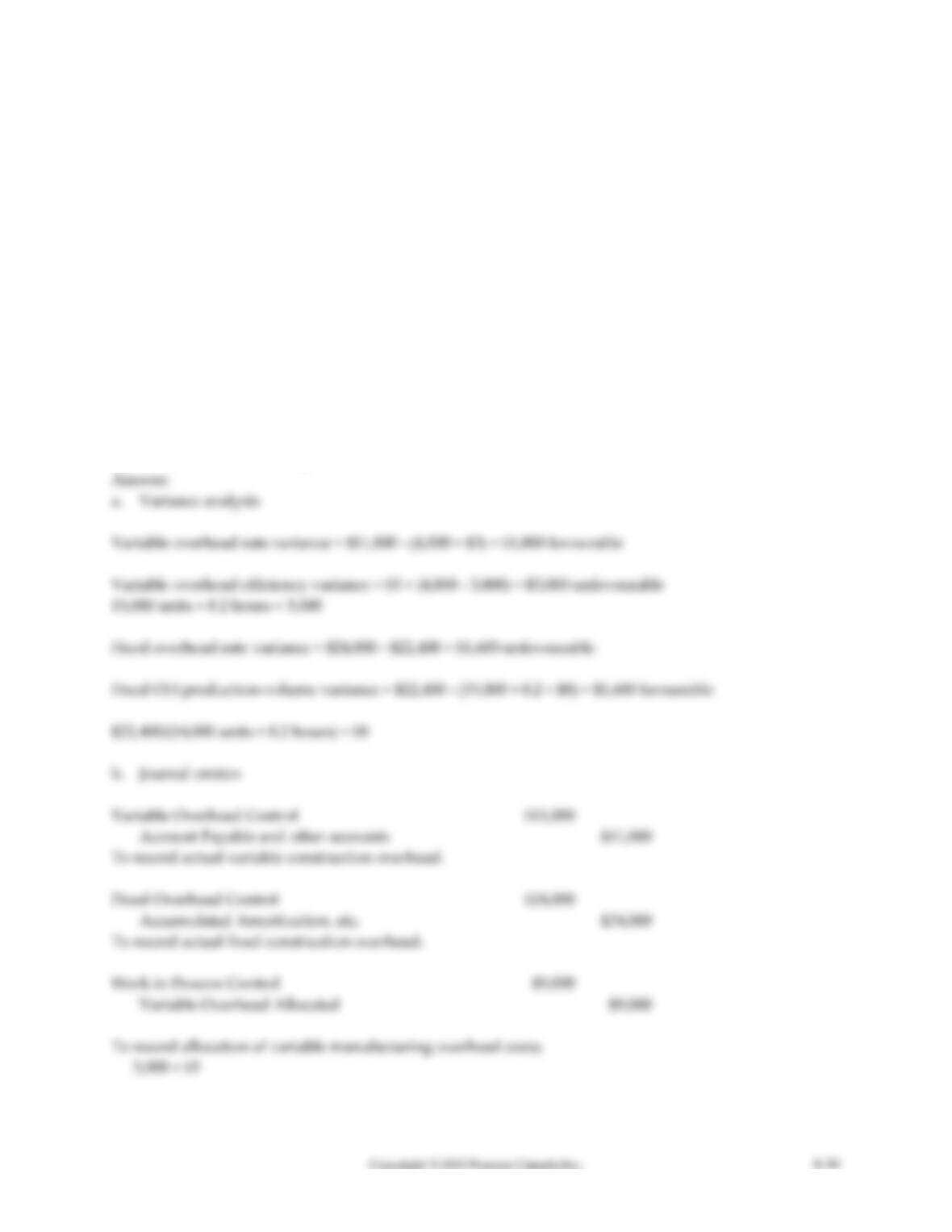
39) McKenna Company manufactured 1,000 units during April with a total overhead budget of $12,400.
However, while manufacturing the 1,000 units the microcomputer that contained the month’s cost
information broke down. With the computer out of commission, the accountant has been unable to
complete the variance analysis report. The information missing from the report is lettered in the
following set of data:
Variable overhead:
Standard cost per unit: 0.4 labour hour at $4 per hour
Actual costs: $2,100 for 376 hours
Flexible budget: a
Total flexible-budget variance: b
Variable overhead rate variance: c
Variable overhead efficiency variance: d
Fixed overhead:
Budgeted costs: e
Actual costs: f
Flexible-budget variance: $500 favourable
Required:
Compute the missing elements in the report represented by the lettered items
Cost Accounting: A Managerial Emphasis, 6e
Chapter 8 – Flexible Budgets, Variances, and Management Control: II
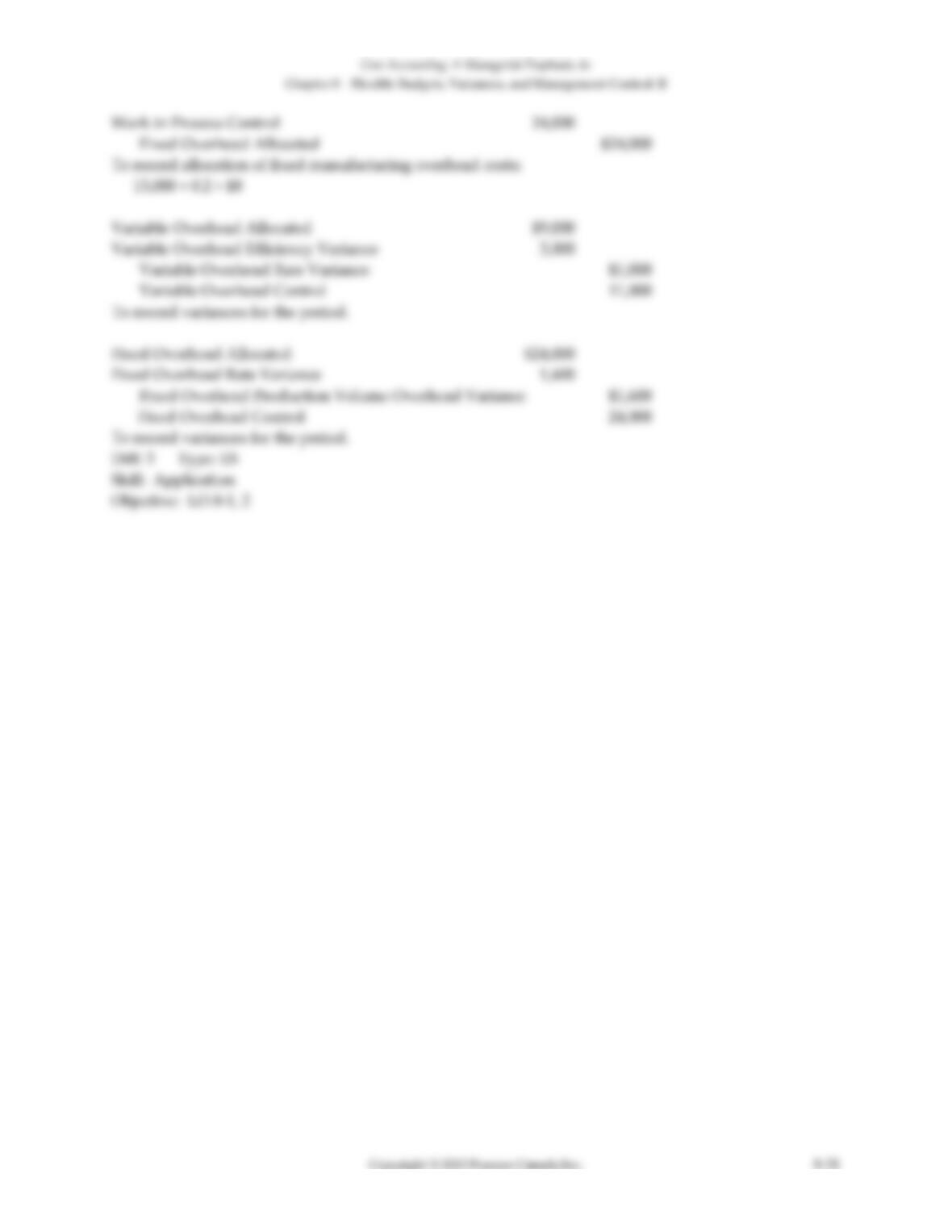
40) Teri’s Furniture uses variance analysis to evaluate manufacturing overhead in its’ table factory. The
information for the May overhead expenditures is as follows:
Budgeted output units 14,000 tables
Budgeted fixed manufacturing overhead $22,400
Budgeted variable manufacturing overhead $3.00 per direct labour hour
Budgeted direct manufacturing labour hours 0.2 hour per table
Fixed manufacturing costs incurred $24,000
Direct manufacturing labour hours used 4,000 hours
Variable manufacturing costs incurred $11,000
Actual units manufactured 15,000 tables
Required:
a. Calculate the variable manufacturing overhead rate and efficiency variances; and, the fixed
manufacturing overhead rate and production-volume variances for the plant controller.
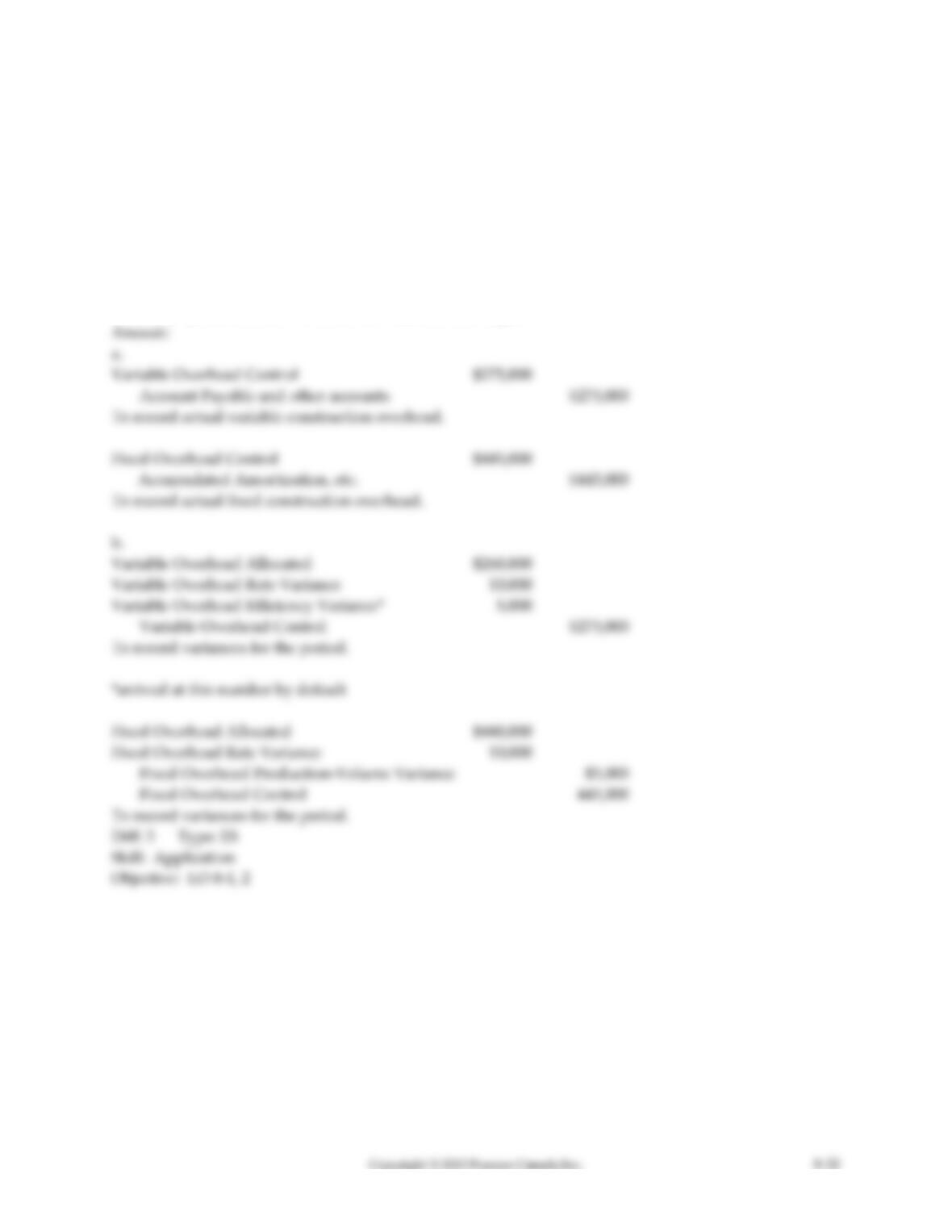
b. Prepare all necessary journal entries to record the actual costs, allocated costs, and variances. Keep
variable and fixed entries separate.
Cost Accounting: A Managerial Emphasis, 6e
Chapter 8 – Flexible Budgets, Variances, and Management Control: II
41) Gibson Homes has allocated budgeted construction overhead for August of $260,000 for variable costs
and $440,000 for fixed costs. Actual costs for the month totalled $275,000 for variable and $445,000 for
fixed. Allocated fixed overhead totalled $440,000. The company tracks each item in an overhead control
account before allocations are made to individual jobs. Rate variances for August were $10,000
unfavourable for variable and $10,000 unfavourable for fixed. The production volume overhead variance
was $5,000 favourable.
Required:
a. Prepare journal entries for the actual costs incurred.
b. Prepare journal entries to record the variances for August.
Cost Accounting: A Managerial Emphasis, 6e
Chapter 8 – Flexible Budgets, Variances, and Management Control: II
42) Briefly explain the meaning of the variable overhead efficiency variance and the variable overhead
rate variance.
43) Briefly explain why a favourable variable overhead rate variance may not always be desireable.
Cost Accounting: A Managerial Emphasis, 6e
Chapter 8 – Flexible Budgets, Variances, and Management Control: II
8.3 Calculate ABC overhead variances.
Answer the following question(s) using the information below.
Munoz Inc. produces a special line of plastic toy racing cars in batches. To manufacture a batch of the cars
Munoz Inc. must setup the machines and molds. Setup costs are batch-level costs because they are
associated with batches rather than individual units of products. A separate Setup Department is
responsible for setting up machines and molds for different styles of car.
Setup overhead costs consist of some costs that are variable and some costs that are fixed with respect to
the number of setup hours. The following information pertains to June 2012:
Actual
Amounts
Static-budget
Amounts
Units produced and sold
15,000
11,250
Batch size (number of units per batch)
250
225
Setup hours per batch
5
5.25
Variable overhead cost per setup hour
$40
$38
Total fixed setup overhead costs
$14,400
$14,000
1) Calculate the efficiency variance for variable setup overhead costs.
A) $1,900 unfavourable
B) $600 favourable
C) $1,900 favourable
D) $600 unfavourable
E) $400 unfavourable
2) Calculate the rate variance for variable setup overhead costs.
A) $1,900 unfavourable
B) $1,900 favourable
C) $400 unfavourable
D) $600 favourable
E) $600 unfavourable
Cost Accounting: A Managerial Emphasis, 6e
Chapter 8 – Flexible Budgets, Variances, and Management Control: II
3) Calculate the flexible-budget variance for variable setup overhead costs.
A) $600 unfavourable
B) $1,300 favourable
C) $600 favourable
D) $1,300 unfavourable
E) $400 unfavourable
4) Calculate the rate variance for fixed setup overhead costs.
A) $1,600 unfavourable
B) $400 unfavourable
C) $600 unfavourable
D) $400 favourable
E) $600 favourable
5) Calculate the production-volume variance for fixed setup overhead costs.
A) $4,666.67 unfavourable
B) $400 unfavourable
C) $1,600 unfavourable
D) $4,666.67 favourable
E) $400 favourable
Cost Accounting: A Managerial Emphasis, 6e
Chapter 8 – Flexible Budgets, Variances, and Management Control: II
Answer the following question(s) using the information below.
Lukehart Industries Inc. produces air purifiers in batches. To manufacture a batch of the purifiers
Lukehart Inc. must setup the machines and assembly line tooling. Setup costs are batch-level costs
because they are associated with batches rather than individual units of products. A separate Setup
Department is responsible for setting up machines and tooling for different models of the air purifiers.
Setup overhead costs consist of some costs that are variable and some costs that are fixed with respect to
the number of setup hours. The following information pertains to June 2012:
Budget
Amounts
Actual
Amounts
Units produced and sold
10,000
9,000
Batch size (number of units per batch)
400
375
Setup hours per batch
6
5.5
Variable overhead cost per setup hour
$50
$52
Total fixed setup overhead costs
$18,000
$17,750
6) Calculate the efficiency variance for variable setup overhead costs.
A) $150 favourable
B) $114 favourable
C) $264 unfavourable
D) $264 favourable
E) $250 favourable
7) Calculate the rate variance for variable setup overhead costs.
A) $150 unfavourable
B) $150 favourable
C) $264 unfavourable
D) $264 favourable
E) $114 favourable
Cost Accounting: A Managerial Emphasis, 6e
Chapter 8 – Flexible Budgets, Variances, and Management Control: II
8) Calculate the flexible-budget variance for variable setup overhead costs.
A) $114 favourable
B) $264 favourable
C) $264 unfavourable
D) $114 unfavourable
E) $150 unfavourable
9) Calculate the rate variance for fixed setup overhead costs.
A) $114 unfavourable
B) $150 unfavourable
C) $250 unfavourable
D) $150 favourable
E) $250 favourable
10) Calculate the production-volume variance for fixed setup overhead costs.
A) $1,800 favourable
B) $1,800 unfavourable
C) $250 unfavourable
D) $250 favourable
E) $114 unfavourable
11) Fixed and variable cost variances can ________ be applied to activity-based costing systems.
A) occasionally
B) always
C) seldom
D) most times
E) never
Cost Accounting: A Managerial Emphasis, 6e
Chapter 8 – Flexible Budgets, Variances, and Management Control: II
12) How can a standard costing system be useful in negotiating new sales?