Introduction to General, Organic & Biological Chemistry, 12e (Timberlake)
Chapter 8 Gases
8.1 Multiple-Choice Questions
1) Which of the following is not part of the kinetic theory of gases?
A) A gas is composed of very small particles.
B) There is very little empty space in a gas.
C) Gas particles move rapidly.
D) Gas particles do not attract or repel one another.
E) Gas particles move faster when the temperature increases.
2) According to the kinetic theory of gases, a gas can be compressed much more than a liquid or
solid because ________.
A) a gas is composed of very small particles
B) the particles of a gas are very far apart
C) gas particles move rapidly
D) gas particles do not attract or repel one another
E) gas particles move faster when the temperature increases
3) In the kinetic molecular theory of gas behavior, the assumption is made that gas molecules
________.
A) move rapidly in random directions
B) are attracted to each other by strong forces
C) are close together in their container
D) move with a kinetic energy equal to their centigrade temperature
E) occasionally come to rest
4) According to the kinetic theory of gases, particles of a gas ________.
A) are very large particles
B) are very far apart
C) lose their valence electrons
D) move slowly
E) decrease kinetic energy as temperature increases
5) In the kinetic molecular theory of gas behavior, particles of a gas tend to move ________ and
collisions between them are ________.
A) rapidly, rare
B) slowly, rare
C) rapidly, elastic
D) slowly, elastic
E) slowly, unusual
6) The force of gas particles against the walls of a container is called ________.
A) pressure
B) volume
C) temperature
D) quantity of gas
E) density
3
7) Which measurement describes the pressure of a gas?
A) 315 K
B) 1.2 g/L
C) 2.5 L
D) 725 mmHg
E) 0.45 moles
8) The unit of 1 atmosphere used to describe the pressure of a gas is equal to ________.
A) 1 mmHg
B) 100 mmHg
C) 200 mmHg
D) 600 mmHg
E) 760 mmHg
9) A 5.00-L tank contains helium gas at 1.50 atm. What is the pressure of the gas in mmHg?
A) 1.50 mmHg
B) 507 mmHg
C) 760 mmHg
D) 1140 mmHg
E) 3800 mmHg
10) In response to Boyle’s law, the pressure of a gas increases as the volume decreases because
________.
A) the gas particles get bigger
B) the kinetic energy of the gas particles increases
C) the temperature of the gas increases
D) the gas particles strike the walls of the container with more force
E) the gas particles strike the walls of the container more often
11) Which of the following correctly describes the process of inspiration (air entering the lungs)?
A) The lungs expand, causing their internal pressure to decrease.
B) The lungs expand, causing their internal pressure to increase.
C) The lungs contract, causing their internal pressure to decrease.
D) The lungs contract, causing their internal pressure to increase.
E) There is no change in the internal pressure in the lungs.
12) The volume of a gas with a pressure of 1.2 atm increases from 1.0 L to 4.0 L. What is the
final pressure of the gas, assuming constant temperature?
A) 1.2 atm
B) 0.30 atm
C) 3.3 atm
D) 4.8 atm
E) 1.0 atm
13) The pressure of 5.0 L of gas increases from 1.50 atm to 1240 mmHg. What is the final
volume of the gas, assuming constant temperature?
A) 4100 L
B) 5.0 L
C) 0.0060 L
D) 5.4 L
E) 4.6 L
14) The gas with an initial volume of 24.0 L at a pressure of 565 torr is compressed until the
volume is 16.0 L. What is the final pressure of the gas, assuming the temperature does not
change?
A) 377 torr
B) 760 torr
C) 848 torr
D) 500. torr
E) 465 torr
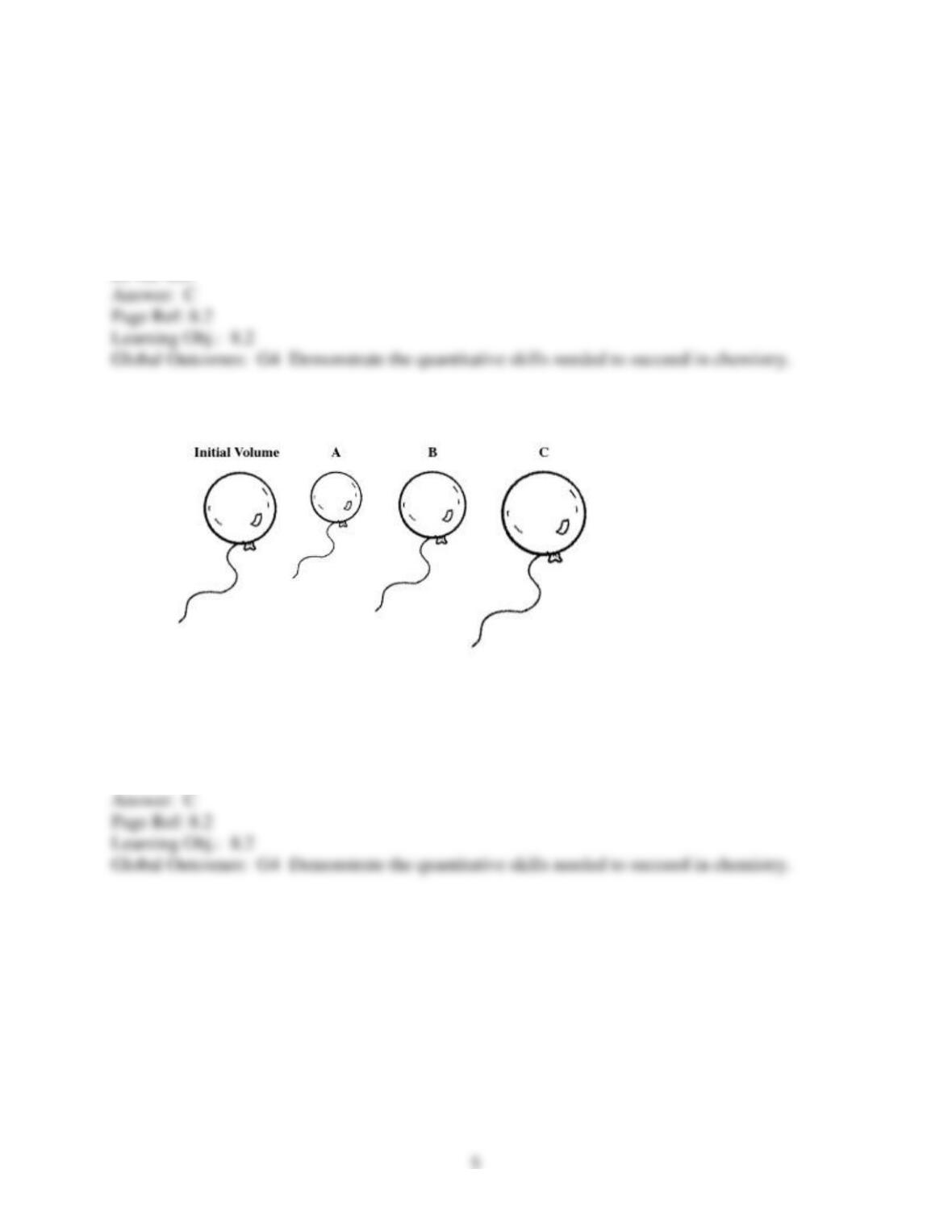
A balloon is filled with helium gas. For the following question(s), select the letter of the balloon
diagram that corresponds to the given change in conditions.
15) The balloon is put into a chamber where the pressure is less than the atmospheric pressure.
A) A
B) B
C) C
D) A and B
E) B and C
16) At constant temperature, a sample of helium at 760. torr in a closed container was
compressed from 5.00 L to 3.00 L. What was the new pressure exerted by the helium on its
container?
A) 800. torr
B) 2280 torr
C) 15.0 torr
D) 3800 torr
E) 1270 torr
17) A gas sample in a closed, expandable container of initial volume 5.00 L was allowed to
warm from 25 °C to What was its new volume?
A) 4.84 L
B) 5.17 L
C) 7.00 L
D) 3.57 L
E) 4380 L
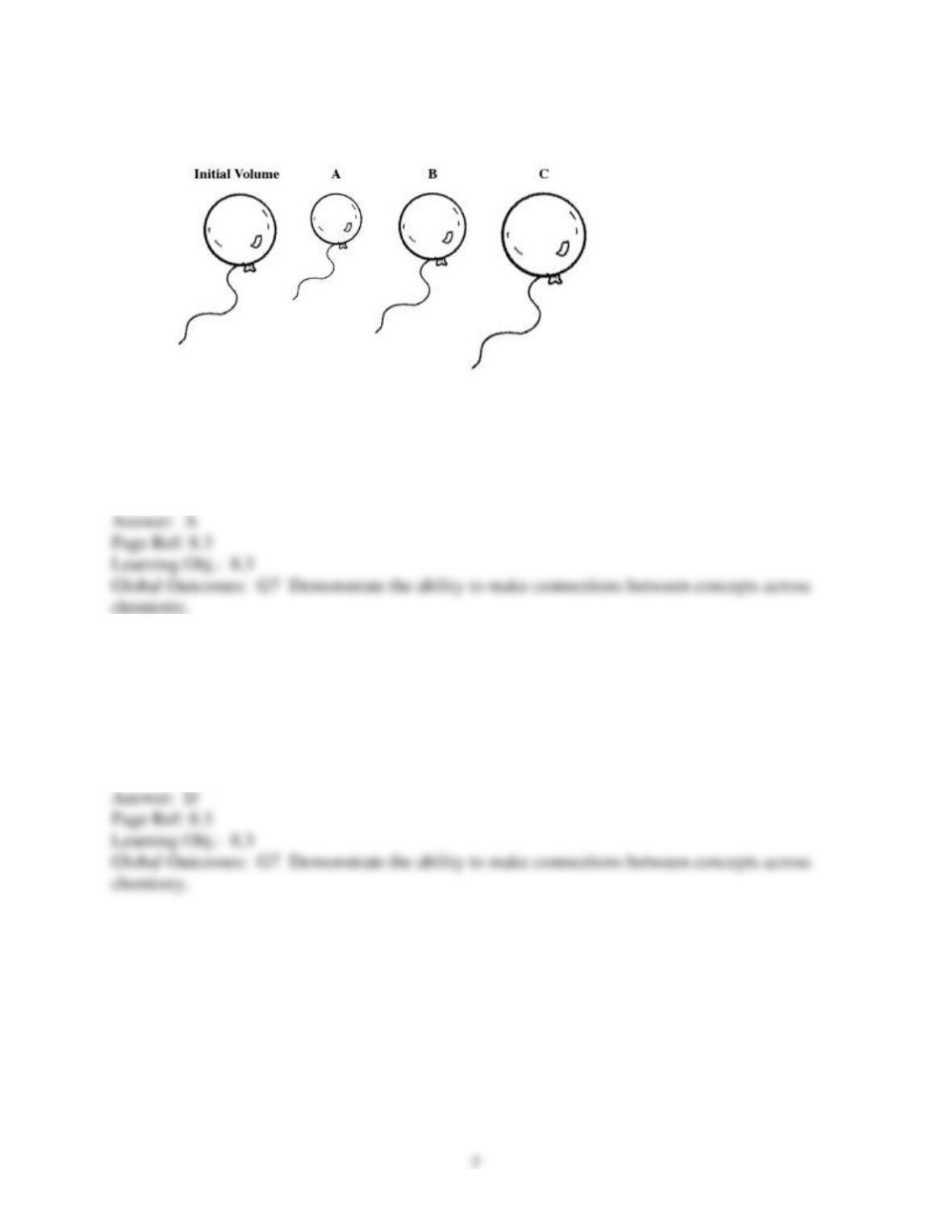
A balloon is filled with helium gas. For the following question(s), select the letter of the balloon
diagram that corresponds to the given change in conditions.
18) The temperature is changed from 50 °C to -150 °C at constant pressure.
A) A
B) B
C) C
D) A and B
E) B and C
19) Complete the following statement: In Charles’s law, the volume of a gas ________ when the
________ decreases.
A) increases, temperature
B) increases, quantity of gas
C) increases, pressure
D) decreases, temperature
E) decreases, pressure
20) What temperature scale is used in gas law calculations?
A) Fahrenheit
B) Celsius
C) Kelvin
D) either Celsius or Fahrenheit
E) either Celsius or Kelvin
21) A temperature of 125 °C is the same as ________.
A) -148 K
B) 398 K
C) 257 K
D) 530. K
E) 273 K
22) The temperature of a 500. mL sample of gas increases from 150. K to 350. K. What is the
final volume of the sample of gas, if the pressure in the container is kept constant?
A) 210 mL
B) 1170 mL
C) 0.00950 mL
D) 0.00474 mL
E) 110 mL
23) In Gay-Lussac’s law, the pressure of a gas increases due to an increase in temperature
because ________.
A) the molecules strike the walls of the container less often
B) the molecules strike the walls of the container more often
C) the molecules get bigger
D) there is a decrease in the volume of the container
E) there is an increase in the number of gas particles
24) A gas contained in a steel tank has a pressure of 1.5 atm at a temperature of 320 K. What will
be the gas pressure when the temperature changes to 450 K?
A) 1.5 atm
B) 0.94 atm
C) 0.47 atm
D) 2.1 atm
E) 1.1 atm
25) A sample of argon at 300. °C and 50.0 atm pressure is cooled in the same container to a
temperature of What is the new pressure?
A) 105 atm
B) 45.5 atm
C) 54.9 atm
D) 23.8 atm
E) 42.7 atm
26) A gas at 5.00 atm pressure was stored in a tank during the winter at 5.0 °C. During the
summer, the temperature in the storage area reached 40.0 °C. What was the pressure in the gas
tank in the summer?
A) 0.625 atm
B) 4.44 atm
C) 5.63 atm
D) 40.0 atm
E) 69.5 atm
27) A sample of nitrogen gas had a volume of 500. mL, a pressure in its closed container of 740
torr, and a temperature of 25 °C. What was the new volume of the gas when the temperature was
changed to 50 °C and the new pressure was 760 torr?
A) 530 mL
B) 450 mL
C) 970 mL
D) 240 mL
E) 400 mL
28) At 570. mmHg and 25 °C, a gas sample has a volume of 2270 mL. What is the final pressure
(in mmHg) at a volume of 1250 mL and a temperature of 175 °C?
A) 1560 mmHg
B) 210 mmHg
C) 7000 mmHg
D) 690 mmHg
E) 470 mmHg
29) A diver exhales a bubble with a volume of 250 mL at a pressure of 2.4 atm and a temperature
of 15 °C. What is the volume of the bubble when it reaches the surface where the pressure is 1.0
atm and the temperature is 27 °C?
A) 580 mL
B) 630 mL
C) 100 mL
D) 110 mL
E) 1100 mL
30) According to Avogadro’s law, ________.
A) the volume of a gas is inversely related to the number of moles at constant temperature and
pressure
B) the volume of a gas is inversely related to the number of moles at standard temperature and
pressure
C) the volume of a gas depends only on the temperature and pressure
D) the volume of a gas depends only on the number of moles in the sample
E) the volume of a gas is directly related to the number of moles at constant temperature and
pressure
31) At STP, temperature and pressure have the values of ________.
A) 0 K and 1 atm
B) 273 K and 1 mmHg
C) 273 K and 760 mmHg
D) 0 K and 760 mmHg
E) 760 K and 273 atm
32) A gas sample contains 4.0 g of and 2.0 g of He. What is the volume of the sample at
STP?
A) 130 L
B) 11 L
C) 17 L
D) 30. L
E) 5.6 L
33) A gas sample containing 12 g of has a volume of 14 L. What will the volume be if 12 g
of He is added? (Temperature and pressure do not change.)
A) 22.4. L
B) 53 L
C) 56 L
D) 70 L
E) 3.5 L
34) How many moles of neon occupy a volume of 14.3 L at STP?
A) 36.7 moles
B) 32.0 moles
C) 6.45 moles
D) 0.638 moles
E) 1.57 moles
35) 1 mole of a gas occupies 22.4 L at ________.
A) 0 °C and 0.50 atm
B) 0 °C and 760 mmHg
C) 100 °C and 1 atm
D) 100 °C and 10 atm
E) 0 K and 1 atm
36) At STP conditions, 11 g of have a volume of ________.
A) 250 L
B) 3.8 L
C) 22 L
D) 0.0076 L
E) 130 L
37) The total pressure in a mixture of gases is equal to the partial pressure(s) of ________.
A) the gas with the greatest number of moles
B) the gas with the smallest number of moles
C) the gas with the highest molecular weight
D) the gas that occupies the largest volume
E) all the gases added together
38) A cyclopropane-oxygen mixture is used as an anesthetic. If the partial pressure of
cyclopropane in the mixture is 330 mmHg and the partial pressure of the oxygen is 1.0 atm, what
is the total pressure of the mixture in torr?
A) 330 torr
B) 430 torr
C) 760 torr
D) 1.4 torr
E) 1100 torr
39) A tank contains helium gas at 490 mmHg, nitrogen gas at 0.75 atm, and neon at 520 torr.
What is the total pressure in atm?
A) 2.1 atm
B) 0.55 atm
C) 1.0 × atm
D) 1.5 atm
E) 1600 atm
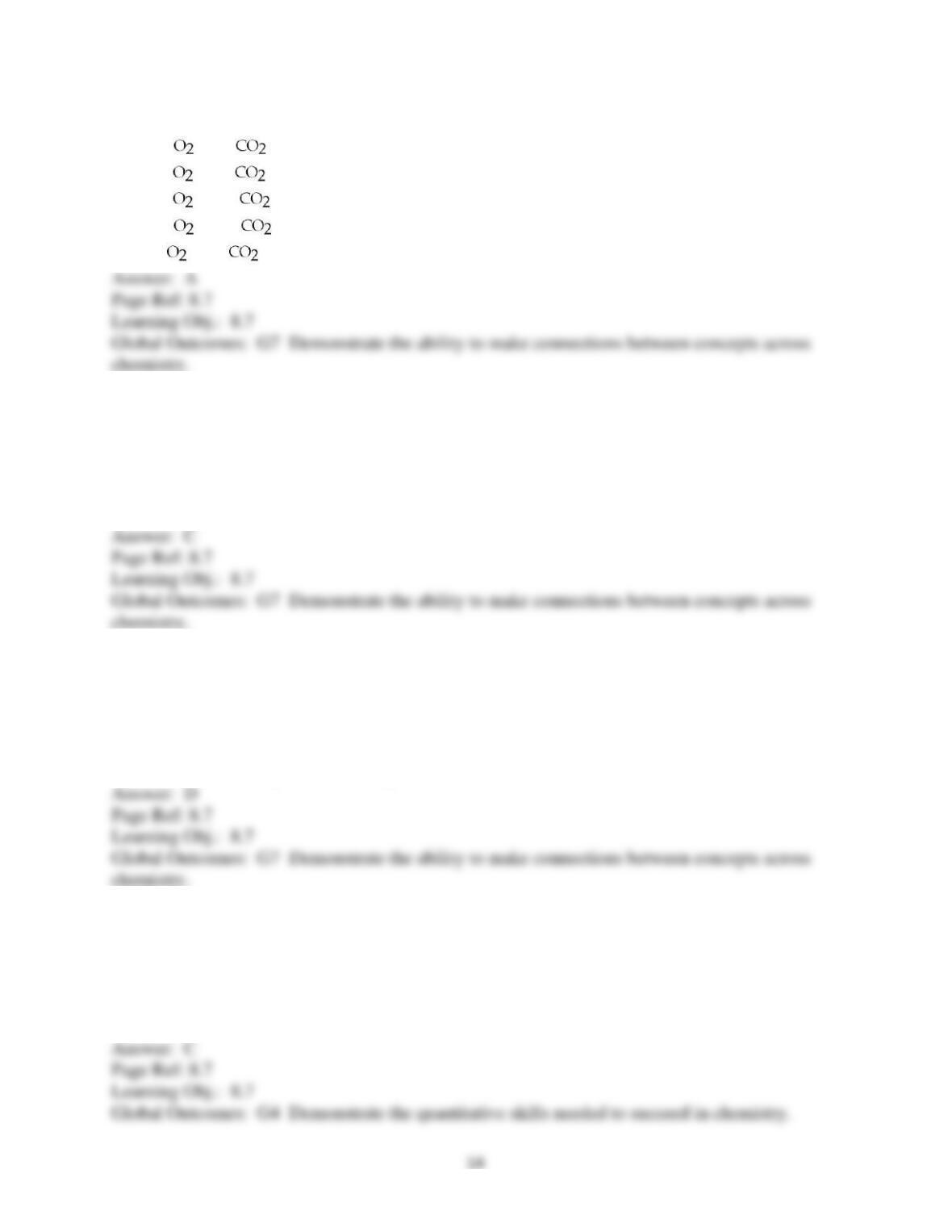
40) Which of the following correctly describes the partial pressures of gases in the body?
A) high , low , oxygenated blood
B) high , low , deoxygenated blood
C) high , high , oxygenated blood
D) high , high , tissue
E) low , low , deoxygenated blood
41) Which of the following is not a potential use for a hyperbaric chamber?
A) treatment for burns and infections
B) counteracting carbon monoxide poisoning
C) increasing the rate at which a broken bone heals
D) treating a diver with the bends
E) treating some cancers
42) The pressure exerted by a gas on its container is directly proportional to ________.
A) the volume of the container
B) the mass of the individual gas molecules
C) the Celsius temperature of the gas
D) the number of molecules of gas in the sample
E) the Fahrenheit temperature of the gas
43) At STP, what is the volume of 4.50 moles of nitrogen gas?
A) 167 L
B) 3420 L
C) 101 L
D) 60.7 L
E) 1230 L
44) At STP, how many moles of helium would occupy 1.00 L?
A) 2.24 moles
B) 224 moles
C) 22.4 moles
D) 0.446 moles
E) 0.0446 moles
45) At STP, what is the volume of 1.0 mole of carbon dioxide?
A) 1.00 L
B) 44.0 L
C) 273 L
D) 22.4 L
E) 12.2 L
46) At STP, what is the mass 13.0 L of methane, C ?
A) 0.580 g
B) 16.0 g
C) 9.31 g
D) 27.6 g
E) 22.4 g
8.2 Short Answer Questions
1) Nitrogen makes up about ________ percent of the atmosphere.
2) A barometer is usually filled with ________.
3) One atmosphere is the same pressure as ________ mmHg.
4) The pressure unit 1 mmHg is the same pressure unit as the pressure unit ________.
5) According to Boyle’s Law, when the volume increases, the pressure ________.
6) A gas has a volume of 12.0 L when the pressure is 840. torr. When the pressure changes to
600. torr, what is the new volume, if there is no change in temperature or amount of gas?
7) A gas has a volume of 46.0 L when the temperature is 400. K. When the temperature changes
to 500. K, what is the new volume, if there is no change in pressure or amount of gas?
8) A temperature of 273 °C is equivalent to ________ K.
9) A gas has a pressure of 540. torr when the temperature is 127 °C. When the temperature
changes to 27 °C, what is the new pressure, if there is no change in volume or amount of gas?
10) A gas has a pressure of 700. mmHg when the temperature is 107 °C. At what temperature
(°C) will the pressure be 600. mmHg, if there is no change in volume or amount of gas?
11) A gas has a volume of 45.0 L and a pressure of 540. mmHg when the temperature is 27 °C.
What is the volume when the pressure changes to 800. mmHg with a temperature of -65 °C, if
there is no change in the amount of gas?
12) A gas has a volume of 36.0 L and a pressure of 750. torr when the temperature is 10. °C.
What is the pressure if the volume changes to 15.0 L and the temperature changes to 78 °C, if the
amount of gas stays the same?
13) STP is ________ mmHg and ________K.
14) What is the volume, in L, of 36.0 g of CH4 at STP?
15) What is the total pressure (in atm) of a gas mixture, which has CH4 600. torr and He 450.
mmHg?
16) The total pressure of a mixture of CO2 and O2 is 780 mmHg. If the pressure of the CO2 is
560. torr, what is the pressure of O2?
8.3 True/False Questions
1) The air we breathe is about 21% oxygen.
2) The speed of gas molecules is related to the volume of the container.
3) The kinetic energy of a gas sample is directly proportional to the Kelvin temperature of the
gas.
4) At 0 K, all molecular motion stops.
5) The pressure increases as the volume increases, if temperature does not change.
6) Gas law calculations require the use of the Kelvin temperature scale.
7) The pressure exerted by a gas on its container is inversely related to its Kelvin temperature.
8) The volume of 1 mole of any gas at STP is 22.4 L.
9) STP stands for 0 °C and 760 mmHg.
10) During inspiration, we use 100% of the oxygen in the air we breathe.
11) In deoxygenated blood, the partial pressure of carbon dioxide is greater than the partial
pressure of oxygen left.

8.4 Matching Questions
Indicate the effect of each change upon the pressure of a gas.
A) no change
B) increases
C) decreases
1) decrease in volume
Page Ref: 8.2
Learning Obj.: 8.2
2) The temperature is doubled. (V,n constant)
Page Ref: 8.4
Learning Obj.: 8.4
3) The volume and the Kelvin temperature are reduced by one-half.(n constant)
Page Ref: 8.5
Learning Obj.: 8.5
4) removing some molecules of gas (V,T constant)
Page Ref: 8.6
Learning Obj.: 8.6
5) A leak occurs and gas escapes.(V,T constant)
Page Ref: 8.6
Learning Obj.: 8.6
6) One mole of gas is added.(V,T constant)
Page Ref: 8.6
Learning Obj.: 8.6