1
Chapter 8
Multiple Choice
1. Of the following items, the one that should be classified as a current asset is
2. The advantage of relating a company’s bad debt experience to its accounts receivable is that this
approach
3. Assuming that the ideal measure of short-term receivables in the balance sheet is the discounted
value of the cash to be received in the future, failure to follow this practice usually does not make
the balance sheet misleading because
4. An account that would be classified as a current liability is
5. Jamison Corporation’s inventory cost on its statement of financial position was lower using first–
in, first-out than last-in, first-out. Assuming no beginning inventory, what direction did the cost of
purchases move during the period?
2
6. If inventory levels are stable or increasing an argument that favors the FIFO method as compared
to LIFO is
7. An inventory pricing procedure in which the oldest costs incurred rarely have an effect on the
ending inventory valuation is
8. When inventory declines in value below original (historical) cost, and this decline is considered
other than temporary, what is the maximum amount that the inventory can be valued at?
9. Which of the following inventory cost flow methods involves computations based on broad
inventory pools of similar items?
10. When the allowance method of recognizing bad debt expense is used, the entries at the time of
collection of an account previously written off would
11. The original cost of an inventory item is above the replacement cost. The replacement cost is
below the net realizable value less the normal profit margin. Under the lower of cost or market
method the inventory item should be priced at its
13. Liquidity is the ability
14. Liquidity ratios measures the
15. Working capital is a measure of
16. A common measure of liquidity is
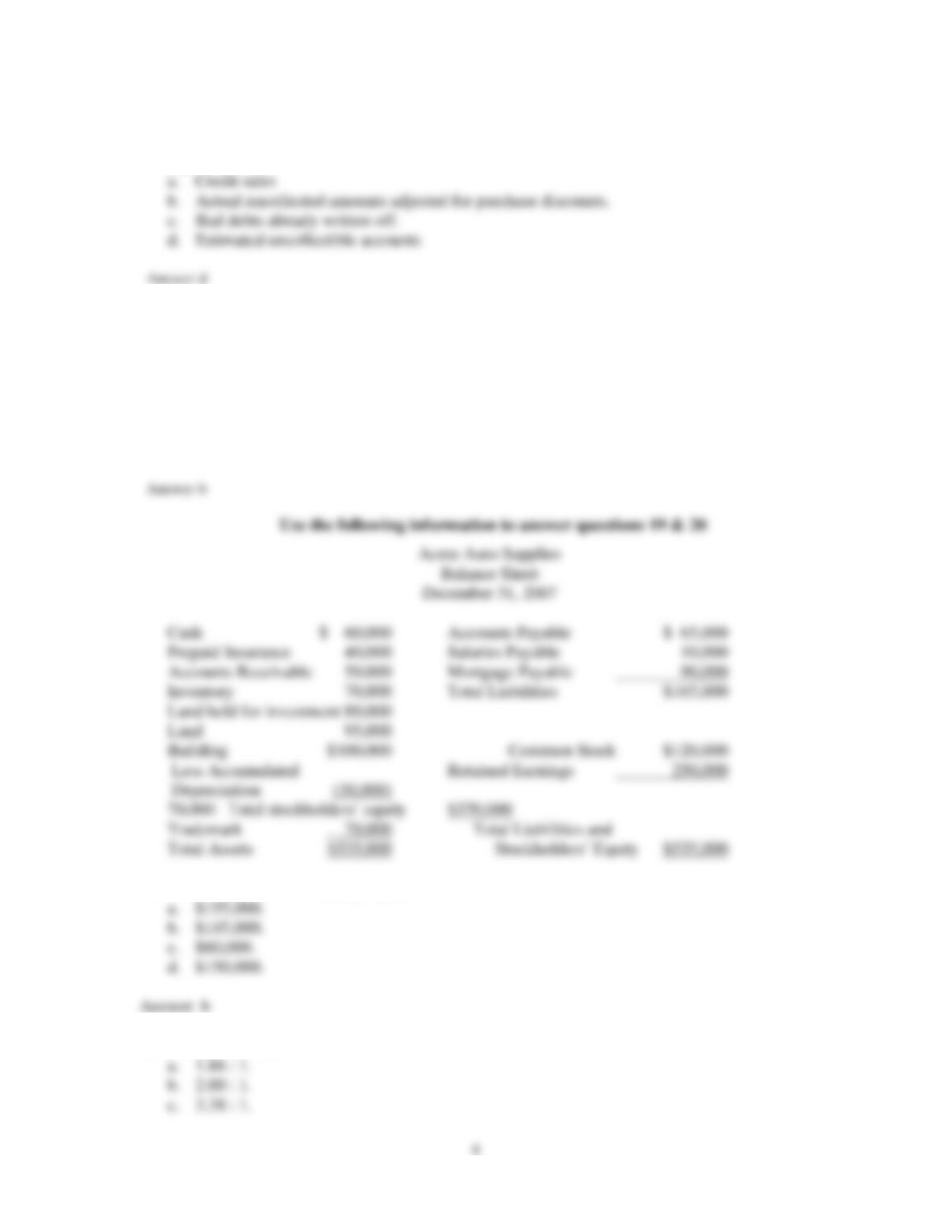
17. The net realizable value of receivables is calculated as the face value of the receivables less
adjustments for
18. A successful discount retail store such as Wal-Mart would probably have
a. A low inventory turnover
b. A high inventory turnover
c. Zero profit margin
d. Low volume
19. The total amount of working capital is
20. The current ratio is
5
Essay
1. Define working capital.
2. Define the following terms:
6
3. Define the following terms:
4. List and briefly define the methods of accounting for investments under SFAS No.
115“Accounting for Certain Investments in Debt and Equity Securities” (FASB ASC 320).
5. Define and discuss the two methods of estimating bad debts on receivables.
6. Why are cost flow assumptions used to determine inventory valuations? Define and explain the
rationale for using each of the cost flow assumptions.
.
7. Discuss the perpetual vs. the periodic methods of accounting for inventories.
8. Obtain a company’s financial statements and ask the students to compute the following: