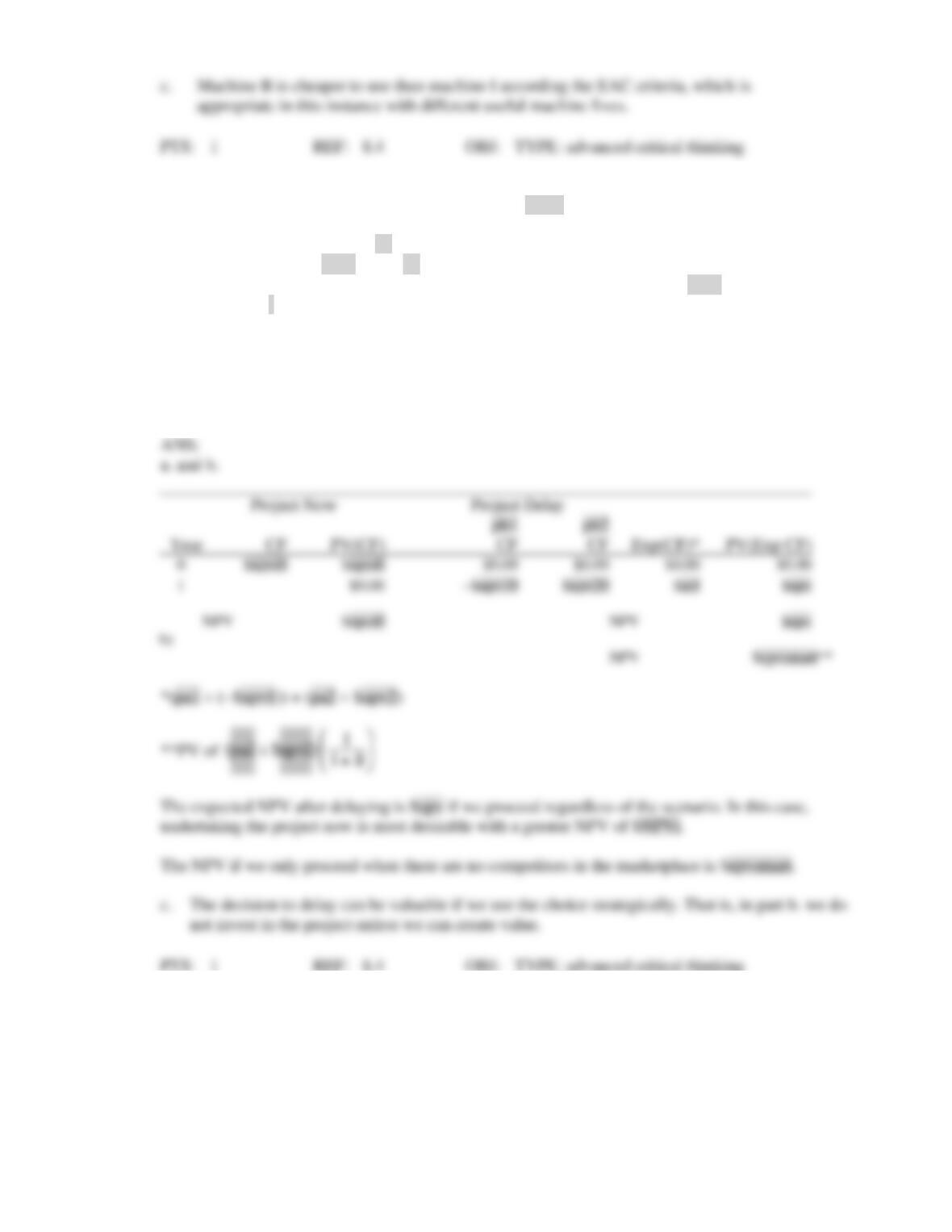
7. You are considering investing in a project related to a new product opportunity. If you undertake the
project immediately, you calculate the NPV will be $NPVi. If you defer the decision for one year, you
will learn more about the relevant manufacturing process as well as the market for your product. If you
wait one year, you expect with p1 percent likelihood competitors will enter the market and your NPV
(in one year) will be −$npv1. With p2 percent likelihood, you will be the only market player and you
will improve your production technology to create an NPV (in one year) of $npv2. The appropriate
discount rate is r percent.
a.
Calculate the expected NPV if you defer the project for one year, regardless of the potential
scenario.
b.
Calculate the expected NPV if you strategically decide how to undertake your project. That is,
if we find that competitors enter the market, we can decide not to enter.
c.
Interpret the difference in your answers to parts a. and b.
8. There is suggestive evidence that stock market prices increase when firms undertake capital
investments. Explain why the stock market should rationally respond favorably to most investment
decisions by firms. In particular, intuitively describe how share prices should respond to good and bad
management decisions by a firm’s management. Consider only financial claimants to a firm’s cash
flows.
c.
Machine II is cheaper to use than machine I according the EAC criteria, which is
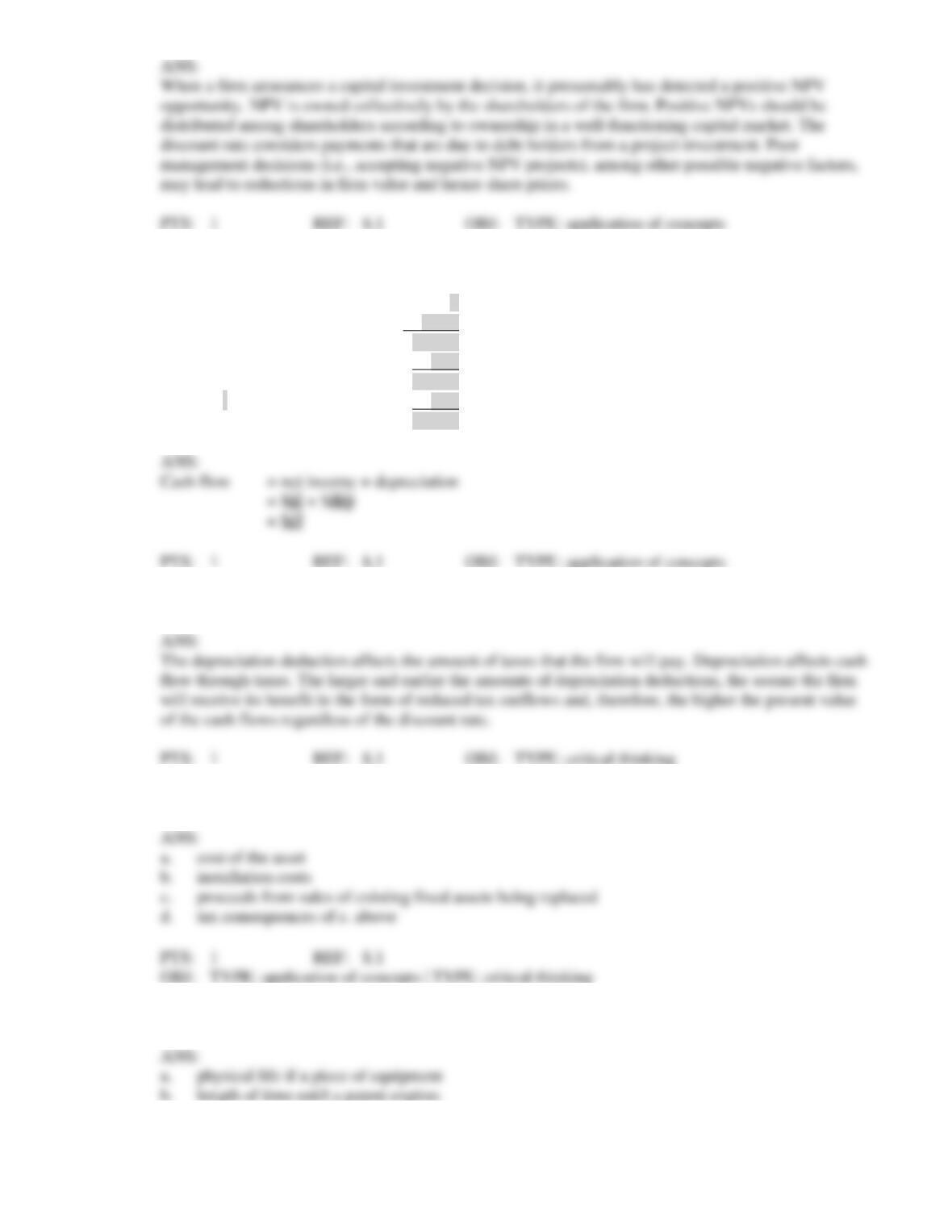
9. Calculate the cash flow generated by Cash Cow Corporation.
Sales
$s
COGS
(cogs)
Gross profit
sg1gp
Depreciation
(dep)
Pretax income
sg2pi
Taxes at t%
(tax)
Net income
sg3ni
Cash flow
= net income + depreciation
10. Why must analysts know the magnitude and timing of depreciation deductions?
11. What are the variables considered in the cash consequences of the initial fixed asset expenditure?
cost of the asset
b.
installation costs
proceeds from sales of existing fixed assets being replaced
d.
tax consequences of c. above
12. What can determine the life span of an investment?
physical life if a piece of equipment
13. What do analysts usually estimate for investment projects?
14. Explain an investor’s opportunity costs used in capital budgeting.
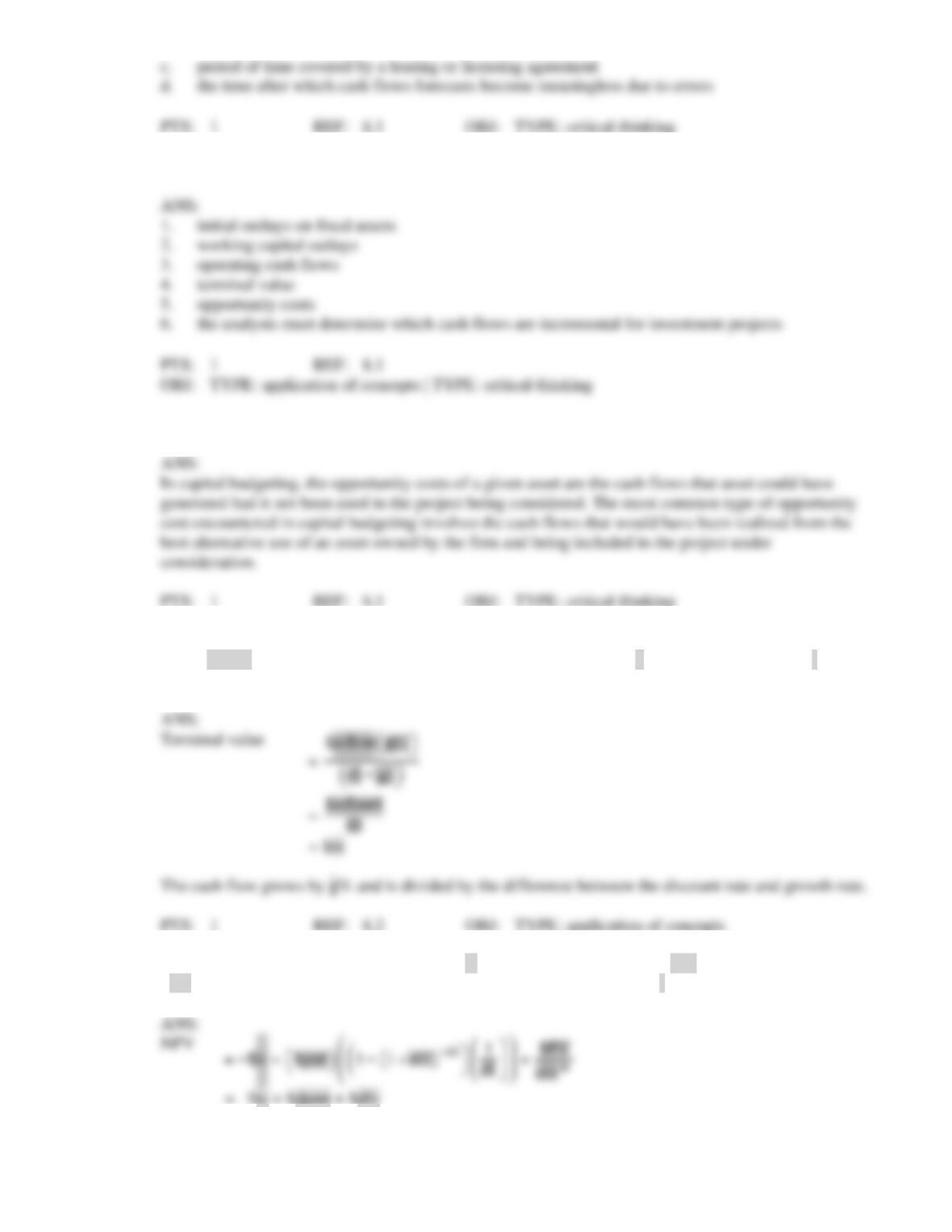
15. Calculate the terminal value at the end of 10 years for a project if the net cash inflow generated in year
10 is $inflow, assuming that cash flows beyond the 10th year grow at g% and are discounted at r
percent.
16. Assume that a project has an initial cost of $ic, 10 years of cash flows of $pmt, and a terminal value of
$FV at the end of year 10. Calculate the NPV for the project assuming a r percent discount rate.
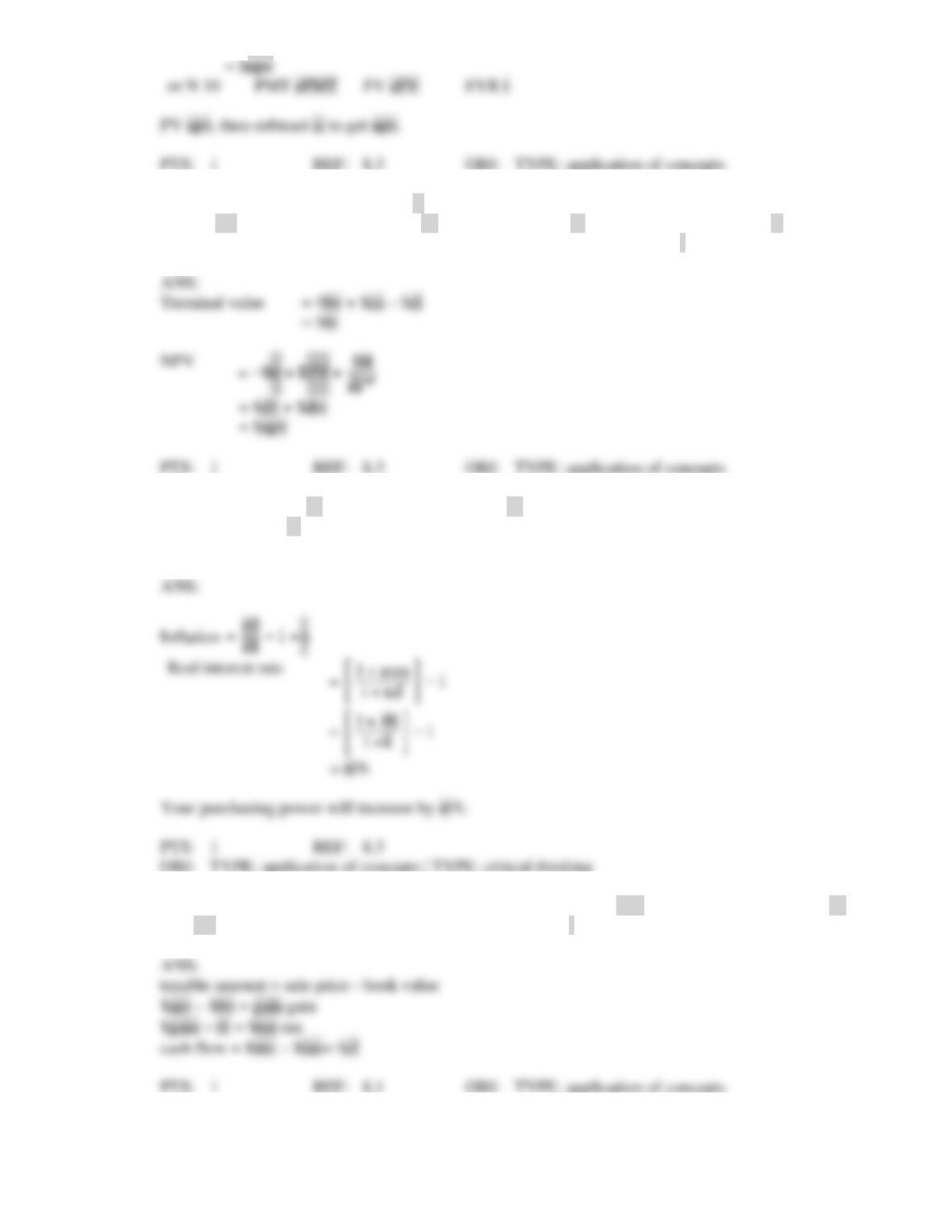
17. A project requires an initial cost of $ic; has a present value of operating cash flows over its ten-year
life of $PV; and has a book value of $bv, current assets of $ca, and current liabilities of $cl. Calculate
the terminal value and NPV using its book value after 10 years, assuming a r percent discount rate.
18. Compact discs cost $c1 today, and they will cost $c2 next year. You have the opportunity to invest in
an asset earning a rn% nominal return for the next year. By what percentage will your C.D. purchasing
power change if you invest your money for the year?
19. If the R & R Corporation sells an old piece of equipment costing $cost and depreciated down to $bv
for $mv, what is the cash flow from the sale if R & R has a t% tax rate?
20. A project requires an investment in machinery today of $invest million. That investment can be
depreciated for tax purposes straight-line to zero over 5 years. Starting one year from now and ending
4 years from now, the project will generate annual revenues of $rev million and expenses of $ex
million, both pretax. An immediate working capital investment of $wc million is required, and
working capital will remain at that level until recovered 4 years from now. Also at year 4, the
machinery will be sold for $mv million. The firm is taxed at t%. An appropriate discount rate is r%.
What is NPV?
21. You own some equipment that will soon need to be replaced. Whenever you replace it, the new
equipment will cost $cost million and last 12 years, after which time it will have no scrap value. After
that, you expect to buy the same equipment at the same price. There is no inflation. This new
equipment does not require maintenance.
You can replace the old equipment today or after 1 year. If you replace today, the old equipment’s
scrap value will be $sv million and there will be no further maintenance expense. If you wait a year,
scrap value will be 0 and you will incur maintenance expense of $me million, which you can assume is
paid 1 year from now. There are no taxes, and the relevant discount rate is r%. Should you replace now
or later?
22. A certain machine that initially costs $cost may be depreciated straight line to zero over 8 years.
However, your firm sells the machine after 5 years for $mv. If the tax rate is t%, how much would you
pay in taxes associated with this sale (or how much would your tax bill be reduced because of this sale,
if that is appropriate)?
23. A firm will make a cash outlay of $cost for a piece of equipment. Assume the firm has no other
expenses or revenues other than those associated with this project. The firm is going to purchase an
additional $addinv of inventory for production with the new equipment and set up a cash account
with a $cash balance. The inventory purchase will result in an account payable of $ap. The firm’s tax
rate is tax%. What is the net cash flow at time zero?
24. From the last year in which you are estimating a project’s cash flow, you derive a cash flow from
operations of $cf. You assume that the cash flows will continue to grow at a rate of g% beyond that.
The discount rate you are applying to the cash flows is r%. Using a constant growth approach to value
cash flows, determine the terminal value of the project.
25. Given the opportunity to choose a depreciation schedule for tax purposes, would a firm generally
prefer a more rapid schedule or a less rapid schedule? Explain.
26. You are deciding between two pieces of harvesting equipment. Assume that whichever one you pick,
you will continue to buy that item each time the previous one cannot be used anymore. The tax rate is
t%. All the cash flows listed will remain the same and there is no inflation.
Option 1: Costs $c1. At the end of each year, it generates annual pre-tax revenues of $rev1, and annual
pre-tax expenses (equipment maintenance and other operating costs) of $exp1. This machine will last
for 14 years, but it can be depreciated straight-line to zero for 10 years.
Option 2: Costs $c2. At the end of each year, it generates annual pre-tax revenues $rev2 and pre-tax
expenses $exp2. It lasts for 10 years, and is depreciated straight-line for 10 years.
At a discount rate of r%, what are the equivalent annual net benefits, and which option is preferred?
ESSAY
1. In the following scenarios, identify the name of the cost or cash flow (incremental cash flow,
opportunity cost, sunk cost, working capital) and how the amount will be included in the capital
budgeting analysis or why it will not be included.
1.
A new machine will increase sales by $a1.
2.
The new project will actually reduce sales of another existing product by $a2 per year.
3.
The firm’s accounts receivable will increase by $ar and accounts payable will increase by
$ap.
4.
The firm has done a marketing research study costing $a4 to determine whether there is
enough demand to expand the product market.
5.
The firm will experience reduced costs of $a5 per year due to the mechanization of the
production line with the new equipment.
6.
The firm currently has $a6 in fixed costs of which it believes it can charge off percent% to
the new project.
2. One approach to determining the terminal value of a project involves the use of the constant growth
model.
a.
Discuss a second approach involving book value to determine the terminal value.
b.
Compare expected results under the two methods.
c.
Discuss why including the terminal value is relevant.
growth model’s terminal value. A growing business should have a market value that exceeds
1.
Include the incremental cash flow on an after-tax basis as an operating cash inflow.
2.
Include this externality on an after-tax basis as an operating cash outflow.
3.
Include the $na difference as a change in working capital as an outflow.
4.
Do not include this sunk cost because it was incurred prior to beginning the project.
5.
Include this incremental cost reduction on an after-tax basis as an operating cash inflow.
6.
Do not include this value as it is not an incremental amount and is a sunk cost.
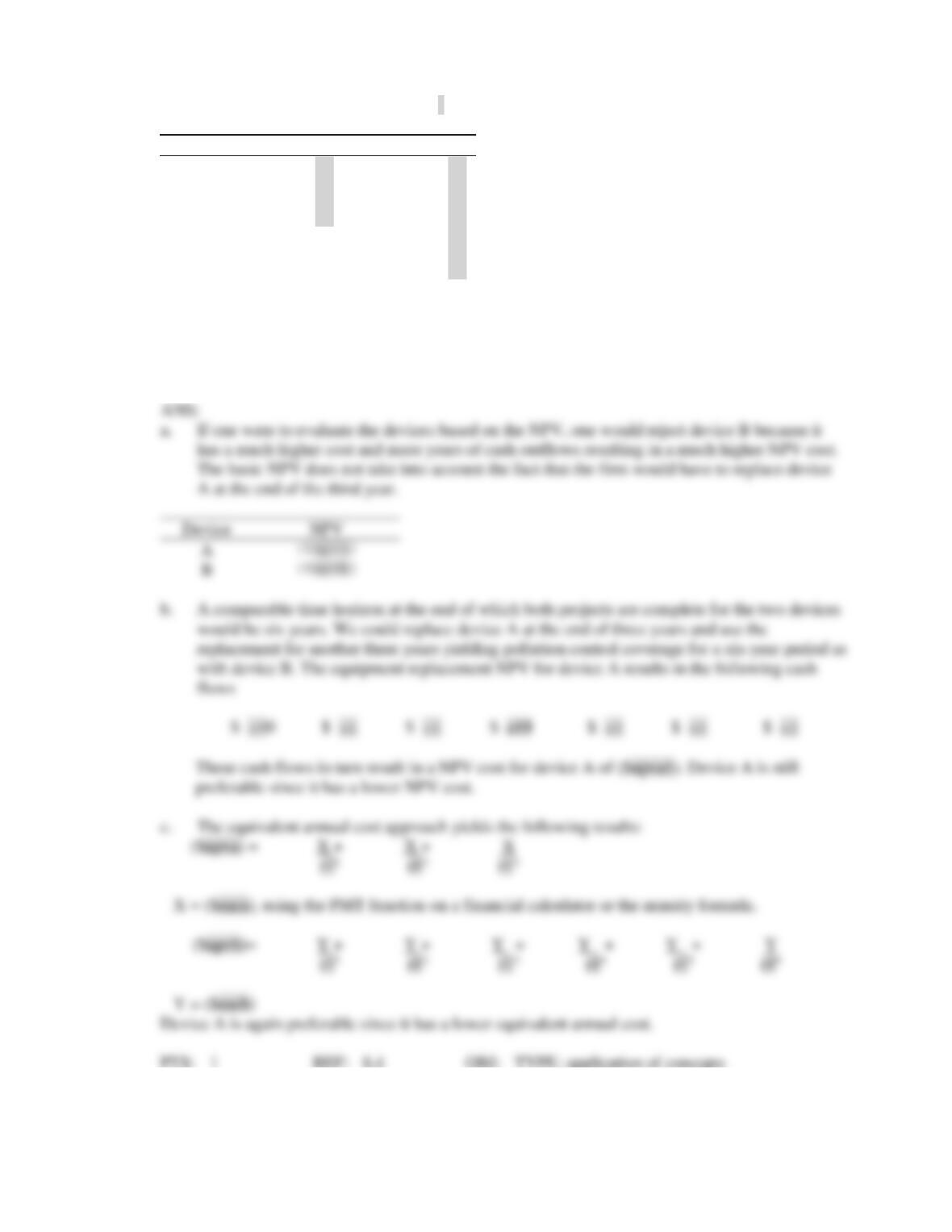
3. Ball Corporation is currently evaluating two mutually exclusive pollution control devices. The devices
have differing initial costs, differing maintenance costs over their operational lives, and different
operating lives. The real discount rate is r%. The real cash flows for each device are as follows:
Time
Device A
Device B
0
($a0)
($b0)
1
($a1)
($b1)
2
($a1)
($b1)
3
($a1)
($b1)
4
—
($b1)
5
—
($b1)
6
—
($b1)
a.
Discuss the problem in evaluating the two projects with the basic NPV.
b.
Evaluate the devices based on the use of comparable time horizons at the end of which both
projects are complete.
c.
Evaluate the devices using the equivalent annual cost (EAC) approach.
These cash flows in turn result in a NPV cost for device A of ($npva1). Device A is still
c.
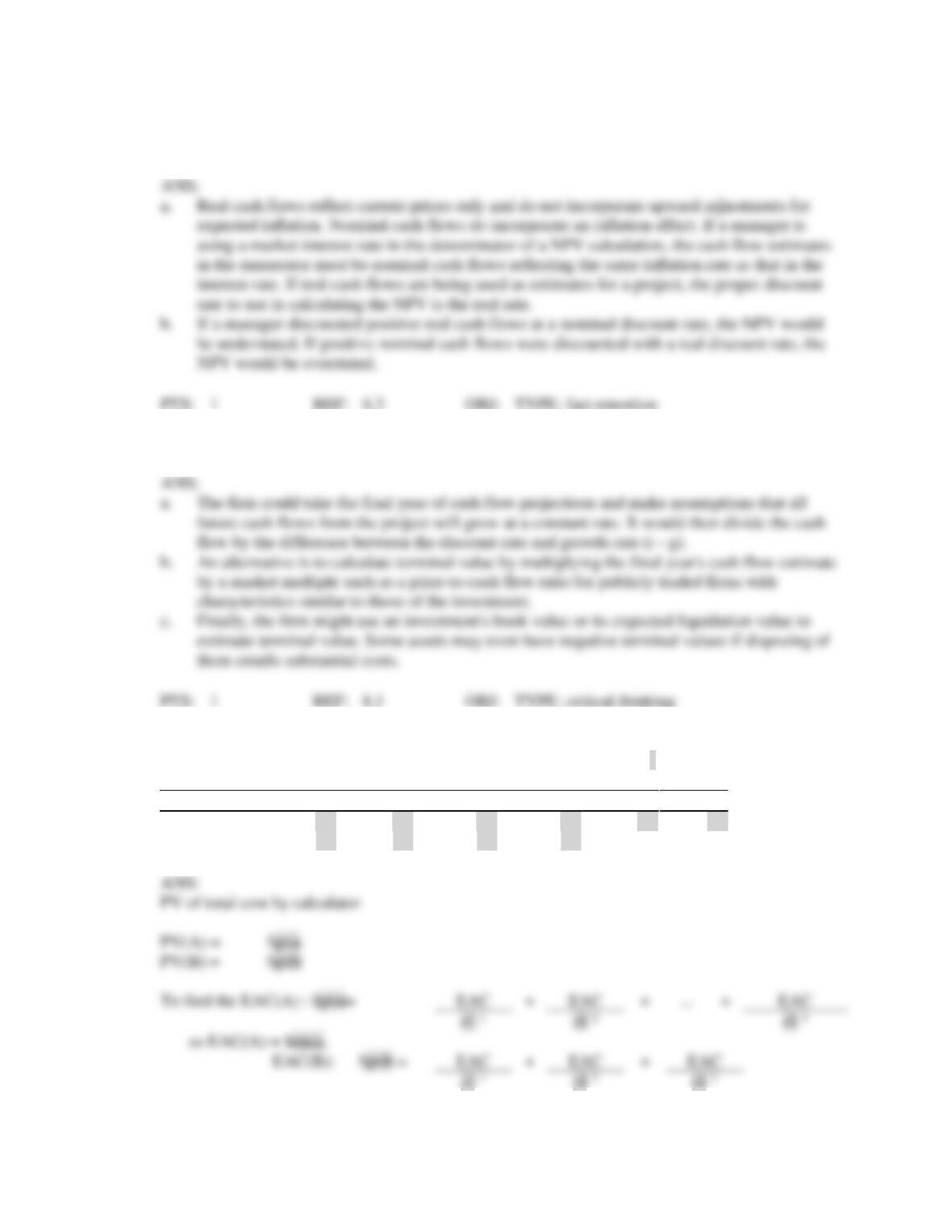
The equivalent annual cost approach yields the following results:
4. When preparing cash flows for capital budgeting purposes both real and nominal cash flows can be
used.
a.
Discuss real and nominal cash flows and how they should be discounted when finding their
present values.
b.
What errors occur when managers discount the cash flows at the wrong discount rate?
5. How should a firm treat terminal value?
flow by the difference between the discount rate and growth rate (r – g).
estimate terminal value. Some assets may even have negative terminal values if disposing of
6. The following information describes the cash outlays required to operate two machines, A and B.
Calculate the equivalent annual cost of operating each machine using a r% discount rate.
Machine
0
1
2
3
4
5
A
A0
A1
A1
A1
A1
A1
B
B0
B1
B1
B1
PV(A) =
$pva
To find the EAC(A) : $pva=
NPV would be overstated.