Chapter 8: Inventories: Special Valuation Issues
127. Walker Towel & Linen Shop uses the lower of cost or market method and has a periodic inventory system.
Additional information follows:
Inventory
Date
Cost
Market
January 1, 2016
$4,600
$4,000
December 31, 2016
6,000
5,000
December 31, 2017
9,000
8,200
Required:
a.
If the direct method of recording the reduction of inventory to market is in use, what would
be the amount of the debit to Inventory on December 31, 2017?
b.
If the allowance method is in use, what would be the debit to Income Summary on
December 31, 2016?
b.
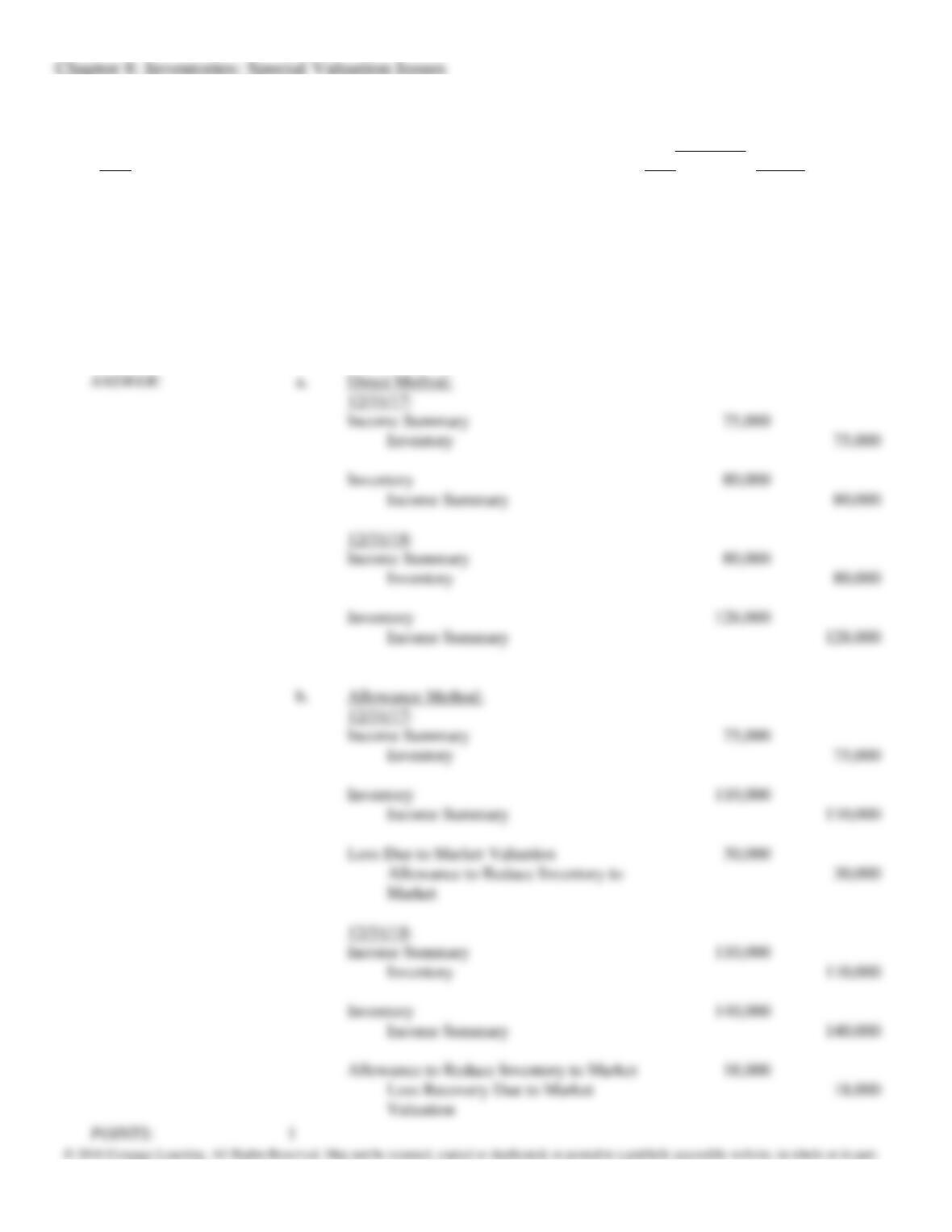
128. The Slayton Company uses a periodic inventory system and values its inventory at lower of cost or market. Its
accounting records indicate the following information relating to inventory:
Inventory
Date
Cost
Market
January 1, 2017
$ 75,000
$ 75,000
December 31, 2017
110,000
80,000
December 31, 2018
140,000
128,000
Prepare the required journal entries at December 31, 2017, and December 31, 2018, to record the inventory at lower
of cost or market using the following methods:
a.
Direct method
b.
Allowance method
12/31/17:
Income Summary
Inventory
Inventory
Income Summary
12/31/18:
Income Summary
Inventory
Inventory
Income Summary
b.
Allowance Method:
12/31/17:
Income Summary
Inventory
Inventory
Income Summary
Loss Due to Market Valuation
Market
12/31/18:
Income Summary
Inventory
Inventory
Income Summary
Valuation
1

Chapter 8: Inventories: Special Valuation Issues
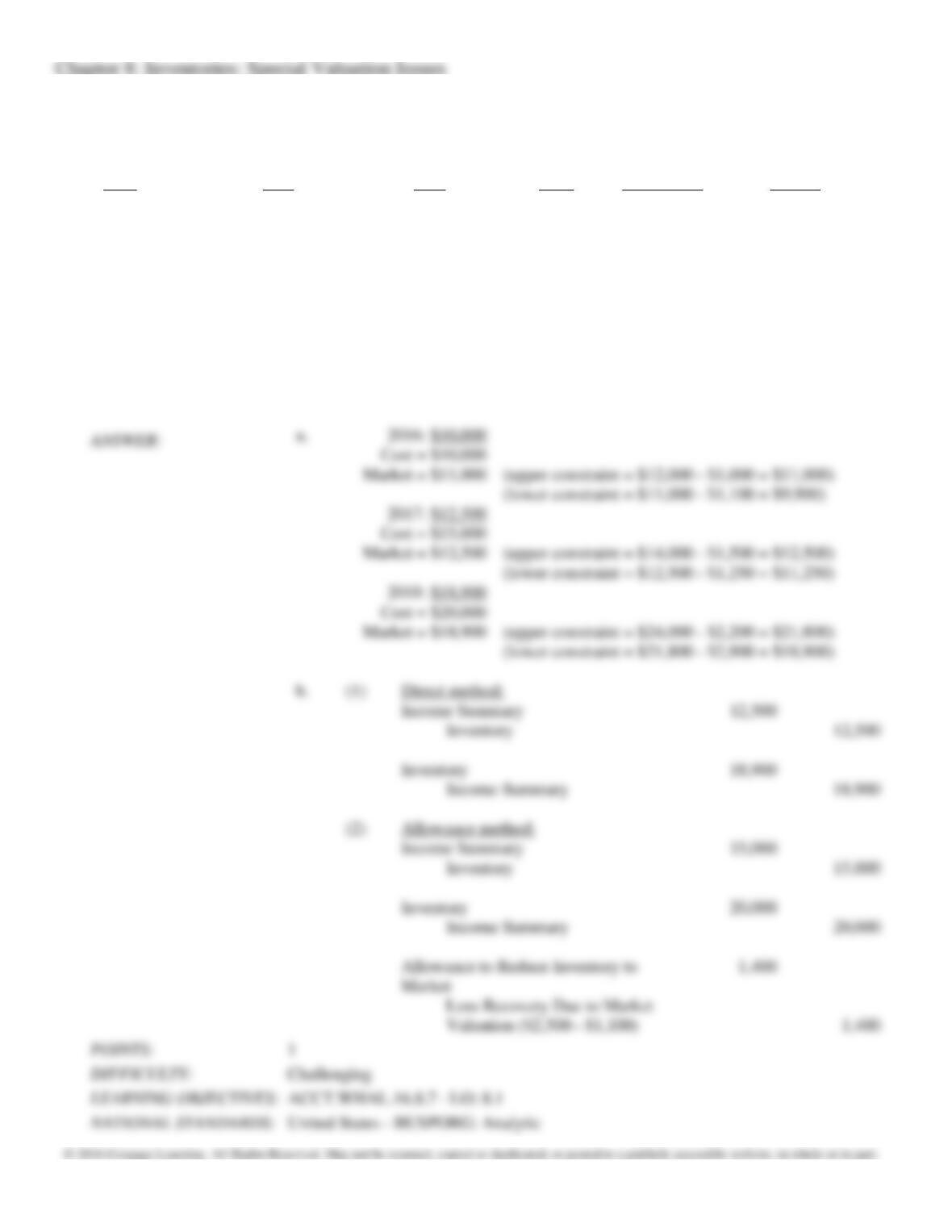
129. Information about the ending inventories of Charleston Chair Company is shown below:
Current
Normal
Replacement
Selling
Cost of
Profit
Year
Cost
Cost
Price
Completion
Margin
2016
$10,000
$11,500
$12,000
$1,000
$1,100
2017
15,000
13,000
14,000
1,500
1,250
2018
20,000
18,600
24,000
2,200
2,900
Required:
a.
Determine the value of the inventory for each year using the lower of cost or market rule.
b.
Assuming that Charleston Chair Company maintains a periodic inventory system, prepare
journal entries for 2018 to record the reduction of the inventory to market value using:
(1)
the direct method
(2)
the allowance method
12,500
12,500
18,900
15,000
20,000
1
Challenging
United States – BUSPORG: Analytic
130. Describe the lower of cost or market rule.
131. Replacement costs are measured based upon GAAP’s requirement of an upper and a lower constraint on the market
value. What are the upper and lower constraints?
132. Under special circumstances GAAP allows a company to report its inventory above cost. How must this exception be
justified?
133. In what situations would the gross profit method be used to estimate ending inventory?
134. Define the following:
Markup
Additional Markup
Net Additional Markup
Markdown Cancellation
135. What are the four alternative valuations used in the application of the Retail Inventory Method?
136. What is dollar value LIFO retail method?
137. A purchase on credit is omitted from the purchases account, but ending inventory is correct. What is the effect of this
error on the balance sheet for the current year? What is the effect on the income statement for the current year?
138. Ending inventory is over stated due to an error, purchases were verified to be correct. What is the effect on the
current year’s income statement?
139. Lower of cost or market rule can be applied to periodic inventory. What are the two methods? Which one requires an
entry to the loss due to market valuation account?
140. Draper Company’s controller was explaining to the company’s president, Dana Draper, that if the inventory’s value
should decrease below its original cost, the inventory must be written down and a loss must be recognized. The
controller told the president that this is called the lower of cost or market rule. The president was unclear as to the
purpose of this rule and wanted to know the disadvantages of this method.
Required:
a.
State the accounting convention that supports the lower of cost or market rule, and in this
context, discuss the purpose of the rule.
b.
Discuss the criticisms of the lower of cost or market rule in the valuation of inventories.
b.
The criticisms of the lower of cost or market rule are as follows:
The rule is applied in only one direction. Inventory holding losses are
recognized, but inventory holding gains are ignored.
(2)
loss is recognized before the earning process is complete and before an
1
Challenging
ACCT.WHAL.16.8.1 – LO: 8.2
United States – BUSPROG: Communication
United States – OH – Default City – AICPA: FN-Decision Modeling
141. Describe the differences in the application of lower of the cost or market consideration between U.S. GAAP and
IFRS.
142. Under what circumstances does GAAP allow inventory to be valued at market prices greater than cost, thereby
allowing companies to recognize profits before items are sold? Briefly explain the justification for this standard.
143. The gross profit method may be used to estimate the cost of inventory.
Required:
a.
List four situations when it might be appropriate to use the gross profit method to estimate
the cost of inventory.
b.
Discuss the potential disadvantages of the gross profit method.
a.
(1)
(2)
(3)
for budgeting purposes.
b.
Potential disadvantages of the gross profit method are as follows:
inventory for the annual financial statements.
1
Challenging
ACCT.WHAL.16.8.3 – LO: 8.3
United States – BUSPROG: Communication
United States – OH – Default City – AICPA: FN-Decision Modeling
144. The retail inventory method is used extensively in the retail industry.
Required:
Discuss the assumptions and benefits of the retail inventory method.
145. Why would a company elect to use dollar-value LIFO retail method for valuing inventory?
146. Careful valuation of the ending inventory is necessary because errors can result in inaccurate values on both the
income statement and balance sheet. Assume that a company overstates its ending inventory for 2016.
Required:
Explain the effects of the error on the income statements and balance sheets for 2016 and 2017.