Chapter 8: Inventories: Special Valuation Issues
89. The correct net income for Sarah Corp. was $53,500. However, the company reported incorrect net income because
beginning inventory was understated by $2,500, purchases were overstated by $2,000, and ending inventory was
overstated by $2,000. What net income did Sarah Corp. report?
a.
$49,000
b.
$51,000
c.
$56,000
d.
$58,000
c
1
Challenging
ACCT.WHAL.16.8.6 – LO: 8.6
United States – BUSPORG: Analytic
United States – OH – Default City – AICPA: FN-Measurement
90. The accountant for Ella Company made the following errors related to the inventory in 2016:
1.
The beginning inventory for 2016 was understated by $1,350 due to an error in the physical
count.
2.
A $1,500 purchase of merchandise in transit was not recorded as a purchase and was
not included in ending inventory.
Assuming a periodic inventory system, Ella Company’s 2016 net income will be
a.
understated by $150.
b.
overstated by $1,350.
c.
overstated by $1,500.
d.
overstated by $150.
ANSWER:
b
POINTS:
1
DIFFICULTY:
Moderate
LEARNING OBJECTIVES:
ACCT.WHAL.16.8.6 – LO: 8.6
NATIONAL STANDARDS:
United States – BUSPORG: Analytic
LOCAL STANDARDS:
United States – OH – Default City – AICPA: FN-Measurement
KEYWORDS:
91. Bennett Company’s accountant made the following errors related to merchandise inventory in 2016:
1.
The beginning inventory for 2016 was overstated by $1,900 due to an error in the physical
count.
2.
A $1,150 purchase of merchandise on credit was not recorded, but the items were included
in the ending inventory.
Assuming a periodic inventory system, Bennett Company’s 2016 cost of goods sold will be
a.
understated by $750.
b.
understated by $1,900.
c.
overstated by $750.
d.
overstated by $1,900.
c
1
Challenging
ACCT.WHAL.16.8.6 – LO: 8.6
United States – BUSPORG: Analytic
United States – OH – Default City – AICPA: FN-Measurement
92. The accountant for Lee Company made the following errors related to merchandise inventory in 2016:
1.
The beginning inventory for 2016 was overstated by $750 due to an error in the physical
count.
2.
A $1,300 purchase of merchandise on credit was not recorded and was not included in the
ending inventory.
Assuming a periodic inventory system, Lee Company’s 2016 cost of goods sold will be
a.
understated by $550.
b.
understated by $2,050.
c.
overstated by $2,050.
d.
overstated by $750.
d
1
Challenging
ACCT.WHAL.16.8.6 – LO: 8.6
United States – BUSPORG: Analytic
United States – OH – Default City – AICPA: FN-Measurement
93. The accountant for Frieda Company did not record a purchase of merchandise on credit or include the items in the
ending inventory. Assuming a periodic inventory system, the balance sheet effects of these omissions on assets,
liabilities, and retained earnings would be
Set
Assets
Liabilities
Retained Earnings
I.
Understate
Understate
Understate
II.
Understate
Understate
No effect
III.
No effect
Understate
No effect
IV.
Understate
No effect
Understate
a.
Set I
b.
Set II
c.
Set III
d.
Set IV
b
1
Moderate
ACCT.WHAL.16.8.6 – LO: 8.6
United States – BUSPORG: Analytic
United States – OH – Default City – AICPA: FN-Measurement
94. The accountant for the Issenock Company did not record a purchase of merchandise on credit for the current year, but
the merchandise was correctly included in the ending inventory. Assuming a periodic inventory system, how would
assets, liabilities, and retained earnings be affected on the year-end balance sheet?
Set
Assets
Liabilities
Retained Earnings
I.
No effect
Understated
Understated
II.
Understated
Understated
No effect
III.
No effect
No effect
Overstated
IV.
No effect
Understated
Overstated
a.
Set I
b.
Set II
c.
Set III
d.
Set IV
d
1
Moderate
ACCT.WHAL.16.8.6 – LO: 8.6
United States – BUSPORG: Analytic
United States – OH – Default City – AICPA: FN-Decision Modeling
95. The accountant for Suzanne Company made the following errors related to inventory in 2017:
1.
The beginning inventory for 2017 was overstated by $1,375 due to an error in the physical
count.
2.
A $1,650 purchase of merchandise on credit in 2017 was not recorded or included in the
ending inventory.
Assuming a periodic inventory system, how would Sue’s cost of goods sold, gross profit, and net income be affected
in 2017 by these errors?
Set
Cost of Goods Sold
Gross Profit
Net Income
I.
Overstated
Understated
Understated
II.
Overstated
Understated
No effect
III.
Understated
Overstated
Overstated
IV.
No effect
No effect
No effect
a.
Set I
b.
Set II
c.
Set III
d.
Set IV
a
1
Challenging
ACCT.WHAL.16.8.6 – LO: 8.6
United States – BUSPORG: Analytic
United States – OH – Default City – AICPA: FN-Decision Modeling
96. What is the effect on net income for the current year if a company fails to record a purchase of materials in transit
(FOB shipping point) but includes the materials in physical inventory at year-end?
a.
Net income is overstated.
b.
Net income is understated.
c.
Net income is unaffected.
d.
Not enough information is provided to determine the answer.
a
1
Moderate
ACCT.WHAL.16.8.6 – LO: 8.6
United States – BUSPORG: Analytic
United States – OH – Default City – AICPA: FN-Decision Modeling
97. If in the current year a purchase was not recorded but the purchased item was included in ending physical inventory,
which one of the following situations occurs for the current year?
a.
Working capital is understated, and net income is overstated.
b.
Working capital and net income are understated.
c.
Working capital is overstated, and net income is understated.
d.
Working capital and net income are overstated.
d
1
Moderate
ACCT.WHAL.16.8.6 – LO: 8.6
United States – BUSPORG: Analytic
98. The accountant for the Hilga Company recorded a purchase of merchandise on credit for the current year, but the
merchandise was shipped FOB destination and did not arrive until after current year-end. Assuming a periodic
inventory system, how would assets, liabilities, and retained earnings be affected on the year-end balance sheet?
Assets
Liabilities
Retained Earnings
I.
No effect
Understated
Understated
II.
Understated
Understated
Understated
III.
No effect
Overstated
Overstated
IV.
No effect
Overstated
Understated
a.
I
b.
II
c.
III
d.
IV
d
1
Moderate
ACCT.WHAL.16.8.6 – LO: 8.6
United States – BUSPORG: Analytic
United States – OH – Default City – AICPA: FN-Decision Modeling
Chapter 8: Inventories: Special Valuation Issues
Exhibit 8-3
The J. Love Company uses a periodic inventory accounting system and values its inventory by using the lower of cost or
market rule. The allowance method is used in applying the lower of cost or market rule. The company adjusts and closes
its books annually on December 31. Below are the cost and market values of the company’s year-end inventories for a
three-year period:
Date
Cost
Market
December 31, 2016
$70,000
$70,000
December 31, 2017
56,000
46,000
December 31, 2018
64,000
58,000
99. Refer to Exhibit 8-3. Which of the following journal entries would be correct as of December 31, 2017, to apply the
lower of cost or market rule to the valuation of inventory?
a.
Inventory 46,000
Income Summary 46,000
b.
Loss Due to Market Valuation 10,000
Allowance to Reduce Inventory
to Market 10,000
c.
Cost of Goods Sold 10,000
Inventory 10,000
d.
Cost of Goods Sold 10,000
Allowance to Reduce Inventory
to Market 10,000
b
1
Moderate
ACCT.WHAL.16.8.7 – LO: 8.1
United States – BUSPROG: Reflective Thinking – BUSPROG: Analytic
United States – OH – Default City – AICPA: FN-Measurement
100. Refer to Exhibit 8-3. Which of the following journal entries would be correct as of December 31, 2018, to apply the
lower of cost or market rule?
a.
Inventory 58,000
Income Summary 58,000
b.
Loss Due to Market Valuation 6,000
Allowance to Reduce Inventory
to Market 6,000
c.
Allowance to Reduce Inventory to Market 4,000
Loss Recovery Due to Market Valuation 4,000
d.
Cost of Goods Sold 6,000
Allowance to Reduce Inventory
to Market 6,000
c
1
Moderate
ACCT.WHAL.16.8.7 – LO: 8.1
United States – BUSPROG: Reflective Thinking – BUSPROG: Analytic
United States – OH – Default City – AICPA: FN-Measurement
101. Given the following information for the Raquel Company:
Date
Cost
Market
December 31, 2016
$500
$500
December 31, 2017
700
650
December 31, 2018
800
730
If the allowance method of recording lower of cost or market is in use, which December 31, 2018, journal entry is
correct?
a.
Loss Due to Market Valuation 20
Allowance to Reduce Inventory to Market 20
b.
Inventory 730
Income Summary 730
c.
Loss Due to Market Valuation 70
Allowance to Reduce Inventory to Market 70
d.
Allowance to Reduce Inventory to Market 800
Income Summary 800
a
1
Moderate
ACCT.WHAL.16.8.7 – LO: 8.1
United States – BUSPORG: Analytic
United States – OH – Default City – AICPA: FN-Measurement
102.Using a periodic inventory system, Bertram Company records inventory at lower of cost or market using the direct
method. The end-of-the-year journal entries to adjust inventories would include
a.
a debit to Inventory to close beginning inventory at cost value.
b.
a debit to Inventory to close ending inventory at market value.
c.
a debit to Loss Due to Market Valuation for the excess of cost over market value.
d.
a credit to Allowance to Reduce Inventory for the excess of market over cost value.
b
1
Moderate
ACCT.WHAL.16.8.7 – LO: 8.1
United States – BUSPROG – BUSPROG: Analytic
Bloom’s: Understanding
103. Using a periodic inventory system, Bertram Company records inventory at lower of cost or market using the
allowance method. The end-of-the-year journal entries to adjust inventories would include
a.
a debit to Inventory to close beginning inventory at cost value.
b.
a debit to Inventory to close ending inventory at market value.
c.
a debit to Loss Due to Market Valuation for the excess of cost over market value.
d.
a credit to Allowance to Reduce Inventory for the excess of market over cost value.
c
1
Moderate
ACCT.WHAL.16.8.7 – LO: 8.1
United States – BUSPROG – BUSPROG: Analytic
United States – Ohio – Default City – AICPA – FN-Decision Modeling
Bloom’s: Understanding
104. Below is a list of key terms.
a)
additional Mark up
b)
allowance method
c)
conventional retail method
d)
markdown cancellation
e)
net realizable value
f)
net additional markup
g)
markup
h)
gross profit method
Required:
Match each key term with the appropriate definition.
______
1)
Total markup less markup cancellations.
______
2)
Increase in selling price after there has been a markdown.
______
3)
Cost to selling price.
______
4)
Can be used by an auditor to verify the cost of inventory.
______
5)
Also known as the retail inventory method.
______
6)
Increase above the original sale price.
______
7)
The loss is recorded in a separate inventory account.
______
8)
Estimated selling price less costs of completion or disposal.
1
f
2
d
3
g
4
h
5
c
6
a
7
b
8
e
1
Challenging
United States – BUSPROG: Reflective Thinking – BUSPROG: Analytic
United States – OH – Default City – AICPA: FN-Decision Modeling
105. The following information for five products (A–E) was taken from the inventory records of the Walker Company:
Product
A
B
C
D
E
# of Units
175
200
250
200
300
Unit cost
$5.50
$10.00
$5.10
$5.10
$5.00
Replacement cost per unit
$6.00
$9.00
$4.60
$4.50
$4.50
Net realizable value (NRV) per unit
$5.20
$12.50
$7.00
$7.00
$7.00
NRV–Normal profit per unit
$4.80
$10.30
$5.25
$4.00
$4.80
Required:
Determine the valuation of the inventory at the lower of cost or market applied to:
a.
individual items
b.
the inventory as a whole
b.
106. Given the following information for Gator Company:
Net
NRV Minus
Realizable
Replacement
Normal
Item
Quantity
Cost
Value
Cost
Profit
1
1
$17.70
$24.60
$18.00
$17.10
2
1
10.80
8.28
9.30
5.58
3
1
72.00
64.80
67.20
57.60
4
1
4.80
3.12
2.88
2.64
5
1
12.00
12.30
12.60
11.10
6
1
48.00
45.60
38.40
40.80
Required:
a.
Determine the lower of cost or market value for each inventory item for Gator Company.
b.
Determine the lower of cost or market value for Gator Company’s inventory if the lower of
cost or market rule is applied to the total inventory.
Value
$18.00
$17.10
10.80
5.58
64.80
2.64
12.30
1
ACCT.WHAL.16.8.1 – LO: 8.2
107. Given the following information for the Lawrence Company:
NRV Minus
Net
Normal
Realizable
Replacement
Item
Cost
Profit
Value
Cost
a
$ 3.40
$ 2.79
$ 4.14
$ 4.65
b
36.00
28.80
32.40
27.60
c
2.40
1.32
1.56
1.94
d
6.00
5.55
6.15
6.30
e
24.00
20.40
22.80
21.00
f
13.35
10.55
12.30
12.90
Required:
Determine the lower of cost or market for each inventory item.
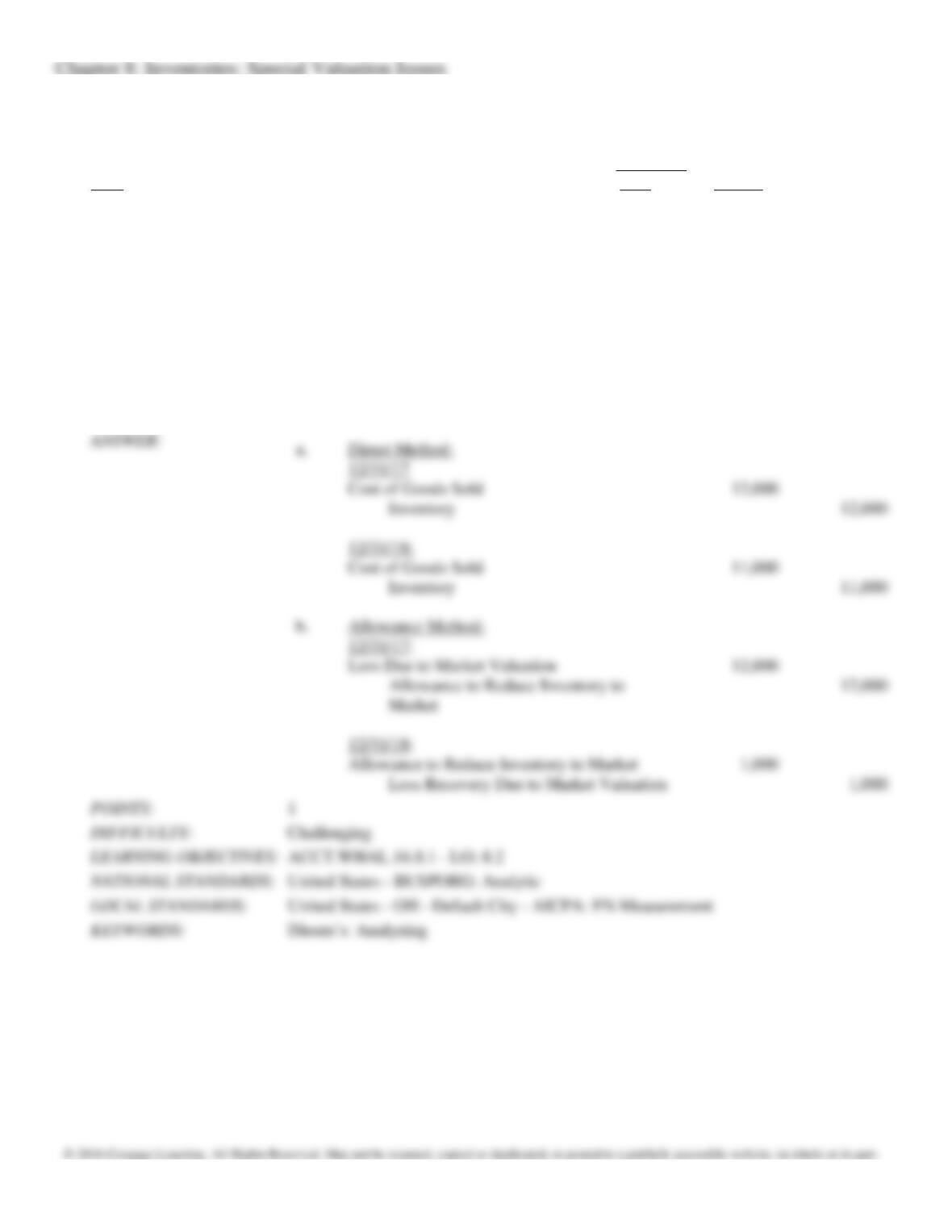
108. Farmington Company uses a perpetual inventory system and values its inventory at lower of cost or market. Its
accounting records indicate the following information relating to inventory:
Inventory
Date
Cost
Market
January 1, 2017
$ 60,000
$ 60,000
December 31, 2017
100,000
88,000
December 31, 2018
115,000
104,000
Required:
Prepare the required journal entries at December 31, 2017, and December 31, 2018, to record the inventory at lower
of cost or market using the following methods:
a.
Direct method
b.
Allowance method
1,000
1
Challenging
ACCT.WHAL.16.8.1 – LO: 8.2
United States – BUSPORG: Analytic
United States – OH – Default City – AICPA: FN-Measurement
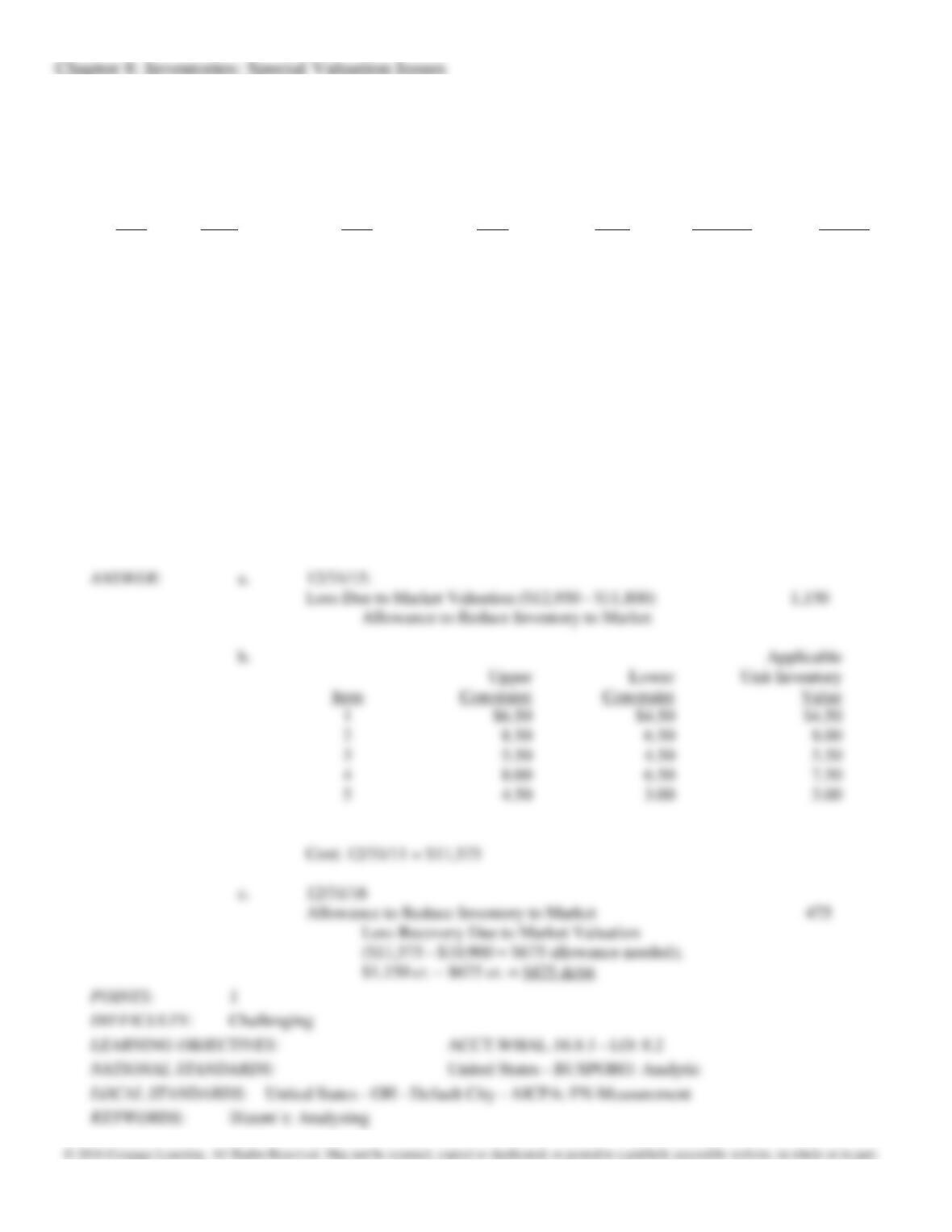
109. The Peter Park Company began operations in early 2015. At December 31, 2015, the company’s ending inventory’s
cost was $12,950. The market value of the inventory at this date was $11,800. Peterson values its inventory at lower
of cost or market applied on an individual item basis and uses a perpetual inventory system. Below is information
relating to Peter’s inventory at December 31, 2016:
Estimated
Estimated
Normal
No. of
Unit
Replacement
Selling
Costs of
Profit
Item
Units
Cost
Cost
Price
Disposal
Margin
1
200
$5.00
$4.00
$ 7.50
$1.00
$2.00
2
400
9.00
8.00
10.00
1.50
2.00
3
350
6.00
7.00
8.00
2.50
1.00
4
450
7.50
8.80
10.00
2.00
1.50
5
500
3.00
2.50
5.00
.50
1.50
Required:
a.
Assuming that the company uses the allowance method, prepare the required entry at
December 31, 2015, to record the inventory at lower of cost or market.
b.
Prepare a schedule to calculate the inventory’s value as of December 31, 2016, using the
lower of cost or market method. The schedule should contain the following column
headings: Item, Upper Constraint, Lower Constraint, Applicable Unit Inventory Value,
Number of Units, and Total Inventory Value.
c.
Prepare the required entry at December 31, 2016, to record the inventory at lower of cost or
market. Assume the allowance method is used.
Applicable
Item
2
4
5
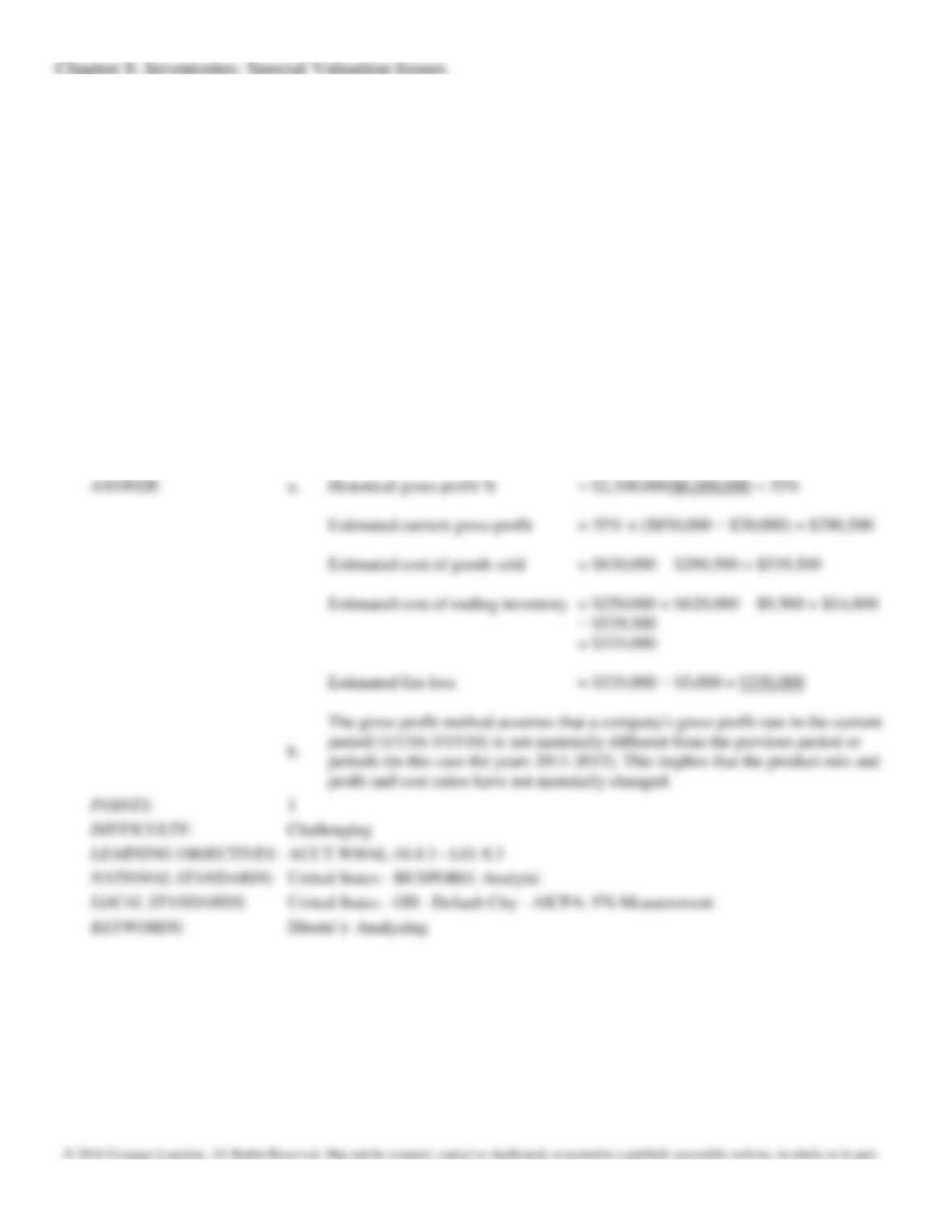
110. A fire destroyed the Churchill Company’s warehouse on March 15, 2016. Only goods with a normal selling price of
$12,500 and a net realizable value of $5,000 were saved. The following information is available from the company’s
records:
Inventory in warehouse, 1/1/16
$250,000
Purchases, 1/1/16-3/15/16
620,000
Purchase returns
9,500
Freight-in
14,000
Sales, 1/1/16-3/15/16
850,000
Sales returns
20,000
For the period from 2011 through 2015, Churchill had a gross profit of $2,100,000 on net sales of $6,000,000.
Required:
a.
Estimate Churchill’s inventory loss from the fire using the gross profit method.
b.
What assumptions allow the use of the gross profit method in these circumstances?
a.
Historical gross profit %
= $2,100,000/$6,000,000 = 35%
Estimated current gross profit
= 35% × ($850,000 − $20,000) = $290,500
Estimated fire loss
= $335,000 − $5,000 = $330,000
periods (in this case the years 2011-2015). This implies that the product mix and
Challenging
ACCT.WHAL.16.8.3 – LO: 8.3
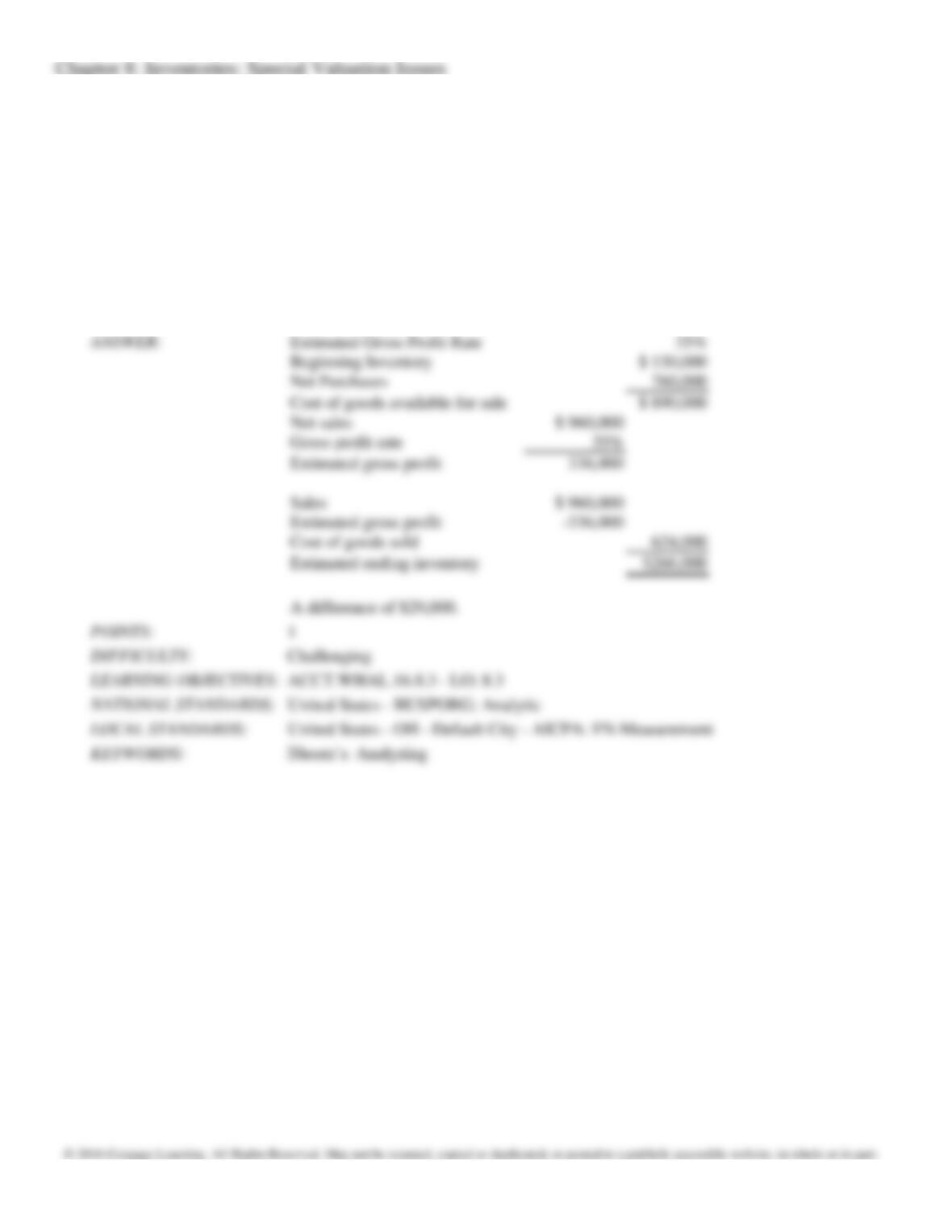
111. After the auditors counted the inventory of the Cracker Jack Manufacturing Co. and reviewed the accounting records
something appeared to be amiss. Inventory that was counted totaled $ 295,000.
Inventory (1/16)
$130,000
Purchases (2016)
760,000
Sales (2016)
1,020,000
Sales returns (2016)
60,000
Gross profit ratio
35% of sales
Using the gross profit method, what did the auditors estimate as the amount of the inventory that should have been
on hand at December 31, 2016?
Estimated Gross Profit Rate
Beginning Inventory
Cost of goods available for sale
Net sales
Gross profit rate
Estimated gross profit
336,000
Sales
Estimated gross profit
Cost of goods sold
A difference of $29,000.
112. Scotland Inc. incurred a fire loss. Certain information follows:
Gross profit on cost
25%
Purchase returns
$1,250
Sales
45,675
Beginning inventory
13,450
Cost of goods not burned
7,465
Accounts receivable
8,780
Purchases
43,500
Purchase discounts
850
Required:
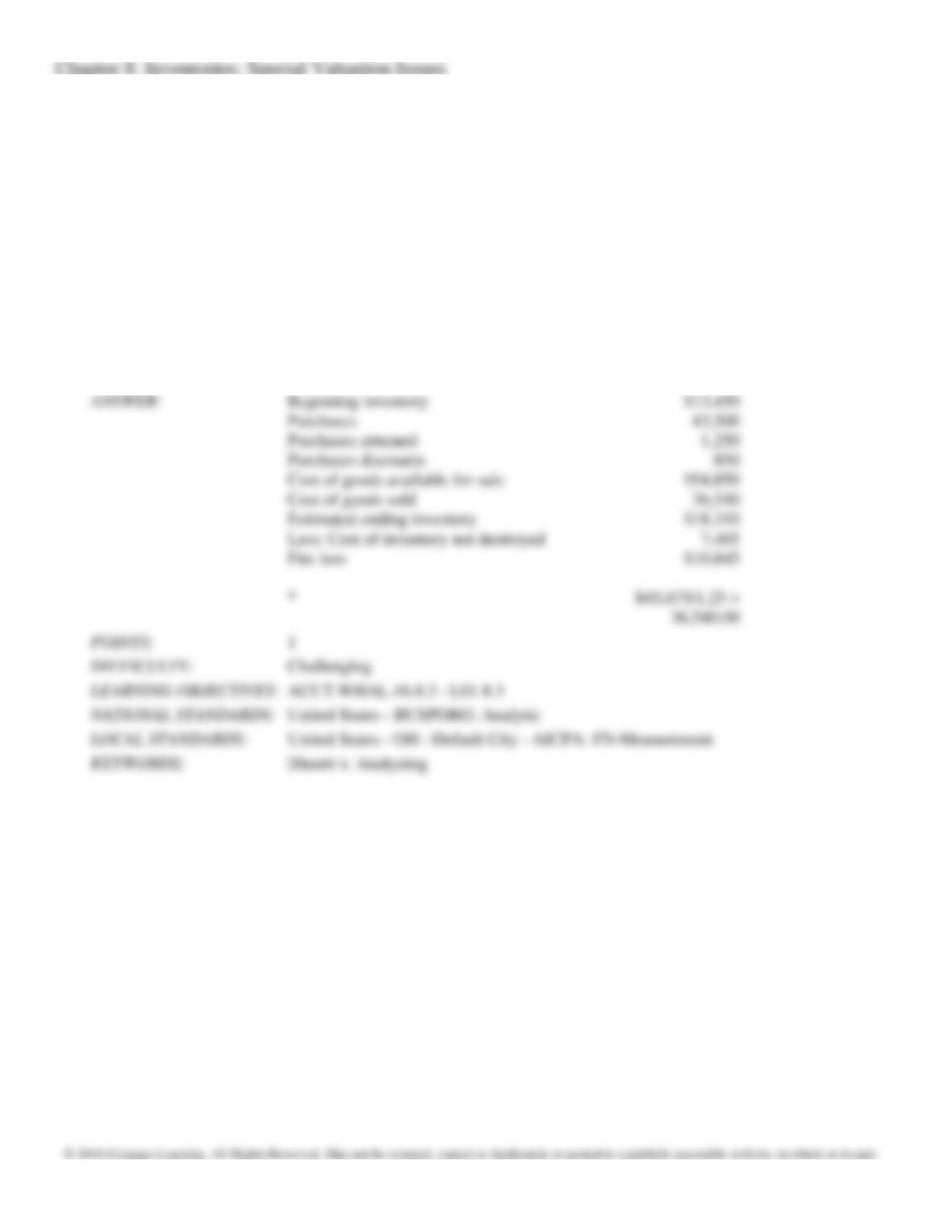
Using the gross profit method, compute the amount of the fire loss.
Beginning inventory
Purchases
Purchases returned
Purchases discounts
Cost of goods available for sale
Cost of goods sold
Estimated ending inventory
Less: Cost of inventory not destroyed
Fire loss
*
Challenging
ACCT.WHAL.16.8.3 – LO: 8.3
United States – BUSPORG: Analytic
United States – OH – Default City – AICPA: FN-Measurement
113. Yamachi Inc. incurred a loss from a flash flood on July 20, 2016. The following information was available from the
company’s accounting records:
Gross profit on cost
20%
Beginning inventory, 1/1/6
$18,000
Sales, 1/1/14-7/20/6
85,000
Sales returns
2,500
Cost of goods not destroyed
3,500
All purchases of merchandise are on account. The accounts payable balance on January 1, 2016, was $16,500, and
cash paid to suppliers during 2016 to the date of the flood loss was $60,000. Purchase discounts taken during the
period were $1,200. The unpaid purchase invoices as of July 20, 2016, totaled $35,050. The accounts payable
account is used only to record purchases of merchandise.
Required:
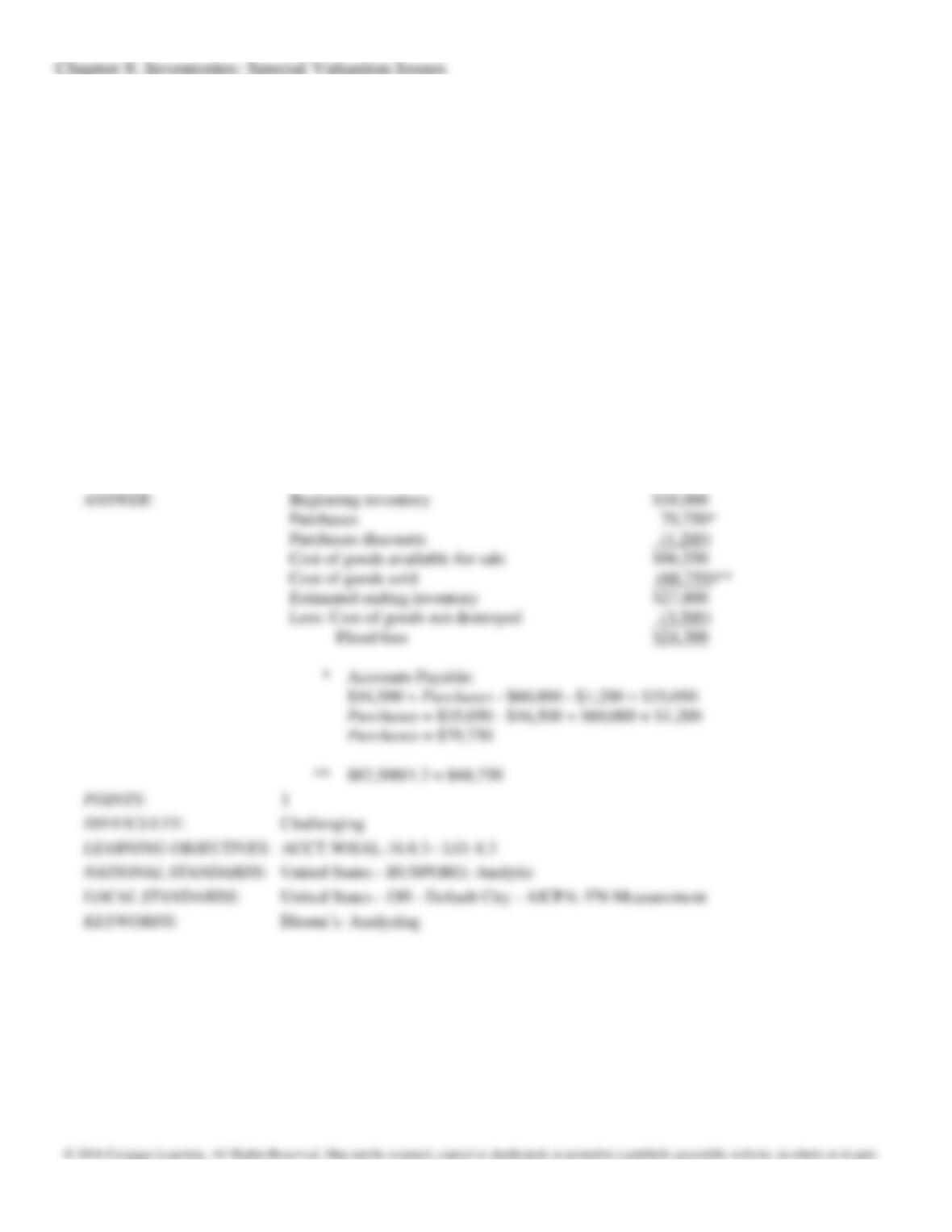
Using the gross profit method, compute the amount of the loss from the flash flood. (Hint: The accounts payable
account must be analyzed to determine purchases.)
114. Companies may express their gross profit as a percentage of net sales or as a percentage of cost of goods sold. The
following data are available on two different companies:
Company A gross profit as a percentage of net sales
25%
Company B gross profit as a percentage of cost of goods sold
65%
Required:
a.
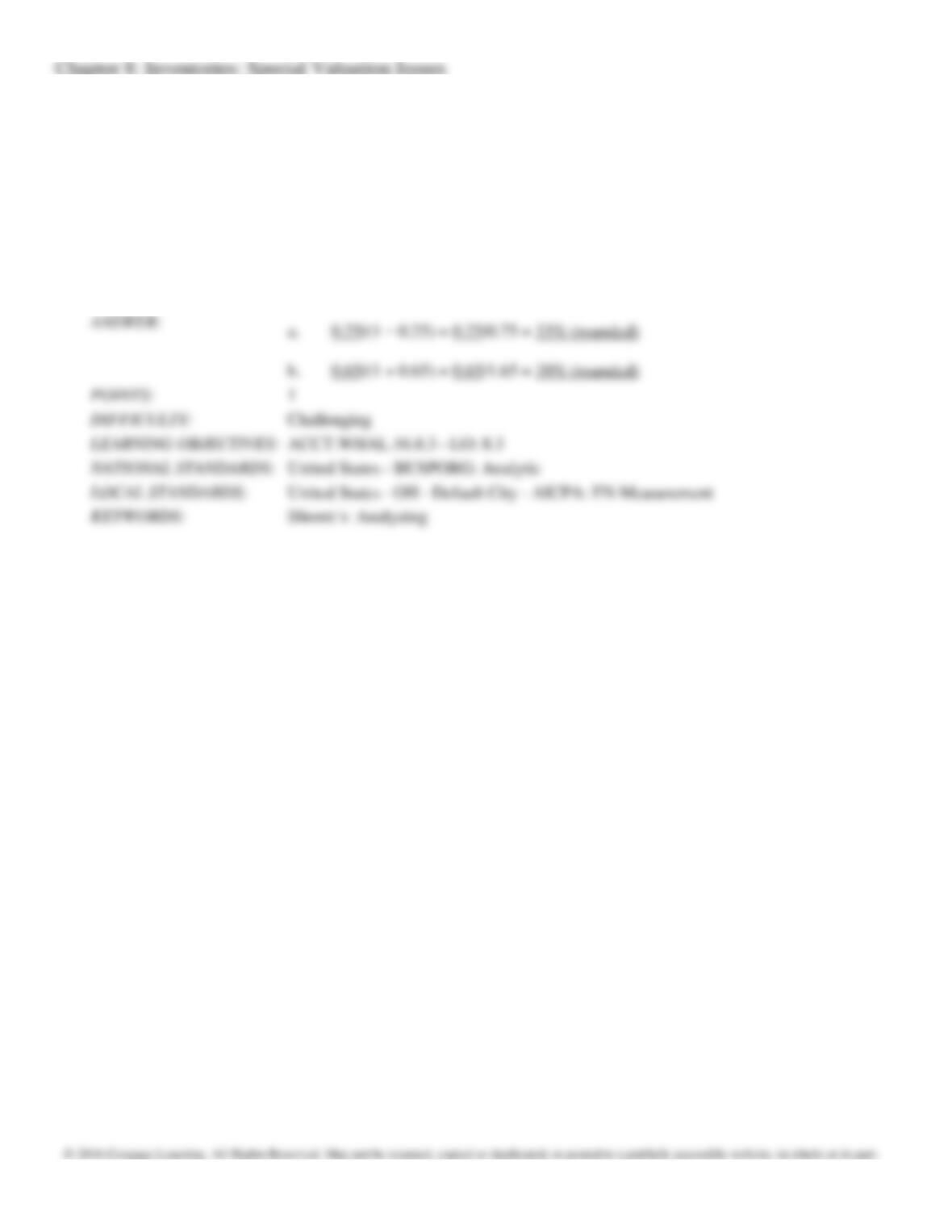
Compute the gross profit as a percentage of cost of goods sold for Company A.
b.
Compute the gross profit as a percentage of net sales for Company B.
a.
b.
115. The Brad’s Farm Company uses the retail inventory method to compute ending inventory. Information for last year is
as follows:
Cost
Retail
Beginning inventory
$12,000
$20,000
Net markups
8,000
Purchases
40,000
80,000
Freight-in
7,100
Purchase returns
3,000
6,000
Sales
50,000
Net markdowns
4,000
Required:
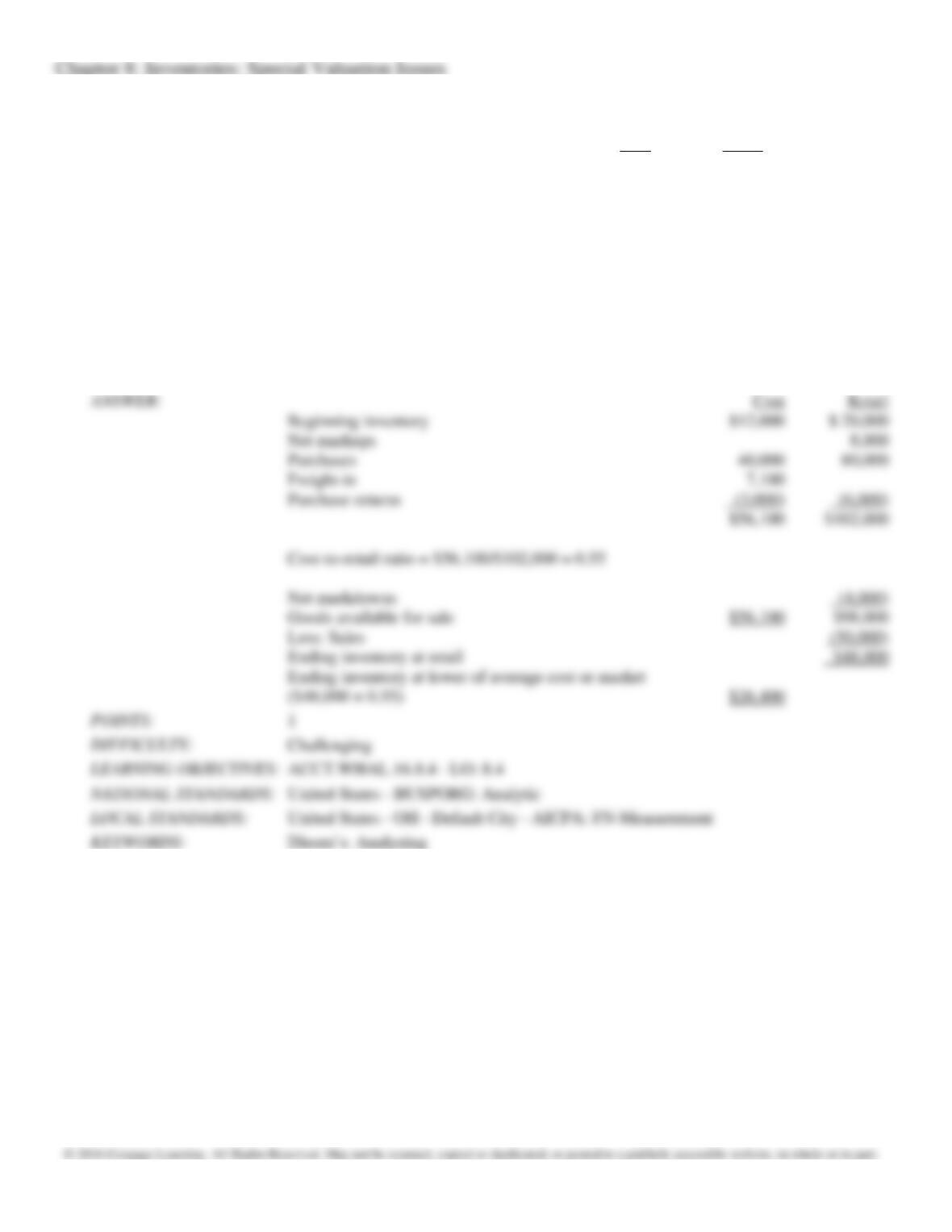
Determine Brad’s Farm Company’s ending inventory based on the retail lower of average cost or market method.
Cost
Beginning inventory
Net markups
Purchases
7,100
Purchase returns
Net markdowns
Goods available for sale
Less: Sales
Ending inventory at retail
Ending inventory at lower of average cost or market
($48,000 × 0.55)
1
Challenging
ACCT.WHAL.16.8.4 – LO: 8.4
United States – BUSPORG: Analytic
United States – OH – Default City – AICPA: FN-Measurement