Chapter 8: Sarbanes-Oxley, Internal Control, and Cash
157.
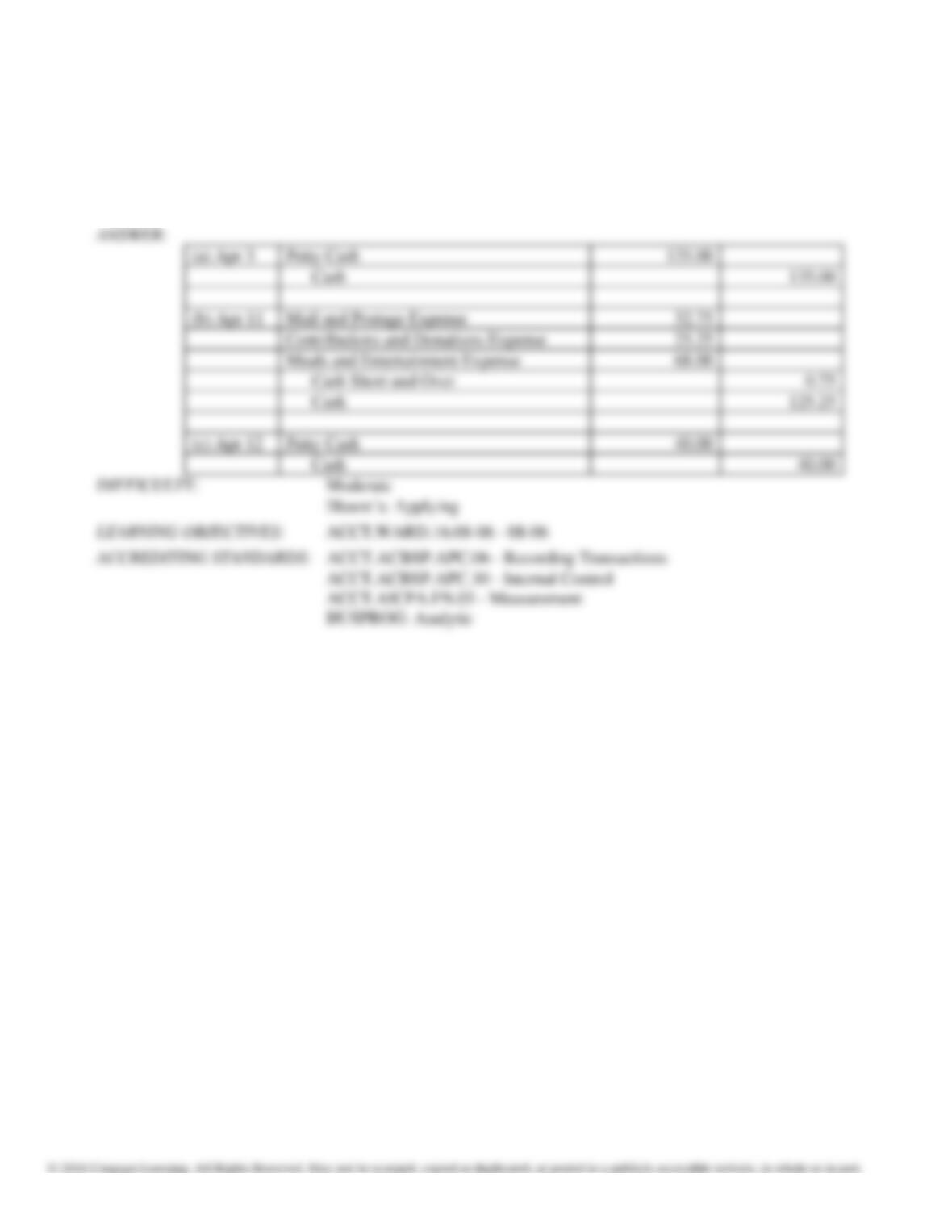
On April 3, Snappy Sales decides to establish a $135.00 petty cash fund to relieve the burden on Accounting.
(a)
Journalize the establishment of the fund.
(b)
On April 11, the petty cash fund has receipts for mail and postage of $32.75, contributions and donations of
$25.25, meals and entertainment of $68.00, and $9.75 in cash. Journalize the replenishment of the fund.
(c)
On April 12, Snappy Sales decides to increase petty cash to $175.00. Journalize this transaction.
Chapter 8: Sarbanes-Oxley, Internal Control, and Cash
158.
Present entries to record the following transactions:
(a)
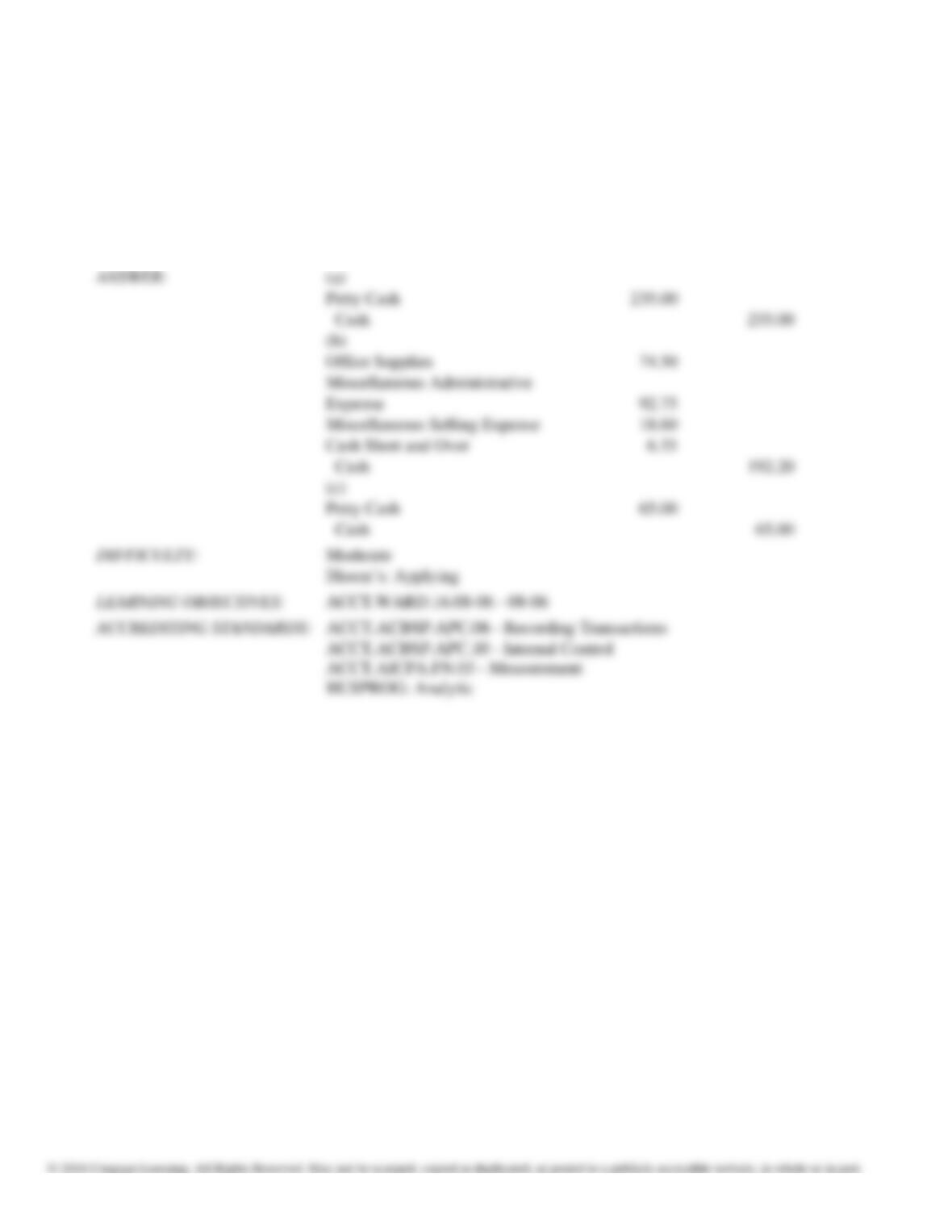
Established a petty cash fund of $235.00.
(b)
The petty cash fund now has a balance of $42.80. Replenished the fund, based on the
following disbursements as indicated by a summary of the petty cash receipts: office
supplies, $74.50; miscellaneous administrative expense, $92.75; and miscellaneous
selling
expense, $18.60.
(c)
Increased the petty cash fund to $300.00.
Chapter 8: Sarbanes-Oxley, Internal Control, and Cash
159.
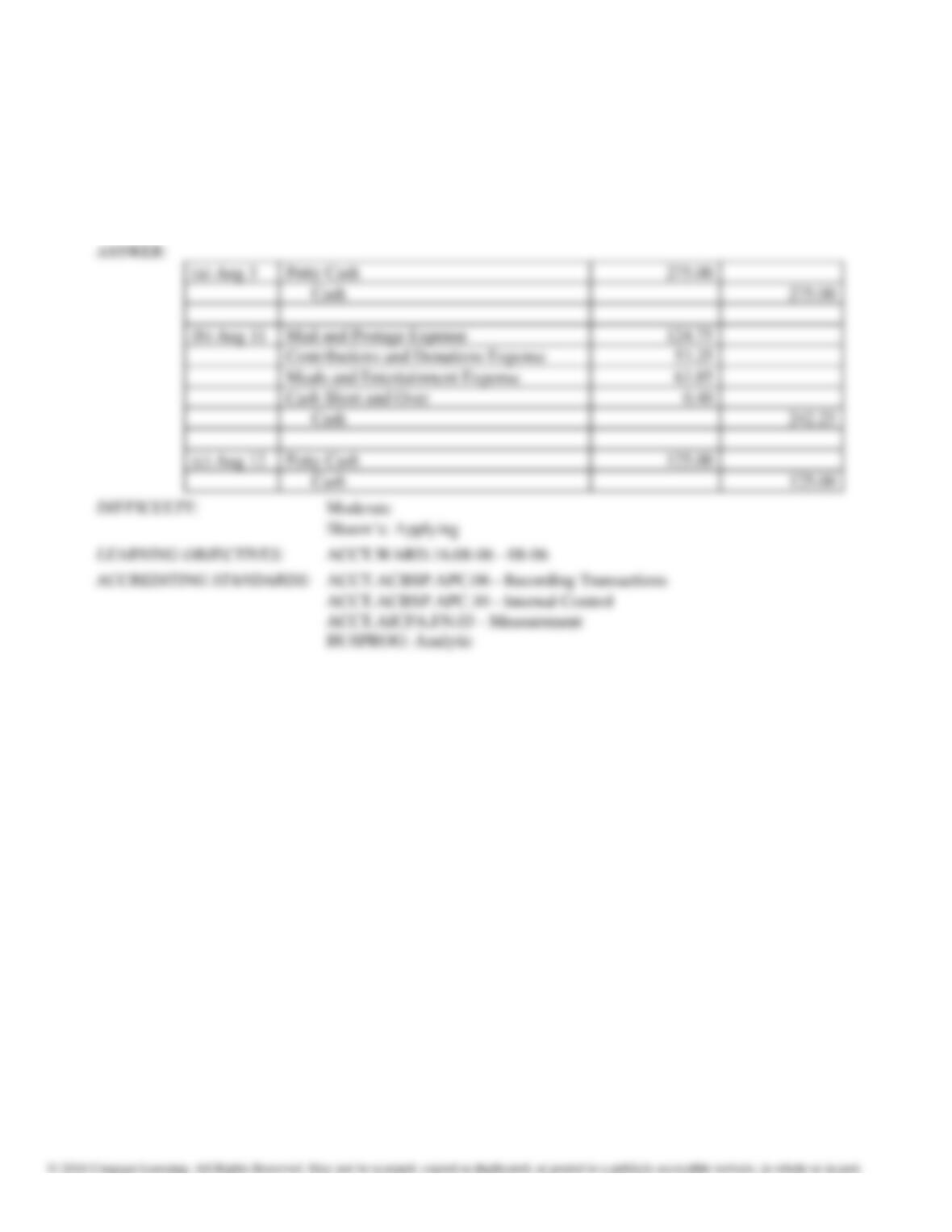
On August 3, Sonar Sales decides to establish a $275.00 Petty Cash Account to relieve the burden on Accounting.
(a)
Journalize the establishment of this fund.
(b)
On August 11, the petty cash fund has receipts for mail and postage of $124.75, contributions and
donations
of $53.25, meals and entertainment of $63.85, and $32.75 in cash. Journalize the replenishment
of the fund.
(c)
On August 12, Sonar Sales decides to increase petty cash to $400.00. Journalize this transaction.
Chapter 8: Sarbanes-Oxley, Internal Control, and Cash
160.
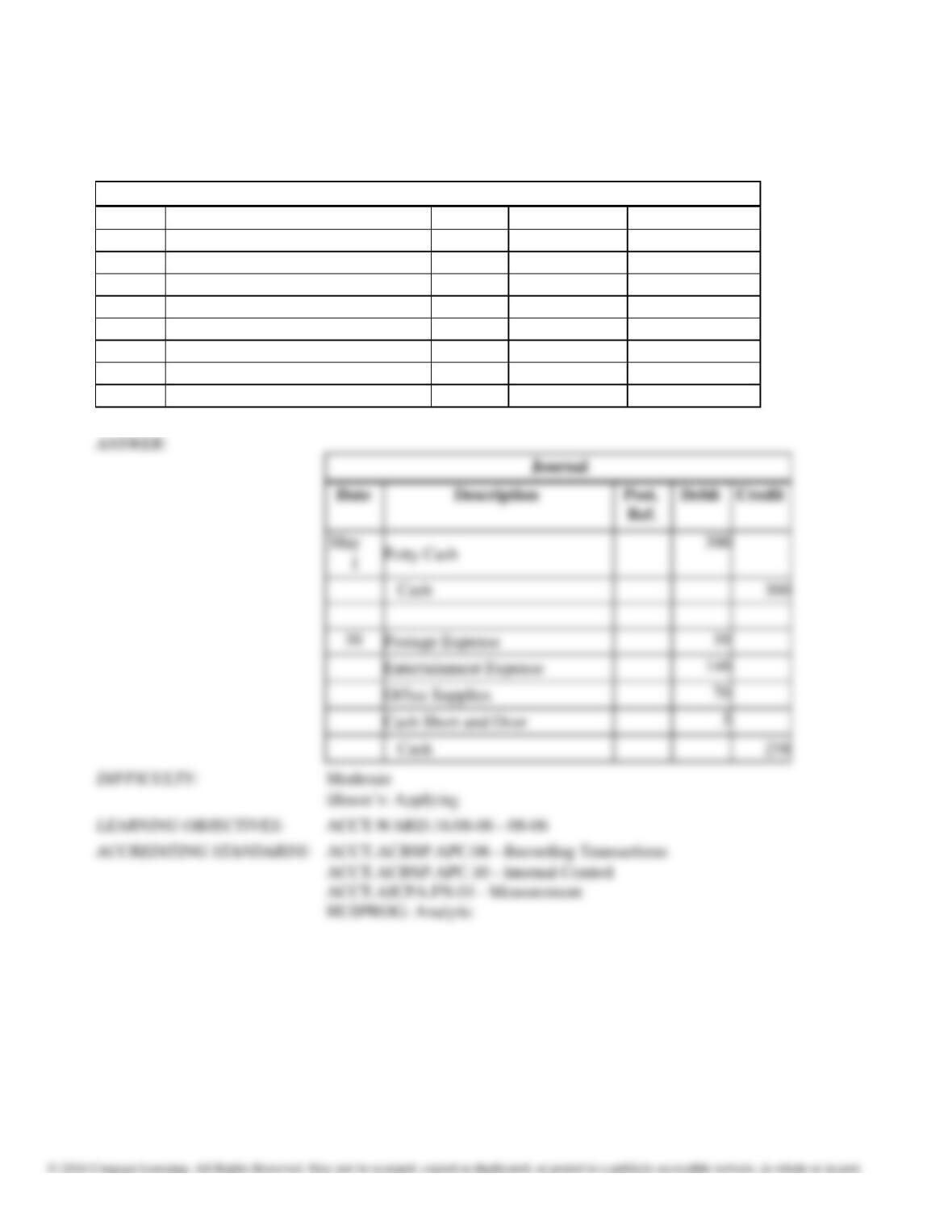
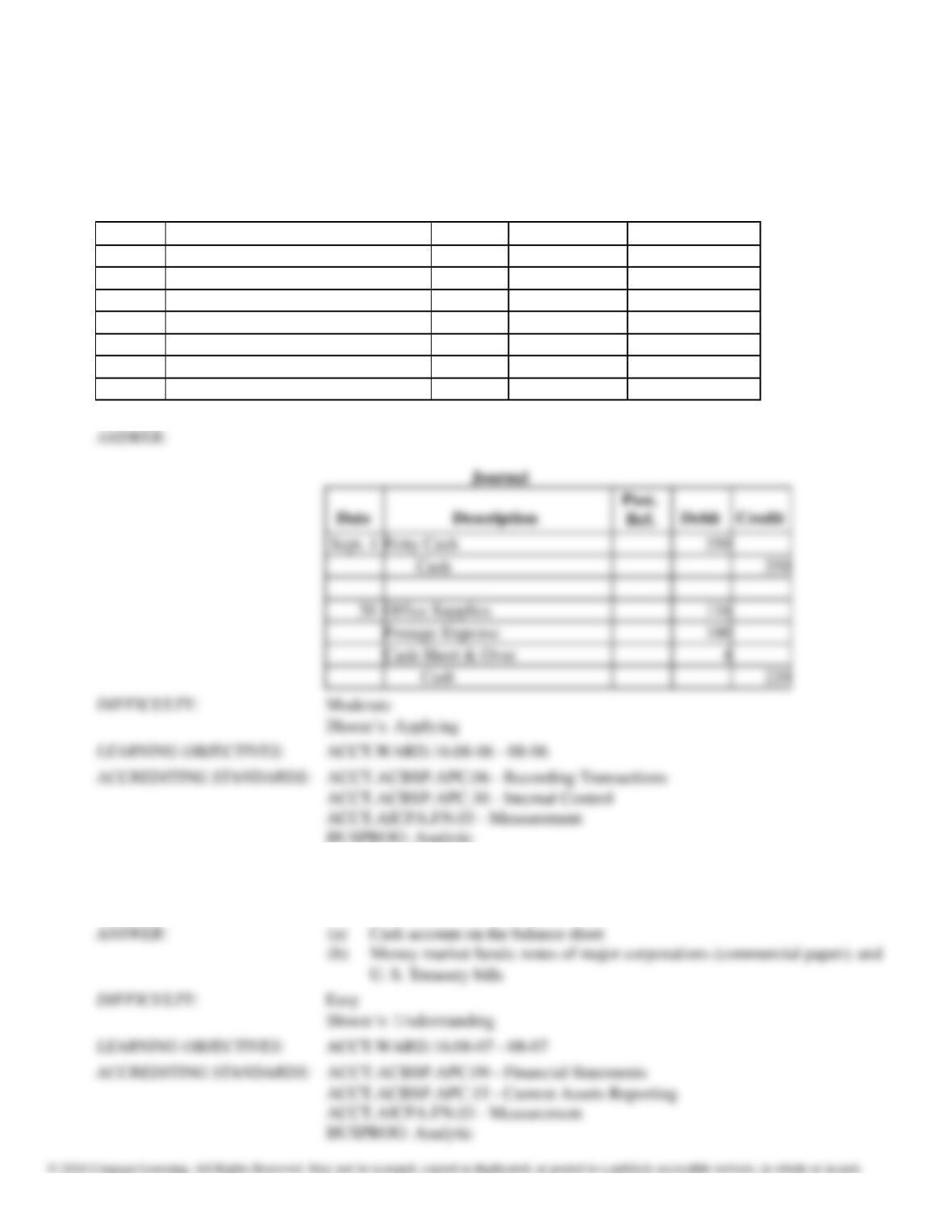
Stephanie Jo Company established a petty cash fund of $300 on May 1. At the end of the month, the petty cash
fund has $42 in cash and receipts for postage, $39; entertainment, $146; and office supplies of $70.
Prepare the needed journal entries, recording any discrepancy in the cash short and over account.
Journal
Date
Description
Post. Ref.
Debit
Credit
Chapter 8: Sarbanes-Oxley, Internal Control, and Cash
161.
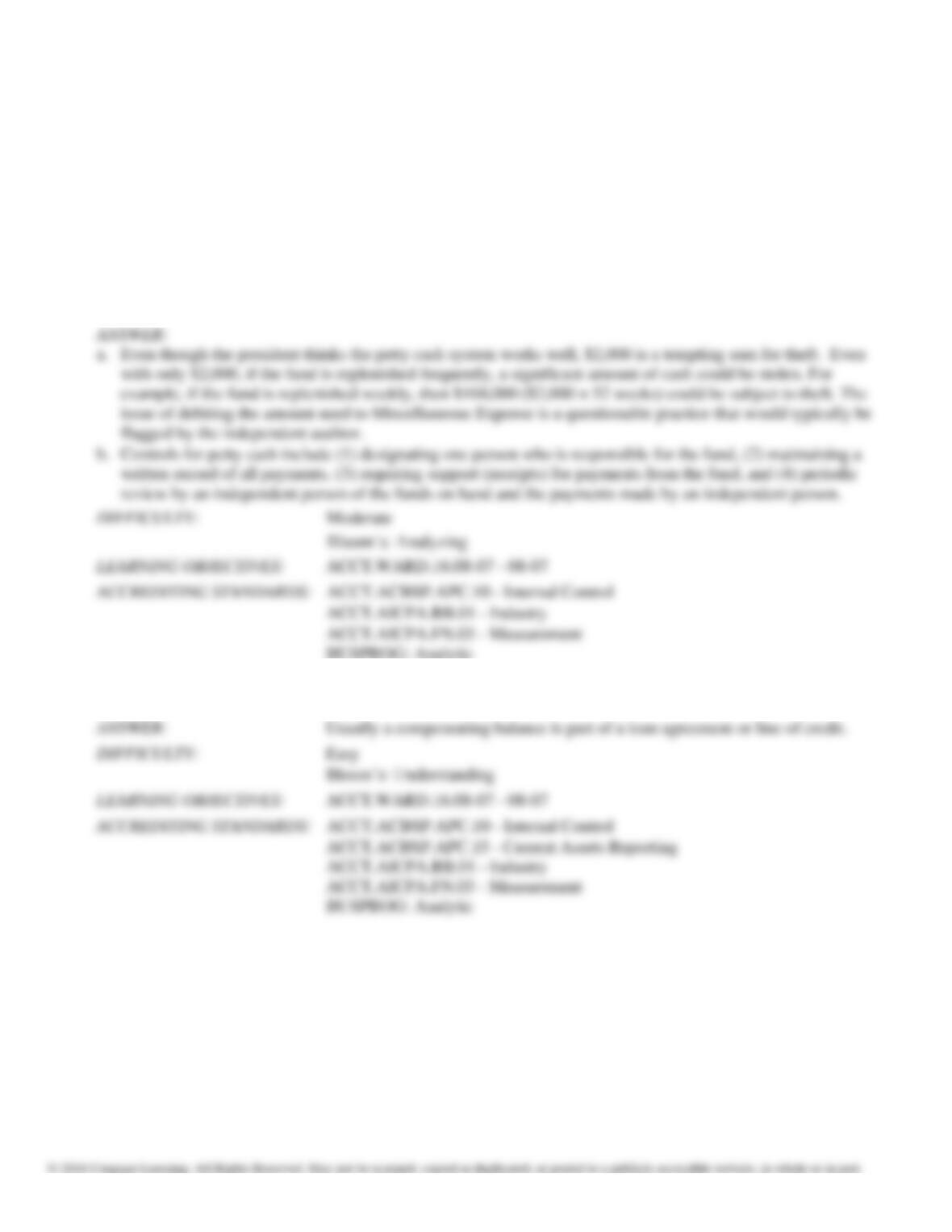
Journalize the entries to record the following:
Sept. 1 Established a petty cash fund of $350.
30 The amount of cash in the petty cash fund is now $130. The fund is replenished based on the
following
receipts: office supplies, $116; postage, $100.
Journal
Date
Description
Post. Ref.
Debit
Credit
162. (a) Where are cash equivalents disclosed in the financial statements?
(b) List three examples of cash equivalents.
Chapter 8: Sarbanes-Oxley, Internal Control, and Cash
163.
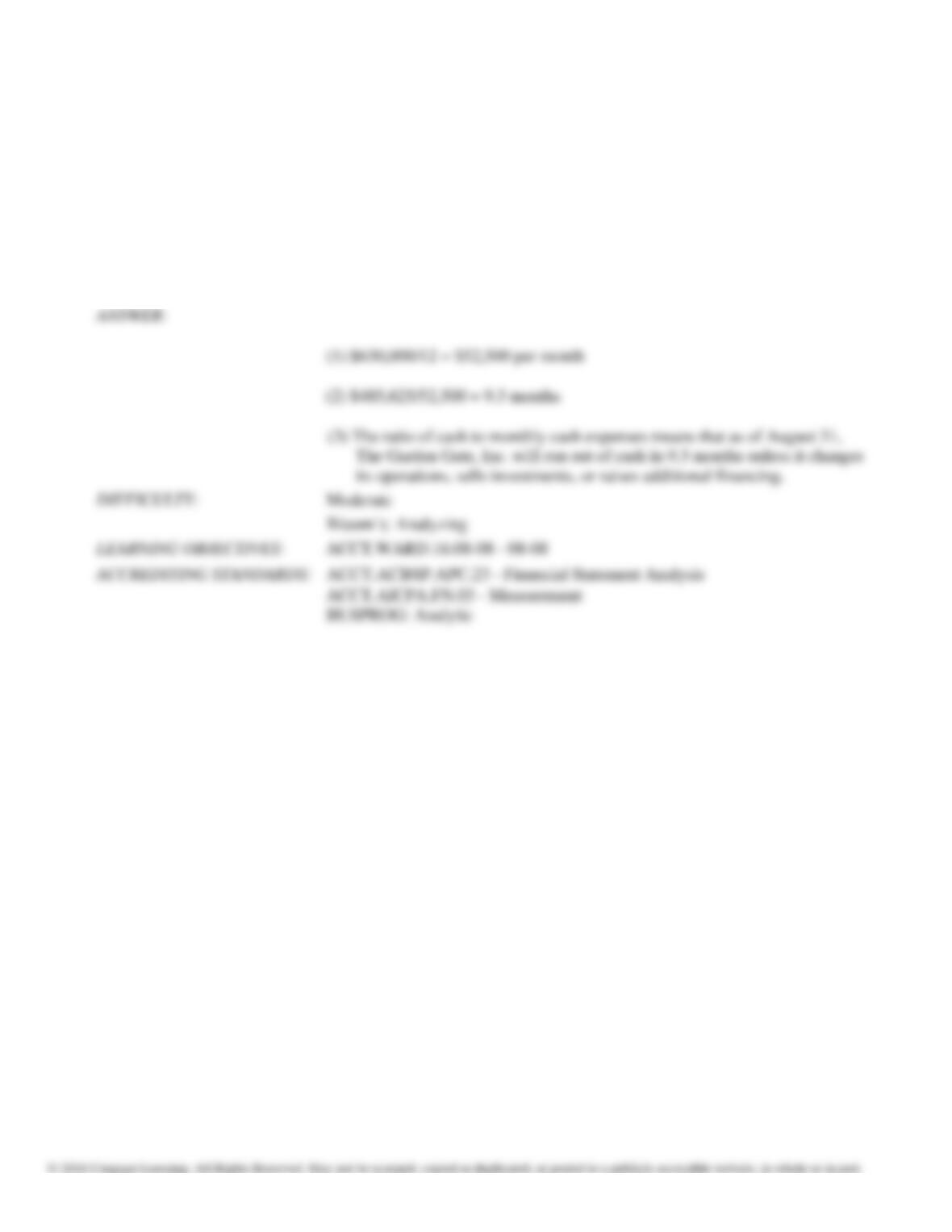
You began your new job as the accountant for Morton Company. You were surprised to find that the company
had
a $2,000 petty cash fund, which sits in the break room. The president of the company told you: “Our petty cash
system here works quite smoothly. Since everyone is honest here, everyone has access to the fund for incidentals
that might pop up in the course of the business day. Most of these situations don’t have any receipts tied to them,
so
I just put the money back in the fund when my secretary tells me that we have run out of petty cash and we
debit the
amount to Miscellaneous Expense.”
Required:
a. Should you implement some controls on petty cash? Why?
b. If so, what controls could be used for petty cash?
164.
Why would a bank require a company to maintain a compensating balance?
Chapter 8: Sarbanes-Oxley, Internal Control, and Cash
165.
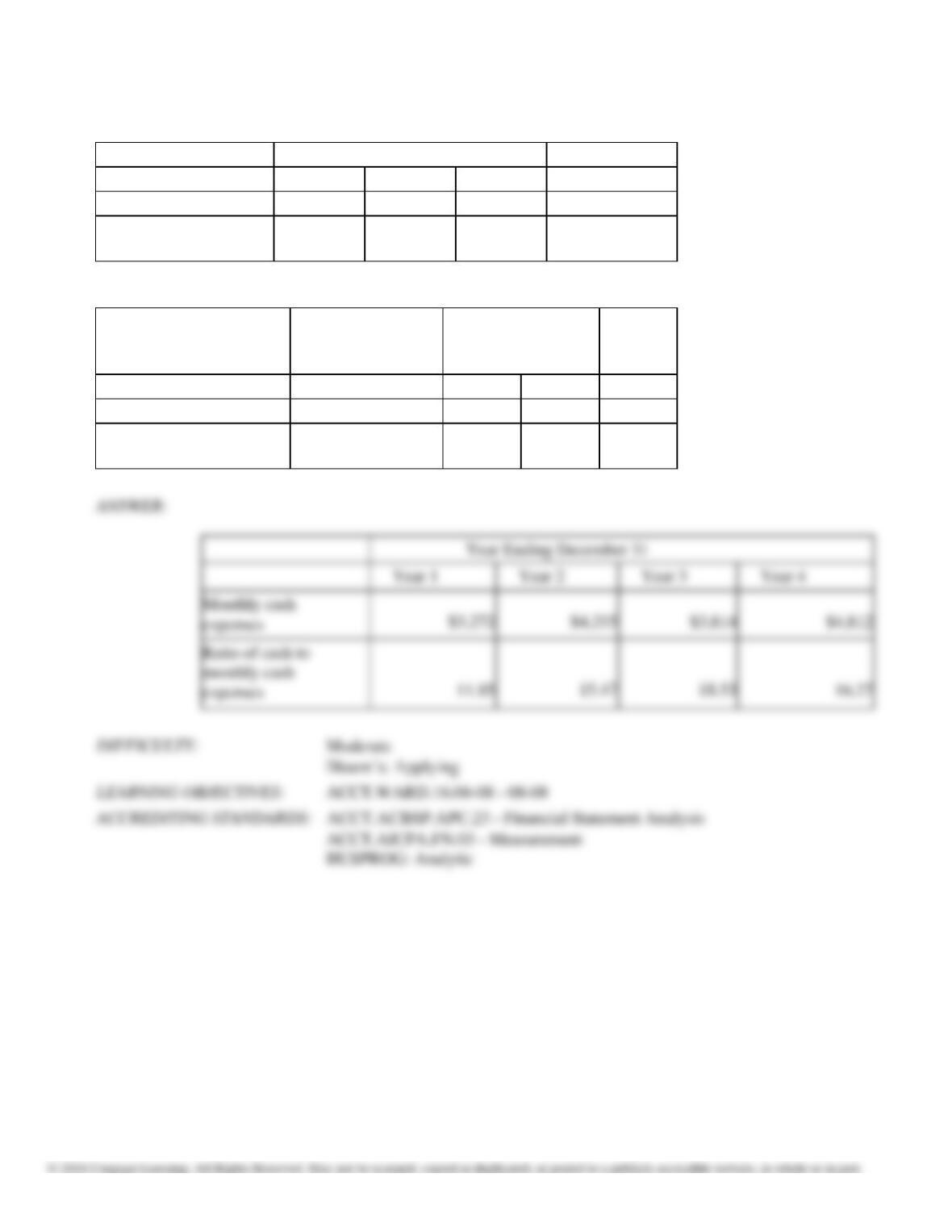
The Garden Gate, Inc. reported the following data in its August 31 annual report.
Cash and cash equivalents
$485 625
Cash flow from operations
Required:
(630,000)
(1)
What is the company’s “cash burn” per month?
(2)
What is the company’s ratio of cash to monthly cash expenses?
(3) Interpret the ratio you computed in part 2. What are the implications for The Garden Gate, Inc.?
Chapter 8: Sarbanes-Oxley, Internal Control, and Cash
166.
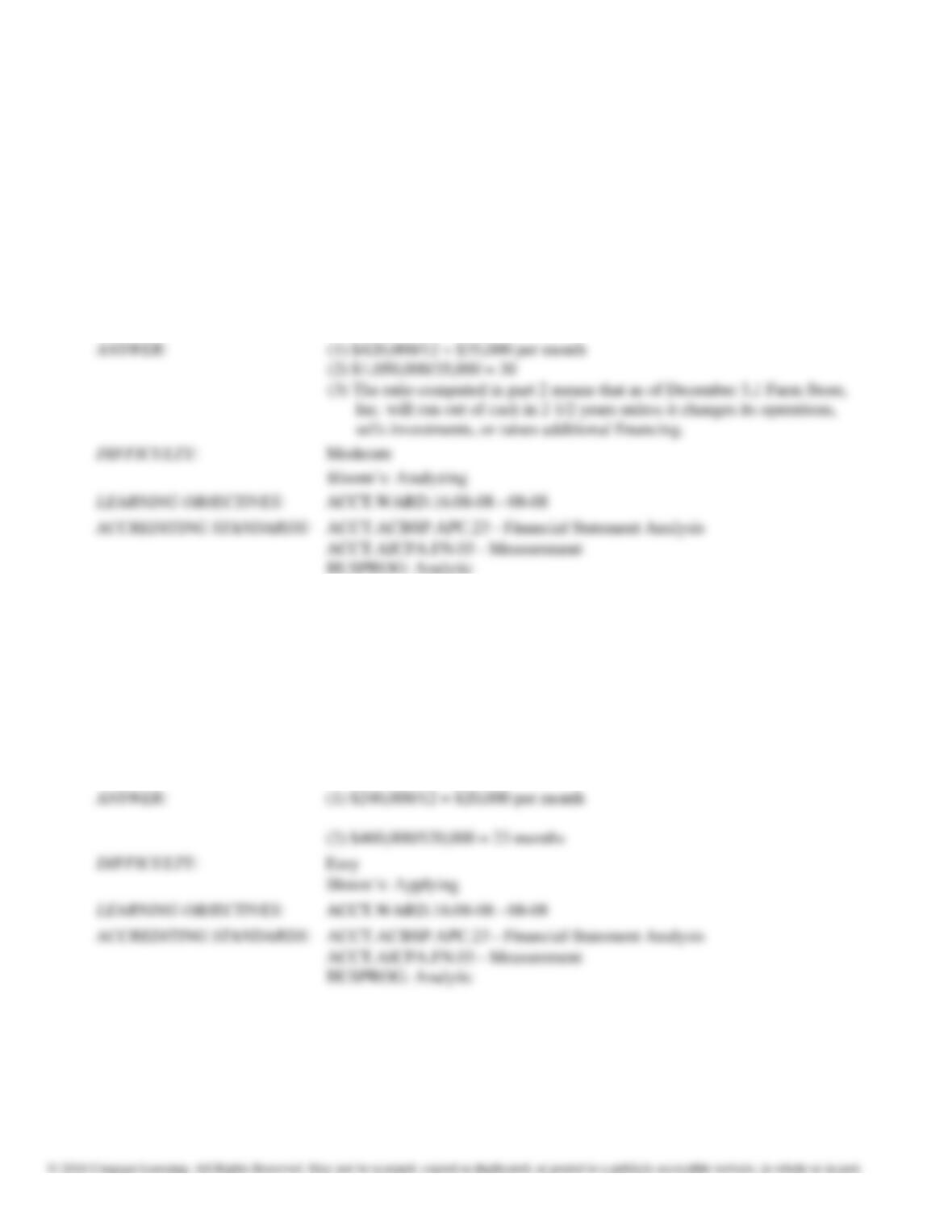
The following data is from the Muffin Shoppe for the past four years.
Year Ending December 31
Year 1
Year 2
Year 3
Year 4
Cash & cash equivalents
38,788
65,216
70,691
78,274
Cash flow from
operations
(39,264)
(50,580)
(45,768)
(57,744)
Calculate the following:
Year Ending
December 31 Data
Year 1
Year 2
Year 3
Year 4
Monthly cash expenses
Ratio of cash to
monthly
cash Expenses
Chapter 8: Sarbanes-Oxley, Internal Control, and Cash
167.
Farm Store, Inc. reported the following data in its December 31 annual report.
Cash and cash equivalents
$1,050,000
Negative cash flows from operations
Required:
(420,000)
(1)
What is the company’s “cash burn” per month?
(2)
What is the company’s ratio of cash to monthly cash expenses?
(3) Interpret the ratio you computed in part 2. What are the implications for Farm Store, Inc.
168.
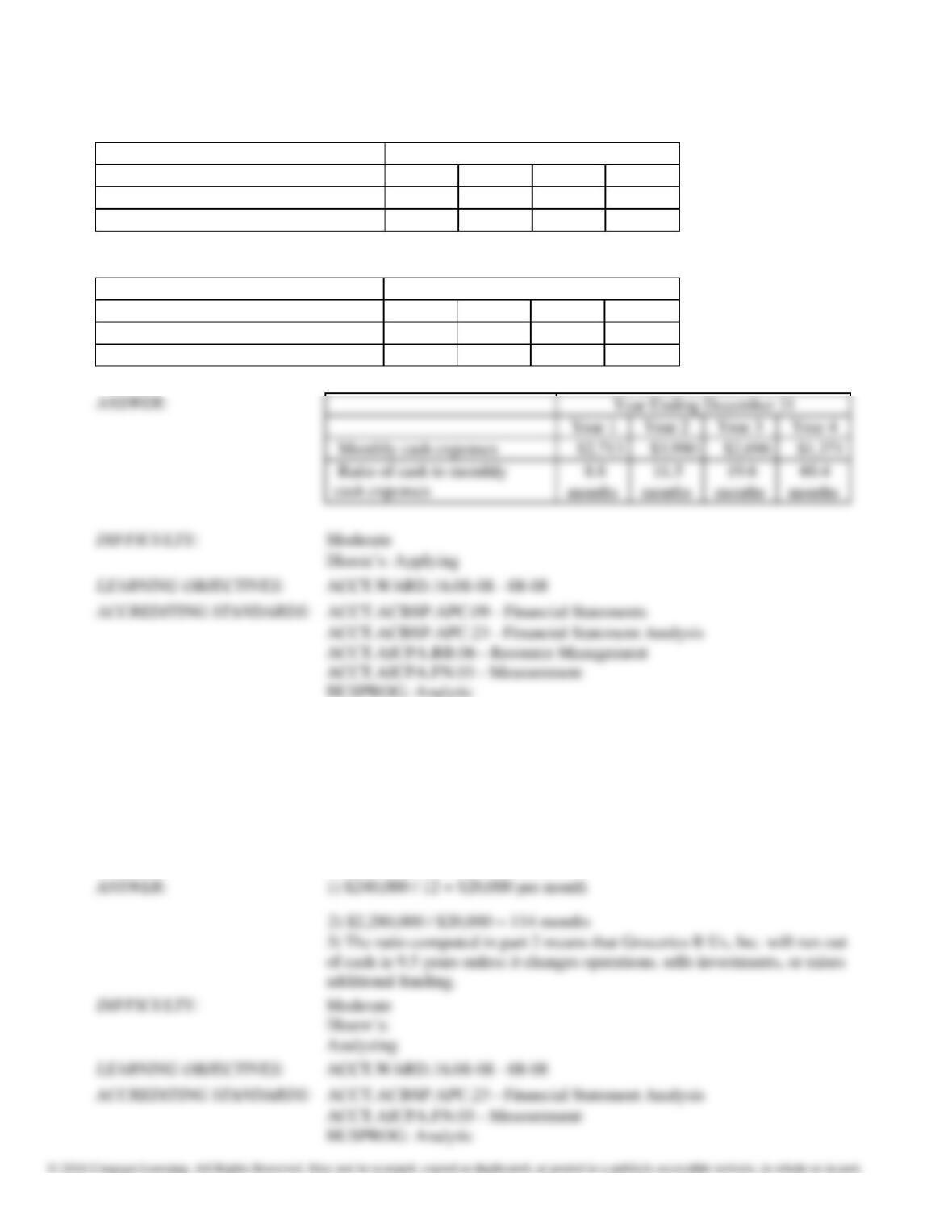
Aspen, Inc. reported the following data in its annual report:
Cash and cash equivalents $ 460,000
Cash flow from operations (240,000)
Required:
(1)
What is the company’s “cash burn” per month?
(2)
What is the company’s ratio of cash to monthly cash expenses?
Chapter 8: Sarbanes-Oxley, Internal Control, and Cash
169.
The following data is from the Autumn Company for the past four years.
Year Ending December 31
Year 1
Year 2
Year 3
Year 4
Cash & cash equivalents
$23,788
$45,776
$52,899
$82,744
Cash flow from operations
(32,556)
(47,880)
(32,357)
(16,450)
Calculate the following:
Year Ending December 31
Year 1
Year 2
Year 3
Year 4
Monthly cash expenses
Ratio of cash to monthly cash expenses
Year 2
Year 3
170.
Groceries R Us, Inc. reported the following data in its annual report.
Cash and cash equivalents $2,280,000
Cash flow from operations (240,000)
Required:
(1)
What is the company’s “cash burn” per month?
(2)
What is the company’s ratio of cash to monthly cash expenses?
(3) Interpret the ratio you computed in part 2. What are the implications for Groceries R Us, Inc.?

Chapter 8: Sarbanes-Oxley, Internal Control, and Cash
Match the following elements of internal control:
a.
provides reasonable assurance that business goals will be achieved
b.
used by management for guiding operations and ensuring compliance with requirements
c.
overall attitude of management and employees
d.
used to locate weaknesses and improve controls
e.
identify, analyze and assess likeliness of vulnerabilities
DIFFICULTY: Easy
Bloom’s: Remembering
LEARNING OBJECTIVES: ACCT.WARD.16.08-02 – 08–02
ACCREDITING STANDARDS: ACCT.ACBSP.APC.10 – Internal Control
ACCT.AICPA.FN.03 – Measurement
BUSPROG: Analytic
171.
Control environment
172.
Risk assessment
173.
Control procedures
174.
Monitoring
175.
Information and communication

Chapter 8: Sarbanes-Oxley, Internal Control, and Cash
Match each item to a bank statement adjustment, a company books adjustment, or either.
a.
bank statement adjustment
b.
company books adjustment
c.
either
DIFFICULTY: Moderate
Bloom’s: Remembering
LEARNING OBJECTIVES: ACCT.WARD.16.08-05 – 08–05
ACCREDITING STANDARDS: ACCT.ACBSP.APC.11 – Bank Reconciliation
ACCT.AICPA.FN.03 – Measurement
BUSPROG: Analytic
176.
Outstanding checks
177.
NSF check
178.
Error in recording a check
179.
Bank charges
180.
Note collected by the bank
181.
Interest revenue
182.
Deposit in transit

Chapter 8: Sarbanes-Oxley, Internal Control, and Cash
Assign the letter to indicate whether the following items would be added or subtracted from the company’s books or
the bank statement during the construction of a bank reconciliation.
a.
Added to the company’s books
b.
Subtracted from the company’s books
c.
Added to the bank statement balance
d.
Subtracted from the bank statement balance
DIFFICULTY: Moderate
Bloom‘s: Knowledge
LEARNING OBJECTIVES: ACCT.WARD.16.08-05 – 08–05
ACCREDITING STANDARDS: ACCT.ACBSP.APC.11 – Bank Reconciliation
ACCT.AICPA.FN.03 – Measurement
BUSPROG: Analytic
183.
Outstanding checks
184.
Bank service charge
185.
Deposit in transit
186.
NSF check
187.
EFT deposit from a customer
188.
Charges for some other company’s safe deposit box were posted to your account
189.
A $1,000 note from one of your customers was collected by the bank
190.
Interest revenue earned by the note above