Chapter 08 – Muscle Physiology
b.
False
False
51. Muscles that produce precise, delicate movements have fewer muscle fibers in their motor units compared to muscles
made for powerful movements.
a.
True
b.
False
True
52. Twitch summation results primarily from a sustained elevation in cytosolic Ca2+.
a.
True
b.
False
True
53. At the outer limits of a muscle’s length, it still can achieve about 80% of its maximal contraction strength.
a.
True
b.
False
False
54. Central fatigue occurs when the central nervous system no longer adequately activates the motor neurons supplying
the working muscles.
a.
True
b.
False
True
55. During the recovery period, fresh supplies of ATP are formed by oxidative phosphorylation using the newly acquired
oxygen, which is provided by the sustained increase in breathing after exercise has stopped.
a.
True
Chapter 08 – Muscle Physiology
b.
False
True
56. Slow and fast fibers are interconvertible.
a.
True
b.
False
False
57. Disuse atrophy occurs when a muscle is not used for a long period of time due to reduced or absent nerve supply.
a.
True
b.
False
False
58. Loss of excitatory input from higher centers brings about flaccid paralysis.
a.
True
b.
False
True
59. In contrast to muscle spindles, which lie in the tendons of muscle, Golgi tendon organs are in the belly of muscle.
a.
True
b.
False
False
60. A connection involving stimulation of the nerve supply to one muscle and simultaneous inhibition of the nerves to its
antagonistic muscle is known as reciprocal innervation.
a.
True
b.
False
True
61. The crossed extensor reflex is a postural reflex that ensures that the opposite limb is in a position to bear the weight of
the body as the injured limb is withdrawn from the stimulus.
a.
True
b.
False
True
62. Unlike skeletal muscle cells, a single smooth muscle cell extends the full length of a muscle.
a.
True
b.
False
False
63. A smooth muscle cell has many T tubules and well developed sarcoplasmic reticulum.
a.
True
b.
False
False
64. ATP splitting is much slower in smooth muscle, so cross-bridge activity and filament sliding occur about ten times
more slowly in smooth muscle than in skeletal muscle.
a.
True
b.
False
True
65. Smooth muscle cells are interconnected by gap junctions found in intercalated discs that join cells together.
a.
True
b.
False
False
66. A single skeletal muscle cell is known as a(n) ____________________.
67. A skeletal muscle fiber contains numerous ____________________, which are cylindrical intracellular structures.
68. The lighter area within the middle of the A band, where the thin filaments do not reach, is the
____________________.
69. ____________________ is a protein complex made of three polypeptide units: one binds to ____________________, one
binds to actin, and a third can bind with Ca2+.
70. The H zone, in the center of the ____________________ where the thin filaments do not reach, becomes
____________________ as the thin filaments approach each other when they slide more deeply inward.
71. A single ____________________ pulls the thin filament inward only a small percentage of the total shortening
distance.
72. At each junction of an A band and I band, the surface membrane dips into the muscle fiber to form a(n)
____________________.
73. The lateral sacs (alternatively known as terminal cisternae) store ____________________.
74. The end of the muscle attached to the more stationary part of the skeleton is called the ____________________, and
the end attached to the skeletal part that moves is the ____________________.
75. In a(n) ____________________ contraction, the muscle is prevented from shortening, so tension develops at constant
muscle length.
76. With eccentric contractions, the muscle ____________________.
77. A(n) ____________________ is a rigid structure capable of moving around a pivot point known as a(n)
____________________.
78. If the muscle fiber is stimulated so rapidly that it does not have a chance to relax at all between stimuli, a smooth,
sustained contraction of maximal strength known as ____________________ occurs.
79. Oxidative phosphorylation takes place within the muscle ____________________ if sufficient oxygen is present.
80. When the end product of glycolysis, pyruvate, cannot be further processed by oxidative phosphorylation, it is
converted to ____________________.
81. The local increase in inorganic phosphate from ____________________ breakdown is considered the primary cause
of ____________________ fatigue.
82. Oxidative fibers have high ____________________ content, which is why they are also called ____________________
fibers.
83. ____________________ movements are the most complex type of motor activity.
84. Premotor and supplementary motor areas, with input from the ____________________, plan the ____________________
motor command that is issued to the appropriate motor neurons by the primary motor cortex through a descending system.
85. The efferent neuron that innervates a muscle spindle’s intrafusal fibers is known as a(n) ____________________ motor
neuron.
86. The patellar tendon, or knee-jerk, reflex is a type of ____________________ reflex.
87. Lacking sarcomeres, smooth muscle does not have Z lines, but it does have ____________________ containing the
same protein constituent found in Z lines.
88. Smooth muscle myosin can interact with actin only when the light chain is ____________________.
89. ____________________ smooth muscle is usually partially contracted at all times; that is, it exhibits smooth muscle
tone.
90. A group of interconnected muscle cells that function electrically and mechanically as a unit is known as a functional
____________________.
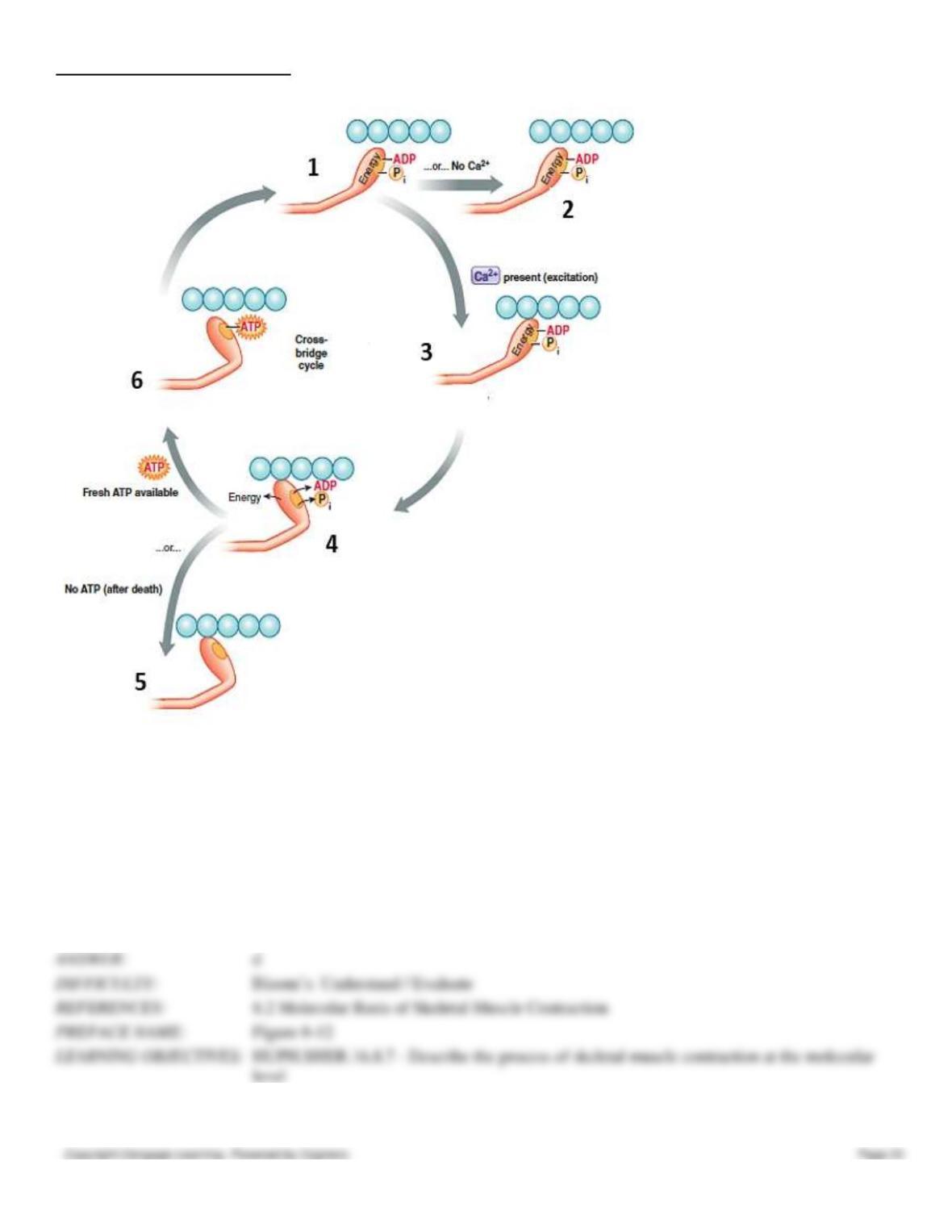
Chapter 08 – Muscle Physiology
Figure 8-12
Answer the following questions using the accompanying figure.
91. Which number in the accompanying figure represents the bending stage of the cross-bridge cycle?
a.
1
b.
2
c.
3
d.
4
e.
5
f.
6
d
92. Which number in the accompanying figure represents the energized state of the cross-bridge cycle?
Chapter 08 – Muscle Physiology
a.
1
b.
2
c.
3
d.
4
e.
5
f.
6
93. Which number in the accompanying figure represents the detachment stage of the cross-bridge cycle?
a.
1
b.
2
c.
3
d.
4
e.
5
f.
6
94. Which number in the accompanying figure represents the resting state of the cross-bridge cycle?
a.
1
b.
2
c.
3
d.
4
e.
5
f.
6
b
95. Which number in the accompanying figure represents the state of rigor complex in the cross-bridge cycle?
a.
1
b.
2
c.
3
Chapter 08 – Muscle Physiology
d.
4
e.
5
f.
6
96. What functions does the controlled contraction of muscles allow?
97. What is rigor mortis?
98. Outline the three primary types of muscle contraction.
99. Describe the symptoms of muscular dystrophy.
100. Describe the three types of filaments in smooth muscle.