69) An increasing number of states have adopted a federal form of government primarily to
A) grant different ethnicities or nationalities more effective representation.
B) encourage the breakup of the superpower alliances.
C) govern compact states more effectively.
D) deploy scarce resources efficiently.
E) accommodate rightwing political parties and their demands for more representation in
national elections.
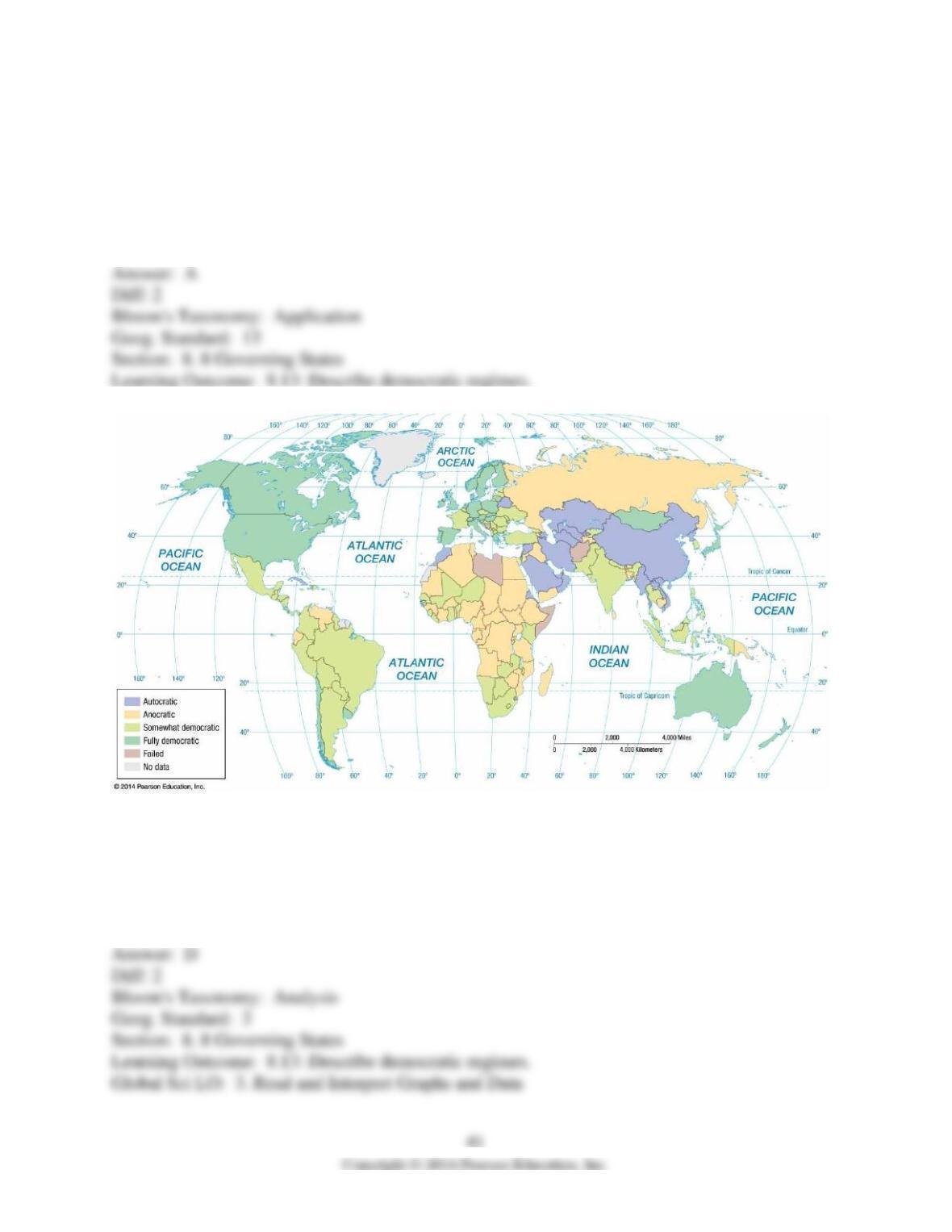
70) According to the map of regime types, Brazil is an example of a(n)
A) autocracy.
B) anocracy.
C) fully democratic and sovereign state.
D) somewhat democratic state.
E) failed state.
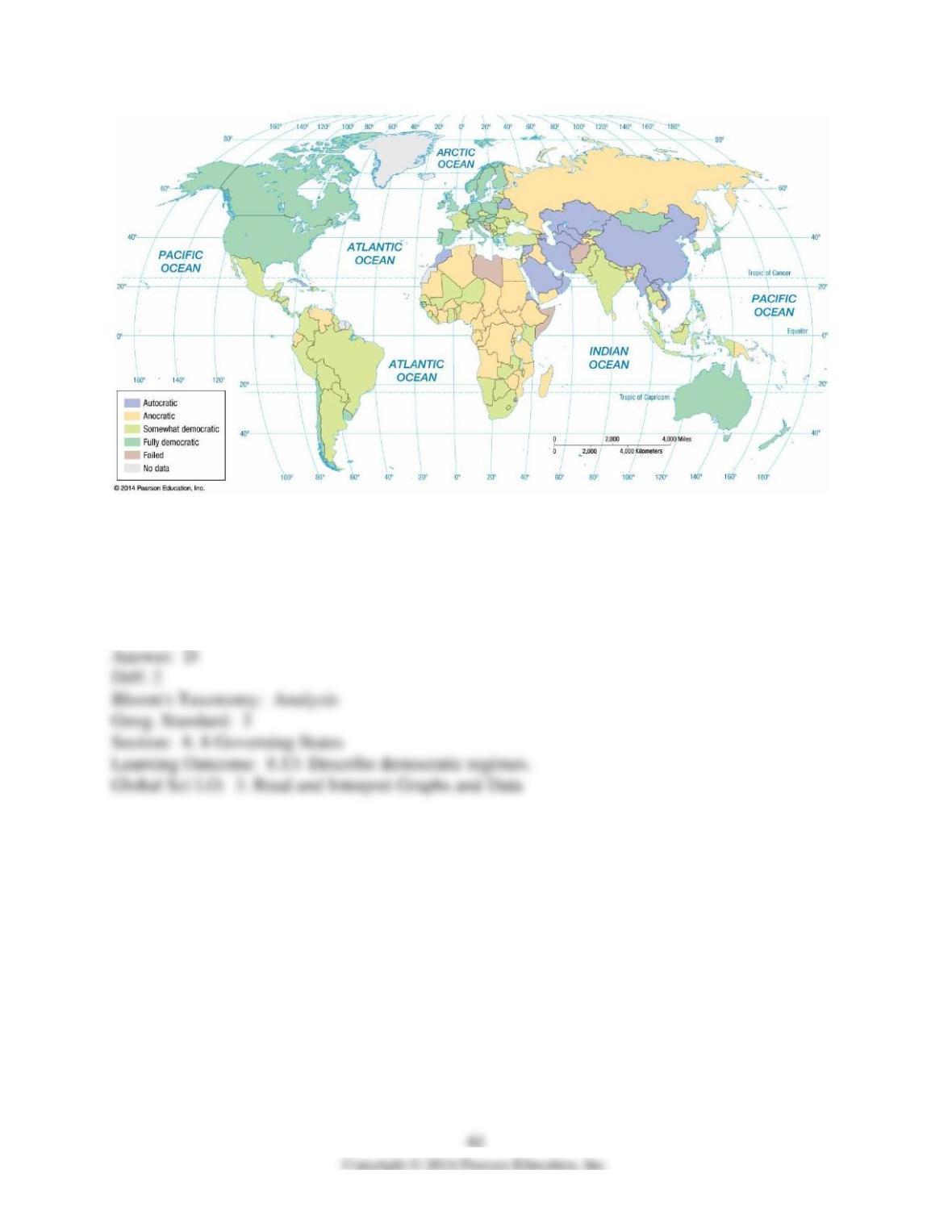
71) According to the map of regime types, Spain is an example of a(n)
A) autocracy.
B) anocracy.
C) partial democracy.
D) full democracy.
E) failed state.
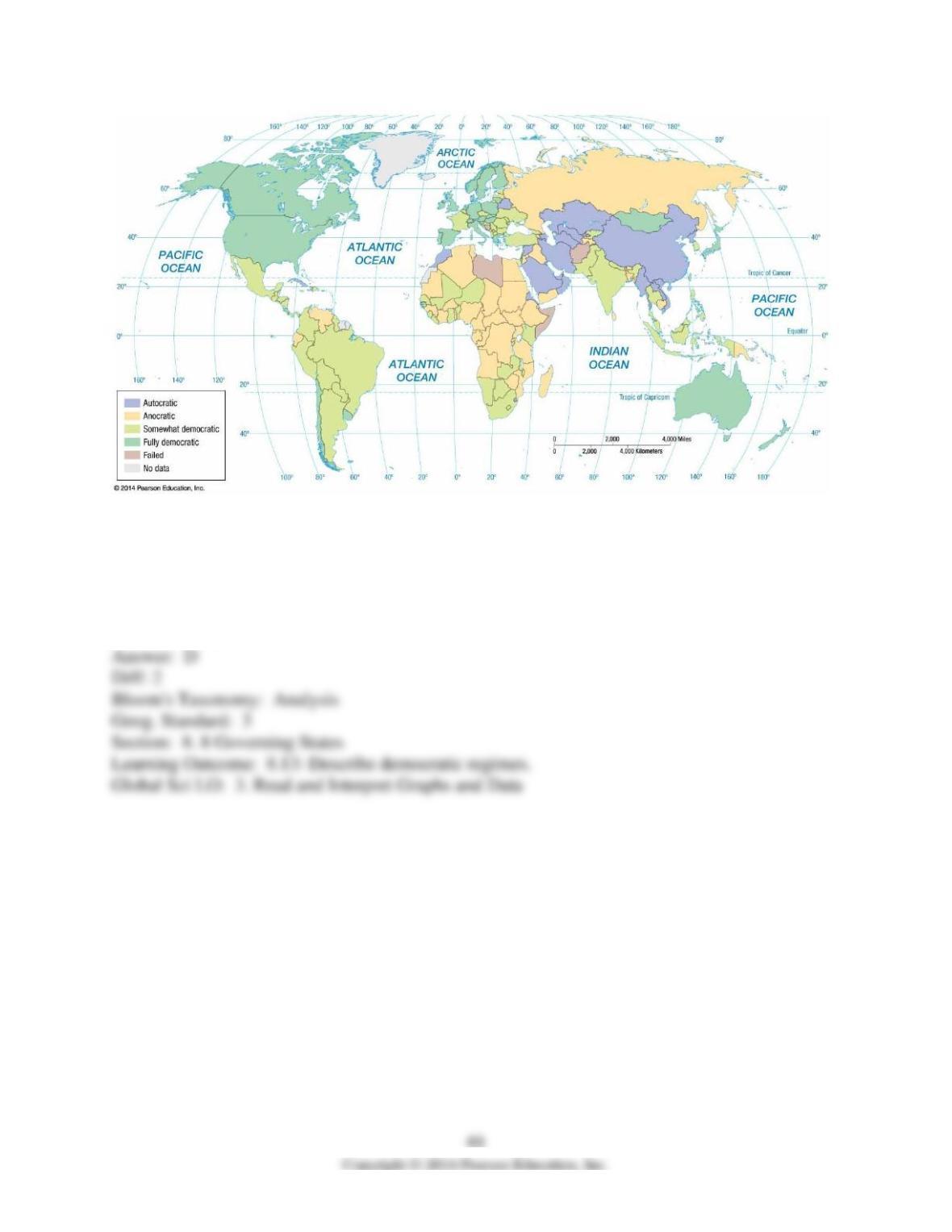
72) According to the map of regime types, Chile is now an example of a(n)
A) autocracy.
B) anocracy.
C) partial democracy.
D) full democracy.
E) failed state.
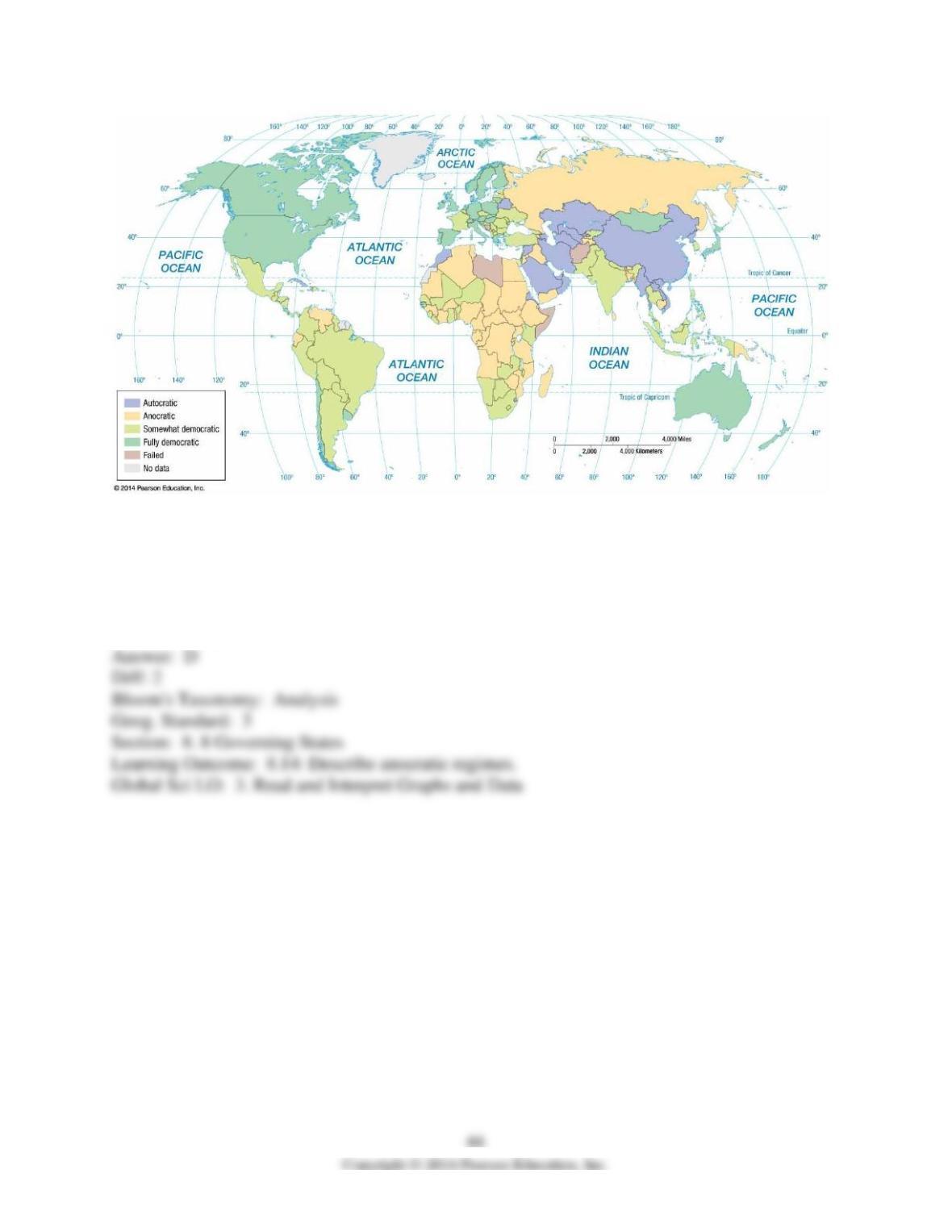
73) According to the map of regime types, Zimbabwe is an example of a(n)
A) autocracy.
B) partial democracy.
C) full democracy.
D) anocracy.
E) failed state.
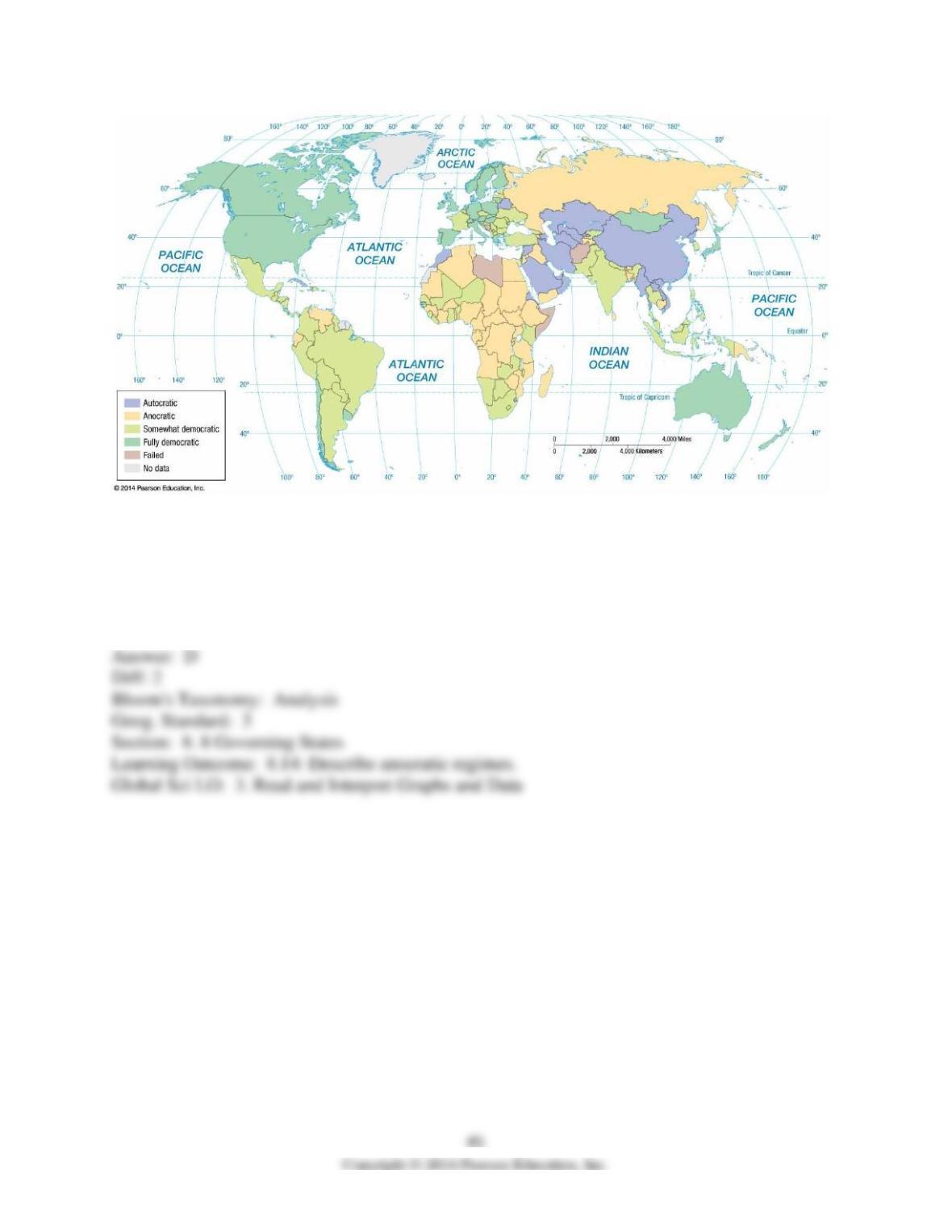
74) According to the map of regime types, Iraq is now an example of a(n)
A) autocracy.
B) partial democracy.
C) full democracy.
D) anocracy.
E) failed state.
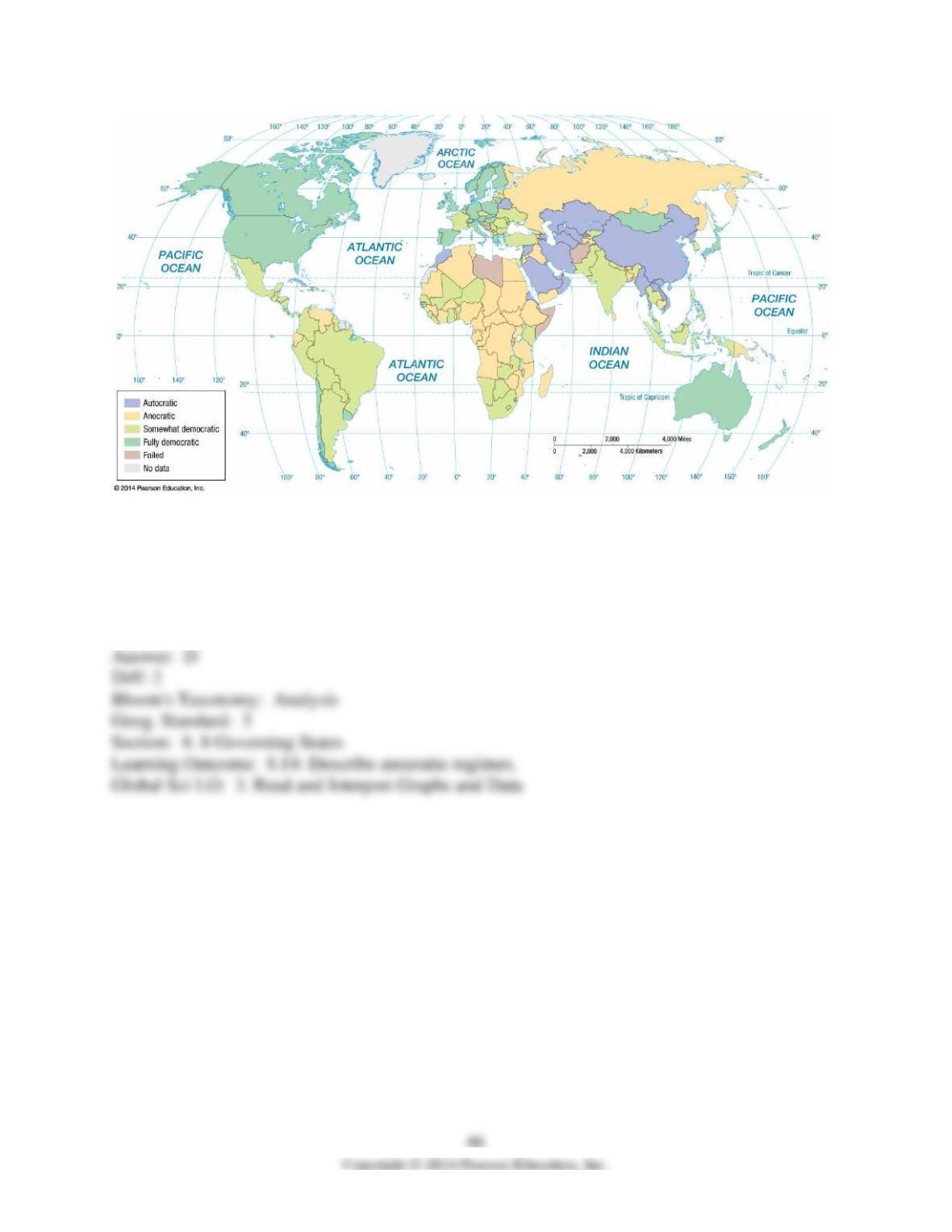
75) According to the map of regime types, Russia is an example of a(n)
A) autocracy.
B) partial democracy.
C) full democracy.
D) anocracy.
E) failed state.
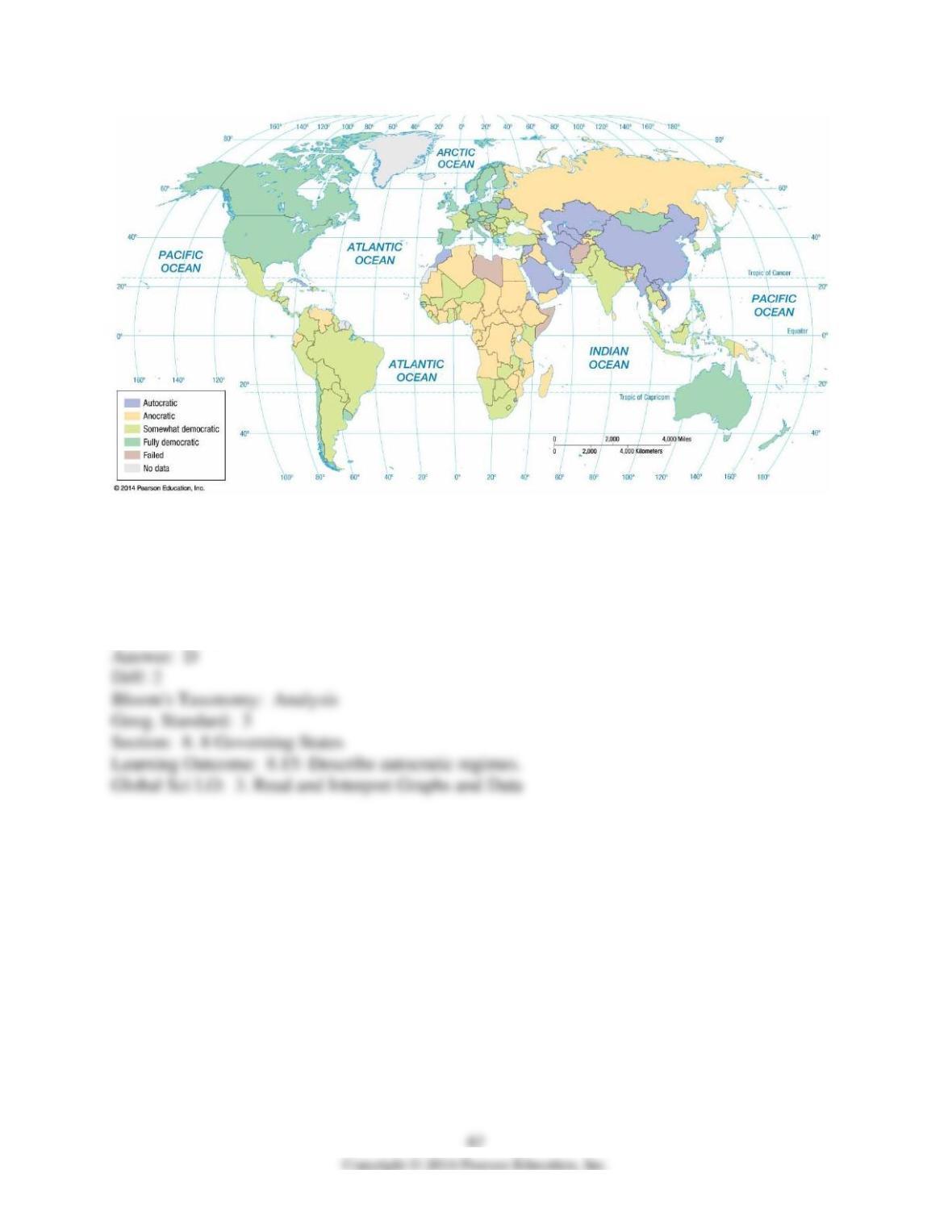
76) According to the map of regime types, Saudi Arabia is an example of a(n)
A) anocracy.
B) partial democracy.
C) full democracy.
D) autocracy.
E) failed state.
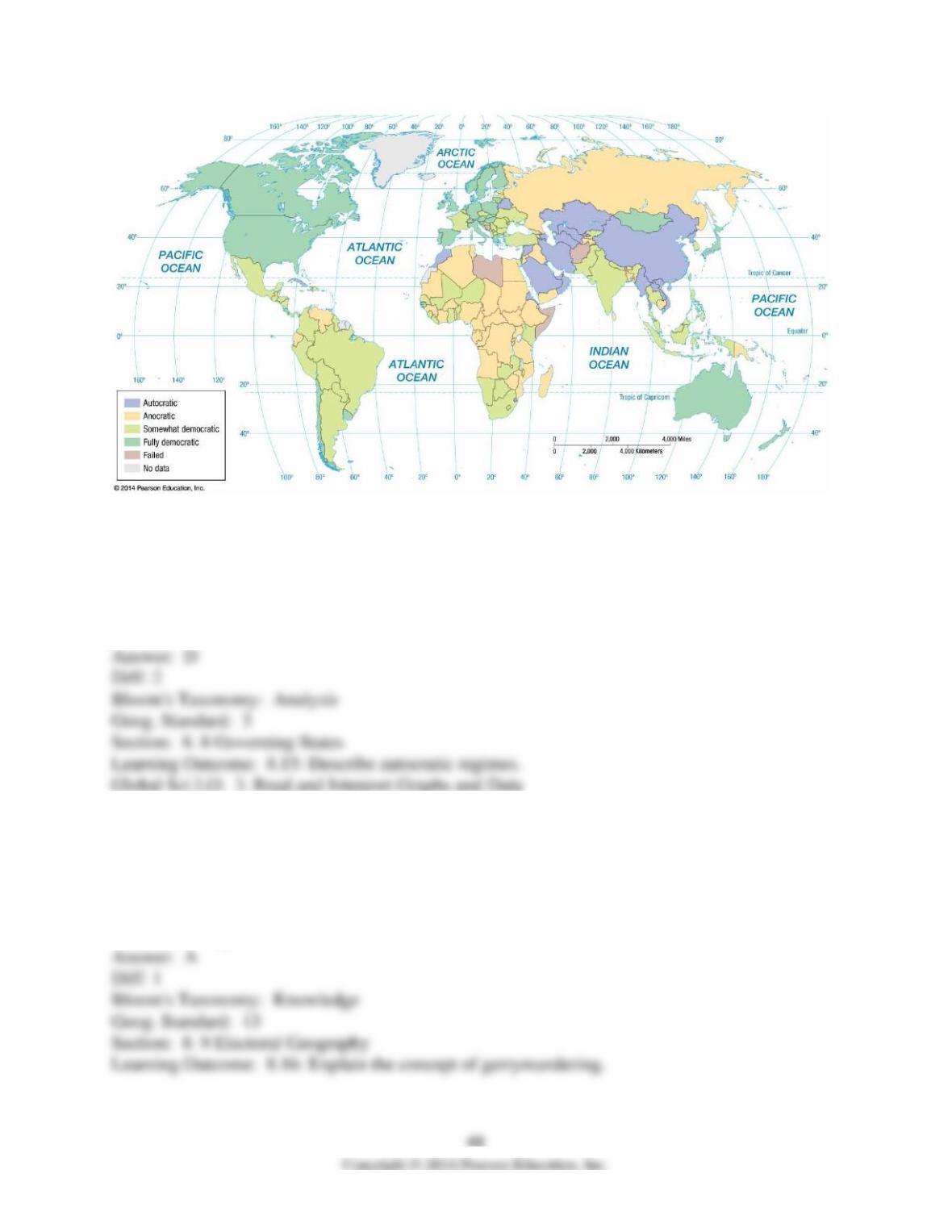
77) According to the map of regime types, Belarus is an example of a(n)
A) anocracy.
B) partial democracy.
C) full democracy.
D) autocracy.
E) failed state.
78) The process of redrawing legislative boundaries to benefit the party in power is called
A) gerrymandering.
B) stacking votes.
C) hanging chads.
D) redlining.
E) blockbusting.
79) When gerrymandering takes place, the kind of redistricting so that the opposition is spread
across many districts as a minority is termed a(n) ________ strategy.
A) wasted vote
B) rightwing
C) stacked vote
D) districting
E) excess vote
80) When gerrymandering takes place, the kind of redistricting that concentrates opposition
voters into a small number of districts, allowing the party in power to gain control of numerous
other districts, is termed a(n) ________ strategy.
A) excess vote
B) red-state rigged
C) stacked vote
D) wasted vote
E) inexcess vote
81) The two Germanys
A) existed separately from 1949 to 1990.
B) are the newest UN member states in Europe.
C) were divided by proto-Germanic languages.
D) are on opposite banks of the Rhine River.
E) were divided by economic and cultural boundaries until 1871.
82) In the geopolitical sphere, a balance of power is
A) a condition of roughly equal strength between opposing sides, as if they were two equally
matched camps.
B) always bipolar but reinforced by satellite states.
C) a condition of unequal strength between opposing sides, as if they were two powerful allies,
supported by a range of satellite states.
D) exemplified by a League of Nations or, in the post-World War II era, the United Nations.
E) the type of power shared by the members of the North Atlantic Treaty Organization.
83) What was a distinctive feature of the world’s superpowers between the 1940s and 1980s
compared to other eras?
A) The United States and the Soviet Union were superpowers for the first time.
B) The two superpowers were never involved in wars.
C) The number of superpowers was much lower than in the past.
D) The superpowers had satellites.
E) The superpowers used religion to settle conflicts.
84) As a result of a 1979 Soviet invasion, fundamentalist Muslims began a major rebellion in
________, supported in part by weapons supplied by the United States.
A) Afghanistan
B) Ethiopia
C) Iran
D) Vietnam
E) Yugoslavia
85) As a result of a 1979 Soviet invasion, Osama bin Laden left Saudi Arabia to join the
rebellion of fundamentalist Muslims calling themselves
A) mujahedeen, or “holy warriors.”
B) kamchatkadeen, or “Kamcha warriors.”
C) iraqideen, or “Southwest Asian warriors.”
D) jalomadeen, or “peace warriors.”
E) Islamic Brotherhood “holy warriors.”
86) ________ entered Afghanistan in the ________ to help fight a jihad against the Soviet
Union, and years later he opposed the stationing of U.S. troops in Saudi Arabia.
A) Osama bin Laden; 1980s
B) Osama bin Laden; 1990s
C) Osama bin Laden; 1970s
D) Muhammad bin Laden; 1980s
E) Ladenbil al Reilly; 1980s
87) In ________ in 1979, when the U.S.-supported leader of the country was ousted from power,
supporters of the ayatollah seized the U.S. embassy and held 62 Americans hostage until January
20, 1981.
A) Iran
B) Iraq
C) Afghanistan
D) Egypt
E) Israel
88) The boundary between the two Germanys was determined by
A) Cold War alliances and rivalries after World War II.
B) membership in the United Nations, along with nationalistic issues.
C) the growth of fascism in Europe.
D) the changing physical boundaries of Europe’s major rivers and coastlines.
E) cultural issues involving shifting language patterns in Europe.
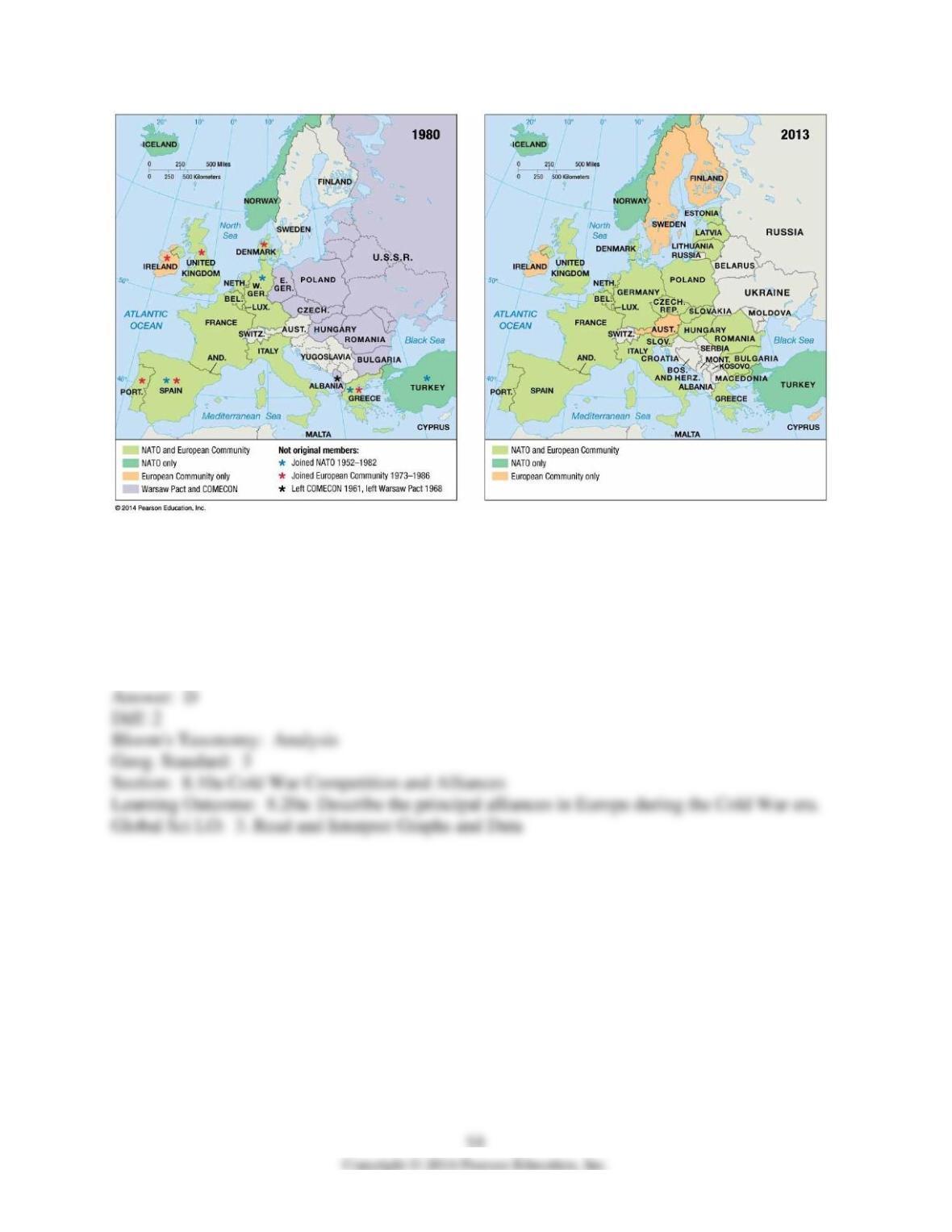
89) As shown on the map of European economic and military alliances in 1980, what NATO
member was directly north of Italy?
A) Austria
B) Switzerland
C) Spain
D) West Germany
E) Czechoslovakia