Chapter 8: Measuring and Assigning Support Department Costs
Learning Questions
True /
False
Multiple Choice
Matching
Exercises
Short
Answer
Problems
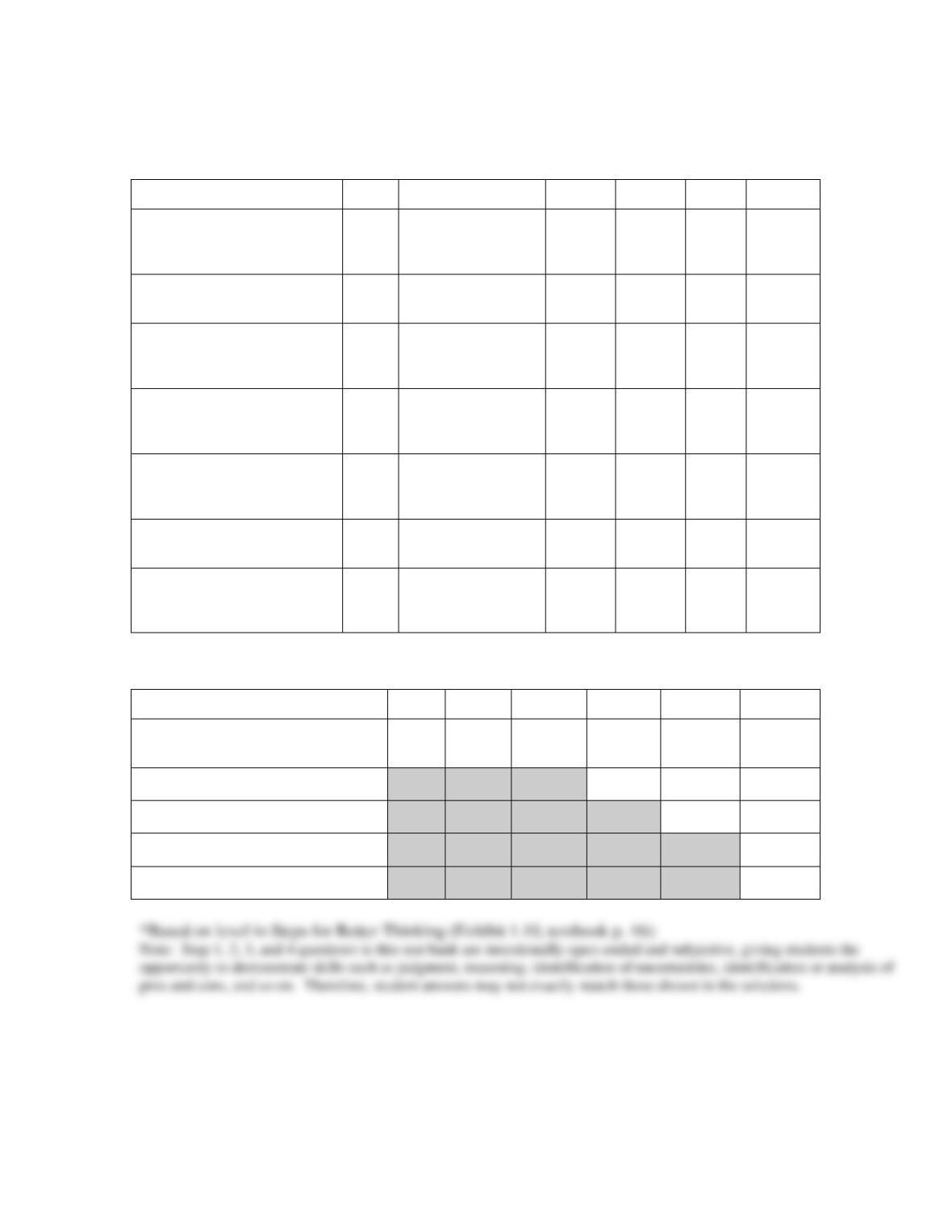
1. What are support
departments, and why are
their costs allocated to other
departments?
1-4
41–49
W: 93-95, 113
1
2, 7
5
2. What process is used to
allocate support department
costs?
5-7
50–58
W: 96, 99
2
1, 6
5
3. How is the direct method
used to allocate support costs
to operating departments?
8-10
7-9, 12-14, 18, 31, 32,
39
S: 76, 82
W: 101, 107, 109, 110
3
1, 3
3
1, 2, 5
4. How is the step-down method
used to allocate support costs
to operating departments?
11–13
10, 11, 15, 16, 19, 25,
26, 30, 33, 34, 40
S: 77, 80, 83, 84
W: 106, 111
3
1, 3
3
1, 5
5. How is the reciprocal method
used to allocate support costs
to operating departments?
14–15
17, 20-24, 27-29, 35-
38
S: 78, 85
W: 102, 112
3
2, 3
3
1, 2
6. What is the difference
between single- and dual-rate
allocations?
16–19
1-5, 60-65, 75
S: 79, 86-89
W: 108
4
8
1, 5, 6
7. What are the limitations of
support cost allocation, and
how can the quality of
information be improved?
21-21
6, 59, 66-74
S: 81, 90-92
W: 97, 98, 100, 103-
105
4, 5, 9
1, 3, 4, 5
S: Questions from the study guide
W: Questions from web quizzes on the student web site
Level of Complexity*
True /
False
Multiple
Choice
Matching
Exercises
Short
Answer
Problems
Foundation: Repeat or paraphrase
information; Reason to single correct
solution; Perform computations; etc.
All
All
All
All
7
All
Step 1: Identify the problem, relevant
information, and uncertainties
1, 4, 6, 8,
9, 11
1
Step 2: Explore interpretations and
connections
2, 5, 10
3, 5, 6
Step 3: Prioritize alternatives and
implement conclusions
2, 4
Step 4: Envision and direct strategic
innovation

8-2 Cost Management
True / False
1. A support department provides internal services for both operating and other support departments.
2. Typical support departments include accounting and human resources.
3. Support department costs are generally allocated to inventory when preparing financial statements
under generally accepted accounting principles.
4. Managers often allocate support department costs as a means of motivating employees.
5. Allocating support department costs has some similarities to activity-based costing, for example costs
are traced and allocated to cost pools.
6. Managers need to clarify their reasons for allocating support department costs before establishing cost
pools.
7. Support department costs are always allocated to individual units of products or services.
8. The direct method allocates the cost of support departments only to operating departments.
9. The direct method acknowledges services provided by one support department to another support
department.
10. The direct method uses each operating department’s allocation rate to allocate costs to a support
department.
11. The step-down method allocates one support department’s cost at a time.
12. The step-down method allocates support department costs in a cascading manner.
13. The step-down method does not recognize services provided between support departments.
14. The reciprocal method reflects only part of the interactions between support departments.
15. The calculations for the reciprocal method are more complex than for other support department cost
allocation methods.
16. Single-rate allocation methods use only one cost pool and one base to allocate both fixed and variable
costs.
17. Single-rate allocations are unlikely to reflect actual resource usage.
18. Under dual-rate allocation, costs are separated into support and operating pools before being
allocated.
19. When managers use dual-rate allocation, they frequently identify cost drivers for fixed cost pools to
identify resource flows more accurately.
20. A properly designed accounting system insures that costs are assigned with complete accuracy to
support and operating department cost pools.
21. “Perceived fairness” is sometimes used as a criterion for allocating support department costs to
operating departments.
Multiple Choice
Use the following information for the next 2 questions.
Cervantes Industries provides an in-house cafeteria for production and administrative employees. This
service costs $25,000 per month, plus $3 per meal served. The company has 800 production employees and
400 administrative employees. During the past month 5,500 meals were served to production employees and
2,000 to administrative.
Chapter 8: Measuring and Assigning Support Department Costs 8-3
1. The amount of cost allocated to the administrative department using actual meals served as the basis
is
a. $16,675
b. $12,667
c. $14,325
d. $18,500
2. The amount allocated to the operating department using a dual-rate basis with the fixed cost
allocation based on number of employees is
a. $33,167
b. $31,683
c. $24,833
d. $41,500
Use the following information for the next 3 questions.
The personnel department provides service to operating departments A and B. Personnel’s budget is based
on 250 employees (100 in department A and 150 in department B). The budget calls for $40,000 in fixed
costs, plus $140 per employee. During a recent month the personnel department incurred $41,000 in fixed
costs and $42,200 in variable costs. The two operating departments, A and B, had 120 and 140 employees,
respectively.
3. How much would be charged to department A if actual costs were allocated based on number of
employees?
a. $36,000
b. $38,400
c. $30,000
d. $34,615
4. How much would be charged to department B if budgeted costs were allocated based on number of
employees?
a. $45,000
b. $44,800
c. $43,600
d. $40,385
5. The CEO of the company described above wants to gather information for a decision to outsource the
HR function. Which of the following allocation methods would provide useful information?
a. A job costing system
b. A dual rate support department allocation system
c. A single rate support department allocation system
b. A process costing system
6. Which of the following is a disadvantage for using budgeted costs instead of actual costs for support
department cost allocation?
a. Managers know their exact costs in advance and have no incentive to minimize use of services
b. Budgeted costs do not reflect current usage, and so managers may overuse support services
c. Allocated support department costs are not under the manager’s control
d. Support departments might be cut back because services are likely to be underused

8-4 Cost Management
Use the following information for the next 5 questions.
Chambers, Inc. has two support departments (utilities and computer) and two operating departments (A and
B). The following data are given:
Services Provided By
Utilities Computer
Direct costs $55,000 $75,000
Services provided to:
Utilities —- 15%
Computer 25% —-
Operating department A 35% 55%
Operating department B 40% 30%
7. If the direct method were used, how much computer cost would be allocated to the utilities
department?
a. $0
b. $18,750
c. $11,250
d. $ 8,250
8. If the direct method were used, how much computer cost would be allocated to operating department
B?
a. $11,250
b. $25,667
c. $26,471
d. $41,250
9. If the direct method were used, how much total cost would be allocated to operating department A?
a. $60,500
b. $55,804
c. $58,500
d. $74,196
10. If the step-down method was used and utilities allocated first, how much computer cost would be
allocated to the utilities department?
a. $0
b. $18,200
c. $13,750
d. $8,250
11. If the step-down method was used and utilities are allocated first, how much total cost would be
allocated to operating department B?
a. $76,676
b. $44,500
c. $53,324
d. $74,196
Use the following information for the next 6 questions.
The accountant for Milton, Inc. is preparing the budgets for operating department support service costs.
Maintenance costs are allocated based on square feet, and cafeteria costs are allocated based on number of
employees. The following data have been collected:
Support Departments Operating Departments
Maintenance Cafeteria Cutting Packaging
Direct costs $50,000 $45,000 $275,000 $300,000
Number of employees 15 10 150 250
Square feet 1,500 2,000 3,500 4,000

Chapter 8: Measuring and Assigning Support Department Costs 8-5
12. If the direct method is used, maintenance costs allocated to the cutting department will be
a. $15,909
b. $23,333.33
c. $20,520
d. $43,750
13. If the direct method is used, the total cost (including allocations) for the packaging department will be
a. $26,667
b. $355,250
c. $54,792
d. $354,792
14. If the direct method is used, maintenance costs allocated to the cafeteria will be
a. $28,571.43
b. $15,909
c. $10,000
d. $0
15. If the step-down method is used and maintenance is allocated first, cafeteria costs allocated to
packaging will be
a. $34,704
b. $55,757
c. $28,125
d. $54,792
16. If the step-down method is used and maintenance is allocated first, the total cost allocated to the
cutting department will be
a. $55,757
b. $39,243
c. $20,822
d. $40,208
17. If the reciprocal method is used, the total amount that will be allocated for maintenance is
a. $52,022
b. $55,952
c. $50,211
d. $57,034
Use the following information for the next 3 questions
Pardee, Inc. allocates engineering costs on the basis of the supervisor’s time and administration costs on the
basis of the number of employees. The company’s accountant determined that engineering provides more
services to administration than administration provides to engineering. The following data have been
collected:
Support Departments Operating Departments
Engineering Administration Assembly Finishing
Direct costs $25,000 $15,000 $200,000 $350,000
Number of employees 15 10 300 450
Engineering supervisor’s time 30% 15% 35% 20%
18. If the direct method is used, the fraction of engineering costs allocated to the finishing department
will be
a. 20/55
b. 20/100
c. 20/70
d. 20/85

8-6 Cost Management
19. If the step-down method is used and engineering costs are allocated first, the fraction of engineering
costs allocated to the assembly department will be
a. 35/55
b. 35/100
c. 35/70
d. 35/85
20. If the reciprocal method is used, what is the amount of engineering cost that will be allocated to all of
the other departments?
a. $21,456
b. $24,330
c. $26,432
d. $25,331
Use the following information for the next 4 questions. The managers of Conch, Inc. want to determine
the most accurate allocation of support department costs to operating departments. To make this allocation,
the accounting department has collected the following data:
Services Provided By
Computer Cafeteria
Direct costs $55,000 $35,000
Service provided to:
Computer department —- 15%
Cafeteria 10% —-
Operating department 1 50% 40%
Operating department 2 40% 45%
21. If the reciprocal method is used, the equation representing the total cost of the computer department is
a. Computer costs = $55,000 + (0.15 × cafeteria cost)
b. Computer costs = $55,000 + (0.10 × cafeteria cost)
c. Computer costs = $55,000
d. Computer costs = $55,000 + 0.10 × ($55,000 + 0.10 × computer cost)
22. If the reciprocal method is used, the equation representing the total cost of the cafeteria is
a. Cafeteria = $35,000
b. Cafeteria = $35,000 + (0.15 × computer cost)
c. Cafeteria = $35,000 + (0.10 × computer cost)
d. Cafeteria = $35,000 + 0.10 × ($55,000 + 0.10 × computer costs)
23. If the reciprocal method is used, the total costs allocated to the operating departments will be
a. $61,168
b. $79,250
c. $41,117
d. $90,000
24. If the reciprocal method is used, the computer costs allocated to operating department 1 will be
a. $47,031
b. $27,500
c. $30,584
d. $22,000

Chapter 8: Measuring and Assigning Support Department Costs 8-7
Use the following information for the next 2 questions.
Cope, Inc. has the following costs and usage data for its support departments:
Percent of Support Services Provided to
Direct Support Departments Operating Departments
Costs A B C 1 2
Services Provided By:
A $50,000 —- 20% 10% 40% 30%
B 60,000 20% —- 20% 20% 40%
C 30,000 10% 10% —- 50% 30%
25. If the step-down method is used, and the order of allocation is department B first, then A, and finally
C, the amount of support department A costs allocated to operating department 2 will be
a. $15,000
b. $23,250
c. $24,000
d. $18,600
26. If the step-down method is used, the total cost of support department C will be
a. $30,000
b. $37,750
c. $42,000
d. $49,750
Use the following information for the next 4 questions. Bronson, Inc. has two support departments,
Personnel and Maintenance, whose costs are to be allocated to the operating department’s overhead for
budgeting and inventory costing purposes. Projected amounts for the next year follow:
Services Provided By
Personnel Maintenance
Direct costs $46,750 $22,500
Services provided to:
Personnel — 10%
Maintenance 20% —
Cutting 40% 30%
Assembly 40% 60%
27. If the reciprocal method is used, the cost function representing the total cost of Personnel will be
a. $46,750 + (0.2 × maintenance cost)
b. $46,750 + (0.4 × maintenance cost)
c. $46,750 + (0.1 × maintenance cost)
d. $46,750 + (0.1 × maintenance cost) + (0.2 × personnel cost)
28. If the reciprocal method is used, the total cost of maintenance will be
a. $32,500
b. $22,500
c. $27,175
d. $31,850
29. If the reciprocal method is used, the cost of personnel allocated to maintenance will be
a. $0
b. $10,000
c. $9,350
d. $4,675

8-8 Cost Management
30. If the step-down method is used and the largest department (in terms of direct costs) is allocated first,
the total cost allocated to assembly will be
a. $32,200
b. $39,933
c. $29,317
d. $24,500
Use the following information for the next 4 questions.
Quinlan, Inc. has two support departments (maintenance and personnel) and two operating departments
(tables and chairs). The maintenance department provides more services to the personnel department than the
personnel department provides to maintenance. Once the support department costs have been allocated to the
operating departments, each operating department allocates its total costs to units produced.
Support Departments Operating Departments
Maintenance Personnel Tables Chairs
Direct costs $27,000 $24,000 $44,000 $21,000
Square feet 6,000 10,000 20,000 60,000
Number of employees 20 40 70 80
Units produced —- —- 4,000 2,000
31. Assume the direct method is used. The proportion of personnel’s costs allocated to the table
department is
a. 1/2
b. 4/7
c. 7/15
d. 1/3
32. Assume the direct method is used. The cost per unit in the chair department would be
a. $20.275 per chair
b. $23.509 per chair
c. $25.147 per chair
d. $25.900 per chair
33. Assume the step-down method is used. The amount of cost allocated from personnel to the table
department is
a. $11,200
b. $12,503
c. $8,938
d. $12,600
34. Assume the step-down method is used. The amount of cost allocated from personnel to maintenance
is
a. $1,500
b. $1,687.50
c. $9,000
d. $0

Chapter 8: Measuring and Assigning Support Department Costs 8-9
Use the following information for the next 4 questions.
The accountants for Brock, Inc. are preparing the operating departments overhead budgets. The maintenance
department direct costs are $12,000, and the administration department direct costs are $54,000. The
following data have been collected about use of services:
Percent of Services Used By
Support Departments Operating Departments
Maint- Admin-
enance istration Op1 Op2 Op3
Services Supplied By:
Maintenance — 25% 50% 12.5% 12.5%
(based on square feet)
Administration 20% — 40% 20% 20%
(based on number of employees)
35. Assume the reciprocal method. The equation to express the full cost of the maintenance department
is
a. Maintenance = $12,000 + (0.50 × Administration)
b. Maintenance = $12,000 + (0.20 × $54,000)
c. Maintenance = $12,000 + (0.20 × Administration)
d. Maintenance = $12,000 + (0.25 × $54,000)
36. Use the reciprocal method. The cost of administration department after support cost allocations but
before allocation to the operating departments is
a. $58,800
b. $60,800
c. $60,000
d. $59,368
37. Using the reciprocal method, the allocation from the maintenance department to Op1 department is
a. $6,000
b. $13,600
c. $13,421
d. $12,000
38. Using the reciprocal method, the total costs allocated to the three operating departments from the
support departments is
a. $66,000
b. $84,000
c. $59,368
d. $60,000
39. Under the direct method
a. A support department’s costs are allocated only to final operating department users
b. A support department’s costs are allocated only to other support departments
c. The costs of the support departments are allocated sequentially
d. The costs of the support departments are allocated in order of their magnitude
40. Under the step-down method of allocation
a. The costs for the support department with the smallest total are allocated first
b. When the second support department’s costs are allocated, they are allocated to each of the other
departments, but not to the first support department that was allocated.
c. Once a support department’s costs have been allocated, it is available for an additional allocation
d. Support department costs are allocated solely to operating departments
8-10 Cost Management
41. Which departments in an organization produce services for external clients?
a. Support departments
b. Operating departments
c. Dual-rate departments
d. Value-added departments
42. Which departments in an organization provide services internal to the organization?
a. Non-value-added departments
b. Value-added departments
c. Support departments
d. Operating departments
43. Which of the following types of organizations can have both operating and support departments?
I. Manufacturing
II. Service
III. Retail
IV. Governmental
a. I and II only
b. II and III only
c. I and IV only
d. I, II, III, and IV
44. Support departments provide services
a. That support customers
b. Only for other support departments
c. For departments that interact with external customers
d. Only for administrative functions
45. When preparing financial statements under generally accepted accounting principles, support
department costs are generally classified as
a. Product costs
b. Period costs
c. Nonoperating costs
d. Variable costs
46. In a discount department store, which of the following is most likely a support department?
a. Housewares
b. Furniture
c. Purchasing
d. Appliances
47. All of the following are likely to be support departments in a CPA firm except
a. Reception
b. Word processing
c. Advertising
d. Income tax preparation
48. Some organizations allocate support department costs to
I. Provide managers incentives for efficient production of operating services
II. Provide managers incentives for appropriate and effective use of support services
III. Monitor managers’ use and production of support services
a. I and III only
b. I and II only
c. II and III only
d. I, II, and III
Chapter 8: Measuring and Assigning Support Department Costs 8-11
49. Which of the following is least likely to be a reason for allocating support department costs?
a. For internal reporting purposes
b. To motivate managers
c. To assist in strategic or operating decisions
d. For financial statements prepared according to GAAP
50. The process of allocating support department costs begins with
a. Choosing an allocation method
b. Clarifying the purpose of the allocation
c. Establishing cost pools
d. Choosing an allocation base
51. To decide the type and number of cost pools to use for support cost allocation, managers should
consider the
a. Reasons for allocating support department costs
b. Ability of operating departments to bear the costs
c. Method they plan to use for the allocation
d. Allocation base
52. When allocating support department costs, managers must identify cost pools. The choice of cost
pools is
a. Determined by generally accepted accounting principles
b. Not influenced by the allocation base
c. Influenced by the design of the accounting information system
d. Not important, because all support department costs will eventually be allocated anyway
53. Managers need allocation bases when they
I. Allocate support department costs to operating departments
II. Trace direct costs to products
III. Trace direct labor to products
a. I only
b. I and II only
c. I and III only
d. I, II, and III
54. Which of the following is the most appropriate cost allocation base for a purchasing department?
a. Time spent speaking with other department heads on the telephone
b. Hours of training provided to purchasing department employees
c. Allocated costs of other departments
d. Number of purchase requisitions
55. Which pair below best matches a support department with an appropriate allocation base?
a. Administration, square feet occupied
b. Housekeeping, number of requisitions for supplies
c. Employee training, number of employees
d. Accounting, number of general ledger accounts
56. Which of the following steps is not always part of allocating support department costs?
a. Allocating costs to units of product or service
b. Clarifying the purpose of the allocation
c. Choosing an allocation base
d. Assigning costs to cost pools
8-12 Cost Management
57. The terms “direct,” “step–down,” and “reciprocal” are associated with which part of allocating
support department costs?
a. Clarifying the purpose of the allocation
b. Choosing and applying a method
c. Allocating costs to units of product or service
d. Choosing an allocation base
58. Departments are often used as cost pools when allocating support department costs because
a. Many organizations already accumulate costs by department
b. Generally accepted accounting principles require it
c. All departments have easily identifiable allocation bases
d. U.S. income tax regulations require it
59. When many different types of support department costs are assigned to the same cost pool
a. Managers cannot allocate them
b. Cost allocation becomes more arbitrary
c. Cost allocation better reflects the flow of resources
d. Managers cannot use the reciprocal method for allocation
60. The practice of using only one base to allocate both fixed and variable costs is called
a. Single-rate allocation
b. Activity-based allocation
c. Budgeted allocation
d. Direct allocation
61. When managers use dual-rate allocation, they separate which kinds of costs into different pools?
a. Support and operating
b. Fixed and variable
c. Product and period
d. Operating and nonoperating
62. Which of the following is a drawback of dual-rate allocation?
I. It introduces uncertainty about cost classification
II. It costs more to develop and maintain than single-rate allocation
III. It may cause managers to believe that all support costs are variable
a. I and III only
b. I and II only
c. II and III only
d. I, II, and III
Use the following information for the next 3 questions.
PIR Corporation has 2 support departments and 2 operating departments. Number of employees is used as an
allocation base for personnel support costs, and square feet are used for janitorial support costs. A breakdown
of their costs, along with other operating information, is shown below for a recent accounting period:
Support Departments Operating Departments
Personnel Janitorial Assembly Finishing
Direct Costs:
Fixed $ 8,000 $ 4,000 $ 3,000 $ 4,000
Variable 6,000 10,000 12,000 6,000
Total $14,000 $14,000 $15,000 $10,000
Number of employees 10 15 30 20
Square feet 3,000 5,000 10,000 10,000
Chapter 8: Measuring and Assigning Support Department Costs 8-13
63. If PIR uses single-rate allocation and the direct method, the allocation rate for personnel will be
a. $280 per employee
b. $215 per employee
c. $187 per employee
d. None of the above
64. If PIR uses dual-rate allocation and the direct method, the variable cost allocation rate for janitorial
services will be
a. $0.50 per square foot
b. $0.61 per square foot
c. $0.70 per square foot
d. None of the above
65. If PIR uses single-rate allocation and the direct method, the total cost (including support department
costs) for Product Assembly will be
a. $14,000
b. $28,000
c. $30,400
d. None of the above
66. Because the process of measuring and allocating support costs is uncertain and requires judgment
a. Managers should not allocate costs to individual units of product
b. Managers should use information technology as much as possible to eliminate the need for
judgment
c. Allocated support cost information can be of low quality
d. Allocated support cost information cannot be used for cost-based contracts
67. Advantages of using budgeted values to calculate support department cost allocation rates include
I. Managers know support department costs in advance.
II. Managers are motivated to use support department services efficiently.
III. Allocated support costs for the period are not affected by actual usage so managers have
little incentive to minimize the use of support services
a. I and II only
b. I and III only
c. II and III only
d. I, II, and III
68. WST Corporation uses actual amounts to calculate support department cost allocation rates. A
disadvantage of this practice is
a. Managers are held responsible for actual usage
b. Support charges are known in advance by managers
c. If one department uses much less of a support department’s services than others, the support
charge to remaining departments will increase to compensate
d. Managers cannot measure the value of support services used
69. The stand-alone method
a. Is not a recognized method for allocating support department costs
b. Eliminates uncertainty when allocating support department costs
c. Cannot be used in retail organizations
d. Allocates common costs based on information about individual users

8-14 Cost Management
70. When one user is viewed as being more responsible for common costs than other users, managers can
allocate support department costs more fairly with the
a. Stand-alone method
b. Reciprocal method
c. Step-down method
d. Incremental cost allocation method
71. Managers can improve the quality of information when allocating support department costs by
I. Using single-rate allocation
II. Using dual-rate allocation
III. Choosing cost drivers for allocation bases
a. I only
b. II only
c. I and III only
d. II and III only
72. Replacing cost-based reimbursement contracts with fixed fee reimbursement contracts is one way to
a. Reduce the incentive to bias information when allocating support department costs
b. Eliminate uncertainty when allocating support department costs
c. Consider perceived fairness when allocating support department costs
d. Eliminate the need to allocate support department costs
73. Which of the following contract types is most susceptible to inappropriate cost allocations?
a. Cost-based
b. Fixed-price
c. Based on activities undertaken
d. Dual-rate
74. The federal government often requires contractors to follow specific cost-measurement rules, such as
those established by the
a. Internal Revenue Service
b. Cost Accounting Standards Board
c. Financial Accounting Standards Board
d. Securities & Exchange Commission
More Difficult Multiple Choice
These multiple choice questions require more complex computations or present information differently than
in the textbook.
75. A firm allocates the cost of electricity to its operating departments based upon the number of
electrical outlets in each department. The actual cost for electricity is $20,000 per period plus $0.02
per kilowatt-hour (KWH). The $20,000 is related to the amount of capacity needed, and capacity is
reasonably estimated by the number of outlets. The firm has a total of 1,000 outlets and typically
uses 700,000 KWH per period. Department W has 25 outlets and typically uses 15,000 KWH per
period.
If the firm switches from a single allocation rate based upon capacity to dual rates based upon
capacity and actual use, Department W’s cost will
a. Increase by $121.43
b. Increase by $342l.50
c. Decrease by $50.00
d. Decrease by $121.43

Chapter 8: Measuring and Assigning Support Department Costs 8-15
Multiple Choice from Study Guide
s76. The allocation method that ignores all services rendered between support departments is the
a. Direct method
b. Step-down method
c. Reciprocal method
d Dual-rate method
s77. The allocation method that ignores some, but not all, services rendered between support departments
is the
a. Direct method
b. Step-down method
c. Reciprocal method
d Dual-rate method
s78. The allocation method that accounts for all services rendered between support departments is the
a. Direct method
b. Step-down method
c. Reciprocal method
d Dual-rate method
s79. The allocation method that allocates fixed and variable costs separately is the
a. Direct method
b. Step-down method
c. Reciprocal method
d Dual-rate method
s80. The allocation method that can manipulate the costs allocated by changing the order of the support
department cost allocation is the
a. Direct method
b. Step-down method
c. Reciprocal method
d Dual-rate method
s81. To avoid passing on inefficiencies of the support departments, support department costs should be
allocated using
a. A budgeted cost allocation rate
b. An actual cost allocation rate
c. Only fixed costs per unit of service
d. Only variable costs per unit of service
Use the following information for the next 4 questions.
Trucker Industries provides the following information about departmental consumption of allocation bases for
its 3 support and 2 operating departments:
Percent of Support Services Used By
Support Departments Operating Departments
Personnel Cafeteria Maintenance Machining Assembly
Services Provided By:
Personnel 10% 20% 30% 40%
Cafeteria 10% 10% 40% 40%
Maintenance 10% 20% 50% 20%
8-16 Cost Management
s82. For the direct method, what proportion of Personnel costs will be allocated to the Machining
Department?
a. 30%
b. 10%
c. 42.9%
d. 14.3%
s83. For the step-down method, what proportion of Maintenance costs will be allocated to the Assembly
Department if the allocation order is Personnel, Cafeteria, and Maintenance?
a. 20%
b. 28.6%
c. 42.9%
d. 30%
s84. For the step-down method, what proportion of Cafeteria costs will be allocated to the Maintenance
Department if the allocation order is Personnel, Cafeteria, and Maintenance?
a. 11.1%
b. 10%
c. 0%
d. 30%
s85. For the reciprocal method, what proportion of Personnel costs will be allocated to the Machining
Department?
a. 30%
b. 42.9%
c. 20%
d. 28.6%
Use the following information for the next 4 questions.
Arthur Henderson, LLC is a CPA firm that has a Printing Department that makes copies for its two operating
departments, Audit and Tax. The Printing Department’s budget for 2005 showed budgeted fixed costs of
$40,000 plus variable costs of 2 cents per copy. At the beginning of 2005, the Audit Department budgeted its
usage at 80,000 copies, and the Tax Department budgeted its usage at 50,000 copies. However, actual usage
was 70,000 copies and 60,000 copies made by the Audit and Tax Departments, respectively.
s86. Under the single-rate method, what is the total budgeted costs for the Audit Department?
a. $1,600
b. $1,400
c. $26,215
d. $22,938
s87. Under the dual-rate method, what amount of cost is allocated to the Audit Department if fixed costs
are allocated based on budgeted usage and variable costs are allocated based on actual usage?
a. $26,015
b. $22,938
c. $26,215
d. None of the above
s88. Under the dual-rate method, what amount of cost is allocated to the Audit Department if fixed costs
are allocated based on budgeted usage and variable costs are allocated based on budgeted usage?
a. $26,015
b. $22,938
c. $26,215
d. None of the above

Chapter 8: Measuring and Assigning Support Department Costs 8-17
s89. Under the dual-rate method, what amount of cost is allocated to the Tax Department if fixed costs are
allocated based on budgeted usage and variable costs are allocated based on budgeted usage?
a. $17,667
b. $16,385
c. $19,661
d. None of the above
Use the following information for the next 3 questions.
The cost of a taxi ride from O’Hare airport to downtown Chicago is $22, plus $1 per person in the taxi, plus
$1 for each luggage item in the trunk. George is on a trip with a business associate from another department.
George has one luggage item and his associate has three.
s90. Compute the portion of the taxi fare allocated to George using the stand-alone method
a. $13.44
b. $24.00
c. $14.56
d $4.00
s91. Compute the portion of the taxi fare allocated to George using the incremental cost allocation method
if George is considered the primary user
a. $2.00
b. $24.00
c. $4.00
d. $28.00
s92. Compute the portion of the taxi fare allocated to George using the incremental cost allocation method
if George’s associate is considered the primary user
a. $2.00
b. $4.00
c. $28.00
d. $14.56
Multiple Choice from Web Quizzes (Available on Student Web Site)
w93. Support departments
a. Do not provide services to other support departments
b. Provide services to other departments within an organization
c. Generate revenue for the organization
d. Are not necessary in very large organizations
w94. Operating departments
a. Manufacture goods or deliver services for external customers
b. Provide services for all other departments within an organization
c. Provide marketing services for all other departments
d. Provide research and development for other departments
w95. Following are reasons to allocate support department costs:
I. To motivate managers to provide and use support services efficiently
II. For external reporting such as cost reports for government contracts
III. For economic planning and decision-making
a. I only
b. II only
c. III only
d. I, II, and III
8-18 Cost Management
w96. Allocation bases used in allocating support department costs
a. Can be any kind of measure
b. Should be related to the services provided by the support department
c. Are usually based only on the direct costs of the departments
d. Are not cost driver
w97. If product costs plus allocated support costs are used to set prices
I. Prices increase as the volume of production decreases
II. Price increases cause further decreases in quantity demanded, causing production to
decrease
III. The company may eventually go out of business
a. I and II only
b. II and III only
c. I and III only
d. I, II, and III
w98. If support department allocations are used to motivate managers to be more efficient
I. The managers must believe the allocation system is fair
II. The managers should choose the allocation bases
III. It is not important that managers understand how the allocations are made
a. I only
b. I and III only
c. II and III only
d. II only
w99. Following are allocation bases that are often used to allocate corporate headquarters costs to
segments, divisions, or departments
I. Revenues
II. Number of employees
III. Direct costs
a. I and III only
b. I and II only
c. I, II, and III
d. I only
w100. (CPA) Which of the following statements is true about support cost allocation?
a. Companies can maximize or minimize their income by selecting different allocation bases for
support costs
b. Companies can select allocation bases to raise or lower reported income on given products
c. Companies’ total incomes will remain unchanged no matter how support costs are allocated
d. Companies should usually allocate support costs randomly or based on an ability-to-bear criterion
w101. The direct allocation method reflects
a. All of the support department interactions
b. None of the support department interactions
c. Part of the support department interactions
d. A relatively complex allocation method
w102. The reciprocal allocation method reflects
a. All of the support department interactions
b. None of the support department interactions
c. Part of the support department interactions
d. A relatively simple allocation method

Chapter 8: Measuring and Assigning Support Department Costs 8-19
w103. A problem with charging other departments for allocated support costs is
I. The charge is often perceived to be very high
II. Support services are likely to be underused
III. Other departments may choose to replicate or outsource internal services
a. I and II only
b. I and III only
c. II and III only
d. I, II, and III
w104. From the organization’s perspective, relevant information when deciding whether to outsource a
support service is most likely to include the
a. Incremental cash flows for insourcing versus outsourcing
b. Total allocated cost of the support service
c. Number of other departments that use the support service
d. Total cost of the support department
w105. A simple method used to allocate common costs is the
I. Stand-alone cost allocation method
II. Incremental cost allocation method
III. Reciprocal method
a. I only
b. III only
c. I, II, and III
d. I and II only
w106. (CPA) Parat College allocates support department costs to its individual schools using the step-down
method. Information for May 2003 follows:
Support Departments
Maintenance Power
Cost incurred $99,000 $54,000
Service percentages provided to:
Maintenance —- 10%
Power 20% —-
School of Education 30% 20%
School of Technology 50% 70%
100% 100%
What is the amount of May 2003 support department costs allocated to the School of Education?
a. $40,500
b. $42,120
c. $46,100
d. $49,125
w107. The simplest cost allocation method is the
a. Direct method
b. Step-down method
c. Reciprocal method
d. None of the above

8-20 Cost Management
w108. (CMA) The printing department supplies copy and printing support for both Departments A and B
and has prepared its total budget using the following information for next year:
Fixed costs $100,000
Available capacity 4,000,000 pages
Budgeted usage:
Department A 1,200,000 pages
Department B 2,400,000 pages
Variable cost $0.03 per page
Assume that the single rate method of cost allocation is used and the allocation base is budgeted
usage. How much photocopying cost will be allocated to Department B using budgeted costs and
usage?
a. $72,000
b. $122,000
c. $132,000
d. $138,667
Use the following information for the next 5 questions.
The managers at Ithaca Manufacturing are discussing ways to allocate the cost of support departments such as
Quality Control and Maintenance to the operating departments. To aid them in this discussion, the controller
has provided the following information.
Support Operating
Quality Maint-
Control enance Machining Assembly Total
Budgeted overhead costs
before allocation $350,000 $200,000 $400,000 $300,000 $1,250,000
Budgeted machine hours 50,000 50,000
Budgeted direct labor hours 25,000 25,000
Budgeted hours of service:
Quality control 7,000 21,000 7,000 35,000
Maintenance 10,000 18,000 12,000 40,000
w109. (CMA) If Ithaca Manufacturing uses the direct method of allocating support department costs, the
total support costs allocated to the assembly department would be
a. $80,000
b. $87,500
c. $120,000
d. $167,500
w110. (CMA) Using the direct method, the total amount of overhead (production and support) allocated to
the machining department for each machine hour at Ithica Manufacturing would be
a. $2.40
b. $5.25
c. $8.00
d. $15.65
w111. (CMA) If Ithica Manufacturing uses the step-down method of allocating support costs beginning with
quality control, the maintenance costs allocated to the Assembly Department would be
a. $70,000
b. $108,000
c. $162,000
d. $200,000

Chapter 8: Measuring and Assigning Support Department Costs 8-21
w112. (CMA) If Ithica Manufacturing uses the reciprocal method of allocating support costs, the total
amount of quality control costs (rounded to the nearest dollar) to be allocated to the other departments
would be
a. $284,211
b. $336,842
c. $350,000
d. $421,053
w113. (CMA) If Ithica Manufacturing decides not to allocate support costs to the operating departments, the
overhead allocated to each direct labor hour in the Assembly Department would be
a. $3.20
b. $3.50
c. $12.00
d. $16.00
Matching
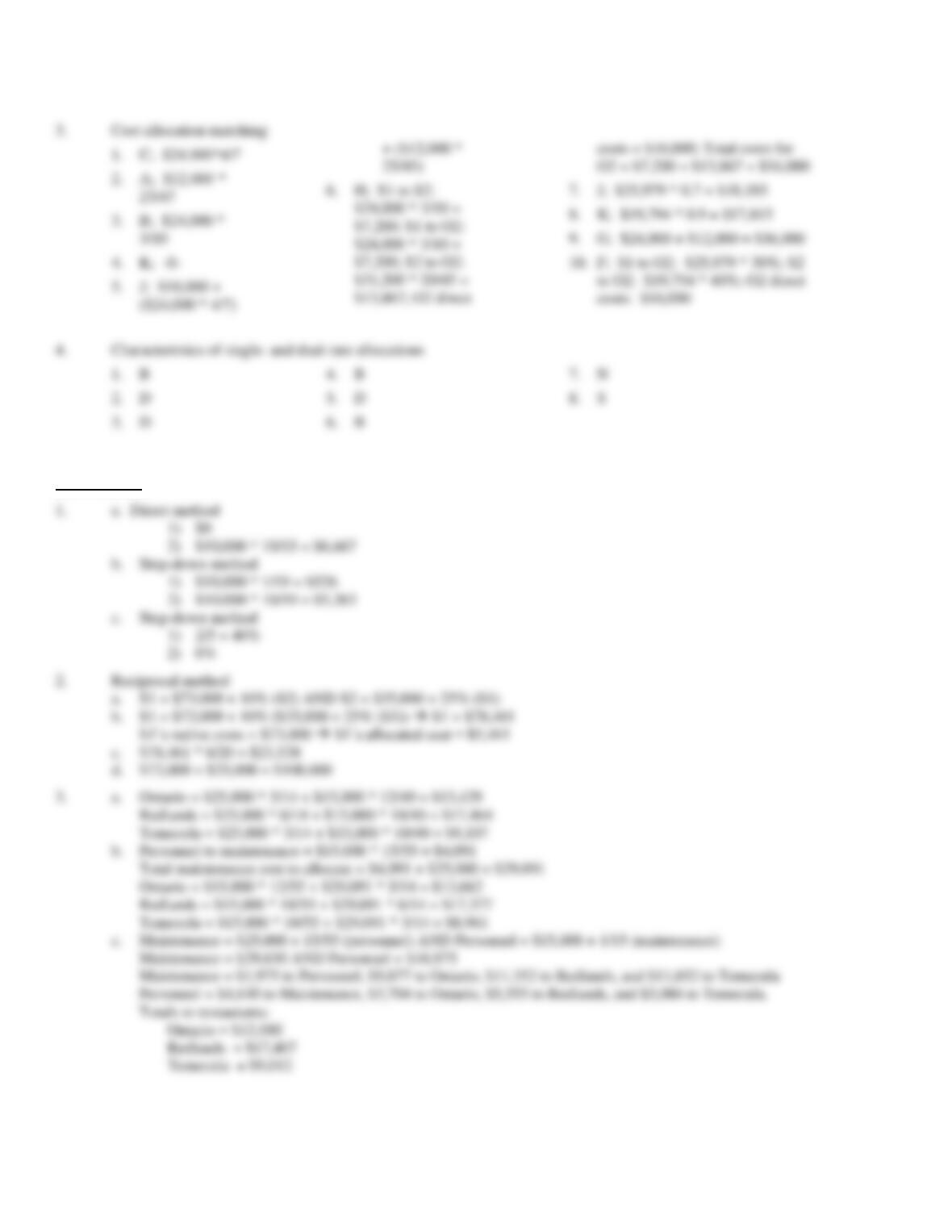
1. Paradise Vacation Club International (PVCI) offers timeshare properties at various locations around
the world. Its web site states, “The concept of Vacation Ownership with Paradise Vacation Club
begins with the comforts of a ‘home resort’, a villa or condominium at any one of our extraordinary
properties. You select the season and the one, two or more weeks you wish to vacation. Your home
resort can be lushly tropical, sparkling with snow, nestled in the vibrant heart of a great city, at the
edge of the vast Pacific, or lit by the warm Mediterranean light. You also have the opportunity to
exchange within a worldwide system of world-class options. So you’re free to visit new destinations
or trade your week(s) for cruises, airline travel, or a wealth of options offering remarkably flexibility.
Only a Fortune 500 company such as Paradise could design, build and maintain the ever-expanding
vacation and every spectacular one of them is yours to enjoy with a priority exchange.”
Suppose the list below contains several of PVCI’s departments. Identify each one as an operating
department (O) or a support department (S).
____ 1. Accounting
____ 2. Child care for timeshare owners
____ 3. Customer relations
____ 4. Child care for employees
____ 5. Front desk (i.e., reception)
____ 6. Housekeeping
____ 7. Information systems
____ 8. Swimming pool maintenance
____ 9. Timeshare sales
____ 10. Human resources
2. The generalized process for allocating support department costs comprises six steps, listed below in
random order. In the space provided, indicate the order in which the steps should be performed (1
through 6).
____ Assign costs to cost pools.
____ Choose and apply a method for allocating support department costs to operating departments.
____ Clarify the purpose of the allocation.

8-22 Cost Management
____ For each support department cost pool; choose an allocation base.
____ Identify support and operating department cost pools.
____ If relevant, allocate support costs from the operating departments to units of goods or
services.
3. RKH Corporation has 2 support departments and 2 operating departments. S1’s costs are allocated
based on documents prepared; S2’s costs are allocated based on square feet.
Support Departments Operating Departments
S1 S2 O1 O2
Direct costs $24,000 $12,000 $18,000 $16,000
Allocation bases:
Documents prepared 2 3 4 3
Square feet 5,000 2,000 25,000 20,000
Match each description on the left below with the best choice on the right. Each numbered item has
only one correct answer. Each lettered item may be used once, more than once, or not at all. Round
all costs to the nearest dollar.
____ 1. Total S1 costs allocated to O1 using the direct method
____ 2. Total S2 costs allocated to O1 using the direct method
____ 3. Total S1 costs allocated to S2 using the step-down
method with S1 allocated first
____ 4. Total S2 costs allocated to S1 using the step-down
method with S1 allocated first
____ 5. O1’s total cost (direct and allocated) after all allocations
using the direct method
____ 6. O2’s total cost (direct and allocated) after all allocations
using the step-down method with S1 allocated first
____ 7. Total S1 cost to be allocated to operating departments
using the reciprocal method
____ 8. Total S2 cost to be allocated to operating departments
using the reciprocal method
____ 9. Total support department costs to be allocated to
operating departments using the reciprocal method
____ 10. O2’s total cost (direct and allocated) after all allocations
using the reciprocal method
A. $6,667
B. $7,200
C. $13,714
D. $19,794
E. $25,979
F. $31,711
G. $36,000
H. $37,067
I. $38,381
J. $18,185
K. None of the
above
4. Several characteristics that may apply to single-rate allocation (S), dual-rate allocation (D), both (B),
or neither (N) are listed below. Indicate, with the appropriate letter, which term applies to each
characteristic.
____ 1. Can be applied using the direct method
____ 2. Cost drivers identified for variable cost pools
____ 3. May lead to mismeasurement because of cost behavior classification
____ 4. May mismeasure support resources used
____ 5. More costly to develop and maintain
____ 6. Reciprocal method may be used for allocations

Chapter 8: Measuring and Assigning Support Department Costs 8-23
____ 7. Support costs separated into product and period cost pools
____ 8. Uses one allocation base to allocate support costs
Exercises
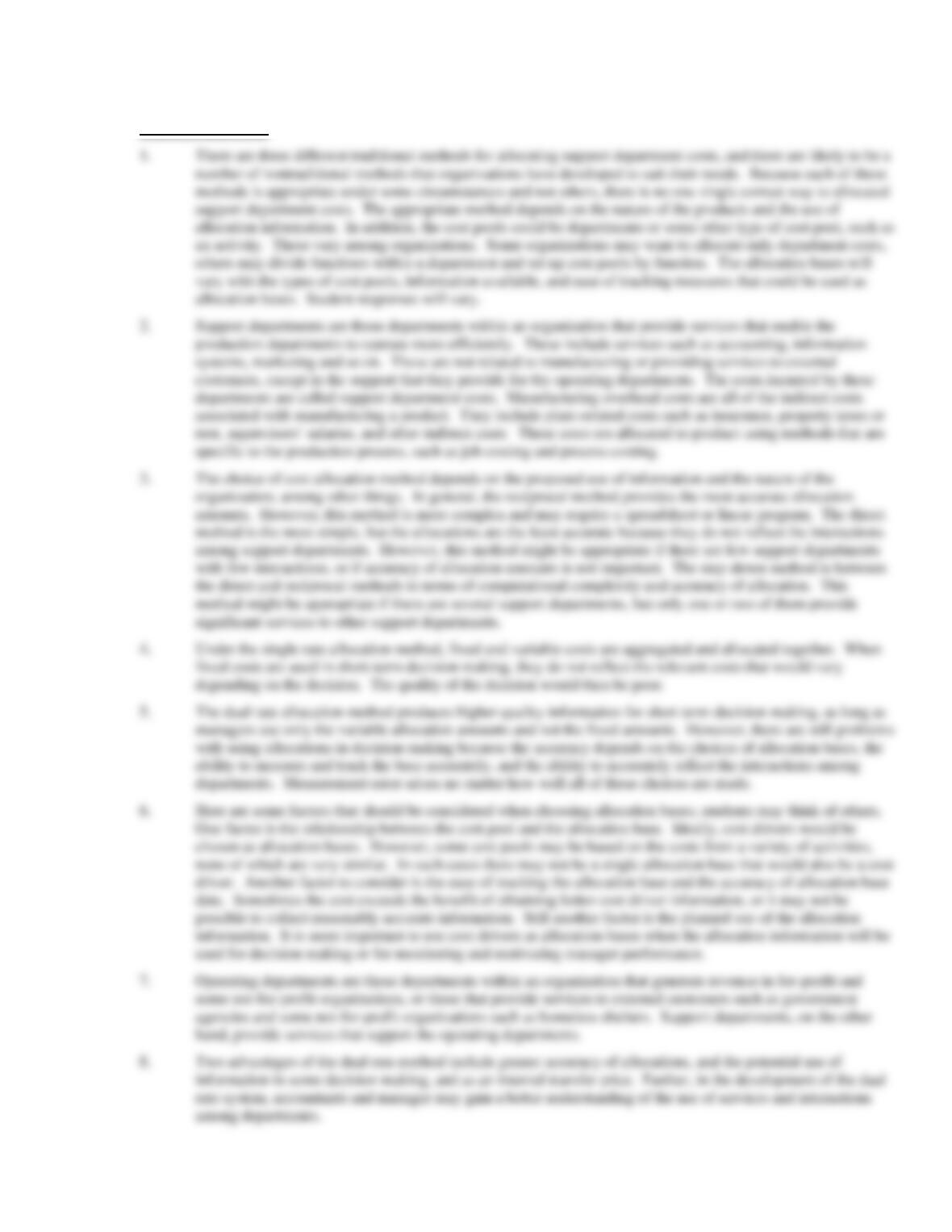
1. Krenz Foundry has 3 support departments and 2 operating departments. Support cost and allocation
base information is provided below.
Support Departments Operating Departments
Maintenance Food Service Personnel Casting Finishing
Direct support costs $10,000 $20,000 $15,000
Allocation bases:
Employees 10 8 9 20 30
Square feet 2,000 3,000 1,000 10,000 5,000
Maintenance costs are allocated on the basis of square feet, and the other support costs are allocated
on the basis of number of employees. Maintenance provides the most services to other support
departments, and food service provides the next most services to other support departments.
a. If the direct method of allocation is used, calculate the maintenance department cost that will be
allocated to:
1) Personnel
2) Casting
b. If the step-down method is used, calculate the maintenance department cost that will be allocated
to: 1) Personnel
2) Casting
c. If the step-down method is used, calculate the percent of personnel department costs that will be
allocated to each of the following. (Note: You are not being asked for the dollar amount.)
1) Casting
2) Personnel
2. The accountants at King Industries want to determine the amount of support department costs that
should be allocated to its operating departments. Actual support costs and allocation base information
for the two support departments is shown below. The costs of support department S1 are allocated
based on the number of service calls made, and the costs of support department S2 are allocated based
on square feet.
Support Departments Operating Departments
S1 S2 O1 O2
Direct support costs $73,000 $35,000 —- —-
Allocation bases:
Service calls 3 5 9 6
Square feet 5,000 2,000 25,000 20,000
Using the reciprocal method:
a. Determine the equations for allocating S1 and S2 costs
b. Determine the amount of cost allocated from S2 to S1
c. Determine the amount of cost allocated from S1 to O2
d. Determine the total support department costs allocated to the operating departments
3. Vince’s Spaghetti is a family-owned restaurant in Southern California. The corporate office provides
2 kinds of services (maintenance and personnel) to Vince’s 3 locations (Ontario, Redlands, and
Temecula). In a recent accounting period, the direct cost for maintenance was $25,000 and for
personnel was $15,000. Maintenance costs are allocated on the basis of square feet, and personnel
costs are allocated based on the basis of number of employees.

8-24 Cost Management
Number of
Square Feet Employees
Support Departments:
Maintenance 1,000 15
Personnel 1,000 8
Operating Departments:
Ontario 5,000 12
Redlands 6,000 18
Temecula 3,000 10
a. If Vince’s uses the direct method, calculate the total support costs allocated to each restaurant
location.
b. If Vince’s uses the step-down method with personnel allocated first, calculate the total support
costs allocated to each restaurant location.
c. Assume Vince’s uses the reciprocal method to allocate costs between support departments.
Calculate the total support department costs allocated to each restaurant location.
Short Answer
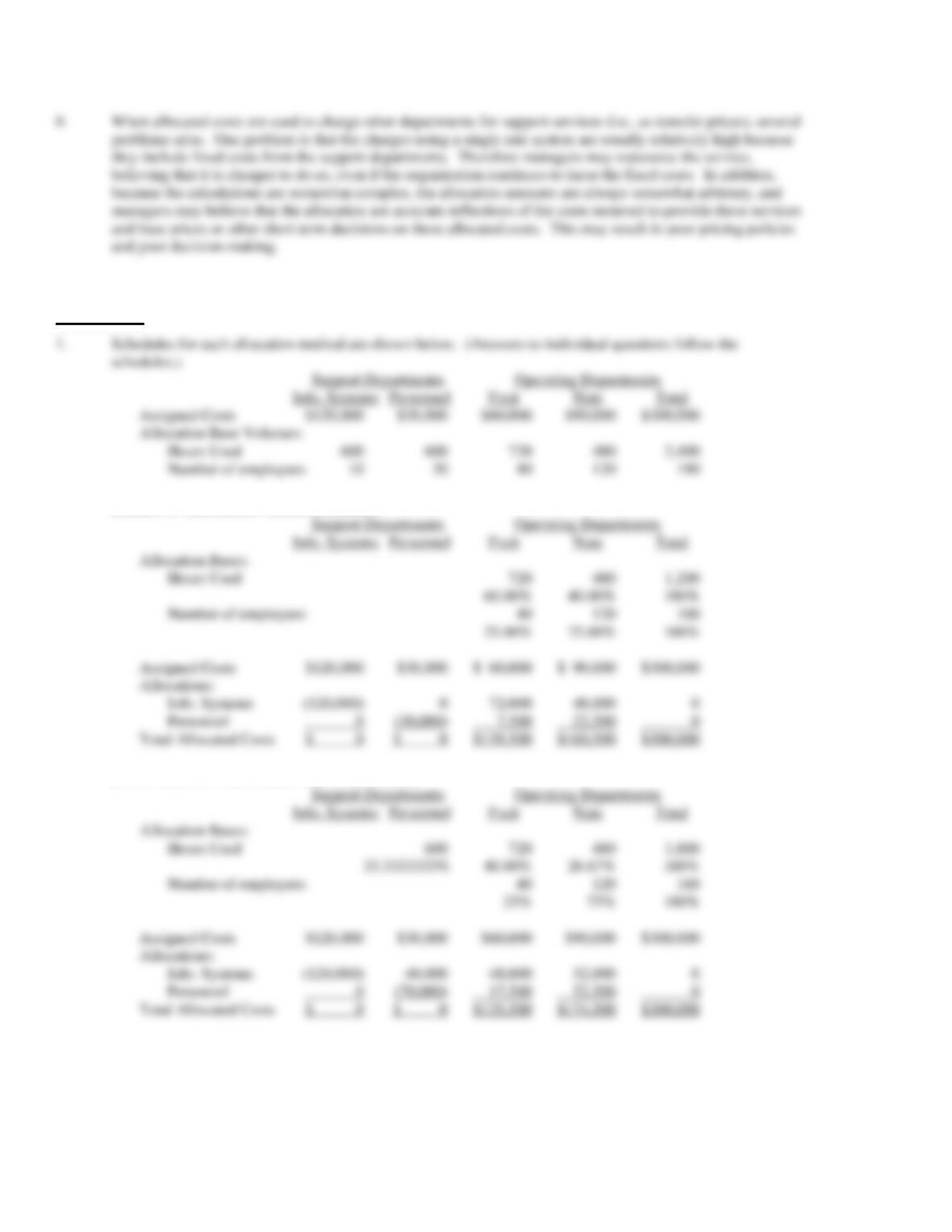
1. There is no single, “correct” way to allocate support department costs to operating departments.
Explain.
2. Distinguish between support department costs and manufacturing overhead costs.
3. What should determine the choice of cost allocation method (direct, step-down, and reciprocal)
discussed in this chapter?
4. Sometimes costs that include single-rate support department allocations are used in short-term
decision making. List several limitations of these costs when used in decision making.
5. Sometimes costs that include support department allocations are used in short-term decision making,
resulting in poor outcomes. Discuss ways to address the limitations inherent in single-rate support
cost allocation information.
6. List two factors that should be considered when choosing allocation bases.
7. Explain the difference between operating departments and support departments.
8. List two advantages of the dual-rate method.
9. Explain one problem that could arise when allocated costs are used to charge other departments for
support services.
Problems
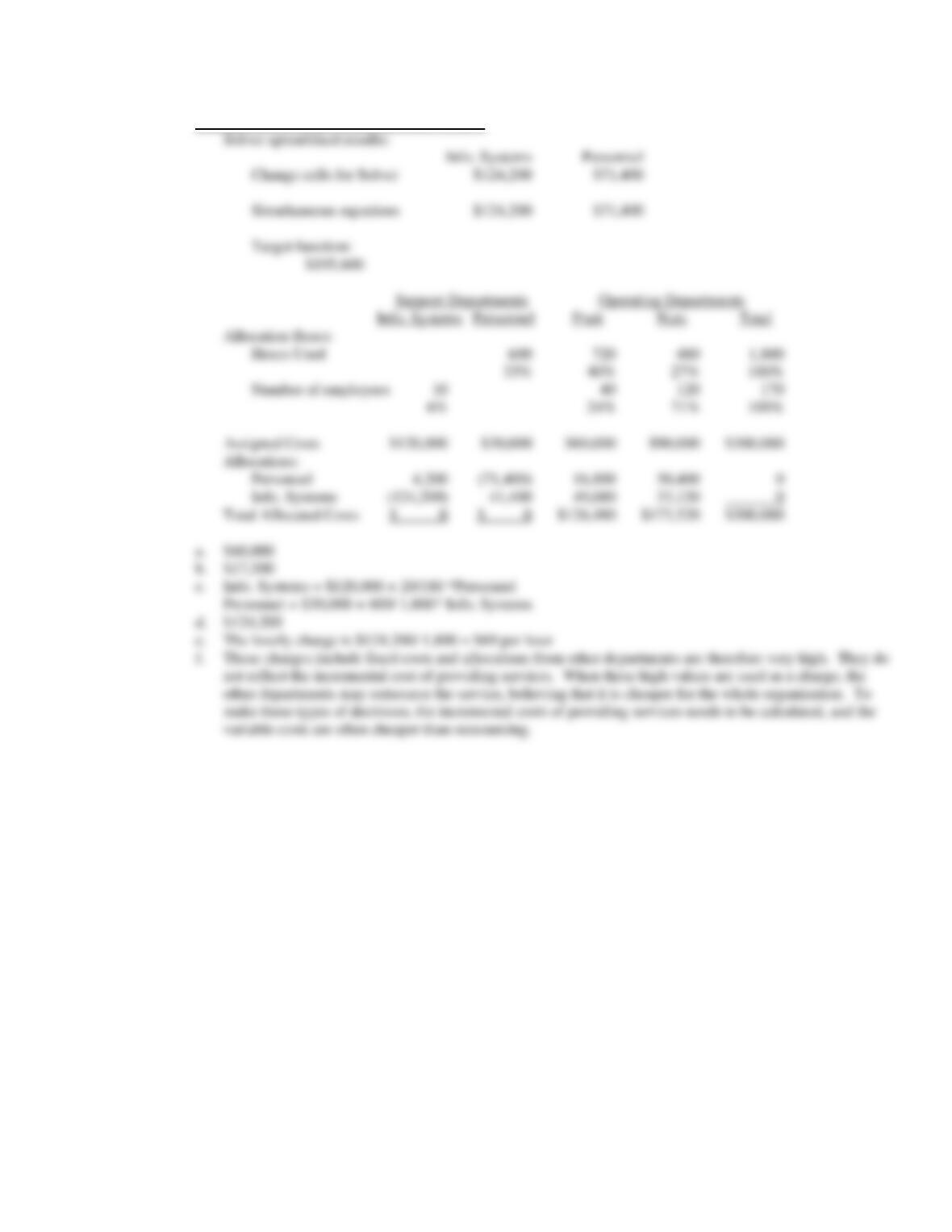
1. Breakfast Bars has two support departments, Information Systems and Personnel. The Information
Systems Department costs of $120,000 are allocated on the basis of hours used. The Personnel
Department costs of $30,000 are allocated based on the number of employees. Costs of the two
operating departments are $60,000 for Fruit Bars and $90,000 for Nut Bars. Data on information
systems hours used and number of employees are as follows:
Information
Allocation Bases: Systems Personnel Fruit Nut
Information systems hours used 600 600 720 480
Number of employees 10 20 40 120

Chapter 8: Measuring and Assigning Support Department Costs 8-25
a. What is the cost of the Information Systems Department allocated to Fruit using the direct
method?
b. Using the step-down method, what is the cost of the Personnel Department allocated to Fruit if
the support department having the highest cost is allocated first?
c. Write the equations needed to allocate the costs of each support department using the reciprocal
method.
d. Now solve for the total cost to be allocated under the reciprocal method for the Information
Systems Department.
e. Breakfast Bars uses the allocation system to charge for services provided by the two support
departments. Assume that Breakfast Bars uses the reciprocal method. What is the hourly charge
for Information Systems’ services?
f. Identify and discuss one problem with using a single rate allocation method to develop charges
for the use of services.
2. Universal Transport Enterprises (UTE) operates an integrated transportation network that includes
both air operations and road operations. UTE has 2 support departments (Administration and
Information Systems) and 2 operating departments (Air and Road). The budgeted level of services at
the start of the year was
Percent of Support Services Used by
Admin- Information
istration Systems Air Road
Services Provided By:
Administration —– 0.10 0.30 0.60
Information Systems 0.20 —- 0.50 0.30
Costs for administration were $135,000, and costs for the information systems department were
$75,000.
UTE monitors the cost per mile in the air for the air department and the cost per mile on the road for
the Road Department. These cost figures include costs allocated from the support departments to the
transportation departments. During the year, the actual transportation miles were
Air operations 800,000 miles
Road operations 1,500,000 miles
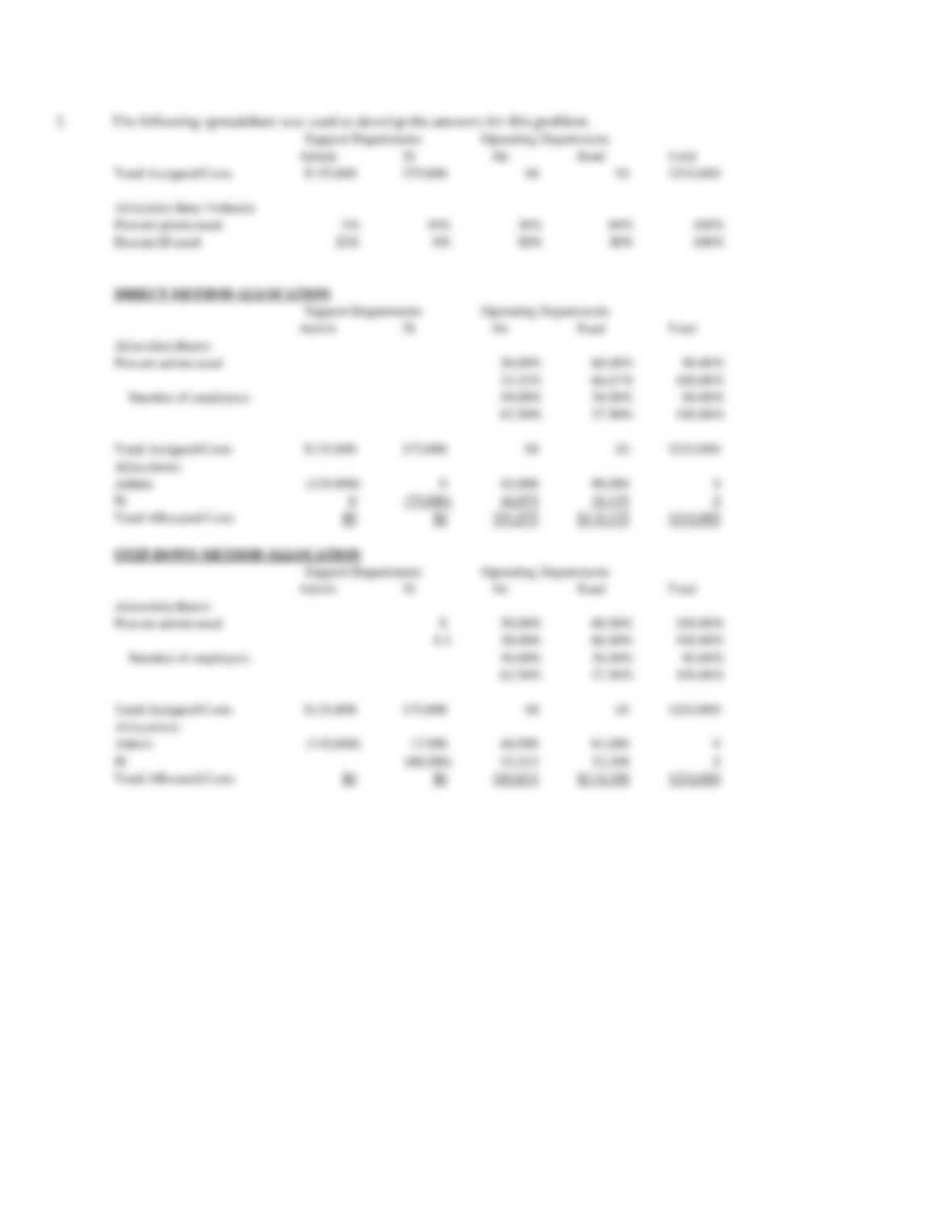
a. Allocate the support department costs to the two transportation departments using the direct
method.
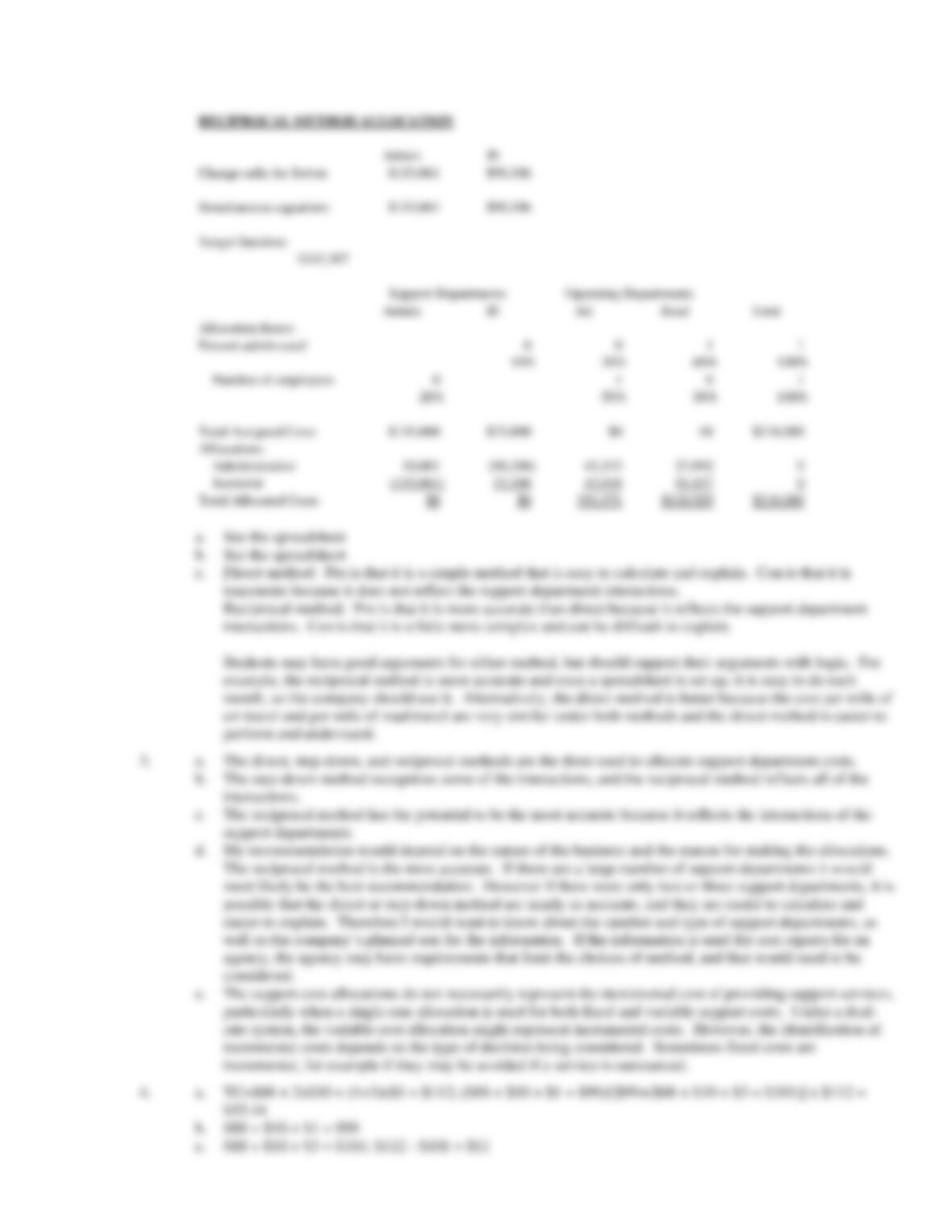
b. Using the reciprocal approach, the following amounts were derived using simultaneous equations
(Admin=Administration; IS=Information Systems):
Admin = $135,000 + 0.2IS = $153,061
IS = $75,000 + 0.10Admin = $90,306
Create a schedule and allocate these amounts among the departments.
c. Suppose you have been asked to help UTE decide on a method for allocating support department
costs. List one pro and one con for the direct and reciprocal methods, and then make a
recommendation for this company.
3. Answer the following questions.
a. What are the three methods of allocating support department costs?
b. Which of these methods recognizes interactions between departments? Explain.
c. Which of these methods has the potential to be most accurate? Why?
d. Assume you are working for an organization and are asked to allocate support department costs.
Describe how you would choose the best method.
e. Suppose a company uses the method you identified in part (c) to allocate support costs. Do the
support cost allocations represent the incremental cost of providing support services? Why or
why not?

8-26 Cost Management
4. The cost of a limousine ride from Newark airport to downtown New York is $88, plus $10 per person
in the taxi, plus $1 for each luggage item in the trunk. Susan is on a trip with George, a business
associate from another department. Susan has one luggage item and her associate has three.
a. Compute the portion of the limousine fare allocated to Susan using the stand-alone method.
b. Compute the portion of the limousine fare allocated to Susan using the incremental cost allocation
method if Susan is considered the primary user.
c. Compute the portion of the limousine fare allocated to Susan using the incremental cost allocation
method if George is considered the primary user.
d. Which method is the most fair? Explain your reasoning.
5. Handy Home Improvement Warehouse is a nationwide chain of hardware stores. It is organized into
several operating departments, including (but not limited to): appliances, cabinets, doors & windows,
flooring, and hardware. Handy requires several support departments, including human resources,
accounting and finance, and information systems.
Suppose the accountant for Handy is considering two support cost allocation methods, direct and
step-down. In a recent accounting period, assume Handy’s accounting information system reported
the following data:
a. Explain the similarities and differences between support and operating departments. Why do
many organizations allocate support department costs to operating departments?
b. List and discuss the steps Handy would likely use to allocate support department costs to
operating departments.
c. Handy has used its departments as cost pools for the purpose of support cost allocation. List one
advantage and one disadvantage of using departments as cost pools.
d. Describe in your own words the direct method of allocation. List one advantage and one
disadvantage of this method.
e. Describe in your own words the step-down method of cost allocation. List one advantage and
one disadvantage of this method.
f. Under the step-down method, discuss whether it is reasonable to use the total direct costs for each
support department to identify which department provided the most services to other support
departments.
g. Is Handy using a single- or a dual-rate allocation process? Explain.
h. List and discuss three ways Handy could improve the quality of its allocated support cost
information.
Chapter 8: Measuring and Assigning Support Department Costs 8-27
6. BP Services is a large company that sells Harley Davidson Motorcycles. The company is organized
with two operating departments, Premier and Elite. The premier department sells only to clients who
have custom ordered a bike. The Elite department sells bikes that are already manufactured. Jan
Socha is in charge of the media department that develops advertising booklets for the two product
lines. The media department’s budget for the upcoming year showed budgeted fixed costs of $80,000
plus variable costs of $1.00 per booklet. At the beginning of the year, Premier budgeted its usage at
4,000 booklets, and Elite budgeted its usage at 10,000 booklets. However, actual usage was 3,000
booklets and 8,000 booklets requested by Premier and Elite, respectively.
a. Under the single-rate method, what are the total budgeted costs for the media department?
b. Under the dual-rate method, what amount of cost is allocated to Premier if fixed costs are
allocated based on budgeted usage and variable costs are allocated based on actual usage?
c. Under the dual-rate method, what amount of cost is allocated to Premier if fixed costs are
allocated based on budgeted usage and variable costs are allocated based on budgeted usage?
d. Which dual-rate method—the one in part (b) or the one in part (c)—would provide better
incentives for using the company’s resources efficiently? Explain.
8-28 Cost Management
Answers
True / False
Multiple Choice
Chapter 8: Measuring and Assigning Support Department Costs 8-29
Matching
8-30 Cost Management
Exercises
Chapter 8: Measuring and Assigning Support Department Costs 8-31
Short Answer
8-32 Cost Management
Problems
DIRECT METHOD ALLOCATION
STEP-DOWN METHOD ALLOCATION
Chapter 8: Measuring and Assigning Support Department Costs 8-33
RECIPROCAL METHOD ALLOCATION
8-34 Cost Management
Chapter 8: Measuring and Assigning Support Department Costs 8-35
8-36 Cost Management
Chapter 8: Measuring and Assigning Support Department Costs 8-37