28)
The initial effect of ionizing radiation on a cell is that it causes
28)
A)
bonding between adjacent thymines.
B)
DNA to break.
C)
base substitutions.
D)
the cells to get hot.
E)
the formation of highly reactive ions.
29)
In Figure 8.3, if enzyme A is a repressible enzyme, compound C would
29)
A)
bind to the enzyme.
B)
bind to RNA polymerase.
C)
bind to gene a.
D)
always be in excess.
E)
bind to the corepressor.
E
30)
Which of the following is NOT a product of transcription?
30)
A)
mRNA
B)
tRNA
C)
rRNA
D)
a new strand of DNA
E)
None of the answers are correct; all of these are products of transcription.
D
E
31)
Protein synthesis in eukaryotes is similar to the process in prokaryotes in that both eukaryotes and
prokaryotes
31)
A)
require snRNPS.
B)
use codons to determine polypeptide sequences.
C)
have exons.
D)
have introns.
E)
use methionine as the “start” amino acid.
32)
The miRNAs in a cell
32)
A)
are responsible for inducing operons.
B)
allow different cells to produce different proteins.
C)
are found in prokaryotic cells.
D)
are a part of the prokaryotic ribosome.
E)
are a part of the eukaryotic ribosome.
Table 8.2
Codon on mRNA and corresponding amino acid
UUA leucine UAA nonsense
GCA alanine AAU sparagine
AAG lysine UGC cysteine
GUU valine UCG, UCU serine
33)
Refer to Table 8.2 The anticodon for valine is
33)
A)
GUU.
B)
CUU.
C)
CAA.
D)
CTT.
E)
GTA.
34)
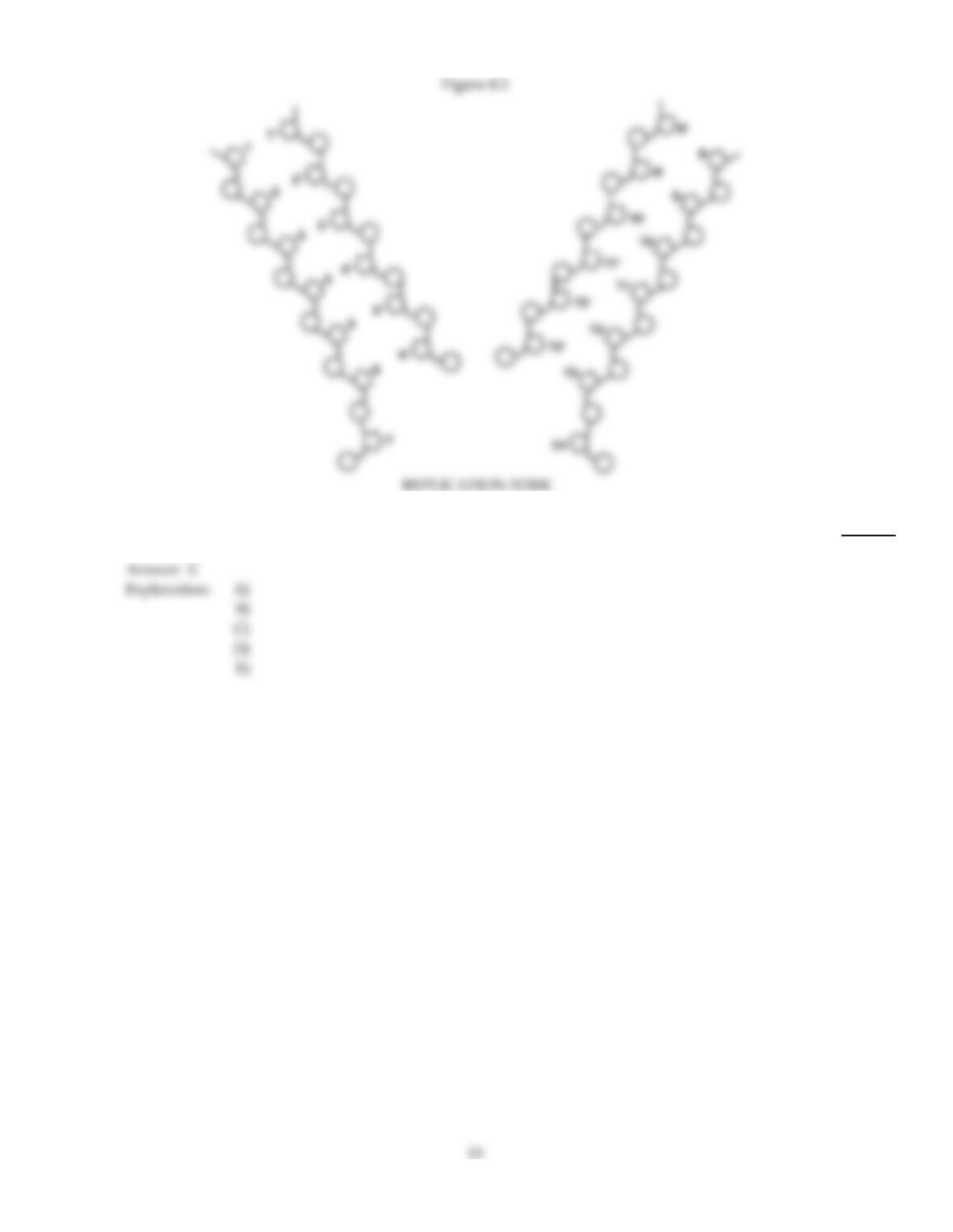
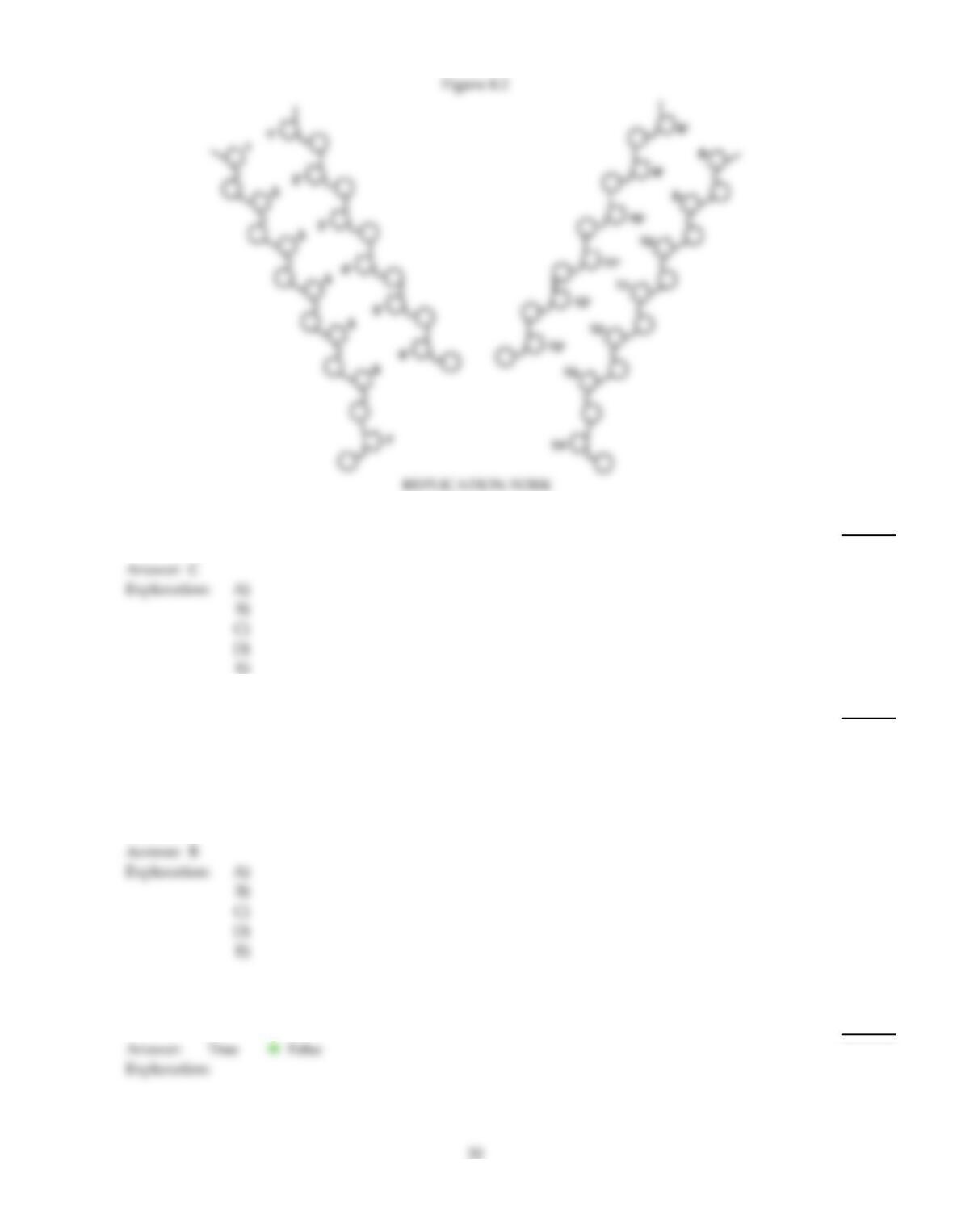
In Figure 8.2, if base 4 is thymine, what is base 11′?
34)
A)
guanine
B)
uracil
C)
thymine
D)
adenine
E)
cytosine
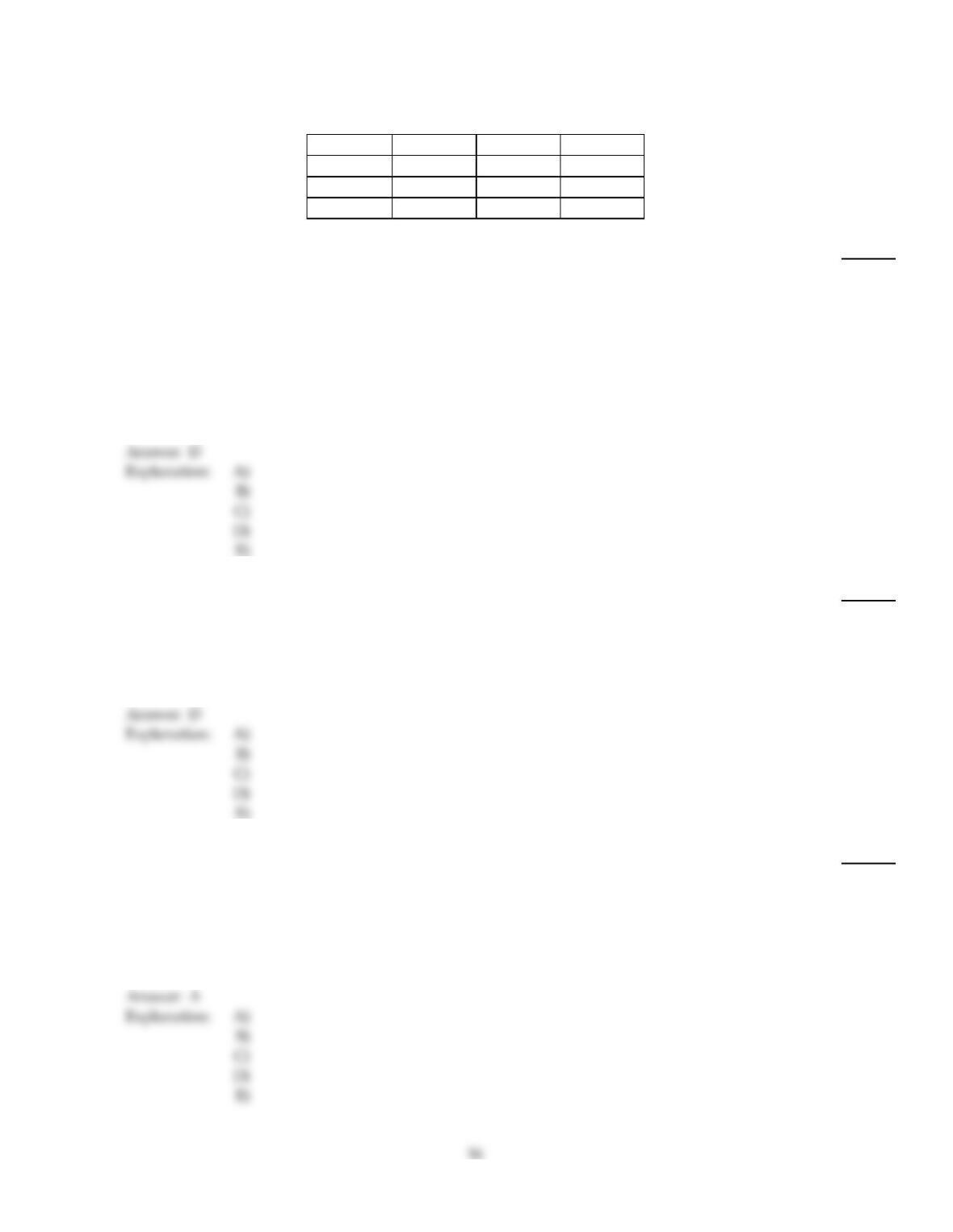
Table 8.2
Codon on mRNA and corresponding amino acid
UUA leucine UAA nonsense
GCA alanine AAU sparagine
AAG lysine UGC cysteine
GUU valine UCG, UCU serine
35)
Refer to Table 8.2. What is the sequence of amino acids encoded by the following sequence of bases
in a strand of DNA?
3’ ATTACGCTTTGC
35)
A)
asparagine–arginine–lysine–alanine
B)
asparagine–cysteine–valine–serine
C)
leucine–arginine–lysine–alanine
D)
Translation would stop at the first codon.
E)
The answer cannot be determined based on the information provided.
36)
An enzyme produced in response to the presence of a substrate is called a(n)
36)
A)
promoter.
B)
restriction enzyme.
C)
repressible enzyme.
D)
inducible enzyme.
E)
operator.
D
37)
If you knew the sequence of nucleotides within a gene, which one of the following could you
determine with the most accuracy?
37)
A)
the primary structure of the protein
B)
the secondary structure of the protein
C)
the tertiary structure of the protein
D)
the quaternary structure of the protein
E)
The answer cannot be determined based on the information provided.
A
D
38)
Transformation is the transfer of DNA from a donor to a recipient cell
38)
A)
by cell–to–cell contact.
B)
by sexual reproduction.
C)
as naked DNA in solution.
D)
by crossing over.
E)
by a bacteriophage.
39)
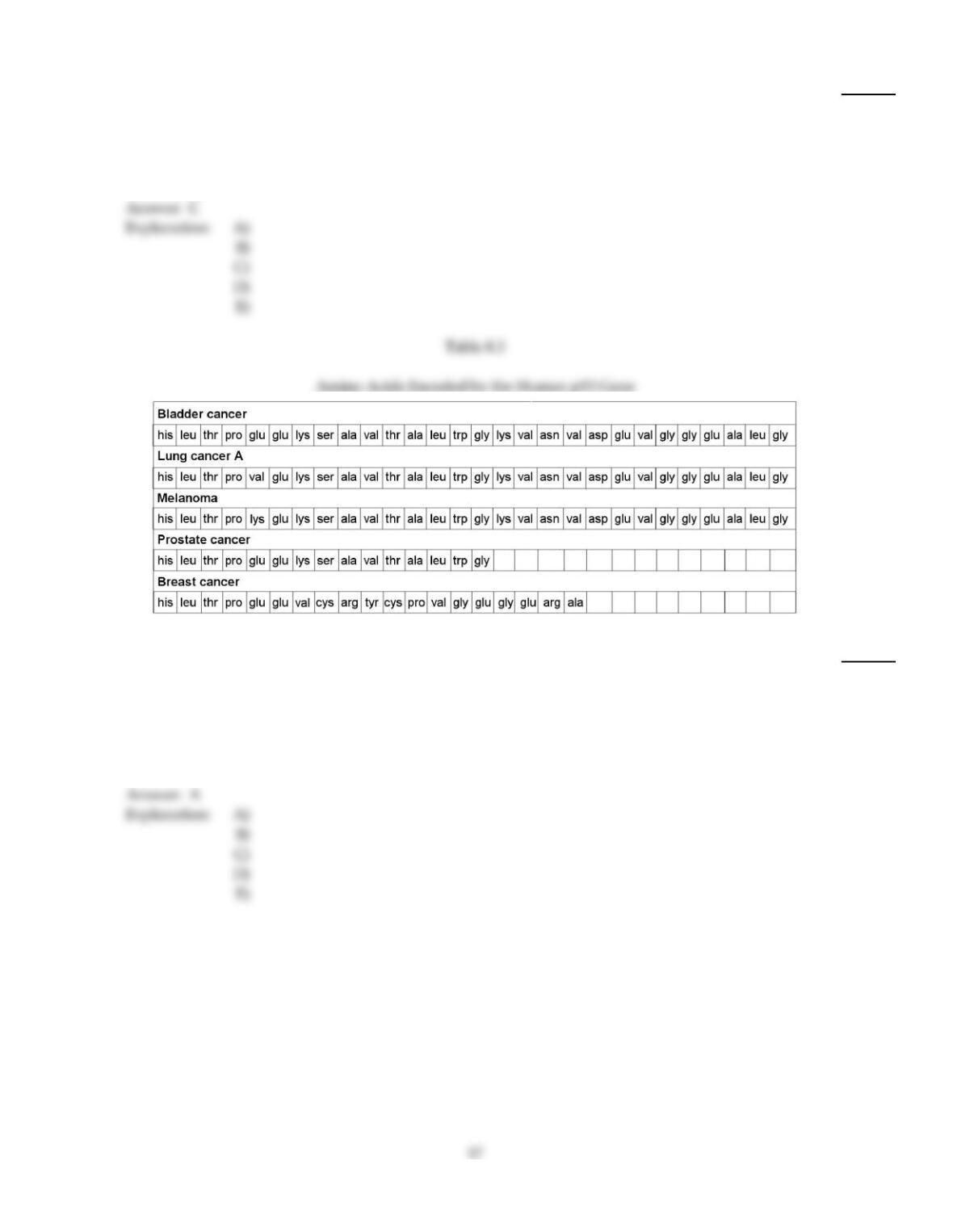
Based on the information in Table 8.3, prostate cancer is probably the result of which kind of
mutation?
39)
A)
nonsense
B)
analog
C)
missense
D)
frameshift
E)
None of the answers is correct.
40)
An enzyme that makes covalent bonds between nucleotide sequences in DNA is
40)
A)
DNA polymerase.
B)
DNA ligase
C)
RNA polymerase.
D)
transposase.
E)
DNA helicase.
41)
DNA is constructed of
41)
A)
a single strand of nucleotides with internal hydrogen bonding.
B)
two complementary strands of nucleotides bonded A—C and G—T.
C)
two strands of identical nucleotides with hydrogen bonds between them.
D)
two strands of nucleotides running antiparallel.
E)
None of the answers is correct.
42)
The necessary ingredients for DNA synthesis can be mixed together in a test tube. The DNA
polymerase is from Thermus aquaticus, and the template is from a human cell. The DNA
synthesized would be most similar to
42)
A)
human DNA.
B)
T. aquaticus DNA.
C)
a mixture of human and T. aquaticus DNA.
D)
human RNA.
E)
T. aquaticus RNA.
Table 8.2
Codon on mRNA and corresponding amino acid
UUA leucine UAA nonsense
GCA alanine AAU sparagine
AAG lysine UGC cysteine
GUU valine UCG, UCU serine
43)
Refer to Table 8.2. If a frameshift mutation occurred in the sequence of bases shown below, what
would be the sequence of amino acids coded for?
3’ ATTACGCTTTGC
43)
A)
asparagine–cysteine–valine–serine
B)
leucine–arginine–lysine–alanine
C)
asparagine–arginine–lysine–alanine
D)
Translation would stop at the first codon.
E)
The answer cannot be determined based on the information provided.
E
44)
In Figure 8.2, if base 4 is thymine, what is base 4′?
44)
A)
thymine
B)
cytosine
C)
adenine
D)
uracil
E)
guanine
45)
When glucose is high, cAMP is _____ : CAP _____ bind the lac operator, and RNA polymerase
_____ bind the lac promoter.
45)
A)
high; does not; does
B)
low; does not; does not
C)
high; does; does
D)
low; does not; does
E)
None of the answers is correct.
TRUE/FALSE. Write ‘T’ if the statement is true and ‘F’ if the statement is false.
46)
Bacteria typically contain multiple chromosomes.
46)
47)
Transposition results in the formation of base substitution mutations in a cell’s DNA.
47)
48)
Cell–to–cell contact is required for transduction to occur.
48)
49)
Open–reading frames are segments of DNA in which both start and stop codons are found.
49)
50)
In the Ames test, any colonies that form on the control should be the result of spontaneous
mutations.
50)
51)
Both base substitution and frameshift mutations can result in the formation of premature stop
codons.
51)
52)
The miRNAs in a cell inhibit protein synthesis by forming complementary bonds with rRNA.
52)
53)
Some organisms may contain multiple genomes.
53)
54)
Mutations that are harmful to cells occur more frequently than those that benefit cells.
54)
55)
Recombination will always alter a cell’s genotype.
55)
ESSAY. Write your answer in the space provided or on a separate sheet of paper.
56)
Why must the cultures used in the Ames test be auxotrophic? Explain the necessity of using a strain that is
mutated in this experiment.
57)
Scientists are concerned that bacteria will be resistant to all antibiotics within the next decade. Using your
knowledge of genetics, describe how bacterial populations can develop drug resistance in such a short time
frame.

58)
What is the survival value of the degeneracy of the genetic code?
59)
What is the survival value of the semiconservative replication of DNA?
60)
Explain why the following statement is false: Sexual reproduction is the only mechanism for genetic change.
Answer Key
Testname: C8
23
Answer Key
Testname: C8