
Exam
Name___________________________________
MULTIPLE CHOICE. Choose the one alternative that best completes the statement or answers the question.
1)
The last glacial maximum (LGM) occurred approximately ________ years ago.
1)
A)
10,000
B)
20,000
C)
50,000
D)
110,000
2)
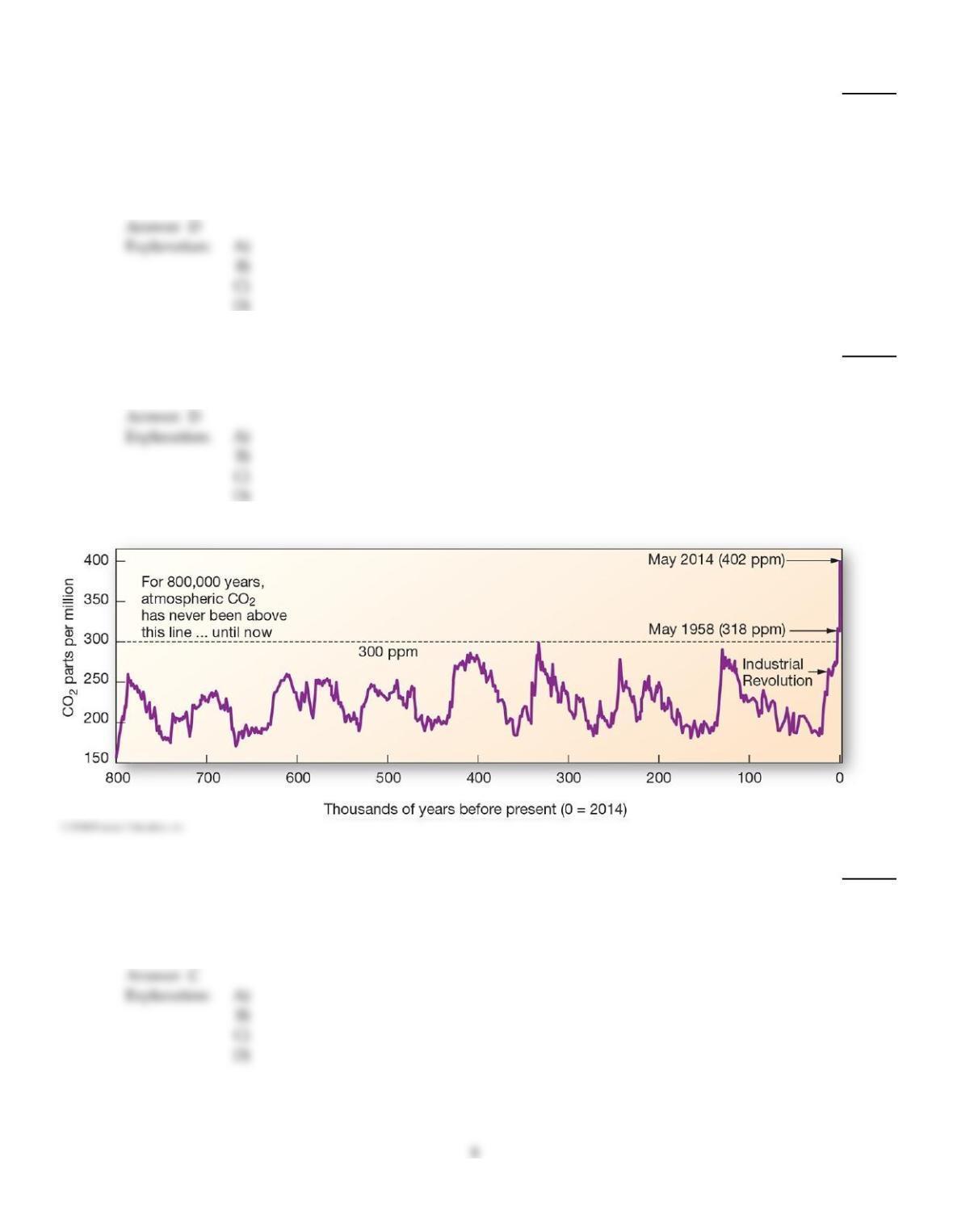
During the last 800,000, climate reconstructions show that CO2 Never changed more than ________
ppm upward or downward in any span of less than 1,000 years, though it has risen by this amount
in the last 13 years.
2)
A)
30
B)
60
C)
120
D)
240
3)
Since the Industrial Revolution
3)
A)
no observable warming or cooling trends have occurred, rather temperatures have oscillated
between warm and cold periods.
B)
global temperatures have continued to warm at accelerating rates.
C)
human population growth rates have decreased with a subsequent decrease in the warming
trend that characterized pre–Industrial Revolution times.
D)
global temperatures rapidly increased, then steadied out over the past 25 to 30 years.
4)
Which of the following is TRUE of 16O and 18O.
4)
A)
Only the 16O isotope occurs in water molecules.
B)
Both the 16O and 18O isotopes occur in water molecules.
C)
Only the 18O isotope occurs in water molecules.
D)
Neither the 16O and 18O isotopes occur in water molecules.

5)
An estimated ________ people could be displaced by a sea level rise of 1.0 m (3.2 ft).
5)
A)
1,000,000
B)
10,000,000
C)
100,000,000
D)
130,000,000
6)
Fossil fuel burning accounts for over ________ percent of CO2 emissions.
6)
A)
20
B)
50
C)
70
D)
85
Explanation:
7)
The majority of human population growth is now occurring in
7)
A)
less–developed countries (LDCs).
B)
more–developed countries (MDCs).
C)
evenly between LDCs and MDCs.
D)
neither LDCs or MDCs; world populations are declining.
Explanation:
8)
Changes in Earth’s elliptical orbit around the Sun is called
8)
A)
eccentricity.
B)
obliquity.
C)
precession.
D)
inclination.
Explanation:
9)
The last interglacial period with temperatures similar to the present interglacial period was the
9)
A)
Eemian interglacial.
B)
Günz–Mindel interglacial.
C)
Flandrian interglacial.
D)
Holstein interglacial.
Explanation:
10)
Which of the following is NOT considered an important carbon sink?
10)
A)
Rocks
B)
Farmlands
C)
The oceans
D)
Forest and soils
Explanation:
Explanation:

11)
The rapid warming associated with the Paleocene–Eocene Thermal Maximum (PETM) likely
resulted from
11)
A)
a sudden increase in atmospheric carbon.
B)
several massive volcanic eruptions.
C)
decreased surface albedo brought about by Paleocene afforestation.
D)
the sudden die off of photosynthetic organisms and associated increase in atmospheric CO2.
12)
Which of the following is CORRECT regarding Arctic sea ice?
12)
A)
Since 1979, summer sea ice minimum extent and winter sea ice maximum extent have
declined.
B)
Until recently, seasonal variations in sea ice extent were rare.
C)
In the summer, most to all sea ice melts, only to refreeze in the winter. However, less water
has been refreezing over the past decade.
D)
Summer sea ice reached its minimum extent in 2001 and has gradually increased since then.
13)
Which of the following is NOT an example of individuals and communities working to mitigate
climate change?
13)
A)
Leaving the decision–making to elected officials.
B)
Tree planting in exchange for greenhouse gas credits
C)
Farmers using no–till agriculture.
D)
Using renewable energy sources.
E)
Protecting and restoring natural habitats.
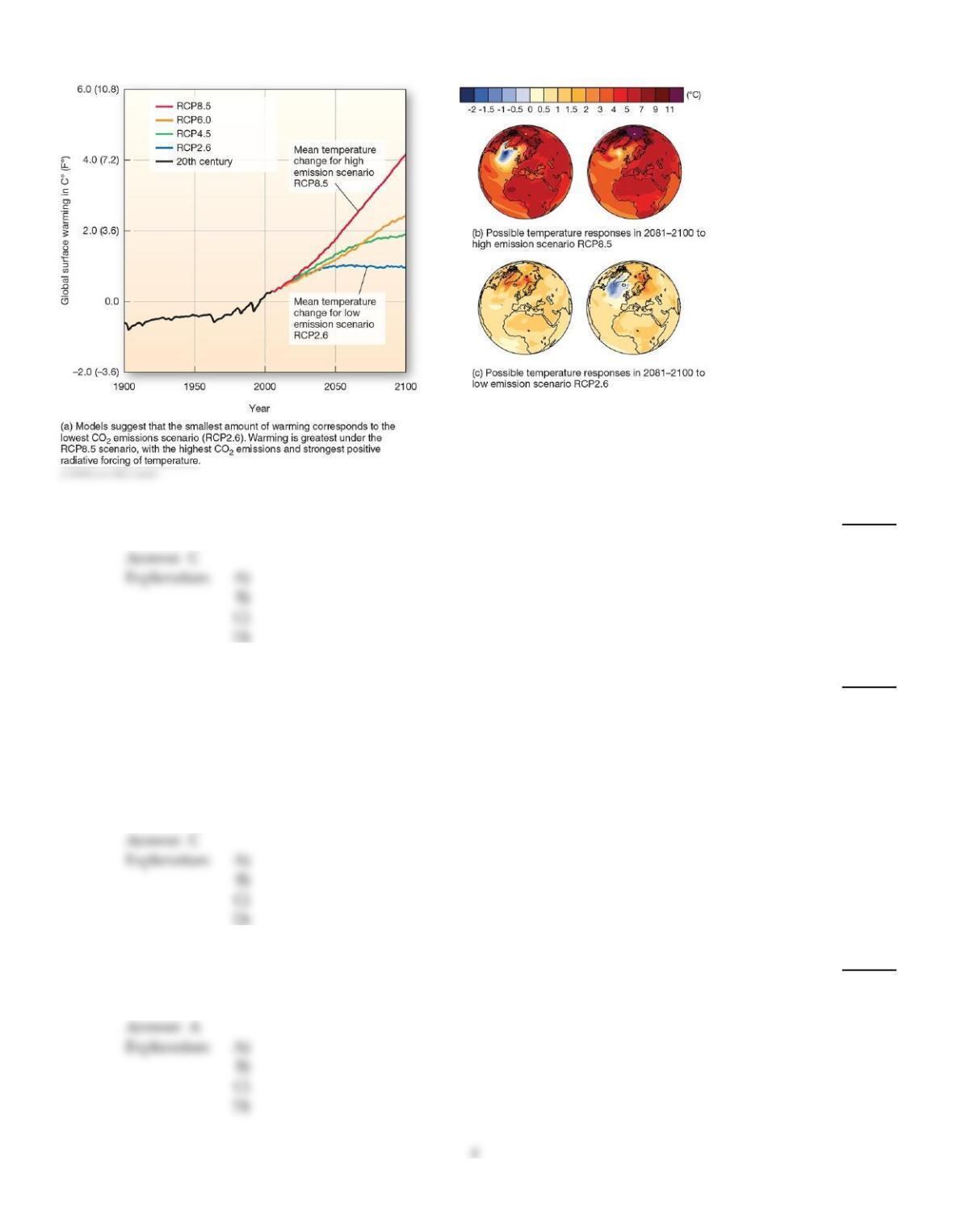
14)
Which scenario predicts the lowest level of warming during the 21st century?
14)
A)
RCP6.0
B)
RCP8.5
C)
RCP2.6
D)
RCP4.5
15)
The Younger Dryas refers to a(n)
15)
A)
global cooling episode, lasting from approximately A.D. 1250 to 1850.
B)
400 year, from A.D. 800 to 1200, period characterized by warmer than normal conditions in
the North Atlantic region (e.g. Greenland and Iceland).
C)
brief return to near–glacial conditions during the transition period from the last glacial period
to the present interglacial period.
D)
interglacial period, characterized by a general warming trend, lasting since the last glacial
maximum (LGM) to the present.
16)
Scientists attribute the recent rise in atmospheric concentrations of nitrous oxide (N2O) primarily to
16)
A)
agricultural activity.
B)
wastewater management.
C)
industrial practices.
D)
automobile combustion.

17)
Changes in the orientation of Earth’s axis over a 26,000–year cycle is known as
17)
A)
eccentricity.
B)
obliquity.
C)
precession.
D)
inclination.
18)
Which of the following has a negative radiative forcing (i.e. cools the planet)?
18)
A)
Methane (CH4)
B)
Carbon dioxide (CO2)
C)
Stratospheric ozone (O3)
D)
Nitrous oxides (N2O)
19)
Of the following anthropogenic methane (CH4) sources, which is the largest?
19)
A)
Livestock
B)
Rice paddies
C)
Wastewater treatment
D)
Agriculture associated fires
20)
According to readings from the Mauna Loa Observatory, CO2 concentrations in May 2013
exceeded ________ for the first time during the last 800,000 years.
20)
A)
100–ppm
B)
200–ppm
C)
300–ppm
D)
400–ppm
21)
Of the following greenhouse gases, which have actually decreased in atmospheric concentrations
during the past 30 years?
21)
A)
HFCs
B)
Chlorofluorocarbons (CFCs)
C)
Methane (CH4) and carbon dioxide (CO2)
D)
Nitrous oxides (N2O)

22)
In which of the following ways is the study of tree rings, speleothems, and corals similar?
22)
A)
Each have growth bands, yielding evidence of the conditions under which they formed and
grew.
B)
All are composed of organic materials and are therefore good candidates for radiocarbon
dating.
C)
The fossilized form of each is used for understanding past climatic conditions.
D)
The chronology each can provide only dates back to a maximum of 5,000 years and are,
therefore, only useful for relatively recent climatic trends.
23)
Which of the following accurately describes 18O/16O ratios of ice sheets?
23)
A)
During periods of colder temperature, the 18O/16O ratio is higher because only the 18O
isotope is being evaporated.
B)
During warmer periods, 16O evaporates more readily and therefore the 18O/16O ratio is
significantly lower than colder periods.
C)
The higher the ratio of ice core 18O/16O, the cooler there temperatures because the 18O will
be locked up in ice sheets.
D)
A higher 18O/16O ratio indicates warmer periods during which more 18O evaporates and
precipitates.
24)
A lower 18O/16O ratio in ice core indicates a ________ climate, whereas a higher 18O/16O ratio
indicates a ________ climate.
24)
A)
warmer; cooler
B)
cooler; cold
C)
warmer; hot
D)
cooler; warmer

25)
How have scientists used isotopic analysis to determine that the rise of atmospheric CO2 is mostly
from the burning of fossil fuels?
25)
A)
The decrease in ratios of atmospheric 13C and 14C to 12C indicates that the source is fossil
fuel carbon.
B)
Since 14C is an unstable isotope, scientists have dated the atmospheric carbon to the period
since the Industrial Revolution.
C)
14C concentrations are much higher in urban areas than in rural areas, indicating fossil fuels
must have a higher 14C/12C ratio than carbon from other sources.
D)
Both coal and oil contain a high proportion of 14C. By analyzing 14C/12C ratios, scientists
have been able to determine the source based on this fact.
26)
Present atmospheric methane (CH4) concentrations are at approximately________ ppb.
26)
A)
750
B)
1000
C)
1500
D)
1800
27)
Which of the following is NOT an example of methods used for short–term climate
reconstructions?
27)
A)
Ocean sediment core analysis
B)
Speleothems analysis
C)
Carbon isotope analysis
D)
Dendrochronology
28)
Since 1880, the year with the highest land surface temperature was
28)
A)
1998.
B)
2014.
C)
1985.
D)
2010.
29)
Milankovitch cycles refer to
29)
A)
tectonic changes in continental position and topographic changes from orogeny, erosion, and
mass wasting.
B)
increases and decreases in atmospheric gases and aerosols, primarily caused by natural
activity such as volcanic activity and changes in net primary productivity.
C)
cyclical changes in solar irradiance caused by increases and decreases in sunspot activity.
D)
changes in Earth‘s orbit, axial rotation, and axial tilt.
30)
The three key elements of climate change science include the following EXCEPT
30)
A)
projection of future climate scenarios.
B)
measurement of current climatic change.
C)
study of past climates.
D)
establishing policy on CO2 emissions.
31)
Carbon dioxide (CO2) concentrations over the past 800,000 years
31)
A)
reached its maximum about 325,000 years before present.
B)
were much higher in the past than the present.
C)
fluctuated over time, but have been increasing since the Industrial Revolution.
D)
have remained relatively constant.

32)
The IPCC Fifth Assessment Report concludes
32)
A)
humans are likely (95% certainty) responsible for the temperature increase from 1951 to 2010.
B)
that while climate change is occurring, it is largely natural climate fluctuations.
C)
it is highly doubtful that recent climate trends represent anything more than a temporary
perturbation in the long–term climate signal.
D)
there is no consensus on recent climate trends; some maintain it is mostly human–caused,
others maintain it is natural fluctuations.
33)
Which of the following is NOT an example of an action an individual can take to help mitigate
against climate change?
33)
A)
Eating locally sourced foods
B)
Using energy efficient light bulbs
C)
Planting trees, especially native species
D)
Driving a vehicle with high fuel economy
E)
Improve regional land use practices
34)
Ice cores provide a climate record for the past ________ years.
34)
A)
800,000
B)
2 million
C)
10 million
D)
70 million
35)
During the last century, sea level
35)
A)
rose 17 to 21 cm (6.7 to 8.3 in.).
B)
rose 30 to 46 cm (11.8 to 18 in.).
C)
dropped 3 to 5 cm (1.18 to 3.15 in.).
D)
remained fairly constant, though some areas (such at the Atlantic coast) experienced
moderate rises.

36)
General circulation models (GCMs) of the atmosphere
36)
A)
are pre–computer based models that estimated atmospheric and oceanic circulation and are
now being used to study climate change.
B)
are based on statistical three–dimensional grids that characterize portions of the atmosphere
and ocean in terms of climate–related variables.
C)
calculate the concentrations of greenhouse gases in the atmosphere based on data from
weather stations located around the globe.
D)
are highly simplistic models that use one or two variables to test the veracity of climate
proxies, such as ice core and ocean sediment core samples.
37)
Variations in Earth’s axial tilt from 21.5° to 24.5° is known as
37)
A)
eccentricity.
B)
obliquity.
C)
precession.
D)
inclination.
B
38)
Seasonal fluctuations in CO2 emissions reflect
38)
A)
increased fuel use for home and building heat in winter months.
B)
geothermal activity, which is highest in the fall.
C)
summer melting in the tundra.
D)
seasonal changes in vegetation cover in the higher latitudes of the Northern Hemisphere.
D
39)
Which of the following is NOT a factor contributing to sea–level rise?
39)
A)
Melting of glaciers
B)
Melting of sea ice
C)
Melting of ice sheets
D)
Thermal expansion of seawater
B
B

40)
Changes in Earth’s orbital configuration may lead to warming temperatures. These warming
temperatures, in turn, may lead to the release of both CO2 and CH4. Increases in these gases may
further warm the planet. This is an example of a
40)
A)
negative feedback loop.
B)
positive feedback loop.
C)
neither a positive or negative feedback loop.
41)
The most abundant greenhouse gas in Earth’s atmosphere is
41)
A)
methane (CH4)
B)
nitrous oxide (N2O)
C)
carbon dioxide (CO2)
D)
water vapor (H2O)
D
Explanation:
42)
The________ is the most recent epoch of repeated glaciation on Earth.
42)
A)
Pleistocene
B)
Miocene
C)
Pliocene
D)
Holocene
A
Explanation:
43)
The interdisciplinary study of the causes and consequences of changing climate for all Earth
systems and the sustainability of human societies is
43)
A)
paleoclimatology.
B)
climate change science.
C)
meteorology.
D)
climate policy.
B
Explanation:
44)
A higher 18O/16O ratio in ocean sediment cores indicates a ________ climate, and a higher 18O/16O
ratio in ice cores indicates a ________ climate.
44)
A)
cooler; warmer
B)
warmer; cooler
C)
warmer; warmer
D)
cooler; cooler
A
Explanation:
B
Explanation:

45)
Increased cloud cover resulting from warming temperatures may lead to either cloud albedo
forcing or cloud greenhouse forcing. Cloud albedo forcing is an example of a ________ feedback
loop and cloud greenhouse forcing is an example of a ________ feedback loop.
45)
A)
positive; positive
B)
negative; negative
C)
positive; negative
D)
negative; positive
46)
As air temperatures increase, evaporation increases, leading to more condensation and cloud
formation. Low, thick cloud cover increases the albedo of the atmosphere, thereby having a cooling
effect on Earth. This is an example of a
46)
A)
negative feedback loop.
B)
positive feedback loop.
C)
neither a positive or negative feedback loop.
A
47)
Which of the following accurately describes the use of tree rings for studying past climates
(dendroclimatology)?
47)
A)
The age of trees can be determined by tree ring analysis. By establishing the age of long–lived
trees, one can determine the climate conditions of the area the year the tree sprouted.
B)
Because most trees only live 60 to 100 years, dendrochronology can only serve as a climate
record for recent history and are primarily used to supplement instrument data.
C)
Dendrochronology is primarily used in the tropical regions, where one can easily correlate a
tree species’ age with the climatic conditions there.
D)
The width of annual tree rings indicates the climatic conditions; wider rings suggest favorable
conditions, whereas narrower rings suggest harsher conditions.
D
48)
Radiocarbon dating of organic material may provide a climate record for up to ________ years
before present.
48)
A)
10,000
B)
25,000
C)
50,000
D)
75,000
C
D

49)
Radiative forcing (climate forcing) refers to
49)
A)
the contribution of each greenhouse gas to global warming.
B)
the power of electromagnetic radiation per unit area.
C)
a measurement of solar radiation energy received on a give surface area.
D)
the amount by which some perturbation causes Earth’s energy balance to deviate from zero.
50)
Mineral deposits in caves and caverns are known as
50)
A)
earlywood.
B)
varves.
C)
latewood.
D)
speleothems.
D
51)
Which of the following accurately describes 18O/16O ratios of the oceans?
51)
A)
The 18O/16O ratio in the ocean is low during the winter because temperatures are too low for
16O to evaporate.
B)
Because 18O evaporates more readily than 16O, the oceans have a higher relative abundance
of 16O during the summer.
C)
During the winter, 16O is high in the ocean; during warmer periods the isotope ratio is lower.
D)
The ratio of oceanic 18O/16O in the late summer is high, because the most of the 16O has
evaporated by then.
C
D
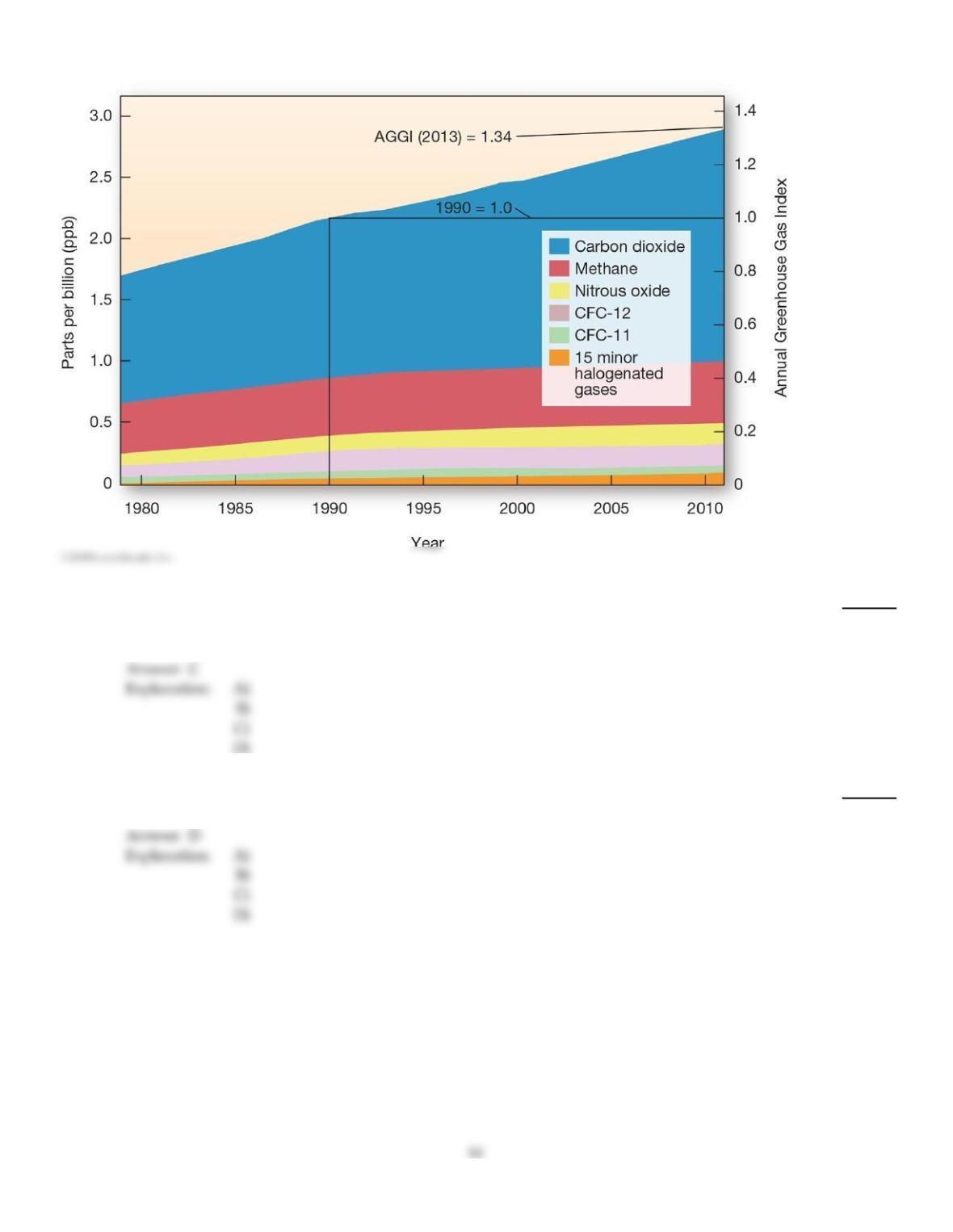
52)
Which of the following gases accounts for the largest amount of radiative forcing?
52)
A)
Methane (CH4)
B)
Chlorofluorocarbons (CFCs)
C)
Carbon dioxide (CO2)
D)
Nitrous oxides (N2O)
53)
The ________ is a graph which plots monthly averages of CO2 concentrations since 1958.
53)
A)
PETM
B)
MCA
C)
Younger Dryas
D)
Keeling Curve
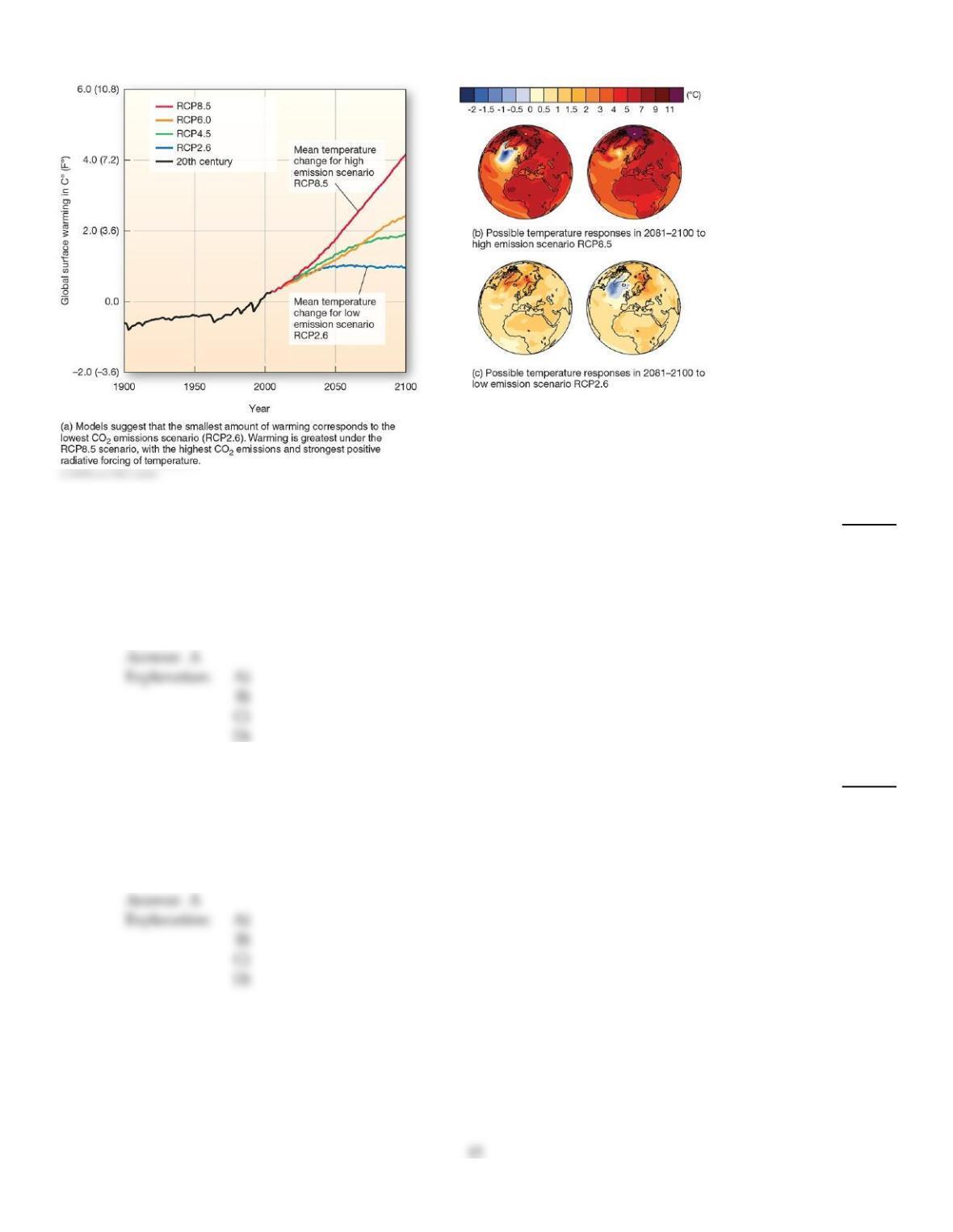
54)
According to the RCP8.5 scenario of high emissions
54)
A)
global surface temperatures will increase throughout the 21st century, perhaps by as much as
4°C (7.2°F) by 2100.
B)
global surface temperatures will increase until about mid–century, then steadily decrease.
C)
global surface temperatures will cool during the most of the 21st century.
D)
global surface temperatures will increase throughout the 21st century, but at a very gradual
rate.
55)
According to the U.S. Department of Energy, the U.S. could meet the carbon emission reduction
targets in the Kyoto Protocol
55)
A)
at a savings of $7 to $34 billion a year.
B)
without any economic benefits or detriments.
C)
at a cost of approximately $10 to $15 billion a year and with a risk of higher unemployment.
D)
at a cost of approximately $5 to $10 billion a year.
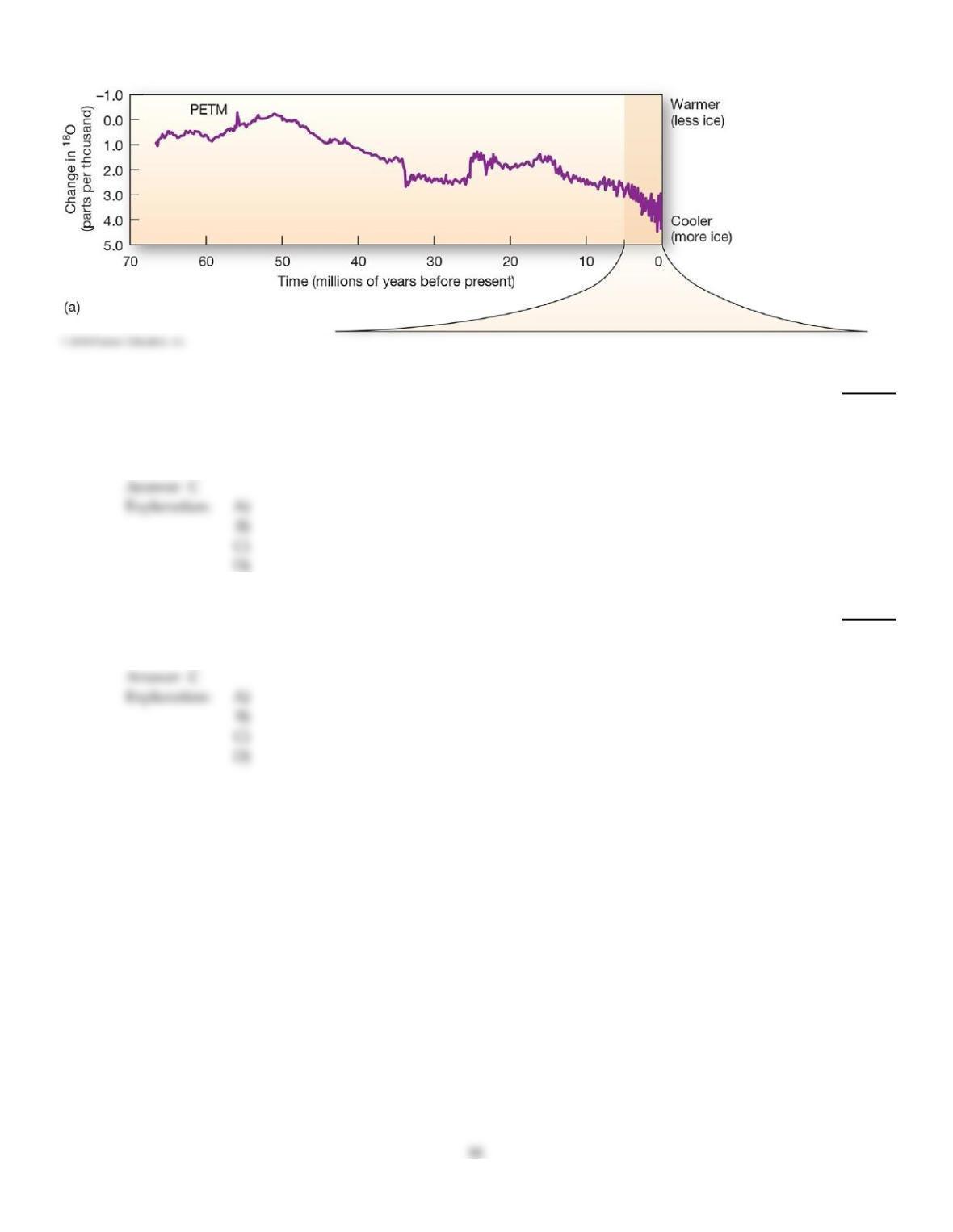
56)
Over the span of 70 million years, Earth‘s climate
56)
A)
was much cooler in the distant past than the present.
B)
was warmest approximately 10 million years ago and coolest about 56 million years ago.
C)
was much warmer in the distant past than the present.
D)
has remained fairly constant, only showing a warming trend during the past 200 years.
57)
A lower 18O/16O ratio in ocean sediment cores indicates a ________ climate, whereas a higher
18O/16O ratio indicates a ________ climate.
57)
A)
cooler; warmer
B)
warmer; hot
C)
warmer; cooler
D)
cooler; cold

58)
How is ocean acidification possibly linked to increased anthropogenic emissions of carbon dioxide
(CO2)?
58)
A)
Thermohaline circulation exchanges carbon between surface dissolved organic carbon and
deep layers of dissolved inorganic carbon.
B)
Increased photosynthetic activity in phytoplankton resulting from increased atmospheric
CO2 concentrations results in acidification due to a complex chemical reaction during plant
decay.
C)
Oceans may absorb much of the rising concentrations of rising carbon, as dissolved CO2
mixes with water to form carbonic acid (H2CO3).
D)
Atmospheric CO2 combines with atmospheric moisture forming a light carbonic acid forms
(H2CO3), that is precipitated over the world’s oceans.
59)
As air temperatures increase, evaporation increases. Warmer temperatures also increase the
capacity to absorb water vapor. More water vapor in the atmosphere accelerates the greenhouse
effect. As temperatures increase further, more water vapor can enter the atmosphere, causing
temperatures to increase even more. This is an example of a(n)
59)
A)
negative feedback loop.
B)
positive feedback loop.
C)
neither a positive or negative feedback loop.
B
60)
Ocean sediment cores provide a climate record for the past ________ years.
60)
A)
800,000
B)
2 million
C)
10 million
D)
70 million
D
61)
Which of the following is NOT an indicator of current climatic warming?
61)
A)
Decreases in relative humidity
B)
Rising sea levels
C)
Melting glacial ice and sea ice
D)
Increased tropospheric, land, and ocean surface temperatures
A
C

62)
The primary anthropogenic source of atmospheric carbon dioxide (CO2) is
62)
A)
respiration.
B)
burning of fossil fuels.
C)
rice farming.
D)
clearing and burning land.
63)
According to models developed by NOAA, by the end of the 21st century, global sea level may rise
as high as
63)
A)
0.2 m (0.7 ft).
B)
0.5 m (1.6 ft).
C)
1.2 m (3.9 m).
D)
2.0 m (6.6 ft).
Explanation:
64)
Per capita emissions of total greenhouse gases are highest in
64)
A)
less–developed countries (LDCs).
B)
more–developed countries (MDCs).
C)
neither LDCs and MDCs; they are approximately equal.
D)
non–populated areas since greatest emissions associated with volcanic eruptions.
Explanation:
65)
Which of the following is NOT a stated co–benefit of reducing greenhouse gas emissions?
65)
A)
Increase in renewable and sustainable energy development.
B)
Improved air quality.
C)
Greater dependence on imported oil.
D)
Fewer oil tanker spills.
Explanation:
66)
The science that studies Earth’s past climates is
66)
A)
paleoclimatology.
B)
dendrochronology.
C)
climate change science.
D)
meteorology.
Explanation:
Explanation:

67)
The legally binding international agreement to reduce greenhouse gas emissions is known as the
67)
A)
ICRW.
B)
CITES.
C)
Montreal Protocol.
D)
Kyoto Protocol.
68)
Which of the following is INCORRECT?
68)
A)
Scientists can definitively (100% certainty) attribute climate changes to anthropogenic causes
alone.
B)
Increased atmospheric carbon dioxide (CO2) causes warming temperatures.
C)
Global warming affects overall climate.
D)
Human activities have increased the amount of atmospheric greenhouse gases.
A
69)
Which of the following accurately describes 13C/12C ratios of plant materials and their use in
climate reconstructions?
69)
A)
Different plants use different types of photosynthesis, each producing a different carbon
isotope ratio in plant materials, which scientists use to determine past temperature and
rainfall conditions.
B)
13C is an unstable isotope, which decays at a constant rate. This is used to date plant material,
which can then be used as a proxy for temperature and climate conditions at that time.
C)
By analyzing the ratio of 13C/12C in marine phytoplankton, the source of the water in which
the organisms resided can be determined.
D)
12C is very rare in nature. When it does appear in plant material, it is indicative of climate
anomalies. By measuring the 13C/12C ratios, scientists can determine whether the plants were
alive during normal or anomalous conditions.
A
70)
Scientists use ________ to study past climates, using ________ to reconstruct climates that extend
back further than our present instrumentation allows.
70)
A)
direct measurements; historical records
B)
proxy methods; climate proxies
C)
indirect evidence; conjecture
D)
computer models; algorithms
B
D
TRUE/FALSE. Write ‘T’ if the statement is true and ‘F’ if the statement is false.
71)
Ice shelves and icebergs are an example of sea ice.
71)
72)
While GCMs are useful for visualization the complex global oceanic–atmosphere circulation, they
have had little utility in the study of climate change.
72)
73)
Vulnerability to sea level rise is not uniformly distributed across the world.
73)
74)
Carbon dioxide (CO2)has a longer residence time in the atmosphere than methane (CH4) does.
74)
75)
More–developed countries (MDCs) currently emit the greatest amount of greenhouse gases per
capita.
75)
76)
Though the U.S. is a signatory to the Kyoto Protocol, the U.S. Congress never ratified it.
76)
77)
Sea level is rising more quickly on th East Coast of the United States than on the West Coast.
77)
78)
Carbon dioxide (CO2) residence time in the atmosphere is 7 to 10 years.
78)
79)
In May 2013, the Mauna Loa Observatory recorded the highest CO2 concentrations on record.
79)
80)
The average individual is helpless to do anything about climate change.
80)
81)
The United States leads the world in total carbon dioxide (CO2) emissions.
81)
82)
Over the span of the last 5 million years, climate reconstructions show a series of cooler and
warmer periods.
82)
83)
Methane(CH4) is the second most prevalent anthropogenic greenhouse gas.
83)
84)
According to climate simulations using GCMs, natural climate forcing, alone, cannot account for
the increases in global temperature trends.
84)
85)
GCMs are used to predict specific temperatures in the near and long–term future.
85)
86)
Carbon dioxide (CO2) produced from human activities is amplifying Earth‘s natural greenhouse
effect.
86)
87)
Carbon dioxide (CO2) is the most abundant natural greenhouse gas.
87)
88)
The physical evidence for global climate change is limited, based primarily on conjecture and
indirect evidence.
88)
89)
The last glacial maximum (LGM) refers to the duration of the last period of glaciation.
89)
90)
The United States leads the world in per capita carbon dioxide (CO2) emissions.
90)
91)
Earth’s climate cycles between warmer and colder periods.
91)
92)
Firsthand, reliable scientific measurements of climate only date back approximately 140 years.
92)
93)
The current data indicate that the record high global temperatures of the past two decades
correspond to record high atmospheric CO2.
93)
94)
Halogenated gases are purely anthropogenic and have no natural sources.
94)
95)
The Paleocene–Eocene Thermal Maximum (PETM) is characterized by some of the coolest
temperatures in Earth’s history.
95)
96)
Earth‘s axial tilt varies from 21.5° to 24.5° during a 41,000 year period.
96)
97)
The majority of human population growth is now occurring in more–developed countries (MDCs).
97)
98)
Ice cores provide a longer, but less detailed climate record than ocean sediment cores.
98)
99)
Over the last two decades, the Antarctic ice sheet has lost mass. However, the Greenland ice sheet
has actually gained mass due to increased winter precipitation.
99)
100)
Thawing of tundra due to warming temperatures results in more carbon released from tundra soils
than is absorbed.
100)
101)
The rate of population growth decreased after 1950.
101)
102)
Milankovitch cycles are currently accepted as a causal factor for long–term climatic fluctuations.
102)
103)
Earth’s elliptical orbit around the sun (eccentricity) is mostly constant, only changing negligibly
over a 100,000 year period.
103)
104)
Paleoclimatologists use direct measurements.
104)
105)
The Younger Dryas, the Medieval Climate Anomaly, and the Little Ice Age demonstrate that
climates naturally fluctuate.
105)
106)
The exoskeletons of marine microorganisms provide a valuable clue of past climatic conditions.
106)
107)
Natural climate forcing is greater than anthropogenic climate forcing.
107)
108)
Delaying action on climate change may be dangerous and more costly in the long run.
108)
109)
Many scientists consider climate change to be one of the most critical issues facing humankind in
the twenty–first century.
109)
110)
Both the 16O and 18O oxygen isotopes occur in water molecules and can be used for isotopic
analysis to reconstruct past climates.
110)
111)
A lower 18O /16O ratio in ocean core sediments is indicative of warmer temperatures, whereas a
lower 18O /16O ratio in ice cores is indicative of cooler temperatures.
111)
112)
Clouds can create both positive and negative feedback loops in relationship to warming climates.
112)
113)
Recent temperature increases correspond to a period of increased sunspot activity.
113)
114)
Climate change science is an integral part of physical geography and Earth system science.
114)
115)
All greenhouse gases contribute equally to global climate change.
115)
116)
The use of tree rings to study past climates is known as dendroclimatology.
116)
117)
Increased atmospheric CO2 may lead to plants in some regions of the world producing more
leaves.
117)
118)
Methane(CH4) has a higher global warming potential than carbon dioxide (CO2).
118)
119)
As ocean temperatures increase, the ocean’s ability to dissolve CO2 diminishes.
119)
120)
The annual growth ring added by tree species is known as a varve.
120)
121)
A definitive link between climate change and extreme weather events has been established.
121)
122)
Sea surface temperatures increased at an average annual rate of 0.07°C (0.13°F) from 1901 to 2012.
122)
123)
Some climate feedback loops, such as CO2 weathering feedback, occur over very long time scales.
123)
124)
Water vapor (H2O) has a longer residence time in the atmosphere than carbon dioxide (CO2).
124)
125)
Currently, atmospheric methane(CH4) concentrations are increasing at a rate faster than carbon
dioxide (CO2).
125)
126)
According to the Intergovernmental Panel on Climate Change (IPCC), warming of the climate
system is unequivocal.
126)
127)
Climate has fluctuated naturally over Earth’s long history. As a result, most scientists are skeptical
that human activity has contributed to recent trends in global climate.
127)
128)
Ice core analysis shows a close correlation between atmospheric methane (CH4) and carbon dioxide
(CO2) concentrations and temperatures.
128)
129)
Speleothems, like trees, have growth rings whose size and property reflect the conditions under
which they formed.
129)
ESSAY. Write your answer in the space provided or on a separate sheet of paper.
130)
Based on climate reconstructions, there is ample evidence that climates have fluctuated throughout Earth’s long
history. Describe some of the mechanisms of this climate fluctuations.
131)
What is some of the evidence establishing that climate change is currently occurring?
132)
What steps can you take to help reduce climate change?
133)
What methods do scientists use to reconstruct both long–term and shorter term climate histories?
134)
Describe the properties, current atmospheric concentrations, and sources the primary greenhouse gases
contributing to climate change?
135)
What is radiative forcing? List gases and aerosols that have positive or negative radiative forcing. What is the
primary source of each.
136)
Describe methods that individuals and communities are taking to mitigate against climate change.
137)
What are some examples of positive and negative climate feedback loops?
138)
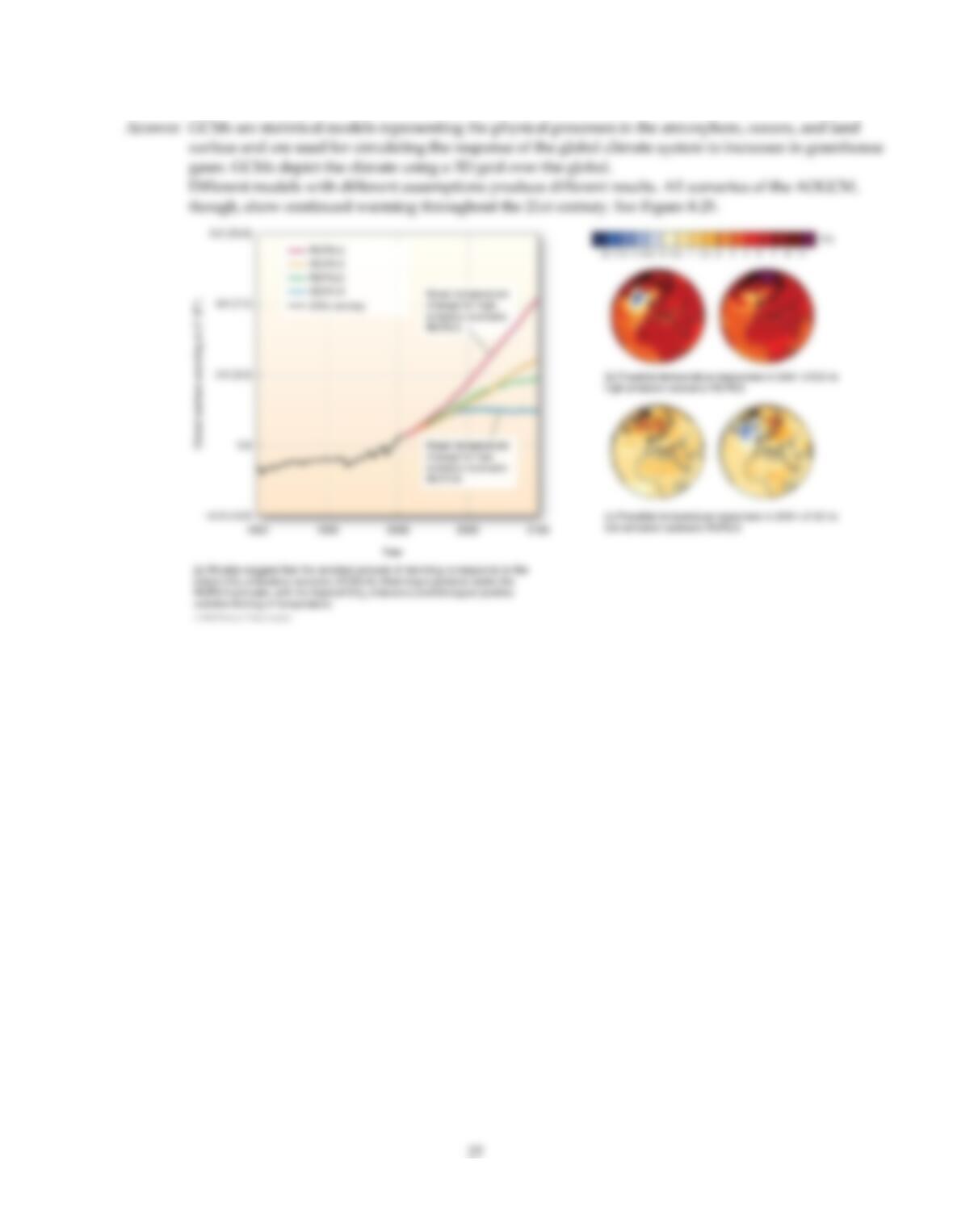
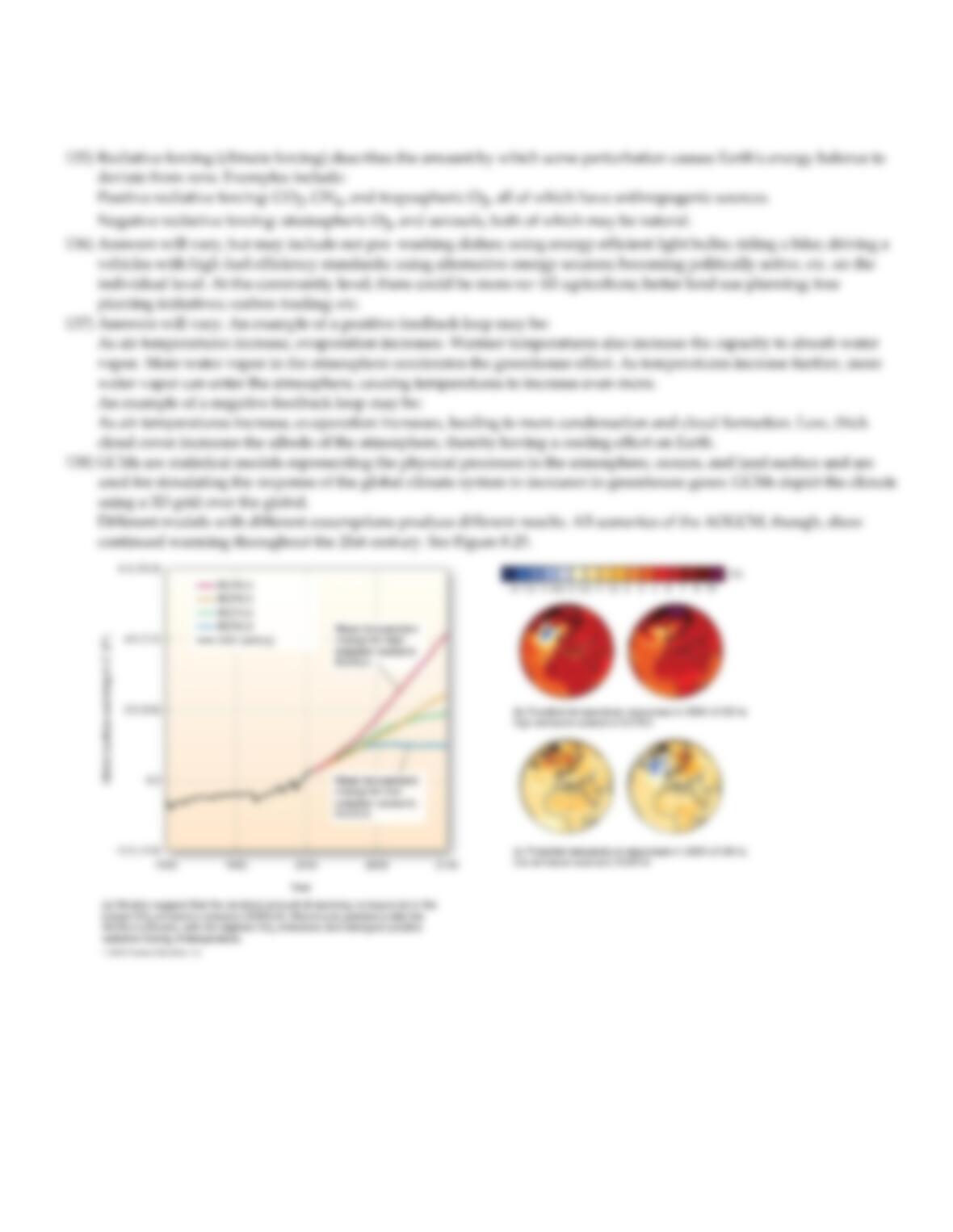
Describe the functioning of a general circulation model. What are some of the predictions for the 21st century
based on GCMs?

Answer Key
Testname: C8

Answer Key
Testname: C8
Answer Key
Testname: C8
Answer Key
Testname: C8
31