Application: The Costs of Taxation 2151
63. Refer to Figure 8-17. Suppose the government imposes a $1 tax in each of the four markets
represented by demand curves D1, D2, D3, and D4. The deadweight will be the smallest in the
market represented by
a. D1.
b. D2.
c. D3.
d. D4.
64. Refer to Figure 8-17. Suppose the government imposes a $1 tax in each of the four markets
represented by demand curves D1, D2, D3, and D4. The deadweight will be the largest in the
market represented by
a. D1.
b. D2.
c. D3.
d. D4.
2152 Application: The Costs of Taxation
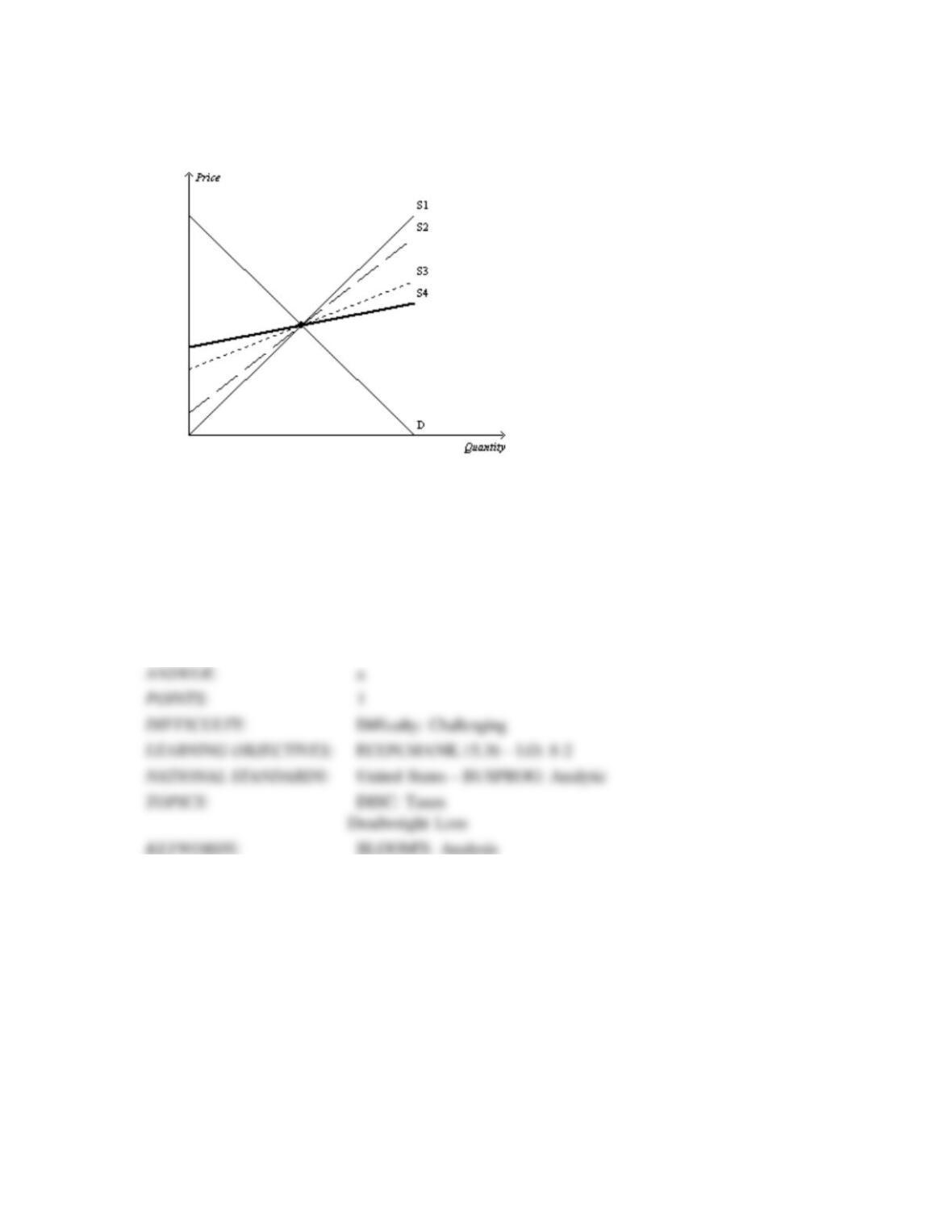
Figure 8-18
65. Refer to Figure 8-18. Suppose the government imposes a $1 tax in each of the four markets
represented by supply curves S1, S2, S3, and S4. The deadweight will be the smallest in the
market represented by
a. S1.
b. S2.
c. S3.
d. S4.
Application: The Costs of Taxation 2153
66. Refer to Figure 8-18. Suppose the government imposes a $1 tax in each of the four markets
represented by supply curves S1, S2, S3, and S4. The deadweight will be the largest in the market
represented by
a. S1.
b. S2.
c. S3.
d. S4.
Multiple Choice – Section 03: Deadweight Loss and Tax Revenue as Taxes Vary
1. A decrease in the size of a tax is most likely to increase tax revenue in a market with
a. elastic demand and elastic supply.
b. elastic demand and inelastic supply.
c. inelastic demand and elastic supply.
d. inelastic demand and inelastic supply.
2154 Application: The Costs of Taxation
2. An increase in the size of a tax is most likely to increase tax revenue in a market with
a. elastic demand and elastic supply.
b. elastic demand and inelastic supply.
c. inelastic demand and elastic supply.
d. inelastic demand and inelastic supply.
3. If the size of a tax increases, tax revenue
a. increases.
b. decreases.
c. remains the same.
d. may increase, decrease, or remain the same.
Application: The Costs of Taxation 2155
4. Suppose the tax on automobile tires is increased so that the tax goes from being a “medium” tax to
being a “large” tax. As a result, it is likely that
a. tax revenue increases, and the deadweight loss increases.
b. tax revenue increases, and the deadweight loss decreases.
c. tax revenue decreases, and the deadweight loss increases.
d. tax revenue decreases, and the deadweight loss decreases.
Figure 8-19
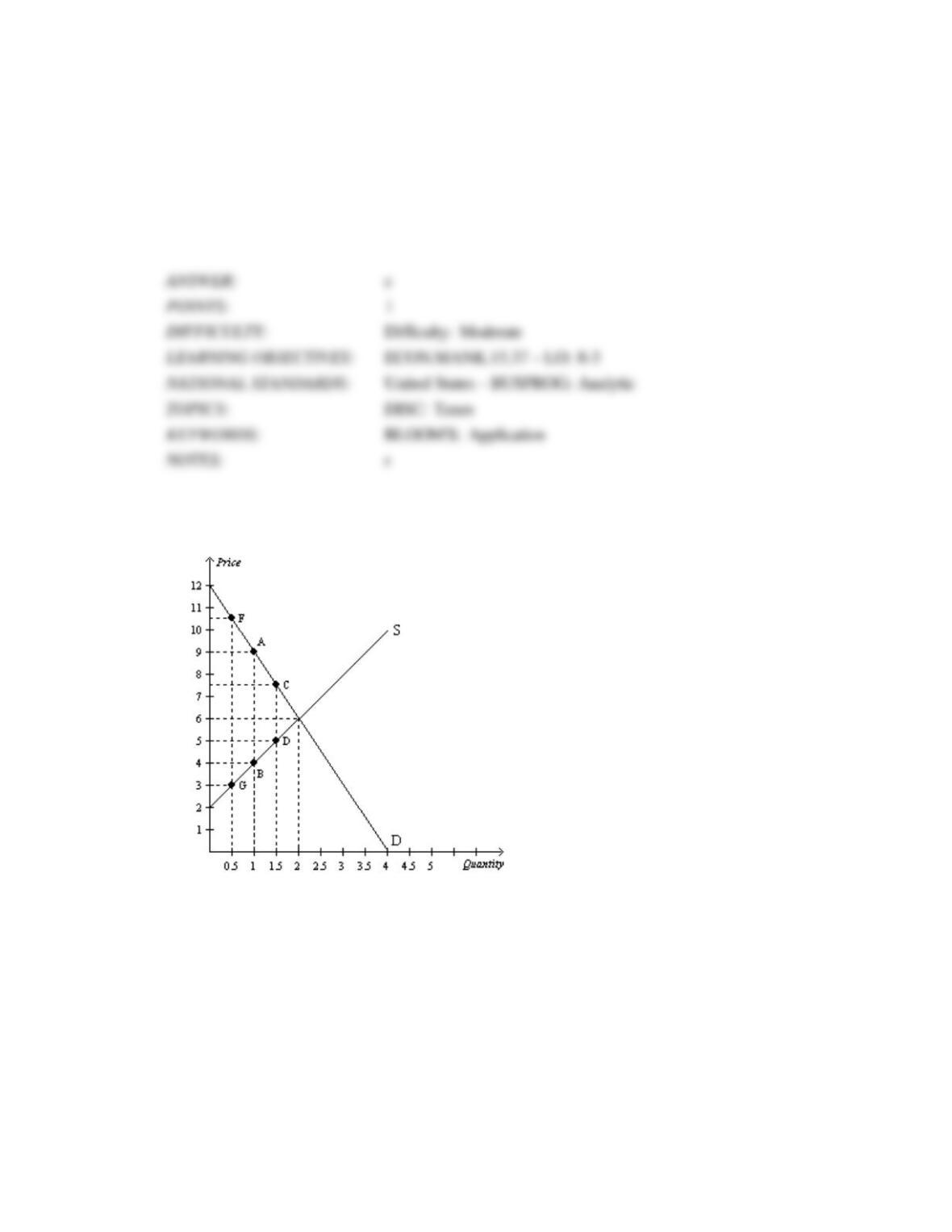
The vertical distance between points A and B represents the original tax.
2156 Application: The Costs of Taxation
5. Refer to Figure 8-19. If the government changed the per-unit tax from $5.00 to $2.50, then the
price paid by buyers would be $7.50, the price received by sellers would be $5, and the quantity
sold in the market would be 1.5 units. Compared to the original tax rate, this lower tax rate would
a. increase government revenue and increase the deadweight loss from the tax.
b. increase government revenue and decrease the deadweight loss from the tax.
c. decrease government revenue and increase the deadweight loss from the tax.
d. decrease government revenue and decrease the deadweight loss from the tax.
6. Refer to Figure 8-19. If the government changed the per-unit tax from $5.00 to $7.50, then the
price paid by buyers would be $10.50, the price received by sellers would be $3, and the quantity
sold in the market would be 0.5 units. Compared to the original tax rate, this higher tax rate would
a. increase government revenue and increase the deadweight loss from the tax.
b. increase government revenue and decrease the deadweight loss from the tax.
c. decrease government revenue and increase the deadweight loss from the tax.
d. decrease government revenue and decrease the deadweight loss from the tax.
Application: The Costs of Taxation 2157
7. Refer to Figure 8-19. The original tax can be represented by the vertical distance AB. Suppose
the government is deciding whether to lower the tax to CD or raise it to FG. Which of the
following statements is correct?
a. Compared to the original tax, the larger tax will decrease both tax revenue and deadweight loss.
b. Compared to the original tax, the smaller tax will increase both tax revenue and deadweight loss.
c. Compared to the original tax, the larger tax will decrease tax revenue and increase deadweight
loss.
d. Both a and b are correct.
8. Refer to Figure 8-19. The original tax can be represented by the vertical distance AB. Suppose
the government is deciding whether to lower the tax to CD or raise it to FG. Which of the
following statements is not correct?
a. Compared to the original tax, the larger tax will increase tax revenue.
b. Compared to the original tax, the smaller tax will decrease deadweight loss.
c. Compared to the original tax, the smaller tax will decrease tax revenue.
d. Compared to the original tax, the larger tax will increase deadweight loss.
2158 Application: The Costs of Taxation
9. As the tax on a good increases from $1 per unit to $2 per unit to $3 per unit and so on, the
a. tax revenue increases at first, but it eventually peaks and then decreases.
b. deadweight loss increases at first, but it eventually peaks and then decreases.
c. tax revenue always increases, and the deadweight loss always increases.
d. tax revenue always decreases, and the deadweight loss always increases.
10. Which of the following ideas is the most plausible?
a. Tax revenue is more likely to increase when a low tax rate is increased than when a high tax
rate is increased.
b. Tax revenue is less likely to increase when a low tax rate is increased than when a high tax
rate is increased.
c. Tax revenue is likely to increase by the same amount when a low tax rate is increased and
when a high tax rate is increased.
d. Decreasing a tax rate can never increase tax revenue.
Application: The Costs of Taxation 2159
11. Which of the following statements is true for markets in which the demand curve slopes
downward and the supply curve slopes upward?
a. As the size of the tax increases, tax revenue continually rises and deadweight loss continually
falls.
b. As the size of the tax increases, tax revenue and deadweight loss rise initially, but both
eventually begin to fall.
c. As the size of the tax increases, tax revenue rises initially, but it eventually begins to fall;
deadweight loss continually rises.
d. As the size of the tax increases, tax revenue rises initially, but it eventually begins to fall;
deadweight loss falls initially, but eventually it begins to rise.
12. In which of the following cases is it most likely that an increase in the size of a tax will decrease
tax revenue?
a. The price elasticity of demand is small, and the price elasticity of supply is large.
b. The price elasticity of demand is large, and the price elasticity of supply is small.
c. The price elasticity of demand and the price elasticity of supply are both small.
d. The price elasticity of demand and the price elasticity of supply are both large.
2160 Application: The Costs of Taxation
13. Which of the following statements correctly describes the relationship between the size of the
deadweight loss and the amount of tax revenue as the size of a tax increases from a small tax to a
medium tax and finally to a large tax?
a. Both the size of the deadweight loss and tax revenue increase.
b. The size of the deadweight loss increases, but the tax revenue decreases.
c. The size of the deadweight loss increases, but the tax revenue first increases, then decreases.
d. Both the size of the deadweight loss and tax revenue decrease.
14. Suppose the government increases the size of a tax by 20 percent. The deadweight loss from that
tax
a. increases by 20 percent.
b. increases by more than 20 percent.
c. increases but by less than 20 percent.
d. decreases by 20 percent.
Application: The Costs of Taxation 2161
15. If the tax on a good is doubled, the deadweight loss of the tax
a. increases by 50 percent.
b. doubles.
c. triples.
d. quadruples.
16. If the tax on a good is tripled, the deadweight loss of the tax
a. remains constant.
b. triples.
c. increases by a factor of 9.
d. increases by a factor of 12.
2162 Application: The Costs of Taxation
17. If the tax on a good is increased from $0.30 per unit to $0.90 per unit, the deadweight loss from
the tax
a. remains constant.
b. increases by a factor of 4.
c. increases by a factor of 9.
d. increases by a factor of 16.
18. If the tax on a good is increased from $1 per unit to $4 per unit, the deadweight loss from the tax
increases by a factor of
a. 5.
b. 9.
c. 16.
d. 24.
Application: The Costs of Taxation 2163
19. Suppose a tax of $0.50 per unit on a good creates a deadweight loss of $100. If the tax is
increased to $2.50 per unit, the deadweight loss from the new tax would be
a. $200.
b. $250.
c. $500.
d. $2,500.
20. Suppose a tax of $0.10 per unit on a good creates a deadweight loss of $100. If the tax is
increased to $0.25 per unit, the deadweight loss from the new tax would be
a. $200.
b. $250.
c. $475.
d. $625.
2164 Application: The Costs of Taxation
21. In which of the following instances would the deadweight loss of the tax on airline tickets increase
by a factor of 9?
a. The tax on airline tickets increases from $20 per ticket to $60 per ticket.
b. The tax on airline tickets increases from $20 per ticket to $90 per ticket.
c. The tax on airline tickets increases from $15 per ticket to $60 per ticket.
d. The tax on airline tickets increases from $15 per ticket to $135 per ticket.
22. In which of the following instances would the deadweight loss of the tax on cartons of cigarettes
increase by a factor of 9?
a. The tax on cartons of cigarettes increases from $10 to $11.11.
b. The tax on cartons of cigarettes increases from $10 to $20.
c. The tax on cartons of cigarettes increases from $10 to $30.
d. The tax on cartons of cigarettes increases from $10 to $90.
Application: The Costs of Taxation 2165
23. Which of the following events is consistent with an increase in the deadweight loss of the gasoline
tax from $30 million to $120 million?
a. The tax on gasoline increases from $0.30 per gallon to $0.45 per gallon.
b. The tax on gasoline increases from $0.30 per gallon to $0.60 per gallon.
c. The tax on gasoline increases from $0.25 per gallon to $0.45 per gallon.
d. The tax on gasoline increases from $0.25 per gallon to $1.00 per gallon.
24. Assume that for good X the supply curve for a good is a typical, upward-sloping straight line, and
the demand curve is a typical downward-sloping straight line. If the good is taxed, and the tax is
doubled, the
a. base of the triangle that represents the deadweight loss quadruples.
b. height of the triangle that represents the deadweight loss doubles.
c. deadweight loss of the tax doubles.
d. All of the above are correct.
2166 Application: The Costs of Taxation
25. Assume that for good X the supply curve for a good is a typical, upward-sloping straight line, and
the demand curve is a typical downward-sloping straight line. If the good is taxed, and the tax is
doubled, the
a. base of the triangle that represents the deadweight loss doubles.
b. height of the triangle that represents the deadweight loss doubles.
c. deadweight loss of the tax quadruples.
d. All of the above are correct.
26. Assume that for good X the supply curve for a good is a typical, upward-sloping straight line, and
the demand curve is a typical downward-sloping straight line. If the good is taxed, and the tax is
tripled, the
a. base of the triangle that represents the deadweight loss triples.
b. height of the triangle that represents the deadweight loss triples.
c. deadweight loss of the tax increases by a factor of nine.
d. All of the above are correct.
Application: The Costs of Taxation 2167
27. Suppose the tax on gasoline is decreased from $0.60 per gallon to $0.40 per gallon. As a result,
a. tax revenue necessarily decreases.
b. the deadweight loss of the tax necessarily decreases.
c. the demand curve for gasoline necessarily becomes steeper.
d. the supply curve for gasoline necessarily becomes flatter.
28. Suppose that the market for large, 64–ounce soft drinks in the town of Pudgyville is characterized
by a typical, downward-sloping, linear demand curve and a typical, upward-sloping, linear supply
curve. The market is initially in equilibrium with 1,000 soft drinks sold per day. The newly-elected
Mayor of Pudgyville wants to tax 64-ounce soft drinks. She is considering either a $0.10 tax or a
$0.30 tax. Her chief economic advisor estimates that the number of soft drinks sold after a $0.10
tax will be 900 and after a $0.30 tax will be 500. Which tax is better?
a. The $0.10 tax is better because it raises more revenue and creates a lower deadweight loss
than the $0.30 tax.
b. The $0.30 tax is better because it raises more revenue and creates a lower deadweight loss
than the $0.10 tax.
c. It is not clear which tax is better because although the $0.30 tax raises more tax revenues, it
creates a larger deadweight loss than the $0.10 tax.
d. It is not clear which tax is better because although the $0.10 tax raises more tax revenues, it
creates a larger deadweight loss than the $0.30 tax.
2168 Application: The Costs of Taxation
29. With linear demand and supply curves in a market, suppose a tax of $0.20 per unit on a good
creates a deadweight loss of $40. If the tax is increased to $0.50 per unit, the deadweight loss from
the new tax will be
a. $200.
b. $250.
c. $475.
d. $625.
30. The higher a country’s tax rates, the more likely that country will be
a. at the top of the Laffer curve.
b. on the positively sloped part of the Laffer curve.
c. on the negatively sloped part of the Laffer curve.
d. experiencing small deadweight losses.
Application: The Costs of Taxation 2169
31. According to Arthur Laffer, the graph that represents the amount of tax revenue (measured on
the vertical axis) as a function of the size of the tax (measured on the horizontal axis) looks like
a. a U.
b. an upside-down U.
c. a horizontal straight line.
d. an upward-sloping line or curve.
32. The graph that represents the amount of deadweight loss (measured on the vertical axis) as a
function of the size of the tax (measured on the horizontal axis) looks like
a. a U.
b. an upside-down U.
c. a horizontal straight line.
d. an upward-sloping curve.
2170 Application: The Costs of Taxation
33. Which of the following events always would increase the size of the deadweight loss that arises
from the tax on gasoline?
a. The demand for gasoline becomes more inelastic.
b. The slope of the supply curve for gasoline becomes steeper.
c. The amount of the tax per gallon of gasoline increases.
d. All of the above are correct.
34. Supply-side economics is a term associated with the views of
a. Ronald Reagan and Arthur Laffer.
b. Karl Marx.
c. Bill Clinton and Greg Mankiw.
d. Milton Friedman.