8
Employee Business Expenses
Solutions to Cumulative Problems
8-40 The solution to 8-40 is on the following pages.
[Insert UNF here]
[Insert UNF here]
[Insert UNF here]
[Insert UNF here]
[Insert UNF here]
[Insert UNF here]
[Insert UNF here]
[Insert UNF here]
[Insert UNF here]
[Insert UNF here]
[Insert UNF here]
8
Employee Business Expenses
Solutions to Tax Research Problems
8-41 Section 162(a) provides that, in general, a taxpayer shall be allowed to deduct all
ordinary and necessary expenses paid or incurred during the taxable year in
carrying on a trade or business. Subsection 162(a)(2) states that such deductible
expenses include “traveling expenses (including amounts expended for meals and
lodging) while away from home in the pursuit of a trade or business.” The critical
language of the statute is the phrase “while away from home,” inasmuch as the
taxpayer must be away from his “tax home” in order to deduct such expenses for
travel, meals, and lodging incurred in the pursuit of a trade or business. The courts
have approached this problem by inquiring whether the expenses incurred by the
taxpayer arose because of some reason personal to the taxpayer (i.e., taxpayer
maintains a residence that requires him to travel long distances to his main
income-producing activity, thereby necessitating meals and lodging away from

his residence that might be § 162 deductions.) The courts also look to whether the
costs of travel, meals, and lodging are unnecessary and inappropriate to the
conduct of his employer’s business.
One of the first cases dealing with this issue was Commissioner vs. Flowers,
46-1 USTC ¶9127, 34 AFTR 301, 326 U.S. 465 (1946), in which the U.S.
Supreme Court abstracted three conditions from § 162(a) which the taxpayer must
satisfy to deduct travel expenses. They are (1) the expenses must be reasonable
and necessary; (2) the expenses must be incurred while away from home, and (3)
the expenses must be incurred in pursuit of business. Failure to satisfy any one of
the three conditions bars the travel expense deduction. The Court did not address
the issue of “tax home” in this case.
In Schreiner vs. McCrory, 60-2 USTC ¶9677, 6 AFTR 2d 5545, 186 F. Supp.
819 (D. Neb. 1960), the taxpayer was employed by an insurance company based
in Omaha, Nebraska where the taxpayer also resided. The taxpayer was assigned a
sales territory that included Nebraska and Colorado. The taxpayer spent a great
deal of time in Denver, Colorado and earned the greater portion of his income in
that city. The taxpayer maintained no office or similar place of business in
Denver. The taxpayer sought to deduct his travel expenses relating to his
employment. The IRS contended that the taxpayer’s “tax home” was in Denver,
despite his residence in Omaha. The U.S. District Court disagreed and found
Omaha to be the taxpayer’s “tax home,” thus allowing the deduction for travel
expenses. The Court stated that to find otherwise would impose on a salesman a
penalty whereby he would be burdened with the cost of two homes: one where his
family lives and the other a “tax home” designated by the government on the basis
of time spent and money earned there.
In Bunewith vs. Commissioner, 52 TC 837 (1969), aff’d in an unreported
memorandum and order, 70-1 USTC ¶9414, 25 AFTR 2d 70-935 (CA-1, 1970),
the taxpayer resided outside of his work area and commuted back and forth to his
various work areas in Massachusetts. The court did not include the term “tax
home” in its opinion, which disallowed the taxpayer’s deduction for travel
expenses. However, the court stated that the taxpayer’s expenses were incurred for
personal reasons (i.e., his desire not to relocate closer to his work areas), and they
were as unnecessary and inappropriate to the conduct of the trade or business of
the taxpayer’s employer as were any other personal living expenses at his
residence.
In Lee E. Daly and Rosemarie H. Daly vs. Commissioner, 82-1 USTC ¶9721,
48 AFTR 2d 81-6008, 662 F.2d 253 (4th Cir. 1981), aff’g. TC and rev’ing after
rehearing en banc the case of 80-2 USTC ¶9719, 46 AFTR 2d 80-5851, 631 F.2d
361 (4th Cir. 1980), the court used both the concept of “tax home” and whether
expenses were personal and unnecessary and inappropriate to the conduct of his
employer’s business to disallow the taxpayer’s deduction for travel expenses. The
taxpayer lived in McLean, Virginia with his wife who was employed in nearby
Washington, D.C. The taxpayer chose to take a job in which he produced most of

his income in Philadelphia; the taxpayer did not maintain an office in
Philadelphia, and the taxpayer’s sales territory did not include his residence. The
Tax Court had originally found that Philadelphia was the taxpayer’s “tax home”
for § 161 (a) purposes and the deductibility of his travel, meals, and lodging must
be determined with Philadelphia as the point of departure instead of McLean,
Virginia. This finding was originally reversed by the U.S. Court of Appeals for
the Fourth Circuit, but upon a petition to rehear the case, the Fourth Circuit
reheard the appeal and reversed its earlier decision, thus affirming the Tax Court
decision. In a concurring opinion, Judge Murnaghan agreed with the result of the
case, but thought that Congress should deal with the issue in which one spouse’s
situation (e.g., here taxpayer’s wife and her employment situs) plays a significant
role in determining the situs of the other spouse’s “tax home.”
Applying the case law to the facts in the problem, it is noteworthy that M need
only cross a bridge to reach his sales territory; thus, M’s position is arguably
tantamount to living in his territory. Also noteworthy is that M’s wife is employed
in Cincinnati. In light of Judge Murnaghan’s concurring opinion in the Daly case,
supra, this gives M a significant reason for residing there. Finally, M does not
maintain an office in Louisville, although he obviously spends a great deal of time
there in income-producing activities. M’s situation seems to closely follow the
pattern in Daly, except for the taxpayer’s close proximity of his residence to his
sales territory. If M could construct an argument that would distinguish his
situation from Daly based on the close proximity of his residence to his sales
territory, M might find support from Schreiner, supra. M should seek to convince
the court that Cincinnati is as reasonable a place to live to serve his employer’s
business as is Louisville, and thus his “tax home” should be Cincinnati. M would
need to show that he did not live in Cincinnati and travel to Louisville merely for
personal reasons and that his travel to Louisville is necessary and appropriate to
conduct of his employer’s business. However, Bunewith, supra, where the
deduction was denied to a taxpayer who lived outside of his work territory,
coupled with the more recent Daly decision, could pose a threat to M’s ability to
take a travel expense deduction using Cincinnati instead of Louisville as the point
of departure. The Daly decision focused not only on establishing a “tax home” for
the taxpayer where he made most of his income, but also showed that the court
will closely scrutinize the situation to disallow the deduction when the taxpayer’s
travel is motivated by personal reasons which the law deems irrelevant.
Moreover, Judge Murnaghan in his concurring opinion to Daly argued that the
plight of two-earner spouses, where one’s situation has a significant influence on
the other’s tax home, is a matter for Congress to resolve. The cases indicate that
the courts are reluctant to delve into areas properly resolved by legislation. Thus,
in light of the similarity of the facts of the problem to Daly, M will probably not
be allowed travel expense deductions for trips to Louisville, as that city will be
deemed M’s “tax home” for § 162(a)(2) purposes.
8-42 In order for R to claim a deduction for the payments to his employees, the
expenses must first meet the general requirements imposed on all potential
business deductions under § 162. This provision allows a deduction for all the

ordinary and necessary expenses incurred in carrying on a trade or business.
Although this three prong test seems innocuous enough in this situation, these
initial requirements must be considered.
The basic provisions of § 162 have been the subject of countless court cases.
Generally, an expense is ordinary if it is normally incurred in the type of business
in which the taxpayer is involved. In this case, R would be required to
demonstrate that someone in the same line of work could reasonably be expected
to incur a similar expense. In order for an expense to be necessary the expense
must be appropriate, helpful, or capable of making a contribution to the taxpayer’s
business. Finally, R must show that the proper nexus exists between the expenses
and R’s trade or business. Neither the Code nor the Regulations give any
particular guidance for determining whether R’s payments are in fact ordinary.
However, several court cases have considered the treatment of expenses similar to
R’s.
In Harold A. Christensen 17 T.C. 1456 (1952) the court examined the
situation of an employee for Parke Davis Company, a corporation that
manufactured medicines and related products. The taxpayer was a field manager
with responsibility for all or parts of six states and 15 salesmen that covered this
area. Mr. Christensen’s compensation consisted of a fixed salary, plus a bonus of
five percent of the average increase in the sales made by the salesmen under him.
During the years in question, the taxpayer spent his own money on salesmen and
their families in an effort to bring about and maintain good business relations
between those salesmen and himself so that the business of his employer might
prosper and his own earnings increase. He was not required by his employer to
make the expenditures for his salesman, but made them entirely on his own
initiative. With little analysis, the Tax Court held that at least a portion of the
expenses could be regarded as ordinary and necessary expenses of the business of
a field manager. However, a skeptical reading of the brief opinion might suggest
that the result may have differed had the taxpayer’s compensation not been
directly tied to the work of those under him. The facts in R’s case do not indicate
whether R’s compensation is directly dependent on his division’s profitability,
and, therefore, the productivity of those he supervised. Nevertheless, it would
seem that R’s compensation and performance evaluation ultimately depended on
his unit’s success regardless of whether any direct relationship was present in
Christensen.
Cases following Christensen tend to cloud the issue. In Robert B. Richardson
TC Memo 1978-332, the taxpayer had over a period of years worked for an
insurance company as vice president, president, and general manager. During his
employment, the taxpayer created the atmosphere of a “family business” creating
a personal relationship with officers, agents, employees, stockholders, and policy-
owners of the company. This was accomplished primarily by gifts and
entertainment. In considering the deduction of such gifts, the court explained that
a corporate officer may deduct unreimbursed expenses actually paid by him as
ordinary and necessary expenses of his business as a corporate executive if the

corporate officer is required to incur entertainment expenses or make gifts in the
course of discharging his executive duties. Relying on a series of cases (Deputy v.
DuPont, 308 U.S. 488, AFTR 808, (1940), Burnet v. Clark, 287 U.S. 410, 11
AFTR 1103 (1932), Jergens v. Comm., 17 T.C. 806 (1951)), the court noted that
in order for the expenses to be deductible the taxpayer must show that the
expenses were made pursuant to corporate policy requiring or expecting him to
bear such expenses. Moreover, the court indicated that reimbursement for such
expenses or a corporate resolution requiring the assumption of such expenses
would tend to show that the expenses were a necessary expense of the office.
Although the court ultimately determined that expenses incurred before the
taxpayer had been chairman would have been deductible under this rationale, the
taxpayer had not proven that expenses made after the taxpayer had become
chairman were either required or expected of him.
The decision in Richardson does not cast favorable light on R’s situation. The
facts of the case do not suggest that R is required to make such gifts. Although
such a requirement would be implied in a reimbursement arrangement, none
apparently existed. The payments were completely voluntary on R’s part. He
received no directive from his employer telling him such expenses were either
required or expected. A strict reading of the Richardson case would seem to
prohibit R’s deductions.
In James B. Walliser 72 T.C. 433, the taxpayer was in a position somewhat
similar to R’s. Walliser was a bank officer responsible for marketing loans. For
several years, he participated in vacation tours attended primarily by builders and
deducted the related costs. He participated in such tours to build social
relationships with the builders to help generate loan business which in turn helped
him meet his assigned loan production quotas and obtain increases in his salary.
For several years, Walliser’s employer had paid for him to participate in the
builder’s tours but budget cutbacks required the company to stop the
reimbursement of this and other expenses. However, Walliser was given leave
with pay, in addition to his normal two-week paid vacation, in order to participate
in the tours. Upon consideration of these facts, the court concluded that such
expenses were deductible. The court, citing the result in Christensen, indicated
that “where a corporate officer personally incurs expenditures which enable him
to better perform his duties to the corporation and which have a direct bearing on
the amount of his compensation or his chances for advancement may be
deductible under § 162.” Nevertheless, the court denied the Walliser’s deduction
in light of the limitations imposed on entertainment expenses contained in § 274.
Noting that the expenses were in the nature of entertainment, the court explained
that such expenses are not deductible where their primary purpose is to simply
generate goodwill.
Although the facts in R’s case bear only remote resemblance to Walliser’s, the
court’s decision would appear to help support R’s deduction. The Walliser
decision in relying on Christensen emphasizes the importance of that 30-year-old
decision which holds that gifts to employees from another employee do satisfy the

ordinary and necessary criteria. Unfortunately, the Richardson decision and others
like it that indicate that the employee must be required or expected to make such
expenditure cloud the issue.
It should be noted that R would not automatically be entitled to a limited
deduction for the payments as business gifts. Section 274 allows a deduction for
business gifts where there is a reasonable expectation of a commensurate financial
return. This requirement rarely raises any difficulty in the case of gifts to
customers. Indeed, all of § 274 is couched in terms of entertaining customers
rather than employees. In R’s case, the payments were to his fellow employees. In
such case, the IRS may balk. It seems more reasonable to assume, however, that a
de minimis amount such as the $25 deduction approved by the Code would be
allowed. Note that R would much prefer deducting the expenses as an ordinary
and necessary business to being subject to the $25 limitation.
8
Employee Business Expenses
Test Bank
True or False
________ 1. L is currently an accountant with a large public accounting firm. This
year he paid $800 to take a review course to prepare him for the C.P.A.
exam. Because L passed the exam, he was promoted to a position open
only to certified public accountants. He may deduct the cost of the
review course.
________ 2. K is an instructor of European history at High School 101. During the
summer she traveled to France, taking slides that she will use in her
class. K may deduct the cost of traveling to Europe as an education or
business expense.
________ 3. F, a landscape architect for an urban firm, commutes seven miles to her
office. She is transferred to a branch office and must now commute 32
miles from home. If she moves to the suburbs, she will have moved 43
miles. She can deduct her moving expenses.
________ 4. T, who graduated from the University of Illinois in June, moved 150
miles to take a job in Chicago that began in September of that year.
Because he was not previously employed, he cannot deduct moving
expenses this year.
________ 5. E moved from Detroit to Beverly Hills to accept a new job as a detective
with the Los Angeles Police Department. During the trip to Los Angeles
he spent $100 on meals and $400 on lodging. E may deduct $500.

________ 6. H, a famous television talk show host, moved from New York to Los
Angeles this year. As part of the move she paid $500 for meals. All of
the costs of her moving expenses, including her meals, were reimbursed
by her employer. H may deduct $500 as an itemized deduction.
________ 7. S is employed by Clips, a large discount office supply store. She spends
most of her time on the road, seeing customers. The company does not
provide her with an office so she has set up a home office. She uses her
home office about 10 hours a week to write-up orders, receive and return
phone calls (obviously a critical part of her job), and shuffle paper.
Based on the IRS’s interpretation of the Soliman decision, S would be
allowed a deduction for her home office.
________ 8. L leases a car that he uses primarily for business. L may not elect to use
the standard mileage rate to account for his automobile expenses.
________ 9. R, a salesman for a drug company, owns a car, which he uses primarily
for business. Last year he computed his auto expense deduction using
actual expenses. This year, he can simplify his bookkeeping by using the
standard mileage rate.
________ 10. V is a district supervisor for several grocery stores. He is a native of
Indianapolis and maintains his residence there. His primary
responsibility, however, is for Louisville and the surrounding area. V
spends virtually all of his time working in the Louisville area. While
working in and around Louisville he incurred the following expenses:
BW Motel, $1,250; ZK Motel, $1,400; LL Motel, $750 (total motel
expense $3,400), and meals, $200. If V is audited, a deduction for the
meals and lodging would be allowed.
________ 11. A taxpayer who travels within the U.S. generally may deduct all of his
transportation expenses for a trip that is primarily for business, and an
allocable portion of such transportation expenses when some business is
conducted.
________ 12. On instructions from his employer, Z traveled from Atlanta to London
on a business trip. Z had no desire for a vacation at that time. Z flew
round-trip at a cost of $570. Once in London, though, he decided to do
some sight-seeing. As a result, he conducted business on five days and
engaged in personal activities for three days. Z can deduct only a portion
of the travel costs to and from London.
________ 13. K, a professor of accounting at the University of Cincinnati, often
teaches continuing education courses for the AICPA. This year she
taught a tax update session in Scottsdale. She invited her husband, L, to
come along, so the couple flew out to Arizona. L helped her prepare
transparencies and flip-charts for her presentation. The cost of L’s flight

to Scottsdale is not deductible regardless of the nature and relevance of
his contribution to K’s work because the cost is not related to his own
trade or business.
________ 14. Taxpayers may deduct the cost of a business meal for a client as long as
the surroundings are conducive to a business discussion. A business
discussion need not transpire before, after, or during the meal.
________ 15. D can deduct expenses for a meal when D’s client meets with her
attorney to discuss a proposed transaction with her company, even
though she is not present at the restaurant.
________ 16. Taxpayer B is the president and sole shareholder of XYZ Corporation,
which has six employees. The corporation may deduct the cost of a
hunting lodge as long as it is primarily used by the employees.
________ 17. While in Chicago, S took her best customer to a Cubs game. In
determining the amount of deductible entertainment expenses, the
amount subject to limitation includes the cost of the entertainment,
meals, taxes, tips, parking, and transportation to the event.
________ 18. D is employed by MH&G public accountants. While at an out-of-town
continuing education course held by the firm, he incurred meal expenses
that were less than the amount he was reimbursed. D is reimbursed under
a per diem scheme that provides for reimbursements not greater than
certain amounts prescribed by the IRS. D must return the excess for the
reimbursement arrangement to qualify as an accountable plan.
Multiple Choice
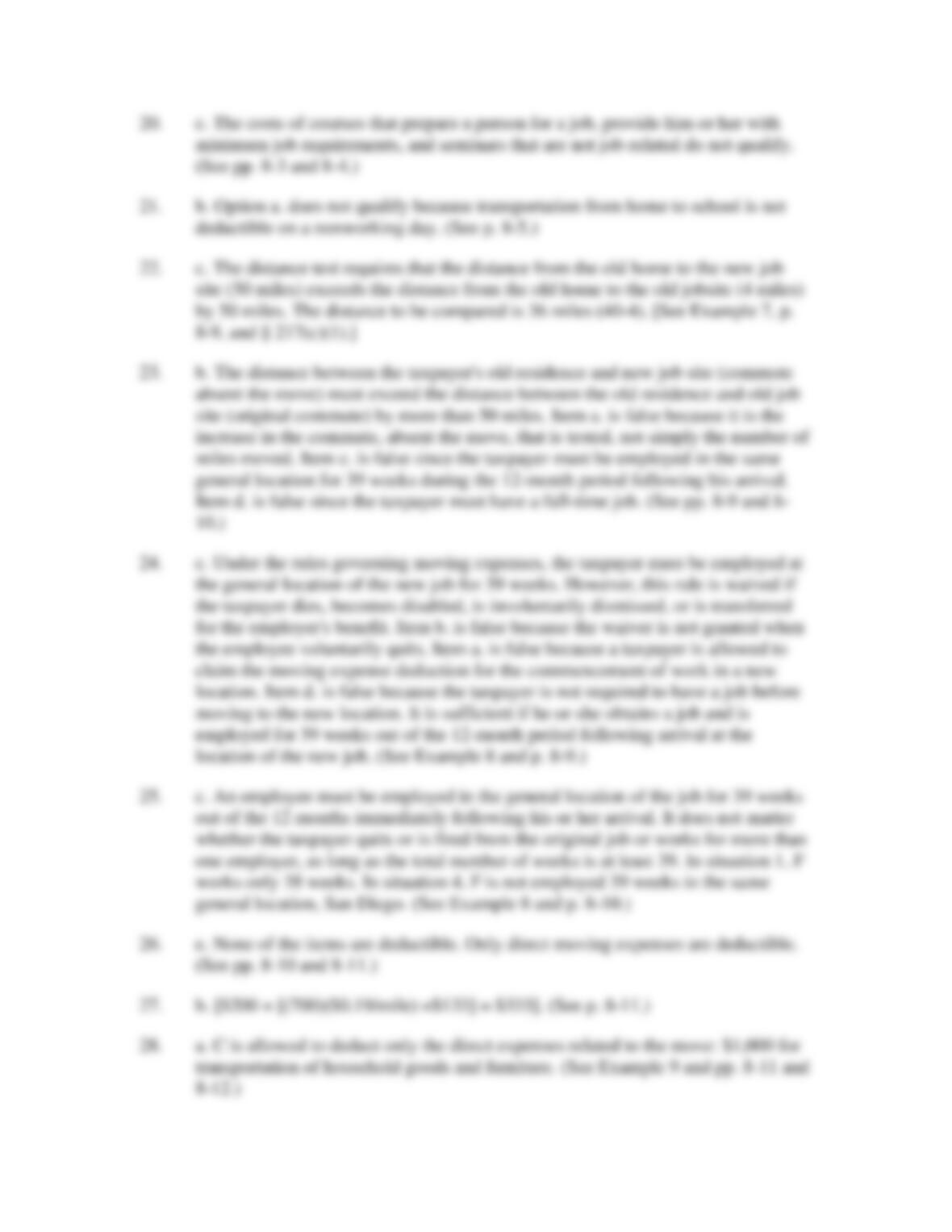
________ 19. B works for AC Manufacturing Co. as a janitor. Due to new federal
regulations regarding plant safety, AC has required that all janitors take a
night class in occupational safety at a local trade school. Although B
would be happy to take the class and keep his current position, he has
learned that by completing the course he will be eligible to be considered
for a supervisory janitor position. B wants to deduct the cost of attending
the night school class, which is not reimbursed to him. Ignoring the
special deduction for qualified tuition, which statement best describes
the deductibility of the cost?
a. B may not deduct the cost of the night school class if the supervisory
position is considered a change in duties.
b. B may not deduct the cost of the night school class if it is not
necessary to meet the minimum educational requirements of B’s
trade or business.
c. B may not deduct the cost if the education qualifies B for a new trade

or business.
d. B may not deduct the cost if the education merely maintains his
current skills.
________ 20. The costs of which one of the following are valid deductible educational
expenses? (Ignore the special deduction for qualified tuition)
a. A college or vocational course necessary to be considered for a job
b. A professional continuing educational program that qualifies the
taxpayer for a new job
c. Professional development courses required by an employer for
retaining a position
d. A tax seminar attended for reasons unrelated to one’s present job
________ 21. Which one of the following would qualify, at least in part, as a
deductible educational expense?
a. The cost of transportation between home and school on a
nonworking day
b. Transportation between work and school on a working day
c. Both of the above
d. Neither of the above
________ 22. M works for MND Corporation, whose headquarters are in downtown
Houston. The firm reassigned M to the real estate division, Woodacres,
whose offices are in a nearby suburb, Conroe. The distance between the
two jobsites is 43 miles. While M was working downtown it was 4 miles
from his home to the office but the Woodacres office was 40 miles from
M’s home. M decided that 40 miles was too far to commute, so early in
2012 he moved 25 miles to a new house that was 19 miles from the
Woodacres jobsite and 29 miles from the downtown jobsite. The travel
distance that determines whether or not M’s moving expenses are
deductible is
a. 19
b. 25
c. 36
d. 40

e. 43
________ 23. The moving expense provisions are designed to ensure that deductions
are granted only when expenses arise from business concerns. Which
one of the following statements most correctly describes the operation of
the rules governing moving expenses?
a. A deduction is denied unless the taxpayer moves more than some
predetermined amount from his former residence.
b. A deduction is denied unless the taxpayer’s commute, absent the
move, would have increased by more than some predetermined
amount.
c. A deduction is granted as long as a taxpayer’s move is attributable to
a job change.
d. A deduction is granted if the taxpayer obtains either part-time or full-
time employment at the new job site.
________ 24. J, a native Texan, graduated in June from Notre Dame University in
Indiana, and obtained a job with a public accounting firm in Dallas. He
began work on September 1. Before he started work, J fell in love with
K, who had accepted a job in San Francisco. Shortly after J began work,
the couple decided to get married. J left his job on March 1 of the
following year and obtained employment two weeks later in San
Francisco. He continued to be employed in the same job the remainder
of the year. Which of the following statements is true regarding the
expenses J incurred in moving to Dallas from Notre Dame?
a. No deduction is allowed since this is J’s first job.
b. A deduction is allowed if J left Dallas because he quit his job.
c. A deduction is allowed if J’s leaving Dallas was because of a transfer
by his employer to a branch of the firm in San Francisco.
d. No deduction is allowed if J did not have a job before moving to
Dallas.
e. None of the above statements is true.
________ 25. F, a news reporter, switched jobs and began working for station KNEE
in San Diego, California on January 1. Four scenarios are given below.
Assuming F otherwise qualifies for the moving expense deduction for
expenses incurred to move to San Diego, in which of the following cases
would the deduction be allowed?

1. F worked 16 weeks for KNEE. Dissatisfied, he voluntarily quit.
Shortly thereafter he went to work for another local station, where he
worked for 22 weeks before the end of his first year in San Diego.
2. F worked eight weeks for KNEE. Dissatisfied, he voluntarily quit.
Shortly thereafter he found work for another network in San Diego,
where he worked for 42 weeks before the end of his first year in San
Diego.
3. F worked 42 weeks for KNEE. Dissatisfied, he voluntarily quit.
Shortly thereafter he found work for another network in San Diego,
where he worked for 10 weeks before the end of his first year in San
Diego.
4. F worked 17 weeks for KNEE. Dissatisfied, he voluntarily quit.
Shortly thereafter he found work for another network 500 miles away
in San Francisco, California, where he worked for 30 weeks before
the end of his first year in California.
a. 1. 2. and 3.
b. 1.2., 3. and 4.
c. 2.and 3.
d. 2., 3. and 4.
e. 3.
________ 26. R and S moved 1,400 miles from Bartlesville, Oklahoma to Boston,
Massachusetts. Assuming the couple qualifies for the moving expense
deduction, which of the following is not deductible at least in part?
a. Forfeited security deposit for early termination of lease in Oklahoma
b. Real estate commission to obtain a new apartment in Massachusetts
c. Cost of second trip to Boston to find a house
d. Meals at the temporary residence in Boston
e. None of the above is deductible
________ 27. J graduated from the University of Texas during the current year and
accepted a job in Kansas City. J lived in Austin and moved to Kansas
City to commence work on June 1. J drove 700 miles pulling a trailer
with all of his belongings. J had rented the trailer for $200. On June 1 he
moved into an apartment and lived there temporarily at a cost of $10 per

day through July 15. On July 16 he moved into his new house. J will be
able to claim a moving expense deduction of
a. $0
b. $333
c. $200
d. $632
e. $782
________ 28. C obtained a new job in Alaska with H&J Engineering. She incurred the
following moving expenses:
Transportation of furniture and household goods $1,000
House-hunting trip 1,900
Attorney’s fees on sale of former residence 1,400
Assuming C is eligible to deduct her moving expenses, what is the
amount of the deduction?
a. $1,000
b. $2,900
c. $3,400
d. $3,900
e. $4,400
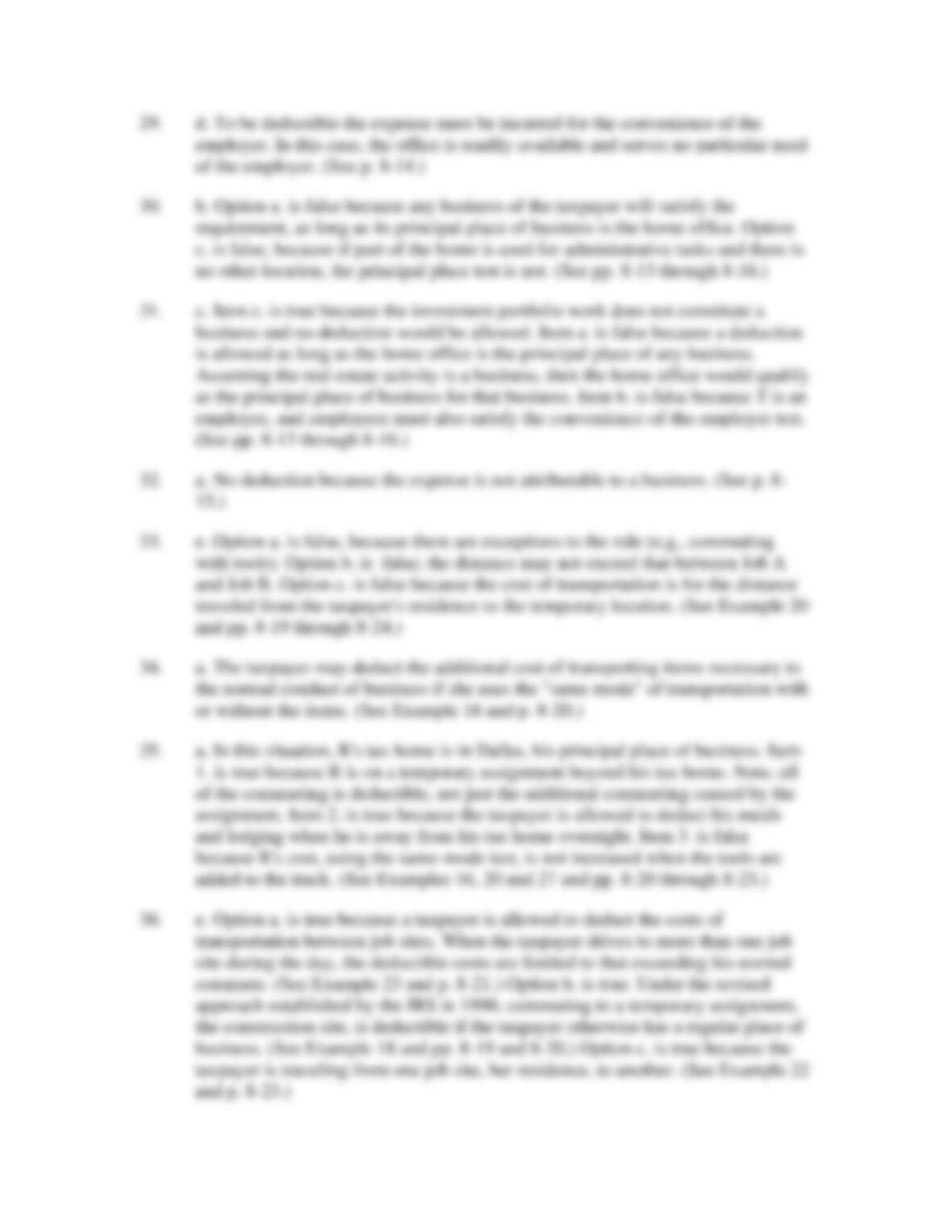
________ 29. An aggressive young attorney is an employee of a small law firm that
provides him with an adequate office. He uses the den in his home to
prepare legal briefs and review legal documents related to his
employment. Assuming the attorney lives near the firm’s office and he
has easy access to the office at all times, which of the following
statements most accurately describes the deductibility of the home office
expenses incurred by the attorney?
a. If the den is used exclusively for business purposes, the expenses are
deductible.
b. If the den is used exclusively for business purposes on a regular
basis, the expenses are deductible.

c. If the den is used exclusively for business purposes on a regular basis
to work for and see clients, the expenses are deductible.
d. In this situation the expenses are not deductible.
e. The home office deduction was completely eliminated as a result of
the Tax Reform Act of 1976.
________ 30. Which of the following statements regarding deductions for home office
expenses is true?
a. Deductions may be taken only if the home office is used for the
taxpayer’s main business.
b. Deductions may be taken if the home office is used regularly for
meeting clients or customers in the normal course of the taxpayer’s
business.
c. Deductions may not be claimed if the taxpayer merely performs
administrative tasks related to his business in the home office.
d. All of above are true.
e. None of the above is true.
________ 31. T’s employer provides an office for her in its downtown headquarters.
Which of the following is true?
a. T maintains an office in her home that she uses to conduct work
related to her rental property. Even though the rental activities may
be considered a business, no deduction can be allowed because T’s
principal business is that of being an employee and its primary
location is downtown.
b. T regularly meets with clients of her employer’s business in her home
office, which is exclusively used for such purpose. T is entitled to the
home office deduction without further inquiry.
c. T maintains a home office that is exclusively used on a regular basis
to conduct work regarding her investment portfolio. No deduction is
allowed.
d. None of the statements above is true.
________ 32. K exclusively uses a portion of his bedroom as a place to manage his few
investments. He charts his stocks daily. Costs allowable to the home
office are $1,000. Gross income from his investments is $800, while his
A.G.I., including the investment income, is $30,000. The amount K may

deduct from his A.G.I. is
a. $0
b. $200 for A.G.I.
c. $400 for A.G.I.
d. $800 from A.G.I.
e. $1,000 from A.G.I.
________ 33. Which one of the following statements is true?
a. The expenses of commuting are personal, and as such are never
deductible regardless of the surrounding circumstances.
b. The expenses of commuting from Job A to Job B are deductible to
the extent that the distance between Jobs A and B does not exceed
the distance from home to Job A.
c. The expenses of commuting to a temporary assignment and returning
the same day when the temporary assignment is outside the vicinity
in which the taxpayer conducts his business (the tax home) are
deductible and are determined based on the cost of transportation
from the employee’s office to the temporary location.
d. Both b. and c. are true.
e. All are false.
________ 34. T sold textbooks for a living by visiting different teaching institutions
and showing samples of various books to professors. She typically
carried about 100 books in her Volkswagen on her way from home to
various local universities that she regularly called upon. Last year a
sudden increase in the number of textbooks revised caused T to increase
her quantity of samples from 100 to 300 books. To carry all of the books,
T rented a trailer that she pulled behind her Volkswagen. T sought to
deduct the cost of the trailer on her tax return. T will
a. Be allowed to deduct the cost of the trailer as an additional cost
attributable to carrying the items that T needs for the cost of doing
business normally
b. Not be allowed to deduct the cost of the trailer. However, T could
have deducted the additional cost of hauling the new books if she had
bought a larger car and used the “same mode” of transporting them
as before

c. Not be allowed to deduct the cost of the trailer because T is still
essentially using the “same mode” of hauling books as before, i.e.,
with a car
d. Be allowed to deduct the cost of renting the trailer because she is not
using the “same mode” of hauling the new books that she used for
the old ones
________ 35. R is employed as a painter for Painting-We–R. He lives in Dallas and
works on jobs in the surrounding area.
1. R is assigned to a job in Ft. Worth for one week, causing him to
commute daily a total of 80 miles, which is 60 miles further than his
normal commute. R may deduct the cost of commuting 80 miles.
2. R travels 100 miles to Waco for a two-day job and stays overnight.
He may deduct, at least in part, the costs of his own meals while
there.
3. R carries a few tools in his light duty truck including paint brushes,
paint, a ladder, and the like. Assuming R would drive the truck with
or without the tools, he is allowed to deduct the costs of commuting
under the IRS view.
Which set of the above statements is true?
a. 1. and 2.
b. 1., 2. and 3.
c. 2.
d. 2. and 3.
e. 3.
________ 36. Which statement concerning deductible transportation costs is true?
a. B drives 20 miles to his office, then later in the day drives to meet a
client at the client’s office. By the time he gets home that night he has
driven 63 miles. He can deduct the cost of driving 23 miles.
b. F, an architect, usually drives 40 miles round trip from home to
office. Today, she skips the office and drives directly to a job site to
inspect the construction. Her round trip is 50 miles. She may deduct
a cost of 50 miles.
c. M, a contractor, works out of her home. She may deduct the cost of

driving to a client’s place of business.
d. More than one answer is true.
e. All are true.
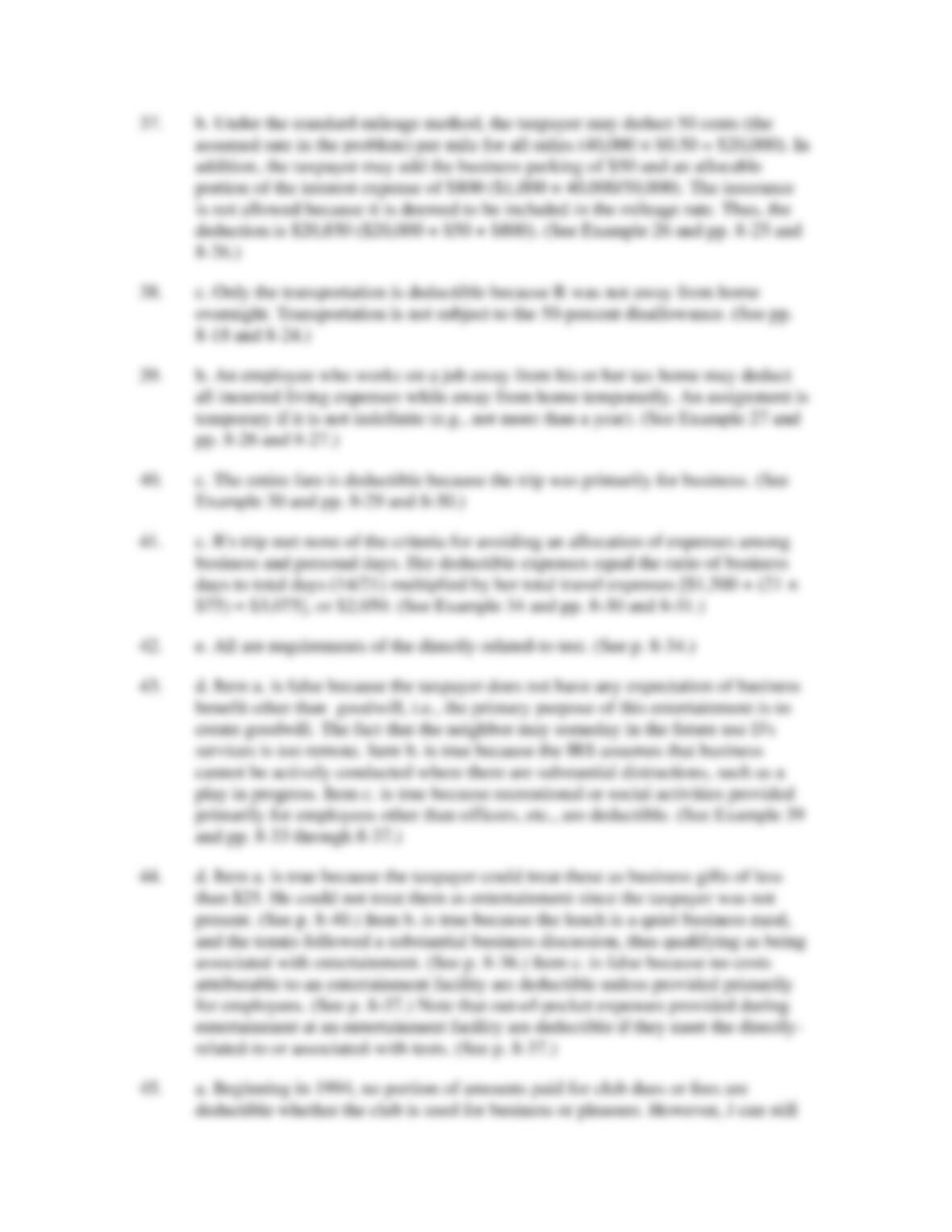
________ 37. J.B., a self-employed taxpayer, acquired a car this year and uses the
standard mileage method to compute her deduction for automobile
expenses. During the year, J.B. drove 50,000 miles: 40,000 for business
and 10,000 for personal purposes. Other expenses related to the car that
she has brought to her tax advisor’s attention include insurance of $400,
parking on business calls of $50, and interest on debt incurred to
purchase the car of $1,000. What is J.B.’s deduction for automobile
expenses (assume the mileage rate is .50 cents per mile for all units)?
a. $20,050
b. $20,850
c. $23,250
d. $21,160
e. Some other amount
________ 38. R coaches the basketball team at Houston High School. In preparation
for the state playoffs he decided to scout his probable opponent, which
was playing in San Antonio. On Friday afternoon, he left from school
and drove to San Antonio to watch the game. Later that night he returned
to school to work on plans for the upcoming game. He incurred the
following costs: transportation, $25; meals, $5. The costs were not
reimbursed. The coach may deduct
a. $20
b. $24
c. $25
d. $29
e. $30
________ 39. S maintains a principal residence in St. Louis, Missouri. He lays brick
for a living. S’s employer asked him to go to Chicago, Illinois to work on
a single job for six months. Due to difficulties with weather, S was
forced to stay in Chicago for a total of 11 months. S wants to deduct a
portion of the cost of meals and lodging in Chicago while on the job. S

will be
a. Denied the deduction because the job in Chicago was only a
temporary assignment
b. Allowed the deduction because the job in Chicago will be considered
temporary, as it was not an indefinite assignment
c. Allowed the deduction because the job in Chicago will be considered
indefinite, as it was not a temporary assignment
d. Denied the deduction because living expenses are always
nondeductible personal expenses
________ 40. L flew from Chicago to Miami primarily for a business meeting. The
meeting lasted three days, so she stayed in Miami for two additional
days to enjoy the sunshine and visit. With respect to the plane fare for
the trip, L should
a. Prorate the plane fare based on time devoted to business and personal
activities and deduct the business portion
b. Divide the plane fare equally between business and personal
activities and deduct the business portion
c. Deduct the entire plane fare
d. Deduct none of the plane fare
e. None of the above
________ 41. R, a museum director, timed a business trip to Egypt to coincide with a
trip to the Pyramids organized by her college’s Alumni Association. She
spent 14 days on business and seven days sight-seeing at the Pyramids.
Air fare was $1,500, and lodging plus 50 percent of R’s meal costs
totaled $75 a day. She can deduct
a. $1,000
b. $1,050
c. $2,050
d. $3,050
________ 42. Which of the following conditions must be satisfied to establish that an
entertainment expense was directly related to business?
a. More than a general expectation of deriving some income (other than

good will) existed as a result of making the expenditure.
b. Business was actually discussed or engaged in during the
entertainment.
c. The combined business and entertainment was principally
characterized as business.
d. More than one but not all of above must be satisfied.
e. All of the above must be satisfied.
________ 43. D owns and operates her own real estate business. She loves to entertain.
Indicate which of the following statements is true. Assume the
expenditure is deductible unless otherwise implied.
a. D takes her new neighbor to the ball game. The expense is
deductible, assuming D’s entertainment expense creates goodwill that
may lead the individual to become D’s client if and when he decides
to sell his house.
b. D takes a prospective client to the theater. Unless the taxpayer can
prove otherwise, the IRS presumes the expense is not deductible
because the nature of the event precludes business discussion.
c. D holds a golf outing for all of her employees. D may deduct the
expense, assuming it is primarily for her employees.
d. More than one but less than all of the statements above are true.
e. None of the statements above is true.
________ 44. G operates his own public accounting firm in Los Angeles. K, an
accounting professor at UCLA, often refers prospective clients to G, as
well as students who might be good employees. Which of the following
statements is true?
a. G gave K two tickets to the Dodger game worth a total of $20 for his
referrals during the year. A portion of the cost of the tickets is
deductible even though he does not accompany K to the game and
discuss business.
b. G met K downtown for lunch. They discussed some prospective
clients, then played tennis. G may deduct the cost of the lunch as
well as the cost of playing tennis.
c. G takes K to sail on his boat. G never gets on his boat without a
business associate. G may deduct the depreciation on the boat.

d. More than one but less than all of the statements above are true.
e. None of the statements above is true.
________ 45. When J became a partner in the public accounting firm of PL&A, he was
required to obtain a membership at a country club. During the year, he
spent $5,000 for dues. His records indicate that he used the club as
follows:
Business meals 40 days
Substantial business discussions at the office followed by golf at the
club 100 days
Personal use 60 days
J. may deduct dues of
a. $0
b. $800
c. $1,600
d. $2,800
e. $4,000
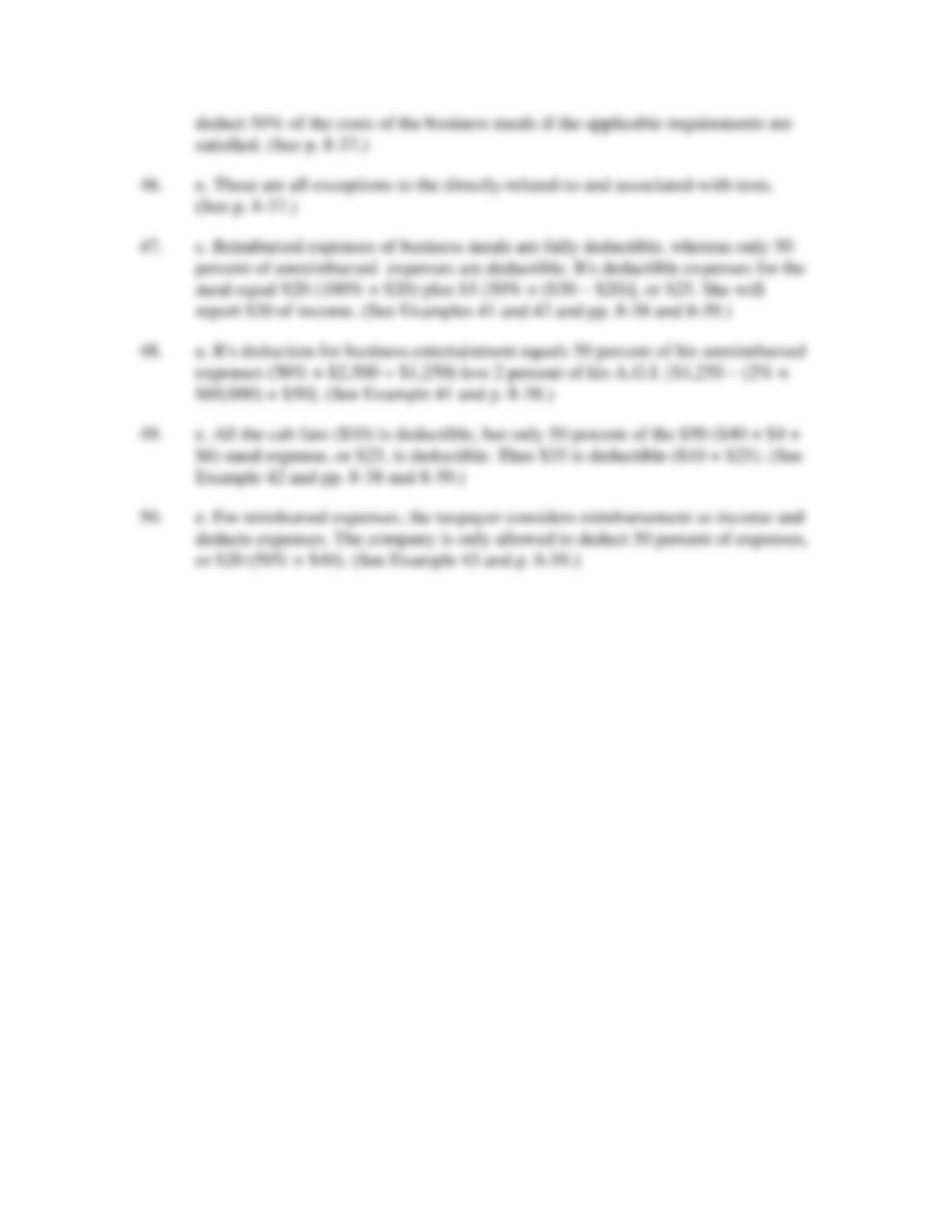
________ 46. In which case are expenses not deductible on account of the directly-
related-to and associated-with tests for entertainment expense?
a. Meal expense for client J and spouse at a business lunch
b. Cost of seven kegs of beer and 200 hot dogs for the annual company
picnic for employees and their families
c. Cost of wine and cheese to be distributed free to guests and
prospective buyers at a gallery opening
d. Cost of a two-week vacation trip to Hawaii for the company’s top
salesperson, who reports the value of the trip as taxable
compensation
e. All of the above are deductible.
________ 47. B is a computer systems analyst for IBM Corporation living and working
in Dayton, Ohio. During the year, she drove to Cincinnati to help C with
problems he was having on a recently purchased system. B spent the
night in Cincinnati and ate by herself, spending $30 for dinner including

$4 for a tip and $1 in tax. Under her per diem arrangement, she was
reimbursed $20 for her meal. B’s deduction, before application of the 2
percent of A.G.I. limitation for miscellaneous itemized deductions, is
a. $20
b. $24
c. $25
d. $28
e. $30
________ 48. R, an employee, spends $2,500 on business entertainment for which he is
not reimbursed. If his A.G.I. is $60,000 (assuming no other
miscellaneous itemized deductions), his deduction would be
a. $50
b. $100
c. $200
d. $800
e. None of the above
________ 49. At a business lunch to entertain a new client, J spent $40 for the meal, $4
tax, $6 tip, and $10 cab fare. Assuming he is not reimbursed, what is the
allowable deduction?
a. $0
b. $25
c. $30
d. $44
e. Some other amount
________ 50. After securing a large order of magic supplies, Q took his customer to
lunch. He paid $40, for which his company, Novelties, Inc., reimbursed
him. Which statement is true?
a. Q may deduct $20.
b. Q includes $40 as income and deducts the entire amount.
c. Novelties, Inc. may deduct $20.
d. Novelties, Inc. may deduct $40.
e. Both b. and c. are true.
8
Employee Business Expenses
Solutions to Test Bank
True or False
Multiple Choice