Chapter 8: Sarbanes-Oxley, Internal Control, and Cash
116.
Which of the following would not be included with the cash and cash equivalents on the balance sheet?
a.
commercial paper
b.
short-term receivables
c.
certificates of deposit
d.
money market mutual funds
117.
Pilger Corporation has cash on hand at year-end of $201,000 and a negative cash flow from operations of $144,000.
What is the ratio of cash to monthly cash expenses?
a.
12.0 months
b.
7.2 months
c.
1.4 months
d.
16.8 months
118.
During the year, Tempo Inc. has monthly cash expenses of $115,000. On December 31, its cash balance is
$1,437,500. The ratio of cash to monthly cash expenses is
a. 8.0
b. 12.5
c. 87.5
d. 11.5
Chapter 8: Sarbanes-Oxley, Internal Control, and Cash
119.
Identify each of the following as relating to (a) the control environment, (b) risk assessment, or (c)
control
procedures.
1.
Mandatory vacations
2.
Personnel policies
3.
Report of outside consultants on future market changes
120.
List the objectives of internal control and give an example of how each is implemented.
Chapter 8: Sarbanes-Oxley, Internal Control, and Cash
121.
You began your new job as the accountant at Bolivar Industries during the month of December. During your
first
month, you found several interesting issues.
1)
While looking through the invoices, you found Invoices 213–242, 245–271, and 275–290. It appears that
invoices
243, 244, 272, 273, and 274 are missing.
2)
During the month, Clerk # 3 issued $250 in refunds as compared to Clerks #1, #2, and #4 who issued less than
$50 each.
3)
The daily cash receipts and bank deposits reconcile, except on Tuesdays during the month.
4)
Business is generally brisk during the holiday season, but two weeks before Christmas there was a
sudden
increase in slow payments.
REQUIRED:
Part A: What kind of warning signs could be associated with these issues?
Part B: What control could you put in place regarding cash refunds mentioned in Part A (2)?
Chapter 8: Sarbanes-Oxley, Internal Control, and Cash
122.
Two features of internal control are presented in the following sections. Each is followed by a list of four
irregularities that occurred in processing data. Identify the one irregularity from each list that would be
discovered
or prevented by the feature of internal control described.
(a)
The sum of the balances of the accounts in the customer’s ledger is compared at the end
of
each month with the balance of the accounts receivable account in the general ledger
by a
person who has no responsibility for maintaining either the general ledger or the
customer’s
ledger.
(1)
Five hours of services were rendered but the customer was only billed for four hours.
(2)
A cash receipt of $750 was recorded correctly in the accounts receivable controlling
account but was posted to the customer’s ledger as $75.
(3)
A bill for services rendered to Cole Co. was erroneously posted to the account of
Coleman Co. in the customer’s ledger.
(4)
No entry was made in the accounting records for services rendered to a customer.
(b)
Both cash and credit charges for services rendered are recorded on prenumbered invoices.
At the end of the day, all invoices are accounted for before the duplicate copies of the
invoices are routed to the accounting department for entry into the accounts and the cash is
sent to the cashier’s department for deposit.
(1)
Some charge customers complained that the monthly statements of account did
not
add all amounts correctly.
(2)
Some clerks used incorrect hourly rates in preparing invoices.
(3)
Some clerks destroyed duplicate copies of cash invoices and misappropriated the cash.
(4)
Some charge customers complained that the monthly statement of account did
not
indicate credits for payments made.
Chapter 8: Sarbanes-Oxley, Internal Control, and Cash
123.
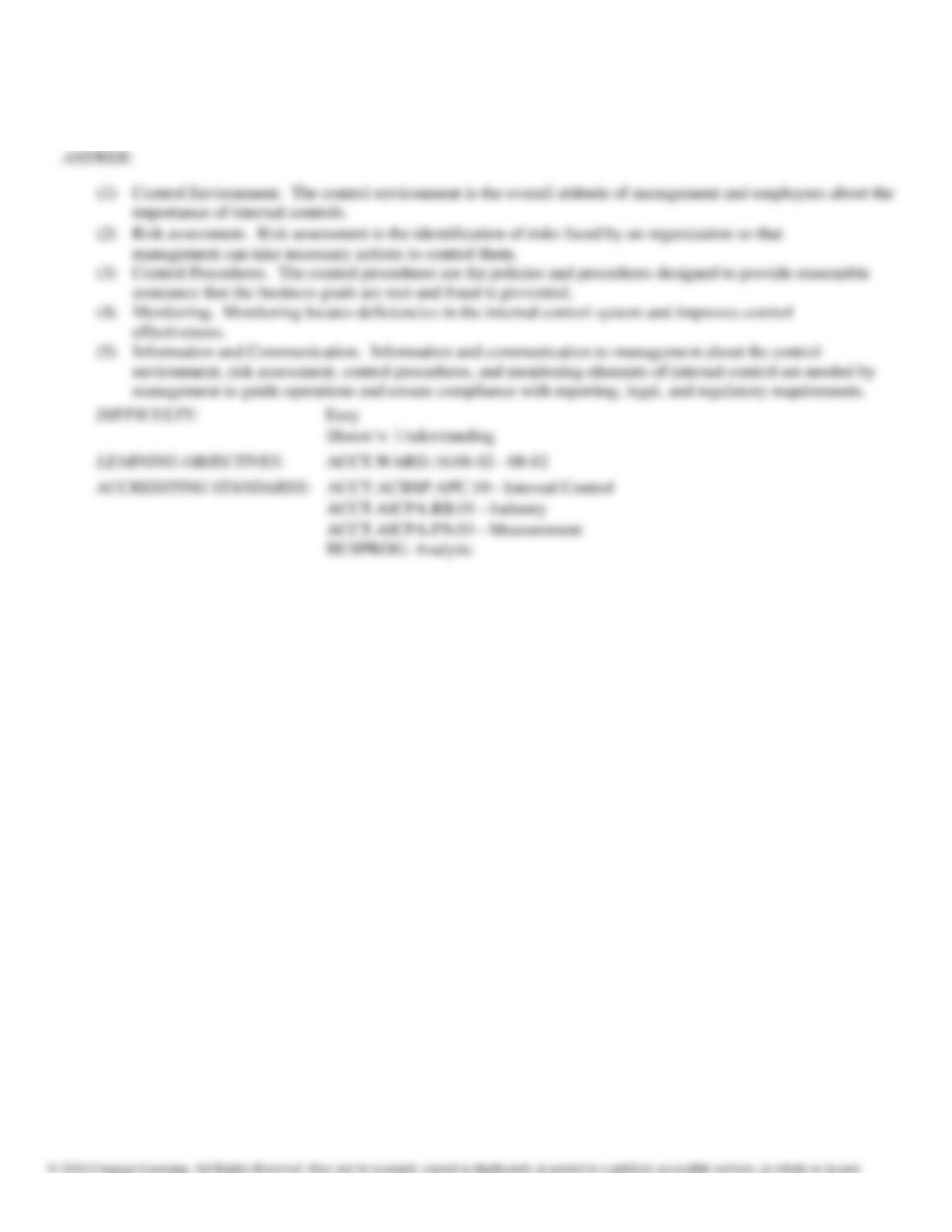
List and define each of the five elements of internal control.
Chapter 8: Sarbanes-Oxley, Internal Control, and Cash
124.
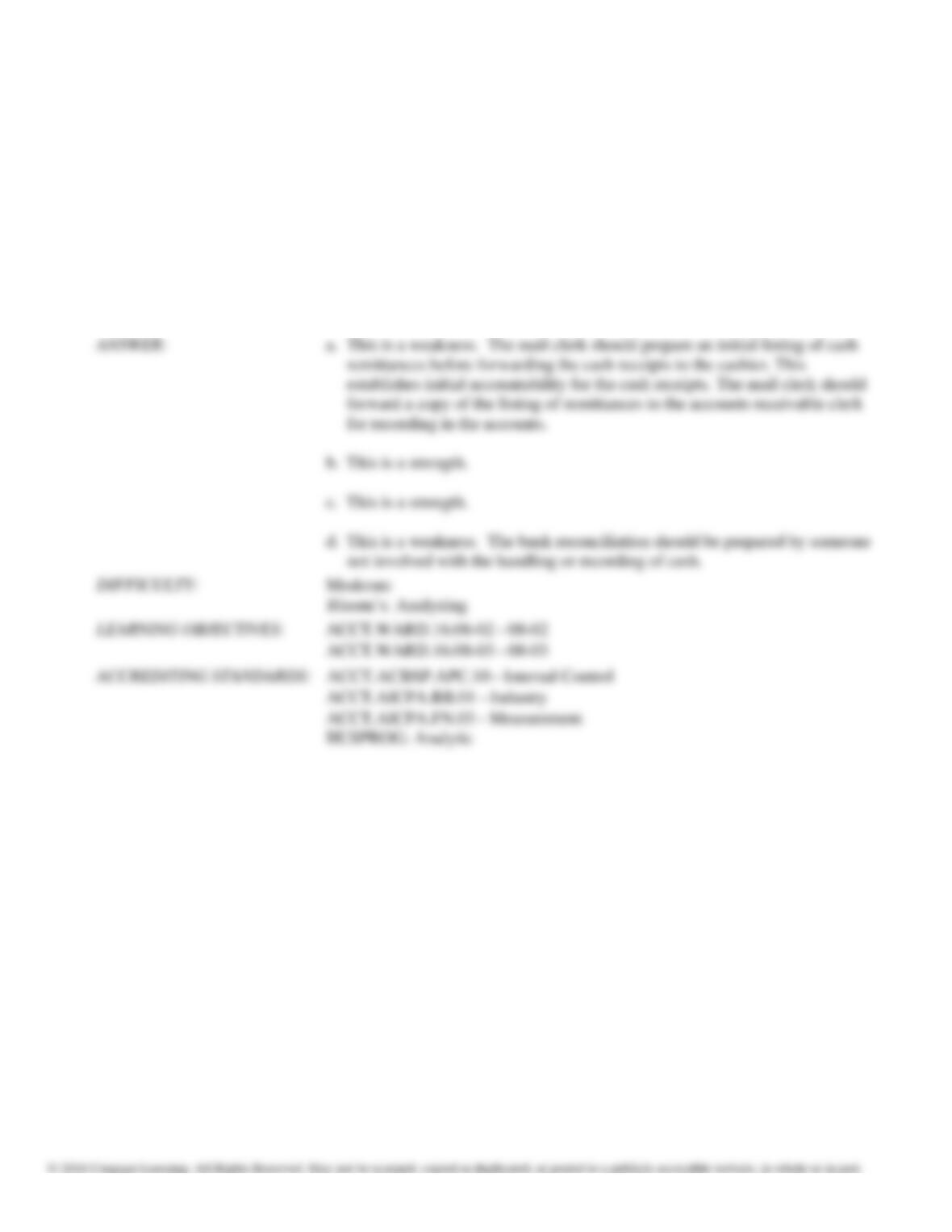
The following procedures were recently implemented at the Health Station, Inc. For each procedure, indicate
whether the internal control over cash represents (1) a strength or (2) a weakness. If it is a weakness, please
explain why.
(a)
All mail is opened by the mail clerk, who forwards all cash remittances to the cashier. The cashier prepares
a
listing of the cash receipts and forwards a copy of the list to the accounts receivable clerk for recording in
the accounts.
(b)
The accounts payable clerk prepares a voucher for each disbursement. The voucher along with the supporting
documentation is forwarded to the treasurer’s office for approval.
(c) At the end of each day, all cash receipts are placed in the bank’s night depository.
(d) The bank reconciliation is prepared by the cashier, who works under the supervision of the treasurer.
Chapter 8: Sarbanes-Oxley, Internal Control, and Cash
125.
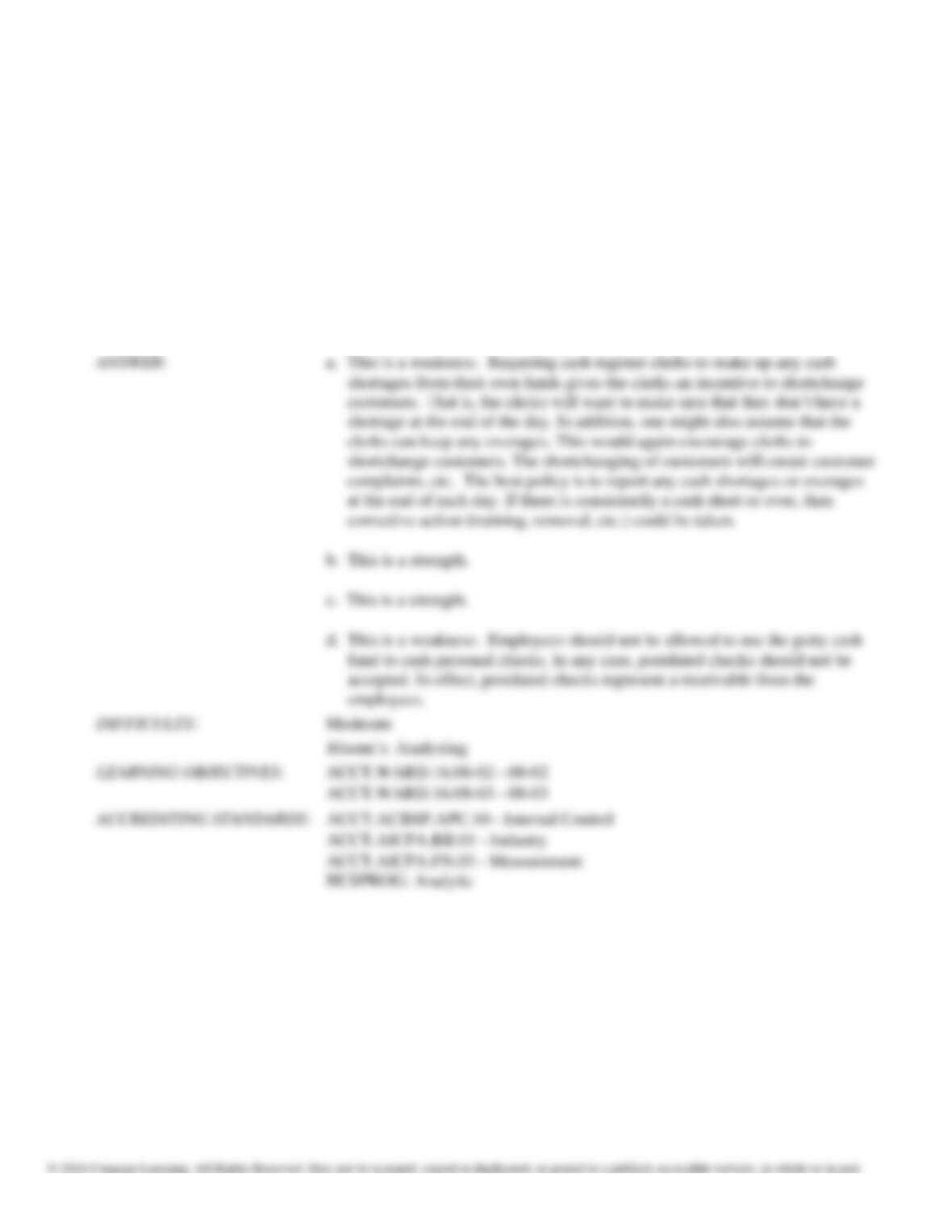
The following procedures were recently implemented at the Pampered Pets, Inc. For each procedure, indicate
whether the internal control over cash represents (1) a strength or (2) a weakness. If it is a weakness, please
explain why.
(a)
At the end of the day, cash register clerks are required to use their own funds to make up any cash shortages
in their registers.
(b)
At the end of the day, an accounting clerk compares the duplicate copy of the daily cash deposit slip with
the
deposit receipt obtained from the bank.
(c)
After necessary approvals have been obtained for the payment of a voucher, the treasurer signs and mails the
check. The treasurer then stamps the voucher and supporting documentation as paid and returns the voucher
and supporting documentation to the accounts payable clerk for filing.
(d)
Along with the petty cash receipts for postage, office supplies, etc., several postdated
employee
checks are in the petty cash fund.
Chapter 8: Sarbanes-Oxley, Internal Control, and Cash
126.
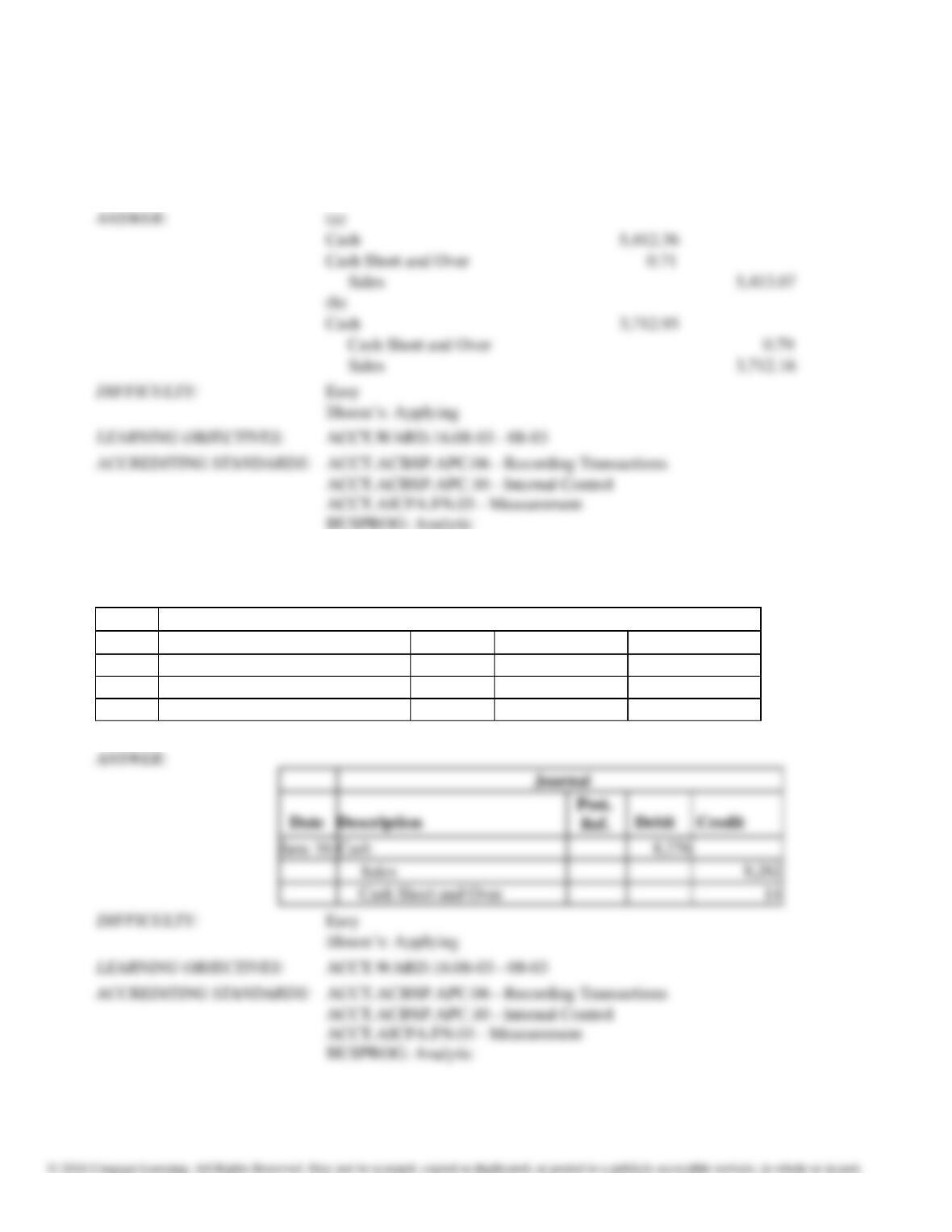
The following selected transactions relate to cash collections for a firm that maintains a $100 change fund at
all
times. Present entries to record the transactions for each of the two days of cash receipts from sales.
(a)
Actual cash in cash register, $5,412.36; cash receipts per cash register tally, $5,413.07.
(b)
Actual cash in cash register, $3,712.95; cash receipts per cash register tally, $3,712.16.
127.
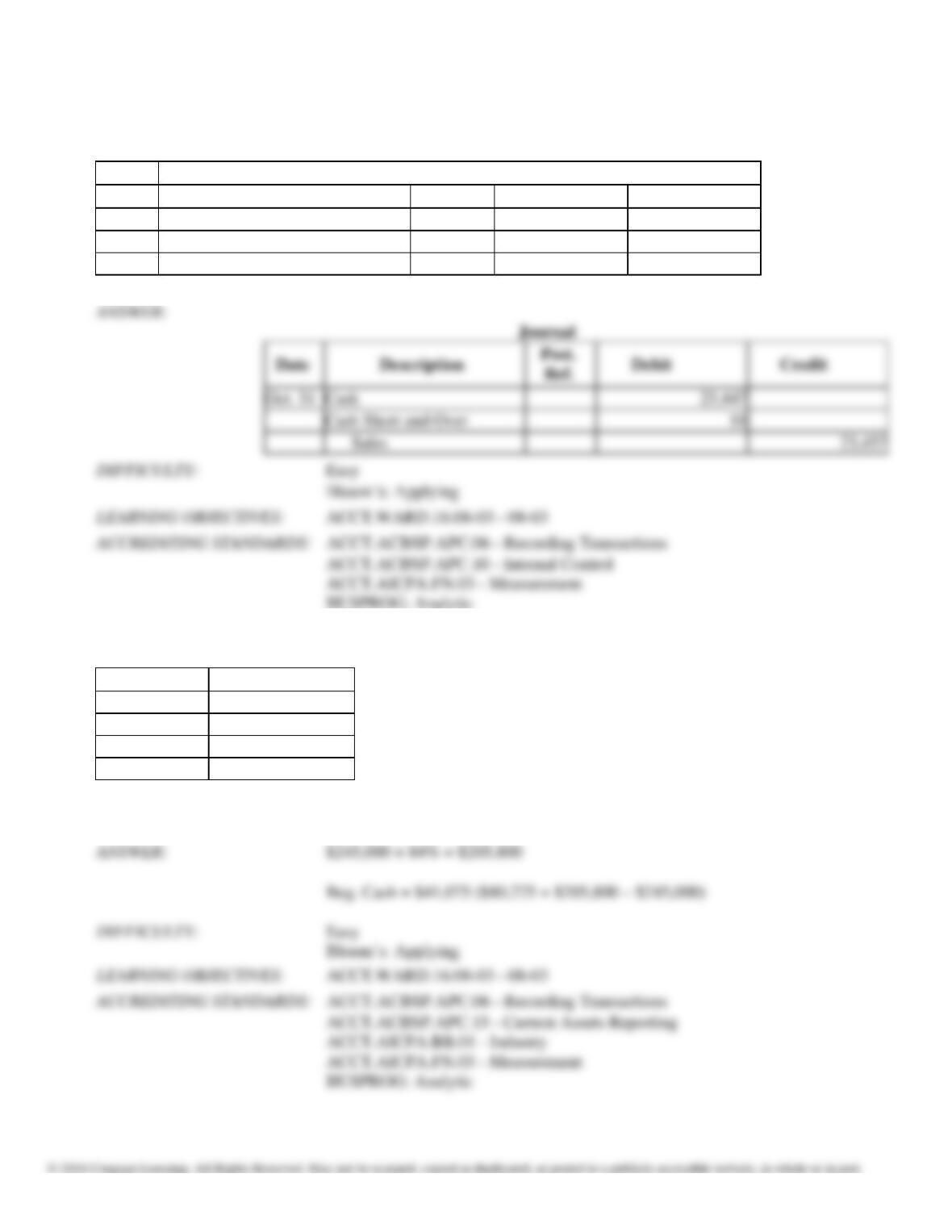
The actual cash received during the week ended June 6 for cash sales was $8,276 and the amount indicated by the
cash register total was $8,262. Journalize the entry to record the cash receipts and cash sales.
Journal
Date
Description
Post. Ref.
Debit
Credit
Chapter 8: Sarbanes-Oxley, Internal Control, and Cash
128.
The actual cash received during the week ended October 31 for cash sales was $23,447 and the amount indicated
by the cash register total was $23,457. Journalize the entry to record the cash receipts and cash sales.
Journal
Date
Description
Post. Ref.
Debit
Credit
129.
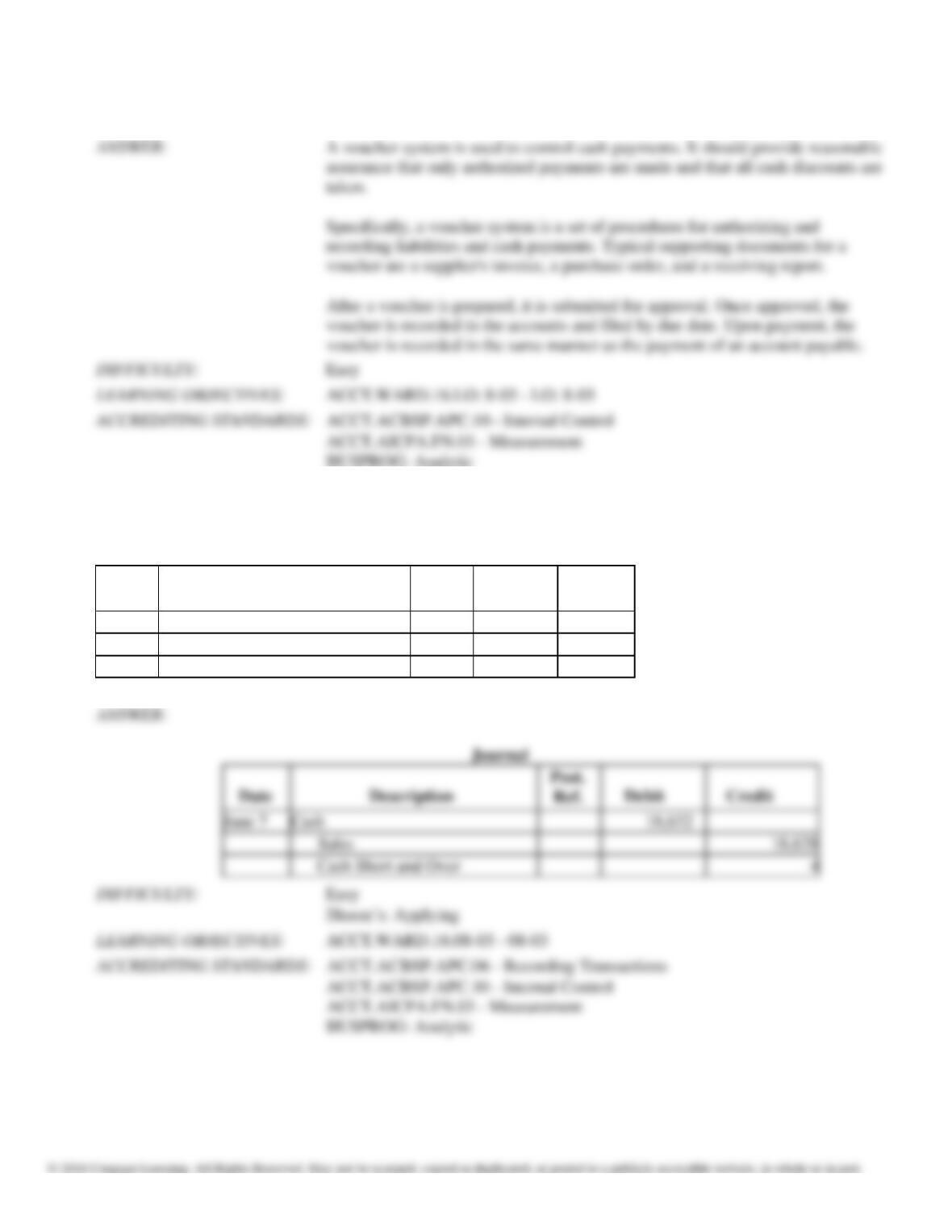
Consider the following information from the cash account. Assume cash payments were 84% of collections.
Cash
??
Beg. balance
$245,000
Collections
??
Disbursements
$80,275
End balance
How much was the beginning balance of the cash account?
Chapter 8: Sarbanes-Oxley, Internal Control, and Cash
130.
Describe the features of a voucher system and list typical supporting documents for a voucher.
131.
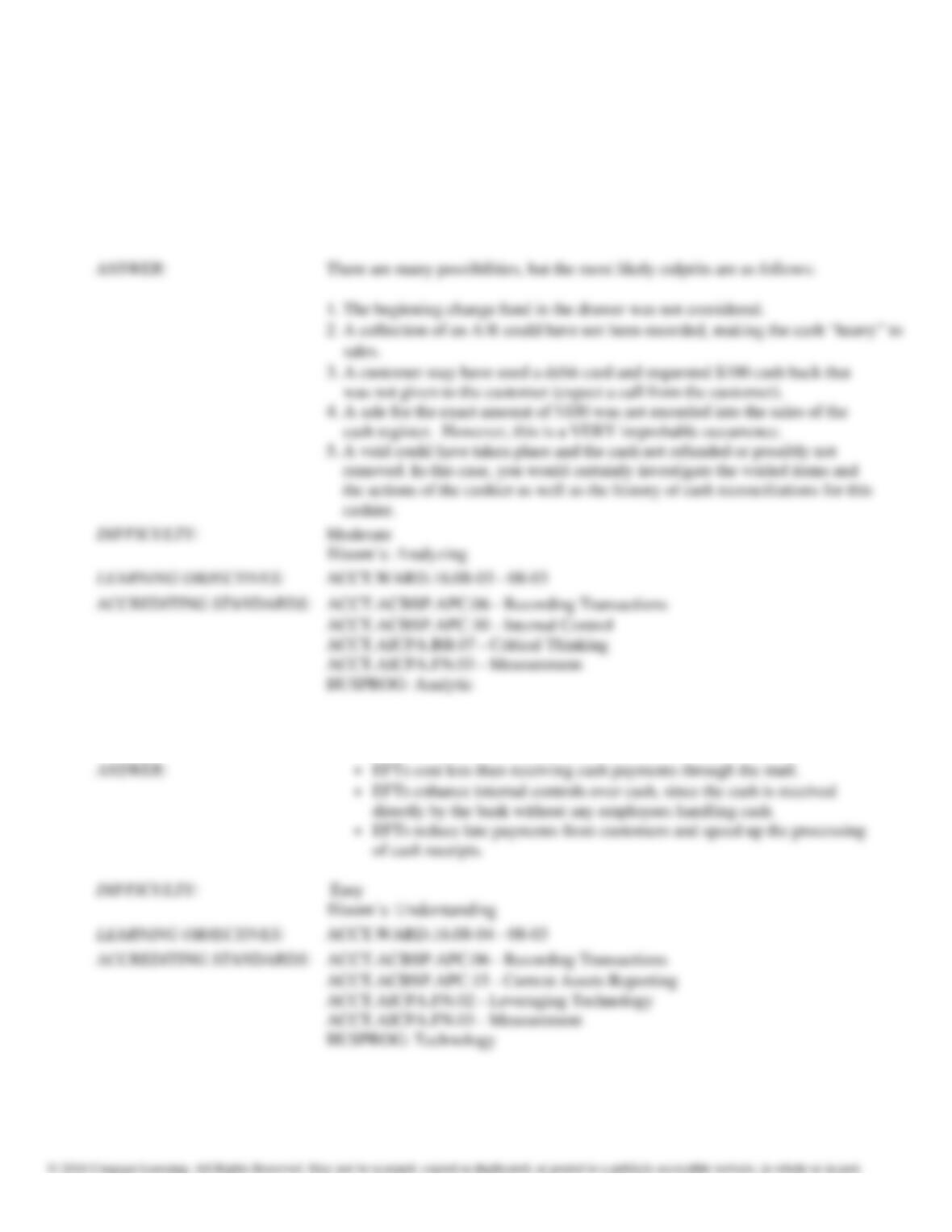
The actual cash received during the week ended June 7 for cash sales was $18,632, and the amount indicated by
the cash register total was $18,628. Journalize the entry to record the cash receipts and cash sales.
Journal
Date
Description
Post.
Ref.
Debit
Credit
Post.
Ref.
Credit
Chapter 8: Sarbanes-Oxley, Internal Control, and Cash
132.
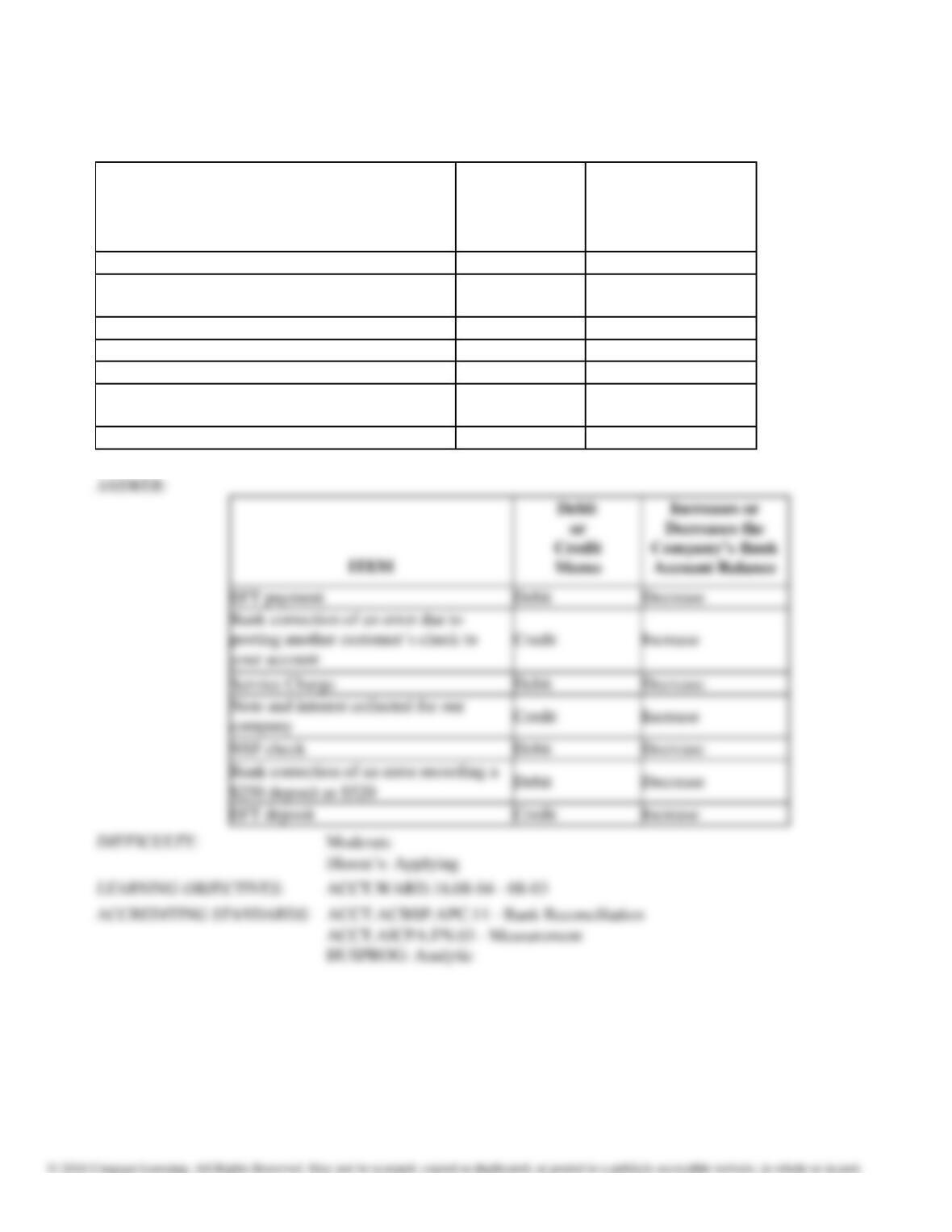
Consider the following journal entry made by Jones Company for one day‘s sales of a single cashier. Upon
investigation, what might you find happened to create this amount of Cash Over/Short account difference?
Give
three possible reasons for this difference.
Cash 2,235.00
Cash Short and Over 100.00
Sales 2,135.00
133.
List the principal advantages of electronic funds transfers.
Chapter 8: Sarbanes-Oxley, Internal Control, and Cash
134.
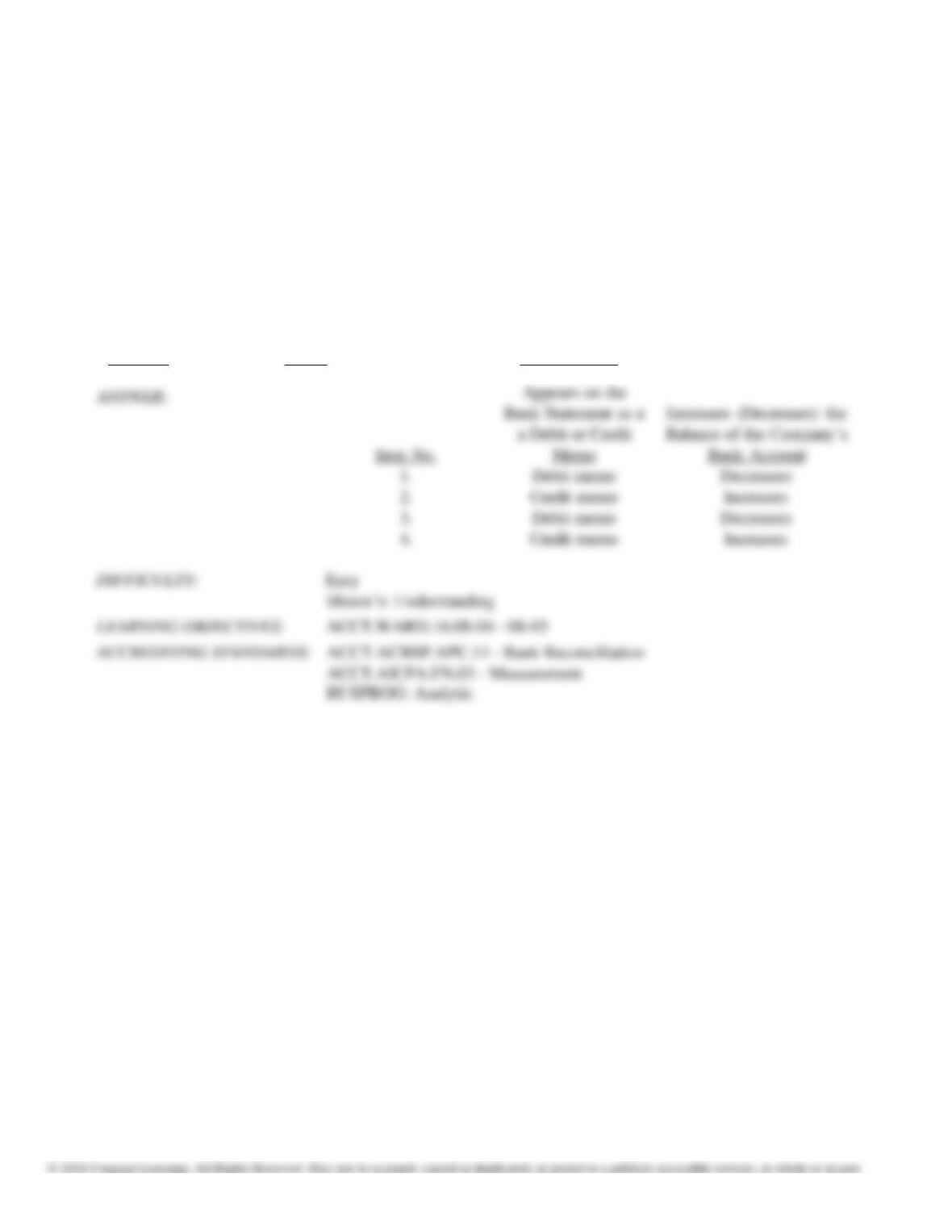
You are trying to explain debit and credit memos that appear on bank statements and whether these will increase or
decrease your company’s bank account balance. Complete the following table to help your new staff understand.
ITEM
Debit
or
Credit
Memo
Increases or
Decreases the
Company’s Bank
Account Balance
EFT payment
Bank correction of an error due to posting another
customer’s check to your account
Service charge
Note and interest collected for our company
NSF check
Bank correction of an error recording a $250
deposit
as $520
EFT deposit
Credit
Memo
EFT payment
Debit
Decrease
Service Charge
Debit
Decrease
Note and interest collected for our
NSF check
Debit
Decrease
Bank correction of an error recording a
EFT deposit
Credit
Increase
Chapter 8: Sarbanes-Oxley, Internal Control, and Cash
135.
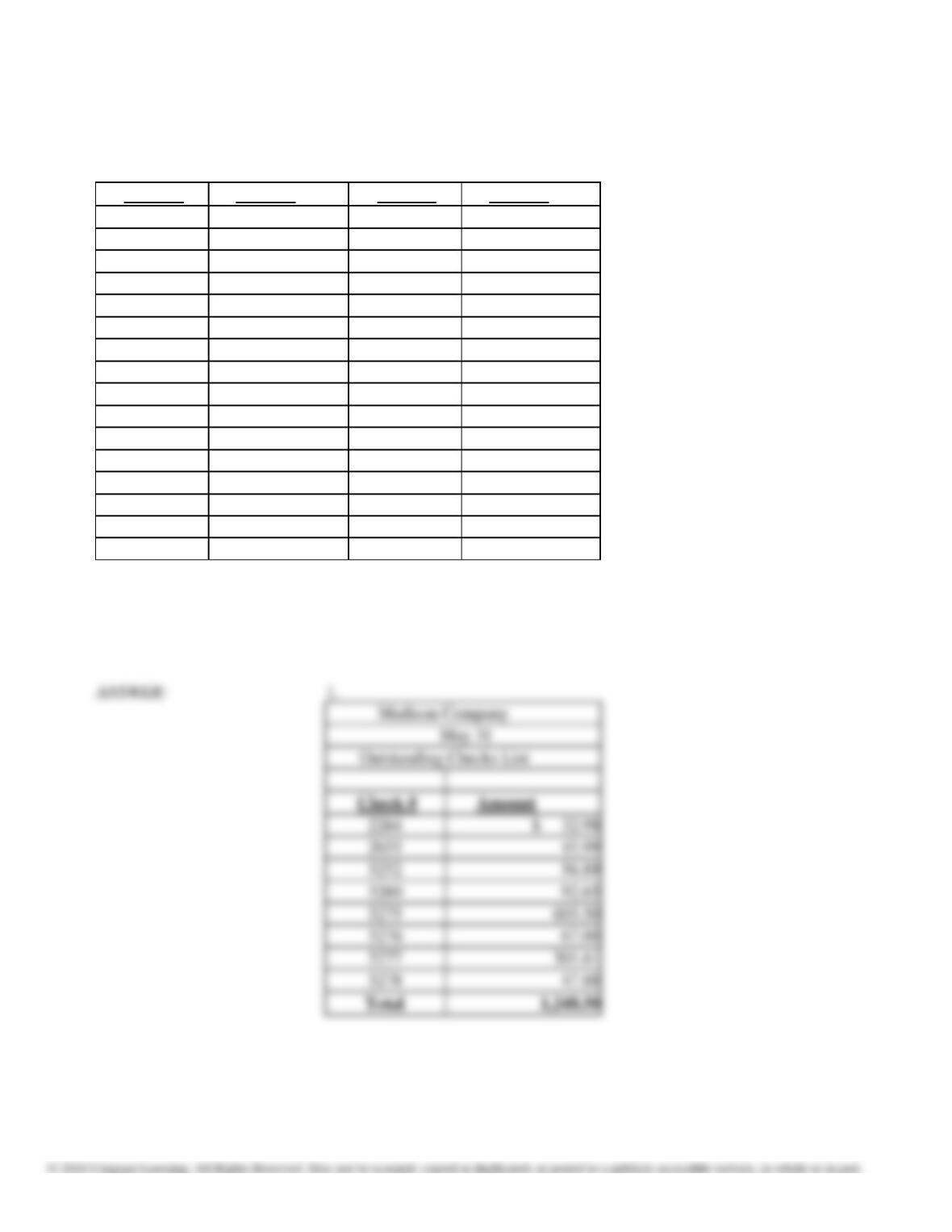
The following items may appear on a bank statement:
1.
NSF check
2.
EFT deposit
3.
Service charge
4.
Bank correction of an error from recording a $300 check as $30.
Indicate whether the item would appear as debit or credit memo on the bank statement and whether the item would
increase or decrease the balance of your account. Use the following format:
Appears on the
Bank Statement as a Increases (Decreases) the
a Debit or Credit Balance of the Company’s
Item No.
Memo
Bank Account
Chapter 8: Sarbanes-Oxley, Internal Control, and Cash
136.
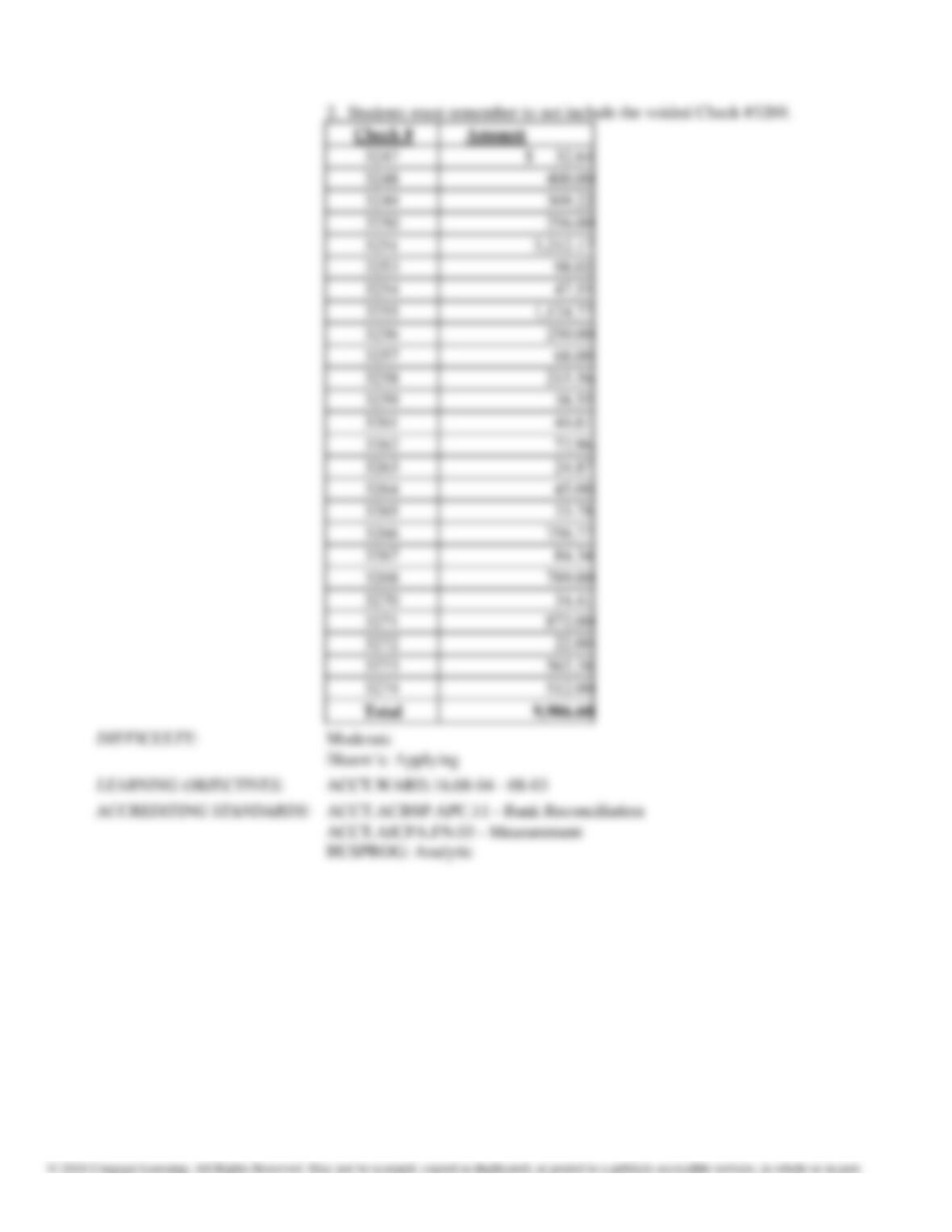
The following information is from Madison Corporation’s accounting records for May. Check #3269 was returned
as a double payment and voided. Checks that have not cleared the bank include #3252, #3260, and series #3275–
3278.
Check #
Amount
Check #
Amount
3247
$ 32.64
3263
$ 24.87
3248
400.00
3264
45.00
3249
309.22
3265
33.78
3250
256.00
3266
756.77
3251
3,212.17
3267
84.34
3252
56.89
3268
789.00
3253
98.02
3269
48.90
3254
47.55
3270
34.41
3255
1,124.77
3271
872.00
3256
250.00
3272
22.00
3257
68.00
3273
562.38
3258
215.56
3274
512.00
3259
38.55
3275
603.50
3260
92.65
3276
67.00
3261
44.61
3277
301.61
3262
72.96
3278
47.88
In addition to the above list of the checks, Madison had check #2264 for $32.98 and check #2655 for $45.99
outstanding previously that have not cleared.
1.
Create an outstanding checks list for Madison at the end of May.
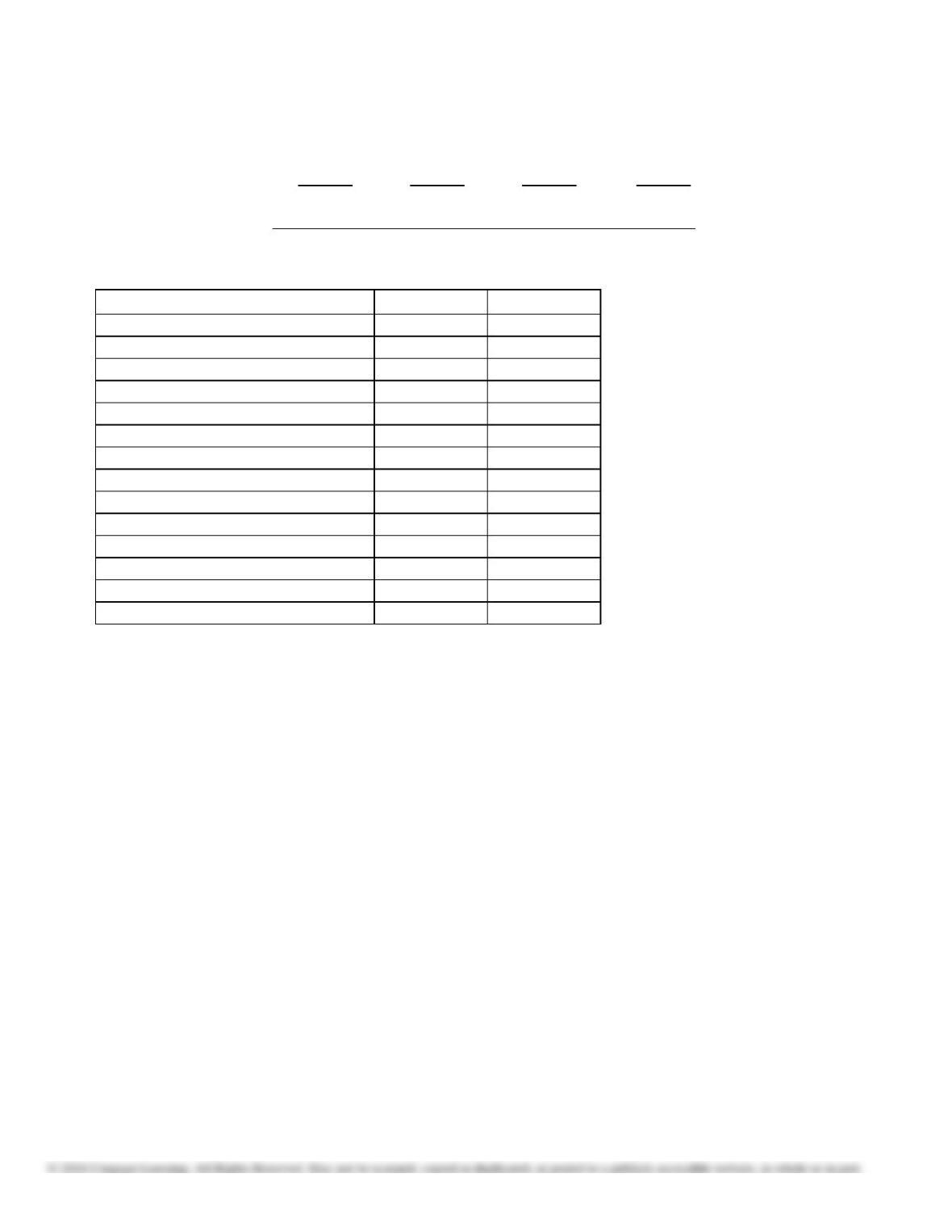
2.
What is the total amount of checks that cleared the bank (written in May)?
Chapter 8: Sarbanes-Oxley, Internal Control, and Cash
Chapter 8: Sarbanes-Oxley, Internal Control, and Cash
137.
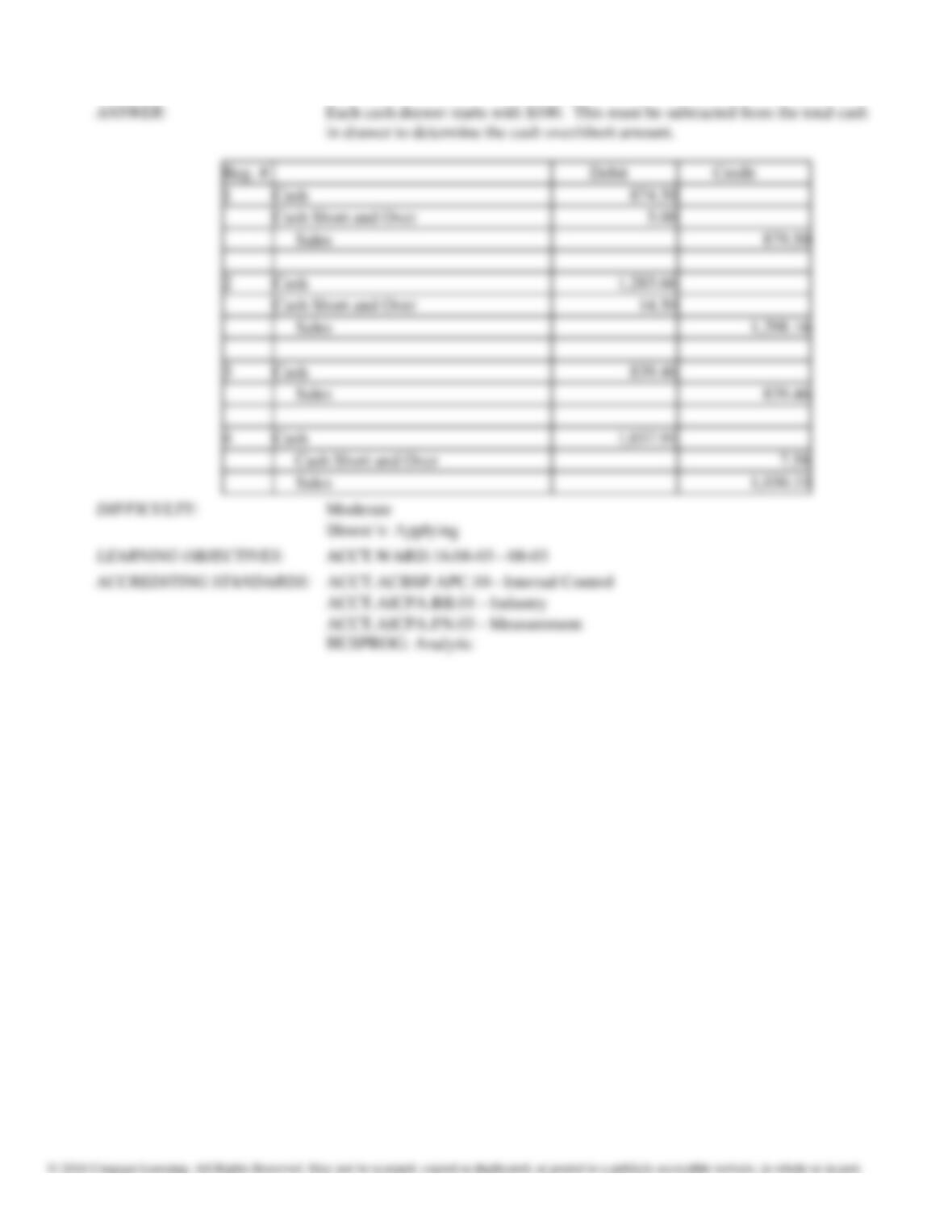
The Scharf Company is a retailer located in a state without sales tax. The following data was given to you to
complete the transactions for the day’s sales to be recorded. All cash drawers start with $100 in change.
Reg. #1 Reg. #2 Reg. #3 Reg. #4
Cash in drawer 974.50 1,383.66 939.46 1,137.91
Sales reading 879.50 1,298.16 839.46 1,030.33
Difference
Record the journal entries for EACH cash register to determine the cashier’s accuracy.
Account
Debit
Credit
Chapter 8: Sarbanes-Oxley, Internal Control, and Cash
Chapter 8: Sarbanes-Oxley, Internal Control, and Cash
138.
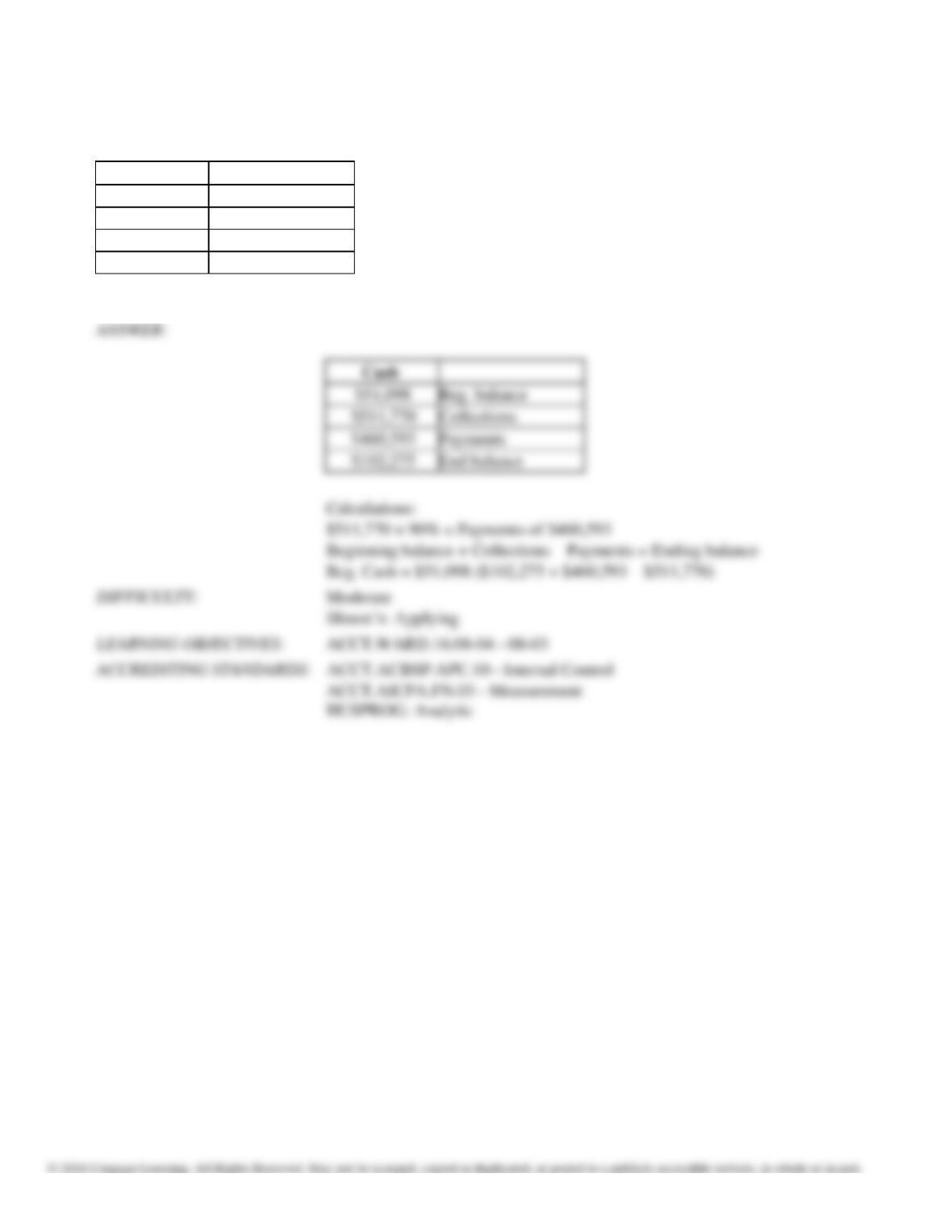
Jackson Industries has collected the following information but needs assistance completing the table. The
cash
payments were 90% of collections.
Cash
??
Beg. balance
$511,770
Collections
??
Payments
$102,275
End balance
How much was the beginning balance of the cash account?
Cash
$511,770
Collections
$102,275
End balance
Chapter 8: Sarbanes-Oxley, Internal Control, and Cash
139.
Identify each of the following reconciling items as (a) an addition to the cash balance according to the bank
statement, (b) deduction from the cash balance according to the bank statement, (c) an addition to the cash balance
according to the company’s records, or (d) a deduction from the cash balance according to the company’s records.
Assume that none of the transactions reported by bank debit and credit memos have been recorded by the
company. Also, indicate by writing “entry” by those items that will require a journal entry in the company’s
accounts.
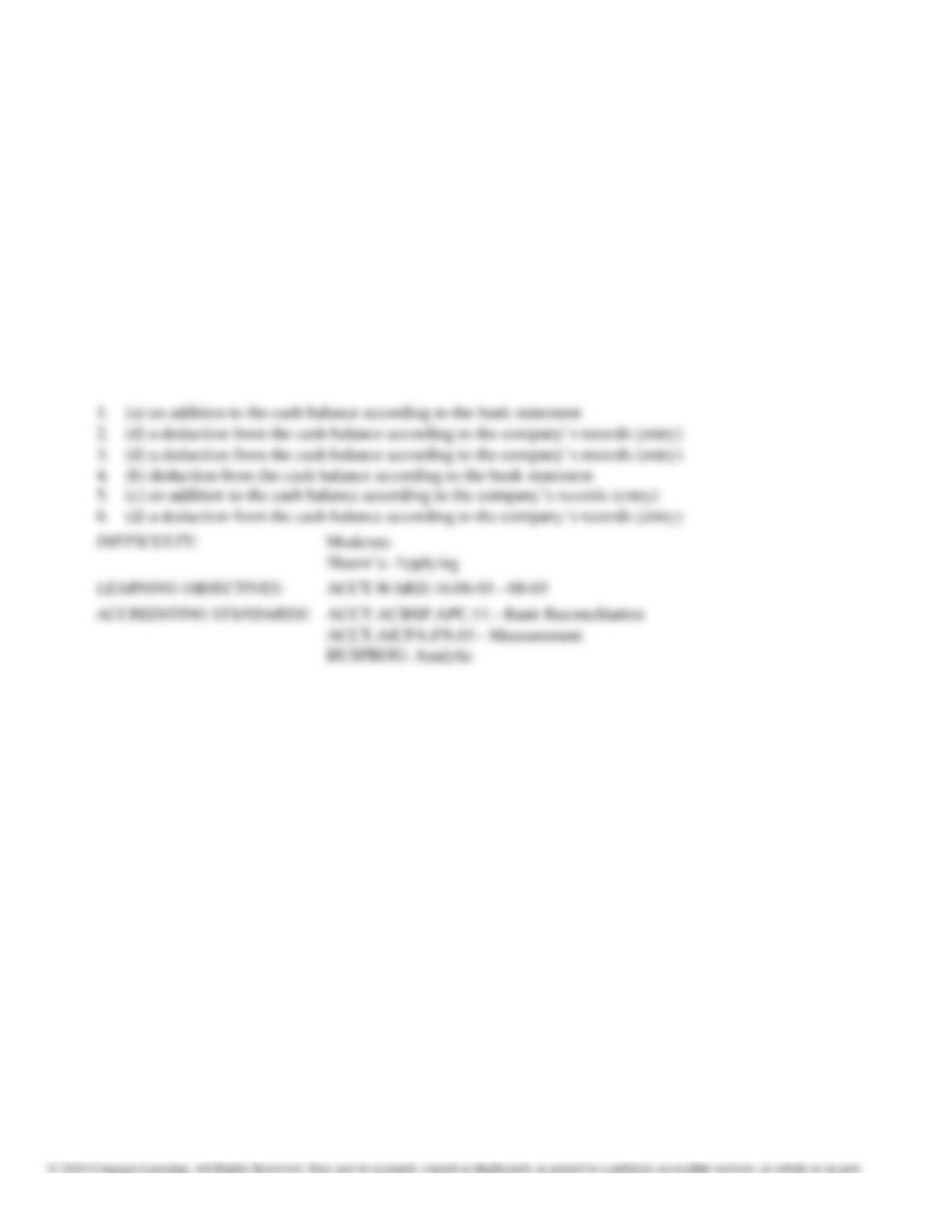
1.
Deposits in transit.
2.
Bank service charges.
3.
NSF check.
4.
Outstanding checks.
5.
Check for $690 incorrectly recorded by the company as $960.
6.
Check for $420 incorrectly recorded by the company as $240.
ANSWER:
Chapter 8: Sarbanes-Oxley, Internal Control, and Cash
140.
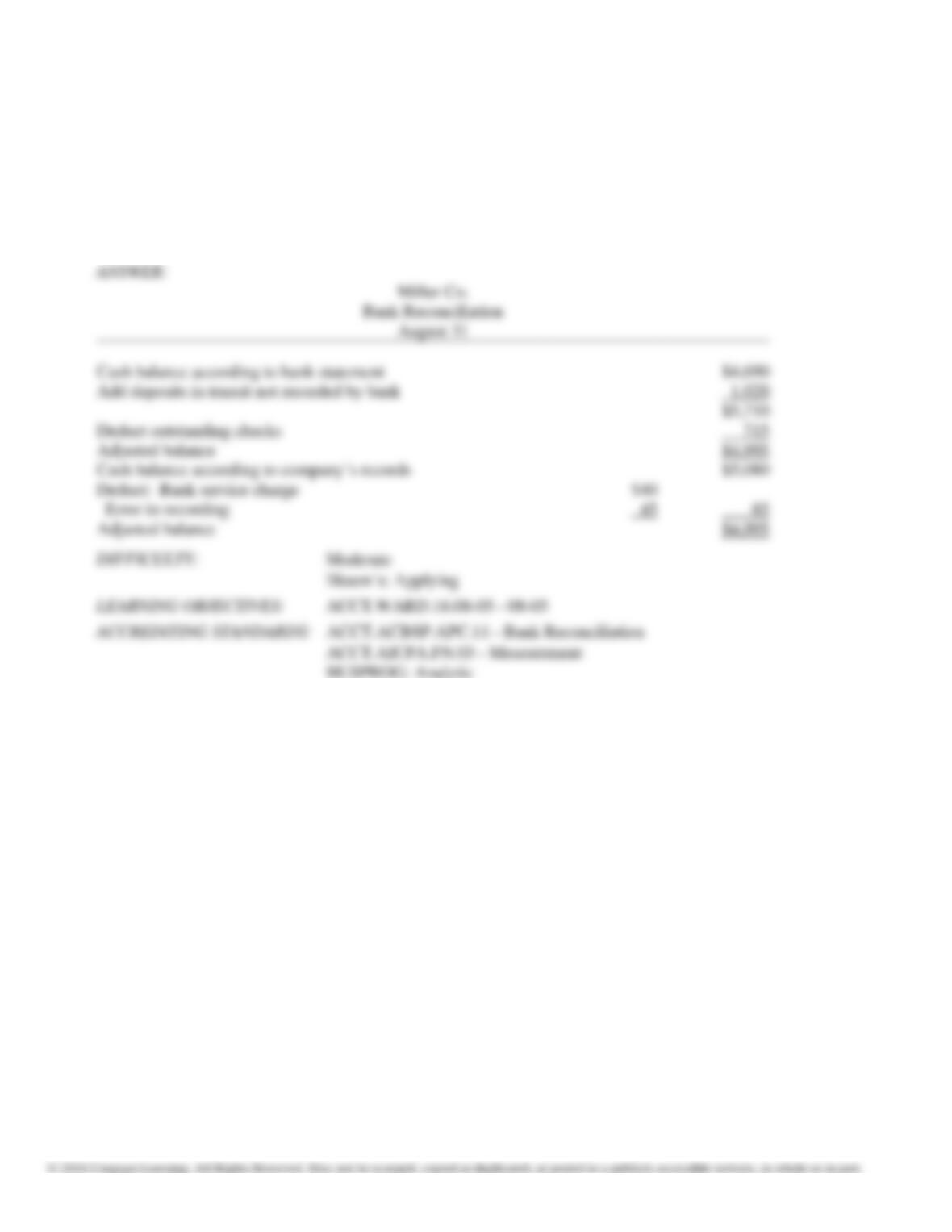
Using the following information, prepare a bank reconciliation for Miller Co. for August 31:
(a)
The bank statement balance is $4,690
(b)
The cash account balance is $5,080.
(c)
Outstanding checks amounted to $715.
(d)
Deposits in transit are $1,020.
(e)
The bank service charge is $40.
(f)
A check for $72 for supplies was recorded as $27 in the ledger.