CHAPTER 8—RISK AND RATES OF RETURN
TRUE/FALSE
1. If we develop a weighted average of the possible return outcomes, multiplying each outcome or
“state” by its respective probability of occurrence for a particular stock, we can construct a payoff
matrix of expected returns.
2. Market risk refers to the tendency of a stock to move with the general stock market. A stock with
above-average market risk will tend to be more volatile than an average stock, and it will have a
beta which is greater than 1.0.
3. A firm cannot change its beta through any managerial decision because betas are completely
market determined.
4. In the real world, the type of security that generates a return that is nearest to a risk-free rate of
return is a Treasury bill.
5. Risk is defined as the chance (probability) of actually observing outcomes that are less than
expected, or unfavorable. Outcomes that are greater than expected are not considered when
evaluating risk because such occurrences are desirable.
6. Risk is defined as the chance (probability) of actually observing outcomes that are greater than
expected, or favorable. Such outcomes are more desirable than observing less-than-expected
events, so the possibility that positive outcomes will occur must be emphasized when evaluating
risk.
7. Risk really should not be a significant factor when making financial decision because all business
decisions involve predictions about the future, which is unknown. As a result, all decisions
automatically include some consideration of risk.
8. Risk is indicated by variability, whether the variability is considered positive or negative. Both
the positive and negative outcomes must be evaluated when considering risk because all
unexpected possibilities should be examined, even the positive ones.
9. A listing of all possible outcomes, or events, with a probability assigned to each is called a
probability distribution.
158 Chapter 8 Risk and Rates of Return
10. The expected rate of return of an asset will always equal one of the possible rates of return for
that asset.
11. Because of differences in the expected returns of different securities, the standard deviation is not
always an adequate measure of risk. However, the coefficient of variation always will allow an
investor to properly compare the relative risks of any two securities.
12. Assume Stock A has a standard deviation of 0.21 while Stock B has a standard deviation of 0.10.
If both Stock A and Stock B must be held in isolation, and if investors are risk averse, we can
conclude that Stock A will have a greater required return. However, if the assets could be held in
portfolios, it is conceivable that the required return could be higher on the low standard deviation
stock.
13. The only condition under which risk can be reduced to zero is to find securities that are perfectly
negatively correlated (r = -1.0) with each other.
14. While the portfolio return is a weighted average of realized security returns, portfolio risk is not
necessarily a weighted average of the standard deviations of the securities in the portfolio. It is
this aspect of portfolios that allows investors to combine stocks and actually reduce the riskiness
of a portfolio.
15. If I know for sure that the market will have a positive return over the next year, to maximize my
rate of return, I should increase the beta of my portfolio.
16. The Y-axis intercept of the SML indicates the return on the individual asset when the realized
return on an average stock (beta = 1.0) is zero.
17. The tighter the probability distribution, the less variability there is and the less likely it is that the
actual outcome will be close to the expected value; consequently the more likely it is that the
actual return will be much different from the expected return.
18. The standard deviation is the weighted average of all the deviations from the expected value, and
it indicates how far above or below the expected value the actual value is expected to be.
19. Combining stocks with perfectly correlated stock returns into a portfolio is less risky than holding
an individual stock since the portfolio will benefit from diversification.
Chapter 8 Risk and Rates of Return 159
MULTIPLE CHOICE
1. Which of the following statements is correct?
a.
Risk refers to the chance that some unfavorable event will occur, and a probability
distribution is completely described by a listing of the likelihood of unfavorable events.
b.
Portfolio diversification reduces the variability of returns on an individual stock.
c.
When company specific risk has been diversified, the inherent risk that remains is market
risk which is constant for all securities in the market.
d.
A stock with a beta of -1.0 has zero systematic (or market) risk.
e.
The SML relates required returns to firms’ systematic (or market) risk. The slope and
intercept of this line cannot be controlled by the financial manager.
2. Choose the correct answer for the following: (1) Which is the best measure of risk for choosing
an asset which is to be held in isolation? (2) Which is the best measure for choosing an asset to be
held as part of a diversified portfolio?
a.
Variance; correlation coefficient.
b.
Standard deviation; correlation coefficient.
c.
Beta; variance.
d.
Coefficient of variation; beta.
e.
Beta; beta.
3. Which of the following statements is correct?
a.
If the returns on a stock could vary widely, and its standard deviation is large, then the
stock will necessarily have a large beta coefficient.
b.
A stock that is more highly positively correlated with “The Market” than most stocks
would not necessarily have a beta coefficient that is greater than 1.0.
c.
A stock’s standard deviation of returns is a measure of the stock’s “stand-alone” risk, while
its coefficient of variation measures its risk if the stock is held in a portfolio.
d.
A portfolio that contained 100 low-beta stocks would be riskier than a portfolio containing
100 high-beta stocks.
e.
Negative betas cannot exist; if you calculate one, you made an error.
4. Stock A has a beta of 1.5 and Stock B has a beta of 0.5. Which of the following statements must
be true about these securities? (Assume the market is in equilibrium.)
a.
When held in isolation, Stock A has greater risk than Stock B.
b.
Stock B would be a more desirable addition to a portfolio than Stock A.
c.
Stock A would be a more desirable addition to a portfolio than Stock B.
d.
The expected return on Stock A will be greater than that on Stock B.
e.
The expected return on Stock B will be greater than that on Stock A.

160 Chapter 8 Risk and Rates of Return
5. The Security Market Line (SML) relates risk to return, for a given set of financial market
conditions. If investors conclude that the inflation rate is going to increase, which of the
following changes would be most likely to occur?
a.
The market risk premium would increase.
b.
Beta would increase.
c.
The slope of the SML would increase.
d.
The required return of an average stock, KA = KM, would increase.
e.
None of the indicated changes would be likely to occur.
6. All else equal, risk averse investors generally require __________ returns to purchase
investments with __________ risks.
a.
higher; lower
b.
lower; higher
c.
higher; higher
d.
None of the above is correct.
7. According to the following information, which of the stocks would be considered riskiest in a
diversified portfolio of investments?
Stock
ABC
12.5%
1.0
FGH
8.0%
0.5
MNO
20.2%
2.4
TUV
15.3%
3.0
a.
Stock MNO, because it has the highest standard deviation.
b.
Stock TUV, because it has the highest beta.
c.
Stock FGH, because it has the highest s/b ratio
d.
Stock ABC, because its beta is the same as the market beta (1.0) and the market is always
very, very risky.
8. According to the capital asset pricing model, which of the following stocks should have the
highest required rate of return?
Stock Name
Standard Deviation
Beta
Alpha Automobiles
19.0%
1.8
Beta Electronics
28.0
1.1
Omega Foods
8.0
0.7
a.
Beta Electronics because its standard deviation is highest.
b.
Alpha Automobiles because its beta coefficient is highest.
c.
Omega foods because the ration of standard deviation/beta is the lowest.
d.
Not enough information is given to answer this question.

Chapter 8 Risk and Rates of Return 161
9. Which of the following statements is most correct?
a.
The required return on a firm’s common stock is determined by the firm’s systematic (or
market) risk. If its systematic risk is known, and if it is expected to remain constant, the
analyst has sufficient information to specify the firm’s required return.
b.
A security’s beta measures its nondiversifiable (systematic, or market) risk relative to that
of most other securities.
c.
If the returns of two firms are negatively correlated, one of them must have a negative
beta.
d.
A stock’s beta is less relevant as a measure of risk to an investor with a well-diversified
portfolio than to an investor who holds only one stock.
e.
Statements b and c are both correct.
10. You have developed the following data on three stocks:
Stock
Standard Deviation
Beta
A
0.15
0.79
B
0.25
0.61
C
0.20
1.29
If you are a risk minimizer, you should choose Stock __________ if it is to be held in isolation
and Stock __________ if it is to be held as part of a well-diversified portfolio.
a.
A; A
b.
A; B
c.
B; A
d.
C; A
e.
C; B
11. Which of the following statements is false?
a.
The coefficient of variation is a better measure of risk than the standard deviation if the
expected returns of the securities being compared differ significantly.
b.
Managers cannot act in the best interests of their shareholders unless they know their
shareholders’ average time preference for receiving their money and what risks a typical
shareholder is prepared to assume.
c.
Companies should deliberately increase their risk relative to the market only if the actions
that increase the risk also increase the expected rate of return on the firm’s assets by
enough to completely compensate for the higher risk.
d.
If the expected rate of return for a particular investment, as seen by the marginal investor,
exceeds its required rate of return, we should soon observe an increase in demand for the
investment, and the price will likely increase until a price is established that equates the
expected return with the required return.
e.
All of the above statements are correct.
162 Chapter 8 Risk and Rates of Return
12. Which of the following statements is most correct?
a.
If you add enough randomly selected stocks to a portfolio, you can completely eliminate
all the market risk from the portfolio
b.
If you formed a portfolio which included a large number of low beta stocks (stocks with
betas less than 1.0 but greater than -1.0), the portfolio would itself have a beta coefficient
that is equal to the weighted average beta of the stocks in the portfolio, so the portfolio
would have a relatively low degree of risk.
c.
If you were restricted to investing in publicly traded common stocks, yet you wanted to
minimize the riskiness of your portfolio as measure by its beta, then, according to the
CAPM theory, you should invest some of your money in each stock in the market, i.e., if
there were 10,000 traded stocks in the world, the least risky portfolio would include some
shares in each of them.
d.
Company specific (or unsystematic) risk can be eliminated by forming a large portfolio,
but normally even highly diversified portfolios are subject to market (or systematic) risk.
e.
Statements b and d are both correct.
13. In a portfolio of three different stocks, which of the following could not be true?
a.
The riskiness of the portfolio is less than the riskiness of each of the stocks if they were
held in isolation.
b.
The riskiness of the portfolio is greater than the riskiness of one or two of the stocks.
c.
The beta of the portfolio is less than the beta of each of the individual stocks.
d.
The beta of the portfolio is greater than the beta of one or two of the individual stock’s
betas.
e.
None of the above (i.e., they all could be true, but not necessarily at the same time).
14. Which of the following statements is most correct?
a.
A portfolio with a beta of minus 2 has the same degree of risk to the holder, relative to the
market, as a portfolio with a beta of plus 2. However the holder of either portfolio could
lower his or her exposure by buying some “normal” stocks.
b.
A stock with a beta of –1.0 has zero systematic (or market) risk.
c.
It is possible for a stock to have a positive beta even in situations where the correlation
between the returns on it and those on another stock are negative.
d.
Diversifiable risk, which is measured by beta, can be lowered by adding more stocks to a
portfolio.
e.
Statements a and c are both correct.
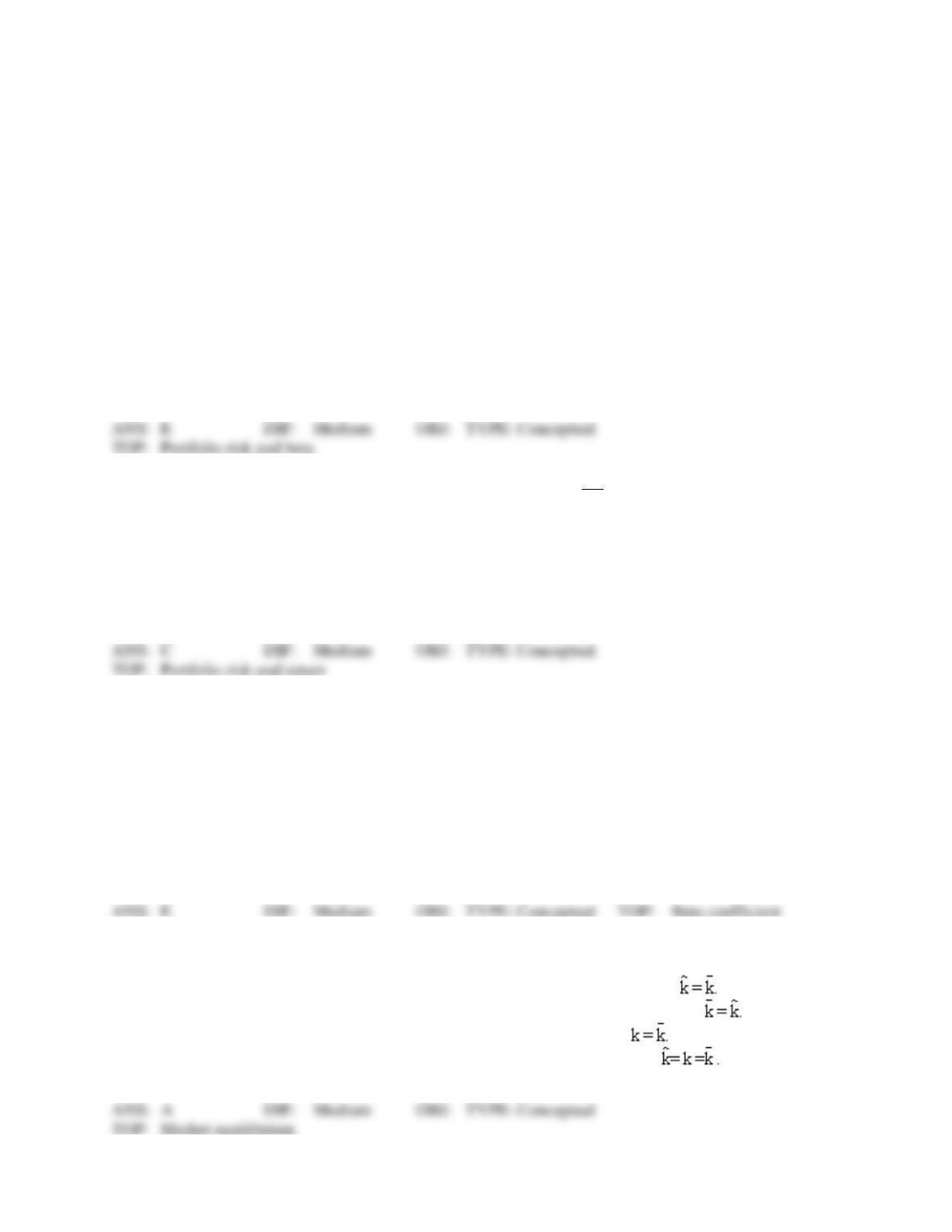
15. For markets to be in equilibrium, that is, for there to be no strong pressure for prices to depart
from their current levels,
a.
The expected rate of return must be equal to the required rate of return; that is,
b.
The past realized rate of return must be equal to the expected rate of return; that is
c.
The required rate of return must equal the realized rate of return; that is
d.
All three of the above statements must hold for equilibrium to exist; that is,
e.
None of the above statements are correct.
Chapter 8 Risk and Rates of Return 163
16. Which of the statements is most correct?
a.
Suppose the returns on two stocks are negatively correlated. One has a beta of 1.2 as
determined in a regression analysis, while the other has a beta of -0.6. The returns on the
stock with the negative beta will be negatively correlated with returns on most other stocks
in the market.
b.
Suppose you are managing a stock portfolio, and you have information which leads you to
believe that the stock market is likely to be very strong in the immediate future, i.e., you
are confident that the market is about to rise sharply. You should sell your high beta stocks
and buy low beta stocks in order to take advantage of the expected market move.
c.
In a recent issue, The Wall Street Journal ran a story on a company named Collections
Inc., which is in the business of collecting past due accounts for other companies, i.e., it is
a collections agency. According to the Journal, Collections’ revenues, profits, and stock
price tend to rise during recessions. This suggests that Collection Inc.’s beta should be
quite high, say 2.0, because it does so much better than most companies when the
economy is weak.
d.
Statements a and b are both true.
e.
Statements a and c are both true.
17. Which of the following is not a difficulty concerning beta and its estimation?
a.
Sometimes a security or project does not have a past history which can be used as a basis
for calculating beta.
b.
Sometimes, during a period when the company is undergoing a change such as toward
more leverage or riskier assets, the calculated beta will be drastically different than the
“true” or “expected future” beta.
c.
The beta of an “average stock,” or “the market,” can change over time, sometimes
drastically.
d.
Sometimes the past data used to calculate beta do not reflect the likely risk of the firm for
the future because conditions have changed.
e.
All of the above are potentially serious difficulties.
18. Which of the following statements is correct?
a.
If the returns from two stocks are perfectly positively correlated (i.e., the correlation
coefficient is +1) and the two stocks have equal variance, an equally weighted portfolio of
the two stocks will have a variance whish is less than that of the individual stocks.
b.
If a stock has a negative beta, its expected return must be negative.
c.
According to the CAPM, stocks with higher standard deviations of returns will have
higher expected returns.
d.
A portfolio with a large number of randomly selected stocks will have less market risk
than a single stock with has a beta equal to 0.5.
e.
None of the above statements are correct.
164 Chapter 8 Risk and Rates of Return
19. Other things held constant, (1) if the expected inflation rate decreases, and (2) investors become
more risk averse, the Security Market Line would shift
a.
Down and have steeper slope.
b.
Up and have less steep slope.
c.
Up and keep same slope.
d.
Down and keep same slope.
e.
Down and have less steep slope.
20. Which of the following statements is most correct?
a.
An increase in expected inflation could be expected to increase the required return on a
riskless asset and on an average stock by the same amount, other things held constant.
b.
A graph of the SML would show required rates of return on the vertical axis and standard
deviations of returns on the horizontal axis.
c.
If two “normal” or “typical” stocks were combined to form a 2-stock portfolio, the
portfolio’s expected return would be a weighted average of the stocks’ expected returns,
but the portfolio’s standard deviation would probably be greater than the average of the
stocks’ standard deviations.
d.
If investors became more averse to risk, then (1) the slope of the SML would increase and
(2) the required rate of return on low-beta stocks would increase by more than the required
return on high-beta stocks.
e.
The CAPM has been thoroughly tested, and the theory has been confirmed beyond any
reasonable doubt.
21. Which of the following statements is most correct?
a.
If beta doubles, the required return doubles.
b.
If a stock has a negative beta, its required return is negative.
c.
Higher beta stocks have more company-specific risk, but do not necessarily have more
market risk.
d.
If a portfolio’s beta increases from 1.2 to 1.5, its required rate of return will increase by an
amount equal to its market risk premium.
e.
If two stocks have the same standard deviation and the correlation coefficient between the
returns of two stocks equals zero, an equally weighted portfolio of the two stocks will
have a standard deviation lower than that of individual stocks.
Chapter 8 Risk and Rates of Return 165
22. Assume you are considering combining two investments to form a portfolio and you are very
concerned with the risk that will result from the combination. If you want to attain the greatest
effect from diversification, you would prefer that the assets are __________ related.
a.
negatively
b.
positively
c.
not
d.
The relationship between the two investments gives no indication of the diversification
effect that will result by combining them to form a portfolio.
e.
Diversification is not an important factor in investment decisions.
23. __________ is a measure of total risk, whereas __________ is a measure of systematic risk.
a.
Standard deviation; beta
b.
Beta; standard deviation
c.
Standard deviation; variance
d.
Coefficient of variation; standard deviation
e.
None of the above is correct.
24. If a stock has a beta coefficient, , equal to 1.20, the risk premium associated with the market is 9
percent, and the risk-free rate is 5 percent, application of the capital asset pricing model indicates
the appropriate return should be __________.
a.
9.8%
b.
14%
c.
5%
d.
15.8%
e.
None of the above is correct.
25. Stock X has = 4.0, which means that it is considered four times riskier than the average stock,
or the stock market as a whole. According to the capital asset pricing model, Stock X should earn
a.
a total return that is four times greater than the market return, that is, kX = 4 kM.
b.
a risk premium that is four times greater than the market risk premium—that is, RPX = 4
RPM, which means that kX B kRF = 4 (kM B kRF).
c.
a return that is less than the market return (kM) because, all else equal, the high risk
associated with Stock X will cause its value to decrease.
d.
the risk-free rate of return (kRF).
e.
None of the above is correct.

166 Chapter 8 Risk and Rates of Return
26. Sharon Stonewall currently has an investment portfolio that contains 10 stocks that have a total
value equal to $160,000. The portfolio has a beta () equal to 1.0. Sharon wants to invest an
additional $40,000 in a stock with = 2.0. After Sharon adds the new stock to her portfolio, what
will be the portfolio’s beta?
a.
1.2
b.
1.5
c.
2.0
d.
Not enough information is given to compute the portfolio’s beta ().
e.
None of the above is correct.
27. Assume the risk-free rate of return (kRF) is 5 percent, the market risk premium (RPM) is 8 percent,
and an investment exists that has a beta () equal to 1.5. According to the Capital Asset Pricing
Model (CAPM), which of the following statements is correct?
a.
The risk premium associated with the investment would be 12 percent.
b.
The appropriate rate of return for the investment is 9.5 percent.
c.
All investments that have betas less than 1.0 must earn a total rate of return less than 8
percent.
d.
There is not enough information to answer this question.
e.
None of the above is a correct statement.
28. Given the following information, compute the standard deviation for Investment A:
Investment A
Payoff
Probability
20%
0.5
10%
0.4
−10%
0.1
= 13.0%
a.
85.0%
b.
5.0%
c.
9.0%
d.
17.%
e.
None of the above are correct.
29. Based on the information given below, which of the investments would be considered best based
on its risk and return relationship? Assume all investors are risk-averse and the investments will
be held in isolation, not in a portfolio.
Investment
D
E
F
Expected return,
10.0%
18.0%
18.0%
Standard deviation,
7.0%
12.0%
20.0%

Chapter 8 Risk and Rates of Return 167
a.
D, because its total risk is lowest.
b.
E, because its coefficient of variation is lowest.
c.
F, because its standard deviation, , is highest.
d.
E and F, because the have the same expected return, .
e.
None of the above.
30. Steve Brickson currently has an investment portfolio that contains four stocks with a total value
equal to $80,000. The portfolio has a beta () equal to 1.4. Steve wants to invest an additional
$20,000 in a stock that has = 2.4. After Steve adds the new stock to his portfolio, what will be
the portfolio’s beta?
a.
1.6
b.
1.9
c.
2.0
d.
Not enough information is given to compute the portfolio’s beta ().
e.
None of the above is correct.
31. Stock Q has a beta () equal to 1.6 and Stock P has a beta equal to 0.8. Based on this information,
according to the capital asset pricing model (CAPM), which of the following statements is
correct?
a.
The required rate of return for Stock Q, kQ, should be 1.6 times greater than the required
rate of return for Stock P, kP.
b.
The risk premium associated with Stock Q, RPQ, should be 1.6 times greater than the risk
premium associated with Stock P, RPP.
c.
The required rate of return for Stock Q, kQ, should be two times greater than the required
rate of return for Stock P, kP.
d.
The risk premium associated with Stock Q, RPQ, should be two times greater than the risk
premium associated with Stock P, RPP.
e.
None of the above is a correct answer.
32. Given the following information, compute the coefficient of variation for Cyber Soda, Inc.:
Probability
Return
0.2
2.0%
0.3
12.0%
0.5
5.0%
a.
3.78
b.
0.58
c.
0.00
d.
1.72
e.
None of the above is correct.