
Chapter 8—Cash Flow and Capital Budgeting
MULTIPLE CHOICE
1. For the recently completed fiscal year, Royal Tees Inc. produced net income of $ni, had a depreciation
expense of $d, total cost of goods sold were $cogs, and taxes paid of $t. Given this information, the
cash flow generated was:
a.
$ans1
b.
$ans2
c.
$ans3
d.
$ans4
e.
none of the above
2. When measuring the inflows and outflows of a firm’s operations for capital budgeting decisions,
accountants and financial analysts differ in their focus because:
a.
accountants want to reflect the state of the firm at a given point in time and therefore
concentrate only on inflows and outflows in the current period
b.
financial analysts are concerned with tax implications whereas accountants only evaluate
pretax book values on an accrual basis
c.
financial analysts measure all cash flows for the firm whereas accountants measure only
the flows which will be recorded on financial statements
d.
financial analysts are concerned with incremental after-tax cash flows, whereas
accountants measure cash flows on an accrual basis
e.
accountants focus on the change in net income from undertaking a particular investment,
whereas financial analysts measure incremental changes in profit
3. The acronym MACRS stands for:
a.
Modified Accelerated Curve Residual System
b.
Modified Accelerated Curve Resource Source
c.
Most Accelerated Cost Residual System
d.
Modified Accelerated Cost Recovery System
e.
None of the above
4. Given the following information with regard to a proposed project:
Inventory increase of $Invent
Cash falls by $Cashfall
Depreciation increases by $d
Accounts payable increase by $accpay
Accounts receivable increase by $accpay
The working capital investment required for this project is:
a.
$ans1
b.
$ans2
c.
$ans3

d.
$ans4
e.
none of the above
5. Tanya believes noncash expenses should be ignored when making capital budgeting decisions because
they have no impact on cash flows. She is mistaken because:
a.
noncash expenses increase net income and must be added back to appropriately calculate
cash flows
b.
noncash expenses decrease the cost of goods sold and therefore increase cash flows
c.
noncash expenses reduce taxable income, decrease tax payments, and increase cash flows
d.
noncash expenses (such as depreciation) allow a firm to spread the cost of fixed assets
over many years and therefore balance cash outflows
e.
noncash expenses increase net working capital and therefore are cash outflows
6. All of the following are incremental costs of commuting to college in your hometown except:
a.
Costs of books
b.
Tuition
c.
Student fees
d.
Room and board
e.
All of the above are incremental costs of attending school
7. When a U.S. firm uses accelerated depreciation for tax purposes and straight-line depreciation for
financial reporting:
a.
only accelerated depreciation should be used when determining project cash flows
b.
only straight-line depreciation should be used when determining project cash flows
c.
NPV analysis of a given project must consider cash flows under both depreciation
methods
d.
potential tax benefits are not being maximized
e.
someone might go to jail
8. Over the prior year a proposed project will result in an increase in gross fixed assets of $FA, an
increase in inventories of $I, an operating cash flow of $OCF, and a depreciation expense of $dep.
Given this information, the net cash flow was:
a.
–$ans1
b.
$ans2
c.
$ans3
d.
$ans4
e.
none of the above

9. If the inflation rate over the prior period was i percent, and the observed nominal rate of interest was r
percent, then the real rate of return over this period (to the nearest tenth of a percent) was:
a.
ans1%
b.
ans2%
c.
ans3%
d.
ans4%
e.
none of the above
10. If the annual change in purchasing power over each of the next two years is expected to be i percent,
and the real annual required rate of return is r percent, then the future value of an initial $v at the end
of year 2 (to the nearest dollar) is:
a.
$ans1
b.
$ans2
c.
$ans3
d.
$ans4
e.
none of the above
11. Everafter, Inc. is considering two substitutable devices to replace aging, low-tech equipment. The first
device costs less initially, will last 7 years, and has higher maintenance costs than the second device.
The second device will last 8 years. When evaluating these alternatives, it would be most efficient to
find the device with:
a.
the lowest equivalent annual cost (EAC)
b.
the highest equivalent annual cost (EAC)
c.
the lowest net present value (NPV)
d.
the highest net present value (NPV)
e.
the lowest maintenance costs
12. When evaluating a firm with excess capacity, which of the following statements is false?
a.
Excess capacity is often treated as a free asset.
b.
Firms operating at less than full capacity can effectively measure the cost of using excess
capacity.
c.
The cost of using an asset with excess capacity is zero because there is no short run
marginal cost associated with using the asset.
d.
The cost of using the asset must consider the fact that more capacity may be needed more
quickly in the future.
e.
All of the above statements are true.

13. For capital budgeting purposes, financial analysts focus on __________ inflows and outflows.
a.
Total cash
b.
nominal cash
c.
working capital
d.
incremental cash
e.
working capital
14. Analysts should measure all cash flows of a project on a/an __________ basis.
a.
After-tax
b.
working-capital
c.
equivalent-annual-cost
d.
opportunity-cost
e.
terminal-value
15. A(n) __________ in working capital represents a(n) __________.
a.
increase; cash inflow
b.
decrease; cash inflow
c.
decrease; cash outflow
d.
increase; equivalent annual cost (EAC)
e.
decrease; equivalent annual cost (EAC)
16. When project cash flows are stated in real terms, the proper discount rate to use in calculating the NPV
is the __________.
a.
inflation rate
b.
real rate
c.
terminal rate
d.
marginal tax rate
e.
none of the above
17. When analyzing capital budgeting projects, it is important to consider __________ and make sure that
the project, in addition to having a positive NPV, makes sense.
a.
cannibalization
b.
equivalent annual costs (EACs)
c.
marginal tax rates
d.
human factors
e.
sunk costs
18. Which statement concerning cash flows included in the capital budgeting process is accurate?
a.
An increase in the cash account would represent a cash inflow when considering a
working capital change.
b.
Depreciation expense is included as a cash outflow.
c.
Year-end profits represent the bottom line cash flow used for each year of the project’s
life.
d.
Only incremental cash flows are considered.
e.
All of the above are accurate statements.

19. Which of the following should not be included as a cash flow in evaluating a new piece of equipment
for manufacturing?
a.
Portion of current fixed administrative costs
b.
Salvage value
c.
Cost reductions
d.
Reduction in production from other equipment if new equipment is put in place
e.
All of the above should be included
20. Assume a firm is in the t% tax bracket. The firm replaces an old asset with a book value of $bv and
sells it for $mv today.
a.
The firm will have to pay $tmv in taxes on the $mv sale.
b.
The firm will avoid any tax consequence since the asset is sold for less than book value.
c.
The firm will pay $ans in taxes on the differential.
d.
The firm will get a tax refund of $tbv on the undepreciated value.
e.
The firm will get a tax refund of $ans on the differential.
21. Generally speaking, our projected overall cash flows for the purposes of finding a project NPV (i.e.,
C0, C1, C2, etc. ) should include
a.
interest payments on long-term debt used to finance the project, but not the repayment of
principal
b.
incremental common-stock dividends we anticipate paying associated with this project
c.
both A) and B)
d.
none of the above
22. If inflation is positive, discounting positive nominal cash flows with a real discount rate will lead to
a.
a correct PV
b.
an overstated PV
c.
an understated PV
d.
an uncertain effect that depends on other factors
23. If you discounted a set of positive real cash flows with a nominal discount rate and inflation were
positive, you would __________ the present value of those cash flows.
a.
underestimate
b.
overestimate
c.
correctly calculate
d.
It depends on other factors.

24. Why is accelerated depreciation (MACRs) useful for a firm?
a.
Since depreciation is not a cash flow, it is not useful, merely required by the tax code
b.
Accelerating the depreciation reduces book value; increasing book-value based return
ratios
c.
MACRs is consistently applied in other countries
d.
MACRS reduces taxes and increases cash flow
25. Why is an increase in the cash component of net working capital considered a cash outflow for capital
budgeting?
a.
It is not, an increase in cash is an inflow
b.
The cash is occupied and cannot be deployed for other uses
c.
The cash must be replenished throughout a project’s life
d.
Cash is king and must be conserved
26. A real estate development firm is studying the feasibility of buying bulldozers to clear land. The
feasibility study was outsourced at a cost of $sunk. The dozer costs $cost, will be used and depreciated
for two years using the 7-year MACRS. The firm has an average tax rate of at% and a marginal tax
rate of mt%. If the expected market value in two year is $mv what is the cash flow from depreciation
in the second year?
a.
$ans1
b.
$ans2
c.
$ans3
d.
$ans4
27. A real estate development firm is studying the feasibility of buying bulldozers to clear land. The
feasibility study was outsourced at a cost of $sunk. The dozer costs $cost, will be used and depreciated
for two years using the 7-year MACRS. The firm has an average tax rate of at% and a marginal tax
rate of mt%. If the expected market value in two year is $mv, what is the after-tax value of the sale of
the bulldozer in the second year?
a.
$ans1
b.
$mv
c.
$loss
d.
$ans4
28. A real estate development firm is studying the feasibility of buying bulldozers to clear land. The
feasibility study was outsourced at a cost of $sunk. The dozer costs $cost, will be used and depreciated
for two years using the 7-year MACRS. The firm has an average tax rate of at% and a marginal tax
rate of mt%. If the expected market value in two year is $mv, what is the after-tax value of the sale of
the bulldozer in the second year?

a.
$bv
b.
$profit
c.
$ans3
d.
$ans4
29. A real estate development firm is studying the feasibility of buying bulldozers to clear land. The
feasibility study was outsourced at a cost of $sunk. The dozer costs $cost, will be used and depreciated
for two years using the 7-year MACRS. The firm has an average tax rate of at% and a marginal tax
rate of mt%. If the expected market value in two year is $bv what is the after-tax value of the sale of
the bulldozer in the second year?
a.
0
b.
$bv
c.
$ans3
d.
$ans4
30. A real estate development firm is studying the feasibility of buying bulldozers to clear land. The
feasibility study was outsourced at a cost of $sunk. The dozer costs $cost, will be used and
depreciated for two years using the 7-year MACRS. The firm has an average tax rate of at% and a
marginal tax rate of mt%. If the expected market value in two year is $mv.
The bulldozer will need to maintain a small inventory of parts, $maintain; to keep it in the field with
minimum down time. What is the total after-tax cash flow for capital budgeting at the time of the
purchase (year 0)?
a.
$cost
b.
$ans2
c.
$ans3
d.
$ans4
31. A real estate development firm is studying the feasibility of buying bulldozers to clear land. The
feasibility study was outsourced at a cost of $sunk. The dozer costs $cost, will be used and
depreciated for two years using the 7-year MACRS. The firm has an average tax rate of at% and a
marginal tax rate of mt%. If the expected market value in two year is $mv. The bulldozer will need to
maintain a small inventory of parts, $maintain; to keep it in the field with minimum down time.
Assume that the dozer is sold at the end of the second year. What is the total after-tax cash flow for
capital budgeting in the second year?
a.
$ans1
b.
$ans2
c.
$ans3
d.
$ans4

MATCHING
Match the following terms with the best description:
a.
marginal tax rate
b.
depreciation
c.
MACRS
d.
working capital
e.
terminal value
1. largest non-cash item for most investment projects
2. accelerated form of depreciation
3. equals the % of taxes owed on an incremental dollar of income
4. equals the difference between current assets and current liabilities
5. value of a project at a given future point in time
Match the following terms with the best description:
a.
nominal cash flow
b.
real cash flows
c.
Inflation Rule 2
d.
Inflation Rule 1
6. project cash flows are stated in real terms
7. discount cash flows at a nominal interest rate
8. reflects the same inflation rate that the interest rate does
9. reflects current prices only
Match the following terms with the best description:
a.
Terminal Value
b.
Opportunity Costs
c.
Cannibalization
d.
Equivalent Annual Cost
10. the situation where sales of a new product come at the expense of a firm’s existing products
11. the equal, annual expenditure over the life of a project that yields the project’s NPV
12. a number intended to reflect the value of a project at a given future point in time

13. the cash flows on the alternative investment that the firm decides not to make
SHORT ANSWER
1. Regina is considering a project with an outflow of $outflow immediately. Projected future real cash
flows are $rcf per year indefinitely into the future.
a.
If the firm has a nominal required rate of return of rrr percent and inflation is expected at i
percent, should the project be undertaken?
b.
If the firm incorrectly uses the nominal rate to discount future real cash flows, will its decision
be correct? Fully explain your answer.
The NPV of the project is $npv1 and should therefore be accepted.
b.
If Regina incorrectly uses a rrr percent discount rate she will reject the project because the
NPV will be understated.
2. You are considering an investment in a new sub-industry of interest to your firm. To understand the
importance of terminal value assumptions you have decided to calculate NPV under two different sets
of assumptions. The project requires an initial outlay of $io. In addition, after-tax cash flows for years
one through six will be $cf per year. The appropriate discount rate for this project is r percent. To deal
with the projects terminal value you are considering two potential methods of modifying the end-of-
year-six cash flow.
i.
Assume the end-of-year seven cash flow is g percent larger than the end-of-year-six cash flow.
The cash flows will continue to grow in perpetuity at a constant rate of g percent thereafter.
ii.
Assume the project can be liquidated at the end of year six (after receiving the end-of-year-six
cash flow) to net an additional after-tax cash inflow of $liq.
a.
Calculate the project NPV assuming i.
b.
Calculate the project NPV assuming ii.
c.
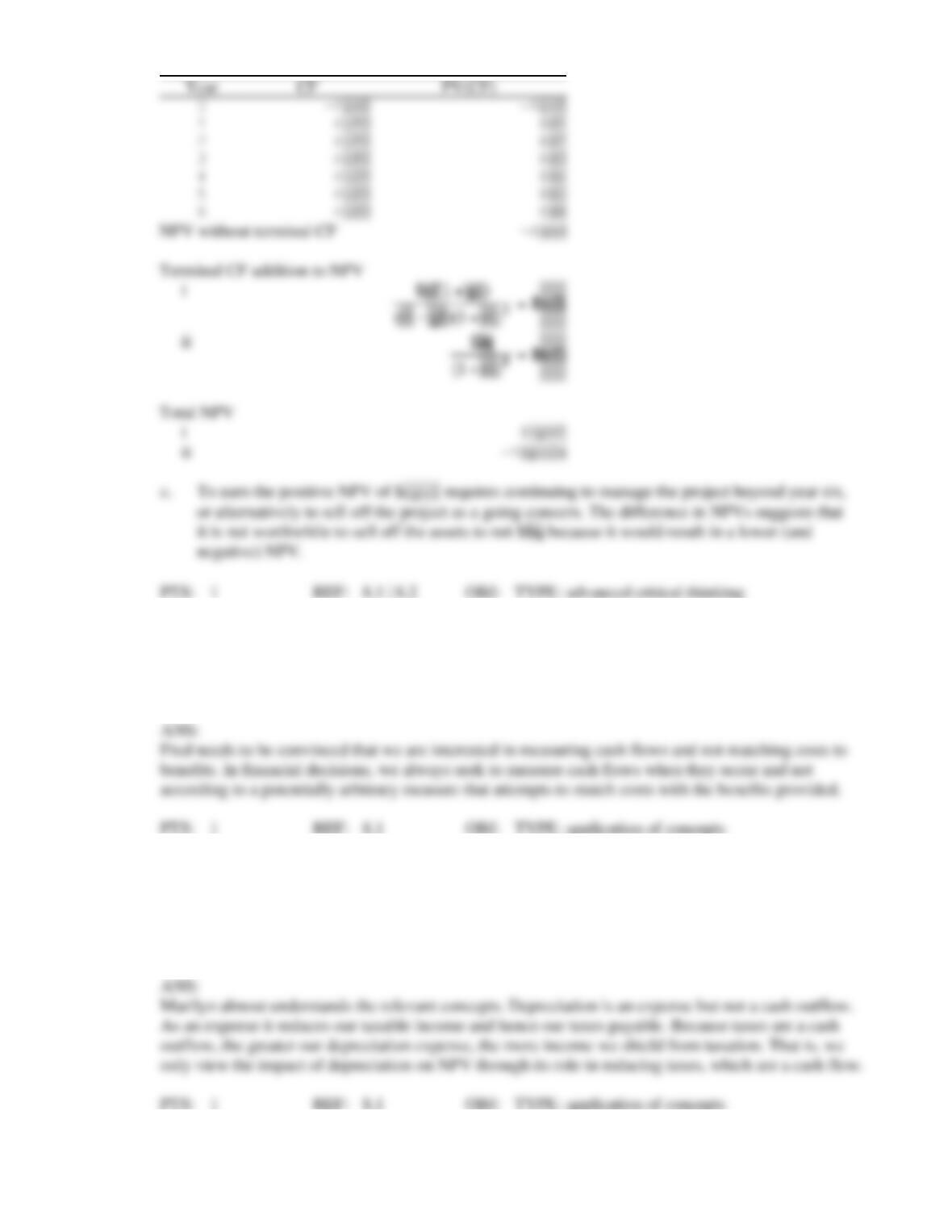
Interpret your answers to a. and b. In your discussion, clarify how the assumptions must
coincide with management decisions.
3. You and your colleague, Fred, are debating how to best handle a large expenditure on a piece of
machinery as a capital budgeting decision. Fred says that his accounting background suggests that
because the benefits of this large piece of machinery will be realized over the project’s ten-year life, so
should its costs. Discuss why you disagree (of course) with Fred.
4. You and your colleague, Marilyn, are arguing over when and how to measure costs. Marilyn suggests
that your view of the world is not consistent. She summarizes by stating that, “Earlier, you convinced
me to measure only cash flows when evaluating capital budgeting projects, but now you say that we
need to adjust for depreciation in our NPV calculations. I thought you understood that depreciation is
not a cash flow!” Respond to Marilyn.
5. You have been asked to assist your friends with some personal financial planning. Following their
current budget they find they are able to save approximately $s per year. They expect their investments
to grow at a nominal rate of g percent and you expect inflation to remain at approximately i percent per
year. Your friends expect to retire in thirty years.
a.
How much money will they have available at their date of retirement in 30 years?
b.
After hearing your answer to the previous question your friends are impressed and decide that
perhaps they don’t need to save as much per year. You disagree, and say, “A million dollars
isn’t what you think.” What do you mean? Support your statement with a calculation.
6. Your old machine has finally lost its productive usefulness. You are considering two potential new
machines for replacement. Machine I will last for six years and will require annual operating costs of
$oc1 per year. Machine II will last for 9 years and will require annual operating costs of $oc2. The
initial costs of Machines I and II are $ic1 and $ic2, respectively. Assume an appropriate risk-adjusted
discount rate of r percent.
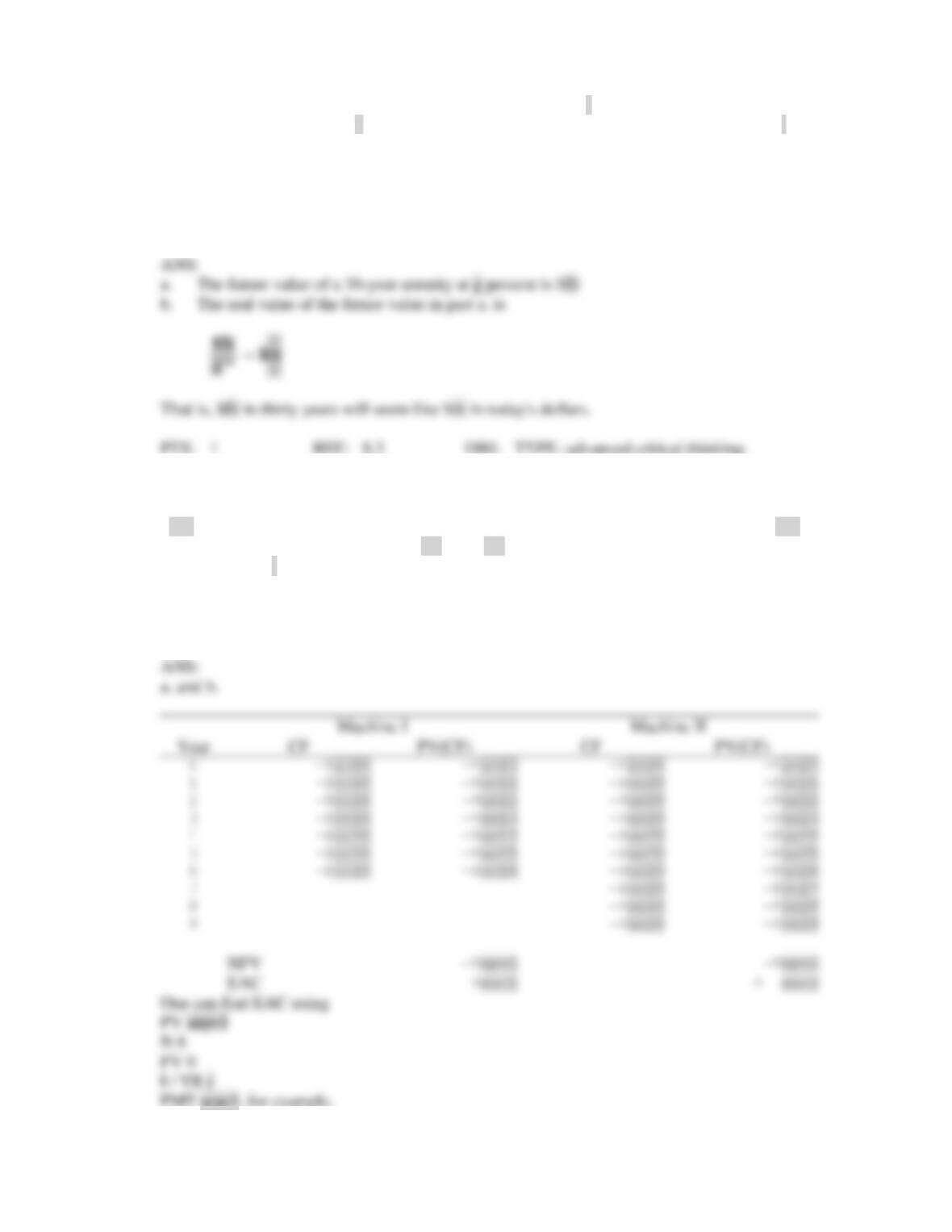
a.
Calculate the cost of each machine in NPV terms.
b.
Calculate the equivalent annual cost (EAC) for each machine.
c.
Which machine will be cheapest for the company to use?
NPV
EAC
a.
The future value of a 30-year annuity at g percent is $fv
b.
The real value of the future value in part a. is