Chapter 8: Operating Assets: Property, Plant, and Equipment, and Intangibles
188. Refer to the information for Hu Corporation.
Required:
(1) Which items on Hu’s balance sheet could be considered intangible assets? Explain the nature of each of these.
(2) Explain why it is important that Hu disclose the amounts expended on research and development each year.
189. Refer to the information for Hu Corporation.
Required:
(1) Explain the impact on net income and cash flows of Hu using straight–line depreciation for financial reporting and
accelerated depreciation methods for income tax purposes.
(2) In the notes to the financial statements, Hu indicates that it uses different depreciation methods for different types
of plant and equipment assets. Explain why Hu might follow this policy.
Chapter 8: Operating Assets: Property, Plant, and Equipment, and Intangibles
190. Music Company’s only asset as of January 1, 2014, was a copyright. During 2014, only the following three
transactions occurred:
Royalties earned from copyright use, $510,000 in cash Cash paid for advertising and salaries, $62,500 Amortization,
$50,000
Required
1. What amount of income will Music report in 2014?
2. What is the amount of cash on hand at December 31, 2014?
3. Explain how the cash balance increased from zero at the beginning of the year to its year–end balance. Why does
the increase in cash not equal the income?
191. Distinguish between current assets and operating assets.
192. Distinguish between tangible and intangible operating assets.
193. Explain how the costs associated with operating assets are reported on the balance sheet.
194. Explain what costs are included in the acquisition cost of operating assets.
Chapter 8: Operating Assets: Property, Plant, and Equipment, and Intangibles
195. You have just received an email from the new staff person, Jennifer Lark. She has just started working in the Fixed
Assets Department of your company. She would like to know under what circumstances should she capitalize interest
as part of the cost of an asset. In a brief memo, explain the issues to Ms. Lark.
196. What is the relationship between the depreciation method chosen and income taxes paid in the early years? Explain.
197. Marrow Company has a large portion of its plant assets concentrated in an area where technology is changing
rapidly. Marrow wants to minimize taxable income and maximize net income reported to stockholders. Recommend a
course of action for Marrow. Support your recommendation.
198. River Company wants to minimize the amount of time and effort its bookkeepers spend on calculating depreciation.
Since River has not been profitable, taxes are not an issue, but maximizing the profit and minimizing reported losses
are major concerns. Recommend a course of action for River. Support your recommendation.
199. What is the relationship between the book value of a plant asset, the market value of the plant asset, and the salvage
value of a plant asset? Explain.
Chapter 8: Operating Assets: Property, Plant, and Equipment, and Intangibles
200. Why do many companies use one method to calculate depreciation for the income statement developed for
stockholders and another method for income tax purposes?
201. Explain by what processes the costs of operating assets are allocated to expense.
202. Distinguish between capital and revenue expenditures.
203. What impact does materiality have on the determination of how a cost related to a plant asset is reported on the
financial statements?
204. How are research and development costs reported in the financial statements? Why is this treatment required?
205. How does goodwill arise? How is it accounted for and reported on the financial statements?
206. Mega Industries has an intangible asset is being amortized over a ten-year time period. However, a competitor has
just introduced a new product that will have a serious negative impact on the asset’s value. Should the company
continue to amortize the intangible asset over the ten-year life? Explain.
Chapter 8: Operating Assets: Property, Plant, and Equipment, and Intangibles
207. Relative to plant assets, how can a company report a net loss for a period, and yet still have positive cash flows from
operating activities?
208. A statement of cash flows reports property, plant, and equipment transactions.
A. What are the effects of acquisitions of plant assets on the statement of cash flows?
B. In which section of the statement of cash flows are cash flows from sales of plant assets reported?
C. How is depreciation reported on the statement of cash flows? Why?
Chapter 8: Operating Assets: Property, Plant, and Equipment, and Intangibles
209. Explain the meaning or significance of the following ratios:
A. Average life of property, plant, and equipment
B. Average age of property, plant, and equipment

Chapter 8: Operating Assets: Property, Plant, and Equipment, and Intangibles
For each of the following items, indicate whether each would be treated as a
a. capital expenditure
b. revenue expenditure
210. Costs related to acquiring an asset, such as sales or excise taxes, transportation, insurance during shipment.
211. Costs incurred prior to using the asset, such as costs to prepare the asset for use, installation costs.
212. Costs incurred after putting the asset into service which keep the asset in normal operating condition.
213. Costs incurred after putting the asset into service which would extend the asset’s useful life
Select the account that would be increased to show each of the following costs.
a. Land
b. Land Improvements
c. Buildings
d. Machinery and Equipment
e. An Expense Account
214. The transportation charges related to the acquisition costs of a new piece of machinery.
215. The interest costs incurred during the construction period of a new building built by a company for its own use.
216. The costs paid to clear land.
217. The annual painting costs of an office building.
218. The sales taxes paid related to a machine purchased.
Chapter 8: Operating Assets: Property, Plant, and Equipment, and Intangibles
219. The costs to pave a parking lot.
Exeter Corporation purchased a piece of equipment with a price of $80,000 on March 1, 2015. The amounts
below are related to the equipment purchase. Match the items below and explain why each revenue
expenditure is not capitalized.
a. This item should be included as part of the cost of the equipment.
b. This item should be considered a revenue expenditure.
220. Terms of the purchase were 2/10, net 30. Edison paid for the purchase on March 8.
221. $3,000 freight costs were paid to ship the equipment from the manufacturer,
222. A state agency required that a pollution-control device be installed on the equipment at a cost of $5,000.
223. During the installation, the equipment was damaged and repair costs of $2,000 were incurred.
224. It was necessary for an architect to redesign the work space to accommodate the new equipment. A fee of $6,000
was paid.
225. The company purchased a three-year liability insurance policy to cover possible damage caused by the new
equipment at a cost of $6,000.
226. The company financed the equipment purchase with a bank loan. Interest of $3,000 was paid on the loan during 2015.
Chapter 8: Operating Assets: Property, Plant, and Equipment, and Intangibles
Identify where each of the following accounts would be reported on CocaCola’s financial statements
a. Balance Sheet – Property, Plant, and Equipment
b. Balance Sheet – Intangible Assets
c. Balance Sheet – Current Assets
d. Balance Sheet – Other Assets
e. Income Statement – Operating Section
f. Income Statement – Other Revenue and Expense Section
g. Statement of Cash Flows
227. Building
228. Total amortization since inception
229. Copyright
230. Land improvements
231. Research and development costs
232. Accumulated depreciation
233. Amortization expense
234. Patents
235. Goodwill
236. Accumulated amortization
Chapter 8: Operating Assets: Property, Plant, and Equipment, and Intangibles
Given the following list of methods of depreciation, select the method that is best for the situation or purpose
given. Some answers may be used more than once, while others may not be used at all.
a. Straight–line
b. Units-of–production
c. Double–declining-balance
d. MACRS
237. Early in the life of the asset, this method maximizes net income.
238. This method is the easiest to use.
239. This method is the best for management bonus plans.
240. This method minimizes taxable income (early in the asset’s life)
Given below is a list of items that may be reported on a statement of cash flows. Identify each as one of the
following using the indirect method:
a. Operating
b. Investing
c. Financing
d. Not separately reported on a statement of cash flows
241. Proceeds from the sale of a building
242. Depreciation expense
243. Cost incurred to acquire a patent
244. Payment of research and development costs
245. Loss of the sale of equipment
246. Amortization of a copyright
Chapter 8: Operating Assets: Property, Plant, and Equipment, and Intangibles
247. Purchase of equipment for cash
Select the financial statement on which the user would most likely find the answer to the question given.
a. Income statement
b. Balance sheet
c. Statement of cash flows
d. Statement of retained earnings
248. What amount of cash was used for to purchase property, plant, and equipment during the year?
249. Acquisition cost is also known as historical cost with respect to property plant and equipment.
a. True
b. False
250. Interest is never a part of the cost of property, plant, and equipment or intangible assets.
a. True
b. False
Chapter 8: Operating Assets: Property, Plant, and Equipment, and Intangibles
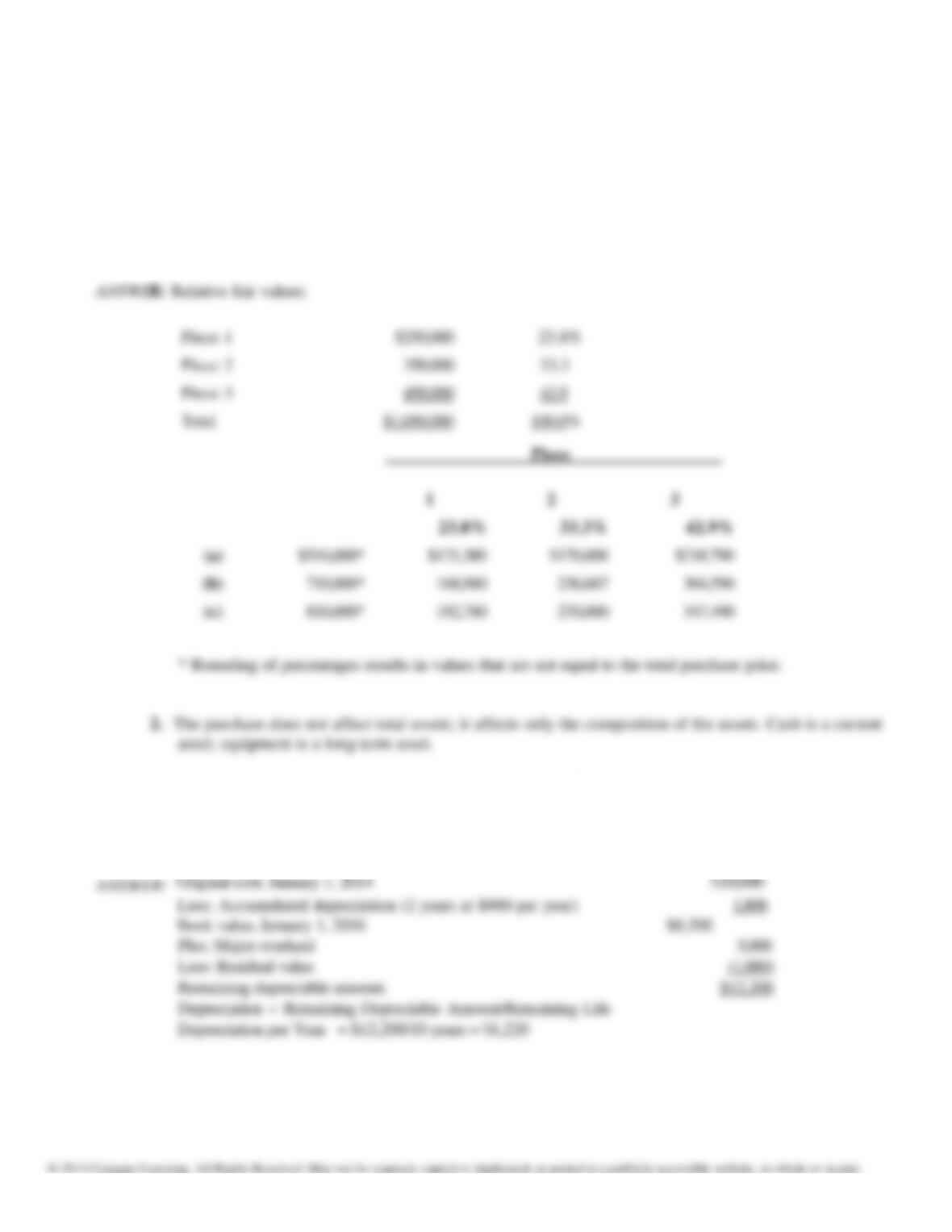
251. Gallery Manufacturing purchased, for cash, three large pieces of equipment. Based on recent sales of similar
equipment, the fair market values are as follows:
Piece 1 $250,000
Piece 2 $350,000
Piece 3 $450,000 Required
1. What value is assigned to each piece of equipment if the equipment was purchased for (a) $510,000, (b)
$710,000, and (c) $810,000?
2. How does the purchase of the equipment affect total assets?
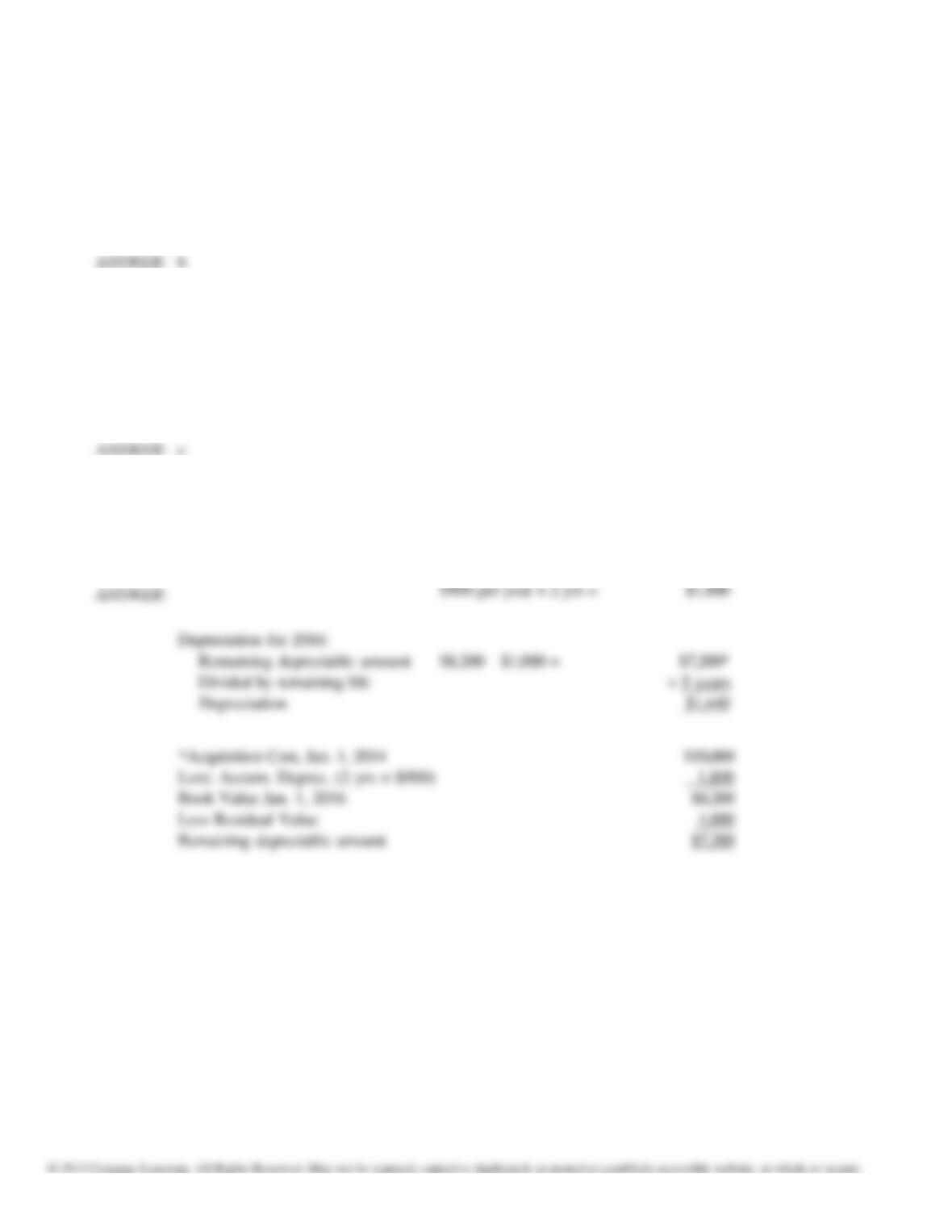
252. Hawk Company purchased an asset on January 1, 2014, for $10,000. The asset was expected to have a ten-year life
and a $1,000 salvage value. The company uses the straight-line method of depreciation. On January 1, 2016, the
company made a major repair to the asset of $5,000, extending its life. The asset is expected to last ten years from
January 1, 2016. Calculate the amount of depreciation for 2016.
Chapter 8: Operating Assets: Property, Plant, and Equipment, and Intangibles
253. A machine with a cost of $100,000 and accumulated depreciation of $80,000 was sold at a loss of $6,000. What
amount of cash was received from the sale?
a. $26,000
b. $14,000.
c. $20,000.
d. $94,000.
254. Mayflower Company had a machine with a cost of $123,000 and accumulated depreciation of $87,000 that was sold
at for a gain of $5,000. What amount of cash was received from the sale?
a. $30,000.
b. $36,000.
c. $41,000.
d. $128,000.
255. Burgess Company purchased an asset on January 1, 2014, for $10,000. The asset was expected to have a ten-year
life and a $1,000 salvage value. The company uses the straight-line method of depreciation. On January 1, 2016, the
company determines that the asset will last only five more years. Calculate the amount of depreciation for 2016.
Depreciation for 2014 and 2015: ($10,000 – $1,000)/10 years =
Chapter 8: Operating Assets: Property, Plant, and Equipment, and Intangibles
256. At December 31, 2015, Ashland Company has the following amounts on its financial statements:
Property, plant, and equipment
$10,000
Accumulated depreciation
5,000
Total assets at January 1, 2015
30,000
Total assets at December 31, 2015
40,000
Net sales
62,000
Depreciation expense
1,000
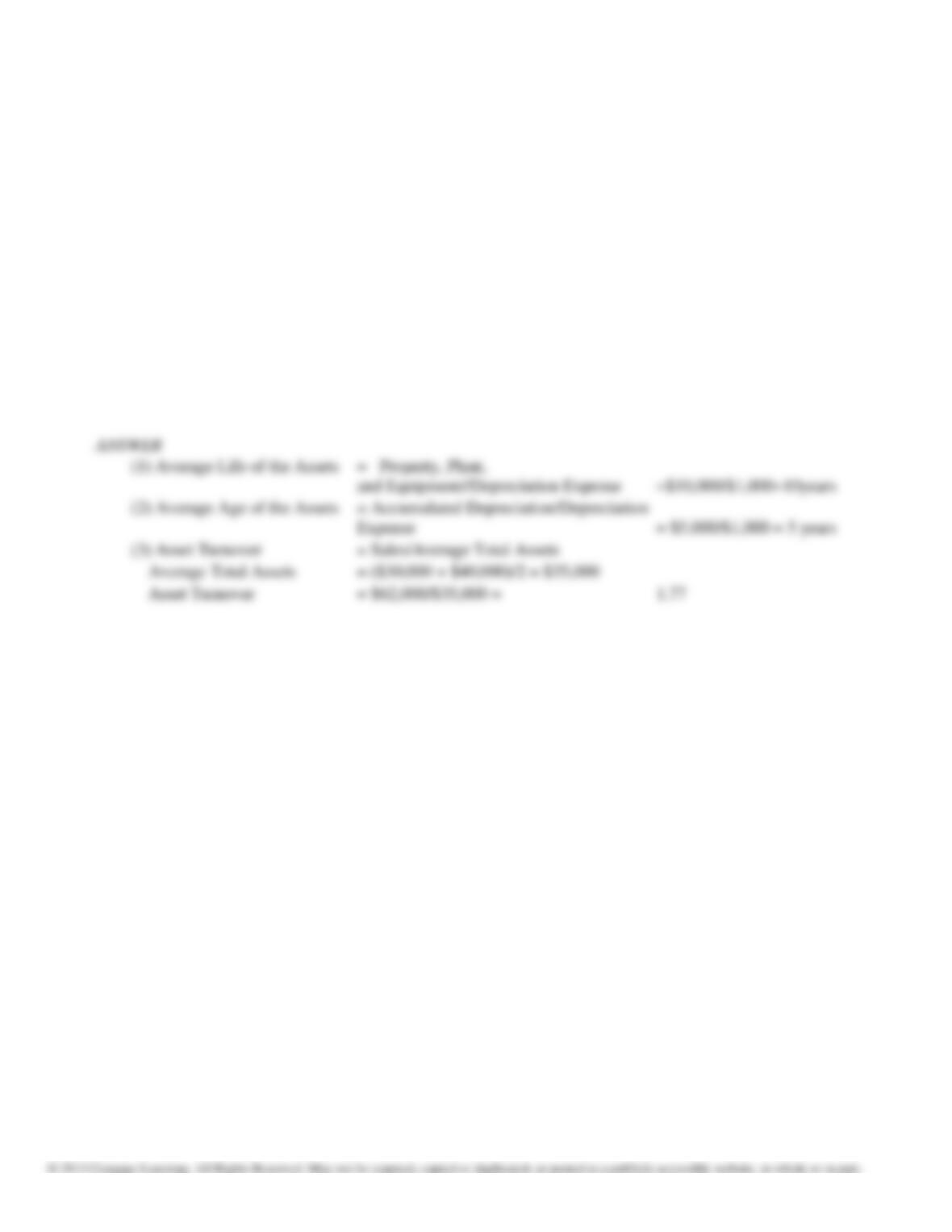
Based on this information, calculate the following ratios:
(1) Average life of the assets
(2) Average age of the assets
(3) Asset turnover